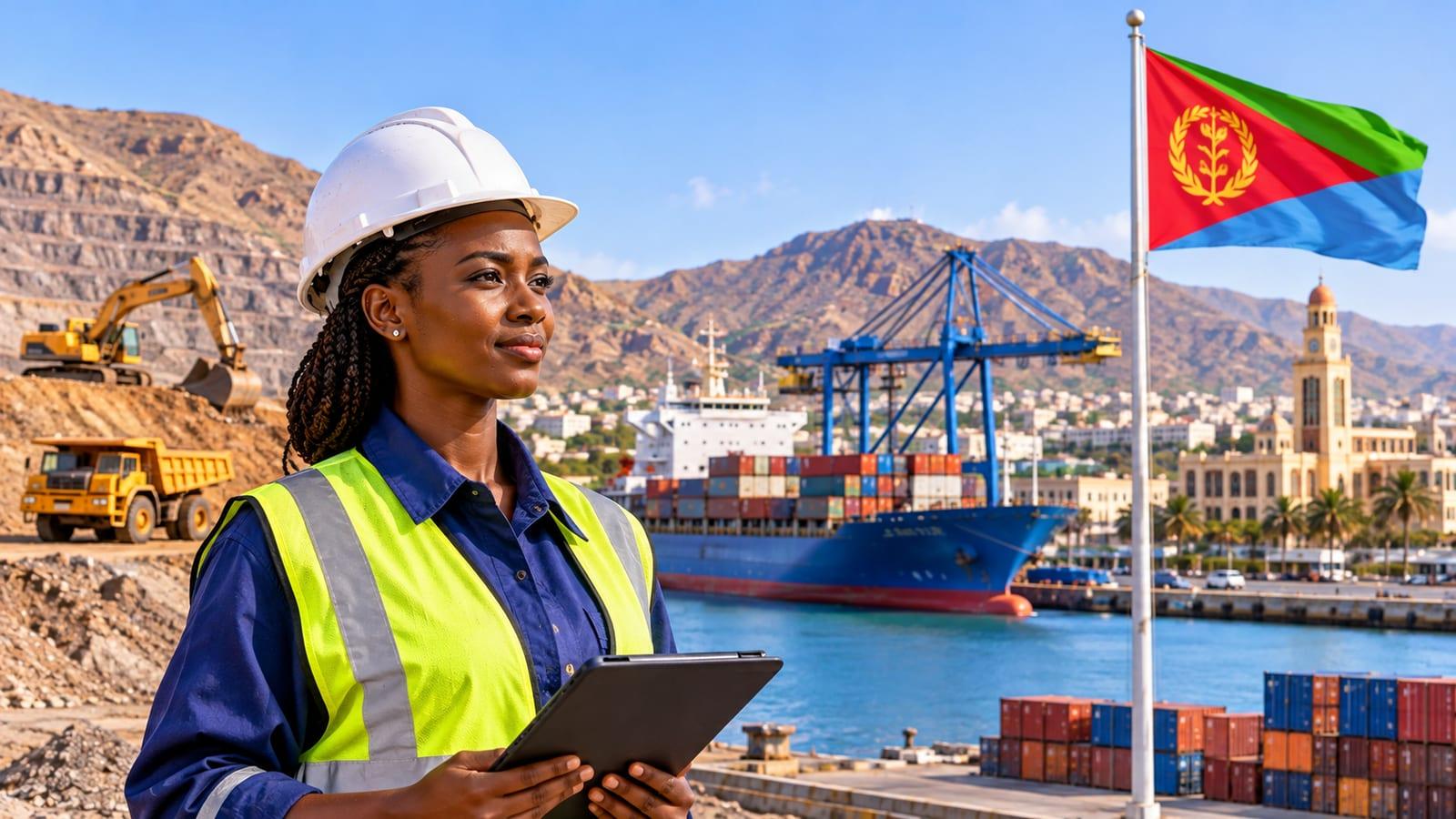
Discover how Eritrea makes its money through gold, copper and zinc mining, its Red Sea ports, international trade and diaspora income, and why its economy remains difficult for businesses to enter.
One mine, and an economy that leans on minerals
In this section
Bisha is run by China's Zijin Mining, which bought its previous owner, Canada's Nevsun Resources, in 2018.
In October 2026, work at Eritrea's Bisha copper and zinc mine was disrupted after a regional fuel shortage forced the operator to bring forward maintenance. The processing plant had been shut since the week before, and some buyers were warned that deliveries of copper and zinc concentrates could be up to four weeks late. Fuel supplies had settled by the time the news broke, but the company had not given a firm date for restarting processing.
The stoppage drew attention because Bisha is one of Eritrea's most important mines, and mineral exports bring in a large share of the country's foreign earnings. A problem at the mine affects more than the companies buying its output. It can also cut the foreign currency available to the country.
Bisha is run by China's Zijin Mining, which bought its previous owner, Canada's Nevsun Resources, in 2018. The Eritrean government holds a 45% stake through its national mining company. In 2025, the mine produced about 83,000 tonnes of zinc and 23,000 tonnes of copper.
Mining is not the only thing happening in the country. Eritrea also has farming, livestock, fishing, small-scale manufacturing and services. But its ability to earn foreign currency through exports rests heavily on minerals, which leaves the economy exposed to world commodity prices and to breakdowns at the mines.
This is the twenty-eighth country profile in our series, Africa's Markets, Country by Country, following Djibouti.
Eritrea sits in the Horn of Africa along the Red Sea, with Sudan to the west, Ethiopia to the south and Djibouti to the south-east. UNCTAD estimated its population at about 3.54 million in 2024. The country became independent in 1993 after a long war with Ethiopia, but later conflicts, tight limits on private business and little access to international finance have held back its development.
The World Bank expects growth of around 3.5% in the near term, helped partly by mining, spending on the Colluli potash mine and upgrades to power stations. The African Development Bank's 2026 outlook is more cautious, at 2.8% for 2026 and 3.2% for 2027. These are estimates by outside institutions, not figures from a full set of published national accounts, because Eritrea does not regularly release the data needed to check them.
Eritrea's position has also grown harder because of renewed tension with Ethiopia. The two countries have traded serious accusations, and relations broke down in October 2026 after Ethiopia closed its embassy in Asmara. Eritrea responded by cutting diplomatic ties. The split has raised fears of another conflict in a region already hit by instability.
Eritrea at a glance
Eritrea publishes little economic data, so the figures below come from international organisations and should be read with their dates in mind. Debt estimates differ widely depending on the year, the method and whether domestic debts are counted, so we do not quote a single debt figure here.
Measure
Figure
Period and source
Population
About 3.54 million
2024, UNCTAD
GDP growth
3.2%
2025, AfDB estimate
GDP growth forecast
2.8%
2026, AfDB
Inflation
5.3%
2025, AfDB estimate
Inflation forecast
5.1%
2026, AfDB
Current account surplus
12.4% of GDP
2024, AfDB
Current account surplus
13.2% of GDP
2025, AfDB estimate
Bisha zinc production
About 83,000 tonnes
2025
Bisha copper production
About 23,000 tonnes
2025
Farming's share of jobs
About 55%
World Bank-based estimate
Currency
Eritrean nakfa (ERN)
Official rate of about ERN 15 to US$1
Main export destination
China
2024, Afreximbank
Main import supplier
China
2024, Afreximbank
Trade arrangements
COMESA member; has not signed the AfCFTA
2026
How Eritrea's economy developed
In this section
In 2009, the UN Security Council placed sanctions on Eritrea, including an arms embargo and targeted measures.
Eritrea became independent on 24 May 1993, after a referendum in which voters overwhelmingly backed independence from Ethiopia. Before that, the country had spent decades fighting for self-rule, and the war had damaged infrastructure and disrupted economic life.
In the first years after independence, there was room to build trade between Eritrea and Ethiopia. The two had old commercial links, and Ethiopia used Eritrean ports, especially Assab, to reach world shipping routes. Eritrea could also earn money from port services, transport and trade with its larger neighbour.
Those chances were badly hurt by the border war that began in May 1998, paused with a ceasefire in June 2000 and ended with a peace agreement in December 2000. The war killed tens of thousands of people, displaced communities and damaged infrastructure. Trade between the two countries broke down, and Ethiopia turned more and more to Djibouti for access to the sea.
The years that followed were a long stand-off, often described as "no war, no peace". The government kept a large army and brought in a national service system that became open-ended for many citizens.
Under this system, people can be made to do military or civilian service for long periods. Civilian postings may include work for government bodies and public projects. International human rights investigations have raised serious concerns about the length of service, low pay, limits on freedom and the effect on people's ability to build their own careers or businesses.
The country's economic controls have also held back private business. State bodies and companies tied to the ruling party have a big presence in key sectors, while access to foreign currency, imports and credit is tightly controlled.
In 2009, the UN Security Council placed sanctions on Eritrea, including an arms embargo and targeted measures. The sanctions were lifted in November 2018 through Resolution 2444, after changes in the region. But lifting them did not by itself open the economy or bring a big rise in private investment.
A major diplomatic step came in 2018, when Ethiopian Prime Minister Abiy Ahmed and Eritrean President Isaias Afwerki signed a peace declaration. It raised hopes that the two countries would restore trade, transport links and movement across their border.
Some border crossings reopened, but the progress did not last. Several crossings closed again in December 2018, and the expected growth in trade between the two countries never came.
Eritrean forces later fought alongside Ethiopia's federal army in the Tigray war, which began in November 2020. A cessation of hostilities was agreed in November 2022 between the Ethiopian government and the Tigray People's Liberation Front. Eritrean forces were not party to that deal, and worries about their continued presence and the wider security situation remained.
By October 2026, relations had worsened further, with embassies closed and fresh accusations of military aggression. Ethiopia's wish for reliable access to the Red Sea, including talk involving Assab, has become a major point of dispute.
This matters for Eritrea's economy because its location gives it access to important sea routes, but regional tension makes it hard to turn that location into steady trade and investment.
What brings in money in Eritrea
In this section
Money sent home by Eritreans living abroad supports households and adds to economic activity in the country.
Mining: the most important export industry
Mining is the biggest source of Eritrea's goods export earnings. The country has gold, copper, zinc, potash and other minerals, and foreign mining companies have helped develop several projects.
Bisha is the best-known example. Located in western Eritrea, it was first developed by Canada's Nevsun Resources with the Eritrean National Mining Corporation, now usually called ENAMCO.
Commercial gold production began in 2011. The mine moved into copper in 2013 and added zinc in 2016. China's Zijin Mining bought Nevsun in December 2018, becoming the majority owner and operator. The Eritrean government keeps a 45% stake through its mining company.
Bisha produces mineral concentrates, not finished goods. Industrial buyers such as smelters process these concentrates further to extract the metals used in construction, manufacturing, electronics and other industries.
China is a major buyer of Eritrean minerals. In 2024, it took 78.1% of Eritrea's goods exports in Afreximbank's trade data, and South Korea took another 17.3%. Relying on so few markets leaves the country exposed to shifts in demand, commodity prices and shipping conditions.
Bisha is not the only mine. The Asmara polymetallic project near the capital completed trial production and reported its first concentrate in April 2026. It adds another mine to Eritrea's production base, although how much it will produce and earn over time depends on how output develops.
Another important project is the Colluli potash mine in the Danakil Depression. Potash is used mainly to make fertiliser, which makes it important for farming around the world.
Colluli has been talked about for years as a project that could make Eritrea a potash exporter. It has faced delays, though, and the World Bank lists production delays as one of the risks to its outlook. Spending on building the mine is expected to support growth, but that is not the same as the mine producing and selling potash.
If Colluli starts producing, it could give Eritrea another mineral export and reduce its reliance on copper, zinc and gold. Until then, its planned capacity and expected benefits are plans, not part of the economy yet.
Farming and livestock
Farming remains important because a large part of the population depends on crops and livestock for food and income.
The country grows cereals, vegetables, fruit and other crops, while livestock provide meat, milk, hides and animals for local trade. Cattle, sheep, goats and camels matter a great deal to farming communities, especially in areas better suited to herding than crops.
Farming faces big challenges. Much of it depends on rain, and droughts and erratic weather can hurt harvests and herds. Limited irrigation, inputs, storage and modern equipment also hold back output.
The government has invested in water conservation and dams to support farming and improve access to water. This matters because farm output cannot grow reliably without better water management.
Although farming employs a large share of workers, it does not earn nearly as much export income as mining. Its main value is supporting household incomes, supplying local markets and reducing the need for imported food.
There is room to raise farm output through irrigation, better seeds, food processing, animal health services and storage. How far this can go depends on access to finance, equipment, reliable electricity and markets.
Eritrea has a long Red Sea coastline and marine resources that could support a bigger fishing industry.
Fishing provides food and income for coastal communities, and the country's waters hold valuable fish and other marine resources. The Dahlak Archipelago, off the coast near Massawa, is also known for its marine life and coral reefs.
The fishing industry is small compared with its potential. Growing it would need investment in boats, cold storage, refrigeration, processing, transport and access to export markets.
Fish spoils quickly, so keeping it fresh and moving it fast matters as much as catching it. Without a reliable cold chain, businesses cannot steadily supply distant markets or meet the quality standards of international buyers.
Eritrea could earn more from seafood exports and processing, but that would need a more supportive business environment and better commercial infrastructure.
Money from the diaspora
Money sent home by Eritreans living abroad supports households and adds to economic activity in the country.
Eritreans live in Europe, North America, the Middle East and other parts of Africa. Some send money to relatives to help pay for food, housing, schooling, healthcare and other costs.
These transfers matter because they give income to families who may have few chances to earn locally. They also help households buy goods and services they could not otherwise afford.
But reliable official figures on these inflows are scarce, so it is hard to say exactly how much money comes in this way.
The government also charges a 2% tax on income earned abroad by Eritreans living outside the country. According to the UN Special Rapporteur on Eritrea, paying the tax is linked to access to some consular services, and the system has been criticised for the pressure it puts on some members of the diaspora.
Diaspora income is an important support for households, but it is not the same as goods exports or foreign direct investment. These are different kinds of money with different effects on what the country can produce.
Services and local trade
Services include retail, transport, telecommunications, public administration, hospitality and other everyday economic activity.
These businesses serve households, government bodies and other companies. Shops and markets sell imported and local goods, while transport operators move people and products between towns, farms, ports and industrial sites.
But services work within an economy where private investment and business face heavy restrictions. Limited access to foreign currency, trouble importing equipment and unclear business rules make it harder for companies to grow.
Services matter a lot to the home economy, even though they show up far less in export figures than mining does.
What Eritrea sells, buys and who it trades with
In this section
Farm and fish exports offer a way to widen the export base, but for now they matter far less than minerals.
Eritrea's trade is dominated by mineral exports and essential imports. Its trade figures also need care, because different international databases report them in different ways.
According to Afreximbank's September 2025 country brief, Eritrea exported about US$573.1 million of goods in 2024 and imported about US$534.4 million. That left a goods trade surplus of about US$38.7 million for the year.
What Eritrea exports
Its main exports include:
Gold and other precious metal products
Copper concentrates
Zinc concentrates
Other mineral products
Smaller amounts of farm and marine products
Mining dominates export earnings, so the value of exports can swing a lot when mine output or world prices change.
Farm and fish exports offer a way to widen the export base, but for now they matter far less than minerals.
Who buys Eritrean products
The main destinations for Eritrea's exports in 2024, according to Afreximbank and IMF trade statistics:
Export destination
Share of exports
China
78.1%
South Korea
17.3%
United Arab Emirates
1.8%
Yemen
0.6%
Croatia
0.5%
China is by far the biggest buyer. South Korea is another important one, while the rest take much smaller shares. This pattern reflects how much the country depends on minerals and on international industrial buyers.
What Eritrea imports
Eritrea imports a range of goods needed by households, businesses and public bodies, including:
Refined petroleum products and other fuels
Food and farm products
Medicines and medical supplies
Machinery and industrial equipment
Building materials
Fertiliser and other farm inputs
Vehicles and spare parts
The country relies on imported fuel and equipment for transport, electricity, industry and more. This causes problems when foreign currency is short or supply chains are disrupted.
Who supplies Eritrea
Import source
Share of imports
China
37.2%
Türkiye
10.4%
Saudi Arabia
9.8%
United Arab Emirates
9.3%
Italy
7.2%
China is also the largest supplier. Türkiye, Saudi Arabia, the United Arab Emirates and Italy are other important sources.
Trade with neighbouring African countries is small. Afreximbank estimated that trade with other African countries made up less than 3% of Eritrea's total trade in 2024. Djibouti and Sudan were among its main African partners.
This is striking because Eritrea borders several African countries and has direct access to the Red Sea.
Trade agreements and how goods move
In this section
Eritrea's ports could matter more if trade with Ethiopia improves or regional transport arrangements change.
COMESA and the AfCFTA
Eritrea is a member of the Common Market for Eastern and Southern Africa (COMESA), a regional group set up to encourage trade and economic cooperation. Our guide to Africa's trade blocs explains how these groups work.
But membership does not mean every country takes full part in COMESA's Free Trade Area. According to COMESA's Trade and Customs Division, Eritrea had cut tariffs by 80% as of April 2026, while 16 member states were full participants in the Free Trade Area.
Eritrea has also not signed the African Continental Free Trade Area (AfCFTA) agreement. It is the only African Union member that has not signed it, according to the ratification status published by tralac at the end of September 2026.
This means Eritrea is not part of the continental free trade arrangements in the way countries that have signed and ratified are. For African companies, this matters when weighing how goods will move into and out of the country.
The Red Sea ports
Eritrea has two main commercial ports on the Red Sea, Massawa and Assab.
Massawa, on the northern coast, is an important entry and exit point for goods. It is linked to the capital, Asmara, by road and has facilities for handling commercial cargo.
Assab lies further south, near the Ethiopian border. Before independence and the border war, it played a big role in Ethiopia's trade. Ethiopia used the port for imports, especially before the 1998 war.
After the war, Ethiopia moved more of its trade through Djibouti, and Assab lost much of its traffic.
Both ports sit on one of the world's important sea routes, linking the Mediterranean and Europe with the Gulf, the Indian Ocean and Asia.
But a coastline and port facilities do not by themselves make a country a logistics hub. Port traffic depends on shipping demand, road links, customs procedures, security and the business relationships that bring cargo through.
Eritrea's ports could matter more if trade with Ethiopia improves or regional transport arrangements change. For now, politics and regional tension limit what they can earn.
Roads, borders and transport
Eritrea's main roads connect Asmara with Massawa and other key towns. They are essential for moving farm produce, imports and mining output.
The land borders also matter for regional trade, but relations with neighbours have limited how much business crosses them.
The border with Ethiopia remains closed to normal trade, while security problems and restrictions at other borders hold back regional supply chains.
These conditions make it hard for Eritrea to use its location as well as it could in a calmer region.
Sectors with room to grow
In this section
Building the sector would need investment in fishing equipment, storage, reliable electricity and transport.
Eritrea has several industries that could add more to the economy if investment, infrastructure and business conditions improve. The difficulty is that many of them need capital, technology and market access that are hard to get under the current system.
Mining and mineral processing
Mining is already established, but there is room to raise output and do more processing in the country.
Bisha, Asmara and the planned Colluli mine each represent part of the country's mineral potential. Gold, copper, zinc and potash could bring in more export earnings if output grows and projects become commercially viable.
There is also room for services around mining, including exploration, equipment maintenance, engineering, transport and mineral processing.
But foreign companies entering this industry must understand the licensing rules, government partnerships and restrictions that apply to mining in Eritrea.
Fishing and seafood processing
Eritrea's Red Sea coast gives it marine resources that could support a bigger commercial fishing industry.
There is potential to expand fish processing, refrigeration, packaging and seafood exports. This could create jobs in coastal communities and bring in income beyond mining.
Building the sector would need investment in fishing equipment, storage, reliable electricity and transport. Businesses would also need access to international buyers and the certifications needed to sell seafood in regulated markets.
Farming and food production
Farming matters a lot for jobs and household income, but local production does not meet all of the country's food needs.
There are openings to improve irrigation, farm equipment, seed supply, livestock care and food processing. Businesses that help farmers grow more and lose less after harvest could add to local food supply.
The government has invested in water infrastructure, including dams, because water is one of the biggest limits on farming.
Food processing could also help Eritrea make better use of its own produce instead of relying on imported finished goods.
Renewable energy
Electricity is another area where investment could make a difference.
Eritrea has strong solar potential thanks to its climate and sunshine. Solar power could serve households, farms, businesses and industrial sites, especially where extending the grid is hard.
Investment in energy storage, distribution networks and reliable power would also help mining, manufacturing and food processing companies run more steadily.
The World Bank's April 2026 outlook names investment in upgrading Eritrea's power stations as one of the things expected to support growth.
Tourism and heritage
Eritrea has cultural and natural attractions that could support a bigger tourism industry.
Asmara stands out for its modernist architecture, built during the Italian colonial period. In 2017, UNESCO added the city to the World Heritage List as Asmara: A Modernist African City. Its buildings, streets and layout make it an important example of modernist architecture in Africa. Our look at Eritrea's history and culture covers the country beyond its economy.
Massawa has a different character, with historic buildings shaped by its life as a Red Sea port. The Dahlak Archipelago also has potential for marine tourism, diving and other coastal activities.
But tourism needs more than attractive places. Visitors need good transport, reliable accommodation, clear visa rules and the freedom to move around without needless restrictions.
Eritrea's travel rules, few international connections and wider political situation make it hard to grow tourism to the scale its attractions could support.
Doing business in Eritrea
In this section
Companies must understand the labour rules and make sure their employment practices meet international standards.
Eritrea is a hard market for foreign businesses to enter, especially for companies that expect to register on their own, raise finance, import goods and operate without heavy government involvement.
The government plays a strong role in the economy, and private business is restricted in key areas. Access to foreign currency is controlled, import licences are needed for many goods, and the financial system offers private businesses little credit.
The banking sector is also dominated by the state. The African Development Bank names weak financial services and limited private-sector credit as major limits on investment and growth.
Companies interested in Eritrea should pay attention to several areas.
Registration and government approvals: Foreign companies need to understand the investment rules, licensing requirements and approval processes before committing money. They should not assume that procedures used in other African markets apply in Eritrea.
Foreign currency and payments: Access to foreign exchange is tightly controlled. Businesses importing machinery, paying foreign suppliers or sending profits home need to understand the currency rules before signing deals.
Local partners: Mining and other big projects often involve state-owned or state-linked bodies. Investors need to understand the ownership, duties and approval requirements of any local partner.
Labour and national service: The national service system affects which workers are available and how they can move. Companies must understand the labour rules and make sure their employment practices meet international standards.
Importing equipment and supplies: Companies that rely on imported machinery, vehicles, spare parts and raw materials must plan for licences, currency limits and possible delays.
Legal and political risks: Limited transparency and restrictions on independent business make it hard for foreign investors to judge risks and settle disputes.
The Eritrean government has said it wants investment in mining and infrastructure, but openings in these areas do not mean the wider economy is open to foreign businesses without restriction.
For most companies, the first step should be getting up-to-date legal advice and checking the proposed investment structure, licences, payment arrangements and government approvals independently.
Risks and trade-offs
In this section
Fuel shortages, equipment failures, transport problems or falling metal prices can all cut export earnings.
Renewed tension with Ethiopia. Relations with Ethiopia are one of the biggest factors in Eritrea's economic future. Ethiopia has wanted reliable access to the sea since Eritrea became a separate state in 1993, and that wish has brought Assab into talk of possible arrangements involving Eritrea. Eritrea has strongly rejected any suggestion that its sovereignty over its land and coast could be challenged. The situation grew more serious in October 2026, when Ethiopia closed its embassy in Asmara and Eritrea cut diplomatic ties. The two governments have also traded accusations about military activity and support for armed groups. A US Congressional Research Service report published on 6 November 2026 warned that the two countries appeared to be preparing for possible conflict. Renewed fighting would threaten trade, mining, transport routes and investment, and could put companies off committing money to projects that depend on long-term access to infrastructure and markets.
Reliance on mineral exports. Export earnings depend heavily on mining, which leaves the country exposed to world prices and production problems. The October 2026 stoppage at Bisha shows how operational trouble can hit mineral shipments. Fuel shortages, equipment failures, transport problems or falling metal prices can all cut export earnings. The country needs more industries that earn foreign currency so its performance does not hinge on a handful of mines.
Public debt and limited finance. Eritrea carries heavy public debt and has little access to international development finance. The African Development Bank notes that the financial sector is narrow and state-dominated, which limits lending to and investment by private businesses. The World Bank also names the debt burden and unpaid arrears as major barriers to development finance. Its lending programme remains inactive because of those arrears, although it still does analysis and technical work. This cuts the country off from some cheap financing that could support infrastructure, energy, farming and public services.
Limited economic information. Businesses and investors need reliable data to judge demand, costs, competition and financial risk. Eritrea publishes little of it. Key figures on national accounts, public spending, private business and investment are not consistently available, which makes it harder for companies to size the market or forecast returns.
Restrictions on private business. Private companies need finance, workers, equipment, steady rules and customers to grow. In Eritrea, government controls and the small role of independent business make it hard for entrepreneurs to grow beyond small-scale trade. Foreign investors face the same problem: a business opportunity does not automatically come with permission to operate.
What this means for an African business
In this section
For farm businesses, it means checking buyers, distribution, import rules and whether payment can be received.
For an African company weighing its next international market, Eritrea calls for careful study rather than a quick entry plan.
The market has clear openings in mining services, industrial equipment, energy, farming, fishing and infrastructure. Its Red Sea coast also gives it strategic weight in regional trade, especially in relation to Ethiopia and the wider Horn of Africa.
But the existence of these openings does not mean companies can enter freely.
A business looking at Eritrea needs to find out who controls the sector it wants to enter, which approvals it needs, how it will be paid, whether it can import the equipment it needs and what legal protection it has if a deal goes wrong.
For mining suppliers, this means understanding what existing operators need and the government's role in the sector. For farm businesses, it means checking buyers, distribution, import rules and whether payment can be received. For energy and infrastructure companies, it means finding out whether projects are open to private companies and what financing is possible.
There is also a regional question worth watching. If Eritrea and Ethiopia eventually reach a lasting peace, Massawa and Assab could become far more important. Ethiopia's large population and demand for imports could create openings in port services, logistics, warehousing and transport. Eritrea could also gain from stronger trade with Sudan and other neighbours.
These possibilities depend on political agreements, security and investment in the infrastructure needed to move goods. They are not immediate business opportunities.
For now, companies with no existing relationships or experience in the country should approach Eritrea with caution. Businesses considering entry should do thorough checks, get specialist legal advice and settle the commercial arrangements before committing serious money.
Eritrea has mineral wealth, a strategic coastline and an economy with room to grow, but its current conditions make it one of the harder African markets for independent businesses to enter.
Its economic future will depend partly on whether it can produce more beyond mining, improve conditions for private business, attract investment and build steadier trade ties with its neighbours.