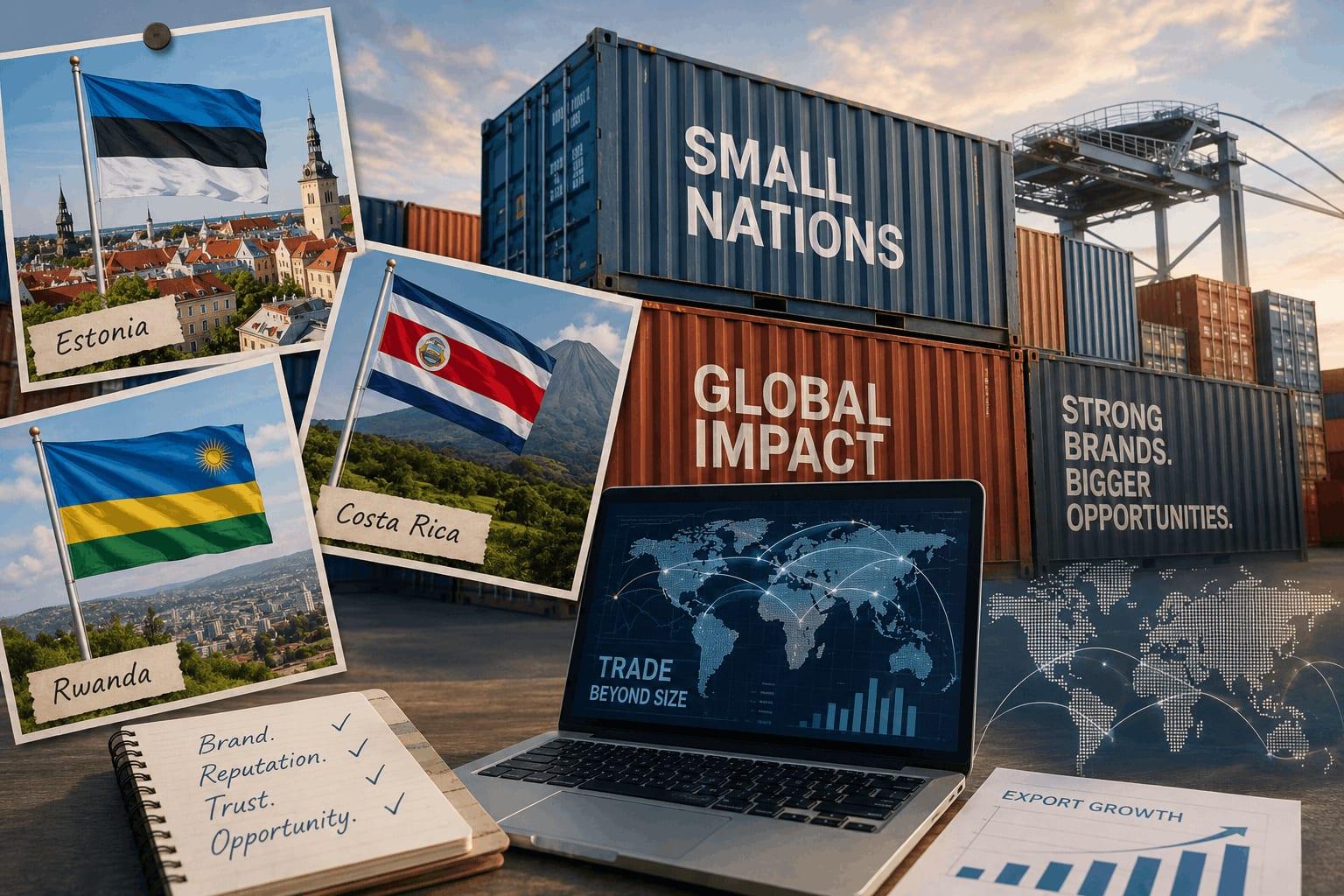
Estonia and Costa Rica built globally trusted nation brands on tiny budgets. Here's what their playbooks mean for Africa, AfCFTA, and intra-African trade.
Estonia has about 1.3 million people. That is fewer people than live in Kumasi, a single city in Ghana. Costa Rica has around five million people, close to the population of Liberia. Neither country sits on oil. Neither has large mineral reserves or a big domestic market to lean on. And yet Estonia has talked more than 135,000 people from 185 countries into becoming digital residents of a country most of them will never set foot in, and Costa Rica now exports more medical devices per person than any other country on earth.
Neither of these things happened by chance. Both countries made a deliberate choice a while back: build a brand that gives the rest of the world a specific, concrete reason to do business with a small country, instead of a vague reason to admire it from a distance.
That distinction matters for Africa. Not just for how African countries present themselves to the world, but for how they present themselves to each other. Intra-African trade still sits at somewhere around 16 to 18 percent of the continent's total trade, a number that has barely moved in years. Part of the reason is simple: African consumers and businesses often do not trust, or even recognize, products made a few borders away. Branding is not a side issue in that story. It is one of the tools that decides whether a product crosses a border with confidence or just sits on the shelf.
Estonia sold a product, not a postcard
In this section
Estonia's own figures put the cumulative economic impact of the programme at close to €400 million since it launched.
Most country branding starts with an adjective. Beautiful. Welcoming. Vibrant. Estonia's most successful branding effort started with a login page instead.
In 2014, Estonia launched e-Residency, a digital identity that lets anyone in the world register and run an EU-based company online, without ever living in Estonia or even visiting it. It wasn't a tourism campaign. It wasn't a slogan on a billboard. It was a working piece of digital infrastructure built to solve one specific problem: starting and running a legitimate European business was slow, paper-heavy, and geographically restrictive for entrepreneurs who lived outside the EU.
The results kept compounding. By the end of 2025, more than 135,000 people from 185 countries had become e-residents, and they had founded over 39,000 Estonian companies along the way. In 2025 alone, e-residents set up 5,556 new companies, 15 percent more than the year before, and that programme brought in a record €125 million in direct state revenue, an 87 percent jump on 2024. Estonia's own figures put the cumulative economic impact of the programme at close to €400 million since it launched. One recent breakdown of the numbers even put it plainly: for every euro Estonia has put into the programme, it has gotten back more than twelve.
Here's the part worth sitting with for a second. Nobody became an Estonian e-resident because they saw an advertisement about Estonian culture. They became one because e-Residency solved a real, specific problem better than any of the alternatives did. The brand was the product. Trust followed usefulness. Not the other way around.
For African economies, the equivalent question isn't "how do we make our country sound appealing." It's closer to: what specific, working problem can we solve for someone outside our borders, and can we solve it well enough that solving it becomes what we're known for. A few African countries are already inching toward this. Rwanda's push to become a regional hub for business registration and conferencing is one version of it. So is Kenya's mobile money infrastructure, which has become a reference point across East Africa in a way that has nothing to do with slogans and everything to do with the fact that it simply works. Build something genuinely useful, and let the reputation follow.
Costa Rica put every sector under one seal
In this section
A coffee exporter, a medical device manufacturer, and a boutique hotel can all carry the same mark.
Costa Rica's approach solved a different kind of problem. By the early 2010s, the country's tourism board, its trade promotion agency, its investment promotion agency, and its culture ministry were each telling a slightly different story about the country to different audiences, using different visual identities. A tourist saw one version of Costa Rica. An investor saw another. And a product coming out of a Costa Rican factory carried no unifying mark of any kind.
In September 2013, after a four-year process involving the Costa Rican Tourism Institute, the Ministry of Foreign Trade, the export promotion agency PROCOMER, and the investment promotion agency CINDE, the government formalized a single nation brand by presidential decree: Essential Costa Rica. It was built on purpose to cover four areas at once, tourism, exports, foreign investment, and culture, all unified under one visual identity and one set of stated values: excellence, sustainability, innovation, social progress, and what the programme calls "Costa Rican rooting."
Any company that meets the qualifying standards can put the Essential Costa Rica seal on its products, its export materials, or its investment pitch decks. A coffee exporter, a medical device manufacturer, and a boutique hotel can all carry the same mark. That means a buyer who already trusts the seal on one Costa Rican product has a reason to extend that same trust to another, even in a category they know nothing about.
And the results in Costa Rica's flagship export category are genuinely hard to argue with. Between 2020 and 2024, medical device exports grew at an average annual rate of 22 percent, reaching close to $8.7 billion in 2024, according to PROCOMER's own analysis, which put the country in the position of the world's tenth largest exporter of medical devices and its leading exporter on a per-capita basis. The growth hasn't slowed since. By October 2025, exports in the sector had already reached $9.2 billion for the year, a 30 percent jump on the same period in 2024, meaning the country had already beaten its entire 2024 total with two months still left on the calendar. Costa Rica now sells 164 different medical device products into 88 markets, and the sector alone made up close to half of all the country's goods exports by late 2025. Costa Rica also accounts for 52 percent of all new foreign direct investment in medical devices across the whole of Latin America, and hosts more than 100 foreign-owned MedTech companies. The brand itself won the 2019 Place Brand of the Year award from City Nation Place, but honestly, the more convincing evidence is in the export numbers, which kept climbing for years after the branding exercise had stopped being news.
The lesson for the African Continental Free Trade Area, or AfCFTA, is fairly direct. The agreement already has a rules-of-origin standard, meaning a defined share of a product's value, 40 percent in the case of vehicles, has to genuinely originate in Africa before that product qualifies for preferential tariffs. What Africa doesn't have yet is a shared, consumer-facing seal that turns that technical compliance standard into something a shopper in Lusaka or a buyer in Lagos actually recognizes on sight, the way global buyers now recognize Essential Costa Rica. A rule of origin lives quietly in a customs database somewhere. A brand seal lives on a shelf, right in front of the person who's about to decide whether to buy.
Rwanda is already running the experiment, on two tracks at once
In this section
Tourism revenue is now up sharply since the Arsenal partnership began in 2018, when it stood at roughly $438 million.
Unlike Estonia and Costa Rica, Rwanda isn't a hypothetical case study for Africa to study from a distance. It is Africa, already mid-experiment, running two branding tracks in parallel. And the results of both tell you something useful.
The first track is domestic. Rwanda's Made in Rwanda policy grew out of the country's 2015 Domestic Market Recapturing Strategy, and it set out to shift consumer habits toward locally made goods and cut the country's dependence on imports, through a mix of production support, quality improvements, cheaper credit for local manufacturers, and a public campaign encouraging Rwandans to buy Rwandan. The government's own figures on the policy show real movement. Between 2010 and 2016, Rwanda's industrial sector grew at an average of 10.3 percent a year, ahead of overall GDP growth of 7.3 percent, and the manufacturing sub-sector on its own grew at 6.9 percent annually over the same stretch. The number of active, formally registered manufacturing firms more than doubled between early 2014 and late 2016, jumping from 155 to 327. And in 2016, Rwanda's goods trade deficit shrank for the first time in more than a decade, narrowing by close to 6 percent as exports rose and imports fell.
But the policy also surfaced the honest limits of what branding can do on its own. A government-commissioned survey of Rwandan manufacturers found that 78 percent of them said raw materials simply weren't available, or weren't sufficiently available, inside the country, which pushed many of them to source from the wider region instead. The same research found that a meaningful share of Rwandans still associate imported goods with higher quality, a perception the campaign chipped away at rather than erased entirely. Made in Rwanda proves that a domestic buy-local brand can move real economic numbers. It also proves, just as clearly, that branding cannot manufacture raw materials that don't exist locally, and it cannot instantly undo decades of consumers assuming that imported automatically means better.
The second track was external, and until recently, it ran straight through English football. Visit Rwanda's sponsorship of Arsenal's shirt sleeve began in 2018 and put the country's tourism brand in front of one of the largest audiences in global sport. The Rwanda Development Board's own figures show tourism revenue climbing to $685 million in 2025, up from $647 million the year before, supported by 1.49 million visitor arrivals, a 9 percent rise on 2024. Tourism revenue is now up sharply since the Arsenal partnership began in 2018, when it stood at roughly $438 million.
Rwanda and Arsenal mutually agreed in November 2025 to end the sleeve sponsorship, with the branding disappearing from the shirt starting with the 2026 to 2027 season and the software company Deel stepping in as the new sponsor. Publicly, both sides have described this as the natural conclusion of a long, successful partnership, with Rwanda saying it wants to diversify into new markets and sports, including its existing ties to the LA Rams and SoFi Stadium in Los Angeles. That framing is only part of the picture, though. The deal had also drawn sustained criticism for years from human rights groups, from sections of the Arsenal fanbase organized under the banner "Gunners for Peace," and from the government of the Democratic Republic of Congo, all pointing to Rwanda's alleged support for the M23 militia operating in eastern DRC. Whatever combination of commercial strategy and outside pressure actually drove the decision, the eight-year run is a useful reminder that even a branding partnership built on genuinely strong numbers can still run into forces branding alone can't manage.
Put the two tracks together and Rwanda offers something neither Estonia nor Costa Rica can: a live, still-unfolding example of a country building both an inward-facing brand, aimed at its own citizens and regional buyers, and an outward-facing brand, aimed at international visitors and investors, at the same time. AfCFTA needs exactly that combination at a continental level. A shared story that African consumers trust when they buy from a neighboring country, and a shared story that convinces the rest of the world Africa is one market worth taking seriously, rather than 54 separate and harder-to-parse ones.
What doesn't transfer, and what does
In this section
What does transfer is the underlying discipline behind all three examples, and it's worth stating plainly.
It would be a mistake to treat any of these three countries as a template Africa can copy word for word, and it's worth being honest about why. Estonia and Costa Rica are each a single government with a single decision-making structure, able to formalize one brand by decree in a matter of years. Africa is 54 countries with 54 governments, dozens of currencies, and wildly different starting points in infrastructure and manufacturing capacity. A continent cannot be branded the same way a country can, and pretending otherwise would just produce something too vague to mean anything. That's exactly the trap AfCFTA's own awareness numbers show it is already at risk of falling into.
What does transfer is the underlying discipline behind all three examples, and it's worth stating plainly.
Brand around something specific and useful, not around a mood. Estonia sold a working digital identity system, not a feeling about Estonia.
Unify the story across sectors under one recognizable mark, so trust earned in one category, say tourism, carries over into another, say exports or investment, the way the Essential Costa Rica seal does.
Run the domestic and international branding efforts together, not as separate departments that never talk to each other. Made in Rwanda built local demand while Visit Rwanda built international demand, and each one reinforced the country's overall credibility.
Be honest about what branding cannot fix. Rwanda's raw material shortage and its lingering "imported is better" bias are not branding problems, and no campaign is going to solve them. They need industrial policy and regional supply chains, which is exactly what AfCFTA's rules of origin are designed to encourage.
Let the brand mature. Rwanda's football sponsorship strategy is changing now partly because it did its job and partly because of outside pressures neither side could fully control, not simply because it failed. A brand strategy that never changes is usually a sign nobody is paying close attention to whether it still fits the market.
The seal Africa doesn't have yet
In this section
The same standards, turned into a mark she recognizes and trusts, could do a great deal more.
There is no equivalent, yet, of the Essential Costa Rica seal that a consumer in Nairobi could recognize on a product made in Dakar and immediately extend a baseline of trust toward. There is no e-Residency-style product that gives a founder in another AfCFTA member state a concrete, specific reason to register and build across an African border rather than default to setting up in Europe or the Gulf. AfCFTA's own rules of origin already provide the technical backbone that a seal like this would need. What's missing is the layer that turns that backbone into something a shopper actually sees and trusts.
The raw material for that seal already exists, even if the seal itself doesn't yet. The African Organisation for Standardisation, known as ARSO, was formed by the Organization of African Unity and the UN Economic Commission for Africa back in 1977. It now counts 43 member states and has worked to harmonize standards across sectors ranging from food safety to construction. On October 9, 2025, ARSO signed what's now called the Kigali Agreement with the International Organization for Standardization, ISO, in Kigali, a framework specifically aimed at strengthening technical cooperation and accelerating standards adoption across the continent, timed deliberately to support AfCFTA's goals. ISO's own description of the deal calls it part of a "One Standard, One Market" push, and it was modeled in part on the Vienna Agreement between ISO and Europe's own standards body.
That's the same kind of institutional backbone Costa Rica's ministries and trade agencies provided before Essential Costa Rica ever became a seal a buyer could recognize, and it's the same kind of quiet infrastructure Estonia built before e-Residency became a product anyone outside the country had heard of. What ARSO hasn't yet become is a consumer-facing mark, the equivalent of the way a "CE" stamp or an "Essential Costa Rica" logo tells a buyer something instantly, without them needing to know anything about the standards body sitting behind it. Harmonized standards sitting inside a technical committee's paperwork do very little for the woman deciding between two bags of rice in a market in Kumasi. The same standards, turned into a mark she recognizes and trusts, could do a great deal more.
What it would take
In this section
ARSO's harmonized standards and the new Kigali Agreement with ISO give the continent a technical foundation that took decades to build.
None of this requires a huge budget. Estonia and Costa Rica both worked with modest resources compared to the global advertising giants they were effectively competing against for attention. They didn't out-brand larger, richer economies by outspending them. They did it by being specific about what they were offering, consistent about the story across every sector, and honest about what the brand could and couldn't do on its own.
That's a playbook Africa, and African countries working with each other, can genuinely afford to run, precisely because none of the three examples above depended on the kind of budget only a large, wealthy economy could justify spending. Estonia's whole programme has generated more in cumulative economic impact than most single-year tourism marketing budgets, and it started as a small team building a login system. Costa Rica's seal cost far less to run than a single global ad campaign, and it's now attached to a sector worth more than $9 billion a year.
For AfCFTA and for African countries individually, the opening is right there. ARSO's harmonized standards and the new Kigali Agreement with ISO give the continent a technical foundation that took decades to build. Rwanda's own experience, both the wins and the limits, shows what happens when a country actually tries running domestic and international branding in parallel rather than treating them as two unrelated jobs. What's missing is the last, most visible step: turning that foundation into something a buyer can actually see, trust, and reach for on a shelf, whether that shelf is in Lagos, Nairobi, Accra, or anywhere else on a continent that is still, for now, better known for its differences than for what it has in common to sell.
Sources: Estonian e-Residency programme, e-resident.gov.ee (2025 annual statistics); PROCOMER, "The World's Health Is Made in Costa Rica" report and 2025 export data; Essential Costa Rica programme records; City Nation Place; Rwanda Development Board 2025 Annual Report and tourism statistics; Rwanda Ministry of Trade and Industry, Made in Rwanda Policy (2017); Arsenal Football Club and multiple sports-business outlets on the Visit Rwanda sponsorship; International Organization for Standardization and African Organisation for Standardisation, Kigali Agreement (October 2025); UN Trade and Development and AfCFTA Secretariat data on intra-African trade.