Picture ten countries that don't speak the same language, don't follow the same religion, and don't even run the same kind of government. One is a monarchy. One used to be a communist single-party state and still carries the habits of one. Others are democracies in various stages of health. Their income levels are miles apart, from Singapore's wealth to some of the poorest economies in Asia. And yet these ten countries agreed on a flag, an anthem, and a shared day of celebration decades before they agreed on much of their economics.
That's the Association of Southeast Asian Nations, known as ASEAN. And the order in which the bloc built things is worth studying closely, because Africa has largely built things the other way around.
The African Continental Free Trade Area, or AfCFTA, has tariff schedules. It has rules of origin. It has a secretariat with real technical staff working on real trade documents. What it doesn't have is a flag anyone outside a trade ministry would recognize, an anthem anyone could hum, or a day the whole continent stops to mark as belonging to the free trade area specifically. ASEAN built exactly those things early, cheaply, and long before its economic integration was anywhere close to finished. The result is a bloc that still doesn't share a currency, still doesn't have full free movement of labor between its members, and yet trades with itself at a noticeably higher rate than Africa does internally. That gap is worth a closer look.
A flag, an anthem, and a day off, decades before a common market
In this section
No separate symbol, no separate day, no story distinct from the broader African Union brand it sits under.
ASEAN was founded in Bangkok in 1967 by five countries: Indonesia, Malaysia, the Philippines, Singapore, and Thailand. Brunei joined in 1984, Vietnam in 1995, and Laos and Myanmar in 1997, with Cambodia following in 1999 to round out what most people think of as "the ten." (As of October 2025, ASEAN actually has an eleventh member. Timor-Leste was formally admitted at the 47th ASEAN Summit in Kuala Lumpur, its first expansion since Cambodia joined in 1999. That's a recent enough change that most write-ups of ASEAN still talk about "ten countries," and this piece will too when discussing the identity-building that happened before Timor-Leste's arrival, since that's the history in question.)
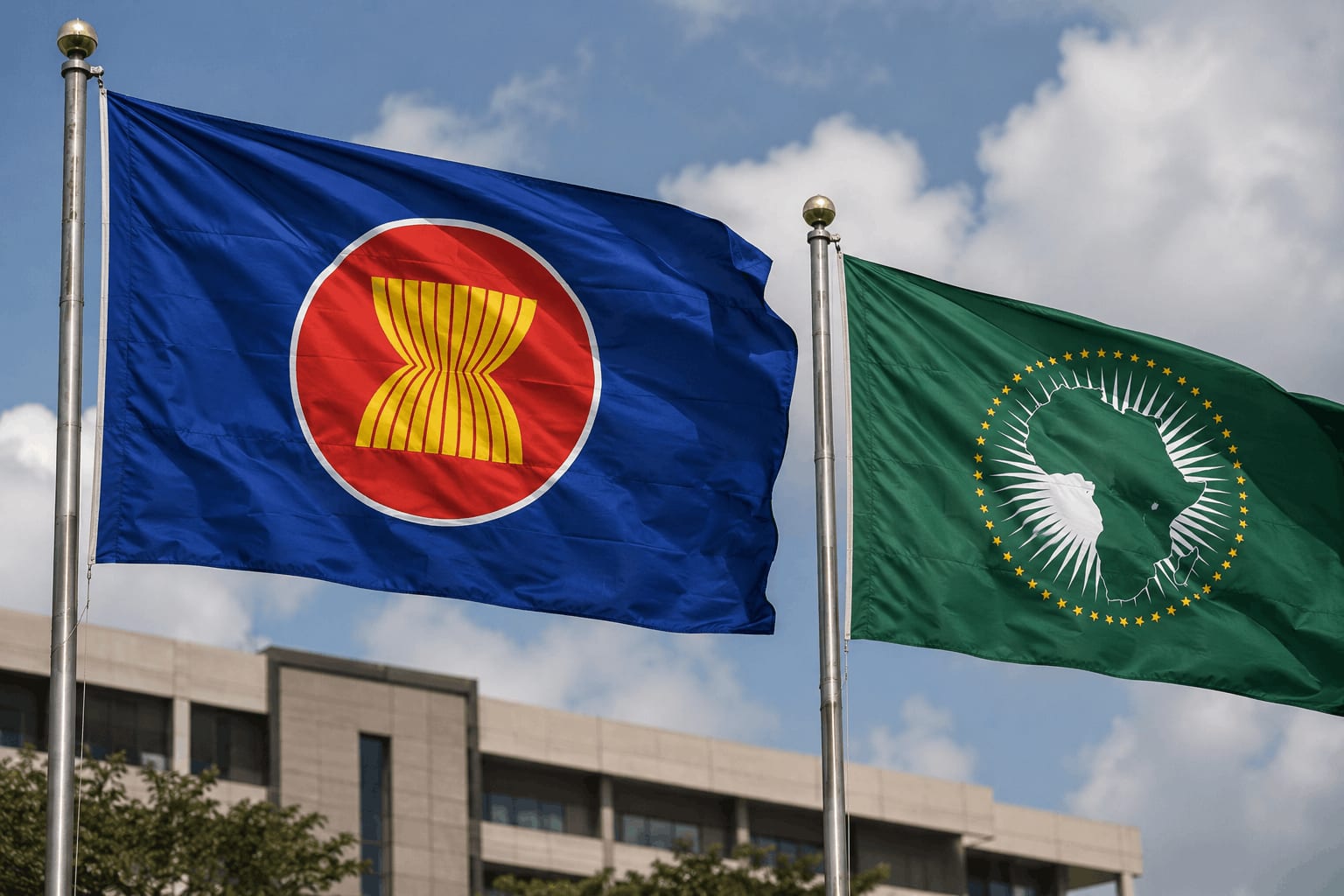
It took decades for the bloc to settle on shared symbols. The current ASEAN flag, a blue field with a red-and-white circle at its center enclosing ten golden stalks of rice bound together, was formally adopted in 1997, replacing an earlier six-stalk version that dated back to the 1970s. Each stalk stands for a member state, and the whole design leans on rice because it's the crop that ties the region's farming economies together. It took another eleven years, until 2008, for ASEAN to settle on an anthem. The bloc ran a region-wide songwriting competition that drew 99 finalists from all ten countries, and the winning entry, "The ASEAN Way," was written and composed by a Thai team.
Every year on August 8, the anniversary of ASEAN's founding, member countries mark ASEAN Day with flag-raising ceremonies, community runs, and cultural events. None of this has anything to do with tariff schedules. It has everything to do with reminding ten very different populations that they're part of something bigger than their own borders. None of it required a treaty renegotiation either. It took a committee, a competition, and a date on the calendar.
Then in 2015, when the ASEAN Economic Community was formally launched, the bloc gave the whole project a motto: "One Vision, One Identity, One Community." Notice what comes first in that phrase. Not one market. Not one tariff schedule. One identity, ahead of the economics.
Africa's institutions have largely moved in the opposite order, building the technical machinery of trade well ahead of any shared identity ordinary citizens can hold onto. The African Union does have its own flag and anthem, and Africa Day is marked every year on May 25. But AfCFTA itself, the specific agreement meant to knit 54 economies into one market, has no identity of its own that an ordinary African would recognize on sight. No separate symbol, no separate day, no story distinct from the broader African Union brand it sits under. It went straight to schedules and secretariats. That's the ASEAN order, run in reverse.
 ---
---
The trade numbers sitting next to ASEAN's identity work
In this section
None of this proves that a flag and an anthem cause a trade outcome by themselves, and it would be dishonest to claim that.
None of this proves that a flag and an anthem cause a trade outcome by themselves, and it would be dishonest to claim that. But the numbers next to ASEAN's identity-building are worth putting on the table honestly, and they need a correction from what's often repeated online. Intra-ASEAN trade, meaning trade between ASEAN countries as a share of the bloc's total trade with the world, sat at around 20 to 21.5 percent in 2024, according to figures cited by Malaysia's Institute of Strategic and International Studies and by Vietnam's Ministry of Industry and Trade. That's actually down from about 24 percent in 2010, a slow decline that has ASEAN policymakers worried enough that boosting intra-regional trade became an explicit priority in 2025.
Intra-African trade, by comparison, sat at roughly 15 percent of Africa's total trade in 2023, rising from about 13.6 percent the year before, according to Afreximbank's African Trade Report. So the real gap between the two blocs is smaller than some earlier comparisons suggested, more like five to six percentage points rather than the wider gap sometimes quoted, but it's still a real and persistent gap, and ASEAN has held that lead for years despite its own limitations.
Because ASEAN does have real limitations. There's no ASEAN-wide currency. Freedom of movement for ordinary workers across the bloc is limited and uneven, nowhere near the European Union's four freedoms of movement for goods, capital, services, and people. ASEAN's own version of an Erasmus-style student exchange, run through the ASEAN University Network's Credit Transfer System, has stayed remarkably small. According to figures compiled with EU support, the scheme has issued around 400 inner-ASEAN scholarships and 100 ASEAN-EU scholarships since it began in 2016, spread across 32 universities in 8 member countries. That's a small fraction of the millions of students Erasmus has moved around Europe over a similar span, and it's a reminder that ASEAN hasn't solved the harder problem of deep integration either.
So ASEAN out-trades Africa internally without a shared currency, without full labor mobility, and without a large student mobility program. What it does have is decades of consistent, low-cost identity signaling that gave its citizens a reason to think of themselves as part of one region before the economics fully caught up. That's not proof that symbols cause trade. But it's a pattern worth taking seriously, especially because building a flag and an anthem costs a tiny fraction of what building a customs union or a shared payments system costs.
Ten countries selling themselves as one destination
In this section
To be fair to ASEAN, its tourism branding hasn't been an unqualified success.
ASEAN's identity-building didn't stop at flags and anthems. It reached into tourism marketing too, and that side of the story shows both what shared branding can do and how easily it can be under-resourced.
For years, ASEAN's tourism boards jointly promoted the region under the tagline "Southeast Asia, Feel the Warmth," an umbrella campaign that sat above each country's own national slogan. Thailand kept marketing itself separately. So did Singapore, Malaysia, Vietnam, and the rest. But all of them also carried the shared regional message to international travel fairs, positioning ten different countries as one destination worth building an itinerary around rather than ten competing choices.
In January 2022, ASEAN refreshed that identity again, unveiling a new logo and tagline at the ASEAN Tourism Forum in Cambodia: "A Destination For Every Dream." The new logo used ten spokes forming a sun shape, one spoke per member country, meant to suggest vitality and renewal as the region reopened after the pandemic. The tagline was built to sit above supporting slogans like "A Destination for Adventure" and "A Destination for Culture," letting each country keep its own personality while still carrying the shared regional message.
That structure matters for how African destinations currently market themselves. Kenya promotes itself as "Magical Kenya." Rwanda built "Visit Rwanda" into one of the most recognized destination brands to come out of the continent in the last decade. Seychelles, Uganda, and dozens of other African tourism boards run their own campaigns, largely on their own, each competing for the same pool of long-haul international travelers rather than jointly presenting a continent that, taken together, offers a far wider range of experiences than any single country could on its own. There's no African equivalent of "A Destination For Every Dream" sitting above Magical Kenya and Visit Rwanda the way ASEAN's shared tagline sits above Thailand's and Vietnam's own campaigns, even though the African Union and Africa's regional tourism bodies have exactly the continental reach that could support one.
To be fair to ASEAN, its tourism branding hasn't been an unqualified success. Analysts covering the region have pointed out that Southeast Asia as a collective holiday destination is still overshadowed internationally by its political and economic image, and that limited joint marketing budgets and inconsistent follow-through across member states have held back what a fully funded shared campaign could achieve. A logo and a tagline aren't enough on their own. They need sustained money and coordinated execution across every member's own tourism board to actually change how a traveler plans a two-week holiday. But even an imperfectly funded shared campaign gives Southeast Asia something Africa's tourism sector still lacks almost entirely: a single, repeatable answer to the question of what the region as a whole is actually like to visit, sitting above fifty-four separate answers that a first-time visitor has no easy way to compare.
ASEAN also shows the limits, and the honesty matters here
In this section
No binding regional visa agreement covering all ASEAN members has actually been signed.
It would be easy to turn this into a simple success story, and that wouldn't survive a fact check. A well-known 2017 essay in the Yale Journal of International Affairs asked directly whether ASEAN's "One Identity and One Community" motto was a slogan or a reality, and its answer was cautious. ASEAN's members still guard their own sovereignty closely, still negotiate bilaterally when that suits them better than acting as a bloc, and there's a real gap between the unity projected in summit statements and the unity ordinary citizens actually feel moving between member states.
The bloc's attempt at one of the more concrete integration projects, a shared regional tourist visa modeled loosely on Europe's Schengen system, shows the same gap between symbol and substance. The idea has circulated for years and was revived again at the ASEAN Tourism Forum held in Cebu in early 2026, with tourism ministers agreeing to formally restart the conversation. But as of mid-2026, the various proposals still cover only a subset of member states, generally Thailand plus five or six mainland neighbors such as Cambodia, Laos, Malaysia, Myanmar, and Vietnam, leaving out Singapore, Indonesia, and the Philippines, which makes a truly bloc-wide agreement politically difficult. No binding regional visa agreement covering all ASEAN members has actually been signed. A shared flag turned out to be far easier to agree on than a shared border policy, which is exactly the order most integration projects tend to follow, symbols first and sovereignty-touching policy much later and much harder.
Africa is living a close cousin of that same story. The East Africa Tourist Visa lets travelers move across three countries, Kenya, Rwanda, and Uganda, on a single 90-day, multiple-entry visa costing 100 dollars, a genuinely useful step that nonetheless covers a small fraction of the continent. ASEAN's stalled multi-country visa talks and East Africa's three-country visa are both evidence of the same broader pattern: shared identity spreads faster and cheaper than shared border policy, everywhere, not just in Africa.
What ASEAN got right, and what it means for AfCFTA
In this section
First, ASEAN built cheap, visible symbols early and didn't wait for the economics to be finished first.
Stripping out the parts that haven't worked, there are a few things ASEAN got right that Africa could put to use directly.
First, ASEAN built cheap, visible symbols early and didn't wait for the economics to be finished first. A flag, an anthem chosen through a public competition, and an annual day of shared celebration cost very little compared to a customs union, and they give ordinary citizens something to feel part of long before a rules-of-origin framework means anything to them personally. AfCFTA, or the African Union on AfCFTA's behalf, could give the trade agreement its own recognizable symbol and its own annual day, separate from the broader Africa Day calendar, tied specifically to the free trade area and what it's trying to build.
Second, ASEAN negotiated with the rest of the world as one bloc rather than as ten or eleven separate voices whenever it mattered most. The upgraded ASEAN-China Free Trade Area, signed on October 28, 2025, at the 47th ASEAN Summit in Kuala Lumpur, added five new chapters covering areas like the digital economy, the green economy, and supply chain connectivity, and it was negotiated as a single agreement between ASEAN and China, not as ten separate bilateral deals. That collective bargaining position is worth more to a small member state like Laos or Cambodia than anything it could negotiate with China on its own, and it only works because the bloc is willing to show up and speak with one voice. AfCFTA's own secretariat has the same opportunity in front of it, negotiating market access and investment terms with outside partners as one African market of roughly 1.4 billion people rather than leaving individual countries to negotiate alone from a much weaker position.
Third, ASEAN kept its identity-building going instead of treating it as a one-time launch. The anthem is now well over fifteen years old and is still sung at official events. ASEAN Day still happens every year, not just in the founding decade. Consistency over time, more than any single campaign, is what turned "One Vision, One Identity, One Community" from a launch-day slogan into something with enough history behind it to actually mean something to people.
Fourth, and specific to the tourism side, ASEAN showed that a shared regional tagline doesn't require any single member state to give up its own brand. Thailand didn't stop being Thailand to carry "A Destination For Every Dream" alongside its own campaigns, and Vietnam didn't stop being Vietnam either. A continental tourism identity for Africa, sitting above Magical Kenya and Visit Rwanda rather than replacing either, could work the same way, provided the African Union or a body like the African Tourism Board is willing to fund it properly. Resourcing is exactly where ASEAN's own version has fallen short, so any African equivalent would need to learn from that gap rather than repeat it.
The honest caveat
In this section
ASEAN largely ran them side by side: symbols early, substance slower, and it ended up trading with itself more than Africa currently does.
Southeast Asia and Africa are not equivalent regions, and it would be a mistake to treat ASEAN's ten or eleven countries and roughly 680 million people as a scaled-down stand-in for Africa's 54 countries and 1.4 billion people. ASEAN's founding members shared enough regional proximity, and in several cases enough historical and cultural overlap, that a common identity had real material to draw on from the start. Africa's diversity is larger by almost every measure: more countries, more languages, more colonial histories pulling in different directions. Any shared symbol built for the whole continent risks feeling thinner and less binding than ASEAN's does for its members.
That's a reason to be realistic about how much a flag or an anthem alone can deliver. It's not a reason to skip the exercise. It's also a reason to expect any African equivalent to take longer and need more patient funding than ASEAN's own version did. ASEAN's own limits, the stalled visa talks, the small mobility program, the persistent guarding of sovereignty, show that identity-building doesn't replace the harder work of infrastructure, payment systems, and rules of origin. What ASEAN's example does suggest is that identity-building is cheap enough, and potentially useful enough, that Africa has little excuse for leaving it undone while it waits for the harder economic integration to finish. The two don't have to happen in sequence. ASEAN largely ran them side by side: symbols early, substance slower, and it ended up trading with itself more than Africa currently does.
Sources: ASEAN Main Portal (asean.org), including its pages on the ASEAN Emblem, ASEAN Flag, ASEAN Anthem, and the announcement on Timor-Leste's admission; Wikipedia entries on the Flag of ASEAN and The ASEAN Way, cross-checked against ASEAN's own site; Yale Journal of International Affairs, "ASEAN's 'One Identity and One Community': A Slogan or a Reality?" (2017); the EU's SHARE program report on Higher Education in Southeast Asia, for AUN-ACTS scholarship figures; ASEAN Tourism Forum announcements from January 2022 and early 2026 (Cebu); Institute of Strategic and International Studies Malaysia (ISIS) and Vietnam's Ministry of Industry and Trade, for 2024 intra-ASEAN trade share figures; Afreximbank's African Trade Report 2024, for intra-African trade figures; Global Times, The Diplomat, and Philippine News Agency reporting on the October 2025 ASEAN-China Free Trade Area 3.0 signing; official visa information from Rwanda's Directorate General of Immigration and Emigration and Uganda's immigration authority, for East Africa Tourist Visa details; AfCFTA Secretariat materials on the trade agreement's current structure.