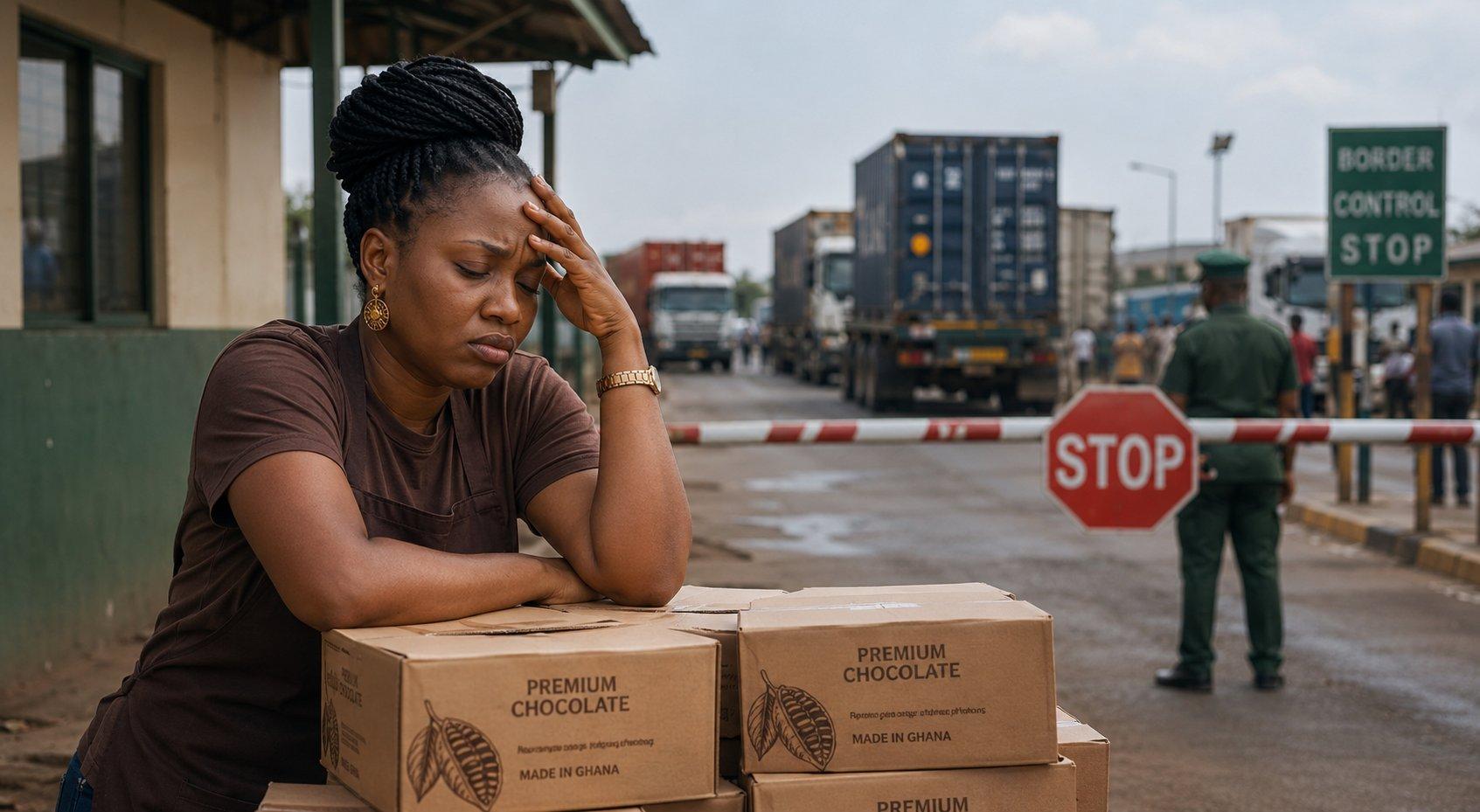
Picture a chocolate manufacturer in Ghana trying to sell products in Kenya, but her biggest challenge is not demand. It is the border. **inserts a long deep sigh**
For decades, it has often been faster, cheaper, and easier to ship African products to Europe than to a neighboring African country. Instead of operating as one connected market, Africa has largely functioned as dozens of separate economies.
That is the problem the African Continental Free Trade Area, or AfCFTA, was created to solve, and it's been making some significant milestone. Some are;
- Trading under the agreement officially began in January 2021.
- Today, 54 of the African Union's 55 member states have signed the agreement, with Eritrea being the only exception.
- Together, those countries represent a market of roughly 1.4 billion people and an economy worth about US$3.4 trillion.
While these numbers are impressive, they do not guarantee growth. The question we should rather be asking as a continent is, are we building the conditions needed to turn a market size of 1.4 billion people into a real economic opportunity, or are we going to let it slip through our hands?
Africa barely trades with itself
In this section
Trade grows when countries produce different goods and services that others want to buy.
One of the biggest surprises about Africa's economy is how little African countries trade with one another.
In Europe, around 60 to 70 percent of exports stay within the region. In Asia, the figure is about 55 to 59 percent. In the America, it is close to 40 percent. In Africa, intra-African trade has remained at roughly 15 to 18 percent for years. According to Afreximbank, trade between African countries reached about US$230 billion in 2025, representing only around 16 percent of the continent's total trade.
Part of the reason lies in history. Much of Africa's roads, railways, and ports were originally built during the colonial era to move raw materials from the interior to ports for export overseas, rather than to connect neighboring African countries. Many of those transport networks still follow the same pattern today.
However, there is another reason that we need to pay attention to.
Trade grows when countries produce different goods and services that others want to buy. Germany exports machinery to France. France exports pharmaceuticals. Italy exports industrial equipment. Each country produces something that complements the others.
Across Africa, a lot of countries produce and export similar products. Oil, minerals, cocoa, coffee, and other raw agricultural commodities leave the continent, while manufactured goods are imported from elsewhere. When neighboring countries are exporting many of the same products and importing the same finished goods, there would be little to no opportunity for trade to happen between them.
Then there are the physical barriers like;
- Weak transport links make moving goods expensive.
- Different customs procedures slow trucks at border crossings.
- Visa restrictions make it harder for business owners and professionals to move across the continent.
Together, these challenges help explain why many African countries still trade more with China, Europe, or other global markets than they do with their African neighbors.
AfCFTA is not Europe's single market
Before Europe created its single market, it already had well-developed transport networks, a strong manufacturing base, connected financial systems, and decades of industrial growth behind it.
However in Africa, we're building a common market while also investing in the roads, railways, ports, factories, and institutions needed to support that market. So the reality for the African market is, it would take a while to achieve great success to increase trade intra continent.
What AfCFTA is actually trying to fix
In this section
The rules are designed to make sure more of the production process actually happens on the continent.
Beyond trying to create lower tariffs, AfCFTA is also working to make trade simpler and more predictable. It includes unified customs processes, common rules for determining where products are made, digital customs systems, shared product standards, dispute resolution mechanisms, and rules covering services, investment, competition, and intellectual property. As of early 2026, around 92 percent of tariff lines had been finalized.
These changes matter because tariffs are often not the biggest obstacle to trade. Other obstacles are delays caused by bureaucracy in paper works, complexity of the trade, uncertainties pertaining infrastructure etc.
Imagine a truck waiting at a border for five days. Cutting a 5 percent tariff does very little if the truck is still stuck in a queue. Reducing that five-day delay would make a bigger difference as it can lower transport costs, reduce spoilage for fresh food, help businesses deliver on time, and make it easier for smaller companies to compete across borders.
Another important part of AfCFTA is its rules of origin. Rules of origin are the criteria used to decide which country a product actually "comes from," for the purpose of getting trade benefits.
For a physical good like a car, that's tricky because a vehicle is made of parts from lots of different places, engine from one country, steel from another, electronics from somewhere else. So AfCFTA had to define a threshold: how much of a car has to actually be made in Africa before it counts as an African product.
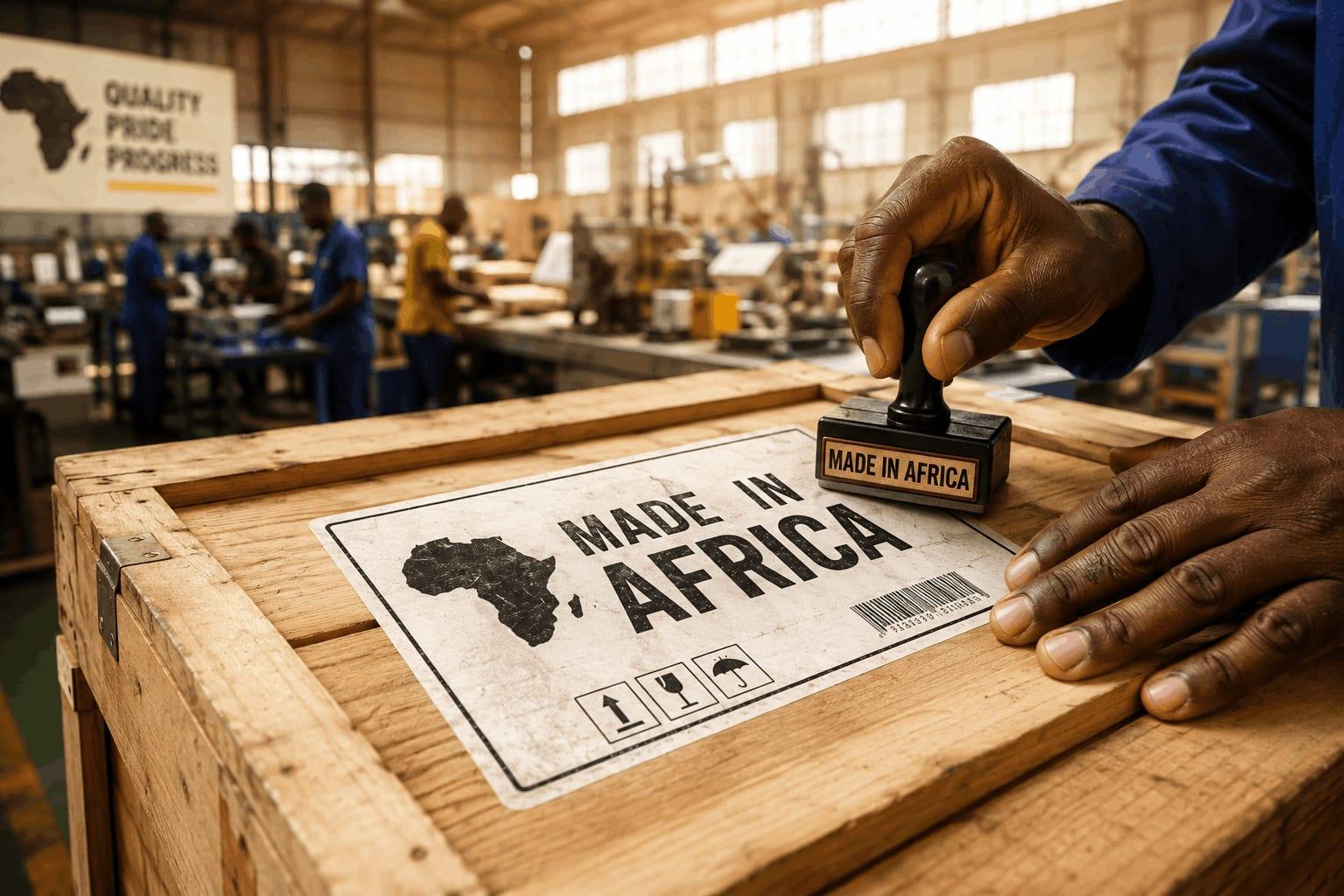
They landed on 40%. So if at least 40% of a vehicle's value comes from locally made parts or labor, that is African-made parts and labor, it's treated as "Made in Africa" and gets the lower AfCFTA tariffs when sold across the continent. If it's mostly assembled from imported parts with minimal African content, it doesn't qualify, and gets taxed like any other import instead.
For example, under the rules approved for the automotive sector, at least 40 percent of a vehicle must be made in Africa, whether through locally produced parts or labor, before it qualifies as an African product and receives lower AfCFTA tariffs.
The purpose is to encourage real manufacturing, not superficial assembly. Without rules like these, a company could import an almost-finished vehicle, make a very small change locally, and claim it was made in Africa. The rules are designed to make sure more of the production process actually happens on the continent.
The agreement also creates opportunities for businesses that do not sell physical goods.
Imagine you are an architect licensed in Nigeria who wants to work on a project in Kenya. There is no tariff stopping you from offering your services. However, does Kenya recognize your Nigerian professional license too?
That is often the real barrier for service businesses. Success depends less on taxes at the border and more on whether countries recognize each other's qualifications, licenses, and professional standards.
Trade needs roads, not just rules
In this section
Trade liberalization only delivers results when businesses can move goods quickly, reliably, and at a reasonable cost.
Trade agreements can make it easier to do business, but they cannot move goods from one place to another. Infrastructure does. Infrastructure like;
- Roads
- Railways
- Ports
- Reliable electricity
- Digital customs systems
Digital customs systems can include:
- Electronic submission of import and export documents.
- Online customs declarations.
- Electronic certificates of origin.
- Digital payment of duties and fees.
- Cargo tracking systems.
- Risk assessment software that identifies which shipments need inspection and which can pass through quickly.
Digital custom systems should: reduce delays, paperwork, mistakes, and corruption while making trade faster and more predictable.
Without these supporting infrastructure, AfCFTA remains largely theoretical. Trade liberalization only delivers results when businesses can move goods quickly, reliably, and at a reasonable cost.
That is why investments such as the Lobito Corridor, which connects Angola's Atlantic coast with mining regions in the Democratic Republic of the Congo and Zambia, matter. The same is true for the LAPSSET Corridor in East Africa, port expansions in places such as Lekki, Mombasa, and Durban, regional electricity projects, and the growing use of digital customs systems across the continent. These investments make trade agreements work in practice.
A tariff reduction has little value if goods cannot reach customers efficiently. The agreement creates the opportunity. Infrastructure makes that opportunity usable.
Manufacturing is where this becomes real
In this section
A better approach would be for different countries to become highly competitive in different industries.
If Africa continues to export mostly raw materials, there will always be limits to how much African countries can trade with one another.
Nigeria exports crude oil. The Democratic Republic of the Congo exports cobalt. Zambia exports copper. Ghana exports cocoa. Much of these resources leave the continent to be processed, refined, or turned into finished products somewhere else.
Now imagine Namibia wants to create and export electronic cars, here's a model that could work and increase wealth for African countries.
- Lithium would be mined in Zimbabwe.
- Copper comes from Zambia.
- Cobalt is imported from the Democratic Republic of the Congo.
- The battery cells are produced in Kenya.
- The vehicle parts are assembled in South Africa.
- The software is developed in Rwanda.
- Then it gets back to Namibia and Namibia exports it through Namibia to markets across Africa and beyond.
That is literally how manufacturing works across many of today's most integrated economies.
Another example would be a smartphone. It does not get designed, built, and assembled in one country. Different components are made in different places before coming together as a finished product. Parts cross borders several times before the final product reaches consumers.
Africa has the opportunity to build similar regional value chains. The automotive sector is already moving in that direction. In February 2026, AfCFTA member states approved rules of origin for vehicles and automotive parts. Under those rules, at least 40 percent of a vehicle must be made in Africa before it qualifies for lower AfCFTA tariffs. The goal is to encourage manufacturers to build more of their supply chains within Africa instead of simply importing finished products for resale.
This is also why specialization matters. No country needs to manufacture everything. In fact, trying to do everything often makes countries less competitive.
A better approach would be for different countries to become highly competitive in different industries. One country might focus on pharmaceuticals, another on textiles, another on batteries, another on fertilizers, and then, they trade with one another. That is broadly how production has developed across Europe and much of East Asia, where industries are spread across several countries instead of being concentrated in just one.
Markets need to be large enough to justify investment
Building a factory is expensive, and businesses do not invest hundreds of millions of dollars unless they believe there will be enough customers to justify the cost. A company deciding where to build its next factory is not only looking at today's market. It is looking at how many people it will be able to reach over the next ten or twenty years.
That is where AfCFTA changes the equation.
Instead of producing for a single national market, businesses can begin planning for access to a much larger regional market. Projects that may not have made financial sense when serving twenty or thirty million people can become viable when they have the potential to reach hundreds of millions of consumers.
Larger markets also make production more efficient. Fixed costs can be spread across more customers, lowering the average cost of making each product. That gives manufacturers greater confidence to invest for the long term.
Small businesses could benefit the most
Large multinational companies have spent years learning how to operate across different countries, tax systems, and regulations. But for many small businesses, those same differences can be overwhelming. AfCFTA could have an even bigger impact on smaller firms. So that, a fashion brand in Ghana could find customers in Rwanda more easily. A food processor in Kenya could expand into Zambia with fewer barriers. A software company in Nigeria could sell services across several African markets without opening an office in every country.
AfCFTA is often discussed in terms of goods crossing borders, but services are also an important part of the agreement, because products is not something that fits inside a shipping container. beyond the physical parts of the product, there's the service areas like, knowledge, expertise, and other professional services that were involved in bringing that product to life.
This is why removing those kinds of barriers that make it hard for African professionals and service businesses to work across the continent is important and should be treated with urgency.
If that can be done. it could prove just as valuable as lower tariffs on physical goods for many businesses.
What could still derail it
In this section
Instead, both businesses may have to convert their money into US dollars before completing the payment.
No serious discussion about AfCFTA is complete without looking at the challenges that could slow its progress.
- Infrastructure remains one of the biggest obstacles.
- Border delays still increase the cost of moving goods.
- Political instability can disrupt trade.
- Some governments may also be reluctant to open their markets if local industries feel threatened by increased competition.
- Payments remain another challenge.
Africa has more than 40 national currencies, and exchange rates can change quickly. A business in Ghana selling products to a customer in Tanzania often cannot settle the transaction directly in Ghanaian cedis and Tanzanian shillings. Instead, both businesses may have to convert their money into US dollars before completing the payment. Every conversion adds cost, takes time, and exposes businesses to a lot of volatility before the transaction is complete.
This is one of the problems the Pan-African Payment and Settlement System, known as PAPSS, is designed to solve. Instead of routing payments through foreign currencies, the system allows businesses in participating countries to settle transactions in their own local currencies. That reduces costs, shortens payment times, and makes cross-border trade easier, particularly for small and medium-sized businesses.
There are other challenges too:
- Africa still has a relatively small manufacturing base in many sectors.
- Businesses across the continent continue to face large trade finance gaps, making it difficult to access the funding needed to import, export, or expand.
- Non-tariff barriers, inconsistent regulations, and slow border procedures also continue to make regional trade more difficult than it should be.
- There is also a political reality that cannot be ignored.
There's a political dimension too, and it's worth naming directly. Every free trade agreement eventually runs into domestic pressure. When imports become more competitive, local industries lobby for protection, and governments have to weigh national political interests against the longer-term gains of regional integration. AfCFTA's success depends not just on economics but on whether governments hold their nerve when that pressure inevitably shows up.
Signing an agreement is always easier than changing the institutions and infrastructure behind it. AfCFTA's own track record shows that gap. Five years after trading began, 49 of the 54 eligible countries had ratified the agreement, and by mid-2025 participating countries had issued just over 8,500 certificates of origin. That represents meaningful progress, but it also shows that implementation is still in its early stages.
Why regional trade matters beyond Africa
The global economy is becoming increasingly regional. The European Union, ASEAN, USMCA, the Gulf Cooperation Council, and Mercosur all show that countries often become more competitive when they trade through larger regional markets rather than operating as isolated economies. The same principle applies to Africa.
For investors, a continent divided into dozens of separate markets is more complicated than one large, connected market. Every additional border, customs process, and regulatory system increases the cost and complexity of doing business. A more integrated market reduces those barriers.
It also makes larger investments easier to justify because businesses know they can serve customers across several countries instead of just one.
Africa also has significant financial resources of its own. Pension funds, sovereign wealth funds, and central banks collectively manage substantial pools of capital. A more predictable investment environment could encourage more of that capital to be invested within Africa rather than flowing elsewhere.
Digital trade is part of the story too
Trade is no longer limited to goods moving through ports and border crossings. Software can be exported. Financial services can be delivered online. Architects can design buildings remotely. Consultants can advise clients in another country without boarding a plane. Artificial intelligence is creating even more opportunities for businesses to deliver services across borders.
For many African entrepreneurs, their fastest-growing export may never pass through the port. It may be delivered through the internet instead.
This is one reason digital trade has become an increasingly important part of AfCFTA.
Cross-border payments, e-commerce, digital identity systems, mobile money, electronic customs platforms, fintech, and AI-powered logistics all have the potential to make regional trade faster and more efficient.
But digital trade also depends on cooperation. If every country has different payment systems, digital identity standards, or data regulations, businesses face many of the same obstacles they encounter at physical borders. Building a connected digital market has become just as important as building roads, ports, and railways.
The real reason trade matters
Trade doesn't create wealth just because goods cross borders. It creates wealth because bigger markets justify bigger investments. Bigger investments build bigger factories. Bigger factories create better jobs. Better jobs raise incomes. As incomes rise, consumers spend more. And a bigger consumer market attracts even more investment.
That cycle is what transformed Europe and East Asia, and it's ultimately what AfCFTA is trying to unlock across Africa.
So, can it deliver?
Yes.
But success depends on much more than signing an agreement.
Infrastructure must continue improving. Manufacturing needs to grow beyond exporting raw materials. Border crossings have to become faster and more efficient. Governments must continue implementing reforms even when they become politically difficult. Most importantly, businesses have to use the opportunities the agreement creates.
Trade agreements create the conditions for trade, but businesses are the ones that turn those conditions into economic activity.
Can AfCFTA become the foundation for Africa's next era of economic growth, or are there bigger challenges that still need to be solved first? Share your thoughts in the comments, and if you found this article useful, subscribe to receive the next piece in the How Africa Creates Economic Value series.
Sources: AfCFTA Secretariat; African Export-Import Bank (Afreximbank), African Trade and Economic Outlook 2026; World Bank, "The African Continental Free Trade Area: Economic and Distributional Effects"; United Nations Economic Commission for Africa; African Development Bank; OECD, "Africa's Development Dynamics"; World Trade Organisation; UNCTAD; International Trade Centre.