Africa is adopting AI fast, but adoption alone won't build wealth. Here's why the real opportunity lies in owning the infrastructure, data, and talent behind AI, not just using the tools built elsewhere.
Every major technological shift splits the world into two kinds of countries. The ones that use the technology. And the ones that build it.
During the Industrial Revolution, almost every country eventually bought manufactured goods. Only a handful actually built the factories that made them. The same happened with cars, semiconductors, the internet, and smartphones. A small group of countries designed and owned the core technology, and everyone else bought access to it.
There's no reason to think AI will play out any differently.
Africa is already using AI. People are chatting with ChatGPT, generating images with Midjourney, writing code with Copilot, running businesses on tools built in San Francisco. That's fine, and it's happening fast. But the more important question isn't whether Africa is using AI. It's whether Africa will also be one of the places that builds it.
Because using a tool and owning a tool are not the same thing and do not attract the same opportunities. Because using technology makes the economy more productive while building technology makes the economy more powerful as it attracts investment, creates jobs etc.
AI is turning into infrastructure, not just software
AI is beyond an app. Beyond something you download or a chatbot you talk to. Let's liken AI to electricity.
Electricity is used in every industry, every home, every college, every and any where humans pass through, stay, live in, visit or walk through, electricity is needed. AI is heading in that same direction. It's already touching healthcare, agriculture, education, banking, law, government services, manufacturing, tourism, logistics, and customer service, and it's not stopping because .
Which means AI isn't really "an industry" in the way people talk about it. It's becoming the layer that every other industry runs on top of. And whoever controls that layer has a kind of leverage that goes far beyond any single app or product.
Using AI makes you efficient. Building AI makes you rich.
In this section
The company that built the tool gets the recurring revenue, the valuation, the leverage over an entire market.
A law firm in Lagos or Nairobi or Kigali that adopts an AI assistant becomes faster and more productive and useful. But look who actually captures the money from that transaction?
OpenAI does. Microsoft does. Google, Anthropic, Meta, and Nvidia do. The firm using the tool gets efficiency. The company that built the tool gets the recurring revenue, the valuation, the leverage over an entire market.
This is the pattern to pay attention to. Adoption improves how you work. Building a technology changes what your economy is capable of producing and exporting. Africa absolutely should keep adopting AI tools, there's no argument against that. But adoption by itself was never going to be the path to technological leadership. It never has been, for any technology, anywhere.
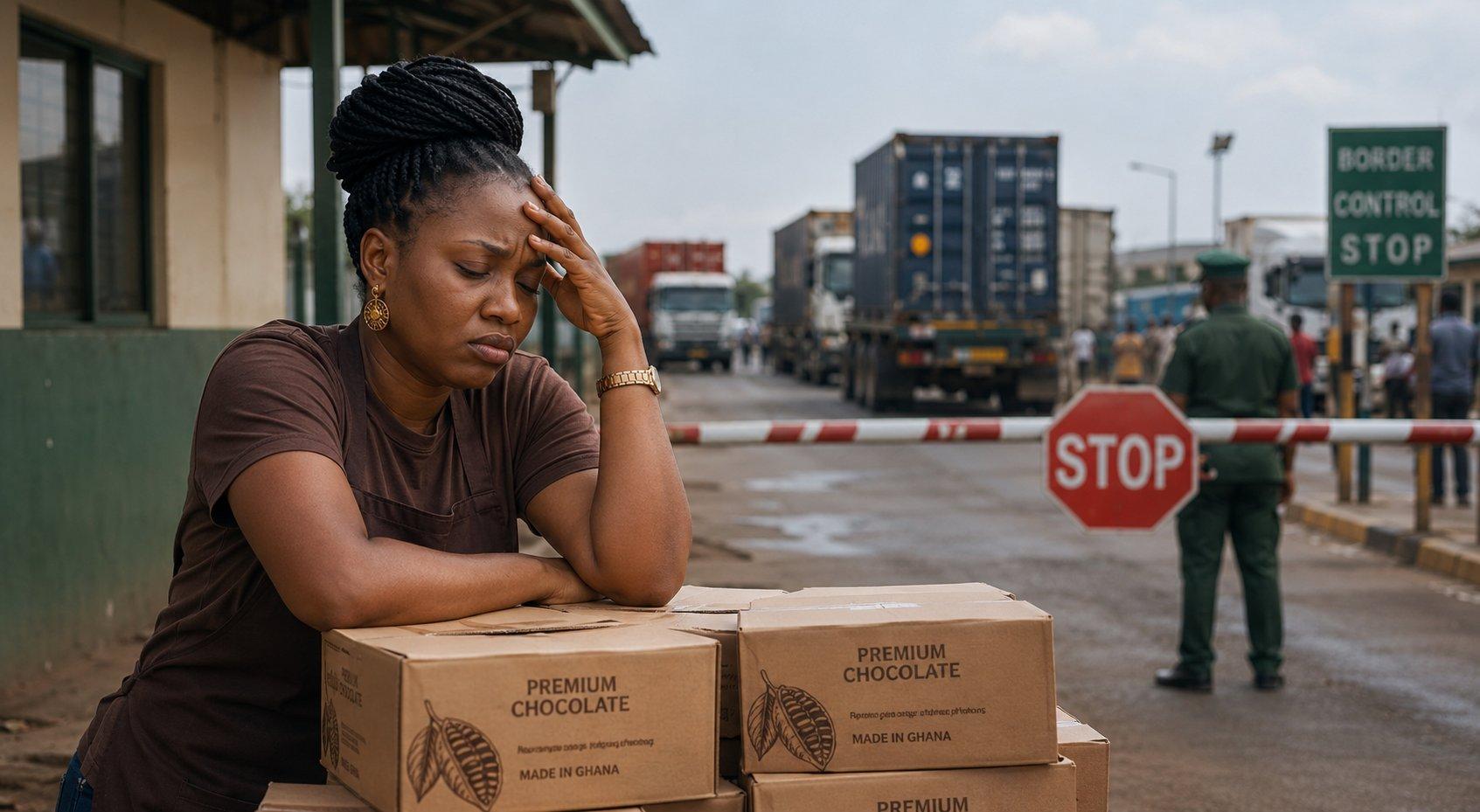
Africa has actually lived through a version of this pattern before. The continent supplied much of the raw material that powered earlier industrial revolutions, the cotton, the rubber, the minerals, while the manufacturing, the branding, and the intellectual property that turned those materials into wealth accumulated somewhere else. Cocoa left Ghana and Ivory Coast as a raw commodity and came back as chocolate bars carrying European brand names and European margins. Artificial intelligence presents a similar fork in the road, just in digital form. Africa can end up mainly consuming technologies built abroad, the way it has often consumed finished goods made from its own raw materials. Or it can invest in the capabilities that let it participate much further up the value chain this time, rather than just supplying the raw inputs, in this case the data, and watching the value get captured elsewhere.
AI has layers, and Africa is mostly stuck at the top one
In this section
Application companies earn whatever's left after paying for the compute and the model access underneath them.
AI is an entire economy stacked on top of itself, with a different set of companies making money at every level.
At the bottom sit the semiconductor companies designing the specialized chips that everything else depends on. Above them are the firms building and operating data centres to house those chips.
Cloud providers then rent out that computing power to developers and companies who don't want to build their own data centres.
Research labs use that rented compute to train foundation models, the large general-purpose systems everything else gets built on top of.
Application companies then build specific products on top of those models.
And at the very end of the chain, businesses and everyday consumers pay to use the finished product.
Each layer captures its own share of the value. Chip designers earn margins that most industries would envy. Cloud providers earn recurring revenue from everyone who needs computing power. Model builders earn licensing fees and platform dominance. Application companies earn whatever's left after paying for the compute and the model access underneath them.
Right now, most African participation in AI happens at the very top of that stack, the application layer. Building apps on top of models trained somewhere else, running on chips designed somewhere else, in data centres owned by somebody else. The higher up that stack a country manages to operate, the more jobs, intellectual property, exports, and long-term wealth it tends to generate from the same underlying technology. Likewise, the further down the stack a country can participate, from infrastructure and compute to models and applications, the more value it captures. Jobs become more specialized. Intellectual property accumulates locally. Export opportunities expand. Long-term wealth compounds.
That's not a criticism of where Africa currently sits. It's just where the entry point is easiest. But it's also exactly what happened with manufacturing for decades: countries assembling parts made elsewhere while the profit sat with the company that owned the design and the factory. The opportunity now is to move up that stack, layer by layer, the same way manufacturing economies eventually did.
Data is becoming the resource that matters, and Africa doesn't hold much of it yet
In this section
Data increasingly shapes how AI systems understand history, language, healthcare, law and culture.
Industrial economies ran on coal. Digital economies run on data. AI systems learn from the information fed into them: language, images, documents, voice recordings, health records, farming patterns, financial transactions, weather data, and more.
This is about more than economics. Data increasingly shapes how AI systems understand history, language, healthcare, law and culture. Countries that cannot govern their own data risk allowing their future digital infrastructure to be shaped almost entirely by assumptions made somewhere else.
If that African data keeps getting stored abroad, processed abroad, and used to train models built abroad, then the value it generates also lands abroad.
And right now, that's largely the situation. Sub-Saharan Africa contributes somewhere around 1 to 2 percent of the world's data creation, despite having roughly a fifth of the global population. The continent also has a fraction of the data centre capacity that regions like North America or Europe have, in some estimates fewer data centres than a country the size of Switzerland.
At an April 2026 UNECA roundtable in Tangier, officials openly discussed the need to grow Africa's data centre capacity by ten times just to catch up, and framed the real goal as "sovereign data," meaning African information stored, processed, and governed on African soil instead of shipped elsewhere by default.
If your continent's data lives in someone else's servers and gets processed by someone else's systems, you don't just lose storage revenue. You lose a say in how the resulting models understand your own people.
Language is an economic asset here, not just a cultural one
In this section
Imagine a medical diagnosis delivered in Wolof by a system that was mostly trained on English and French medical literature.
Africa is home to more than 2,000 languages. Most AI models barely understand a handful of them.
Yoruba, Igbo, Hausa, Wolof, Shona, Kinyarwanda, Amharic, Luganda, Zulu, and hundreds more carry huge populations of speakers, and huge gaps in how well any major AI system can actually work in them. Researchers have found that African languages make up a strikingly small share of online content overall, well under 1 percent by some measures, even though hundreds of millions of people speak them daily.
An AI model reflects whatever it was trained on. If African languages are barely present in that training data, then African knowledge, context, and nuance are barely present either. That has real downstream effects: government services, legal systems, healthcare tools, and education platforms all become harder to digitalize properly for the people who actually need them, because the underlying models were never built with those languages in mind.
Imagine asking an AI assistant for legal advice in Yoruba, and getting a confident answer built on almost no real Yoruba legal text. Imagine a medical diagnosis delivered in Wolof by a system that was mostly trained on English and French medical literature. Imagine a farmer in rural Uganda asking for agricultural guidance in Luganda and getting a generic answer that has no idea what actually grows in that soil. If those languages barely exist in the training data behind these systems, millions of people effectively become invisible to the next generation of digital services, at exactly the moment those services are becoming the default way governments, banks, hospitals, and schools interact with people.
Language stops being just a cultural matter here.
It becomes economic infrastructure. Whoever builds the models that actually understand Yoruba or Amharic or Wolof well is building something with real commercial value, not just cultural value.
None of this works without the infrastructure underneath it
In this section
Without those, there's no AI industry to speak of, no matter how many talented engineers a country has.
It's tempting to think of AI as pure software, something that just lives in the cloud. In reality it depends on a long list of very physical things: electricity that doesn't cut out, fibre connectivity, functioning data centres, GPUs, cooling systems, stable power grids, and serious cybersecurity.
Without those, there's no AI industry to speak of, no matter how many talented engineers a country has. This is exactly where AI ambitions run straight into the same infrastructure gaps that have shaped African economic development for decades. The grid, the fibre, the ports, the data centres. It's the same conversation, just with a new name attached to it.
There's one part of that list worth pulling out on its own: compute. Training advanced AI systems takes enormous computing resources, and most of that capacity currently sits in a small handful of countries. Access to GPUs, cloud infrastructure, and high-performance computing is turning into something as strategically important as access to electricity was during earlier industrial revolutions. Countries without meaningful compute capacity of their own risk becoming permanent consumers of AI rather than producers of it, no matter how good their engineers are or how much local data they generate. This is a conversation the whole world is going to be having repeatedly over the next decade, and it's worth Africa entering it early rather than late.
Africa isn't starting from zero here
It's easy for a piece like this to sound discouraging. It shouldn't be, because Africa actually walks into this with real advantages.
Africa has the world's youngest population, with a median age under twenty, giving it one of the largest future workforces any region has ever experienced. The continent is a fast-growing developer community, mobile-first habits that already reshaped how people bank and pay, and one of the most advanced fintech ecosystems anywhere. It also has something less obvious: a massive informal economy generating types of data that don't exist anywhere else, in agriculture, health, climate patterns, small-scale trade, and local languages.
Africa doesn't need to copy Silicon Valley to take advantage of any of this. The better path is solving African problems directly: detecting crop disease early, improving medical diagnostics in places with few specialists, building real translation tools for underserved languages, streamlining supply chains, supporting wildlife conservation, optimizing mining operations, and building climate resilience tools for farmers and coastal cities. Solutions built for these problems can eventually become exports in their own right, the same way Africa's mobile money systems ended up influencing fintech conversations well beyond the continent.
Africa's greatest AI export may not look anything like ChatGPT
In this section
A homegrown foundation model that competes head-on with the big general-purpose chatbots out of the US and China.
There's an assumption baked into a lot of AI conversations in Africa, that the goal should be to produce an African OpenAI. A homegrown foundation model that competes head-on with the big general-purpose chatbots out of the US and China.
That's probably the wrong target, because Competing head-on with the world's largest foundation model companies is unlikely to be Africa's strongest comparative advantage.
Africa's real competitive advantage likely sits somewhere else entirely: agriculture AI trained on crop patterns nobody else has bothered to model properly, mining AI built around mineral geology that's specific to the continent, climate modelling tuned to African weather systems, wildlife conservation tools built where the wildlife actually is, multilingual translation for languages the big labs have ignored, logistics optimisation for supply chains that look nothing like American or European ones, fintech built for informal economies, and public health tools designed for health systems with very different constraints than the ones in wealthy countries.
Estonia is a useful comparison. Estonia never tried to become the United States. It became one of the most digitally advanced small countries in the world by focusing tightly on what it could actually do well, digital government services, and building outward from there. Africa doesn't need a general-purpose AI giant to prove it can build. It needs deep, specific, defensible AI capability in the areas where its data, problems, and expertise are genuinely unique. That's a realistic and arguably more valuable target than trying to out-build companies that already have a decade's head start and hundreds of billions of dollars behind them.
China's playbook is worth studying, minus the politics
In this section
China didn't become a technology power because it launched one breakout AI company.
Set the politics aside and just look at the economics. China's real lesson isn't Huawei, or Alibaba, or DeepSeek. Those companies are the visible result of something less visible: patience.
China didn't become a technology power because it launched one breakout AI company. It became one because it spent decades investing in universities, engineering talent, semiconductor manufacturing, telecommunications infrastructure, and research institutions long before any of that investment produced a household name. The companies came later. The ecosystem came first, and it came first by years, sometimes decades.
Robert Tama Lisinge, who directs technology, innovation, connectivity, and infrastructure work at the UN Economic Commission for Africa, has been making a related point in recent interviews: the goal for African countries shouldn't just be using AI tools that already exist, but building the technical capacity to actually train models and process data locally. He's pointed to partnerships with countries like China as one route toward that kind of capability transfer, while also stressing that African nations need to secure their own technological sovereignty so that the tools reflect local realities rather than someone else's assumptions.
The lesson isn't "copy China's politics." It's that technology leadership gets built over years of deliberate investment, in the unglamorous parts nobody writes headlines about. Nobody buys their way into it, and nobody skips the queue.
This needs an ecosystem, not a single flagship company
In this section
Strong universities feed strong startups, which attract more investors, which fund more infrastructure.
A common mistake is imagining one national AI champion will fix all of this. It won't. What's actually required looks more like the input side of manufacturing: universities producing the right graduates, research institutes, engaged governments, private investors willing to fund early-stage work, cloud providers, founders, engineers, venture capital, sensible data policy, reliable electricity, and functioning digital identity systems.
Which raises an obvious question this article has mostly danced around so far: who exactly is supposed to build all of this?
The honest answer is that no single actor can. It takes governments setting policy and funding early research, universities training the people who will actually do the work, startups turning research into usable products, private investors willing to back those startups before they're safe bets, telecom companies extending the connectivity everything else depends on, cloud providers making compute accessible to smaller players, research institutions pushing the underlying science forward, regulators building rules that protect people without strangling the industry in its infancy, and regional bodies like the African Union coordinating enough of this across borders that a country of 20 million people isn't trying to build an entire AI ecosystem alone.
Every one of those pieces reinforces the others. Weak funding limits research. Weak infrastructure limits everything. Strong universities feed strong startups, which attract more investors, which fund more infrastructure. It's a system, and systems need every part working at once, not one flagship company carrying the weight of an entire continent's ambitions.
The risks are real, and they're reasons to invest, not reasons to hold back
In this section
Every country that eventually built a technology industry faced some version of this list first.
It would be dishonest to write this without naming the obstacles. Brain drain pulls skilled engineers abroad. Energy shortages and limited GPU access constrain what's technically possible. Venture funding for African AI startups remains thin compared to other regions. Many markets stay dependent on foreign platforms by default. Data sovereignty, cybersecurity, and regulatory gaps all need serious attention, and AI bias remains a genuine concern when models are trained mostly on data from elsewhere.
Brain drain deserves a closer look, because it's easy to talk about it as an abstract statistic and miss what it actually costs. Every talented African AI engineer who leaves for a lab in London or a startup in San Francisco isn't simply an individual changing jobs. They represent research capacity that won't exist locally, mentorship that a younger engineer won't receive, and a company that might have been founded at home and now gets founded somewhere else instead. Multiply that by thousands of departures over a decade, and it starts to look less like a personnel issue and more like a structural drag on exactly the kind of ecosystem this article keeps describing.
None of these are arguments against pursuing AI capability. They're the specific list of things that need deliberate investment and policy attention. Every country that eventually built a technology industry faced some version of this list first.
What happens to jobs
This part shouldn't get skipped over. Every major technological shift changes the shape of the job market. Some jobs disappear, others get created, that pattern has held for over two centuries now.
The real question is who ends up creating the new jobs. Countries that build AI industries tend to generate more high-value work, research roles, engineering roles, infrastructure roles, than countries that only ever consume AI built somewhere else. Consumption alone doesn't build much of a job market beyond the roles needed to use the tool.
The countries that build AI industries also tend to shape the education systems that feed those industries. Universities begin producing different graduates. Research funding changes. Entire career paths emerge that did not exist a decade earlier. Technology industries rarely create only technology jobs. They reshape labour markets around them.
The bigger opportunity
In this section
Countries that invest in creating it will end up shaping the industries everyone else has to operate inside of.
Roads built industrial economies. Digital infrastructure is building today's economies. AI will build tomorrow's.
Artificial intelligence is going to touch nearly every industry over the next couple of decades. The countries that benefit most probably won't be the ones that adopted it first. They'll be the ones that built the infrastructure, the talent pipelines, and the institutions sitting underneath it.
Africa has already shown it can leapfrog a technology, mobile banking being the clearest example, skipping past traditional banking infrastructure entirely. AI offers a similar kind of opening, but only if the continent looks past the app layer and starts investing seriously in what sits beneath it.
The same pattern keeps showing up, no matter which angle you look at Africa's economy from.
Processing creates more value than extraction. Infrastructure is what makes processing possible in the first place. Artificial intelligence is becoming one more layer of that infrastructure, the same way electricity and fibre and ports became infrastructure before it.
Countries that invest only in consuming technology will get more efficient. Countries that invest in creating it will end up shaping the industries everyone else has to operate inside of.
The question was never really whether Africa will use AI. It already does, every day, in increasing numbers.
The real question is whether Africa will own a meaningful share of the technology that's about to shape the next wave of global wealth. That answer has less to do with clever prompts and chatbot subscriptions, and a lot more to do with electricity grids, fibre networks, research labs, universities, data centres, local languages, and the people willing to build all of it.
Africa still has time to choose which path it follows.
The opportunity is no longer simply to participate in the AI economy.
It is to help build it.
Because every technological revolution has rewarded the builders more than the users.
The AI economy isn't just chatbots.
Chips → Compute → Data Centres → Cloud → Foundation Models → Applications → Businesses → Consumers
The more layers a country builds, the more value it captures.