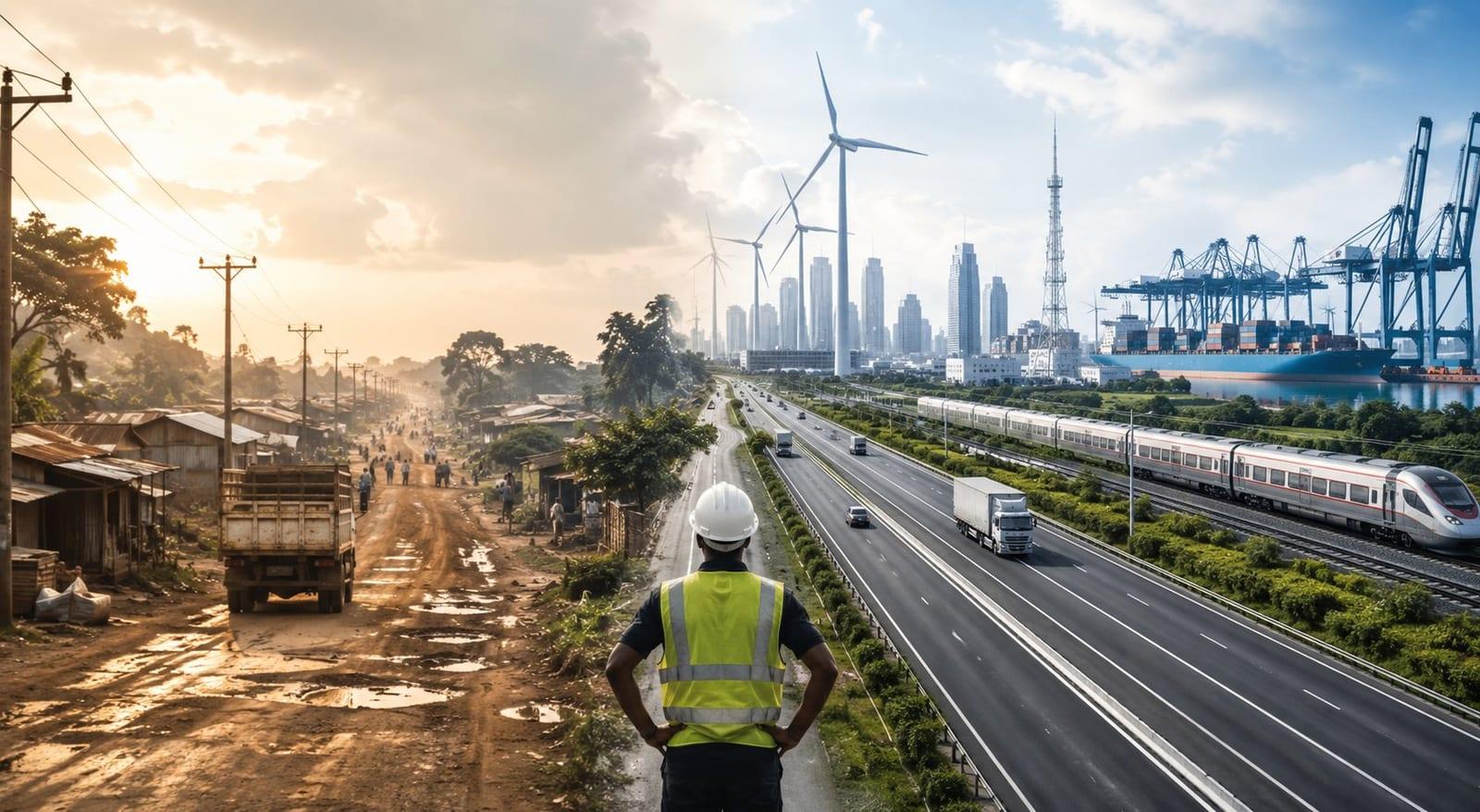
Infrastructure is one of the few things every politician promises, every economist talks about and almost every citizen takes for granted. It is often treated as a collection of construction projects: roads, bridges, ports, airports and power stations. Yet that way of thinking misses what infrastructure actually is.
Infrastructure is the operating system of an economy. Every business, every industry and almost every technological breakthrough depends on it in one way or another.
Without electricity, there are no factories. Without roads, farmers cannot reach markets. Without ports, exporters cannot compete on price or speed. Without fibre networks, there would be no digital economy.
Infrastructure is invisible when it works. It only becomes visible when it fails. That is precisely why it is so easy to overlook.
Nobody opens a newspaper to read about a transformer that did not fail this week, or a container that cleared customs on schedule. The importance of infrastructure is only seen through absence, in the form of a hospital without power, a factory running below capacity, a truck stuck at a border post for three days while its cargo spoils.
This is the third article in the Building Africa series. This article answers the question: if processing and manufacturing are what create prosperity, what makes processing and manufacturing possible in the first place?
The answer is infrastructure, because it determines whether production can happen at all, at what cost, and at what scale.
Roads, electricity, ports, railways and digital networks rarely dominate headlines. Yet every prosperous economy has been built on them. Infrastructure is not simply about construction. It is the foundation upon which industries, innovation and long-term economic growth are built.
Every prosperous economy built infrastructure before prosperity
In this section
South Korea paired an expansion of electricity generation with the creation of manufacturing zones built for export.
No country has been industrialized by accident. Each one first built the systems that allowed goods, energy, people and information to move efficiently, and prosperity followed.
Britain's Industrial Revolution did not begin with factories. It began with canals that could move coal and raw materials at a fraction of the cost of horse-drawn transport, followed by a railway network that linked producers to ports and ports to global markets. The factories came after the logistics did, because factories without a way to receive goods and ship goods and items are just expensive buildings.
The United States told a similar story a century later. The Interstate Highway System, built from the 1950s onward, did more than connect cities. It created a single national market by making it cheap to move goods across enormous distances, which in turn allowed manufacturers to build at a scale that regional markets alone could never support.
China's more recent transformation followed the same logic, compressed into a few decades. Expressways, high-speed rail, purpose-built industrial parks and some of the world's busiest ports were constructed deliberately and in advance of the manufacturing boom they were designed to support, not as a reaction to it. South Korea paired an expansion of electricity generation with the creation of manufacturing zones built for export. Singapore, with almost no natural resources, built one port so efficient that it became a hub for global trade routes that had nothing to do with Singapore's own economy.
None of these countries first became wealthy and then built infrastructure to support their economies. They built infrastructure first, often at significant short-term cost, because they understood that businesses cannot operate efficiently on systems that do not exist.
Infrastructure is the hidden cost of doing business
In this section
Weak digital connectivity slows down everything from banking to logistics coordination to customer service.
Poor infrastructure does not merely inconvenience an economy. It raises the cost of producing almost everything within it and, ultimately, the cost of living itself.
Unreliable electricity forces manufacturers to buy and run diesel generators, which is a de facto private tax on production. Poor roads and congested ports add days to delivery times and unpredictability to supply chains, which businesses price in as risk. Slow customs processes add cost before a product has even left the country. Weak digital connectivity slows down everything from banking to logistics coordination to customer service.
These costs also affect businesses that seem to have nothing to do with infrastructure. A bakery depends on electricity that does not cut out mid-bake. A software company depends on internet that does not drop during a client call. A hospital depends on both power and roads, since medicine has to arrive and patients have to be reached. A tourism operator depends on airports and transport networks that make a destination accessible rather than aspirational. A factory depends on ports and rail to receive inputs and ship finished goods. A university cannot run laboratories without electricity. A film studio cannot upload high-resolution productions without reliable broadband. Even creative industries depend on infrastructure far more than they often realise.
The World Bank's Enterprise Surveys have repeatedly found that firms across many African countries report electricity and transport as among their most significant operating constraints, with unreliable power pushing many businesses toward costly self-generation. Analysts covering the continent's infrastructure gap have separately estimated that weak infrastructure adds meaningfully to the cost of goods moving through African supply chains. None of this shows up on an invoice as an "infrastructure charge." It shows up as higher prices, thinner margins and businesses that never scale past a certain size because the economics stop working.
Electricity changes everything
In this section
Every hour without power is an hour when machines, workers and capital sit idle instead of creating value.
Of every category of infrastructure, electricity may be the one whose absence is most directly disqualifying for industrial ambition.
According to the International Energy Agency, close to 600 million people across Africa still lack access to electricity, with sub-Saharan Africa accounting for the majority of the global electricity access gap. Progress has been slow, and in recent years the number of people gaining access has barely kept pace with population growth, meaning the absolute size of the gap has changed little even as electrification efforts have continued.
For manufacturers, this is not simply an inconvenience. A factory that loses power for several hours a day cannot compete on cost or reliability with a factory elsewhere that does not. Many businesses across the continent generate their own electricity through diesel generators, which is far more expensive than grid power and adds a structural cost disadvantage before a single unit has been produced. Electricity, in this sense, is not primarily an energy policy question. It is an industrial competitiveness question, because no amount of talent, ambition or market access compensates for a production line that stops every afternoon. It is also a productivity question. Every hour without power is an hour when machines, workers and capital sit idle instead of creating value.
There is an opportunity here alongside the challenge. Africa has some of the best solar resources on earth, substantial hydropower potential, and growing wind capacity, and much of this generation can be built without ever passing through the fossil-fuel-heavy grid architecture that older industrial economies had to build and later retrofit. Regional power pools and cross-border transmission projects are beginning to allow countries to share generation capacity rather than each building in isolation, and mini-grids are extending power to communities that a national grid may not reach for years. The IEA has noted that closing the financing gap for electricity access would require a significant scale-up in investment, but the underlying resource base to build a cleaner and more distributed grid than the ones industrialised economies inherited is genuinely there.
Roads do far more than move cars
In this section
A manufacturer waiting weeks for imported components loses production time that competitors elsewhere never lose.
Transport infrastructure is easy to underrate because its effects are diffuse. It does not belong to one sector. It multiplies productivity across almost all of them.
A farmer without reliable access to a paved road loses a share of the harvest to spoilage before it ever reaches a buyer, and receives a lower price for what does arrive because middlemen price in the difficulty of collection. A factory without efficient transport links pays more for inputs and takes longer to deliver finished goods, eroding its ability to compete with producers elsewhere.
Medicine that has to travel long distances over poor roads arrives late or not at all, with consequences that are measured in more than money. Students in areas with limited transport travel further and lose more time getting an education than their urban counterparts.
Tourists, whose spending can support entire regional economies, simply do not visit destinations they cannot reasonably reach. A beautiful destination that cannot be reached reliably is, economically speaking, a destination that barely exists. Mining operations, which are often located far from population centers, absorb high costs simply moving raw material to a port or processing site.
Infrastructure also determines how societies spend time. A commuter who spends four hours each day in traffic is losing nearly an entire working day every week. A farmer delayed by flooded roads misses market prices. A manufacturer waiting weeks for imported components loses production time that competitors elsewhere never lose. Good infrastructure compresses time. Bad infrastructure wastes it. Over years and decades, that difference compounds into enormous economic gains or losses.
In each of these cases, the road itself creates nothing. What it does is allow value that already exists, a harvest, a shipment, a patient, a visitor, to actually reach the place where it becomes economically useful. That is the sense in which infrastructure multiplies productivity rather than creating it directly: it removes the friction that otherwise prevents value from moving to where it is needed.
Ports, railways and logistics determine competitiveness
In this section
For any economy that wants to trade, physical logistics is not a supporting factor.
For any economy that wants to trade, physical logistics is not a supporting factor. It is often the deciding factor in whether a product is competitive at all.
Ports, rail links, air cargo capacity, border-crossing efficiency, warehousing and cold-chain storage together determine how quickly and cheaply a good can move from producer to buyer, domestically or internationally. Several projects show us the direction African logistics infrastructure is moving in: the Lekki Deep Sea Port in Nigeria, expansions at the Port of Mombasa in Kenya and the Port of Durban in South Africa, the Port of Djibouti's role as a gateway for the Horn of Africa, and the Lobito Corridor, a rail line connecting Angola's Atlantic coast to the copper-producing regions of Zambia and the Democratic Republic of Congo, which broke ground as a greenfield project designed explicitly to shorten the route minerals travel to global markets.
These projects matter because trade agreements reduce barriers on paper, but ports, railways and logistics determine whether trade actually happens. The African Continental Free Trade Area has created a framework for lowering tariffs and easing trade rules across the continent, but a preferential tariff is worth little to an exporter whose goods sit for days at a border crossing or whose nearest port cannot handle modern container volumes efficiently. Physical connectivity is what allows a trade agreement to translate into an actual increase in the volume of goods moving between African countries, rather than remaining a document.
Digital infrastructure is now economic infrastructure
In this section
Countries without this digital foundation risk becoming permanent consumers of technologies built elsewhere.
The twenty-first century has added an entirely new layer to what counts as infrastructure, one that did not exist when Britain built its canals or the United States built its highways: fibre optic networks, mobile broadband, data centres, cloud computing capacity, undersea cables, internet exchange points, digital identity systems and digital payment rails.
This layer matters because it now underpins nearly every other sector. Banking increasingly runs on mobile and digital platforms rather than branches. Government services, from tax collection to civil registration, depend on functioning digital systems. E-commerce cannot exist without reliable connectivity and payment infrastructure. Healthcare systems increasingly rely on digital records and remote diagnostics. And artificial intelligence, whatever its ultimate role in African economies turns out to be, depends entirely on the availability of computing infrastructure and connectivity, without which it is simply unavailable. Digital infrastructure is no longer a technology issue. It is national economic infrastructure in the same way roads and electricity became in earlier industrial eras.
Digital infrastructure is best understood as the railway network of this era. Railways did not simply move goods faster than carts; they made entirely new kinds of economic organization possible, national markets, mass production, specialization across regions. Fibre networks and data centers are doing something structurally similar today, and an economy without them is as disadvantaged now as an economy without railways was in the nineteenth century.
In the age of artificial intelligence, infrastructure no longer ends with roads and power stations. It includes data centres, cloud computing, high-capacity fibre networks and the computing infrastructure required to train and deploy modern AI systems. Countries without this digital foundation risk becoming permanent consumers of technologies built elsewhere.
Infrastructure attracts investment
In this section
Businesses invest where they believe power will remain on, goods will reach customers and contracts can be fulfilled without costly delays.
Investors do not choose locations at random, and they consistently gravitate toward places where infrastructure already exists rather than places where it has been merely promised. This is why industrial parks, special economic zones and manufacturing clusters tend to form around existing transport and power infrastructure rather than the reverse.
This pattern, sometimes called an agglomeration effect, tends to unfold in a fairly predictable sequence. A road or port is built. Businesses that depend on that access begin to locate nearby. Housing follows to accommodate the workers those businesses employ. Schools, banks and services follow the rising population. What began as a single piece of infrastructure gradually becomes an economic ecosystem, one that continues to attract further investment because the infrastructure, workforce and supporting services are already in place. Infrastructure, in other words, does not just support an existing economy. It actively creates the conditions under which new economic activity clusters and compounds.
Infrastructure also shapes confidence. Businesses invest where they believe power will remain on, goods will reach customers and contracts can be fulfilled without costly delays. Investors rarely describe infrastructure as trust, yet dependable infrastructure is one of the clearest signals that an economy can support long-term investment.
Infrastructure is only valuable if it lasts
Building infrastructure is only half the challenge. Maintaining it is equally important. Roads that deteriorate after a few rainy seasons, power plants operating below capacity or ports constrained by poor maintenance gradually erase the economic gains they were meant to create. Countries that sustain growth tend to treat infrastructure not as a one-off capital project, but as a long-term national asset requiring continuous investment, skilled management and institutional discipline.
Africa is building the foundations
In this section
The LAPSSET Corridor in East Africa aims to link Kenya, South Sudan and Ethiopia through road, rail, pipeline and port infrastructure.
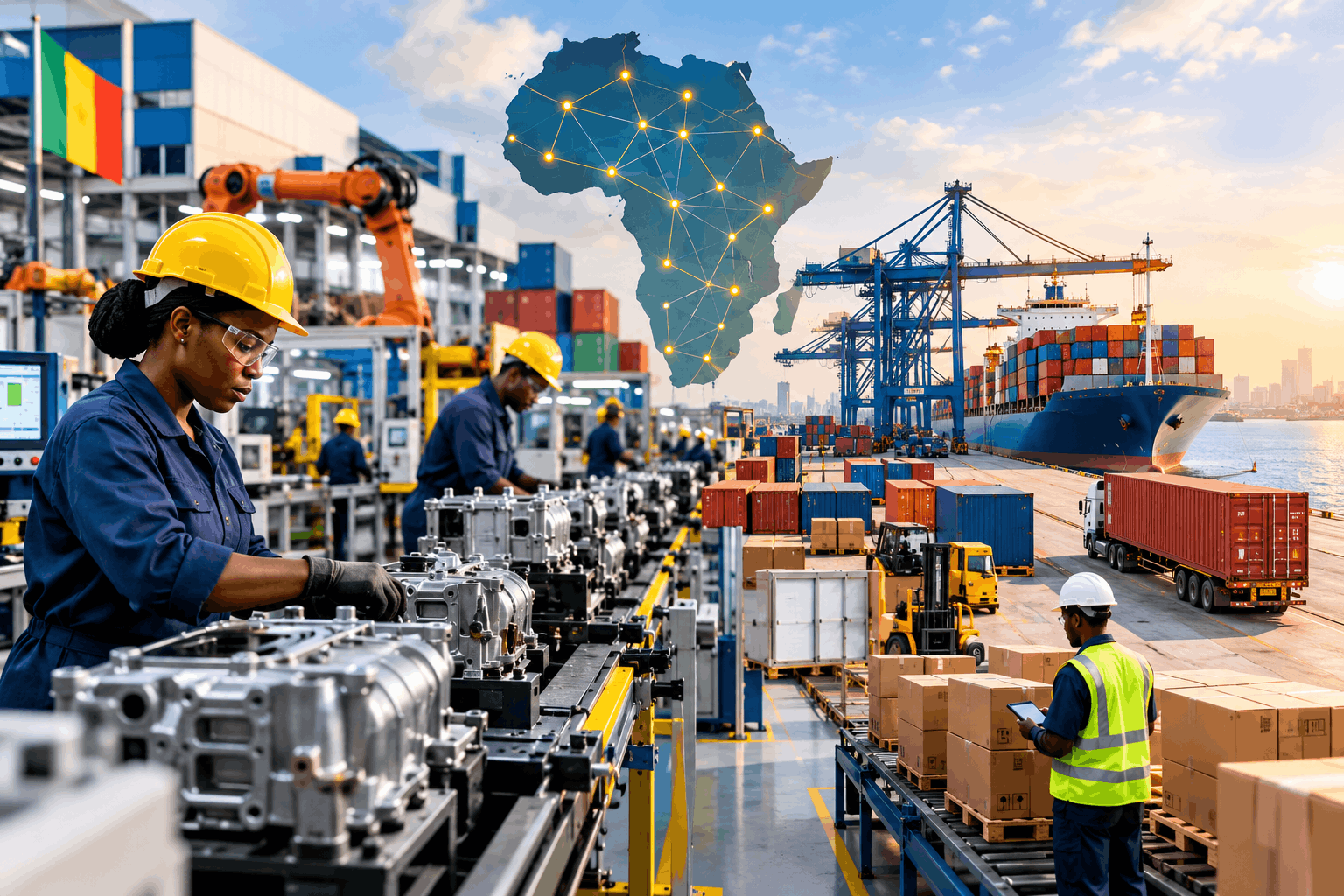
Across the continent, a pattern is beginning to emerge. Rail corridors are connecting mineral belts to ports. New ports are expanding maritime trade. Regional power pools are linking electricity markets. Fibre networks and data centers are extending the digital economy beyond major cities. Individually, these projects solve local problems. Collectively, they begin to resemble the foundations of a more connected African economy.
The Lobito Corridor rail project, backed by international and regional financing, is designed to cut transport times for minerals moving from central Africa's copper belt to the Atlantic coast. The LAPSSET Corridor in East Africa aims to link Kenya, South Sudan and Ethiopia through road, rail, pipeline and port infrastructure. The Grand Ethiopian Renaissance Dam, whatever the regional disputes surrounding it, represents a substantial addition to the continent's hydropower capacity. Regional power pools are gradually allowing countries to trade electricity across borders rather than each depending solely on domestic generation. National fibre backbone projects and a growing number of data centres are extending digital capacity into markets that had little of it a decade ago.
Estimates from the African Development Bank and other institutions suggest Africa needs somewhere in the range of $130 to $170 billion in infrastructure investment annually, with a financing gap that recent assessments place at roughly $68 to $108 billion a year depending on how infrastructure needs are defined. A joint 2025 report from the OECD and the African Union Commission estimated that raising annual infrastructure investment to around $155 billion, from an average of about $83 billion between 2016 and 2020, could accelerate the continent's annual growth by 4.5 percentage points and more than double Africa's GDP by 2040. These are not small numbers, and closing a gap of this size will require governments, development finance institutions and private capital to work in combinations that have not always come together easily in the past. But the direction of travel, and the scale of what is now being planned and financed, is different from a decade ago. These projects are not isolated announcements. Taken together, they represent the early architecture of a more connected continent.
Infrastructure creates possibility, not wealth itself
In this section
Infrastructure rarely receives the attention given to billion-dollar companies or breakthrough technologies.
Every conversation about manufacturing eventually becomes a conversation about electricity. Every conversation about exports eventually becomes a conversation about ports. Every conversation about artificial intelligence eventually becomes a conversation about fibre networks and data centers. Pull on almost any thread of economic transformation for long enough, and it leads back to infrastructure.
Infrastructure rarely receives the attention given to billion-dollar companies or breakthrough technologies. It does not generate the same headlines as a new unicorn or a product launch. Yet we see, across different regions, that almost every economic transformation begins there, quietly, years before the industries it enables become visible.
It is worth being precise about what infrastructure actually does. Roads do not create wealth on their own. Neither do ports, nor electricity grids, nor fibre networks. What they create is possibility: the conditions under which a factory can operate reliably, a farmer can reach a paying market, an exporter can compete on price, and a business can scale beyond its immediate neighborhood. Businesses, entrepreneurs and workers are what turn that possibility into actual growth. Infrastructure does not replace the hard work of building industries. It is simply what makes that work possible in the first place.
Every successful economy has a story about entrepreneurs, inventors and businesses. Beneath each of those stories is another one that receives far less attention: the roads that connected suppliers to customers, the electricity that kept factories running, the ports that linked producers to global markets and the digital networks that connected ideas across continents.
Infrastructure rarely becomes the headline.
It creates the conditions that make every future headline possible.
Roads, ports and electricity powered previous industrial revolutions. Data centres, computing capacity and digital networks are already shaping the one now underway.
In the next article, we explore why Africa's greatest AI opportunity may not lie in using artificial intelligence built elsewhere, but in building the infrastructure, talent and institutions to create it.
Be a part of the conversation by sharing, commenting and subscribing to our newsletter.