Explore Ethiopia's economy and trade, from gold and coffee exports to currency reforms, foreign investment, the Djibouti corridor and opportunities for African businesses.
Gold overtakes coffee as Ethiopia's biggest export
In this section
The increase in gold exports has coincided with major changes to the country's foreign exchange system.
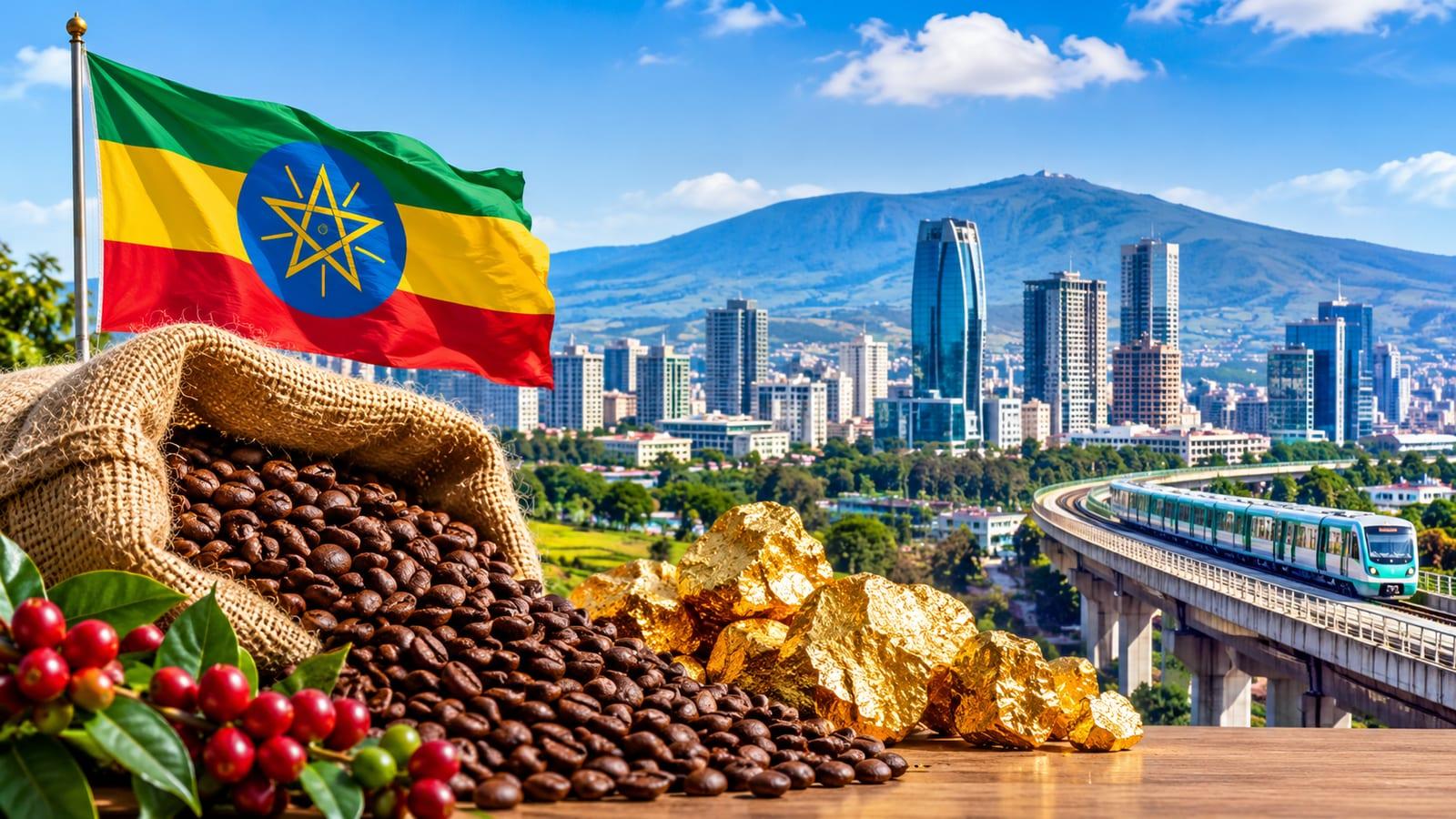
Coffee has been one of Ethiopia's most recognised exports for generations, but gold has taken the lead. In the 2025/26 Ethiopian financial year, which ended in July 2026, the country earned a reported US$5.5 billion from gold exports. Coffee brought in another US$3 billion, according to announcements by the Ethiopian government. Together, the two commodities generated approximately US$8.5 billion.
Ethiopia's total goods export earnings topped US$10.7 billion during the same financial year, according to the Ministry of Trade, compared with US$8.33 billion in 2024/25. Gold and coffee therefore accounted for close to 80% of the country's export earnings. These figures come from government announcements, rather than a published, independently audited breakdown of every export category, but they show how heavily Ethiopia's foreign trade depends on two commodities.
The increase in gold exports has coincided with major changes to the country's foreign exchange system. In July 2024, Ethiopia moved towards a market-based exchange rate, allowing the birr to adjust much more freely against other currencies. Before the reform, the official exchange rate was considerably stronger than the rate available outside the formal banking system. This created difficulties for exporters, importers and businesses trying to obtain foreign currency.
The reform was part of a wider economic programme supported by the International Monetary Fund (IMF), which approved a four-year US$3.4 billion financing arrangement for Ethiopia. It was intended to address foreign currency shortages, improve the country's external accounts, attract investment and reduce distortions in the economy. The changes have improved some areas of economic performance, although they have also made imported goods more expensive and placed pressure on households and businesses.
This is the twenty-first country profile in our series, Africa's Markets, Country by Country, following our side-by-side look at West Africa's 15 economies.
Ethiopia is Africa's second-most populous country, with about 132 million people in 2024, according to the World Bank. The IMF's October 2026 projections put its nominal GDP at approximately US$127.2 billion and forecast economic growth of 9.2% for 2026. Because the birr has lost so much value, Kenya now has the larger economy in dollar terms in the IMF figures, even though Ethiopia's economy is growing faster. These figures place Ethiopia among the continent's larger economies, although the country's low average income, inflation, foreign currency needs and security problems remain significant concerns.
Understanding how Ethiopia earns its money requires looking beyond coffee and gold. Agriculture, manufacturing, aviation, telecommunications, construction, remittances and trade through neighbouring countries all contribute to the economy. The government is also opening sectors that were previously restricted to foreign investors, creating opportunities for businesses willing to understand the country's regulations and operating conditions.
Ethiopia at a glance
Ethiopia's financial year runs from 8 July to 7 July. This means the 2025/26 financial year ended on 7 July 2026. Coffee production statistics, however, are often reported using a separate marketing year, which should not be confused with the country's financial year.
Measure
Figure
Period and source
Population
About 132 million
2024, World Bank
Nominal GDP
US$127.2 billion
2026 projection, IMF October WEO
Real GDP growth
9.2%
2026 projection, IMF
Inflation
15.3%
July 2026, Ethiopian Statistics Service
Food inflation
15.7%
July 2026, Ethiopian Statistics Service
Total goods exports
More than US$10.7 billion
2025/26, Ministry of Trade
Gold export earnings
US$5.5 billion
2025/26, government announcement
Coffee export earnings
Approximately US$3 billion
2025/26, government announcement
Coffee production
11.56 million 60kg bags
2025/26 marketing year, USDA estimate
Foreign direct investment
US$4.32 billion
2025/26, Ethiopian Investment Commission
Gross official reserves
Approximately US$5.86 billion
End of 2025/26 projection, IMF staff report
IMF financing programme
US$3.4 billion
Four-year Extended Credit Facility
Currency
Ethiopian birr
Market-based exchange rate since July 2024
Regional memberships
COMESA, IGAD and BRICS
Ethiopia has also ratified the AfCFTA
The export, investment and macroeconomic figures come from different institutions and reporting periods. They should therefore be read as separate indicators rather than as figures from one consolidated national account.
How Ethiopia's economy is built
In this section
Ethiopia is also an important livestock-producing country, with large cattle, sheep, goat and camel populations.
For much of the past two decades, Ethiopia followed a state-led development model. The government directed large investments towards roads, railways, dams, power generation, industrial parks and other infrastructure. State-owned companies also played major roles in banking, telecommunications, logistics and energy.
The approach helped expand the country's infrastructure and supported years of rapid economic growth. Agriculture remained central to the economy, employing a large share of the population and supplying both domestic consumers and export markets. Smallholder farmers produce teff, wheat, maize, sorghum, pulses, oilseeds and coffee, while livestock farming supports the supply of meat, hides and other animal products.
Ethiopia is also an important livestock-producing country, with large cattle, sheep, goat and camel populations. The sector provides income for farming households and pastoral communities, although limited processing capacity, animal health concerns, transport costs and access to export markets restrict the value the country captures from its livestock.
The state-led model came under increasing pressure as public borrowing grew, foreign currency became scarce and the gap between the official exchange rate and the parallel market widened. Businesses struggled to obtain dollars for imported machinery, fuel, medicine and raw materials. Exporters also had less incentive to bring foreign currency into the banking system when the official rate did not reflect the price available elsewhere.
The situation was made worse by conflict. The war in Tigray began in November 2020 and a cessation of hostilities agreement was signed in Pretoria in November 2022. The conflict caused extensive destruction, displacement and disruption to economic activity. Fighting also affected neighbouring areas, while insecurity in Amhara and Oromia continued to create difficulties for transport, agriculture and investment.
In December 2023, Ethiopia defaulted on a US$1 billion international bond after missing an interest payment. The government subsequently entered negotiations with international creditors to restructure its debt.
The economic reforms that began in 2024
In July 2024, the National Bank of Ethiopia introduced a major foreign exchange reform, moving away from the previous system towards a market-based exchange rate. The birr depreciated sharply as the official rate adjusted, bringing it closer to the rate at which foreign currency had been traded outside the formal banking system.
The government also began implementing wider reforms covering monetary policy, public finances, banking, investment and the management of state-owned enterprises. The IMF approved a four-year US$3.4 billion Extended Credit Facility to support the programme.
The reform has helped improve the availability of foreign currency through formal channels and encouraged exporters to use the banking system. The IMF's July 2026 review projected that gross official reserves would reach about US$5.86 billion by the end of the 2025/26 financial year, equivalent to about 2.1 months of prospective imports. Two years earlier, reserves covered about 0.7 months.
Export performance also improved. Goods exports increased from US$3.8 billion in 2023/24 to US$8.33 billion in 2024/25, according to the Ministry of Finance. The Ministry of Trade then announced goods export earnings of more than US$10.7 billion for 2025/26.
The reforms have not removed Ethiopia's economic difficulties. The depreciation of the birr raised the local cost of imported goods, while the removal of some subsidies and changes to monetary policy have affected household spending and business costs. Inflation, although lower than the levels recorded in 2023 and 2024, increased again during 2026.
The Ethiopian Statistics Service reported year-on-year inflation of 15.3% in July 2026, with food inflation at 15.7%. For households that depend on imported food, fuel, transport and manufactured goods, these increases affect the cost of living. Businesses face similar pressure when they need imported equipment, packaging, fertiliser, fuel or production materials.
Debt restructuring
Ethiopia's debt problems have also shaped its economic reforms. After defaulting on its international bond in December 2023, the government began negotiations with bilateral and commercial creditors.
In June 2026, Ethiopia announced an agreement in principle with holders of its Eurobond. The proposed restructuring involved replacing the outstanding bond with a new US$880 million bond carrying an interest rate of 6.15% and a maturity date of 15 July 2029. The agreement also provided for the payment of missed interest.
The announcement was an important development, but an agreement in principle should not be confused with the completion of every legal and financial step required to implement a restructuring. In August 2026, the Official Creditor Committee found the terms consistent with how official creditors are being treated, which cleared the way to finalise the deal.
Ethiopia has also been negotiating with official creditors, including China and members of the Official Creditor Committee. These negotiations are intended to reduce immediate repayment pressure and make the country's debt obligations more manageable.
The depreciation of the birr has complicated debt management because foreign currency obligations become more expensive when measured in local currency. Even where the government reaches agreements with creditors, it still needs to generate enough foreign currency through exports, investment and other inflows to meet future payments.
What Ethiopia sells, buys and who it trades with
In this section
The country is widely recognised as the birthplace of Arabica coffee and is Africa's largest coffee producer.
Gold
Gold has become Ethiopia's largest merchandise export by value. The government reported earnings of US$5.5 billion from gold exports in 2025/26, a major increase from the previous financial year.
The country's gold sector includes large-scale mining operations as well as smaller miners and informal producers. Changes to the foreign exchange system have improved the financial incentive to sell gold through official channels. This is important because gold that previously moved through informal or smuggling networks does not contribute to recorded export earnings or the formal supply of foreign currency.
International gold prices have also influenced export earnings. When global prices rise, the same quantity of gold can generate more revenue. It would therefore be misleading to attribute the entire increase in Ethiopia's gold earnings to currency reform or changes in local purchasing arrangements.
The United Arab Emirates is an important destination for gold from Ethiopia, although the precise distribution of exports across destination countries should be established using current customs data before assigning individual market shares.
Mining also offers opportunities beyond gold. Ethiopia has deposits of potash, tantalum, iron ore, gemstones, including opals, and natural gas. However, the presence of mineral deposits does not mean that all of them are commercially developed. Exploration, infrastructure, financing, licensing and environmental requirements determine whether these resources can support viable mining operations.
Coffee
Coffee remains one of Ethiopia's most important agricultural exports and a major source of income for farming communities. The country is widely recognised as the birthplace of Arabica coffee and is Africa's largest coffee producer.
The United States Department of Agriculture estimated Ethiopia's 2025/26 coffee production at 11.56 million 60-kilogram bags, equivalent to approximately 694,000 tonnes. This is a production estimate for the coffee marketing year, which begins in October, rather than the Ethiopian financial year.
The government announced coffee export earnings of approximately US$3 billion for 2025/26, following earnings of US$2.65 billion in the previous financial year. Higher international prices, increased production and changes in the foreign exchange system have contributed to the sector's performance.
Coffee is grown across several parts of the country, including Oromia, Sidama and the South Ethiopia region. Smallholder farmers supply much of the crop, which passes through washing stations, cooperatives, processors and exporters before reaching international buyers.
Ethiopia exports both washed and naturally processed coffee. Its coffee varieties and regional origins are valued in international specialty markets, although most export earnings still come from beans rather than finished consumer products.
There is room for greater domestic processing, roasting, packaging and brand development. Ethiopian businesses could capture more value by selling finished coffee products instead of relying mainly on green bean exports. African importers, distributors and coffee companies can also explore supply arrangements with Ethiopian producers and exporters.
Other agricultural exports
Agriculture provides Ethiopia with several other export products, including sesame, pulses, oilseeds, cut flowers, fruits, vegetables, livestock and meat.
Sesame is an important export crop, while pulses and oilseeds supply buyers in international food and processing markets. The horticulture sector includes flowers grown for export, with the Netherlands serving as an important European trading and distribution centre.
Ethiopia also exports live animals and meat products, particularly to markets in the Middle East. However, the livestock trade faces challenges involving animal health certification, processing facilities, cold storage, transport and compliance with destination-market requirements.
The country has opportunities to increase earnings from these products by investing in processing, packaging, storage and reliable supply chains. For example, exporting processed meat can allow businesses to capture more value than selling live animals, provided that they meet the health and quality standards of their target markets.
Manufacturing and industrial exports
Ethiopia has spent years developing industrial parks to attract manufacturers, particularly in textiles, garments, footwear and leather products. The government offered investors access to industrial infrastructure, relatively low labour costs and electricity generated largely from hydropower.
Industrial parks such as Hawassa were developed to support export-oriented manufacturing and attract international companies looking for production locations in Africa.
The sector has faced difficulties, including foreign currency shortages, supply-chain problems, conflict and the loss of preferential access to the United States under the African Growth and Opportunity Act (AGOA). Ethiopia lost AGOA eligibility in January 2022 amid concerns over human rights violations during the Tigray conflict and remains suspended as of November 2026. The US extension of the programme in 2026 did not restore Ethiopia's eligibility.
This loss affected the competitiveness of Ethiopian textile and garment manufacturers that had relied on preferential access to the US market. Manufacturers now have to consider other export destinations and trade arrangements, including the European Union, regional African markets and other international buyers.
Manufacturing remains an important part of Ethiopia's development plans, but its contribution to export earnings is still relatively small compared with gold and coffee. The country's ability to expand the sector will depend on reliable electricity, access to imported inputs, transport costs, investment conditions and the availability of foreign currency.
Services, aviation and remittances
Ethiopia earns foreign currency through services as well as merchandise exports. Ethiopian Airlines is one of the country's most important service exporters and a major international business in its own right.
Based in Addis Ababa, the airline connects African cities with destinations in Europe, Asia, the Middle East and the Americas. Its passenger, cargo, maintenance and training operations contribute to the country's aviation industry and support other businesses, including hotels, logistics companies, tourism operators and suppliers.
The airline's cargo services are particularly relevant to agricultural exports. Flowers, vegetables, meat and other time-sensitive products can be transported to international markets by air, allowing exporters to serve buyers that require regular deliveries.
Remittances from Ethiopians living abroad also provide foreign currency to households and the wider economy. These transfers help families pay for food, education, housing, healthcare and other expenses. They can also support savings and small business activity.
The National Bank of Ethiopia's foreign exchange reforms have sought to encourage more remittance transfers through formal channels. However, remittances should be distinguished from export earnings because they are transfers from individuals abroad rather than payments for goods or services sold by Ethiopian businesses.
Foreign direct investment is another important source of external financing. The Ethiopian Investment Commission reported that the country attracted US$4.32 billion in FDI during 2025/26, an increase of 8% from the previous financial year. It also reported issuing 528 new investment licences.
These figures indicate investment commitments and inflows reported by the Commission, but a licence does not necessarily mean that a project has been completed or has begun commercial operations. Investors need to assess the status of individual projects rather than treating every announced investment as productive capacity already in place.
What Ethiopia imports
Ethiopia imports considerably more goods than it exports, creating continued demand for foreign currency.
Major imports include petroleum products, fertiliser, wheat, edible oils, machinery, vehicles, electrical equipment, pharmaceuticals, steel and construction materials. These products support agriculture, manufacturing, transport, healthcare and infrastructure development.
China is an important supplier of manufactured goods, machinery, equipment and industrial inputs. India, Turkey, Saudi Arabia, the United Arab Emirates and other trading partners also supply goods to the Ethiopian market.
The country's import requirements create opportunities for foreign manufacturers and distributors, particularly in sectors where local production cannot meet demand. However, businesses exporting to Ethiopia need to understand customs procedures, product registration requirements, foreign exchange arrangements and payment risks.
The cost of importing goods is also affected by the birr's exchange rate. A product that becomes more expensive in local currency may be difficult for customers to afford, even when there is demand for it.
Trade agreements and how goods move
In this section
Ethiopia also has access to the European Union's Everything But Arms arrangement as a least developed country.
Regional and international trade arrangements
Ethiopia belongs to the Common Market for Eastern and Southern Africa (COMESA) and the Intergovernmental Authority on Development (IGAD). It is also a member of BRICS, having joined the grouping in January 2024.
The country has ratified the African Continental Free Trade Area (AfCFTA), which is intended to expand trade between African countries by reducing tariffs and addressing other barriers to cross-border commerce.
However, ratification does not mean that every product traded by Ethiopia automatically receives preferential treatment in every African market. Businesses must check the relevant tariff schedules, rules of origin, customs procedures and the implementation status of the agreement for the products and countries involved.
Ethiopia is a member of COMESA but does not participate in the bloc's Free Trade Area. Under its current arrangement, qualifying trade can receive a 10% tariff reduction, provided that traders satisfy the relevant rules of origin. This is different from the duty-free access available to participants in the COMESA Free Trade Area.
For African businesses, this distinction is important when calculating the cost of exporting products into Ethiopia or sourcing goods from Ethiopian suppliers.
Ethiopia also has access to the European Union's Everything But Arms arrangement as a least developed country. This provides eligible products with duty-free and quota-free access to the EU market, subject to the programme's rules and product requirements.
Ethiopia's dependence on Djibouti
Ethiopia became landlocked when Eritrea gained independence in 1993. Since then, the Port of Djibouti has served as the country's main international maritime gateway.
More than 90% of Ethiopia's external trade has historically moved through the Djibouti corridor. This makes the port, the roads connecting it to Addis Ababa and the railway linking the two countries important parts of the Ethiopian economy.
The Addis Ababa to Djibouti railway began commercial transport services in January 2018. It provides an alternative to road freight for moving goods between Ethiopia's capital and the port, although road transport continues to carry a substantial share of cargo.
Dependence on one major corridor creates risks for Ethiopian importers and exporters. Port charges, customs procedures, road conditions, fuel prices, transport delays and regional disruptions can affect the cost and timing of shipments.
For a manufacturer importing machinery or raw materials, delays at the port can interrupt production. For an exporter of agricultural goods, additional transport time can affect product quality and delivery commitments.
The Ethiopian government has therefore explored alternative access arrangements involving Berbera in Somaliland, Port Sudan and Lamu in Kenya.
In January 2024, Ethiopia signed a memorandum of understanding with Somaliland concerning sea access and other arrangements. The agreement caused a diplomatic dispute with Somalia, which considers Somaliland part of its territory.
In December 2024, Ethiopia and Somalia signed the Ankara Declaration, facilitated by Türkiye. The declaration established a framework for negotiations on Ethiopia's access to the sea through commercial arrangements under Somalia's sovereign authority. It did not itself grant Ethiopia a port or naval base.
Alternative routes could give Ethiopia greater flexibility in the future, but their commercial value depends on infrastructure, political agreements, security, customs arrangements and the cost of moving goods. Djibouti remains the country's principal trade corridor.
Roads, railways and air cargo
Ethiopia has invested heavily in roads, railways and other transport infrastructure over the past two decades. Addis Ababa is connected to regional cities and trading centres through an expanding road network, although road quality and transport reliability vary across the country.
Ethiopian Airlines also provides an important link between domestic producers and international markets. Its cargo operations support exports of flowers, vegetables, meat and other products that require fast delivery.
The government has announced plans for a new international airport at Bishoftu, south-east of Addis Ababa. The proposed project is intended to expand the country's aviation capacity and support the airline's longer-term growth. It should be understood as a planned development rather than an airport already available to businesses.
Sectors with room to grow and doing business in Ethiopia
In this section
The Grand Ethiopian Renaissance Dam (GERD), built on the Blue Nile, is Africa's largest hydropower project.
Agro-processing
Ethiopia produces substantial quantities of coffee, sesame, pulses, livestock, cereals, fruits and vegetables. Much of the country's agricultural output is still sold with limited processing, which reduces the amount of value retained by local producers and businesses.
There are opportunities in coffee roasting and packaging, oilseed processing, flour production, meat processing, leather manufacturing, food preservation and cold-chain logistics.
The domestic market is also significant. A population of more than 130 million creates demand for packaged food, household goods, beverages and other consumer products. Businesses that can produce competitively priced goods locally may be able to serve customers while reducing dependence on imported finished products.
However, agricultural processing requires more than access to raw materials. Reliable electricity, water, storage, packaging, transport, quality control and working capital are all important to operating a commercially viable business.
Manufacturing and industrial parks
Ethiopia's industrial parks were developed to attract manufacturers and increase the country's share of processed exports. Hawassa Industrial Park is among the best-known examples, with a focus on textiles and garments.
The country has advantages that may appeal to manufacturers, including a large workforce, hydropower resources and access to regional markets. However, businesses must also consider the cost of importing machinery and production materials, access to foreign currency, labour availability, transport infrastructure and the status of trade preferences in their intended export markets.
African manufacturers considering Ethiopia should examine whether producing locally would be more competitive than importing finished products. They should also assess the possibility of using Ethiopia as a production base for supplying other African markets under applicable AfCFTA arrangements.
Energy
The Grand Ethiopian Renaissance Dam (GERD), built on the Blue Nile, is Africa's largest hydropower project. Ethiopia inaugurated the dam in September 2025 after years of construction.
The project is expected to increase the country's electricity generation capacity and support domestic industrial development. Ethiopia already exports electricity to neighbouring countries, including Djibouti, Sudan and Kenya, through regional power connections.
The expansion of generation capacity creates opportunities in energy-intensive industries, manufacturing, transmission infrastructure and electricity distribution. It also offers potential for regional electricity trade.
However, installed generation capacity does not automatically mean that every business or household has reliable access to electricity. Transmission lines, distribution networks, maintenance, financing and the location of industrial activity all influence the availability of power.
Rural electrification and off-grid energy systems remain important areas for investment, particularly in communities that are not adequately served by the national grid.
Finance, telecommunications and digital services
Ethiopia's financial and telecommunications sectors were historically protected from substantial foreign competition. Recent policy changes have begun to open these markets.
In March 2025, Ethiopia adopted Banking Business Proclamation No. 1360/2025, allowing foreign banks to enter the market through approved subsidiaries, branches, representative offices or investments in domestic banks. Foreign ownership is subject to limits and regulatory approval.
The reform creates opportunities for international and African financial institutions interested in serving businesses, households and investors in Ethiopia. Potential areas include corporate banking, trade finance, payments, foreign exchange services and financial technology.
The Ethiopian Securities Exchange also began trading in July 2025, providing a regulated platform for securities trading and a potential source of capital for businesses.
Telecommunications has undergone changes as well. Safaricom Ethiopia began commercial operations in 2022, ending the long-standing position of Ethio Telecom as the country's only mobile network operator.
Mobile financial services have also expanded. Ethio Telecom operates Telebirr, while Safaricom offers M-Pesa services. These platforms provide payment and financial services to customers and businesses, although the regulatory environment and market structure continue to influence how providers can operate.
For African fintech companies, the market is worth studying, particularly in business payments, merchant services, digital financial infrastructure and services for customers who remain underserved by traditional banking.
Mining
Gold is currently Ethiopia's most valuable mineral export, but the country's mineral resources extend beyond the metal.
Potash, tantalum, iron ore, gemstones and natural gas are among the resources identified in different parts of the country. Potash is particularly relevant because of its potential use in fertiliser production, while gemstones such as Ethiopian opals already have established international recognition.
Developing these resources requires exploration, geological information, financing, transport infrastructure, technical capacity and appropriate environmental safeguards. Companies considering mining investment should also examine licensing requirements and the security situation in the specific region where a project is located.
The existence of a mineral deposit should not be confused with an established commercial mining operation. Some resources remain at the exploration or development stage.
Entering the Ethiopian market
Foreign investors considering Ethiopia generally work with the Ethiopian Investment Commission and the relevant government regulators. The country's investment framework has changed in recent years, with additional sectors opened to foreign participation.
However, not every activity is available to foreign investors on the same terms. Some sectors remain reserved for Ethiopian nationals, while others have minimum capital requirements, ownership restrictions or licensing conditions.
Businesses should confirm the current rules before committing capital, particularly in retail, wholesale trade, financial services, telecommunications and other regulated sectors.
The main practical considerations include:
Foreign currency: The 2024 reforms improved the formal foreign exchange system, but businesses still need to plan for currency movements, payment arrangements and the cost of imported inputs.
Inflation: Rising prices can affect wages, rent, transport, stock replacement and the cost of operating a business.
Import procedures: Companies importing machinery, raw materials or finished products need to understand customs requirements, documentation and applicable product standards.
Transport: Moving goods through Djibouti adds costs and makes delivery schedules dependent on the port and connecting road or railway networks.
Licensing: Investment approval, sector-specific licences and regulatory requirements vary according to the proposed activity.
Security: Conditions differ across Ethiopia. Businesses need current information about the location where they intend to operate, including road access and the possibility of disruption.
Local partnerships: Working with experienced local professionals, suppliers, distributors and advisers can help foreign businesses understand regulations and establish commercial relationships.
Amharic is the federal working language and an important language for government and domestic business. English is used in many international business settings, particularly in Addis Ababa, but companies should not assume that every supplier, customer or government office operates in English.
Risks and trade-offs
In this section
Companies that depend on imported materials or equipment may need to revise their prices and budgets regularly.
Ethiopia offers a large domestic market and several expanding industries, but businesses need to understand the risks before entering.
Inflation and currency movements
The birr's move towards a market-based exchange rate changed the cost of importing goods and servicing foreign currency obligations. Although the reform helped address distortions in the previous system, the depreciation also increased the local price of imported products.
Inflation remained a concern in July 2026, when annual consumer price inflation reached 15.3%. Companies that depend on imported materials or equipment may need to revise their prices and budgets regularly.
Conflict and political uncertainty
Security conditions remain a major concern. The conflict in Tigray that began in 2020 formally entered a cessation of hostilities agreement in November 2022, but disputes over its implementation continued.
Renewed fighting in 2026 has further weakened the agreement. Reports from October and November describe fresh clashes and changing territorial control in parts of Tigray. Conflict in Amhara and Oromia also continues to affect movement, commercial activity and investment in some areas.
The wider Horn of Africa presents additional political and security concerns, including tensions involving Eritrea and disagreements over access to the sea.
Businesses should assess security conditions at the regional and local levels rather than treating Ethiopia as one uniform operating environment.
Dependence on gold and coffee
Gold and coffee accounted for close to 80% of the country's reported goods export earnings in 2025/26. This concentration exposes Ethiopia's foreign currency earnings to changes in international commodity prices, production conditions and demand from overseas buyers.
A fall in gold prices or a poor coffee harvest could affect export revenue and the availability of foreign currency. Expanding manufacturing, agricultural processing and other service exports would help reduce this dependence over time.
Debt and public finances
Debt restructuring has reduced some immediate repayment pressure, but Ethiopia still needs to manage its external obligations and finance infrastructure, public services and development programmes.
The government must also balance the cost of economic reforms with the need to protect households facing higher living costs. If inflation remains high or foreign currency shortages return, businesses may face renewed pressure.
Jobs and household incomes
Ethiopia's population creates a large potential workforce and consumer market, but the number of people seeking employment is also substantial. Economic growth needs to generate enough productive jobs to improve household incomes and support domestic demand.
Businesses considering Ethiopia should therefore examine the purchasing power of their intended customers, not rely on population size alone when estimating market potential.
What Ethiopia means for African businesses
In this section
Agricultural businesses can explore partnerships with Ethiopian coffee, sesame, livestock and horticultural producers.
Ethiopia is one of the continent's largest consumer markets by population, and recent reforms have opened parts of its economy to new forms of investment and competition. For African companies, there are opportunities in financial services, manufacturing, food processing, logistics, energy, telecommunications and the supply of imported goods.
Kenyan and other African financial institutions may examine the banking reforms and assess whether they can serve Ethiopian companies engaged in domestic and international trade. Fintech businesses can investigate payment infrastructure, merchant services and financial products for customers who have limited access to traditional banking.
Manufacturers in countries such as Kenya, South Africa, Nigeria and Egypt can assess opportunities to supply machinery, pharmaceuticals, food products, building materials and household goods. However, they need to compare the costs of exporting finished products with the possibility of establishing local production or distribution arrangements.
Agricultural businesses can explore partnerships with Ethiopian coffee, sesame, livestock and horticultural producers. There is also room for investment in storage, processing, packaging and transport services that help producers meet the requirements of international buyers.
Logistics companies should pay close attention to the Djibouti corridor, which remains central to Ethiopia's international trade. The country's dependence on this route creates demand for freight services, warehousing, customs support and supply-chain management.
The AfCFTA may offer additional opportunities as implementation progresses, but companies must check the applicable tariff concessions and rules of origin for their products rather than assuming that ratification guarantees duty-free access.
Ethiopia is not a market where businesses should make decisions based on population figures or government investment announcements alone. The exchange rate, import requirements, security conditions, payment systems, customer purchasing power and availability of local partners all affect the commercial case for entering the country.
Companies that take the time to understand these conditions will be better placed to identify where demand exists, how goods and services can reach customers, and what it will cost to operate.
The next profile in the East Africa stage of Africa's Markets, Country by Country, is Sudan, where the war that began in April 2023 has severely damaged the economy and disrupted trade, agriculture and public services.