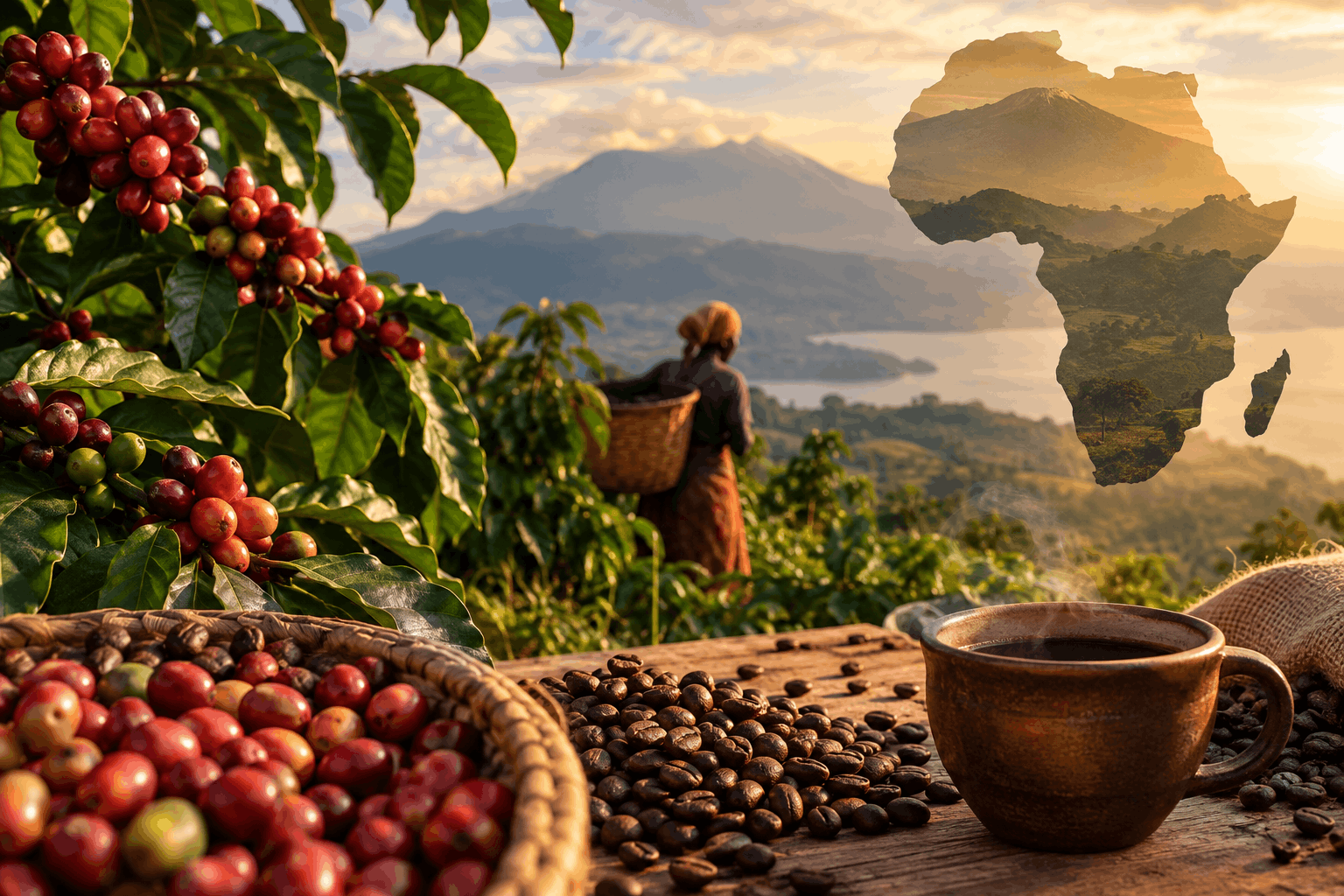
Africa is coffee’s birthplace, yet much of its crop leaves as green beans. Explore African coffee production, trade, processing, health, regulation and value.
On a Friday at the end of September 2022, a consignment of coffee left Rwanda on a RwandAir flight bound for Accra, the capital of Ghana. By the standards of the coffee trade, it was tiny. What made it news was the paperwork. The Rwandan Ministry of Trade announced that it had issued the country's first certificate of origin under the African Continental Free Trade Area, known as the AfCFTA, to a women-led firm called Igire Coffee. A certificate of origin is a document proving where goods were produced, and under a free trade agreement it is what lets a shipment claim lower import taxes. The coffee had been collected from women's cooperatives, processed in Rwanda and sold to an African buyer.
The founder of Igire explained why the shipment mattered to her. Western companies, she said, were used to buying a kilogram of Rwandan coffee for a few dollars. She wanted the trade to start flowing between African countries instead.
That a shipment of coffee from one African country to another was still notable tells you something about the continent's relationship with this crop. Coffee began in Africa. Africa still grows enough of it to export well over a million tonnes a year. Yet most of it leaves the continent as raw green beans, and most Africans drink little of it. This article explains how that situation came about, what is being done about it, and what the rules and numbers look like today.
How to read the numbers in this article. It separates three kinds of information: current statistics (mostly from the International Coffee Organization, or ICO, the intergovernmental body that collects world coffee data), historical research (especially a 2017 study by the African Development Bank, or AfDB), and our own calculations, which are labelled. Where sources disagree, or where we could not find a figure, we say so.
Where coffee comes from
In this section
In dry or natural processing, whole cherries are dried before the dried fruit is removed from the beans.
A hybrid that arose in Ethiopian forests
The coffee most of the world drinks includes a species called Coffea arabica, and its evolutionary home is Ethiopia. Scientists describe Ethiopia as arabica's centre of origin: the place where the species evolved in the wild. A 2024 study in the journal Nature Genetics sequenced 39 arabica varieties, including an 18th-century herbarium specimen, and confirmed that arabica is an allotetraploid hybrid formed from Coffea canephora (robusta) and Coffea eugenioides. The study dates the founding polyploidy event to hundreds of thousands of years ago, long before humans began cultivating coffee. Some public summaries give a wider estimate for the evolutionary history of the species, but the safest formulation is that arabica's origin predates agriculture by a very long period.
That history left arabica with unusually low genetic diversity. The species passed through several population bottlenecks, meaning periods when only relatively small numbers of plants survived and reproduced. Low genetic diversity can leave a crop more exposed when a disease, pest or climate stress affects the conditions in which it grows. Ethiopia's wild and traditionally cultivated arabica therefore matters not only as a historical source of coffee, but also as a reservoir of genetic material that breeders may need as growing conditions change.
Yemen, the doorway
Ethiopia is where arabica evolved, but Yemen became the crucial early centre from which cultivated arabica spread beyond its original range. Genetic research identifies Yemen as a secondary dispersal centre: almost all arabica grown outside Ethiopia descends from early Yemeni coffee populations. From Yemen, coffee plants were later carried to India, Indonesia, the Caribbean and Latin America.
The movement out of Ethiopia also narrowed the genetic pool. Ethiopia retains far more arabica diversity than the populations that descended from the early Yemeni farms, which is one reason Ethiopian coffee forests and traditional growing areas are treated as important genetic resources for future breeding.
The history of drinking coffee is different from the history of the plant itself. The earliest well-documented evidence of coffee being prepared as a beverage dates to Yemen in the 15th century, where it became associated with Sufi communities that used it to stay awake during night worship. The popular story of an Ethiopian goatherd named Kaldi noticing that his goats became lively after eating coffee berries is a legend, not a documented event.
The two coffees that matter
Africa produces both of the world's two main commercial coffee species.
Arabica generally grows best at higher elevations and in cooler conditions. It is often described as more delicate or complex in flavour and usually commands higher prices than conventional robusta. In Africa it is dominant in Ethiopia, Kenya, Rwanda, Burundi, Tanzania, Malawi, Zambia and Zimbabwe, and it is also grown in Uganda and Cameroon. These country descriptions should not be read as current species percentages because the detailed FAO country profiles used for some of them are based on older data.
Robusta, or Coffea canephora, is also African in origin. It is native to parts of West and Central Africa and has important wild populations and genetic diversity in Uganda. It generally tolerates warmer, lower-altitude conditions better than arabica, contains more caffeine and is widely used in instant coffee and espresso blends. In Africa it is especially important in countries including Uganda, Côte d'Ivoire, Cameroon and the Central African Republic.
In the AfDB's 2017 review, the global export mix used for its analysis was roughly 60 percent arabica and 40 percent robusta. That is a historical reference point, not a current annual species split.
From cherry to bag: why processing matters
Coffee beans are the seeds inside a small red fruit called a coffee cherry. Turning cherries into a product that can be stored and traded involves processing, and the method affects the flavour, cost and infrastructure required.
In wet processing, also called washed processing, the fruit is removed from the coffee seed, the beans are fermented for a period and then washed and dried. It generally requires more equipment, water and labour and is associated with cleaner, brighter cup profiles. FAO's historical country profile, for example, records Burundi's arabica as entirely wet-processed.
In dry or natural processing, whole cherries are dried before the dried fruit is removed from the beans. The method can require less machinery and water but needs careful drying conditions. It is associated with fuller or fruitier flavour profiles and is widely used in Ethiopia and for robusta in parts of Africa.
After processing, coffee is usually exported as green coffee, meaning dried but unroasted beans. The standard statistical unit is the 60-kilogram bag, which is why international coffee reports often quote exports in millions of bags. Roasting, grinding, packaging and branding generally take place after the green coffee has left the producing country, although African roasters and exporters are increasingly trying to capture more of those activities at home.
What coffee does to the body
In this section
Decaf is not chemically identical to regular coffee, however, and it still contains a small amount of caffeine.
For decades coffee was treated with suspicion, partly because early studies did not always separate coffee consumption from other behaviours that affect health. Larger observational studies and reviews have since produced a more favourable picture for most healthy adults, but the evidence needs to be read carefully.
Frank Hu of the Harvard T.H. Chan School of Public Health has said that moderate coffee drinking, roughly two to five cups a day, is associated with a lower likelihood of several conditions, including type 2 diabetes, cardiovascular disease, liver and endometrial cancers, Parkinson's disease and depression. The key word is associated. Much of the evidence is observational, meaning researchers follow groups of people and compare outcomes rather than randomly assigning people to drink coffee. That can identify patterns, but it cannot by itself prove that coffee caused the difference.
A major umbrella review published in the BMJ found that the strongest associations with lower risk for several outcomes generally appeared around three to four cups a day, while also stressing that the evidence does not establish cause and effect. Evidence is particularly consistent for some liver outcomes and type 2 diabetes, while evidence for cardiovascular disease, stroke and neurological outcomes is more mixed. The International Agency for Research on Cancer has also concluded that coffee is not classifiable as carcinogenic to humans and has reported evidence of lower risks for some cancers, particularly liver and endometrial cancer.
Coffee contains hundreds of compounds. Chlorogenic acids are among its important polyphenolic compounds. Cafestol and kahweol are diterpenes found in coffee oils and have been studied for biological effects, but they should not be presented as a simple explanation for coffee's health associations. In particular, cafestol can raise LDL cholesterol, especially when coffee is consumed unfiltered. Brewing methods such as paper-filtered coffee remove much of these compounds. Some associations have also been observed among people drinking decaffeinated coffee, which suggests that caffeine is not the only component involved. Decaf is not chemically identical to regular coffee, however, and it still contains a small amount of caffeine.
A few practical limits apply. The US Food and Drug Administration cites up to about 400 milligrams of caffeine a day as an amount not generally associated with negative effects for most healthy adults. That is a caffeine limit, not a cup limit: the amount in a cup varies widely according to the bean, brewing method and serving size. During pregnancy, the American College of Obstetricians and Gynecologists advises limiting caffeine to less than 200 milligrams a day. People who take regular medication should check with a doctor or pharmacist if they are concerned about an interaction, because caffeine and coffee can affect some medicines differently.
The evidence on coffee should also not be transferred automatically to every coffee-based drink. Sugar, cream, syrups and other additions can substantially change the nutritional profile and calorie content of a drink. That does not mean they literally erase the associations seen in studies of coffee consumption, but it does mean that a large sweetened coffee should not be treated as nutritionally equivalent to plain coffee.
This matters beyond personal health. In its review of a five-year programme to raise coffee drinking in 15 African countries, the ICO listed negative public perceptions about coffee and health as one of the obstacles to growing local demand. The programme therefore funded awareness activities, including workshops and a documentary, to address those perceptions.
Africa's coffee today
In this section
By the 2010s those shares had fallen to roughly 10 to 11 percent of production and about 8 percent of exports.
The size of the industry
Coffee grows in about 25 African countries, according to the sector literature used by the AfDB and the Inter-African Coffee Organisation (IACO), the continent's coffee producers' body. Smallholders, meaning farmers working small plots, usually of a hectare or less, produced close to 95 percent of Africa's coffee according to the AfDB's 2017 study. That structure matters. When prices fall or a disease spreads, the losses fall on millions of households, not a few large estates.
In the 2024/25 coffee year (which runs from October to September), African countries exported 19.69 million bags, about 1.18 million tonnes. That was 18.6 percent more than the year before and the first time African shipments passed a million tonnes, according to ICO data reported by Ecofin Agency. African production rose 7.6 percent to 22.78 million bags.
Two countries account for most of it. Uganda exported about 495,600 tonnes and Ethiopia about 442,200 tonnes, together nearly 80 percent of the continent's total. Tanzania ranks third. Even so, Africa accounted for about 14.2 percent of global coffee exports in 2024/25. In other words, roughly one in seven exported bags came from Africa. The 11 percent figure that appears elsewhere in the coffee debate is usually a production-share baseline used by the G25, not the 2024/25 export share.
Why 2024/25 was so strong, and why it did not last
It would be easy to read the record as evidence of surging worldwide demand for African coffee. The ICO's own explanation is more modest. For Uganda and Ethiopia in particular, it pointed to a good harvest, high international prices and "front-loading", meaning exporters shipping earlier than usual to take advantage of high prices. Ethiopia was also in the "on" year of a two-year cycle in which arabica trees alternate between heavier and lighter harvests. Arabica prices in New York had risen about 51 percent year on year by the end of September 2025. High prices make farmers more willing to harvest and sell, and buyers more willing to purchase early.
Those conditions did not last. ICO figures for May 2026 showed African exports down by about a quarter on May 2025, which had been a record month for both Uganda and Ethiopia, so part of the fall is the comparison with an unusually high base. A year of bumper exports followed by a year of decline is normal for a crop that depends on weather, cycles and prices. It is also a reminder that a single year is a poor guide to a trend.
The long slide before the rebound
The more important story is the long decline that came first. In the 1970s Africa produced about 27 percent of the world's coffee and, in 1974, around 35 percent of world coffee exports. By the 2010s those shares had fallen to roughly 10 to 11 percent of production and about 8 percent of exports. The AfDB study explains why this happened, and the explanation is the key to everything that follows. It is covered in the section on why Africa earns so little from its coffee, below.
Counting the people involved
Estimates of how many people depend on coffee vary widely. The AfDB study reported that close to a quarter of Ethiopia's population drew a livelihood from coffee production, marketing and export, and that in Uganda about half a million smallholders grow coffee, with some 2.5 million people (8 percent of the population) relying on it as their main income. More recent Ethiopian figures range from more than six million smallholders to more than 20 million farmers. The sources do not use identical definitions (households versus individuals, growers versus everyone in the chain), so these numbers should not be compared directly.
The main producing countries
In this section
Côte d'Ivoire's coffee output collapsed during the civil conflict of the late 1990s and has recovered only partly.
The table summarises what each country is known for. The coffee-type descriptions combine older FAO country profiles, which rest on production data from the late 1990s, with more recent sources. Treat them as general character, not as current percentages. Production volumes change every season, so check the latest ICO Coffee Market Report for up-to-date figures.
Country
Main type
What stands out
Ethiopia
Arabica
Origin of the species; a record of about US$2.65 billion to US$2.7 billion in coffee exports in 2024/25; large domestic consumption
Uganda
Robusta and arabica
Africa's largest exporter by volume in 2024/25
Tanzania
About 70% arabica, 30% robusta
Regional and online auctions, with direct-export routes also available; production-growth target for 2030
Kenya
Overwhelmingly arabica
Coffee Act 2026 now governs the sector
Rwanda
Washed arabica
Quality-focused, washing-station model
Burundi
About 93% arabica
Entirely wet-processed arabica
Côte d'Ivoire
Robusta
Once Africa's coffee giant; still below its 1980s output
Ethiopia combines the oldest coffee culture with Africa's second-largest export volume. Its coffee exports earned a record of roughly US$2.65 billion in 2024/25 according to Addis Fortune, and the Ministry of Agriculture reported about US$2.7 billion for the fiscal year. Unlike most African producers, Ethiopia also drinks a great deal of its own crop. In 2019, the head of the national Coffee and Tea Authority said about 53 percent of production was consumed at home. The ICO's later survey of 15 African countries measured Ethiopian consumption at 2.2 kilograms per person per year, the highest in the group.
Uganda
Uganda overtook Ethiopia as the continent's biggest exporter by volume in 2024/25, and in May 2025 it briefly led in a single month by shipping 47,606 tonnes against Ethiopia's 43,481 tonnes and earning about US$243.9 million. Uganda's own coffee authority reported that farmers received roughly 70 percent of the export price for robusta and 80 percent for arabica. That is a government agency's figure rather than an independent measure, but it is notably higher than the AfDB's 2017 estimate for African producers generally (see below).
Tanzania, Kenya, Rwanda and Burundi
Tanzania produces 30,000 to 40,000 tonnes a year, around 70 percent of it arabica. Kenya's output slid from an average of about 1.5 million bags a year between 1970 and 2000 to 756,000 bags by 2013/14, as many growers switched to other crops. Rwanda's coffee sector grew out of the arrival of the crop under German colonial rule in 1904 and today is built around washing stations, the small processing plants where farmers deliver cherries. An International Growth Centre study found that only about 30 percent of Rwandan coffee was fully washed at export at the time of the research, while washing stations ran at barely more than half capacity, and estimated that doubling the fully washed share could raise export revenue by 10 to 20 percent. Burundi grows almost entirely arabica and uses the wet method for all of it.
Côte d'Ivoire, Cameroon and the rest
Côte d'Ivoire's coffee output collapsed during the civil conflict of the late 1990s and has recovered only partly. Angola, once among Africa's top five producers in the early 1970s, saw coffee overshadowed by oil, and its output fell below 1 percent of its earlier level. That is a textbook case of what economists call "Dutch disease": when one export boom, here oil, raises a country's exchange rate and makes every other export, including coffee, too expensive to compete.
Why Africa earns so little from its coffee
In this section
The findings below are the study's, based on data up to the mid-2010s, so they describe the situation then and not today.
The 1989 turning point
To understand Africa's coffee decline, start with 1989. For roughly two decades before that, producing and consuming countries had operated under the International Coffee Agreement, which gave each exporting country a quota, a fixed limit on how much it could sell abroad. Because supply was held back, prices stayed relatively high. The agreement's quota system collapsed in 1989 and prices dropped sharply. They fell to about 45 cents a pound in 2001, the lowest in four decades. At the same time, Vietnam was using irrigation, fertiliser and credit to expand production at extraordinary speed, flooding the market.
African earnings from coffee fell from about US$3.5 billion in 1977 to a low of about US$0.5 billion in 2002.
What the AfDB found
In 2017 the AfDB's agriculture department published Africa's Coffee Sector: Status, Challenges and Opportunities for Growth, the most detailed continental analysis to date. Its central question was whether Africa's decline was caused mainly by outside forces, such as low world prices, or by problems at home. By comparing six major African exporters with Asian and Latin American competitors who faced the same prices but kept growing, it concluded that domestic problems were more important. The findings below are the study's, based on data up to the mid-2010s, so they describe the situation then and not today.
Low yields. African coffee yields were at least 50 percent below the world average, and in some countries the gap reached sixfold.
Old trees. In most coffee-growing African countries the average tree was more than 30 years old. Uganda's farmers often worked with trees around 40 years old, and some about 70. Replacing a tree means going without income from it for about three years while its successor matures, and few smallholders can afford that gap without credit, which banks were reluctant to offer.
Disease. Coffee wilt disease cost poor Ugandan households an estimated US$580 million in lost income between 1997 and 2007.
Thin advice for farmers. In the Ugandan fieldwork, there was roughly one agricultural extension officer per coffee district, which the study put at around 200,000 farmers per officer. (Extension officers are government advisers who teach farmers better techniques.)
A weak position in the price chain. The study estimated that coffee producers received only 15 to 18 percent of the retail price, and that African farm-gate prices averaged about 55 percent of the export price, compared with more than 85 percent in Vietnam and Brazil. "Farm-gate" means the price paid to the farmer, and the export price here is the "FOB" price, short for "free on board": the price of the coffee loaded onto the ship, before freight and insurance.
Why would that low farm price slow production? The AfDB's analysis points to a cycle. Low prices leave little money for fertiliser or new trees, so yields stay low; low yields keep incomes low, which makes coffee unattractive to young people, so the farmers get older and the trees get older. The study called it a vicious cycle of low yield.
The missing processing step
The second structural problem is that Africa sells the least valuable form of coffee. The AfDB found that, at the time of its analysis, Africa accounted for about 2 percent of the world's instant coffee production and 8 percent of roast-and-ground coffee. More recent statements by officials and by an International Trade Centre report cited in the press tell the same story: over 90 percent of African and East African coffee is exported as green beans. President Samia Suluhu Hassan of Tanzania put the value of Africa's coffee exports at about US$2.5 billion a year, a small part of a global trade she put at about US$500 billion.
A caution on those headline figures. IACO has cited a global coffee market of about US$460 billion, of which producing countries collectively earn about US$25 billion and Africa about US$2.4 billion. The "market" figure includes retail and café sales, so it is not comparable with the value of green-bean exports. Both are real numbers, but they measure different things.
Who captures the value
Most of the price of a cup is added after the coffee arrives in the consuming country: roasting, packaging, branding, distribution and the café itself. The AfDB study noted that the roasting and retail ends of the market are concentrated in a few large firms, which gives them pricing power that millions of dispersed farmers lack. Governments of importing countries also collect taxes on coffee that, by one estimate the AfDB cited, are roughly equivalent to the export earnings of producing countries.
At the 2026 Marrakech forum, discussed below, organisers argued that Africa captures less than 10 percent of the coffee industry's final value. That is an advocacy figure from the organisers, measured differently from the AfDB's price-chain estimate, and the two should not be treated as the same statistic.
How much coffee moves within Africa?
In this section
At the third G25 African Coffee Summit in Dar es Salaam in February 2025, leaders adopted the Dar es Salaam Declaration.
There is no agreed, independently reproducible continental figure for the share of African coffee that is traded between African countries. That is the honest starting point, and it is why you will see different numbers quoted.
What the data show
The best verifiable evidence comes from an ICO review of a domestic-consumption programme in 15 countries (Cameroon, Central African Republic, DR Congo, Côte d'Ivoire, Ethiopia, Gabon, Ghana, Guinea, Kenya, Nigeria, Rwanda, Tanzania, Togo, Uganda and Zambia). For 2022/23 it recorded:
production: 17.2 million bags
exports: 13.3 million bags
imports: 718,988 bags
home consumption: 5.4 million bags, an average of 0.3 kilograms per person.
From these figures we calculate that imports were about 5.4 percent of exports and that home consumption was about 31 percent of production. Those calculations apply only to this 15-country group, not to Africa as a whole, and they are our arithmetic, not the ICO's. The consumption figure is also heavily shaped by Ethiopia.
A second data point comes from Uganda. In June 2021 the Uganda Coffee Development Authority reported that African countries took 109,506 bags, or 21 percent of Uganda's exports that month, with Algeria, Sudan, Morocco, Tunisia, South Africa, Tanzania, Egypt and Kenya among the African buyers. Europe took 65 percent, with Italy alone at 40 percent. This is one month for one country. It shows what intra-African trade can look like for one exporter; it is not a continental average.
Ethiopia sits at the other end of the spectrum. In 2019 the head of its Coffee and Tea Authority said value-added coffee made up less than 2 percent of exports and that almost all exports went outside Africa.
The 15 percent baseline
At the third G25 African Coffee Summit in Dar es Salaam in February 2025, leaders adopted the Dar es Salaam Declaration. (The "G25" is the group of 25 coffee-producing African countries.) Among its targets was raising trade in coffee among African nations from 15 percent to at least 50 percent by 2030. The same declaration set a goal of lifting Africa's share of global production from 11 to 20 percent by 2030, and of having at least half of Africa's coffee processed on the continent by 2035. The summit also announced that Ethiopia will host the fourth summit in 2027 to assess progress.
The 15 percent figure should therefore be treated as a policy baseline, not as a continent-wide trade statistic with a fully transparent methodology. The public summit material does not make clear whether it is a percentage of volume or value, green beans only or all coffee products, or exactly which countries are included. It differs from the 5.4 percent import ratio above because that calculation uses a defined 15-country sample and compares imports with exports. The two figures should not be substituted for one another.
Why trade between neighbours is so low
Several explanations are offered, and they reinforce one another. Most African roasters buy beans the way global traders do, by price and consistency, and many roasters have historically bought from Asia or Latin America. Egypt, one of the continent's larger coffee markets, has been reported to buy most of its coffee from South-East Asia; an Egyptian official quoted by The Niles attributed that to flavour and preference, while analysts point to trade finance, logistics and marketing. Packaging is another obstacle. The ICO's 15-country review noted that most packaging materials are imported from China, India, Turkey, the United States and Europe, which raises the cost for local roasters.
For context, and not as a coffee statistic, only about 14.4 percent of all African exports of goods stay on the continent, according to figures attributed to UNCTAD in an opinion article by the former Botswana trade minister Bogolo Kenewendo. Coffee's low regional share is part of a wider pattern.
Why demand may be about to grow
The same ICO review identified opportunities: people aged 15 to 34 make up about a third of the population of the surveyed countries, cities are growing, middle-class incomes are rising, and small local roasters and branded cafés are multiplying. The ICO's Special Fund gave US$454,021 to IACO to run the programme from 2019 to 2023, and its work has continued under an IACO initiative called "Drink African Coffee, Build Africa" (DACBA). Tanzania, for its part, has set a goal of raising local consumption from 7 percent to 15 percent by 2030 (the source does not say 7 percent of what).
How exporting works, and who regulates it
In this section
The Act transferred the functions previously assigned to the UCDA to the Ministry responsible for agriculture.
One rule: there is no continental rulebook
No single set of rules governs exporting coffee from one African country to another. Each producing country regulates coffee through its own law and its own agency, and those rules apply whether the buyer is in Milan or Accra. What a regional or continental trade agreement adds is a lower or zero import tax in the buyer's country, which is claimed using a certificate of origin like the one issued to Igire Coffee. The AfCFTA is the framework meant to do this across the continent, and its secretariat has signed a memorandum of understanding with IACO to support the coffee value chain. An African Union official said at the 2025 G25 summit that coffee would soon be recognised as a strategic commodity within the AfCFTA, a statement of intention and not an enacted rule.
What follows describes the national rules in five countries with well-documented systems. The regulatory picture changed in Uganda and Kenya within the last two years, and we flag where details are still unclear.
Uganda: a regulator that has been absorbed
Uganda's National Coffee Act, No. 17 of 2021, was designed to regulate the whole coffee chain. It required free registration of farmers and the registration and licensing of everyone else in the chain, from nursery operators and buyers to processors, roasters, warehouses and exporters. It barred anyone from running a coffee business without the relevant licence, and it required warehouses storing coffee for export to sign an agreement with the regulator. The regulator then was the Uganda Coffee Development Authority (UCDA), which also certified exports and tracked coffee for traceability.
That arrangement has now changed. Parliament passed the National Coffee (Amendment) Bill in November 2024, and the National Coffee (Amendment) Act, 2025 was subsequently enacted. The Act transferred the functions previously assigned to the UCDA to the Ministry responsible for agriculture.
The government argued it would cut costs under a programme to streamline state agencies; many MPs and industry groups warned the ministry lacked capacity, and Parliament asked the minister to report twice a year on whether the ministry was ready. In October 2024 the Ministry had already launched a national registration programme for coffee value-chain actors, partly to prepare for the European Union's deforestation rules (see below).
What this means for an exporter: licences and certificates that were once issued by UCDA now come from the ministry. Anyone relying on older guides, including the International Trade Centre's 2021 Coffee Export Procedures Guide for Uganda, should confirm the current office and forms.
Ethiopia: from a central exchange to a licensed direct trade
For years Ethiopian law required most coffee to be sold through the Ethiopia Commodity Exchange (ECX), a government-supervised marketplace where coffee is graded, weighed and traded. Proclamation No. 1051 of 2017 made buying or selling coffee outside the exchange or other approved channels an offence, and required exporters to register with the National Bank of Ethiopia and report their export contracts.
Since then the rules have loosened in some ways and tightened in others. Suppliers may now deliver coffee directly to exporters, bypassing the exchange floor, with authorisation from the Ethiopian Coffee and Tea Authority (ECTA); this "vertical integration" accounted for over half of the coffee shipped in the year reported in early 2026. In September 2023, ECTA allowed all grades of coffee to be exported, ending a rule that had limited exports to the top grades.
A later directive, No. 1106 of 2025, raised the bar for exporters. Private exporters must now hold a minimum capital of 15 million birr (up from 1 million), operate certified testing laboratories, and employ licensed "cuppers", the tasters who grade coffee, each of whom may work for only one exporter. The authority has also targeted "export diversion", where coffee bought at export grade is rerouted to the domestic market: in 2023/24 it seized 775 tonnes worth about 100 million birr.
Kenya: the Coffee Act 2026
Kenya's coffee sector is now governed by the Coffee Act, 2026, Act No. 8 of 2026. The Act was assented to on 13 March 2026 and commenced on 27 March 2026. It establishes the Coffee Board of Kenya and the Coffee Research and Training Institute and sets out a new licensing and regulatory framework for the industry.
The Act permits coffee to be traded through the auction system, direct sales and an international exchange, among other approved routes. For exports, it requires documentation including a phytosanitary certificate, notification or registration of the direct-sales contract where applicable, a certificate of origin, a certificate of quality and other approvals required by the Board. The new law supersedes the earlier framework built on the 2013 Crops Act and the 2019 coffee regulations. Older material from the Agriculture and Food Authority can still be useful for understanding the transition, but it should not be presented as the current legal framework.
Tanzania: auctions, regional markets and direct export
Tanzania's Coffee Industry Act of 2001 and its regulations give the Tanzania Coffee Board (TCB) power to license exporters, and coffee cannot be exported without the relevant Board licence. The auction system remains important, but it is no longer accurate to describe the entire market as a single weekly Moshi auction. Tanzania has introduced regional auction sites and online auction arrangements, while direct export is also permitted when the Board's conditions are met.
The ICO's description of the Tanzanian system records a mix of central and regional auctions, cooperative marketing and direct export. Exporters can also hold separate licences for different forms of coffee, including green, roasted and ground and instant coffee. Older accounts of a 1 percent levy and specific cooperative-delivery requirements should be treated as historical unless confirmed against the current TCB requirements. The important point for an exporter is that the TCB remains the licensing authority and the route to export depends on the type of coffee and the applicable marketing channel.
Rwanda: a licence plus three documents
Rwanda's process is one of the simplest to follow. An exporter needs a coffee export licence from the National Agricultural Export Development Board (NAEB). NAEB then tests the coffee and issues a certificate of quality, which states its type and grade, and a certificate of origin; a phytosanitary certificate (a plant-health document) comes from Rwanda's agricultural inspection service, and the shipment is cleared through an online export declaration with the Rwanda Revenue Authority.
Selling to Europe: the deforestation rules
Whatever the rules at home, coffee sold into the European Union (the EU) faces a new regulation on deforestation. The EU Deforestation Regulation, or EUDR, requires that coffee, cocoa, soy, palm oil and several other commodities placed on the EU market were not grown on land deforested after 31 December 2020, and were produced legally. Companies must prove it by supplying the geographic coordinates of the plots where the coffee grew and filing a due-diligence statement.
As of 1 October 2026, the European Commission's current timetable applies the EUDR from 30 December 2026 to large and medium operators and from 30 June 2027 to micro and small operators, subject to the specific transitional provisions in the regulation. Coffee must be produced legally and must not have been produced on land deforested or degraded in breach of the regulation's cut-off requirements. Geolocation data for the plots are part of the due-diligence system.
The responsibility is not shared equally across every actor in the chain. Under the revised framework, the first operator placing a relevant product on the EU market has the due-diligence responsibility for the required statement, while suppliers outside the EU may need to provide the information and traceability data that the operator needs to complete that process. A 2026 delegated measure also brings soluble coffee within the relevant EUDR product scope from 30 December 2027. The dates and requirements should therefore be checked against the European Commission's live implementation guidance when an exporter is preparing an actual shipment.
For African smallholders the difficulty is practical. Proving where coffee grew requires mapping thousands of tiny plots, and many farmers lack formal land titles or digital records. Reporting on the 2025 delay described it as breathing space for African exporters, not a retreat. Uganda's registration programme and Kenya's first EUDR-compliant shipment to Poland are examples of early preparation.
What the African Development Bank has done
In this section
The facility was proposed through IACO, with the ICO and the agricultural research body CABI, to channel investment into African coffee.
The AfDB's role in coffee is real but narrower than people often assume, so it helps to separate what is documented from what is not.
The documented record. The Bank's agriculture department commissioned the 2017 study discussed above. Its preface states that, under the Bank's Feed Africa strategy, coffee was among the strategic commodities selected for support, and acknowledges that the Bank's support for coffee until then had been limited. The study's final section proposed where the Bank could help: strengthening coffee research institutes and extension services; short- and medium-term credit, including loans to build small washing stations and fertiliser credit; irrigation; helping farmers form or strengthen cooperatives (groups that give smallholders collective bargaining power and easier access to loans); a traceability system that rewards quality; and measures on climate, gender and youth. The argument was that combining these would give a "big push" to break the low-yield cycle.
At country level, the Bank's then-president Akinwumi Adesina said it would support agricultural value chains in Côte d'Ivoire, including coffee and cocoa, as part of a portfolio of about US$2.7 billion in that country. Analysts have also named the AfDB, alongside Afreximbank and the African Union's development agency, among institutions that should coordinate on cross-border infrastructure supporting intra-African trade.
What we could not find. We did not identify a dedicated, continent-wide AfDB coffee financing facility with published amounts, and we did not find the AfDB named as a funder of the Africa Coffee Facility. That is a statement about what our search found, not proof that none exists. The AfDB's online project portal, searchable by country and crop, is the right place to look for coffee-related operations approved after 2017, which we did not review.
The Africa Coffee Facility. The facility was proposed through IACO, with the ICO and the agricultural research body CABI, to channel investment into African coffee. An ICO document describes a ten-year facility with a five-year financing target, of which the first component, building a sustainable supply chain, would take 80 percent, or US$120 million. A news report on its 2019 launch gave a headline figure of US$950 million and a goal of raising high-quality exports by 40 percent to a value of US$5 billion a year. The two figures describe different things or different horizons, and we could not reconcile them without the underlying financing documents.
New efforts to change the picture
In this section
Uganda's President Museveni made the argument at an earlier G25 summit that African countries must process raw materials to capture value.
A hub in Morocco. On 5 and 6 May 2026 a regional forum in Marrakech brought together African governments and business to discuss the coffee value chain. Reports differ on the details: Morocco World News counted eight countries signing the first agreements, while Barista Magazine's account lists nine, a list that includes Morocco itself alongside Cameroon, Côte d'Ivoire, Guinea, Madagascar, Nigeria, Sierra Leone, Togo and Uganda. The agreements cover post-harvest handling, quality control, traceability, aggregation, logistics, branding and market access. The concept is that Morocco, which does not grow coffee, would host an "African Coffee Hub" that sorts, blends and quality-tests African beans for export. A pan-African coffee centre of this kind has been launched at the Tangier Med port complex, according to the trade magazine Global Coffee Report. It is a proposed model for the region's supply chain, not yet an established continental system. Organisers also cited statistics, including that Africa produces close to 15 percent of the world's coffee and supports about 100 million people, which should be read as the organisers' claims; they conflict with the ICO-based production share of about 11 percent used elsewhere in this article.
Continental recognition. The 2025 summit announced that IACO had been formally integrated into the African Union as a specialised agency, which gives it a formal channel to speak for producers. African ministers also argued that the African Union, through IACO, should be part of negotiations when the EU changes rules that affect coffee.
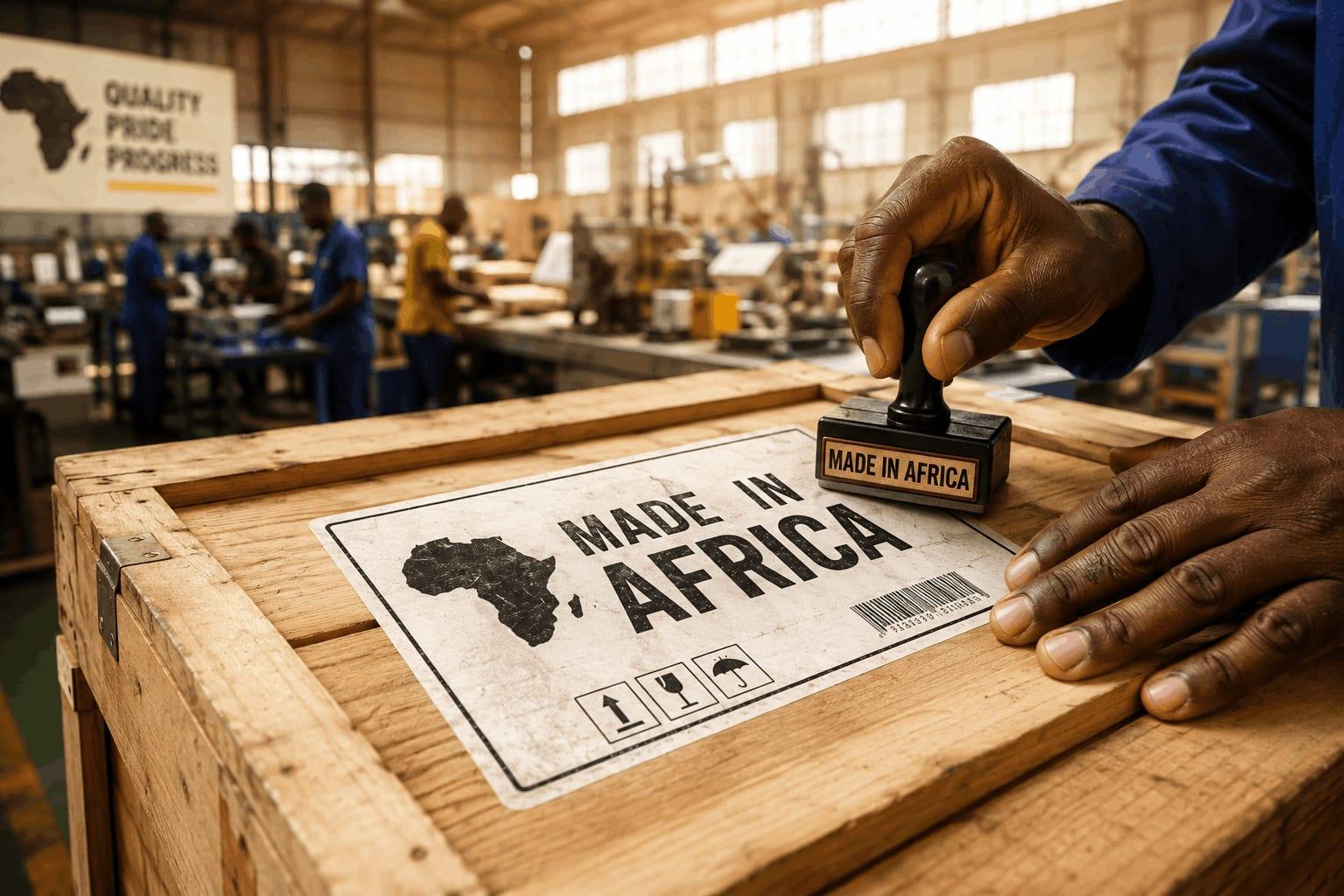
Value addition and local demand. Both the processing target for 2035 and the consumption targets described earlier aim at the same thing: keeping more of the price of a cup inside Africa. Uganda's President Museveni made the argument at an earlier G25 summit that African countries must process raw materials to capture value.
What would have to change, and what is already moving
In this section
Meeting the EUDR requires farm-level mapping that, once built, could serve every buyer.
The sources reviewed here describe the same chain of problems and point to the same chain of remedies.
Yields and trees. The AfDB's analysis suggests the most basic gap is on the farm. Faster research on disease-resistant and drought-tolerant varieties, enough extension officers to reach farmers, and loans that let farmers replace old trees without losing years of income would all raise output per hectare.
Money. Credit is a recurring obstacle. In Vietnam, a state development bank lent heavily to coffee farmers and froze repayments for up to three years when prices collapsed; the AfDB contrasts this with African banks that see coffee lending as risky.
Processing and branding. Washing stations, roasteries and local brands add value at home. Rwanda's washed-coffee experience shows both the gain and the difficulty: processing raises export income, but washing stations need working capital and reliable supplies of cherries to run at capacity.
Regional demand and trade rules. Growing coffee-drinking cultures, cheaper local packaging, and the tariff cuts and simplified paperwork promised by the AfCFTA could make selling to a neighbour as easy as selling to Europe.
Compliance. Meeting the EUDR requires farm-level mapping that, once built, could serve every buyer.
None of these is new. What has changed is that governments, regional bodies and exporters are now pursuing several at once and have put numbers on their goals. Whether the numbers are met will be visible by 2030.
Back to Accra
The Rwandan shipment that left in September 2022 was a pilot, one of a handful of trial consignments under the AfCFTA's "Guided Trade Initiative", which tested whether the new system worked in practice with a small group of countries. Whether coffee will become a regular African trade, with exporters in Kigali or Kampala selling roasted, packaged coffee to cafés in Accra, Lagos or Cairo, depends on matters this article has described: the price of fertiliser, the regulator's paperwork, the packaging supplier, the loan officer, the certificate of origin and the cup.
The evidence suggests Africa is better placed than it was twenty years ago. Export volumes have set records. The continent's coffee countries now have shared targets. But as 2025/26 showed, a good harvest and high prices can lift exports in one year and fall away in the next, and the structural problems the AfDB identified have not disappeared. On International Coffee Day, the most useful way to hold both facts is this: the crop that began in Ethiopian forests has been grown for the world for centuries, and the question now is how much of it Africa will roast, sell and drink for itself.