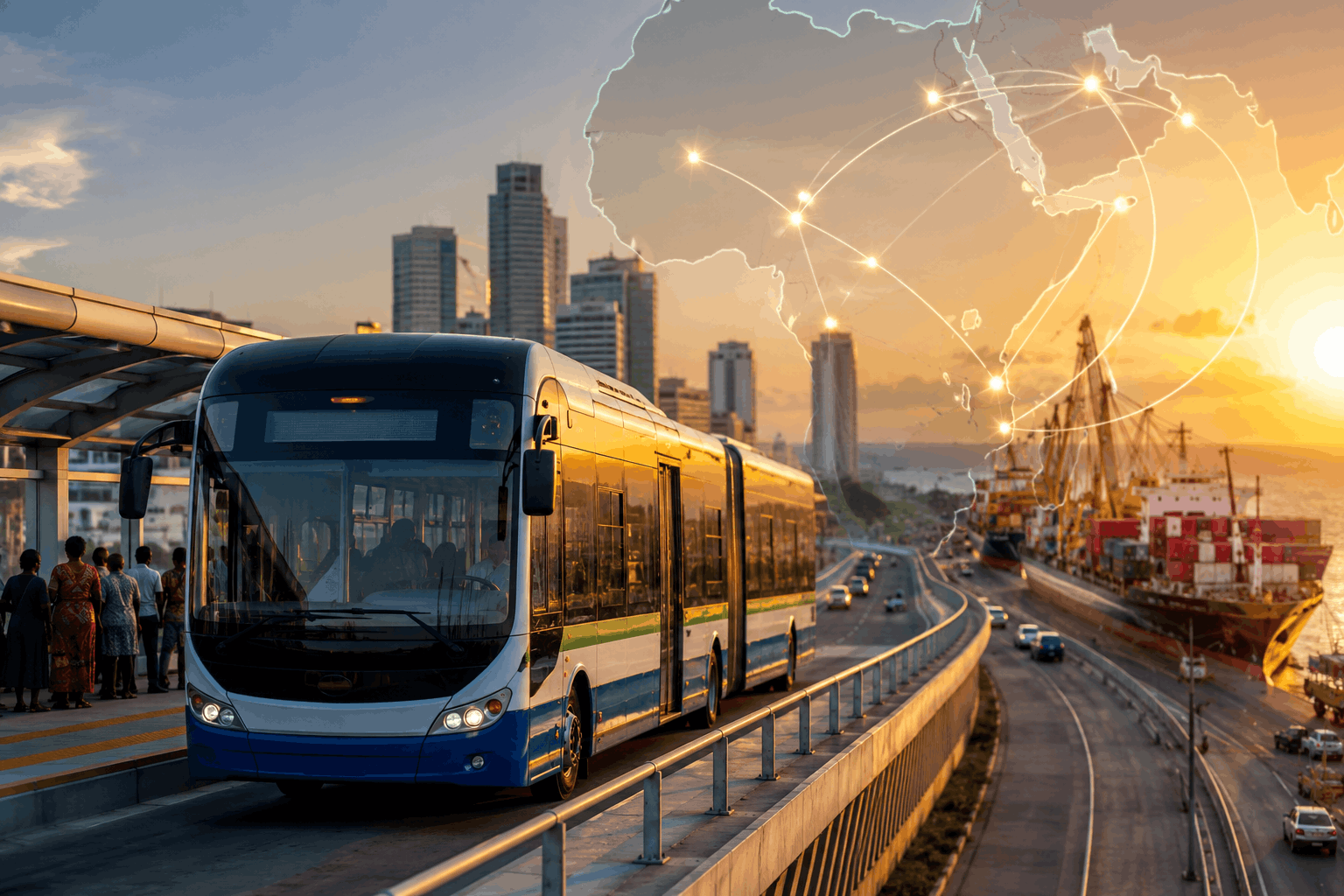
Every few months, a headline appears predicting that Africa will define the global economy in the decades ahead. The reasons are usually the same; Africa has the world's youngest population. Its cities are growing quickly. Mobile technology is spreading. A continent-wide free trade area is beginning to take shape.
These are all great developments. But they are often presented as though they automatically lead to economic growth, and they do not.
A larger population does not guarantee a larger economy. More cities do not automatically create wealth. Better internet access does not always produce better jobs. Even a free trade agreement cannot transform an economy if businesses still struggle to move goods, invest confidently, or find skilled workers.
There's a deeper question we are yet to ask and hold ourselves accountable to. The question is;
What would actually need to happen for Africa's economy to look very different by 2050?
To answer this question accurately, we'll need to understand how economies create value. Population, cities, trade and technology all matter, but they matter because they affect one underlying measure: productivity.
Economists use the term to describe how much value each worker produces. Countries become wealthier over time not simply because more people are working, but because each worker is able to produce more goods, provide more services or solve more complex problems than before.
Viewed this way, many of the biggest conversations about Africa's future would have a better forward moving perspective.
Population growth determines how many people could work.
Urbanization shapes where they live and do business.
Trade influences the size of the markets they can serve.
Digital technology changes how efficiently they can work.
None of these factors creates wealth on its own. But when combined, they influence whether the productivity of a nation, people, youths rises or falls. By 2050, Africa will almost certainly be one of the world's most important economic regions by size of workforce. Whether it also becomes one of the world's most productive is a different question entirely.
Understanding that difference is our goal today.
A continent with more workers than ever before
One of the trends shaping Africa's future is also one of the easiest to measure. The continent's working-age population is expected to grow rapidly over the next few decades. According to the World Bank, Sub-Saharan Africa alone is projected to add more than 620 million working-age people by 2050, the largest increase recorded in any region of the world. While many countries in Europe and East Asia are preparing for ageing populations and shrinking labor forces, much of Africa will be experiencing the opposite. This is often described as a demographic dividend.
The idea is simple. When a country has a larger share of people who are old enough to work, and a smaller share of dependents, its economy has the potential to grow more quickly. More people can earn incomes, produce goods and services, pay taxes and support investment.
The important word, however, is potential.
Wealth within a nation is not created by population growth alone. It only exists if those additional workers are able to find productive work. This is where the conversation becomes more interesting.
Every year, an estimated 10 to 12 million young Africans enter the labor market, yet only around three million new formal wage jobs are created across the continent. The gap does not mean the remaining workers do nothing. Most find work in farming, informal retail, transport, construction or small family businesses. These activities provide livelihoods for millions of people, but they often generate lower and less predictable or stable incomes than formal employment.
The challenge, then, is not simply creating jobs. It is creating jobs that allow workers to become more productive over time.
Imagine two countries with the same number of workers. One has reliable electricity, efficient transport networks, access to finance and businesses that invest in modern equipment. The other struggles with power shortages, poor roads and limited access to capital. Even if both countries have identical populations, the first will almost certainly produce more economic value because each worker has better tools and better conditions in which to work.
This is why economists usually think about growth as the combination of three things:
labor,
investment
and productivity.
A growing workforce increases an economy's capacity, but investment and productivity determine how much of that capacity is actually maximized to become profitable.
Africa's expanding labor force should therefore be seen as an economic input rather than an economic outcome. It increases the continent's potential. Whether that potential becomes higher incomes depends on everything built around those workers, including education, infrastructure, access to finance, business investment and the quality of public institutions.
The structure of employment also matters.
According to the International Labour Organization, about 83 percent of employment across Africa is informal, rising to around 85 percent in Sub-Saharan Africa. Informal businesses play a vital role in supporting livelihoods, especially where formal employment opportunities are limited. However, they are often smaller, and less able to access credit or invest in expansion.
As economies develop, productivity usually rises not because informal work disappears, but because more workers move into businesses that can grow, invest and compete more effectively. That shift allows wages or salaries to increase, tax revenues to expand and businesses to reinvest in future growth.
Seen this way, we'd realize that Africa's growing workforce is neither an economic guarantee nor an economic problem. It is simply one part of a much larger equation. By itself, population growth changes very little. What matters is whether each new worker can create more value than the one before.
Where Those Workers Will Live and Why It Matters
A growing workforce tells us how many people could contribute to an economy. It does not tell us where that work will happen. That is where urbanization becomes important.
Africa is expected to become far more urban over the coming decades. According to OECD projections, the continent's urban population could almost double, growing from around 700 million people today to about 1.4 billion by 2050. By then, roughly six out of every ten Africans are expected to live in towns and cities.
This change is often used as a tell tale prophecy of Africa's economic rise. But, like population growth, urbanization is not valuable on its own. Its economic importance lies in what cities make possible.
People living close together change the way economies function.
A farmer in a rural community may travel long distances to reach customers, suppliers or financial services. A business in a city can often reach all three within a few kilometers. Transport costs fall. Businesses can serve larger markets. Workers have more employment options. Companies can specialize because there are enough customers to support niche products and services.
Economists call these agglomeration effects. When people and businesses cluster together, they usually become more productive.
This is one reason why the world's largest economies are also highly urbanized. Cities concentrate skills, investment, infrastructure and ideas in ways that are much harder to achieve when populations are widely dispersed. The benefits extend beyond individual businesses.
A city with millions of residents can often justify investments in airports, ports, rail systems, broadband networks and public transport because enough people use them. Universities, hospitals, research centers and financial institutions also become easier to sustain when there is a large population nearby.
These investments, in turn, make the city more attractive to businesses, creating a cycle where economic activity reinforces itself. That does not mean every growing city automatically becomes more productive.
Urbanization creates opportunities, but it also creates demands.
Housing must keep pace with population growth. Roads need to accommodate more vehicles. Water systems, electricity networks and waste management services all require continuous investment. If infrastructure expands more slowly than the population, congestion increases, transport becomes less reliable and businesses face higher operating costs.
In other words, cities can become engines of productivity or centers of inefficiency. The difference often comes down to planning and investment rather than population size.
Research by the OECD shows that urban land across Africa has been expanding faster than urban populations. Instead of becoming denser, many cities are spreading outward. This pattern, often called urban sprawl, makes it more expensive to provide roads, electricity, water and public transport because infrastructure must cover much larger areas while serving relatively fewer people.
For businesses, these costs are not theoretical, they are REAL. A delivery company spends more time reaching customers. Manufacturers pay more to transport goods. Workers spend longer commuting instead of producing. Governments must stretch limited budgets across larger areas rather than improving services within existing neighborhoods.
The result? Cities become bigger without necessarily becoming more productive.
This is why urbanization should not be measured only by the number of people living in cities. The more important question is whether cities make it easier for people and businesses to create value. This question should also change how we think about employment.
As cities grow, their economies usually become more diverse. Manufacturing may expand, but so can sectors such as logistics, finance, healthcare, tourism, education, software development, business services and renewable energy. Different countries will develop different strengths depending on their resources, institutions and investment climate.
What these industries have in common is not the products they make. It is that they depend on workers with the right skills, businesses willing to invest and infrastructure that allows them to operate efficiently.
Education therefore becomes part of the urbanization story.
Getting more children into school is an important achievement, but enrolment alone is not enough. Economic growth depends on what students learn and whether those skills match the needs of growing industries. A larger urban workforce creates opportunities only if businesses can find employees with the knowledge and technical skills they require.
By 2050, Africa's cities will almost certainly be much larger than they are today.
Whether they become centers of innovation, manufacturing, services and entrepreneurship, or places where infrastructure struggles to keep pace with demand, will depend less on how quickly they grow than on how well that growth is managed.
Population growth increases the number of people who can work.
Urbanization shapes the environment in which that work happens.
The next question is "would those workers and businesses will be able to serve markets beyond their own cities and countries?' This is where trade begins to matter.
Trade Within Africa Is About More Than Tariffs
As Africa's cities grow, businesses gain access to larger local markets. The next step is making it easier for those businesses to reach customers beyond their own borders. That is the idea behind the African Continental Free Trade Area, better known as AfCFTA.
When it is fully implemented, AfCFTA will connect 54 countries, a market of more than 1.3 billion people and a combined GDP of roughly US$3.4 trillion, making it the world's largest free trade area by the number of participating countries.
These numbers are impressive, but they do not explain why the agreement matters economically.
Most people hear the words "free trade agreement" and immediately think about tariffs. It is a reasonable assumption because tariffs, which are taxes placed on imported goods, have traditionally been one of the biggest barriers to international trade.
In Africa, however, tariffs are only part of the picture. For many businesses, the greater challenge has never been the tax paid at the border. It has been everything that happens before and after.
A shipment travelling between two neighboring countries may face long delays at border crossings. Businesses often deal with different customs procedures, separate product standards, inconsistent paperwork requirements and regulatory systems that do not easily recognize one another. Each delay increases costs. Each additional document takes time. Each uncertainty makes trade more difficult.
These are known as non-tariff barriers, and they can be far more expensive than tariffs themselves.
Imagine a manufacturer producing packaged food in Ghana that wants to sell in Côte d'Ivoire, or a pharmaceutical company in Kenya looking to supply hospitals in Uganda. Even if import duties are low, delays at border posts, repeated inspections or conflicting regulations can make regional trade slower and more expensive than importing from outside the continent.
This is one reason why trade within Africa has historically remained low compared with other regions of the world.
According to the World Bank, the greatest economic gains from AfCFTA are expected to come not from reducing tariffs but from making trade easier.
Its 2020 analysis estimated that full implementation of AfCFTA could increase regional income by about 7 percent, equivalent to around US$450 billion by 2035, while helping lift approximately 30 million people out of extreme poverty. More importantly, the study found that nearly two-thirds of those projected gains would come from improvements in trade facilitation, including faster customs procedures, simpler regulations and lower administrative costs, rather than tariff reductions alone.
That finding changes the way the agreement should be understood.
AfCFTA is not simply about allowing goods to cross borders more cheaply. It is about reducing the friction that prevents businesses from expanding across the continent.
Lower trade costs have effects that extend well beyond exporters.
When businesses can serve larger markets, they often have more capital to invest in new equipment, improve production processes and hire more workers. Larger markets also encourage competition, which can lead to better products, lower prices and greater innovation.
A company that only serves customers in one city has limited room to grow. A company that can confidently reach customers across several countries can justify much larger investments.
That relationship between market size and investment has shaped the development of many successful economies around the world.
It is also why trade matters for productivity.
If businesses can sell to more customers without facing unnecessary delays or excessive administrative costs, they are more likely to expand production, adopt better technology and employ more specialized workers. Those improvements allow each worker to produce more value, which is ultimately what drives long-term economic growth.
Trade agreements establish rules, but rules alone do not move goods across borders. Their success depends on implementation. Customs systems need to become more efficient. Border agencies need to cooperate. Product standards need to be recognized across countries. Transport infrastructure must continue to improve. Businesses also need access to information and finance so they can take advantage of new opportunities.
In other words, signing an agreement is only the beginning.
The real measure of success will be whether it becomes easier for an entrepreneur in Kigali to sell to customers in Lagos, for a manufacturer in Egypt to source products or tools from Kenya, or for a technology company in Nigeria to expand into Southern Africa without facing unnecessary barriers at every step.
Trade does not create economic value simply because goods cross borders. It creates value when businesses can reach larger markets, invest with greater confidence and become more productive as a result.
That same principle also helps explain another fact shaping Africa's economy. Over the past two decades, digital technology has steadily reduced the cost of communicating, making payments and doing business. Like trade, its greatest contribution is not the technology itself, but how it allows people and businesses to work more efficiently.
That is where Africa's digital economy begins to fit into the story.
Africa's Digital Economy Is Growing, but Its Real Value Lies Elsewhere
Discussions about Africa's digital economy often focus on startups, billion-dollar valuations or the next wave of innovation. Those stories are important, but they can create the impression that digital technology is transforming the continent.
The broader picture is more practical. Digital technology creates economic value when it makes everyday economic activity faster, cheaper and more reliable. A business that can receive payments instantly, communicate with suppliers more easily or reach customers online becomes more productive, even if it never calls itself a technology company.
In that sense, Africa's digital economy is less about the technology sector itself and more about what technology allows other sectors to do. One of the clearest examples is mobile connectivity.
According to the GSMA, mobile technologies and services contributed approximately US$240 billion to Africa's economy in 2025, equivalent to 7.8 percent of the continent's GDP. By 2030, that contribution is projected to rise to around US$290 billion as smartphone adoption, mobile internet usage and digital services continue to expand. These figures represent more than the revenues of telecommunications companies.
They capture the economic activity that mobile technology makes possible across agriculture, retail, banking, transport, healthcare, education and countless other sectors. Farmers receive market prices before selling their produce. Small businesses communicate with customers through messaging platforms. Drivers use digital maps to reduce travel time. Entrepreneurs advertise products online without needing physical storefronts.
The technology itself is only part of the story. Its real contribution is reducing the time and cost required to carry out everyday economic activities. Mobile money illustrates this well.
Before digital financial services became widespread, sending money often required travelling to a bank branch, relying on informal networks or carrying cash over long distances. These methods were slower, more expensive and often less secure.
Today, millions of Africans can transfer money, pay bills, receive salaries and make business transactions using mobile phones. This convenience may seem ordinary, but its economic effects have been measurable.
Research examining Côte d'Ivoire, Ghana, Kenya, Senegal and Tanzania found that by the end of 2023, GDP in these countries was between 8 and 10 percent higher than it would likely have been without mobile money. In Ghana, researchers estimated that mobile money's contribution to the economy was comparable to the output of the country's manufacturing sector.
These findings are significant because they show that digital infrastructure is not simply changing how people communicate. It is changing how the economy function.
The same pattern is beginning to appear in other areas.
Digital platforms are helping businesses find customers beyond their immediate communities. Logistics companies are using technology to improve delivery routes. Governments are expanding digital public services, reducing paperwork and making some administrative processes more efficient. Financial technology companies continue to broaden access to credit and payment systems for individuals and small businesses that were previously excluded from traditional banking. None of these developments eliminates the need for roads, ports, electricity or factories.
Digital technology complements physical infrastructure rather than replacing it. An online retailer still depends on transport networks to deliver goods. A manufacturer using advanced software still needs reliable electricity to keep production running. A technology company developing artificial intelligence still requires skilled workers, stable internet connections and investment capital.
Digital infrastructure makes existing economic activity more efficient. It does not remove the need for the foundations on which economies are built. It is also important to keep Africa's digital growth in perspective.
The continent has made remarkable progress in mobile connectivity and digital financial services, but digital adoption remains uneven. Internet access, smartphone ownership and digital skills still vary widely between countries and between urban and rural areas. Some countries have developed vibrant technology ecosystems, while others continue to face significant infrastructure and affordability challenges.
This means Africa's digital transformation is still unfolding rather than complete. The opportunity lies not simply in building more technology companies, but in helping businesses across every sector use digital tools to become more productive.
Viewed alongside population growth, urbanization and regional trade, the digital economy becomes part of a much larger pattern.
A growing workforce increases the number of people who can contribute to the economy.
Cities bring those workers closer to businesses and markets.
Trade expands the number of customers businesses can reach.
Digital technology helps those businesses operate more efficiently.
Each one strengthens the others. Yet none of them guarantees higher incomes on its own. They all point back to the same underlying question.
"Can African economies enable each worker to create more value than before?"
The answer to this question will determine what Africa's economy looks like by 2050.
What Africa Could Look Like by 2050
By now, a pattern has started to emerge.
Population growth, urbanization, regional trade and digital technology are often discussed as separate factors shaping Africa's future. In reality, they are closely connected.
That is why understanding Africa's economic future requires looking beyond individual statistics. The continent's population may double. Its cities may continue to expand. Mobile technology may become even more widespread. Trade within Africa may increase significantly.
None of those developments automatically produces higher incomes. The question that matters is whether they lead to higher productivity.
If they do, Africa's economy in 2050 could look very different from today's. If they do not, many of the same structural challenges could persist despite impressive demographic and technological changes.
Rather than thinking about one inevitable future, it is more useful to consider a few different possibilities.
Scenario One: A More Productive Africa
In the first scenario, many of today's long-term investments begin to reinforce one another.
Education systems produce graduates with stronger technical and practical skills. Businesses invest more confidently because infrastructure becomes more reliable and regulations become more predictable. Cities grow in ways that make transport, housing and public services more efficient rather than more congested. AfCFTA reduces the cost of doing business across borders, allowing companies to reach larger markets. Digital technology continues to lower the cost of payments, communication and commerce across every sector.
Under these conditions, businesses become more productive.
Workers are able to produce more value because they have better tools, stronger skills and access to larger markets. Formal employment expands alongside entrepreneurship, creating more stable incomes and stronger tax revenues. Governments have greater resources to invest in healthcare, education and infrastructure, reinforcing the cycle of growth.
Population growth, in this scenario, becomes an economic advantage because institutions, investment and productivity grow alongside it.
The demographic dividend that economists often describe becomes visible not because the population increased, but because each additional worker contributes more to the economy than the previous generation.
Scenario Two: Growth Without Enough Productivity
A second outcome is also possible.
Population continues to grow. Cities continue to expand. Smartphone adoption increases. More countries implement AfCFTA.
Yet productivity improves only slowly.
Businesses continue to face unreliable electricity, expensive logistics, limited access to finance and regulatory uncertainty. Schools succeed in enrolling more students but struggle to improve learning outcomes. Urban growth outpaces infrastructure investment, creating larger cities without significantly improving how efficiently they function.
Economic activity still increases because there are more people buying, selling and working.
GDP grows. Consumer markets become larger. Demand for housing, transport and services continues to rise. But income per person grows slower, slower than a snail moving.
This is an important distinction because economies can become larger without becoming significantly wealthier.
A country with twice as many people will usually produce more goods and services overall. That does not necessarily mean each household enjoys a higher standard of living.
In this scenario, Africa remains an increasingly important market simply because of its size, but productivity growth falls short of its potential.
Scenario Three: Uneven Progress
The third possibility is perhaps the most realistic.
Africa does not move in one direction.
Some countries make substantial progress while others advance more gradually.
Large cities with strong infrastructure attract investment and create high-productivity industries, while other urban centers struggle with congestion and limited public services. Some governments successfully implement trade reforms, while others continue to face administrative barriers. Digital innovation spreads rapidly in certain markets but remains less accessible elsewhere.
This would not be unusual.
Economic development has rarely occurred evenly, either within countries or across regions.
East Asia, Europe and North America all experienced periods where some cities, industries and countries advanced much faster than others before growth became more widespread.
Africa's diversity suggests a similar pattern is likely.
Rather than one continental story, there may be dozens of national and regional stories unfolding at the same time.
Some economies could become manufacturing centers. Others may specialize in digital services, tourism, logistics, renewable energy, agriculture or financial services.
The industries may differ. The underlying principle does not.
Countries that consistently improve productivity are more likely to experience sustained increases in living standards than those that rely on population growth alone.
The Common Thread
Looking across these different scenarios, one conclusion remains consistent. The most predictable part of Africa's future is not its level of income. It is its demographics.
Population projections may change slightly over time, but the broad direction is already clear. The continent will have far more working-age people over the coming decades than it does today.
Everything else is far less certain:
The quality of education can improve or stagnate.
Infrastructure can keep pace with urban growth or fall behind.
Businesses can choose to invest or postpone expansion.
Trade agreements can be fully implemented or remain only partially realized.
Digital technologies can spread broadly across the economy or remain concentrated in a handful of sectors.
These are economic choices rather than demographic outcomes.
That is why discussions about Africa's future should be less focused on the size of its population and more focused on the conditions that allow that population to become productive.
Conclusion
Africa's next economic chapter will not be written by demographics alone.
A larger workforce creates opportunity, but opportunity is not the same as wealth. Wealth emerges when workers have the skills to solve more complex problems, businesses have the confidence to invest, cities support rather than hinder economic activity, markets become easier to access and institutions create an environment where productivity can continue to improve over time.
Population growth makes all of these investments more important. It does not replace them.
By 2050, Africa will almost certainly be home to one of the world's largest labor forces. That much is already reflected in demographic projections.
Whether it also becomes one of the world's most productive economic regions depends on decisions that are being made today by governments, businesses, investors, educators and entrepreneurs across the continent.
The future, in other words, is not determined by how many people Africa will have. It is determined by what those people are able to build.
This is the last post in our series; How Africa Creates Economic Value. If you enjoyed this, do susbscribe to our newsletter. Together, we can contribute our quota to growth in Africa through trade and tourism. You can also share this post with a friend.
References
African Continental Free Trade Area (AfCFTA). (2021). Agreement Establishing the African Continental Free Trade Area.https://au-afcfta.org/