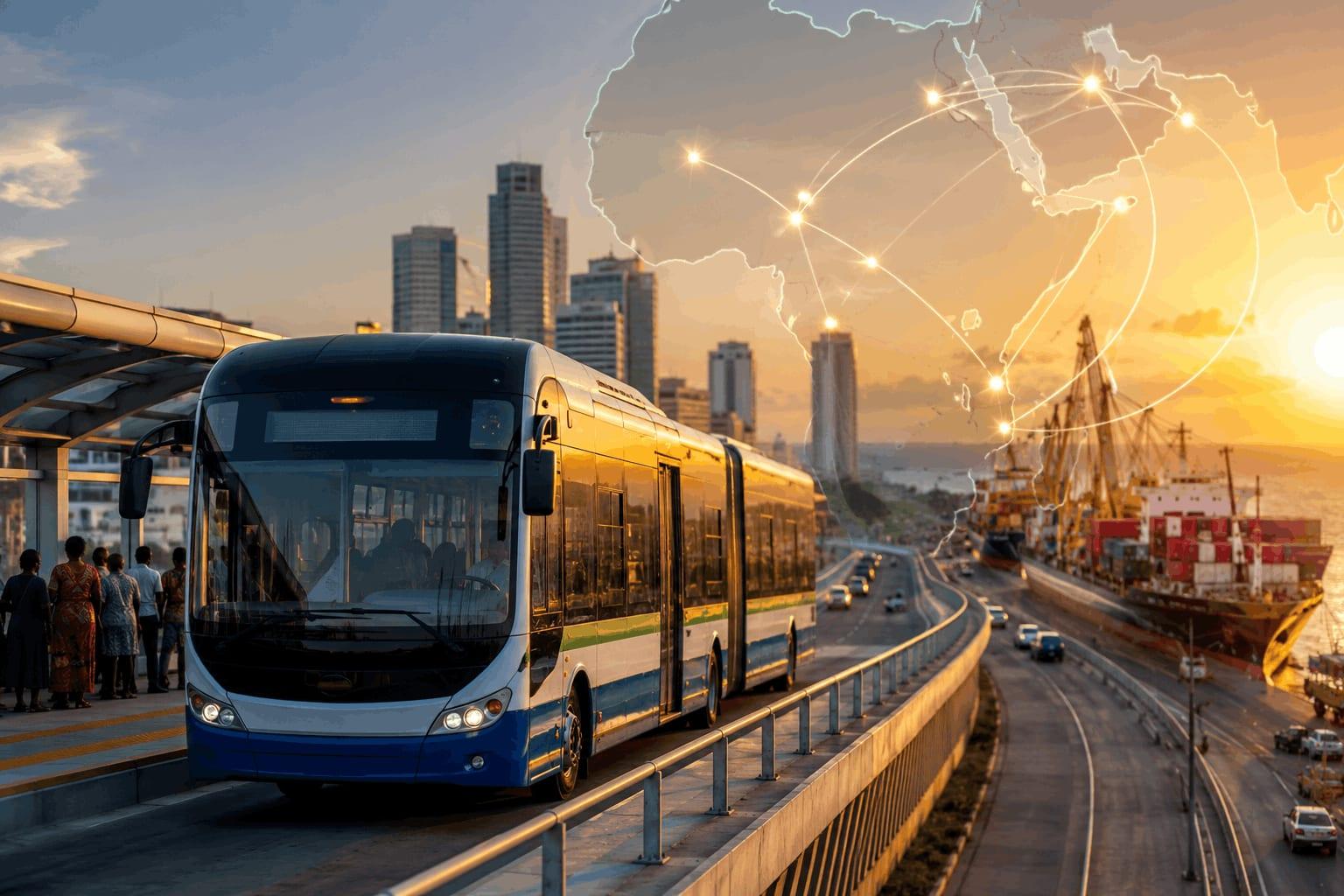
Dar es Salaam’s new BRT is changing how people move through Tanzania’s commercial hub. Here’s what it could mean for the economy, regional trade and connectivity.
On 7 August 2026, Tanzania’s President Samia Suluhu Hassan and African Development Bank Group President Dr Sidi Ould Tah travelled down Kilwa Road in one of Dar es Salaam’s new buses as the city formally launched Phase II of its Bus Rapid Transit system.
People in Mbagala gathered for the occasion. There were speeches, a ribbon cutting and the usual symbolism that comes with a major infrastructure project.
Dar es Salaam is Tanzania’s commercial hub. Its port handles about 95 percent of Tanzania’s international trade, according to the Tanzania Ports Authority, and serves as a gateway for landlocked countries including Zambia, the Democratic Republic of Congo, Burundi, Rwanda, Malawi, Uganda and Zimbabwe. The U.S. Commercial Service also describes Dar es Salaam as Tanzania’s key entry and distribution point for imported goods.
Understanding this gave us a new perspective at The Colony, especially in terms of trade.
The new buses are not carrying Tanzania’s gold to an international market. They are not taking containers from the port to Zambia. They are not replacing the Central Corridor, the railway or the roads that carry freight across borders.
So we won't call the BRT a trade corridor, that would be wrong. But it would also be too narrow to treat it as simply a commuter project.
Which is why, we'd be focusing on what happens when a country improves the way people move around the city at the center of its commercial and trade network.
Now, let’s get into the details:
First, what exactly has Tanzania built?
Phase II of Dar es Salaam’s BRT covers 20.3 kilometers of dedicated infrastructure. The project includes two flyovers, 26 passenger stations, a major bus depot, two off-road terminals, four feeder stations and a pedestrian bridge, alongside improvements for pedestrians and other road users. The corridor runs from Mbagala through Kilwa and Kawawa roads towards the city center, connecting with Phase I of the BRT network.
The African Development Bank and the Africa Growing Together Fund financed the project with $155 million, while the Tanzania National Roads Agency, TANROADS, implemented it.
The official launch happened in August 2026, but passenger services on the Phase II corridor began in October 2025. This has made commuting easier for citizens and people who live there. According to the African Development Bank, travel time along one of the city's busiest routes has fallen from about 90 minutes to roughly 30 minutes. Passenger numbers have also tripled to about 90,000 a day.
Once fully operational, the fleet is expected to consist of 250 clean-energy buses. The African Development Bank says the project is expected to reduce greenhouse gas emissions along the corridor by 76 percent, from about 250 tonnes annually to 60 tonnes. Really, this is beautiful!
However, one benefit that data might never capture is “Time”. A journey that once took roughly an hour and a half can now take about half an hour along the corridor.
For a person making that journey regularly, that is a significant change. And that is where transport starts becoming an economic issue.
Time lost in traffic is an economic cost
In this section
Small businesses need to reach their markets, and companies need to be able to reach the people they want to hire.
Dar es Salaam's congestion problem is not new.
A 2016 study published in the Journal of Sustainable Development examined traffic congestion and worker productivity in the city. It surveyed 96 public-transport users along Morogoro and Mandela roads and found that congestion was associated with substantial losses of commuting time and working time. The researchers estimated that about 2.5 hours were lost to traffic each day among the workers studied.
That study was not evaluating Phase II, and it was carried out before this corridor existed. But it still helps us understand why travel time is more than just a matter of convenience.
When people spend hours getting to and from work, those hours have a cost. And it is not just workers who feel it. Businesses do too.
Employees need to get to work. Customers need to get to businesses. Suppliers need to reach the businesses they serve. Technicians need to get to clients. Small businesses need to reach their markets, and companies need to be able to reach the people they want to hire.
When movement becomes difficult, more time and money go into simply getting from one place to another.
Of course, saving someone an hour on their commute does not mean Tanzania's GDP automatically goes up by an hour's worth of economic activity. It is not that simple.
But transport can either make economic activity easier or make it harder. Dar es Salaam's BRT is, at its core, an attempt to make that movement easier.
The first phase gives us something useful to look at
In this section
The system has to actually work well for the people using it if the wider benefits are going to show up.
Phase II is new, so it would be premature to claim that it has already increased Tanzania's exports, reduced import costs or increased intra-African trade. There is no evidence yet that allows us to make those claims. But Phase I gives us a reason to look more closely.
The first BRT corridor began operations in 2016 and was designed to improve movement along one of Dar es Salaam's major transport corridors.
Research on the system has examined its operational performance and the experience of people using it. One academic evaluation found that the BRT offered faster and more reliable travel than conventional buses and private vehicles on parts of the corridor, although it also identified problems including overcrowding and operational challenges.
That last part is important too.
Just building the infrastructure does not mean everything suddenly works. You can have dedicated BRT lanes and new stations, but if the buses are too crowded, the service is unreliable, or more people start using the system than it can handle, you still have a problem.
So the lesson from Phase I is not simply that BRT works.
It is that what happens after the infrastructure is built matters too. The system has to actually work well for the people using it if the wider benefits are going to show up.
That is something worth watching as Phase II takes on more passengers.
Now consider where this BRT sits
In this section
From the port, goods move inland, primarily by road, while Tanzania is also developing its standard-gauge railway network.
This is where Dar es Salaam becomes particularly important.
The city is the commercial hub of Tanzania. The Port of Dar es Salaam is the country's principal port, with the Tanzania Ports Authority stating that it handles about 95 percent of Tanzania's international trade. The authority also identifies it as a freight link serving Zambia, the Democratic Republic of Congo, Burundi, Rwanda, Malawi, Uganda and Zimbabwe.
The U.S. Commercial Service similarly describes Dar es Salaam as the main entry and distribution point for imported goods into Tanzania. From the port, goods move inland, primarily by road, while Tanzania is also developing its standard-gauge railway network.
This means Dar es Salaam has two roles that overlap. It is a city where millions of people live and work. And it is part of a national and regional trade network. Those two functions depend on the same physical space.
Workers need roads.
Businesses need roads.
Buses need roads.
Delivery vehicles need roads.
Freight vehicles need roads.
Port-related businesses need roads.
That does not mean putting BRT lanes on the road will suddenly make freight move faster. But it does mean that how Dar es Salaam manages movement matters to the businesses operating there, and to the wider economy around the city.
The BRT does not move the exports. People do.
Maybe the easiest way to explain it is this:
The BRT does not take Tanzania's exports to foreign markets. It helps move the people and businesses behind those exports.
Think about what it takes to keep trade moving. Customs clearing companies need people. Freight forwarders need staff. Warehouses need workers. Manufacturers need people to get to the factory. Hotels need workers and guests. Shops need customers. Banks need staff and customers. Logistics companies need drivers, dispatchers, technicians and other workers.
None of these things is directly about riding a bus. But they all depend on people being able to move around the city.
That is why the economic value of the BRT should not be judged only by how many buses are running or how many passengers they carry.
Over time, it is also worth looking at whether people are getting to jobs more easily, whether businesses around the corridor are seeing more activity, whether households are spending less on getting around, and whether people can rely on the system to get where they need to go.
That is where the economic value of better urban transport starts to show.
Then there is the wider trade network
In this section
Tanzania Ports Authority identifies it as a gateway for several of the country's landlocked neighbors.
Tanzania's trade numbers make the importance of connectivity a little easier to see. According to the U.S. Commercial Service, using Bank of Tanzania data, Tanzania recorded about $17 billion in exports in 2025. About $9.9 billion came from goods, while $6.9 billion came from services. Imports were slightly higher at about $17.1 billion, including $14.1 billion in goods and $3 billion in services.
These numbers explain why infrastructure matters so much to Tanzania.
Tanzania is not only trading to meet the needs of its own market. Its location gives it another advantage. It has a coastline on the Indian Ocean and borders several landlocked countries, which means its transport infrastructure can serve both its own economy and the wider region.
The Port of Dar es Salaam is a good example. Tanzania Ports Authority identifies it as a gateway for several of the country's landlocked neighbors.
So, for Tanzania, being competitive is not only about what happens inside the country. It is also about how well it can connect its coast to the businesses and markets further inland.
And this is where the BRT fits. It is one part of the infrastructure that keeps people, businesses and economic activity moving around Dar es Salaam.
Different infrastructure does different jobs
It helps to look at what each part of this network actually does.
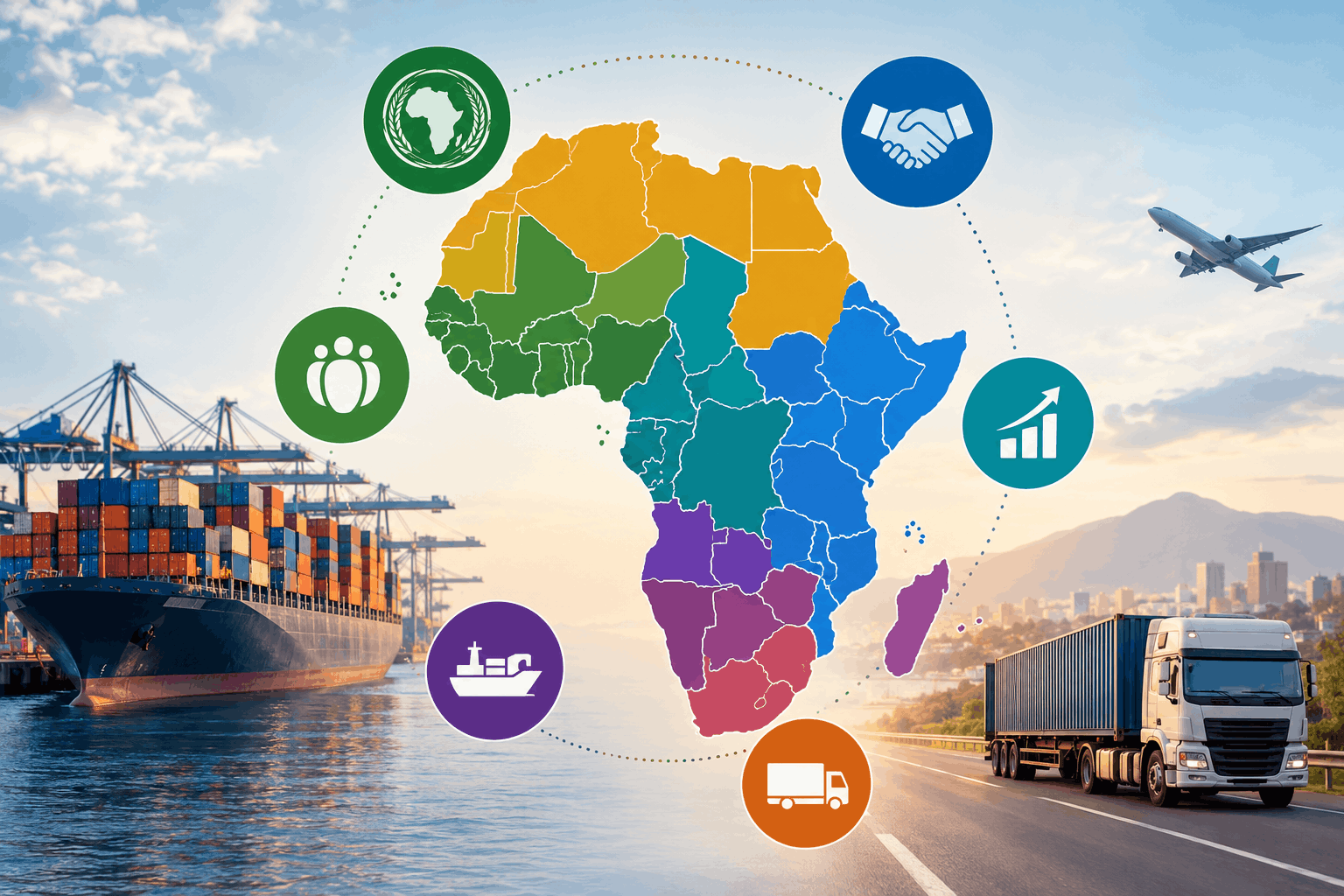
The BRT moves people around the city. Roads and railways connect cities and regions and move both people and goods. The port connects Tanzania and its neighbors to markets outside the region. Border systems determine how smoothly those goods can move from one country to another, while trade agreements set the rules for how that trade happens.
They all matter, but one cannot simply do the job of another.
A better bus system cannot replace a railway. A bigger port cannot make up for a slow border crossing. Removing a tariff under AfCFTA does not mean much if the goods still cannot get to the market efficiently. And building a new road does not automatically solve customs delays.
That is why I would be careful about saying the BRT will increase Tanzania's exports directly.
What it does is strengthen one part of the urban infrastructure that supports a city already deeply tied to Tanzania's domestic economy and its trade with the rest of the region.
And regional trade is growing
There is another reason this matters now. Trade within East Africa is growing.
The East African Community reported that intra-EAC trade increased by 27 percent, from $14.2 billion to $18 billion, between June 2024 and June 2025. During the same period, total EAC trade with the rest of the world increased by 22 percent, from $115.4 billion to $140.8 billion.
The EAC has also reported stronger regional trade figures for the fourth quarter of 2025. Its April 2026 update said intra-EAC trade reached $19.3 billion, while trade within Africa reached $39 billion, representing 25.2 percent of total EAC trade during that period.
These numbers show that regional trade is not some distant ambition. It is already happening.
But it is happening within a region where businesses still face transport and logistics costs, border delays and other barriers.
The EAC continues to identify non-tariff barriers as a constraint on cross-border trade. That is why infrastructure matters.
If African countries succeed in lowering policy barriers to trade, they will still need physical systems capable of handling the additional activity.
This is where the AfCFTA conversation gets practical
In this section
The goods then have to cross a border, clear the necessary checks and continue their journey to the buyer.
Africa has spent years talking about the need to trade more with itself. The idea is simple enough: African countries should be buying and selling more from one another instead of relying so heavily on markets outside the continent. The African Continental Free Trade Area is one of the biggest attempts to make that easier. But a trade agreement cannot move a product from one country to another.
Take a Tanzanian manufacturer selling to a buyer in Rwanda. The agreement can determine the tariff and the rules that apply to the product. But the manufacturer still has to make it. Someone has to collect it, get it to a warehouse, prepare the paperwork and put it on a truck. The goods then have to cross a border, clear the necessary checks and continue their journey to the buyer.
Every one of those steps takes time and costs money. So, if Africa wants to trade more within the continent, it cannot only focus on the rules around trade. It also has to make it easier for the goods to actually move.
And this is where Tanzania's position matters. Its coastline, ports and connections to several landlocked countries give it a role that goes beyond its own domestic market.
Dar es Salaam is part of a regional gateway system
Tanzania's port is important for more than the goods coming into and leaving the country. It is also important because of the markets beyond Tanzania that it connects to.
The Tanzania Ports Authority lists Zambia, the Democratic Republic of Congo, Burundi, Rwanda, Malawi, Uganda and Zimbabwe among the landlocked countries served by Dar es Salaam. That creates an opportunity for Tanzania beyond simply handling its own imports and exports.
There is money to be made from moving and handling all that cargo. Transport companies move it. Warehouses store it. Clearing and forwarding companies handle the paperwork. Banks and insurers support the transactions, while hotels, restaurants and other businesses serve the people working across the trade network.
In other words, the value of a trade corridor is not only in the goods passing through it. There is also an economy that grows around moving those goods. That is part of what makes Tanzania's position as a gateway to several landlocked countries economically important.
But the BRT's contribution is still one step removed
If people can get to work more easily, businesses can spend less time dealing with transport problems. If workers spend less time on the road, they have more time available for work and other parts of their lives. If people can reach markets more easily, businesses along the route may benefit too.
Put together, these changes affect how easily the city can work, and that matters in a city that sits at the center of Tanzania's commercial and trade activity. The question now is whether those benefits will show up beyond shorter journeys, and over time, in the wider economy.
The next question should be: what happens beyond the buses?
The launch is only the beginning.
What matters now is what happens as more people start using the system. Does the shorter travel time hold up as passenger numbers grow? Do people living in Mbagala and the other areas along the route find it easier to get to work? Do businesses around the stations see more activity? Does it change how much households spend getting around the city?
And then there is the bigger question: does all of this make Dar es Salaam a more productive place to live and do business?
Those are the things that will tell us whether the investment is delivering more than a new bus service.
Tanzania is building connectivity at several levels
The BRT is also part of a much wider effort to improve how people and goods move around Tanzania.
The country is developing its standard-gauge railway, investing in roads, upgrading its ports and working to strengthen connections with neighboring countries. At the same time, Tanzania is part of the East African Community and has ratified the African Continental Free Trade Area.
Each of these serves a different purpose.
The BRT helps people move around Dar es Salaam. Roads and railways connect the city to other parts of the country and to neighboring markets. The ports connect Tanzania to international trade, while regional corridors link the country to landlocked neighbors. Trade agreements then create the rules that allow businesses to sell across those borders.
The value comes from how these different parts work together.
A business cannot take advantage of a larger regional market if it cannot get its goods there. And a port cannot create much value for inland markets if the roads, railways and other connections leading to it do not work well.
That is why what happens to Dar es Salaam's transport system matters beyond the people who use the BRT every day.
There is also a climate and urban-growth question
In this section
The network also needs to grow in line with where people actually live and where jobs and businesses are.
The BRT is also coming at a time when Dar es Salaam is continuing to grow.
The African Development Bank says the Phase II fleet will use clean-energy buses and is expected to reduce emissions along the corridor by 76 percent once it is fully operational.
But there is a more immediate issue for a growing city: getting people around.
As more people live and work in Dar es Salaam, more people need to move around the city every day. More businesses need to move goods and serve customers too. Without enough public transport, that can mean more vehicles on already busy roads and more time spent getting from one place to another.
The BRT provides another way to move large numbers of people through dedicated routes.
Whether it works as intended will depend on how well the system is run. There need to be enough buses, reliable services, safe stations and good connections to other forms of transport. The network also needs to grow in line with where people actually live and where jobs and businesses are.
The African Development Bank says President Samia has announced plans to extend BRT services into the neighboring Coast Region.
If that happens, the network will reach beyond Dar es Salaam itself, making the question of how well it supports movement between the city and surrounding areas even more important.
So what does this mean for imports and exports?
In this section
Better urban transport can make it easier for workers to get to businesses, for customers to reach markets and for businesses to operate.
So, what does this mean for Tanzania's imports and exports?
The BRT is not going to directly increase exports or make imports cheaper. There is no evidence yet showing that Phase II has had either effect.
What we can say is that the project improves how people move around Dar es Salaam, and that matters because of the role the city plays in Tanzania's economy.
Dar es Salaam is the country's commercial hub. Its port handles about 95 percent of Tanzania's international trade, according to the Tanzania Ports Authority, and also serves several landlocked countries in the region. The city is also an important distribution point for goods coming into Tanzania.
At the same time, trade between Tanzania and other EAC countries is growing, while businesses across East Africa are becoming more connected.
So, when a city sits at the center of all this activity, how well people can move around it matters. Better urban transport can make it easier for workers to get to businesses, for customers to reach markets and for businesses to operate.
That is where the BRT fits into Tanzania's economy. Not as a project that moves exports, but as infrastructure that helps the city where much of that economic activity happens function better.
The bigger lesson is about how we think about infrastructure
When we talk about infrastructure and trade in Africa, the conversation usually goes to ports, railways, highways, border posts and airports. That makes sense. These are the places where goods and people physically move between markets.
Urban transport is easier to overlook.
But before a container gets to the port, there are people and businesses making that movement possible.
A worker has to get to the factory. A supplier has to reach the warehouse. A manager has to get to the office. A customs agent has to get to work. A logistics company has to have people on the ground. A customer still has to get to the business.
All of that happens in the city.
So when the transport system makes it easier for people to move around, it can also make it easier for the businesses around them to function.
That is where Dar es Salaam's BRT becomes part of the trade conversation. It is not carrying Tanzania's exports, but it is helping move some of the people who make the country's economic activity possible.
What Tanzania should measure next
If Tanzania wants to know what Phase II is really doing for the city, the next few years will tell us more.
It will be worth watching whether the shorter travel times hold up, whether the service remains reliable as passenger numbers grow, whether people are spending less on getting around, and whether businesses around the stations see more activity. It will also be useful to see what happens to congestion on surrounding roads and, where there is a clear connection, whether businesses notice any change in their transport costs.
Trade will need to be watched separately.
If Tanzania's exports grow, there will be many reasons for that. Commodity prices, investment, production, tourism, mining, agriculture, manufacturing, exchange rates and demand in other markets can all affect the numbers. The same applies to imports.
The BRT will be one part of the environment in which all of this economic activity takes place.
And that is enough. Infrastructure does not have to transform trade on its own to make a difference to the economy.
The real story is the network
In this section
What remains to be seen is what that change means for the businesses, workers and economic activity around them.
Dar es Salaam's new BRT is one part of how Tanzania is improving movement around the country.
The BRT moves people within the city. Roads and railways connect Dar es Salaam to other parts of Tanzania and to neighboring markets. The port connects the country to international trade, while the EAC and AfCFTA provide the frameworks for trading across regional and continental borders.
Each one does a different job, and they all depend on the others working reasonably well.
A port can be efficient, but businesses still need roads and railways to get goods to it. Trade agreements can make it easier to sell across borders, but the goods still have to get there. And businesses need people who can actually get to work and keep those systems running.
That is why the BRT is worth watching.
Tanzania is improving transport inside a city that already plays a major role in the country's commercial activity and in regional trade. Whether that eventually shows up in trade numbers will depend on what happens across the rest of the network too.
For now, the BRT has already changed how tens of thousands of people move through Dar es Salaam each day. What remains to be seen is what that change means for the businesses, workers and economic activity around them.