Explore The Gambia's economy and trade, from diaspora remittances and winter tourism to groundnuts, Banjul's port, imports and business opportunities.
The money that comes home
In this section
Agriculture also supports a large part of the population, with groundnuts remaining an important cash crop.
In 2025, Gambians living abroad sent home approximately US$872.1 million, according to the Central Bank of The Gambia. That was a 12.4% increase from the previous year.
Money sent home by the diaspora is one of the country's largest sources of foreign exchange. President Adama Barrow described these transfers as equivalent to about 34% of GDP in his March 2026 State of the Nation Address. Another government estimate has placed the contribution at approximately 30%. Both figures show how important these payments are to the economy, although the published estimates are not identical.
For many Gambian households, money from relatives abroad helps pay for food, rent, school fees, healthcare, transport and house construction. It also provides foreign currency that supports the country's ability to pay for imports.
Remittances are not the only important source of income. Tourism brings visitors, particularly during the European winter, while trade through Banjul connects The Gambia to neighbouring countries. Agriculture also supports a large part of the population, with groundnuts remaining an important cash crop.
These activities help explain how a small country with a limited industrial base participates in regional and international trade.
This is the twentieth country profile in our series, Africa's Markets, Country by Country, following Guinea-Bissau.
The Gambia is mainland Africa's smallest country. It occupies a narrow strip of land along both banks of the Gambia River and is almost entirely surrounded by Senegal, apart from its Atlantic coastline.
The economy is relatively small, with nominal GDP projected at approximately US$3.0 billion in 2026. GDP per person is projected at about US$1,030, according to the International Monetary Fund.
The country is also preparing for a presidential election scheduled for 5 December 2026. President Barrow is seeking a third term under the current constitution.
The Gambia at a glance
Measure
Figure
Period and source
Nominal GDP
Approximately US$3.0 billion
2026 projection, IMF
GDP per person
Approximately US$1,030
2026 projection, IMF
Real GDP growth
6.0%
2025 estimate, IMF
Expected real GDP growth
5.1%
2026 projection, IMF
Inflation
6.6%
December 2025, IMF
Inflation
7.0%
April 2026, Central Bank
Monetary policy rate
14%
May 2026, Central Bank
Remittances
US$872.1 million
2025, Central Bank
Gross international reserves
US$586.2 million
End-2025, IMF
Present-value public debt ratio
71.0% of GDP
2025, IMF
Overall fiscal deficit
5.0% of GDP
2025, IMF
Goods trade deficit
Approximately US$963 million
2025, Central Bank
Current account deficit
4.1% of GDP
2025, IMF
Groundnut production
61,043 tonnes
2025, government
Registered mobile money users
5.4 million
March 2026, Central Bank
Currency
Gambian dalasi (GMD)
Market-determined exchange rate
Regional trade arrangements
ECOWAS, AfCFTA
Membership
Presidential election
5 December 2026
IEC
National Assembly election
10 April 2027
IEC
Note
These figures come from different reporting periods and institutions. Public debt figures, in particular, can differ depending on whether the measure is gross debt or the present value of debt.
How the economy is built
In this section
Remittances, tourism receipts and other foreign currency inflows help support the supply of foreign exchange.
Services account for a large share of The Gambia's economic activity. This includes wholesale and retail trade, tourism, transport, telecommunications, financial services, construction-related services and government activities.
The Greater Banjul area is the country's main commercial centre. Businesses, financial institutions, hotels, government offices and much of the country's transport infrastructure are concentrated around Banjul, Serrekunda and the coastal settlements.
Agriculture contributes approximately 25% of GDP, but its importance goes beyond the value it adds to the economy. It is the largest source of employment, accounting for around 70% of jobs nationwide, according to the World Bank. Many farmers depend on rainfall and grow groundnuts, rice, millet, maize and vegetables.
Industry is smaller and includes construction, food processing, manufacturing and electricity production.
The economy grew by an estimated 6% in 2025, according to the IMF. The IMF's October 2026 outlook projects growth of 5.1% in 2026. Construction, tourism, remittances and domestic demand have supported recent economic activity.
Prices remain a concern for households and businesses. Inflation had fallen to 6.6% by December 2025 but increased to 7% in April 2026. Higher food prices, transport costs and international energy prices have contributed to the increase.
The Central Bank reduced its monetary policy rate to 14% in February 2026 and maintained that rate in May. Its inflation target remains 5%.
The Gambian dalasi is not tied to the CFA franc used by neighbouring Senegal. Its exchange rate is determined in the foreign exchange market, with the Central Bank intervening as necessary. Remittances, tourism receipts and other foreign currency inflows help support the supply of foreign exchange.
At the end of 2025, the country's gross international reserves stood at approximately US$586.2 million, according to the IMF.
Public finances remain a concern. The IMF estimated the overall fiscal deficit at 5% of GDP in 2025, higher than the earlier programme target. It also reported a present-value public debt ratio of 71% of GDP.
These figures need to be understood alongside the government's reported gross debt figures, which use a different measurement. The IMF continues to classify The Gambia as being at high risk of debt distress.
The country is receiving financial support through an IMF Extended Credit Facility arrangement and a Resilience and Sustainability Facility. In July 2026, the IMF completed the fifth review of the programme and the second review of the climate-related facility, allowing a further disbursement of approximately US$22.5 million.
The IMF also noted that the government had missed some fiscal targets in 2025. This reflects the difficulty of increasing public spending on infrastructure and services while managing debt and government revenue.
Politics has also influenced the country's economic direction. In 2016, Adama Barrow defeated Yahya Jammeh, who had ruled the country for 22 years. The change in government was followed by renewed engagement with international partners and The Gambia's return to the Commonwealth in 2018.
Attempts to replace the 1997 Constitution with a new constitution failed in 2020 and again in 2025. The existing constitution does not impose presidential term limits. This allows Barrow to seek another term in December 2026.
The Independent Electoral Commission has scheduled the presidential election for 5 December 2026 and the National Assembly election for 10 April 2027. The presidential nomination process is scheduled for November 2026.
What The Gambia sells, buys and who it trades with
In this section
The story of Kunta Kinteh and the history of the transatlantic slave trade are important to heritage tourism.
The Gambia imports considerably more merchandise than it exports. Its domestic market depends on foreign suppliers for food, fuel, vehicles, machinery, medicines and many manufactured products.
The Central Bank recorded a goods trade deficit of approximately US$963 million in 2025. This means the value of imported merchandise was substantially higher than the value of exported merchandise.
However, the current account deficit was smaller, at 4.1% of GDP according to the IMF. The current account also includes services, income and transfers, including remittances. This helps explain why the difference between imports and exports does not translate directly into an equally large current account deficit.
Re-exports and regional trade
Banjul is an important entry point for imported goods. Traders bring products into The Gambia for local distribution, while some goods are subsequently moved into neighbouring markets.
Rice, sugar, flour, cooking oil, textiles, vehicles and other consumer products feature in the country's import trade.
The Gambia's location gives it access to markets in Senegal, Guinea-Bissau, Guinea and Mali. This creates opportunities for traders, transport companies, wholesalers and freight operators.
However, it is important to distinguish between goods produced in The Gambia, goods imported and then re-exported, and goods transported through the country as transit cargo. These activities are not the same, and export destination figures alone do not establish which goods have been re-exported.
The WTO's 2024 trade data provides a useful picture of the country's merchandise exports. China accounted for 36.3% of recorded export destinations, followed by Mali at 25.2%, Guinea-Bissau at 14.8% and Senegal at 11.7%.
These figures describe recorded merchandise exports. They should not be treated as a breakdown of re-export destinations.
Groundnuts
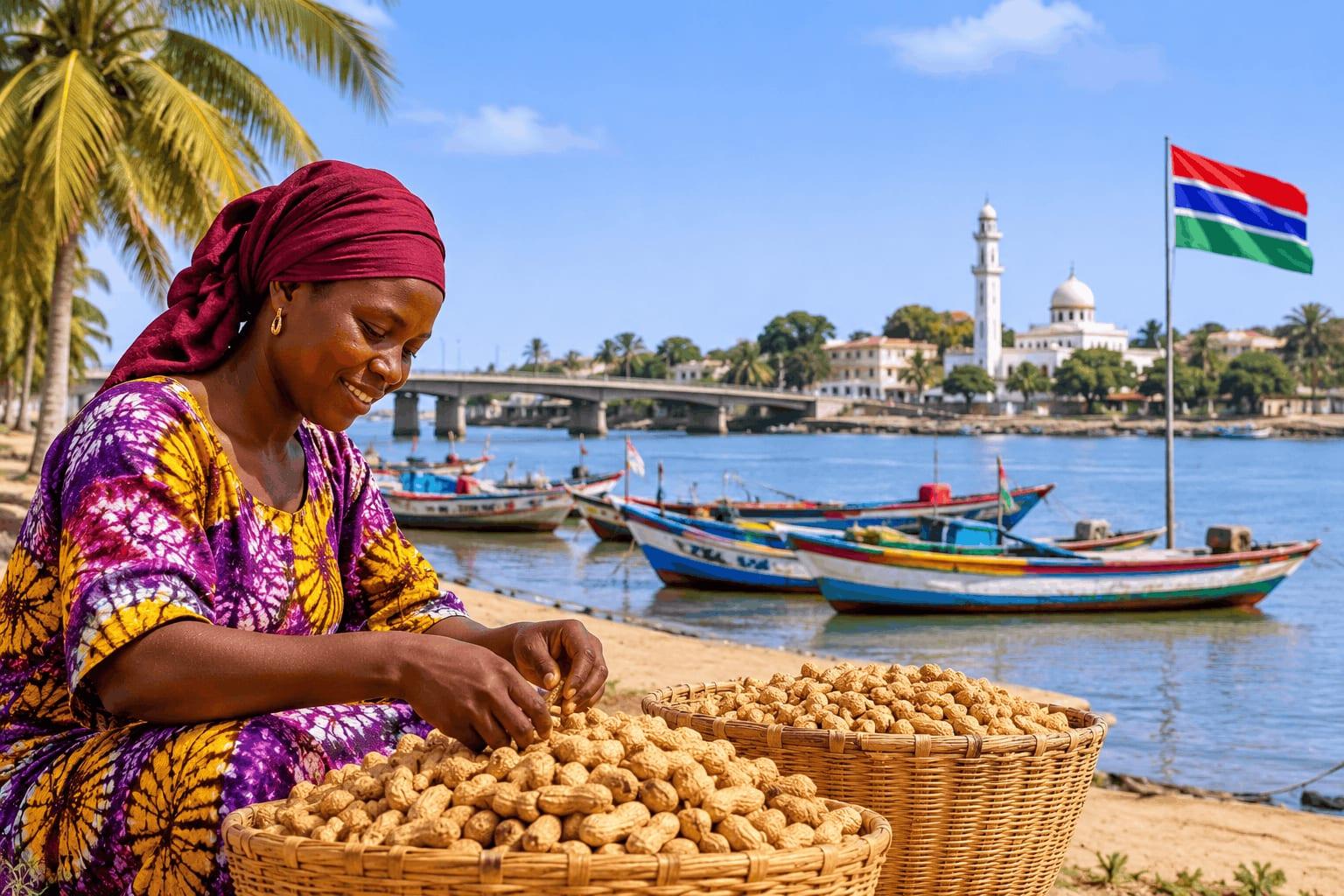
Groundnuts have been an important part of The Gambia's economy for generations. They remain one of the country's best-known agricultural products and provide income for farmers and traders.
Production increased from 52,642 tonnes in 2024 to 61,043 tonnes in 2025, a rise of 16%, according to the government.
For the 2025/26 agricultural season, the government announced a D2 billion intervention to purchase up to 50,000 tonnes of groundnuts.
The crop is sold in different forms, including groundnuts in shell, groundnut seeds and processed products. WTO trade data recorded groundnuts in shell as one of the country's leading merchandise export categories in 2024.
There is also room for more local processing. Shelling, roasting, oil production, packaging and other forms of processing could allow more value to remain within the country.
Fish, cashews and other exports
Fish and seafood, cashew nuts, fruit and other agricultural products also feature in Gambian trade.
WTO merchandise data for 2024 recorded cashew nuts in shell among the country's export products. Fresh and chilled fish also appeared in the export figures.
The fishing industry supports coastal communities, fish traders, processors and people working in related transport and distribution businesses.
Fishmeal production has also attracted attention along the coast. Some processing facilities have faced criticism over environmental concerns and their possible effects on local fishing communities.
These concerns deserve attention because coastal fishing provides both income and food for many households. The long-term value of the industry depends on protecting fish stocks and managing the environmental effects of processing activities.
Tourism
Tourism is another major source of foreign exchange.
The World Bank estimates that tourism contributes approximately 20% of GDP and 15% of employment. The industry attracts visitors from Europe, particularly during the colder months between October and April.
Many visitors stay in hotels and resorts along the Atlantic coast, including areas around Bakau, Kotu, Kololi and Senegambia.
The country also attracts visitors interested in its history and culture. The story of Kunta Kinteh and the history of the transatlantic slave trade are important to heritage tourism. River excursions, birdwatching and visits to communities along the Gambia River also form part of the tourism offering.
The European market remains important, but there is room to attract more visitors from other African countries. Better air connections, regional travel packages, cultural events and business travel could help expand the market.
What The Gambia buys
The country imports a wide range of goods because local production does not meet domestic demand.
Major imports include:
Rice, wheat and other food products.
Petroleum products and other fuels.
Vehicles and spare parts.
Machinery and industrial equipment.
Medicines and medical supplies.
Building materials.
Textiles and manufactured consumer goods.
According to WTO data for 2024, Senegal was The Gambia's largest recorded import supplier, accounting for 21.2% of imports. The European Union accounted for 16.2%, followed by China at 8.7%.
Other suppliers included Russia, India, Brazil, Liberia, Egypt and Nigeria.
For Nigerian businesses, the presence of Nigeria among The Gambia's recorded import suppliers provides an existing trade connection to build on.
Trade agreements and how goods move
In this section
The government also reports that it has constructed more than 1,200 kilometres of all-weather roads since 2017.
The Gambia participates in regional and international trade arrangements that give its businesses access to different markets.
ECOWAS and the West African Monetary Zone
The Gambia is a member of the Economic Community of West African States (ECOWAS). The organisation promotes regional trade, economic cooperation and the movement of people and goods among member countries.
Under the ECOWAS Trade Liberalisation Scheme, qualifying goods produced within member states can receive preferential duty-free treatment when traded within the region. Businesses must meet the applicable rules of origin and certification requirements to benefit.
The Gambia is also part of the West African Monetary Zone (WAMZ), which is working towards monetary integration among participating countries. However, The Gambia continues to use its own currency, the dalasi.
It is not a member of the West African Economic and Monetary Union (WAEMU), whose members use the CFA franc.
AfCFTA
The Gambia has ratified the African Continental Free Trade Area (AfCFTA) agreement.
The agreement aims to reduce trade barriers between African countries and create a larger market for goods and services produced across the continent.
For Gambian businesses, this provides a framework for expanding sales into other African markets. However, businesses still need to comply with product rules, customs procedures, applicable rules of origin and the requirements of individual participating countries.
Ratification does not mean that every product can automatically enter every African market without restrictions.
Trade with the European Union and United States
The Gambia benefits from the European Union's Everything But Arms arrangement because it is classified as a least developed country.
The arrangement gives eligible Gambian products duty-free and quota-free access to the EU market, subject to the applicable rules of origin and product requirements.
The country also benefits from the United States' African Growth and Opportunity Act (AGOA), which provides eligible African countries with preferential access to the American market.
There is an important date to watch here. The United States reauthorised AGOA through 31 December 2026 under legislation signed in February 2026. Businesses planning to use the arrangement should check the latest extension and beneficiary eligibility before making export decisions.
The Port of Banjul
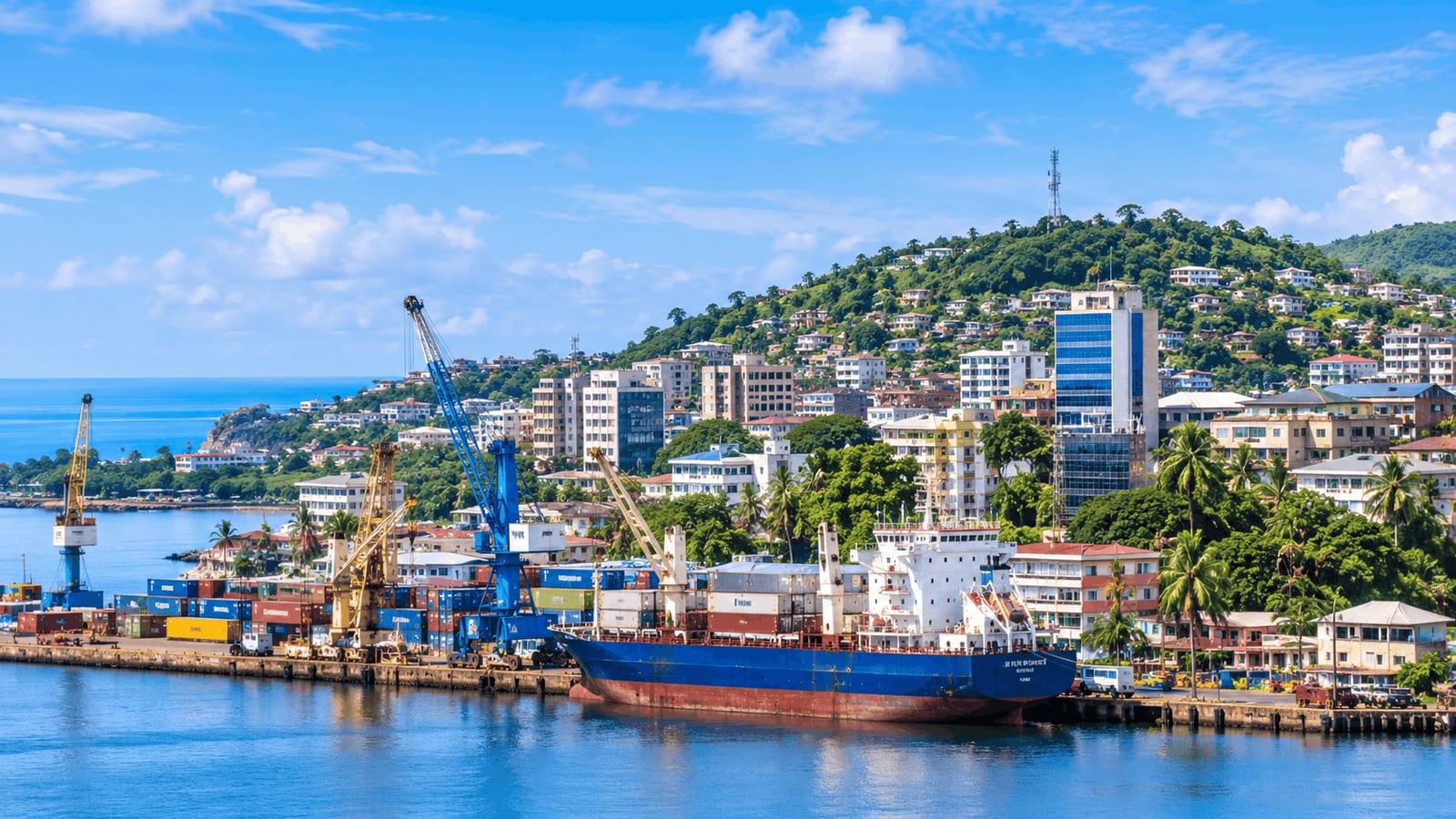
The Port of Banjul is the country's main seaport and handles a large share of its international merchandise trade.
Its location near the mouth of the Gambia River makes it an important entry point for imported goods. The port also supports businesses involved in shipping, customs clearance, warehousing, distribution and road transport.
Port operations have undergone improvements in recent years. In his March 2026 State of the Nation Address, President Barrow reported that cargo waiting time had fallen from more than 14 days to 17 hours.
The government has also reported improvements in vessel waiting times following port expansion and operational changes. These are separate measurements and should not be confused.
Another major infrastructure project is the proposed Sanyang Deep Seaport, south of Banjul. The project is intended to accommodate larger vessels and help reduce shipping costs.
Government project information confirms that preparatory engineering work, including bathymetric and geotechnical surveys, has been undertaken. However, the published information does not establish that full construction has been completed or that the port is operational.
Roads, bridges and the river
Road transport connects The Gambia to Senegal and other neighbouring markets.
The Senegambia Bridge, which opened in 2019, crosses the Gambia River at Farafenni. It forms part of the Trans-Gambia corridor and has made it easier for vehicles to travel between northern and southern Senegal through Gambian territory.
This connection is important for traders moving goods between different parts of Senegal and for transport businesses operating across the region.
The government also reports that it has constructed more than 1,200 kilometres of all-weather roads since 2017. The 84-kilometre Niumi-Hakalang road was inaugurated in 2025.
Ferries remain important for crossing the river, particularly between Banjul and Barra. The government has also reported the delivery of a new eco-friendly ferry intended to improve the service and reduce waiting times.
The Gambia River itself remains important for communities, agriculture and transport in areas away from the main coastal commercial centres.
Sectors with room to grow and doing business
In this section
In 2024, approximately 5% of foreign air arrivals visited for business, while around 3% came for conferences.
The Gambia has several sectors that could attract more investment from local and foreign businesses. Some are connected to existing industries, while others depend on improvements in infrastructure, finance and access to markets.
Transit and logistics
Banjul's port, the Senegambia Bridge and the country's location within Senegal give The Gambia an opportunity to serve regional trade.
Businesses involved in freight forwarding, customs services, trucking, warehousing, distribution and cold storage can serve importers and exporters operating within the country and across neighbouring markets.
However, companies considering this sector need to assess port charges, border procedures, transport costs and the actual demand for logistics services.
The proposed Sanyang Deep Seaport could change the country's shipping capacity if the project moves into construction and becomes operational.
Tourism
Tourism already contributes approximately 20% of GDP and 15% of employment, according to the World Bank.
The industry could benefit from more direct flights from African cities, better connections between tourism destinations and a wider range of accommodation options.
There is also room to develop cultural tourism, heritage visits, birdwatching, river excursions and experiences outside the main coastal hotel areas.
African tour operators and hospitality businesses could find opportunities in packages that connect The Gambia with Senegal and other nearby destinations.
The visitor market is not limited to holidaymakers. In 2024, approximately 5% of foreign air arrivals visited for business, while around 3% came for conferences. These figures suggest room to develop business and conference tourism alongside leisure travel.
Agro-processing
Agriculture supports a large share of the population, but much of the country's production is still sold with limited processing.
Groundnuts provide opportunities in oil production, roasting, packaging and other processed food products.
Cashews, mangoes and other fruits also offer opportunities for processing, preservation and packaging.
Rice is another important area. The Gambia produced 57,225 tonnes in 2025, according to the government, but still relies heavily on imports to meet domestic demand.
Investment in irrigation, improved seeds, storage, processing equipment and agricultural distribution could support local production and reduce losses after harvest.
For businesses entering this sector, access to reliable raw materials, electricity, water, finance and distribution channels will be important considerations.
Electricity access remains a major part of the country's development plans.
The World Bank reported in May 2026 that electricity access had reached approximately 90%. It also identified reliable and affordable power as important to business growth and employment.
The government is working on expanding electricity infrastructure, including regional transmission connections through the Organisation for the Development of the Gambia River Basin (OMVG).
Solar energy is another area receiving attention. The government has announced plans for a solar park at Soma with a proposed capacity of 150 MW.
The project should be treated as planned infrastructure rather than existing electricity generation. Its procurement and construction progress need to be followed.
Businesses involved in solar installation, energy storage, electrical equipment, maintenance and energy distribution may find opportunities as the sector develops.
Digital services and financial technology
Digital financial services are expanding in The Gambia.
The Central Bank reported 5.4 million registered mobile money users in March 2026, compared with 4.7 million in September 2025.
This figure refers to registered users, not necessarily unique individuals or active customers.
The growth of mobile money creates opportunities for payment providers, financial technology companies, merchants and businesses offering services to people receiving money from abroad.
Remittance services are particularly relevant because of the large amount of money Gambians living overseas send home.
There is also room for digital services that help small businesses manage payments, record transactions and access financial products.
However, companies entering the market need to understand the Central Bank's licensing and regulatory requirements.
Doing business in The Gambia
Companies interested in establishing operations can obtain investment information and support through the Gambia Investment and Export Promotion Agency (GIEPA).
The agency provides information on investment opportunities, incentives and the processes involved in setting up eligible businesses.
In 2025, GIEPA facilitated Special Investment Certificates and Export Processing Zone licences for 16 businesses with a combined planned investment of US$204 million, according to the government.
This represents planned investment, not necessarily money already spent or projects already completed.
The country uses English as its official language, which can make communication and business documentation easier for companies from Nigeria, Ghana and other English-speaking countries.
However, familiarity with the language does not remove the need to understand Gambian company law, tax obligations, licensing procedures and sector-specific regulations.
The World Bank's Business Ready assessment provides information on the country's regulatory framework, public services and operational efficiency. Access to finance and the quality of public services remain important issues for businesses.
The World Bank's 2026 country report also notes that small and medium-sized enterprises account for 80% of Gambian businesses, but only 15% have access to formal finance.
For a company considering entry, it is worth checking financing options, registration requirements, tax procedures, electricity costs and the availability of qualified workers before committing significant capital.
Risks and trade-offs
In this section
Public debt also remains high, and the IMF continues to classify The Gambia as being at high risk of debt distress.
The Gambia has opportunities in trade, tourism, agriculture and services, but businesses also need to consider the risks that affect the country's economy.
Dependence on money from abroad
Remittances and tourism provide important foreign exchange and support household spending.
A fall in remittances, a decline in European tourism or changes in migration opportunities could affect the amount of money entering the country.
Businesses that depend heavily on household spending should consider how changes in these income sources could affect demand.
Inflation and public debt
Inflation increased again in 2026 after falling during the previous year. Higher food, transport and energy costs can raise operating expenses for businesses and reduce the amount households can spend.
Public debt also remains high, and the IMF continues to classify The Gambia as being at high risk of debt distress.
Government spending, borrowing and debt repayments will remain important issues to watch.
Climate and agriculture
Much of Gambian agriculture depends on rainfall. Changes in rainfall patterns, flooding and other environmental pressures can affect crop production and rural incomes.
The World Bank's 2026 Country Climate and Development Report also identifies flooding, heat stress and coastal erosion as threats to infrastructure, agriculture and economic activity.
These risks are relevant to businesses involved in farming, food processing, tourism, transport and property development.
Political developments
The presidential election scheduled for December 2026 is an important event for businesses to follow.
The country has experienced a period of political change since 2016, and the current election follows two unsuccessful attempts to replace the 1997 Constitution.
The outcome of the election and the policies of the next administration could influence public spending, investment decisions and the business environment.
Pressure on fish stocks and coastal communities
Fishing provides income and food for many Gambian households. Concerns about fishing practices, industrial processing and pollution need to be considered when assessing investment in the sector.
Businesses involved in fisheries and seafood processing need to pay attention to environmental requirements, resource management and the interests of local fishing communities.
What this means for an African business
In this section
With this profile, we have completed our coverage of the 15 West African countries included in this series.
The Gambia has a small domestic market, but its location, trading links and reliance on imported products create opportunities for businesses from other African countries.
For Nigerian, Ghanaian, Senegalese and Ivorian companies, the import market offers areas to investigate, particularly food products, building materials, machinery, consumer goods and other products that meet local demand.
The WTO's 2024 trade data already records Nigeria among The Gambia's import suppliers. This provides evidence of an existing trade connection, although it does not establish the profitability or demand for any particular product.
There are also opportunities beyond selling goods.
Companies involved in logistics, freight forwarding, warehousing and distribution can assess the demand created by Banjul's port and regional transport routes.
Agricultural businesses can examine opportunities in groundnut processing, cashew processing, fruit preservation and agricultural equipment.
Financial technology companies can study the remittance and mobile money market, while energy businesses can look at solar equipment, storage and related services.
Tourism offers opportunities for hospitality companies, tour operators, transport providers and businesses developing cultural and heritage experiences.
However, entering The Gambia requires an understanding of the size of the local market, import competition, customer purchasing power, operating costs and regulatory requirements. Companies should also assess the practical arrangements for moving goods across borders rather than assuming that regional trade agreements remove every barrier.
The December 2026 election, the government's fiscal position and progress on major infrastructure projects are also worth monitoring before making large investments.
The Gambia's economy depends heavily on services, agriculture, tourism, trade and money sent home by its diaspora. These activities support households and businesses, but the country still faces challenges with domestic production, imports, infrastructure and access to finance.
For African businesses, the strongest starting point is to identify a specific demand, understand how the product or service will reach customers and check the cost of operating in the market.
With this profile, we have completed our coverage of the 15 West African countries included in this series. Our next article will compare the countries side by side, looking at their economies, incomes, exports, imports and the trade routes that connect them.
Sources
International Monetary Fund, The Gambia: 2026 Article IV Consultation and Fifth ECF Review
Central Bank of The Gambia, Monetary Policy Committee Statement, 21 May 2026
Government of The Gambia, State of the Nation Address, March 2026
World Trade Organization, The Gambia Trade Profile
World Trade Organization, The Gambia Trade Policy Review, February 2026
World Bank, Building Resilience, Powering Jobs and Growth for The Gambia's Future, May 2026
World Food Programme, The Gambia Country Strategic Plan 2024 to 2028
Government of The Gambia, official infrastructure projects
Independent Electoral Commission, official election information
Gambia Participates, Country Context Prior to the Elections, July 2026
US Trade Representative, AGOA Reauthorisation, February 2026
Ministry of Tourism, Arts and Culture, 2024/2025 Tourist Season