How Guinea earns, spends and trades through bauxite, gold, iron ore, agriculture and regional trade. Understand its economy, major exports, infrastructure and business opportunities.
183 million tonnes of bauxite
In this section
Bauxite is the main reason Guinea has become such an important supplier to the global aluminium industry.
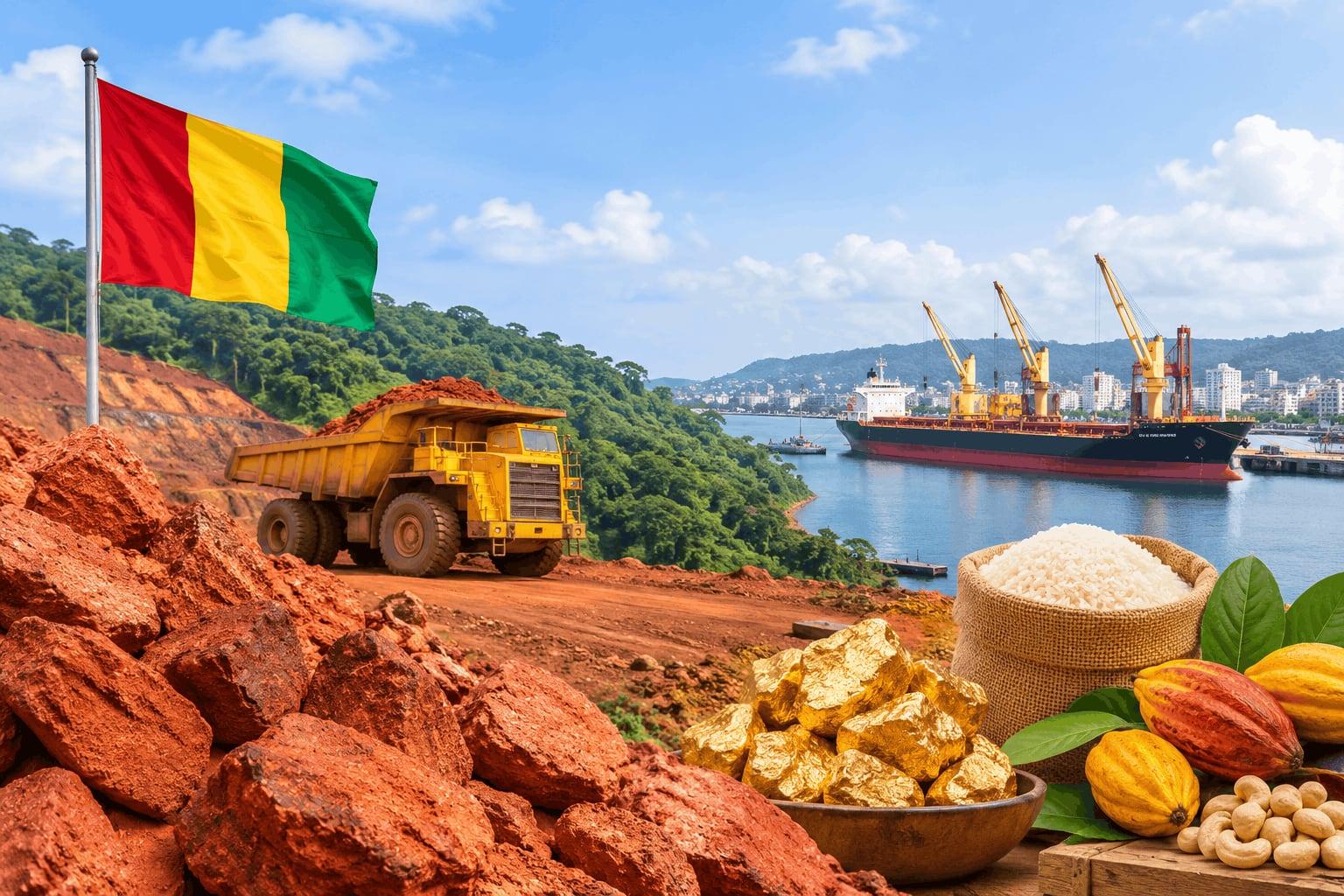
In 2025, Guinea exported 182.8 million tonnes of bauxite, the reddish-brown rock used to produce aluminium. That was a 25% increase from the previous year and another record for a country that has become the world's largest bauxite exporter.
China received 74% of those shipments. The remaining exports went to other markets, including buyers in Europe and elsewhere. Twenty-three companies exported bauxite from Guinea in 2025, with operations concentrated largely in the Boké region in the west of the country.
Bauxite is the main reason Guinea has become such an important supplier to the global aluminium industry. But another mineral project is now attracting attention.
On 2 December 2025, the first iron ore shipment from the Simandou project left Guinea's coast for China. Simandou is a group of high-grade iron ore deposits in the country's south-east. Development had been delayed for decades, partly because the mines needed an entirely new railway and port system before large-scale exports could begin.
The project involves two mining consortia, the Guinean government and several international companies. Its combined infrastructure is designed to support exports of up to 120 million tonnes of iron ore annually when fully developed.
For Guinea, this creates another major source of export earnings alongside bauxite and gold. It also raises questions about how much of the money will remain in the country, how many jobs the projects will create and how mining revenue will be used.
This is the twelfth country profile in our series, Africa's Markets, Country by Country, following Burkina Faso.
Guinea is a coastal country in West Africa with a population of approximately 15 million. Its economy has grown quickly in recent years, supported by mining production and investment. The World Bank estimates that economic growth reached 7.4% in 2025 and projected growth of 8.8% for 2026 in its April 2026 outlook.
However, strong economic growth does not automatically mean that most people benefit from it. Mining contributes heavily to export earnings, but agriculture remains the main source of employment for much of the population. The country also imports large quantities of goods that it could produce or process locally.
Understanding Guinea's economy therefore means looking beyond its mines. It means examining what the country produces, what it buys, where its goods go and the conditions businesses face when operating there.
Guinea at a glance
Measure
Figure
Population
Approximately 15 million, 2025
Real GDP growth
7.4% in 2025
GDP growth forecast
8.8% for 2026, World Bank April 2026 projection
Bauxite exports
182.8 million tonnes in 2025
Share of bauxite exports sent to China
74% in 2025
Simandou iron ore export capacity
Up to 120 million tonnes annually when fully developed
Main exports
Bauxite, gold, alumina and iron ore
Main import partner
China
Currency
Guinean franc (GNF)
Regional trade groups
ECOWAS and AfCFTA
Sources: World Bank, Reuters, USGS and WTO.
How Guinea's economy is built
In this section
Services, retail, transport, telecommunications and government activity are important parts of the economy too.
Guinea has a large mining industry, an agricultural economy that employs a significant share of its population and a services sector centred largely around its cities.
Mining is the country's biggest source of export earnings. Bauxite, gold and iron ore are the main minerals attracting international investment. Alumina, the processed form of bauxite used to produce aluminium, is also produced locally, although most of Guinea's bauxite is still exported before being processed.
The scale of the mining industry is clear from the production figures. According to the United States Geological Survey, Guinea was the world's leading bauxite producer in 2024, accounting for 33.2% of global production, excluding US production.
Agriculture employs approximately 52% of Guinea's workforce, according to the World Bank. Farmers grow rice, cassava, maize, fonio, groundnuts, fruits and other crops. The country also has agricultural production in areas such as coffee, cocoa, palm oil and cashews.
However, a large agricultural workforce does not mean the country produces enough food to meet all its needs. Guinea still imports significant quantities of rice and other food products. Limited processing capacity, storage facilities, transport infrastructure and access to finance affect how much value farmers and local businesses can earn from agricultural production.
Services, retail, transport, telecommunications and government activity are important parts of the economy too. Conakry, the capital, is the main centre for government, finance, imports and much of the country's commercial activity.
Economic growth and the challenge of creating jobs
Guinea's economy grew by 7.4% in 2025, according to the World Bank. Increased bauxite production and investment in mining infrastructure contributed to this growth.
The World Bank projected growth of 8.8% in 2026, with further expansion expected as Simandou increases iron ore production.
The figures are encouraging, but there is a difference between the growth of the mining industry and improvements in everyday living conditions.
Large mines require substantial investment in equipment, engineering, railways and ports. They can generate significant export earnings and government revenue, but they do not employ as many people as labour-intensive industries such as agriculture and some forms of manufacturing.
This means Guinea has to consider how mining income can support other parts of the economy. Better roads, electricity, schools, healthcare, agricultural processing and local industries could help more people benefit from the money generated by mineral exports.
In August 2026, the International Monetary Fund announced a staff-level agreement with Guinea on a proposed 41-month Extended Credit Facility worth SDR 310.59 million, approximately US$439 million at the time.
The programme is intended to improve public finances, strengthen economic management and help the country use its mineral resources to support longer-term development. The IMF also highlighted the need for better revenue collection, transparency and stronger financial institutions.
The agreement was subject to the IMF's approval process when announced.
What Guinea sells, buys and who it trades with
In this section
The country has some of the world's largest bauxite reserves and has become the leading exporter of the ore.
Guinea's exports are heavily concentrated in minerals. Bauxite and gold accounted for most of the country's merchandise export earnings in 2024, according to WTO trade data. Iron ore is now becoming another important export as Simandou moves into production.
1. Bauxite
Bauxite is Guinea's largest mineral export.
The country has some of the world's largest bauxite reserves and has become the leading exporter of the ore. Its deposits, particularly in the Boké region, have attracted mining companies from China and other countries.
In 2025, Guinea exported a record 182.8 million tonnes of bauxite, up 25% from 2024. China received 74% of these shipments.
Among the leading exporters were:
Chalco: China's aluminium company exported 22.1 million tonnes.
Compagnie des Bauxites de Guinée (CBG): Exported 17.4 million tonnes. The company has a joint ownership structure involving the Guinean state and an international mining consortium.
Société Minière de Boké (SMB): Exported approximately 17 million tonnes.
AGB2A/SDM: A largely Guinean-owned joint venture that also exported approximately 17 million tonnes.
These companies operate in a sector that supplies raw materials to aluminium producers. Bauxite is mined, transported and shipped to processing facilities, where it is converted into alumina before being used to produce aluminium.
Guinea has an alumina refinery at Fria, but most of its bauxite exports still leave the country without being processed into alumina.
This is one reason the government has been pushing mining companies to invest in local refineries. Processing more bauxite within Guinea could create additional industrial activity, jobs and opportunities for local suppliers.
However, building and operating refineries requires substantial investment, reliable electricity and supporting infrastructure. These remain important challenges.
Sources: Reuters, January 2026; US Geological Survey.
2. Iron ore: the Simandou project
Simandou is one of the most important mining developments in Guinea's recent history.
Located in the south-east, the deposit contains high-grade iron ore used in steel production. Its development required more than the construction of mines. The companies involved also needed to build a railway of more than 600 kilometres and new port infrastructure to move the ore from the mining area to the coast.
The project is divided between two main mining groups.
One is Winning Consortium Simandou, a Chinese-led consortium responsible for two of the four mining blocks.
The other is SimFer, a joint venture involving the Guinean government, Rio Tinto and the Chinalco-led CIOH consortium. SimFer is responsible for the other two blocks.
The first iron ore shipment from Simandou left Guinea in December 2025. Exports continued in 2026 as the railway, mines and port facilities moved through commissioning and operational expansion.
In August 2026, SimFer reported that it had shipped 2.2 million tonnes of iron ore in the first half of the year. Its own port facilities at Morebaya were still being completed.
In September 2026, SimFer began staged commissioning of key port equipment, including systems used to store, move and load iron ore. The company said the port was 85% complete at the end of June, with full commissioning expected in the first quarter of 2027.
Until its own port facilities are fully operational, SimFer ore continues to be shipped through the Winning Consortium's port.
The wider Simandou project is designed to support exports of up to 120 million tonnes of iron ore annually when fully developed. This is the planned capacity of the combined project, not its current export volume.
The railway is also expected to carry passengers and other goods, creating a transport corridor that could serve purposes beyond mining.
In September 2026, American rail equipment company Wabtec announced a services agreement worth more than US$700 million with La Compagnie du TransGuinéen. The agreement covers maintenance and support for the locomotives operating on the railway.
For Guinea, Simandou could bring substantial export earnings. The longer-term benefits will depend on how the government manages mining revenue, how much work goes to local companies and whether the new infrastructure supports other economic activities.
Sources: Rio Tinto, SimFer and Wabtec.
3. Gold
Gold is another major source of export earnings.
It is mined by industrial operators as well as artisanal and small-scale miners. Artisanal mining involves individuals and smaller groups using relatively basic equipment, rather than the large machinery and infrastructure found at industrial mines.
Gold is important to Guinea's export earnings. WTO trade data for 2024 shows that unwrought gold accounted for 47.2% of the country's merchandise exports by value.
The sector is also facing changes in government policy.
On 8 July 2026, Guinea issued Decree D/2026/216/PRG/SGG, which introduced requirements for gold to be refined locally before export. The decree established a 90-day transition period during which the previous rules for exporting unrefined gold continued to apply.
The policy is intended to increase local processing and strengthen oversight of the gold trade.
For businesses operating in the sector, the new requirements affect how gold must be processed, documented and prepared for export. Companies involved in refining, certification and related services will need to understand the applicable rules.
Sources: WTO and LégisGuinée, Decree D/2026/216/PRG/SGG.
4. Agriculture and other exports
Mining receives much of the attention, but agriculture remains important to Guinea's economy.
Rice, cassava, maize, fonio, groundnuts, fruits and other crops are grown across the country. Cocoa and coffee are also part of its agricultural production.
The country has opportunities to increase the amount of food it produces and processes locally. Rice is a particularly important example. Guinea produces rice but continues to import it to meet domestic demand.
The World Bank identifies agriculture as a major source of employment and points to the need for more investment in processing, storage and commercial farming.
For businesses, opportunities may exist in food processing, packaging, agricultural equipment, storage, transport and distribution.
However, these opportunities depend on the ability to source products consistently, reach markets and manage the costs of moving goods. Agricultural production alone does not guarantee a viable processing business.
5. What Guinea buys
Guinea imports fuel, food, machinery, vehicles, construction materials, medicines and consumer goods.
Rice is an important food import, alongside wheat, sugar and vegetable oils. The country also needs machinery and equipment for mining, construction, transport and other industries.
The WTO's 2024 trade figures identify China as Guinea's largest import partner.
China supplied 36.5% of Guinea's imports, worth approximately US$2.92 billion. The European Union accounted for 29.3%, followed by India at 4.9%, the United Arab Emirates at 4% and Türkiye at 3.7%.
These figures show how important international suppliers are to Guinea's domestic market.
They also point to opportunities for companies that can supply products and services needed by households, farms, mining operators and construction businesses.
Source: WTO Tariff and Trade Data, Guinea country profile.
Trade agreements and how goods move
In this section
Bauxite from the Boké region moves by road and rail towards ports and shipping terminals, including Kamsar.
Guinea's location on the Atlantic coast gives it access to international shipping routes and road connections with several neighbouring countries.
It is also part of regional trade arrangements that affect how goods move across West Africa.
ECOWAS and AfCFTA
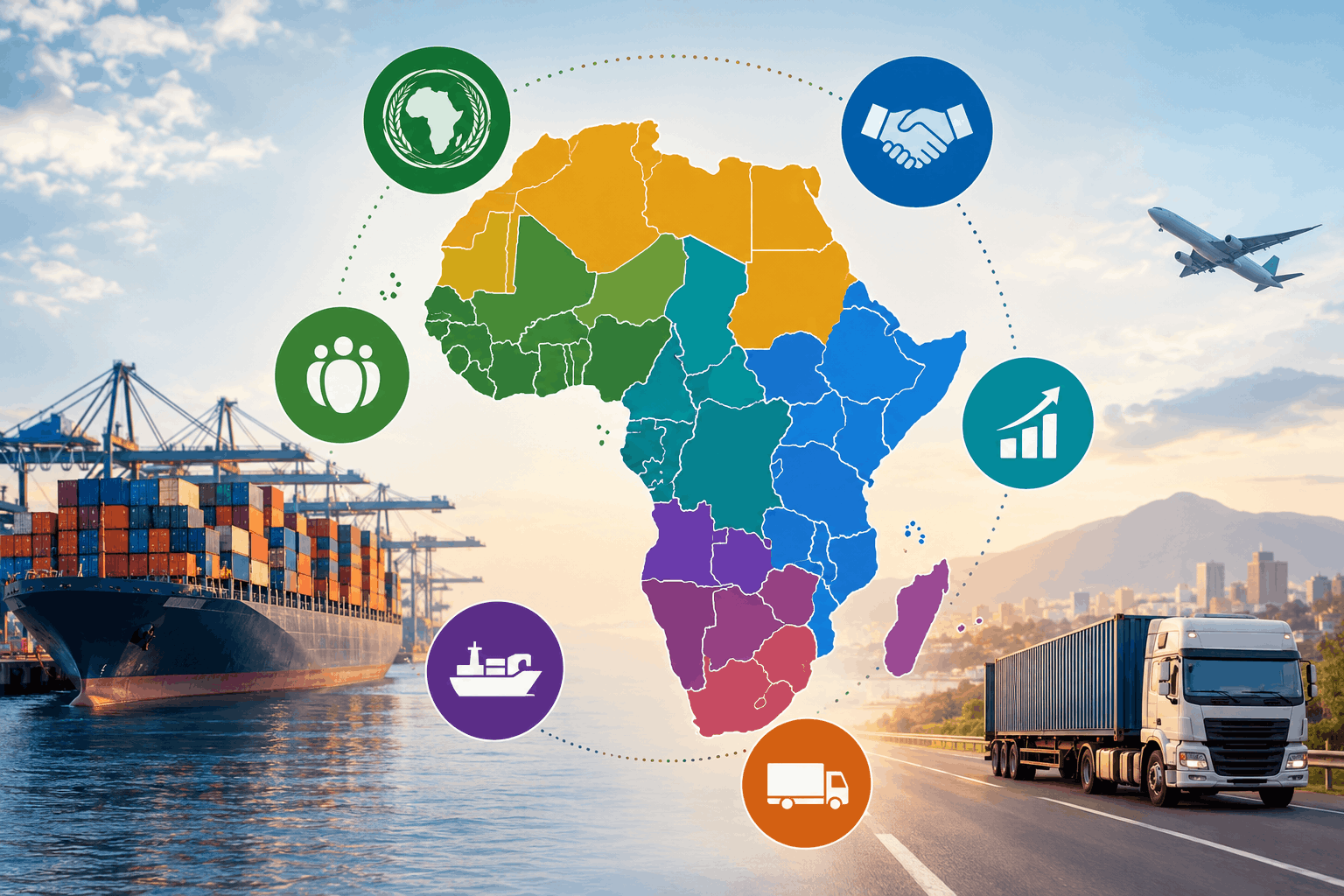
Guinea is a member of the Economic Community of West African States (ECOWAS), the regional organisation that promotes economic cooperation and trade among West African countries.
ECOWAS has trade arrangements that provide preferential treatment for qualifying products originating within member countries. Under the ECOWAS Trade Liberalisation Scheme, eligible goods can receive duty-free access across the region, provided they meet the relevant rules of origin.
This can benefit businesses producing or processing goods in Guinea and selling them to other West African markets.
Guinea is also a party to the African Continental Free Trade Area (AfCFTA), which aims to reduce trade barriers and make it easier for African countries to trade with one another.
The benefits of these arrangements depend on implementation. Businesses still need to understand customs procedures, product classification, documentation and rules of origin before assuming that a product qualifies for preferential treatment.
Guinea is not part of the West African Economic and Monetary Union (WAEMU). It has its own currency, the Guinean franc, rather than using the West African CFA franc.
Mining ports and railways
The movement of minerals is a major part of Guinea's transport system.
Bauxite from the Boké region moves by road and rail towards ports and shipping terminals, including Kamsar. From there, it is loaded onto vessels for export.
Simandou required a separate transport system because the deposits are located far from the coast. The Trans-Guinean Railway connects the mining area to the coast, while new port facilities handle the movement of iron ore onto ships.
The railway is more than 600 kilometres long and was built to support the mining project. It is also intended to carry passengers and other goods.
Its longer-term contribution to Guinea will depend on how access is organised and whether the infrastructure can support commercial activity beyond mineral exports.
Conakry and regional trade
Conakry is Guinea's capital and an important centre for imports and general cargo.
The Autonomous Port of Conakry handles containers, fuel, food products, machinery and other goods entering the country. It also serves some transit trade with neighbouring countries, including Mali.
Guinea shares land borders with Guinea-Bissau, Senegal, Mali, Côte d'Ivoire, Liberia and Sierra Leone. These connections provide routes for regional trade, although the quality of roads and border procedures affects how easily goods can move.
For businesses trading within West Africa, the ability to manage transport costs, customs documentation and delivery times is an important part of operating in Guinea.
Sectors with room to grow and doing business
In this section
The experience of mining investors also shows why contracts and government approvals need careful attention.
Guinea's mining industry creates demand for more than mining companies themselves. Large projects require transport, engineering, equipment, maintenance, food supplies, construction and other services.
There are also opportunities in sectors that serve the wider population and domestic economy.
Mining services and local processing
The expansion of bauxite production and the development of Simandou create demand for equipment, engineering, maintenance, transport, logistics and other services.
Companies that can supply machinery, spare parts, technical support and infrastructure services may find opportunities through mining operators and their contractors.
The government's push for local alumina refining and further mineral processing could also create opportunities for industrial suppliers and service providers.
However, these projects require substantial investment and reliable electricity. Businesses considering this market need to assess the cost of operations and the requirements of individual mining contracts.
Energy and hydropower
Guinea has significant hydropower resources.
The Kaléta and Souapiti dams are among the country's major electricity projects. They were developed with Chinese involvement and are part of efforts to increase domestic electricity supply.
Reliable electricity is important for households, businesses and industrial activity. It is particularly important for energy-intensive operations such as alumina refining.
Further investment in electricity generation, transmission and distribution could support manufacturing, food processing and other industries.
However, having large hydropower potential does not mean every part of the country has a reliable electricity supply. Businesses need to assess power availability at their proposed locations.
Agriculture and food processing
Agriculture employs a large share of Guinea's workforce, but there is room to develop more commercial farming and local processing.
Rice production, fruit processing, cashew processing, food storage, packaging and agricultural logistics are areas worth examining.
Businesses may also find opportunities in equipment supply, irrigation, cold storage and the transport of agricultural products.
The World Bank has highlighted the need for greater investment in agricultural processing because this is where more jobs and additional value can be created.
The development of Simandou involves major investment in railways, ports and related infrastructure.
Beyond mining, Guinea needs roads, electricity networks, water systems, housing and public infrastructure.
These needs create potential demand for construction companies, engineering firms, building materials, equipment suppliers and professional services.
The government's Simandou 2040 development programme is intended to connect mining investment with wider national development. Its results will depend on how projects are financed, managed and delivered.
Doing business in Guinea
Foreign companies considering Guinea need to understand the country's investment rules, registration procedures and sector-specific requirements.
The Investment Promotion Agency of Guinea (APIP) provides information and support for investors. Guinea's Investment Code sets out incentives for qualifying projects in selected sectors, including agriculture, fishing, livestock, industry and tourism.
Mining is governed by separate legislation and licensing arrangements. Companies entering the sector should examine the mining code, individual mining agreements and the obligations attached to their licences.
Guinea is also part of the OHADA legal system, which provides common business law across participating African countries. This covers areas such as commercial companies, business registration, accounting and commercial procedures.
Companies should obtain current advice on tax, employment, customs, foreign exchange and investment requirements before committing funds.
The experience of mining investors also shows why contracts and government approvals need careful attention. Guinea has revoked mining titles and changed the ownership of certain mining operations, including Guinea Alumina Corporation in 2025.
A business entering the country should therefore examine the legal terms of its investment, understand the responsibilities of local partners and make sure its operations comply with current regulations.
Risks and trade-offs
In this section
When a country depends heavily on raw materials, its income can be affected by international prices and demand.
Guinea has important natural resources and a growing mining industry, but businesses should understand the risks alongside the opportunities.
Dependence on China and mineral exports
China is Guinea's largest import partner and the destination for 74% of its bauxite exports in 2025.
This makes China an important market for the mining industry. It also means that changes in Chinese demand for aluminium and iron ore can affect Guinea's export earnings.
The concentration of exports in a few minerals is another concern. When a country depends heavily on raw materials, its income can be affected by international prices and demand.
Developing agriculture, manufacturing and local mineral processing could help broaden the economy.
Changes in mining policy and contracts
The government has taken a stronger approach to mining licences and local processing requirements.
In August 2025, it revoked the mining title of Guinea Alumina Corporation, a subsidiary of Emirates Global Aluminium, and transferred the title to a newly established state-owned company, Nimba Mining Company.
EGA subsequently announced that GAC would terminate its activities in Guinea.
The government has also introduced new rules for gold exports and is pushing mining companies to process more minerals locally.
These decisions show that mining investors need to pay close attention to changes in regulation, licence conditions and government expectations.
Political conditions
Guinea has experienced several years of political uncertainty since the September 2021 coup that removed President Alpha Condé.
Mamadi Doumbouya, who led the coup, became transitional president. A new constitution was approved in a referendum in September 2025. It introduced a seven-year presidential term and allowed Doumbouya to contest the election.
He won the presidential election held on 28 December 2025, receiving 86.7% of the vote.
However, major opposition figures were unable to contest the election, and political restrictions remained a concern.
Legislative elections took place on 31 May 2026, following the dissolution of 40 political parties in March. Parties supporting Doumbouya secured most of the seats. The newly elected National Assembly held its first session in July, bringing the transitional period that began after the 2021 coup to an end.
Guinea remained a member of ECOWAS during the transition. On 29 January 2026, ECOWAS announced that it had lifted its remaining sanctions against the country and restored its full participation in the organisation's decision-making activities.
For investors, the country's political and regulatory direction remains important. Changes in government policy can affect licensing, contracts and the conditions under which businesses operate.
Managing mining revenue
Simandou could bring substantial export earnings to Guinea as production increases.
However, earning money from minerals and using that money to improve living conditions are two different things.
The government will need to manage public revenue, maintain transparency and direct spending towards development priorities.
The IMF's August 2026 assessment highlighted the importance of strengthening public finances, improving governance and managing resource revenue carefully.
It also identified risks from commodity price changes, financing pressures and delays in implementing reforms.
Electricity and transport
Electricity supply and transport infrastructure remain important considerations for businesses.
Mining companies can build dedicated infrastructure for their operations, but other businesses may not have access to the same facilities.
Unreliable electricity can increase operating costs, while poor roads and transport delays can affect the movement of goods.
Companies should assess these conditions before deciding where to establish operations or how to distribute products.
What this means for an African business
In this section
The challenge is to turn this activity into a wider range of businesses, jobs and opportunities across the country.
Guinea is a market of approximately 15 million people with a major mining industry, a large agricultural workforce and significant demand for imported goods.
For businesses elsewhere in Africa, there are opportunities in mining services, construction, energy, logistics, agriculture and food processing.
Companies from Nigeria, Senegal, Côte d'Ivoire, Morocco, South Africa and other African markets may find opportunities to supply equipment, engineering services, transport, financial services, agricultural products and consumer goods.
The demand created by Simandou and the wider mining industry is particularly important. However, companies should look beyond the mining operators themselves. Contractors, suppliers, transport businesses and local service providers are also part of the commercial activity surrounding large projects.
Agriculture offers another area worth examining. Guinea imports food despite having a large agricultural workforce. Businesses that can support production, storage, processing and distribution may find opportunities in the domestic market.
Regional trade arrangements also give businesses a framework for selling qualifying products across West Africa and, under the AfCFTA, other African markets.
But entering Guinea requires preparation. Companies need to understand local regulations, identify reliable partners, assess transport and electricity costs and examine the terms of any government or mining contract carefully.
Guinea has the mineral resources and infrastructure projects to attract more investment. The challenge is to turn this activity into a wider range of businesses, jobs and opportunities across the country.
The next profile in the series is Benin, a coastal country whose economy is closely linked to the Port of Cotonou and trade with Nigeria.
Sources
Reuters, Guinea's bauxite exports jump 25% to 183 million tonnes in 2025 on Chinese demand, 26 January 2026
United States Geological Survey, Guinea: Mineral Industry Information
World Bank, Guinea Macro Poverty Outlook, April 2026
Rio Tinto, Simandou's First Iron Ore Ship Sails from Guinea, December 2025
SimFer, Morebaya Port Infrastructure Begins Staged Commissioning, 8 September 2026
Wabtec, US$700 Million Plus Rail Services Agreement for Simandou, 21 September 2026
International Monetary Fund, Guinea's 2026 Article IV Mission and Proposed 41-Month Extended Credit Facility, 11 August 2026
World Trade Organization, Guinea Trade Profile
LégisGuinée, Decree D/2026/216/PRG/SGG on Gold Exports, 8 July 2026
Emirates Global Aluminium, Statement on the Withdrawal of Guinea Alumina Corporation's Mining Title, 5 August 2025
International IDEA, Guinea's December 2025 Presidential Election