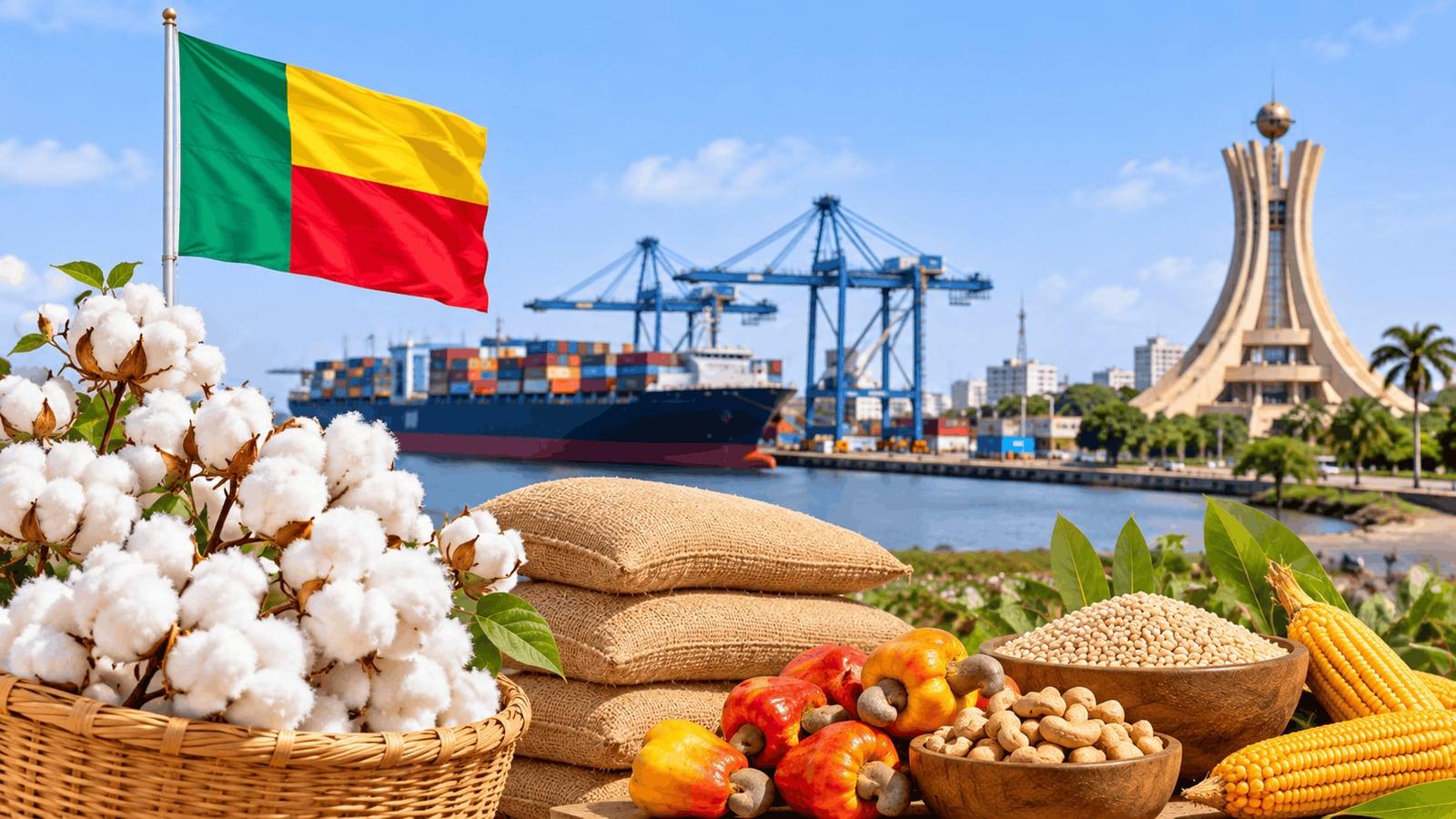
Discover how Benin makes its money through cotton, agriculture, manufacturing, regional trade, the Port of Cotonou and Niger's oil exports.
Benin's economy is built around agriculture, trade, transport, manufacturing and services. Cotton remains one of its most important export products, while the Port of Cotonou connects the country to international markets and provides access to the sea for landlocked neighbours. The country also earns revenue from transporting Niger's crude oil through a pipeline that runs across its territory to the coast.
In recent years, Benin has recorded strong economic growth. The government has invested in industrial projects, encouraged local processing of agricultural products and worked to attract foreign businesses. However, the economy still faces challenges, including a dependence on a few major exports, a large trade deficit, informal employment and security concerns in parts of the north.
To understand how Benin makes its money, it is worth looking beyond its best-known export, cotton. Its economy also depends on the movement of goods across borders, the services that support regional trade and the businesses that supply its domestic market.
This is the thirteenth country profile in our series, Africa's Markets, Country by Country, following Guinea.
Understanding Benin's economy
In this section
Economic growth, however, does not tell us how much people earn or how evenly income is distributed.
Benin is located in West Africa, between Togo and Nigeria, with Burkina Faso and Niger along its northern borders. It has a coastline on the Gulf of Guinea, giving it direct access to maritime trade.
Its location has influenced the way its economy has developed. Benin produces agricultural goods for local consumption and export, but it also provides a route for products moving between the coast and countries further inland. This is particularly important for Niger and Burkina Faso, which do not have direct access to the sea.
The country uses the West African CFA franc (XOF), a currency shared by eight members of the West African Economic and Monetary Union (WAEMU). The currency is pegged to the euro at CFAF 655.957 to €1. This shared currency arrangement supports trade and financial transactions within the monetary union.
Benin's economy has expanded over the past few years. The International Monetary Fund (IMF) estimated that the economy grew by 7.5% in 2025 and forecast growth of 7% in 2026. The African Development Bank published a higher 2025 estimate of 8.1%, reflecting differences in the institutions' data and assessment methods.
The IMF's April 2026 World Economic Outlook put Benin's 2026 GDP at approximately US$27.79 billion, with GDP per person at around US$1,800. These are estimates, rather than final national accounts figures.
Economic growth, however, does not tell us how much people earn or how evenly income is distributed. A large share of Benin's workforce remains in informal employment. The World Bank has reported that informal employment accounts for about 90.1% of employment, while underemployment stands at 72%. These figures point to the difficulty of creating enough stable, productive jobs for the country's population.
1. Cotton is one of Benin's most important sources of export income
In this section
After harvesting, seed cotton is taken to ginning facilities, where the fibre is separated from the seeds.
Cotton has played a major role in Benin's economy for decades. It is grown mainly in the central and northern parts of the country and supports a chain of economic activities involving farmers, agricultural suppliers, transport operators, cotton ginners, exporters and textile manufacturers.
After harvesting, seed cotton is taken to ginning facilities, where the fibre is separated from the seeds. The fibre, known as cotton lint, is the part used by textile manufacturers to make yarn and fabric. The seeds can also be used for other products, including cottonseed oil and animal feed.
For Benin, cotton is particularly important because it is a major export earner. According to the National Institute of Statistics and Demography (INSTAD), uncarded and uncombed cotton generated about CFAF 303.6 billion in export value in 2024. It was the country's leading export product by value that year.
However, cotton production does not remain at the same level every year. Benin produced 533,112 tonnes of seed cotton during the 2025/2026 season. This was considerably lower than the 766,273 tonnes recorded in the 2021/2022 season. The decline was attributed to weather disruptions and attacks by jassid insects, which damage cotton plants and affect yields.
For the 2026/2027 season, the Association Interprofessionnelle du Coton set a production target of 602,773 tonnes. This is a target for the new season, not a confirmed harvest figure.
The fluctuations show one of the risks of depending heavily on an agricultural export. Production can be affected by rainfall, pests, farming costs and access to agricultural inputs. International cotton prices also influence how much the country and its producers earn.
Benin has therefore been looking beyond the export of raw cotton. Rather than sending most of its cotton abroad for processing, the government wants more of the production process to take place within the country. This is part of the reason for its investment in textile manufacturing.
2. Benin wants to earn more from cotton through textile manufacturing
In this section
The textile park is designed to process 40,000 tonnes of cotton lint annually in its first phase.
For a long time, Benin's cotton industry has depended heavily on selling cotton fibre to buyers outside the country. Those buyers then use the raw material to manufacture yarn, fabric, clothing and other textile products.
Each stage of production creates economic value. Spinning turns cotton fibre into yarn. Weaving or knitting turns yarn into fabric. Garment manufacturing uses the fabric to make finished products. When these activities take place in different countries, the income from processing and manufacturing is also spread across those countries.
Benin wants to retain more of that value by expanding its local textile industry.
One of the main projects supporting this plan is the Glo-Djigbé Industrial Zone (GDIZ), located about 45 kilometres from Cotonou. It is a public-private industrial development involving the Beninese government and ARISE Integrated Industrial Platforms (ARISE IIP).
GDIZ is being developed to accommodate several industries, including textiles, cashew processing, soybean processing and other manufacturing activities. The aim is to provide businesses with industrial facilities and infrastructure that can support production for domestic and international markets.
The textile park is designed to process 40,000 tonnes of cotton lint annually in its first phase. It includes three integrated factories with different production capacities, covering activities such as spinning, fabric production and garment manufacturing.
This capacity is important, but it needs to be understood correctly. It describes the park's designed processing capacity, not the amount of cotton already being processed every year. Actual production depends on factory operations, access to raw materials, orders from buyers and other business conditions.
The industrial zone has also attracted interest from international clothing companies. Its published list of partners includes Kiabi, The Children's Place and U.S. Polo. These partnerships are part of the effort to connect Beninese manufacturing with international buyers.
For Benin, the potential benefits extend beyond the sale of clothing. Textile production can create jobs in factory operations, quality control, packaging, maintenance, logistics and other supporting services. It can also create more demand for local suppliers and transport businesses.
However, building factories does not automatically create a successful manufacturing industry. Businesses still need reliable electricity, skilled workers, competitive production costs, access to finance and customers willing to buy their products. Benin will need to keep addressing these issues if it wants its textile industry to compete with established manufacturing countries.
3. Cashew and soybean production provide other export opportunities
In this section
The policy is intended to give local businesses access to raw materials before those products are sent abroad.
Cotton is not the only agricultural product that contributes to Benin's economy. Cashew nuts and soybeans are also important, particularly because the government wants to increase the amount of these crops processed locally.
Cashew production supports farmers, traders, transport operators and processing businesses. The nuts can be processed into edible kernels, which are then packaged and sold to consumers and food businesses. Processing requires several stages, including shelling, drying, peeling, grading and packaging.
When cashew is exported without being processed, the country earns money from selling the raw agricultural product. When it is processed locally, businesses can earn income from the additional work involved in preparing the kernels for sale.
Benin has been trying to expand its cashew processing industry for this reason. The Glo-Djigbé Industrial Zone includes plans for cashew processing as part of its wider agricultural manufacturing activities.
Soybeans also have several uses. They are processed into products for human consumption and animal feed, and they are used by food manufacturers. Local processing can create opportunities for farmers and businesses involved in storage, transport, crushing and food production.
The government has introduced restrictions on the export of raw cashew nuts and grain soybeans to encourage local processing and ensure that domestic industries have access to the crops.
The policy is based on Decree No. 2022-568 of 12 October 2022, which came into effect on 1 April 2024. It does not mean that every export is prohibited under all circumstances. Benin's official export authorisation services explain that exporters may obtain approval once the needs of local processors and other domestic users have been met.
The policy is intended to give local businesses access to raw materials before those products are sent abroad. However, the availability of raw materials alone is not enough. Processing companies need suitable equipment, reliable electricity, finance, workers and buyers for their finished products.
The country will need to keep building these capabilities if it wants to earn more from cashew and soybean production.
4. Other agricultural products support domestic supply and trade
In this section
Without these, crops can be lost after harvest or sold at prices that do not adequately cover production costs.
Agriculture remains an important part of Benin's economy, both as a source of income for households and as a supplier of goods for local markets.
Farmers produce maize, rice, cassava, yams, pineapple, palm products and other crops. Some are mainly consumed within the country, while others are sold through domestic and regional markets.
Food production is particularly important because it affects the cost of living and the amount of food Benin needs to import.
Rice provides a useful example. Benin has local rice production, but domestic supply does not meet all demand. According to INSTAD, rice imports were worth CFAF 428.5 billion in 2024, making rice the country's largest import product by value that year.
This creates an opportunity for local farmers and processors. Improving rice production, milling, storage and distribution could help local businesses supply more of the domestic market.
The same applies to other agricultural products. Increasing production is only one part of the process. Farmers also need access to storage facilities, transport, processing equipment and buyers. Without these, crops can be lost after harvest or sold at prices that do not adequately cover production costs.
Agriculture also supports businesses outside the farm. Transport companies move produce to markets, wholesalers distribute it, processors turn it into other products, and retailers sell it to consumers. These activities contribute to the wider economy even when the goods are not exported.
5. The Port of Cotonou is central to Benin's trade economy
In this section
Businesses in these countries need to use ports in neighbouring coastal countries to import and export goods.
Benin's location along the Gulf of Guinea gives it an advantage in maritime trade. The Port of Cotonou is one of the country's most important economic facilities because it handles goods entering and leaving Benin and provides a route for trade with neighbouring landlocked countries.
The port handles imports such as food, fuel, machinery, vehicles, medicines and consumer goods. It also handles exports, including agricultural products and other goods produced in Benin.
However, its importance goes beyond the country's domestic trade.
Niger and Burkina Faso are landlocked, meaning they do not have direct access to the sea. Businesses in these countries need to use ports in neighbouring coastal countries to import and export goods. Cotonou is one of the ports available to them.
Goods arriving at Cotonou can be transported by road to destinations further inland. Exports from those markets can also travel through the port before being shipped to international buyers.
This creates business opportunities in several areas, including cargo handling, customs services, warehousing, trucking, freight forwarding, shipping and distribution.
The port's cargo figures reflect its role in regional trade. In 2025, it handled 14.7 million tonnes of cargo, compared with 9.6 million tonnes in 2024. This represented an increase of 52.3%. The growth was linked in part to the movement of Niger's crude oil through Benin.
More cargo passing through the port can support businesses involved in moving and handling goods. It can also generate government revenue through customs duties, taxes and port-related charges.
However, the total value or weight of goods passing through the port should not be confused with the amount of money Benin earns from them. Some goods are in transit, meaning they are passing through the country rather than being bought or sold within its domestic market. Revenue comes from the services and charges associated with handling that trade, as well as applicable taxes and duties.
The port's performance also depends on what happens beyond its gates. Road conditions, border procedures, regional relations and security all affect the movement of goods. A disruption at a border can change the routes traders use and the amount of cargo passing through Cotonou.
6. Niger's oil exports provide another source of transit activity
In this section
The full pipeline is approximately 1,980 kilometres long, with about 675 kilometres running through Benin.
Benin's role in regional transport is not limited to general cargo. It also provides a route for crude oil from Niger to reach international markets.
Niger is a landlocked country, so it needs access to a neighbouring country's coastline to export crude oil by sea. The Niger-Benin oil pipeline was developed to connect Niger's Agadem oil fields to an export terminal at Sèmè-Kpodji on Benin's coast.
The full pipeline is approximately 1,980 kilometres long, with about 675 kilometres running through Benin. It transports crude oil from Niger across Beninese territory to the coastal export facilities.
This arrangement gives Niger an export route and gives Benin a role in the transport and handling of the oil.
Benin can earn revenue from transit-related arrangements and services connected to the pipeline and export terminal. The project also supports economic activity around the infrastructure, including operations, maintenance and related logistics.
It is important to be clear about what this means for Benin's economy. The crude oil is produced in Niger, not Benin. The value of Niger's oil exports is therefore not Benin's export revenue. Benin's earnings come from its role in providing the route and related services.
The pipeline has also influenced activity at the Port of Cotonou. The increase in cargo handled in 2025 was partly linked to Niger's oil exports, although the port handles many other types of goods as well.
The project demonstrates how a country can earn from infrastructure and services without producing the commodity being transported. It also shows how closely the economies of neighbouring countries can depend on one another.
7. Benin's major trade partners and what it buys and sells
In this section
The country's large rice imports show that agricultural production does not yet meet all domestic demand.
Benin trades with countries across Africa, Asia, Europe and the Americas. Its largest export destinations are not necessarily its largest import suppliers, because the products it sells abroad differ from the goods it buys.
INSTAD's 2024 foreign trade report provides a useful picture of these relationships.
In that year, Benin's total exports were valued at CFAF 674.7 billion, while imports were valued at CFAF 2,136 billion. This left the country with a trade deficit of CFAF 1,215.7 billion. The deficit was 25.7% lower than in 2023.
A trade deficit occurs when a country spends more on imported goods than it earns from exported goods. It does not mean that the country has no other sources of income. Services, investment, remittances and other financial flows are separate parts of the economy. However, the difference between exports and imports shows the scale of Benin's dependence on imported goods.
Where Benin sells its exports
Asia was the largest destination for Benin's exports in 2024, receiving 68.2% of export value. Africa accounted for 15.1%, while Europe received 10.8%.
Bangladesh was the largest individual export destination, accounting for 43.2% of export value. India received 7.8%, Pakistan 6.8%, Denmark 6.2% and the United States 5.4%. Other destinations included China, Chad, Nigeria, the United Arab Emirates and Togo.
Bangladesh's position is closely connected to cotton. The country has a large textile and garment manufacturing industry, which creates demand for cotton fibre and other textile inputs.
This also shows why Benin's cotton production matters beyond its borders. The crop connects farmers and exporters in Benin to manufacturers and clothing supply chains in other parts of the world.
Where Benin gets its imports
Benin's imports come from a different mix of countries.
In 2024, India accounted for 17.6% of import value, followed by China at 12.5% and France at 9.2%. Nigeria accounted for 5.3%, Togo 5.1% and the United States 5.0%. Other major suppliers included Russia, Côte d'Ivoire, Belgium and the United Arab Emirates.
The products Benin imports include rice, fuel, machinery, vehicles, medicines, industrial inputs and other goods needed by households and businesses.
The country's large rice imports show that agricultural production does not yet meet all domestic demand. Imports of machinery and industrial inputs also reflect the needs of businesses that depend on equipment and materials from abroad.
These trade figures provide a useful starting point for understanding Benin's international economic connections. They also show why the country needs to expand its range of exports and develop more local production if it wants to reduce its dependence on imported goods.
8. Trade with Nigeria has a major influence on Benin's economy
In this section
Informal trade also makes it difficult to measure the full value of economic activity between the countries.
Nigeria is Benin's eastern neighbour and one of its most important regional trading partners.
The two countries share a long land border, and trade between them takes place through formal customs channels as well as informal cross-border markets. Their proximity has made it possible for traders to move agricultural products, manufactured goods, food items and consumer products between the two markets.
Benin has also served as a route for goods imported through the Port of Cotonou and then transported into Nigeria. Some of these transactions involve re-exports.
A re-export occurs when goods are imported into one country and then sent to another without being substantially transformed. For example, a product imported through Cotonou may be transported across the border and sold in Nigeria.
This trade supports several businesses in Benin, including importers, wholesalers, warehouse operators, transport companies, customs agents and small traders.
However, the trade relationship has not always been smooth. In August 2019, Nigeria closed its land borders as part of an effort to tackle smuggling and other cross-border trade problems. The closure disrupted formal trade between Nigeria and its neighbours, including Benin.
Businesses that depended on the movement of goods across the border were affected. The closure also affected customs revenue and trade-related activities in Benin. Nigeria reopened its land borders in December 2020.
Trade between the two countries has continued, but changes in border procedures, import policies and enforcement can affect how goods move. Informal trade also makes it difficult to measure the full value of economic activity between the countries.
The relationship is important for another reason: Benin's trade with Nigeria is connected to the wider movement of goods across West Africa. A disruption at one border can affect traders, transport operators and businesses in neighbouring countries.
9. Regional trade agreements and Benin's access to international markets
In this section
The agreement could create opportunities for Beninese businesses to reach customers in other African markets.
Benin belongs to several regional and international trade arrangements. These agreements can provide opportunities for businesses to sell goods across borders, but they do not remove every barrier to trade.
The West African Economic and Monetary Union
Benin is a member of the West African Economic and Monetary Union, commonly known by its French abbreviation, UEMOA or WAEMU.
The union includes eight countries that share the CFA franc and a common monetary policy. Its members are Benin, Burkina Faso, Côte d'Ivoire, Guinea-Bissau, Mali, Niger, Senegal and Togo.
WAEMU works to support economic integration through common rules, regional trade arrangements and monetary cooperation. For businesses, the shared currency removes the need to exchange currencies when trading between member countries.
However, a shared currency does not mean that every cross-border transaction is free of administrative requirements. Businesses still need to follow customs procedures, tax rules and other regulations that apply to the products they trade.
The Economic Community of West African States
Benin is also a member of the Economic Community of West African States (ECOWAS), which was established to promote economic cooperation and integration across West Africa.
ECOWAS has worked towards reducing trade barriers and supporting the movement of goods and people across the region. Its Trade Liberalisation Scheme provides preferential treatment for eligible products that meet the applicable rules of origin.
Regional integration has faced political challenges in recent years. Burkina Faso, Mali and Niger formally withdrew from ECOWAS on 29 January 2025. All three countries remain members of WAEMU, which means the two regional organisations do not have identical membership.
For Benin, the political changes matter because regional trade depends on cooperation between neighbouring governments. Border restrictions and disagreements can affect transport routes, the movement of goods and businesses that rely on cross-border customers.
The African Continental Free Trade Area
Benin has signed the African Continental Free Trade Area (AfCFTA) agreement. The agreement aims to create a single continental market for goods and services by reducing tariffs and other barriers to trade between African countries.
However, signing and ratifying the agreement are separate steps. Signing indicates a country's support for the agreement, while ratification is the formal domestic approval needed for it to become a party to the agreement.
According to the trade status information available in 2026, Benin had signed the agreement but had not completed ratification. Businesses should therefore check the country's current implementation status and the rules applicable to their products before making decisions based on AfCFTA preferences.
The agreement could create opportunities for Beninese businesses to reach customers in other African markets. This could be particularly relevant for agricultural processing, textiles, food products and manufactured goods.
However, access to a market does not guarantee sales. Businesses still need to meet product standards, understand customs requirements, manage transport costs and compete with suppliers already operating in those markets.
Access to the European Union through Everything But Arms
Benin is classified as a least developed country (LDC). This gives it access to the European Union's Everything But Arms (EBA) arrangement.
Under EBA, eligible products from least developed countries can enter the EU without customs duties or quotas, except for arms and ammunition. Products must still meet the relevant rules of origin, product standards and import requirements.
This can be useful for Beninese agricultural and manufactured products that meet European market requirements. However, the preference does not mean that every product can enter automatically. Exporters need to understand the documentation, quality standards and conditions that apply to their goods.
Access to the United States through AGOA
The African Growth and Opportunity Act (AGOA) is a US trade preference programme that gives eligible sub-Saharan African countries preferential access to the American market for qualifying products.
AGOA has been important to discussions about African exports because it provides eligible countries with an opportunity to sell certain products in the United States under preferential trade conditions.
In February 2026, the US Congress reauthorised AGOA through 31 December 2026, retroactively covering the period from 30 September 2025. This means the programme's extension did not run through 2028, and its position beyond the end of 2026 remains subject to further action by the US Congress.
Businesses considering the US market should check the current eligibility of the country and the specific products they intend to export. Trade preferences are subject to conditions, and access can change when the programme's legal status changes.
10. Tourism and services contribute to Benin's economy
In this section
Benin has historical sites, cultural attractions, natural areas and coastal destinations that attract visitors.
Benin's economy is not built entirely on agricultural exports and trade. Services also support employment and income across the country.
Tourism is one part of this sector. Benin has historical sites, cultural attractions, natural areas and coastal destinations that attract visitors.
Ouidah is known for its history and its connection to the transatlantic slave trade. The town includes sites associated with the history of enslaved Africans and the movement of people from the region across the Atlantic.
Abomey is home to the historic royal palaces of the Kingdom of Dahomey, a UNESCO World Heritage Site. The palaces provide insight into the history, political organisation and cultural life of the former kingdom.
Benin is also an important centre of Vodun, a religion with deep roots in the country. The annual Vodun festival attracts visitors interested in the country's religious and cultural traditions.
In the north, Pendjari National Park is known for its wildlife and protected natural areas. However, security conditions in parts of northern Benin require visitors and tourism businesses to check current travel advice before making plans.
Tourism spending supports hotels, restaurants, guides, transport operators, cultural businesses and local suppliers. Its economic contribution therefore extends beyond the money visitors spend on accommodation.
Other service industries also contribute to Benin's economy. These include retail, telecommunications, banking, construction, education, professional services and transport. They serve households and businesses, create employment and support activity across different sectors.
The services sector is particularly important because not all economic activity is reflected in merchandise export figures. A transport company moving goods between Benin and Niger, for example, earns income from providing a service, even though it is not producing or exporting the goods itself.
11. What businesses should know about operating in Benin
In this section
OHADA provides a common framework for several areas of business law across participating African countries.
Benin has been working to attract investment in manufacturing, agriculture, logistics and other sectors. The government has introduced investment support structures and developed industrial facilities intended to make it easier for companies to establish operations.
The Investment and Export Promotion Agency (APIEx) is one of the institutions involved in supporting investors and exporters. It provides information and services connected to business establishment and investment procedures.
The Glo-Djigbé Industrial Zone is another part of the country's investment strategy. It offers industrial facilities for businesses involved in manufacturing and processing. However, companies considering the zone need to understand the specific requirements of the investment regime under which they intend to operate.
The incentives available to businesses in GDIZ are subject to eligibility conditions. The IMF's analysis of the zone describes different regimes, including an export-processing regime with a requirement for a significant share of turnover to come from exports. The benefits available depend on the relevant regime and investment conditions. They should not be treated as automatic tax exemptions for every company operating in the zone.
Benin is also part of the OHADA business law system. OHADA provides a common framework for several areas of business law across participating African countries. This includes rules relating to commercial companies, business security interests and other aspects of commercial activity.
For companies operating across several OHADA member countries, the shared legal framework can make it easier to understand certain business requirements. However, national tax rules, licences, employment requirements and sector-specific regulations still need to be checked.
Businesses should also consider the practical costs of operating in the country. These include electricity, transport, access to finance, skilled labour, land, suppliers and the time required to complete administrative procedures.
For companies involved in regional trade, the condition of roads and border procedures is particularly important. A business that depends on moving goods between Benin and Nigeria, Niger or Burkina Faso needs to understand the routes available and the regulations that apply at each border.
12. The challenges facing Benin's economy
In this section
Armed groups operating in the wider Sahel region have increased pressure on some communities and border areas.
Benin has recorded strong economic growth and is investing in new industries. However, several challenges could affect how much of that growth translates into higher incomes, stronger businesses and more jobs.
Dependence on a limited range of exports
Cotton remains a major source of export income. While the country is working to expand textile manufacturing and other processing industries, its export earnings remain exposed to changes in agricultural production and international prices.
A poor harvest can affect farmers, exporters and businesses that depend on cotton. Changes in global demand can also influence the price buyers are willing to pay.
Developing more export industries and processing a wider range of agricultural products could help reduce this dependence.
A large trade deficit
Benin imports considerably more goods by value than it exports.
INSTAD recorded exports of CFAF 674.7 billion and imports of CFAF 2,136 billion in 2024. This produced a trade deficit of CFAF 1,215.7 billion, although the deficit was 25.7% lower than in 2023.
The country's imports include goods that households and businesses need, such as rice, fuel, machinery, medicines and industrial materials. Importing these products is not necessarily a problem in itself. However, the difference between the value of imports and exports shows that Benin spends much more on imported merchandise than it earns from selling its own goods abroad.
Expanding domestic production and processing could help the country supply more of its own market and increase the value of goods it exports.
Informal employment and limited access to stable jobs
A large share of Benin's workforce earns a living through informal activities. These include small-scale trading, transport, agriculture and other businesses that may not be fully registered or covered by formal employment arrangements.
Informal businesses provide income and services, but they can face difficulties accessing loans, insurance, training and other forms of support. Workers may also have limited access to social protection.
The World Bank's reported figures of 90.1% informal employment and 72% underemployment show that creating more jobs is not the only challenge. Benin also needs to improve the stability and productivity of the work people already do.
Security concerns in the north
Benin has experienced growing security concerns in parts of its northern region, particularly around its borders with Burkina Faso and Niger.
Armed groups operating in the wider Sahel region have increased pressure on some communities and border areas. These security problems can affect farming, transport, tourism and investment in the affected locations.
The risks are not uniform across the country. Businesses and visitors should assess the specific areas they intend to operate in or visit, rather than treating the entire country as equally affected.
Political and regional uncertainty
On 7 December 2025, Benin experienced an attempted coup. The attempt was unsuccessful, but it raised concerns about security and political stability.
Romuald Wadagni won the April 2026 presidential election with 94.27% of the vote, while Paul Hounkpè received 5.73%, according to the reported official results. Wadagni was sworn in as president in May 2026.
His administration faces the task of maintaining economic growth while addressing security, employment, public finances and the need to expand the country's productive industries.
Relations with neighbouring countries will also remain important. Benin's economy depends partly on the movement of goods through regional corridors. Border closures, political disagreements and changes in trade arrangements can affect the port, transport businesses and traders.
What Benin's economy tells us about doing business in West Africa
In this section
The Port of Cotonou gives Benin a role in moving goods between international markets and landlocked countries.
Benin makes its money through a combination of agricultural production, regional trade, transport, manufacturing and services. Cotton remains one of its most important exports, but the country is also working to process more of its agricultural output locally.
The Port of Cotonou gives Benin a role in moving goods between international markets and landlocked countries. The Niger-Benin oil pipeline adds another source of transit activity, while trade with Nigeria connects Beninese businesses to one of the region's largest consumer markets.
The country's industrial plans offer opportunities in textiles, cashew processing, soybean processing and other manufacturing activities. Agriculture, logistics, tourism and business services also provide areas for investment and business development.
However, companies considering Benin need to look beyond the country's growth figures and investment announcements. They need to understand the cost of operating, the availability of skilled workers, the condition of infrastructure, the regulations that apply to their industry and the markets they intend to serve.
Benin's position gives it access to several West African markets, but access alone does not guarantee a successful business. Companies still need to understand local demand, build reliable supply chains and work within the trade and regulatory arrangements that apply to each market.
The country's ability to earn more from its resources will depend partly on how well it develops local industries, improves the conditions for businesses and creates more productive employment. Its progress in cotton processing, regional logistics and agricultural manufacturing will be important to watch in the coming years.
The next profile in our series is Niger, whose crude oil reaches the sea through the pipeline across Benin.