Foreign investors are putting billions of dollars into Africa every year. They are not, however, coming to the continent for the same reasons.
The 2025 figures make that clear once the headline ranking is examined more closely. According to UN Trade and Development's World Investment Report 2026, Africa received about $70 billion in foreign direct investment, or FDI, in 2025. Egypt attracted about $15.5 billion, making it the continent's largest recipient for the fourth consecutive year. Guinea followed with about $7.8 billion, Mozambique with $5.7 billion, Nigeria with $4 billion, Ethiopia with $3.8 billion, Uganda with $3.4 billion, Morocco with $3.3 billion and Kenya with $3.2 billion. Côte d'Ivoire received about $2 billion, while Ghana and the Democratic Republic of the Congo received about $1.9 billion each. Tanzania recorded about $1.7 billion and Algeria about $1.5 billion.
The ranking becomes more interesting when the countries are placed beside one another.
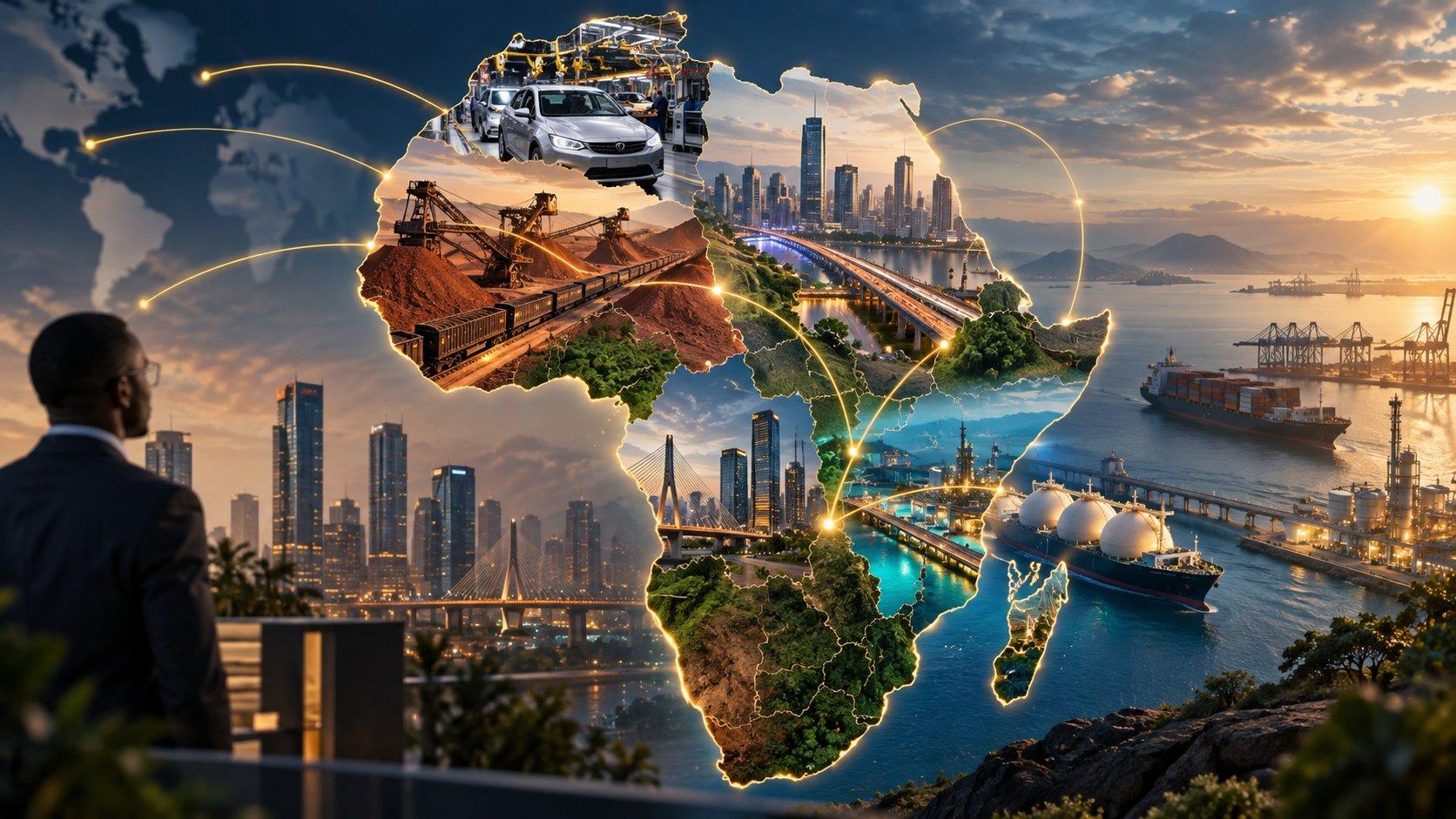
Guinea, with a population of roughly 15 million people, received almost twice as much FDI as Nigeria in 2025 and more than twice as much as Morocco or Kenya. The explanation has little to do with the size of Guinea's domestic consumer market. Much of the money was connected to Simandou, one of the world's largest undeveloped high-grade iron ore deposits, and to the railway and port infrastructure required to move the ore from southeastern Guinea to international markets.
Morocco offers a different proposition. Its investment story is closely connected to its position inside European manufacturing supply chains, particularly automobiles and increasingly electric vehicles and batteries. Egypt offers another proposition again, combining a domestic market of more than 100 million people with its location between Africa, Europe and the Middle East.
The figures therefore tell us where the money went, but they do not tell us what investors were buying.
To understand the ranking, that second question matters.
What the number is measuring
Before comparing countries, it helps to understand what FDI actually measures because the term is often used to describe several different forms of foreign capital.
FDI is a balance-of-payments measure of investment involving a lasting interest in a business or productive asset in another country. In international statistics, an ownership stake of 10 percent or more is normally used as the threshold for identifying a direct investment relationship. FDI flows have three main components: equity investment, reinvested earnings and loans or other financial transactions between a foreign parent company and its foreign affiliate.
The distinction between those components matters.
Suppose a foreign-owned company operates in Nigeria and earns $100 million in profit. If the parent company takes the entire amount out of the country, that money does not become a new FDI inflow simply because the company is foreign-owned. If the company instead retains part of the profit and uses it to build another production line, expand a plant or finance another investment in Nigeria, the reinvested amount can be recorded as FDI.
The money did not necessarily cross the border during that year. It was already being generated inside the country.
The opposite can happen as well. FDI flows are recorded on a net basis, so a country can have a negative FDI figure in a particular period. A foreign investor may sell a stake, repay an intra-company loan or restructure ownership between companies in different countries. Those transactions can produce an outflow even when an operating business remains open and continues employing people.
This is one reason an annual FDI ranking should not be read as a simple league table of countries where factories were built.
It also explains why FDI is different from portfolio investment. When an overseas investor buys government bonds or shares on a stock exchange without establishing a lasting controlling interest in a company, that money is generally classified as portfolio investment rather than FDI. Aid, remittances and ordinary commercial lending are also different categories.
Those distinctions become important in both South Africa and Nigeria, where different investment measures tell very different stories.
Africa's total fell from 2024, but 2024 was an exceptional year
Africa received about $70 billion in FDI during 2025, down from approximately $94 billion in 2024. The fall is substantial, but the 2024 figure needs context because it was heavily affected by a single transaction in Egypt. UNCTAD's 2026 data places 2025 at the continent's third-highest annual FDI level since 1990 and about one-third above its long-term average.
There is also a revision worth knowing about. UNCTAD's 2025 report originally reported approximately $97 billion for Africa in 2024. Its 2026 revised series now places the figure at about $94 billion. The difference comes from revisions to the underlying balance-of-payments data, so the current World Investment Report is the appropriate reference for comparing 2024 with 2025.
The unusual size of the 2024 figure was largely explained by Egypt's Ras El-Hekma development on the Mediterranean coast. In February 2024, an Abu Dhabi-led consortium agreed to invest $35 billion in the development, including $24 billion for development rights and the conversion of $11 billion of existing UAE deposits into investments. Egypt's reported FDI subsequently rose from about $9.8 billion in 2023 to roughly $46.6 billion in 2024.
That does not mean the entire $46.6 billion was the Ras El-Hekma transaction. It means the project was the dominant reason the country's annual inflow became so large.
The distinction matters when comparing 2025 with 2024. Africa's 2025 result was weaker than an exceptional year, but it was not an unusually weak year when placed against the continent's longer history. UNCTAD describes 2025 as the third-highest level since 1990.
The global comparison also puts the African number into perspective. World FDI rose by 6 percent in 2025 to about $1.6 trillion. Africa's roughly $70 billion therefore represented about 4 percent of global FDI. The world's largest investment flows were concentrated in a relatively small group of economies, and UNCTAD notes that the top 20 host economies accounted for more than 80 percent of global FDI.
Africa's challenge is therefore not simply attracting more money. It is attracting investment that creates productive capacity, employment, skills, technology and local supply chains, while spreading investment beyond a small number of countries and sectors. UNCTAD makes this distinction because the size of an FDI flow does not automatically tell us what the investment contributes to the economy.
The largest flows are closely connected to what the world needs to build with
One of the clearest features of Africa's investment landscape is the importance of energy, infrastructure and extractive industries.
UNCTAD's recent investment data shows that strategic sectors have become increasingly important globally. Critical minerals, energy-transition technologies, advanced manufacturing, semiconductors and artificial intelligence infrastructure accounted for 44 percent of global greenfield investment value in 2025, compared with 16 percent in 2020. In Africa, energy, infrastructure and critical minerals have been among the areas attracting significant investment.
Greenfield investment is different from the FDI figure discussed above. It refers to an announced investment in a new operation or facility, such as a new factory, mine or power plant. A greenfield announcement can take years to become an operating project and the amount announced does not necessarily equal the FDI that enters a country in the same year.
That distinction is particularly important in Africa because some of the largest projects require infrastructure on a scale that makes their development expensive and slow.
Guinea's Simandou project illustrates this better than almost any other example.
Guinea is attracting capital because of Simandou
Simandou is a group of high-grade iron ore deposits in southeastern Guinea. Rio Tinto describes it as the world's largest untapped high-grade iron ore deposit, and the project has taken decades to reach production after a long history of ownership disputes, negotiations and infrastructure challenges.
The size of the investment is easier to understand when the infrastructure is included.
The mining deposits are far from Guinea's Atlantic coastline. Moving the ore therefore requires a new railway across the country as well as port infrastructure capable of handling large volumes of mineral exports. The Simandou development involves more than 600 kilometres of new multi-use railway and port facilities. At full capacity, the shared infrastructure is designed to support the export of up to 120 million tonnes of iron ore a year from the two Simandou mining concessions.
Operations began in November 2025, when the project partners marked the start of operations at the port in Forécariah. Rio Tinto subsequently reported the first shipment from Simandou in December 2025. The infrastructure is being developed through partnerships involving the Guinean government, Rio Tinto's SimFer consortium and Winning Consortium Simandou, with the shared infrastructure to be transferred to and operated by the Compagnie du TransGuinéen. The Guinean government holds a 15 percent stake in that infrastructure joint venture.
This helps explain Guinea's $7.8 billion FDI figure.
The investment is tied to an asset that international steelmakers need, but the project also requires the physical infrastructure to connect that asset to global markets. The railway and port are therefore part of the investment proposition. Without them, the ore cannot reach customers at the required scale.
The development also shows why an FDI ranking cannot be interpreted as a ranking of consumer-market attractiveness. Guinea's domestic market is much smaller than those of Egypt or Nigeria, yet its natural-resource endowment can support a project worth billions of dollars because the intended market for the output is global.
That does not mean the project has no domestic economic relevance. Rail construction, mining operations, procurement, employment, government revenue and infrastructure development can all affect the Guinean economy. The more difficult question is how much processing, supplier development and other economic activity will remain in Guinea rather than taking place elsewhere in the iron and steel value chain.
Mozambique's investment story is built around LNG
Mozambique provides another example of resource-led investment, this time around natural gas.
The country attracted about $5.7 billion in FDI in 2025. One of the major developments behind renewed investor activity was the resumption of work on TotalEnergies' Mozambique LNG project in Cabo Delgado.
The project had been placed under force majeure in 2021 following the worsening security situation in northern Mozambique. In November 2025, the Mozambique LNG consortium announced that it was lifting the force majeure and resuming project activities. In January 2026, TotalEnergies and the Mozambican government announced the full restart of onshore and offshore activities. More than 4,000 workers had been mobilised at the Afungi site at that point, including more than 3,000 Mozambican nationals.
The United States Export-Import Bank also approved an amendment in March 2025 to proceed with up to $4.7 billion in financing for equipment and services associated with the integrated LNG project. The financing supports engineering, procurement and construction for the onshore LNG plant and related offshore activities.
The scale of the project explains why movements in Mozambique's investment figures can be large. LNG developments require enormous upfront expenditure on extraction, processing, pipelines, liquefaction facilities, ports and supporting infrastructure before the first cargo is exported.
This is also why it would be misleading to say that the capital is simply "buying gas." Investors are financing an entire system that allows gas reserves to become an exportable product.
The broader economic question is what happens alongside that export activity. Mozambique has the opportunity to develop domestic suppliers, technical skills, infrastructure and related industries around the gas economy. Whether those connections become large enough to diversify the economy is a separate question from whether the LNG project itself attracts investment.
Morocco is attracting investors into European supply chains
Morocco's investment story is different again.
The country attracted about $3.3 billion in FDI in 2025, and manufacturing and automotive activity were among the factors behind its stronger performance.
Morocco has spent years building an industrial ecosystem around automobile manufacturing, supplier companies, logistics and export infrastructure. Renault provides a useful example. The company produced more than 394,000 vehicles in Morocco in 2025, making the country Renault Group's second-largest production platform by volume. About 82 percent of production from its Tangier and Casablanca plants was exported to 63 destinations. Renault also reports nearly 10,000 employees in Morocco and describes the proximity between factories, suppliers and the Tangier port as an important part of the system.
The point is larger than Renault.
A manufacturer choosing where to locate a plant is not only deciding where it can sell cars. It is deciding where it can obtain components, train workers, move finished products, reach customers and integrate the new factory into its existing production network.
Stellantis has continued expanding its Moroccan operations. Its Kénitra plant is being expanded toward total annual production capacity of 535,000 vehicles and micromobility units, including 400,000 cars and 135,000 micromobility units. The company expects local purchases from Moroccan suppliers to exceed €6 billion by 2030 and is targeting a local integration rate of 75 percent.
Morocco is also moving further upstream into electric-vehicle supply chains. Gotion High-Tech's planned battery gigafactory is being developed in phases. The first phase represents an investment of about 12.8 billion Moroccan dirhams, with planned capacity of 20 gigawatt-hours. The Moroccan government says the longer-term plan could reach 100 gigawatt-hours and a total investment of about 65 billion dirhams.
The results are visible in trade data. Morocco's automotive exports reached 58.28 billion dirhams in the first four months of 2026, up 18.6 percent from the same period in 2025. The increase was driven mainly by higher exports in vehicle construction and wiring.
Morocco therefore offers manufacturers access to an established industrial ecosystem, proximity to Europe, trade connections, ports and a growing supplier base. Its domestic market is part of the picture, but the export platform is a major reason international manufacturers have continued expanding there.
Egypt has something different to offer
Egypt's position in the ranking is harder to explain through a single resource or export platform because its investment proposition is broader.
The country attracted approximately $15.5 billion in FDI in 2025, remaining Africa's largest recipient for the fourth consecutive year.
One reason Egypt can attract investments that require a large domestic customer base is its population of more than 100 million. A company selling food, financial services, housing, telecommunications, consumer goods or other products does not need to rely entirely on exports to make a large project commercially meaningful.
Egypt also sits at a geographic point where businesses can connect African, Middle Eastern and European markets. Its Suez Canal position, ports, industrial zones and large urban centres add to that proposition.
The 2024 Ras El-Hekma transaction demonstrated another feature of the Egyptian market: its ability to absorb very large pools of capital in a single project. The $35 billion agreement with the Abu Dhabi-led consortium became the dominant factor behind Egypt's exceptional 2024 FDI result.
The lesson from Egypt is not that a large population automatically produces large FDI. A large population becomes an investment advantage when investors can reach consumers, obtain foreign exchange, build projects at scale and operate within a sufficiently developed business and infrastructure environment.
That is one reason Egypt's investment story looks different from Guinea's. Guinea is attracting capital around a globally traded mineral resource. Egypt can attract capital into projects where the country's own population is part of the commercial opportunity.
An announcement is not the same as money arriving
Tanzania shows why investment reporting needs another distinction.
The Tanzania Investment and Special Economic Zones Authority, TISEZA, registered 915 investment projects worth $10.95 billion in 2025. The figure represents approved or registered investment capital rather than $10.95 billion of FDI recorded as having entered the country during the year. UNCTAD's FDI measure for Tanzania was about $1.7 billion.
Both figures can be accurate because they answer different questions.
A project registration indicates that an investment has been approved or registered at a particular value. The project may be implemented over several years, and the capital may arrive in stages. Some projects can also be delayed, resized or cancelled.
FDI statistics measure the financial flows recorded during a particular year.
The difference becomes easier to understand through individual projects. Barrick reported that it had injected $558 million into the Tanzanian economy during the first half of 2025 as part of its wider operations and investment through the Twiga partnership. The company also reported that more than 90 percent of its procurement was from Tanzanian suppliers and that 96 percent of its workforce was Tanzanian.
Lifezone Metals provides another example. The company raised $75 million during the second half of 2025 to fund pre-final-investment-decision work at the Kabanga nickel project. That money supported activities including drilling, site preparation and project-readiness work, while coordination continued around electricity and rail infrastructure.
These projects show what Tanzania is trying to build around its mineral resources. The country is attracting investment into gold, nickel and other minerals, while also trying to develop the infrastructure needed to process and transport them.
The $10.95 billion project-registration figure and the $1.7 billion FDI figure should therefore never be presented as competing claims. One describes the value of projects registered during the year. The other describes recorded FDI flows.
Ethiopia shows why opening a sector does not remove every investment barrier
Ethiopia presents a different case because some of its most important investment developments have come through policy reform.
In July 2024, Ethiopia moved toward a market-determined exchange-rate system, replacing a system that had maintained an official exchange rate substantially different from conditions in the foreign-exchange market. The country also began implementing a broader economic reform programme supported by the International Monetary Fund.
The financial-sector changes have been particularly significant. Ethiopia's Banking Business Proclamation No. 1360/2025 created a legal framework for foreign investment in banking, including foreign-bank subsidiaries and branches. The National Bank of Ethiopia subsequently issued licensing requirements covering foreign investors and representative offices of foreign banks.
The Ethiopian Securities Exchange also began operations in January 2025, giving the country a formal securities market after more than five decades without a functioning stock exchange. That matters because a securities market gives companies another way to raise capital and gives investors a mechanism for buying and selling financial assets locally.
These reforms were accompanied by substantial external financing. Ethiopia's IMF programme provides about $3.4 billion over four years. The World Bank also provided $1.5 billion in budget support during 2024/25, with further support programmed under the reform programme.
Ethiopia's FDI was approximately $3.8 billion in 2025. One of the largest industrial investments announced during the year was the Dangote Group and Ethiopian Investment Holdings fertiliser project in Gode. The shareholders' agreement, signed in August 2025, values the project at $2.5 billion and gives Dangote a 60 percent stake and Ethiopian Investment Holdings a 40 percent stake. The planned complex is designed to produce up to three million tonnes of urea fertiliser a year.
The banking reforms also show why changing the law is only one part of attracting investment.
A foreign bank deciding whether to enter Ethiopia needs to know more than whether the sector is legally open. It needs to understand how it will fund operations, convert and repatriate earnings, access foreign currency, manage credit risk and operate within the country's financial system.
Ethiopia has made progress on some of these issues, but the adjustment is still underway. IMF data shows gross international reserves rose from about $1.4 billion, equivalent to 0.7 months of prospective import coverage, at the end of 2023/24 to about $4.4 billion, or 1.9 months of import coverage, at the end of 2024/25.
Debt restructuring remains part of the process. IMF analysis has estimated that Ethiopia requires several billion dollars in debt relief over the programme period to close financing gaps and reduce its external debt vulnerabilities.
The broader lesson from Ethiopia is that investment reform happens in stages. Opening a market can make an opportunity legally possible. Investors still have to decide whether the financial and operating conditions make that opportunity workable.
South Africa shows why a negative FDI figure does not mean investment has stopped
South Africa provides perhaps the clearest example of why annual FDI flows should not be confused with the health of an entire economy.
South African Reserve Bank data shows that direct investment liabilities moved from an inflow of R43.5 billion in 2024 to an outflow of R41.4 billion in 2025. The second quarter of 2025 recorded an outflow of R73.5 billion, with the movement linked primarily to Anglo American's disposal of equity in Valterra Platinum.
The number therefore tells us that the financial relationship between foreign investors and South African companies changed substantially during the year. It does not mean that South Africa suddenly stopped receiving foreign investment or that factories across the country closed.
Corporate restructurings can produce very large changes in FDI statistics because the statistics record ownership and financial relationships as well as new physical investment.
The same principle appeared in reverse in 2021, when the Naspers and Prosus corporate restructuring produced an exceptionally large South African FDI flow. A single corporate transaction can therefore change the annual headline dramatically even though the underlying productive economy has not changed by the same proportion.
South Africa's position in the 2025 ranking needs to be read with that history in mind.
Nigeria shows the difference between foreign capital and foreign direct investment
Nigeria presents almost the opposite statistical problem.
UNCTAD recorded approximately $4.0 billion in FDI in Nigeria in 2025. Nigeria's National Bureau of Statistics, however, recorded total capital importation of about $23.22 billion for the same year. At first glance, those numbers seem difficult to reconcile.
They are measuring different things.
NBS recorded about $19.74 billion in portfolio investment, representing approximately 85 percent of total capital importation. Foreign direct investment was about $923 million. The banking sector received the largest share of total capital imported into the country.
Portfolio investors were therefore responsible for most of the foreign capital entering through Nigeria's capital-importation system in 2025. They were investing in financial assets, particularly money-market instruments, bonds and equities. FDI was much smaller in the NBS series.
UNCTAD's FDI measure includes reinvested earnings and transactions between foreign parent companies and their Nigerian affiliates. NBS's capital-importation statistics capture capital imported through the Nigerian banking system. Some foreign-owned companies can therefore generate FDI through reinvested earnings or intra-company financial transactions without those amounts appearing as new capital importation through the same channel.
The difference between the two figures should therefore not be interpreted as an error in either dataset.
It also tells us something about the type of foreign capital Nigeria attracted during 2025. The country was able to attract a large amount of overseas money, but much of it was portfolio capital rather than new long-term direct investment.
That distinction becomes clearer when Nigeria is compared with Kenya.
Kenyan startups raised about $984 million in debt and equity funding in 2025, according to Africa: The Big Deal. That represented roughly 32 percent of the $3.2 billion raised by African startups during the year. Energy companies and consumer-credit businesses were among the significant recipients of the Kenyan funding.
Startup funding is not FDI. It is a different form of capital with a different risk profile and different expectations about growth and returns.
A venture investor backing a Kenyan energy company may be betting on the company's expansion across several African markets. A portfolio investor buying Nigerian government securities is making a different calculation about interest rates, currency and financial returns. A mining company building a new operation in Guinea is making a longer-term calculation about mineral reserves, infrastructure and global commodity demand.
Putting all three into a single category called "foreign investment" can hide more than it reveals.
What each market is actually offering
Read together, the 2025 figures describe several different investment propositions across Africa.
Guinea, Mozambique, the Democratic Republic of the Congo and Tanzania are attracting significant capital around natural resources and the infrastructure needed to extract, process or export them. The commercial opportunity is connected to assets such as iron ore, natural gas, gold, nickel and other minerals that have value in international markets. The domestic consumer market can be important to the wider economy, but it is not the main reason a company develops a multibillion-dollar mine or LNG facility.
Morocco has built a different proposition around its location in international manufacturing supply chains. Automotive companies can manufacture there, source components locally, connect factories to ports and export finished products to European and other international markets. The growth of battery manufacturing suggests that this model is beginning to extend beyond conventional vehicle assembly into parts of the electric-vehicle supply chain.
Egypt combines several advantages. Its population gives companies access to a large domestic market, while its location and infrastructure provide connections to Europe, the Middle East and other African markets. Its ability to absorb very large real-estate, infrastructure and industrial projects also makes it one of the few African economies where a single investment can move the national FDI figure by tens of billions of dollars.
Ethiopia is building a proposition around economic reform, industrial development and the potential of a large domestic economy. The opening of banking to foreign investment is significant because it gives international financial institutions access to a market that was previously closed to them. The challenge is turning regulatory reform into an operating environment where investors can move capital, manage foreign exchange and plan for the long term.
Kenya occupies another part of the investment landscape. Its FDI total is smaller than Egypt's or Guinea's, but its financial system, technology ecosystem, regional connectivity and startup market have helped it attract capital that does not always appear in traditional FDI statistics.
These differences explain why a simple ranking can be misleading.
A country can rank highly because it has a mineral deposit. Another can rank highly because it has a huge domestic market. Another can attract manufacturers because it provides access to a larger export market. Another may attract technology investors because its financial and digital infrastructure makes it a useful regional base.
The investment numbers only become meaningful when the reason behind the money is understood.
What happens after the money arrives matters just as much
The size of an FDI inflow is useful, but it does not tell us how much value an economy captures from that investment.
A mine can create employment, taxes, local procurement and infrastructure while still exporting an unprocessed commodity. A manufacturing plant can create a network of suppliers and technical jobs, or it can operate as an isolated assembly facility that imports most of its components. An LNG project can generate government revenue and technical expertise while leaving the wider economy highly dependent on one commodity.
This is why UNCTAD places increasing emphasis on the development impact of investment. Its 2026 report notes that FDI contributes more strongly to development when it builds productive capacity, jobs, skills and technology transfer.
The distinction is particularly important for resource-rich countries.
Simandou can turn Guinea into a much larger iron ore exporter, but the longer-term economic effect will depend partly on what develops around the mine and railway. Will local businesses become suppliers? Will workers acquire skills that are useful outside the mine? Will infrastructure serve other economic activities? Will more processing eventually occur in Guinea? These are questions about the economic structure created around the investment rather than the investment figure itself.
Morocco offers a different example because its automotive strategy has deliberately built connections between multinational manufacturers and local suppliers. Renault's supplier ecosystem and Stellantis's local-sourcing targets illustrate how an investment can become part of a wider industrial network.
Tanzania is working through a similar question in mining. Barrick's reported procurement from Tanzanian suppliers shows one route through which mining investment can create domestic economic activity. Lifezone's work on Kabanga also involves infrastructure, environmental preparation, local engagement and technical development before the mine reaches a final investment decision.
The amount of money entering a country is therefore only the beginning of the investment story.
The next questions are where that money goes, who supplies the project, who gets the jobs, what skills remain in the country, what infrastructure becomes available to other businesses and how much of the value generated by the investment stays within the economy.
What the 2025 numbers actually tell us
The countries at the top of Africa's FDI ranking are not all competing for the same investor.
Guinea's $7.8 billion is largely part of a resource and infrastructure story built around Simandou. Mozambique's $5.7 billion is closely connected to major energy developments. Morocco's $3.3 billion reflects its position within manufacturing and export supply chains. Egypt's $15.5 billion reflects a combination of domestic-market scale, infrastructure, real estate, energy and its geographic position. Ethiopia's $3.8 billion sits within a market undergoing substantial economic and regulatory reform. Nigeria's $4 billion FDI figure looks very different when placed beside the country's $23.22 billion total capital-importation figure, because most of that broader inflow was portfolio investment rather than FDI.
The figures also show why investment announcements should be read carefully. Tanzania registered $10.95 billion in investment projects in 2025, while UNCTAD recorded $1.7 billion of FDI flows. The two numbers describe different stages of investment and should not be used interchangeably.
Africa's investment story in 2025 was therefore not simply about which countries were most attractive to foreign investors. It was about the particular assets, markets and connections each country could offer.
For some investors, the attraction was under the ground. For others, it was the factory floor, the port, the railway, the consumer market or the ability to serve several countries from one location.
The ranking tells us where the money went. Understanding what investors were buying tells us much more about why it went there, what could keep it there and what African economies can build around it.
The next stage of the story is not only whether Africa can attract more foreign capital. It is whether countries can turn individual investments into wider industrial capacity, stronger local businesses, better infrastructure and skills that remain useful long after a mine is exhausted, a gas field declines or a particular manufacturing contract ends.