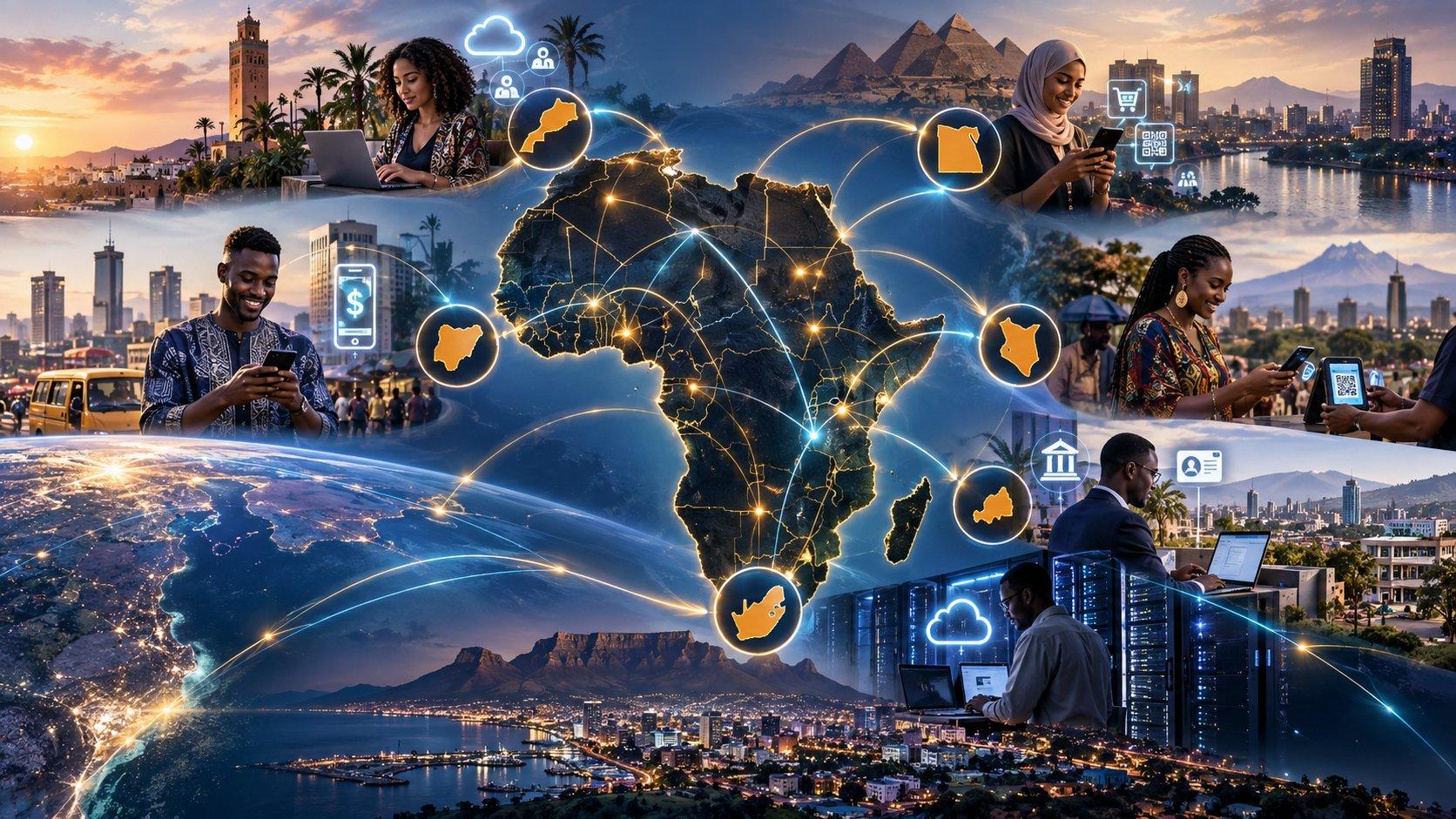
Africa's digital economy is not being built in one country, and it is not developing in the same way everywhere.
Morocco entered 2026 with more than nine in ten people using the internet. Kenya had a much lower share of its population online, yet millions of people there had already spent years paying shops, sending money and receiving payments through their phones. Nigeria had more internet users than any of the other countries in this comparison and an instant-payment system handling billions of transactions every year. South Africa had become the main African base for the large cloud-computing systems built by companies such as Amazon, Microsoft and Google. Egypt was connecting almost 100 million internet users to a rapidly growing national payment system, while Rwanda had placed hundreds of government services online even though only about a third of its population used the internet.
They are all building digital economies, but they have taken different routes.
At the end of 2025, Morocco had an estimated 35.5 million internet users, representing 92.2 percent of its population. Egypt had 98.2 million users, or 82.7 percent of its population, while South Africa had 51.7 million users, representing 79.6 percent. Nigeria had 109 million people online, the largest number among the six countries, but because Nigeria has a much larger population, those users represented only 45.5 percent of the country. Kenya had 23.4 million internet users, or 40.5 percent of its population, while Rwanda had 5.01 million, representing 34.2 percent.
Those numbers tell us how many people can get online. Once payments, businesses, data centres, government services, investment and skilled workers are added, the countries begin to look quite different.
Kenya is a good place to begin because its internet penetration is nowhere near Morocco's, Egypt's or South Africa's, yet it has built one of Africa's most established digital financial systems.
Kenya turned mobile money into an everyday habit
M-PESA began in Kenya in 2007 with a fairly simple proposition: people could use a mobile phone to send money to someone else.
That solved a practical problem in a country where having access to a mobile phone was becoming far more common than having easy access to a bank branch. A customer could give cash to an M-PESA agent, have the money credited electronically to a mobile wallet and send it to another phone number. The recipient could keep it electronically, spend it or withdraw cash from another agent.
A smartphone was not required. Neither was a debit card.
Over the years, what started as a way of transferring money became part of a much larger financial system. People could pay businesses, settle bills, receive salaries, access credit, save and move money between different services.
By the financial year ending in March 2026, Safaricom reported 40.99 million one-month active M-PESA customers in Kenya. More than KSh41.68 trillion passed through the service during the year across more than 46 billion transactions. Safaricom also reported more than 1.04 million businesses using Lipa na M-PESA tills and more than 2.09 million Pochi La Biashara merchants, a service designed for smaller businesses that want to keep business money separate from personal funds.
KSh41.68 trillion is several times the size of Kenya's annual economic output, but payment volume and GDP are measuring different things. GDP counts the value of goods and services produced. A payment platform counts money each time it moves, so the same shilling can appear in several transactions during the year.
The frequency of those transactions says more about Kenya's digital economy than the enormous headline figure does.
A customer may use M-PESA to buy groceries in the morning, pay transport later in the day and send money to a relative that evening. A small trader who may never have installed a card terminal can still receive digital payments from customers. Someone using a basic handset can participate without needing the kind of continuous internet access that an online banking app would require.
Kenya reached that point gradually. Almost two decades of using mobile money have produced something that cannot be measured by internet penetration alone: familiarity.
Across the wider mobile-money industry, that level of regular use is not guaranteed. GSMA recorded 2.3 billion registered mobile-money accounts worldwide in 2025, but 593 million were active during a typical 30-day period. The global monthly activity rate was 25.7 percent. More than $2.1 trillion passed through mobile-money services during the year, while merchant payments alone reached $155 billion.
Opening an account is one stage. Getting people to use it repeatedly is another.
Kenya has had years to build that habit.
Nigeria built around instant bank transfers and agents
Nigeria's system developed differently.
Mobile money exists in Nigeria, but much of the country's digital-payment growth has come from instant bank transfers, fintech apps and the huge network of PoS agents that now operate in cities, towns and neighbourhoods across the country.
At the centre of that system is NIBSS Instant Payment, or NIP, which was introduced by the Nigeria Inter-Bank Settlement System in 2011. It allows money to move between participating financial institutions in real time and operates around the clock.
Nigeria processed about 11.2 billion electronic transactions worth approximately ₦1.07 quadrillion in 2024, up from 9.7 billion transactions worth about ₦600 trillion in 2023. NIBSS says its instant-payment platform handles the bulk of those payments.
By November 2025, AfricaNenda had classified NIP as the first African instant-payment system to reach the highest, "mature", level on its inclusivity spectrum. The assessment considers more than transaction volume. It looks at whether a system can support different types of payments, how accessible it is, what it costs users, whether different financial providers can participate and how disputes and consumer protection are handled.
The payment network is also visible on Nigerian streets.
By March 2025, about 5.9 million PoS terminals were active or deployed in the country, compared with roughly 2.4 to 2.6 million during the same period a year earlier. Transactions through PoS terminals reached about ₦10.45 trillion in the first quarter of 2025, compared with approximately ₦3.62 trillion in the first quarter of 2024.
A PoS terminal in Nigeria is often doing more than accepting payment for goods. Agents use the terminals to provide withdrawals, transfers, deposits and other services. In places where a bank branch is distant or inconvenient, a kiosk or neighbourhood shop can function as a small financial-service point.
Nigeria ended 2025 with 109 million internet users, but more than half of the country's population was still offline according to DataReportal's estimate. The growth of electronic payments has not waited for that gap to disappear. Bank transfers, USSD services, agents and mobile applications have developed alongside one another, allowing different types of customers to enter the system in different ways.
There are still obvious weaknesses. Failed transactions, fraud, telecommunications problems and uneven access continue to affect customers and businesses. NIBSS itself acknowledges periodic network and power constraints even as settlement speeds and system reliability have improved.
Nigeria's digital identity system is still expanding. NIMC reported 123.9 million unique NIN enrolment records by October 31, 2025, up from about 121.4 million at the end of June. The government has continued nationwide enrolment efforts in 2026, including programmes intended to bring registration closer to communities.
The difference between Nigeria's payments and identity systems is striking. One has already reached enormous transaction volumes, while the other is still trying to extend a common identity layer across a population of well over 200 million people.
Egypt is putting a national payment system behind a large connected population
Egypt began from another position entirely.
It entered 2026 with an estimated 98.2 million internet users. At 82.7 percent penetration, the country combined one of Africa's largest populations with one of the largest connected populations on the continent.
The Central Bank of Egypt launched the country's Instant Payment Network in April 2022, with InstaPay giving customers a way to send money instantly between participating accounts.
Growth was rapid. During 2024, the Instant Payment Network processed close to 1.5 billion transactions worth about EGP2.9 trillion. Around 12.5 million people had registered for InstaPay by the end of that year.
The payments network has grown alongside a broader expansion in formal financial access.
By June 2025, 53.8 million Egyptians aged 15 and above owned and actively used some form of transaction account, including bank accounts, Egypt Post accounts, mobile wallets and prepaid cards. That represented 76.3 percent of the country's 70.5 million eligible adults, up from 74.8 percent six months earlier.
Egypt's digital economy is developing on several layers at once. A large share of the population is already online, more adults are using formal financial accounts and the country has built domestic infrastructure for moving money instantly.
The customer base also changes the kind of digital businesses that can grow there. A company does not only see a country of more than 100 million people. It sees tens of millions of people who are already connected to the internet and an expanding group who can transact electronically.
That does not remove Egypt's wider economic challenges. Inflation, currency changes and pressure on household incomes still affect what people can spend. Digital access increases the number of customers a company may be able to reach, but it does not decide how much those customers can afford.
Still, very few African markets combine Egypt's population size with this level of internet use and national payment infrastructure.
South Africa has become the continent's main base for large-scale cloud infrastructure
South Africa's digital economy looks different again because a large part of its strength sits behind the services that consumers actually see.
Amazon Web Services opened its Cape Town region in April 2020, the first AWS cloud region on the African continent. Google opened its first African cloud region in Johannesburg in January 2024. Microsoft already had enterprise data-centre infrastructure in Johannesburg and Cape Town and announced in March 2025 that it would spend another ZAR5.4 billion expanding its cloud and artificial-intelligence infrastructure in South Africa by the end of 2027.
Cloud regions are easy to overlook because most customers never see them.
A banking app, online shop, streaming service or government platform needs computers somewhere to process requests and store information. Before major providers built infrastructure on the continent, African companies often depended more heavily on servers located in Europe or other regions. Hosting services closer to users can reduce delays, and local infrastructure can also help businesses dealing with rules about where certain types of information may be stored.
South Africa now hosts infrastructure that businesses elsewhere on the continent can also use.
The country already had many of the institutions required to support that growth: large banks, telecommunications companies, universities, corporate customers, professional-services firms and a relatively mature technology industry. Internet penetration stood at 79.6 percent at the end of 2025, representing about 51.7 million users.
Software talent has developed around the same ecosystem. A 2026 analysis by Boston Consulting Group, based mainly on GitHub activity, estimated that Africa had about 4.7 million developers in 2024. South Africa, Egypt and Nigeria had the largest developer populations in absolute terms.
There are limits to what those numbers say. GitHub activity includes students, researchers and self-taught programmers as well as people formally employed as software engineers, so it should not be read as a labour-force count.
It does give a comparable picture of where software-building communities are developing.
South Africa's advantage is not that every part of the population has equal access to technology. The country continues to deal with severe income inequality, and the affordability of devices and connectivity still shapes who can participate fully online. What South Africa has built more deeply than most other African markets is the business infrastructure behind digital services: cloud computing, enterprise technology, professional talent, finance and a large base of corporate customers.
Morocco has connected digital infrastructure to an export industry
Morocco had the highest internet penetration of the six countries at the end of 2025, with 35.5 million users representing 92.2 percent of its population.
A large part of its digital economy is also designed to earn money from customers outside Morocco.
The country's offshoring industry provides services for foreign businesses in areas such as information technology, customer support, business-process outsourcing, engineering, data work and other professional services. French companies are an obvious market because of language and geography, but the industry extends beyond France.
Morocco's Ministry of Digital Transition reported 148,500 jobs in the offshoring sector at the end of 2024, with service exports worth MAD26.22 billion. More recent ministry information says export revenue exceeded MAD27 billion in 2025. Under the Digital Morocco 2030 strategy, the government wants the sector to reach about 270,000 jobs and approximately MAD40 billion in annual export revenue by 2030.
The country is in a convenient time zone for serving European businesses and has a multilingual workforce that can operate in French, Arabic, English and, in parts of the market, Spanish. High internet penetration means the basic connection required for digital work is already widespread.
Morocco's developer community has been expanding as well.
BCG's 2026 analysis found that South Africa, Egypt and Nigeria had the largest developer populations in Africa, but population size changed the picture once the numbers were compared per 1,000 inhabitants. Kenya had a higher developer density than Nigeria despite having a far smaller population. Morocco, Kenya and Tunisia stood out for their combination of developer scale and growth, while Morocco also had one of the stronger concentrations of African developers working in artificial intelligence, machine learning and data science.
Morocco is not relying only on its domestic consumer market to justify its digital investment. A developer in Casablanca may be building software for a European company. A customer-service team in Rabat may spend its day serving customers in France. An engineering team can generate export revenue without a physical product leaving a Moroccan port.
The country is effectively exporting hours, expertise and technical work.
That business remains competitive rather than guaranteed. Outsourcing work can move when another market offers a better mix of price, skills and service. Morocco has to keep producing workers with the languages and technical abilities international companies need if it wants to reach the government's 2030 targets.
Rwanda put government services online while household connectivity was still catching up
Rwanda's numbers look quite different from Morocco's.
Only about 5.01 million people were using the internet at the end of 2025, giving the country an internet penetration rate of 34.2 percent.
Yet Rwanda has spent years building digital systems inside government.
IremboGov was launched in 2015 to give citizens a single platform for accessing public services. By July 2025, 248 services from almost 40 institutions had been digitised through the platform. These include frequently requested civil documents such as birth, marriage and single-status certificates.
The system also uses agents because putting a service online does not mean every citizen suddenly owns the right device or knows how to complete the process alone. Irembo says its network of agents covers all sectors of the country, helping people who lack digital skills or confidence access services. Some services are also available through USSD for people using feature phones.
The United Nations Economic Commission for Africa reported in 2026 that IremboGov had processed more than 25 million applications since launch, with transactions worth about $300 million. The platform was handling roughly 300,000 to 500,000 applications a month.
Rwanda has also been trying to narrow the skills gap that sits between building digital services and getting people to use them independently.
Since 2017, the Digital Ambassadors Programme has trained more than 4.5 million Rwandans, according to RISA (Rwanda Information Society Authority), while the country's basic digital literacy rate has risen from 8.9 percent in 2017 to more than 75 percent, and Rwanda's current strategy aims for universal digital literacy by 2029.
That is a different route from Kenya's. Kenya's most recognisable digital system grew around payments made by consumers. Rwanda pushed digital services through government and then built ways for people with different levels of connectivity and digital skill to access them.
The country's smaller population also means the scale is different. Rwanda cannot produce Nigeria's transaction volumes or Egypt's number of connected consumers. Its experience is more relevant to questions about digital government, public-service delivery and how a state can build common platforms before internet use becomes close to universal.
The startup money remains concentrated
Another part of the digital economy can be seen in where investors keep putting their money.
In 2025, four countries again dominated disclosed African startup funding: Kenya, Egypt, South Africa and Nigeria.
Africa: The Big Deal, which tracks startup funding rounds of at least $100,000, calculated that the four countries received 82 percent of all startup funding raised on the continent during the year. Together, they account for roughly 30 percent of Africa's population and about 40 percent of its nominal GDP, so startup capital was much more geographically concentrated than either people or economic output.
Kenya led in total funding with approximately $984 million. Egypt raised about $614 million and South Africa around $600 million. Nigeria raised approximately $343 million and was the only member of the group to record a fall from the previous year.
The totals do not all represent the same type of money.
A significant part of Kenya's funding came through debt, particularly in energy and climate-related businesses. More than 90 percent of South Africa's roughly $600 million was equity, giving it the largest equity total on the continent under Africa: The Big Deal's methodology. Nigeria recorded many individual deals even as its overall funding declined.
Startup databases also produce different totals because they do not all count debt, grants, exits and smaller transactions in the same way. It is safer to use one tracker consistently for a comparison than to take one country's figure from one database and another country's figure from somewhere else.
The broader pattern has been unusually persistent. Africa: The Big Deal says the same four countries have taken between 80 and 86 percent of African startup funding every year since 2019.
Capital tends to return to places where an ecosystem already exists. Lagos, Nairobi, Cairo, Johannesburg and Cape Town have founders who have built companies before, investors who understand the local market, lawyers and advisers familiar with startup transactions, established companies that can become customers, and workers who can move from one technology business to another.
Once enough of those pieces gather in one place, the next company does not have to build everything from the beginning.
The largest country does not necessarily have the deepest talent pool
Technical talent follows a similar pattern.
Africa's developer population remains small in global terms. BCG estimated 4.7 million developers across the continent in 2024, compared with 73.9 million in Asia, 27.5 million in Europe and 24 million in North America.
Africa was growing from a much smaller base, but the number of developers increased by an estimated 21 percent a year between 2019 and 2024, the fastest rate of any continent in BCG's analysis.
Population alone did not determine where those developers appeared.
South Africa, Egypt and Nigeria had the largest absolute communities. Nigeria, however, had fewer developers per 1,000 people than Kenya. Morocco also performed strongly once both the size and growth of its developer community were considered.
For a company hiring engineers, the difference can become very practical.
A country may have a huge population and still have a relatively small pool of people with a particular technical skill. Another country with fewer people may have a denser community because universities, training programmes, technology companies and investment have been concentrated in the same cities for years.
The concentration within countries is important too. Nigeria's technology industry is not distributed evenly across more than 200 million people. Much of it is concentrated in Lagos and a small number of other cities. Kenya's technology industry is similarly centred around Nairobi, while Morocco's strongest developer communities include Casablanca, Rabat and the emerging ecosystem around Benguerir.
A national headcount can hide those clusters.
Six countries, six different digital economies
Put the six countries beside one another and there is no single model for building a digital economy.
Kenya spent almost two decades making mobile money normal enough to use for everyday purchases. Nigeria built a huge instant-transfer system around banks, fintech companies and agents. Egypt combined a large connected population with national payment infrastructure and rapidly rising financial inclusion.
South Africa became the main African location for hyperscale cloud infrastructure and developed one of the continent's deepest corporate technology markets. Morocco used connectivity, languages and proximity to Europe to build an export industry around digital and professional services. Rwanda moved government services online and then built agent networks and digital-literacy programmes to help more people use them.
Even their weaknesses do not line up neatly.
Kenya still has millions of people outside regular internet use. Nigeria's payment system is far ahead of full internet and digital-identity coverage. South Africa's advanced infrastructure exists inside one of the world's most unequal societies. Morocco's offshoring industry competes with other service-export markets for international contracts. Egypt has had to expand its digital economy through a period of high inflation and wider macroeconomic pressure. Rwanda has built public digital infrastructure faster than household connectivity and device ownership have spread.
Internet penetration remains important. None of these systems can keep expanding indefinitely without affordable connectivity. But connectivity is the foundation rather than the finished economy.
What comes after it is where the countries begin to separate.
Can a customer pay?
Can a small business receive that payment without expensive equipment?
Can a company find engineers and other technical workers locally?
Can businesses process and store data close to their customers?
Can citizens interact with government without spending a day moving between offices?
Can a startup find investors who understand the market?
Can digital services reach people who own only basic phones, or people who need help using them?
Kenya, Nigeria, Egypt, South Africa, Morocco and Rwanda answer those questions differently, which is why simply arranging them from highest to lowest internet penetration would miss most of the story.
Africa's digital economy is being built through payments in one market, cloud infrastructure in another, exported services somewhere else and digital government in another. The countries that keep appearing in discussions about the continent's digital future have usually spent years developing one or more of those systems until businesses and consumers could begin building on top of them.
For companies, that makes the comparison more practical than asking which country is "the most digital".
A business built around consumer payments may find Kenya or Nigeria especially interesting. A company handling large amounts of corporate or regulated data will look more closely at South Africa. Morocco offers a different proposition to a business looking for multilingual technology or support teams serving international clients. Egypt combines population and connectivity at a scale few markets can match, while Rwanda offers a smaller market where government digitisation has moved particularly far.
The answer changes with the business.
And that leads into the next question: what makes an African country a good market for business in the first place?
A strong digital economy can make a country easier to enter and easier to serve, but it is only one part of the decision. Population, purchasing power, infrastructure, regulation, logistics, regional access and the cost of actually reaching a customer still have to fit together.
Sources and further reading
DataReportal, Digital 2026 country reports for Morocco, Egypt, South Africa, Nigeria, Kenya and Rwanda.
GSMA, State of the Industry Report on Mobile Money 2026.
Safaricom PLC, FY2026 annual reporting and M-PESA operating data.
Nigeria Inter-Bank Settlement System and AfricaNenda Foundation, Nigerian electronic-payment and NIP data.
Central Bank of Egypt, Instant Payment Network and financial-inclusion statistics.
Amazon Web Services, Google Cloud and Microsoft, South African cloud-infrastructure announcements.
Morocco Ministry of Digital Transition and Administrative Reform, offshoring-sector data and Digital Morocco 2030 targets.
Irembo and Rwanda Information Society Authority, digital-government and digital-literacy data.
Africa: The Big Deal, 2025 in Review.
Boston Consulting Group, Develop the Developers: A Strategic Priority for Africa, 2026.