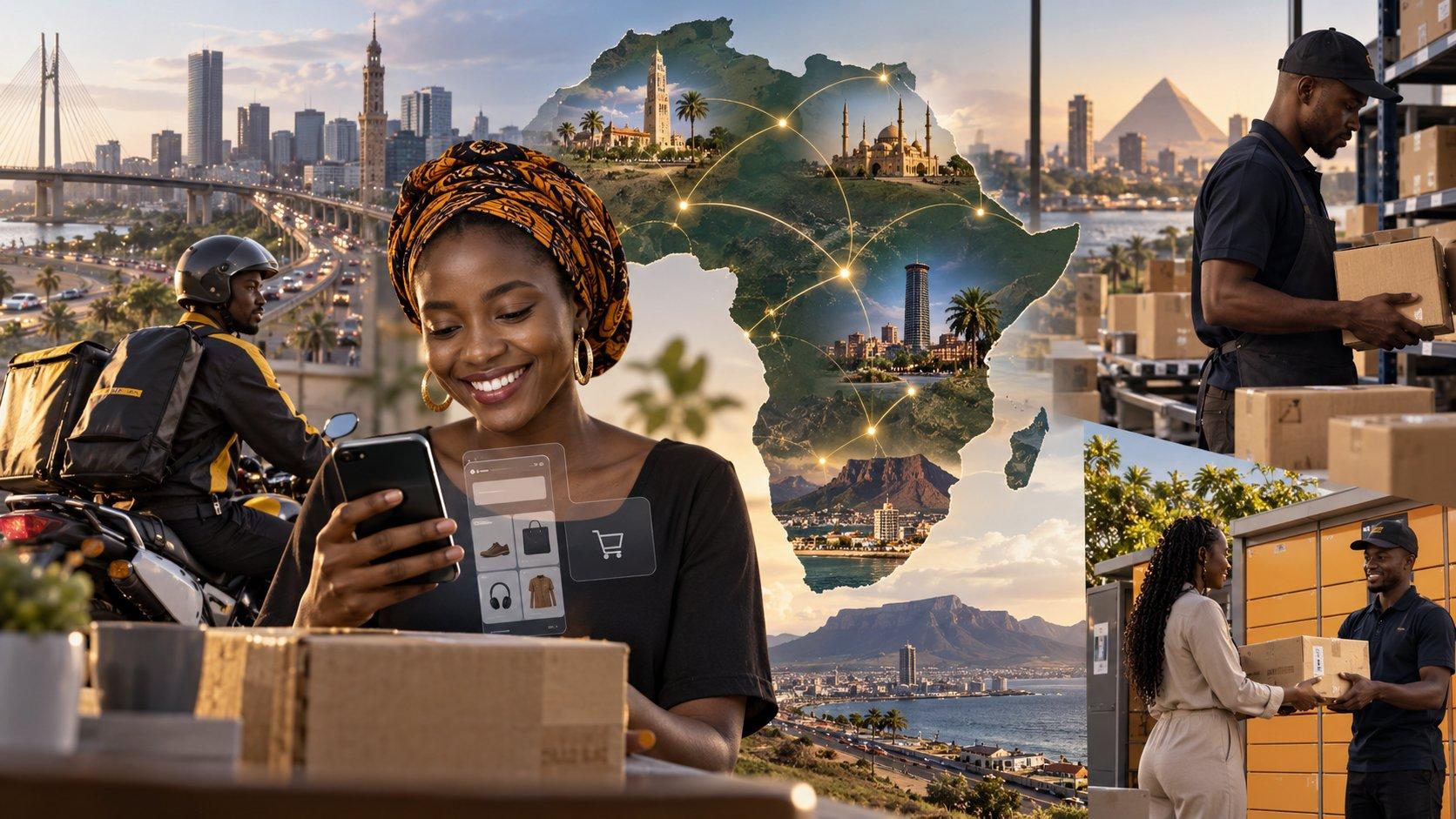
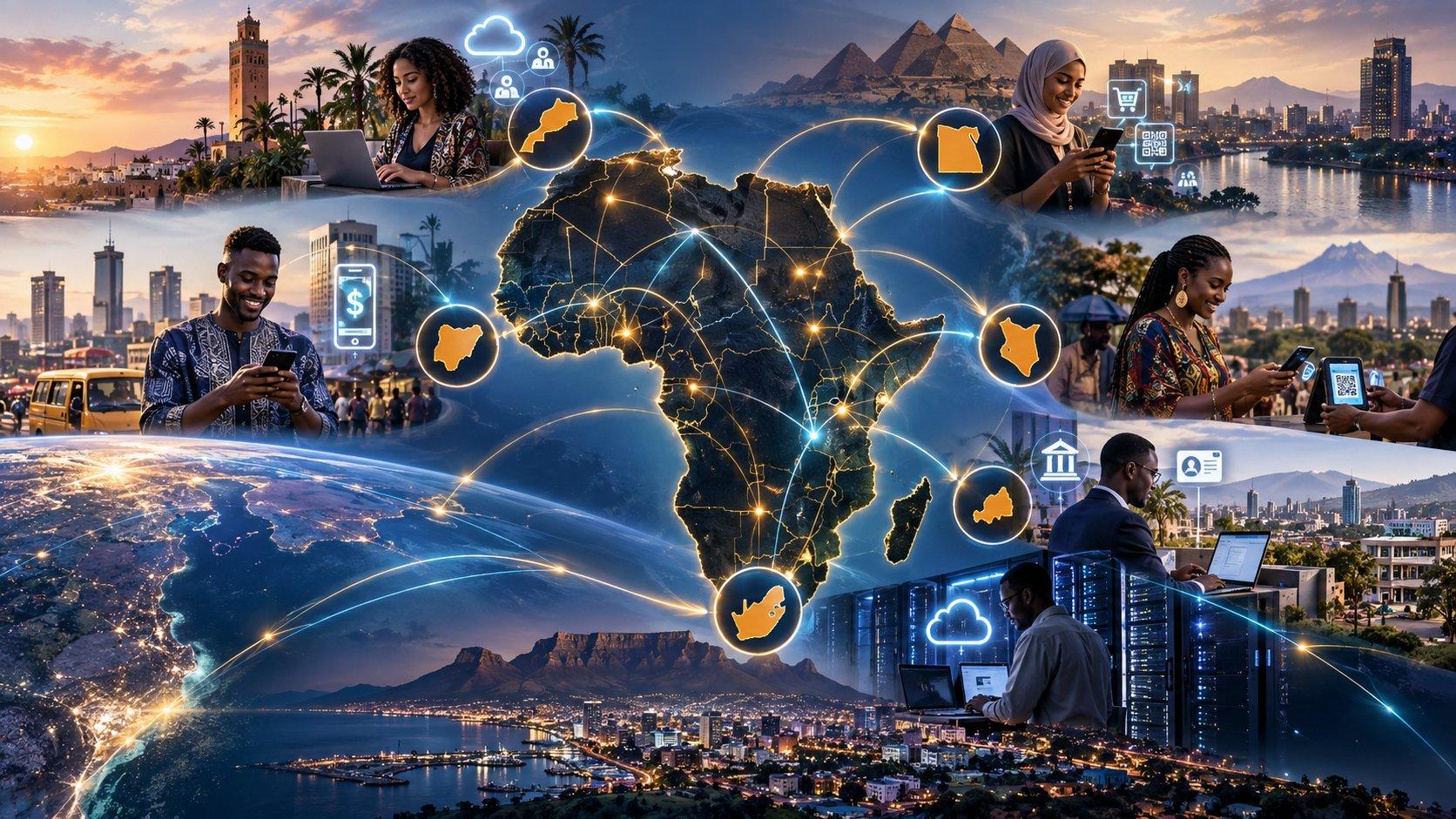
Africa has hundreds of millions of internet users. So why is buying something online still easier in some African countries than in others?
Two companies make the difference easier to see.
In the financial year ending March 2026, South Africa's Takealot Group recorded about $2 billion in gross merchandise value, or GMV, which is the total value of goods sold through its platforms before deductions such as returns. The group also reported its first full year of positive adjusted earnings before interest and tax, or adjusted EBIT, after fifteen years of trading. Jumia, which operates across several African countries, recorded $818.6 million in GMV for the whole of 2025 and an adjusted EBITDA loss of $50.5 million. Adjusted EBITDA is a measure companies use to show operating performance before interest, tax, depreciation, amortisation and certain adjustments.
The comparison is not perfect because the two companies have different business models and reporting periods, but the difference is still useful. Takealot generated far more merchandise value inside one country than Jumia generated across its multi-country network.
There is another detail that makes the comparison interesting. Jumia once operated in South Africa through Zando, but it closed its South African and Tunisian businesses by the end of 2024 after deciding that they contributed too little to the wider group. In February 2026, it also decided to leave Algeria, which had accounted for about 2 per cent of its 2025 GMV. That left the company concentrating its resources on markets where it saw stronger prospects for growth and eventual profitability.
The point is not that Jumia misunderstood African e-commerce. If anything, its experience helps explain what African e-commerce actually requires.
An online shop can be built almost anywhere. A functioning e-commerce market is harder to build because the website is only one part of the system. Someone has to be able to access it, trust the seller, pay, give the seller a usable destination, receive the parcel and return it if something goes wrong. The strength of African e-commerce markets therefore depends on much more than how many people have internet access.
The previous article in this series looked at which African countries are building strong digital economies. E-commerce takes that question further because selling a physical product online forces the digital and physical economy to work together. A payment can move through the internet in seconds. A refrigerator, pair of shoes or packet of groceries still has to move through roads, warehouses and neighbourhoods before the transaction is complete.
An online sale depends on several systems working at the same time
It helps to break an ordinary online purchase into its parts.
First, the shopper has to find the product. That requires a suitable device, an internet connection and a platform they know how to use. They then have to decide that the seller is trustworthy enough to buy from, especially when they cannot inspect the product in person.
Payment comes next. The customer needs a method that the seller accepts, whether that is a card, bank transfer, mobile money, digital wallet or payment on delivery.
Then the physical economy takes over. The seller needs to know where the customer is. A warehouse or merchant has to prepare the order, a logistics company has to move it, and someone has to complete the final journey to the customer's home, office or pickup point.
The transaction is still not finished. If the product is damaged, incorrect or simply not what was advertised, the buyer needs some way to return it, obtain a replacement or recover their money.
That is why internet penetration by itself is a weak way to judge the strength of an e-commerce market. It tells us how many people can theoretically reach an online store. It does not tell us how many can comfortably shop from one, pay for an order, receive it at an acceptable cost and trust that the transaction can be reversed if something goes wrong.
A country can perform well on two or three parts of that chain and remain difficult for e-commerce businesses to serve at scale.
Being connected does not mean everyone is ready to shop online
The first constraint appears before a customer has even added anything to a basket.
Africa has made enormous progress in mobile coverage, but coverage and actual internet use are not the same thing. The GSMA reported 416 million mobile internet users across Africa in its 2025 Mobile Economy report, equivalent to about 28 per cent of the population. At the same time, around 960 million people, or 64 per cent of the population, lived within reach of mobile broadband coverage but were not using mobile internet. The GSMA calls this the usage gap.
Part of the explanation is the cost of the device needed to make meaningful use of that network. GSMA research found that the median price of an entry-level smartphone in sub-Saharan Africa was about $39 in 2024. That was equivalent to roughly 26 per cent of average monthly GDP per capita, compared with about 16 per cent across low and middle-income countries more broadly. For the poorest households, the burden was much larger.
The distinction matters for e-commerce because different digital activities place different demands on the user. Sending money through a mobile-money service can work on a basic phone or through a simple interface. Shopping online usually involves product images, searching, comparing prices, reading descriptions and reviews, communicating with sellers and completing checkout.
This is why device affordability has become part of Africa's e-commerce story. At MWC Kigali in October 2025, the GSMA and six large African mobile operators, including Airtel, MTN, Orange and Vodacom, proposed minimum specifications for cheaper entry-level 4G smartphones. They also called on governments to remove taxes and duties on devices priced below $100. GSMA research said eliminating some of these costs could, depending on the market, reduce handset prices substantially and bring millions more people within reach of mobile internet.
Morocco shows why connectivity is important but not enough. DataReportal estimated that the country had 35.5 million internet users by late 2025, representing internet penetration of 92.2 per cent. Yet Euromonitor's measure of Moroccan retail e-commerce sales placed the market at MAD3.03 billion in 2025, following 16 per cent growth that year. Different market-research providers define e-commerce differently, so their absolute market-size estimates should not be mixed, but the underlying comparison is still useful: Morocco can have one of Africa's highest levels of internet use without automatically developing a physical online-retail market on the scale of South Africa's.
Connectivity creates access to the shop. The rest of the system determines whether the person completes the purchase.
Cash on delivery solves one trust problem but creates another business problem
Trust and payment are closely connected in many African e-commerce markets.
Consider a buyer ordering from a seller for the first time. Paying before delivery requires the customer to believe that the seller actually exists, that the product will match its description, that the parcel will arrive and that somebody will solve the problem if it does not.
Where that confidence is weak, paying when the product arrives can feel safer.
Cash on delivery, or COD, allows the buyer to delay payment until delivery. Some platforms also allow digital payment at the point of delivery, producing a similar effect: the buyer does not part with the money before there is a parcel to receive.
From the customer's side, that can remove an important barrier to trying e-commerce. From the seller's side, it transfers much of the risk to the business.
The merchant has already picked, packed and dispatched the product before receiving payment. If the customer rejects the order, cannot be reached or fails to collect it from a pickup point, the logistics work has already happened.
Jumia's 2025 annual filing gives a useful indication of how expensive this can become. The company said payment on delivery remains particularly important for customers shopping online for the first time, but it also produces significantly more failed deliveries than prepaid orders. In 2025, failed deliveries represented 25 per cent of Jumia's gross cash-on-delivery orders. The company explained that these failures increase fulfilment costs, impose extra costs on sellers and prevent Jumia from earning commissions on orders that are ultimately returned.
This makes the relationship between payments and e-commerce more complicated than it first appears. A country can develop excellent digital payment infrastructure and still have consumers who are reluctant to prepay unfamiliar merchants. Making money easy to transfer is one problem. Giving the customer confidence that the money can be recovered if the transaction goes wrong is another.
That is why consumer protection, reliable returns and dispute resolution matter almost as much as the payment technology itself.
Kenya shows what strong payments can solve, and what they cannot
Kenya is one of the clearest places to see this distinction.
The country has one of Africa's best-known mobile-money ecosystems because of M-PESA. Safaricom reported that its M-PESA customer base reached about 41 million in its 2026 financial year. Money can move between individuals and businesses with little of the complexity that traditionally came with opening and using a conventional bank account.
That infrastructure has helped create a strong foundation for digital commerce. When Kenya launched its National E-Commerce Strategy, UN Trade and Development noted that online shopping among Kenyans had risen from 9 per cent in 2017 to 16 per cent in 2021, which placed the country third in Africa at the time behind Mauritius and Tunisia.
But the same assessment identified obstacles that mobile money could not solve. These included the cost of digital devices, uneven network coverage, the cost of some digital transactions and gaps in areas such as data protection and mechanisms for resolving disputes.
That last point is important.
Imagine that paying a seller takes thirty seconds, but recovering money from a dishonest seller takes three months, repeated phone calls and a complaint process the customer does not understand. The payment system is efficient, yet the transaction still feels risky.
Trust in e-commerce therefore comes partly from technology and partly from institutions. Payment infrastructure answers the question, "Can I send the money?" Consumer protection answers another question, "What happens if I should not have sent it?"
A strong e-commerce market needs reasonable answers to both.
The address becomes a business problem when the parcel leaves the warehouse
Once payment has been dealt with, the most difficult part of physical e-commerce often begins.
The parcel has to find the customer.
Addressing systems vary significantly across Africa, and it would be wrong to describe every African city as unaddressed. However, studies of African e-commerce logistics repeatedly identify incomplete street addressing, weak postcode systems and the use of landmarks or telephone directions as important last-mile challenges in several markets.
The GSMA's research on African e-commerce identified poor national addressing systems alongside transport infrastructure and fragmented delivery services as major logistics constraints. Where an address cannot reliably identify the destination, delivery companies rely more heavily on phone calls, GPS pins, landmarks and the local knowledge of drivers. This can work, but it is more difficult to standardise and automate.
Every additional call, wrong turn and failed attempt adds cost. A courier who spends forty minutes locating one customer cannot deliver as many parcels during the day as a courier following a route made up of precise addresses.
Technology is helping businesses work around the problem. Location services can allow customers to submit GPS coordinates at checkout. Digital addressing products can turn coordinates or mobile numbers into reusable location information. Platforms can also analyse previous delivery behaviour to identify orders with a higher risk of failure.
Another solution is simpler: do not deliver every parcel to a door.
Pickup stations allow several orders to be delivered to one known location, after which customers collect their parcels themselves. That reduces the number of individual destinations the logistics company has to reach and can make expansion outside major cities easier.
Jumia has invested heavily in this model. Its 2025 Kenya rural e-commerce report said the company had more than 300 pickup stations and more than 26,000 JForce agents. JForce is a network of independent sales agents who help customers place orders and use the platform, particularly in areas where online shopping is less familiar. They are not the same thing as pickup stations, although both form part of Jumia's wider strategy for reaching customers outside the largest cities.
In Nigeria, Jumia has also built a network of hundreds of pickup locations as it expands further into secondary cities.
The economics explain why these changes matter. Jumia reported fulfilment expense of $1.97 per order in the fourth quarter of 2025, down 12 per cent from a year earlier. The company attributed the improvement to productivity gains, economies of scale, call-centre automation and better rates negotiated with logistics partners.
That figure may look small, but e-commerce margins are often small too. If the cost of getting an order to the customer consumes too much of the value of the basket, selling low-priced physical goods online becomes difficult regardless of how many potential customers live in the country.
South Africa shows what changes when the wider system is already in place
Among the large African markets considered here, South Africa has the clearest evidence of physical e-commerce operating at scale.
World Wide Worx, working with Mastercard, Peach Payments and Ask Afrika, estimates that South African online retail will reach about R159 billion in 2026. That would be 22.5 per cent higher than the roughly R130 billion recorded in 2025 and would make 2026 the first full calendar year in which online sales average about 10 per cent of national retail turnover on the report's like-for-like measure.
The longer trend makes the change easier to understand. Online retail sales were about R30.2 billion in 2020, R71 billion in 2023 and R96 billion in 2024. The estimated R29 billion being added between 2025 and 2026 is almost as large as the entire market was in 2020.
South Africa does not have perfect infrastructure, nor does every address or delivery experience work equally well. What it has is a combination of mature retailers, established warehousing, widespread electronic payments, more developed logistics networks, formal consumer businesses and years of accumulated experience with returns, fulfilment and online customer service.
Large traditional retailers have also become major e-commerce operators rather than leaving online shopping to specialist marketplaces.
Checkers Sixty60 is one of the clearest examples. Sales through the service grew 34.5 per cent to R25.5 billion in the year to June 2026, after growing 47.7 per cent in the previous year. It is essentially a supermarket operation supported by stores, distribution networks, existing supplier relationships and an established retail brand, all of which reduce some of the problems a marketplace has to solve from scratch.
Payment behaviour also reflects the maturity of the market. Card payments remain central to South African online shopping, while instant transfers, pay-by-bank products, wallets and buy-now-pay-later services provide additional options. The importance of local trust can also be seen in consumer research. In the 2025 Online Retail in South Africa study, 46 per cent of respondents said they trusted local platforms more than international ones, while 36 per cent trusted both equally.
By 2026, Takealot remained the most widely used online platform in the World Wide Worx consumer research, used by 35.3 per cent of online shoppers surveyed. Shein followed at 21.5 per cent, Checkers Sixty60 at 15 per cent and Amazon at 12.7 per cent before the launch of Amazon Prime in South Africa in June 2026. These percentages measure reported platform use among online shoppers, not each company's share of retail revenue.
The development of Takealot Fulfilment Solutions shows what can happen once an e-commerce company has spent years building logistics infrastructure. Rather than using its warehouses and delivery systems only for its own marketplace, Takealot now sells fulfilment services to external customers. Naspers reported that the business increased revenue by 93.5 per cent in its 2026 financial year.
At that point, logistics stops being only an expense required to support e-commerce. It becomes a service that can be sold to other companies.
Egypt and Nigeria have scale, payments and a harder physical problem to solve
South Africa is currently the strongest example of physical online retail operating at scale, but it is not the only market worth watching.
Egypt combines a large population with rapidly expanding digital finance. DataReportal estimated 98.2 million internet users in the country by late 2025, representing about 82.7 per cent of the population. The Central Bank of Egypt reported that financial inclusion reached 79 per cent by June 2026, meaning 56.4 million people aged fifteen and older held active accounts that allowed them to carry out financial transactions. These accounts include bank and postal accounts, mobile wallets and prepaid cards.
Egypt has also developed a national Instant Payment Network, which allows money to move between participating banks and payment instruments around the clock. The InstaPay application sits on that infrastructure and allows customers to access multiple accounts and make instant transfers. The network processed about 1.5 billion transactions worth EGP2.9 trillion in 2024, while InstaPay had approximately 12.5 million registered users by the end of that year.
Its e-commerce market is also becoming more competitive. Euromonitor reported that Amazon held about 11 per cent of Egyptian retail e-commerce sales in 2025, while Noon held 8 per cent. Jumia, Homzmart, Talabat and other platforms contributed to a market that Euromonitor described as becoming more fragmented rather than being dominated by one operator.
Nigeria presents a different version of the same opportunity. DataReportal estimated 109 million internet users at the end of 2025, making it one of the continent's largest online populations. It also has a very large electronic-payment system. Nigeria Inter-Bank Settlement System data shows that the country's NIBSS Instant Payments platform processed about 11.2 billion transactions in 2024, and electronic-payment activity has continued to grow.
Demand for online retail is also visible in Jumia's own results. In the fourth quarter of 2025, orders in Nigeria increased 33 per cent from a year earlier while GMV increased 50 per cent. Those figures apply specifically to the fourth quarter, not the full year, but they show that customers are using the platform in growing numbers.
Nigeria's challenge is that digital demand has to meet a difficult physical environment. Address quality varies, traffic congestion can make urban delivery expensive, and businesses must decide how much of their network should rely on home delivery, pickup stations and local logistics partners.
This helps explain why logistics infrastructure is attracting more investor attention across Africa.
In February 2026 alone, African logistics and transport startups raised $119.6 million, according to TechCabal Insights, compared with $54.1 million for fintech during that month. The comparison should not be extended across January and February together because fintech had led January with $131.6 million while logistics and transport raised $27.1 million. What February showed was that capital was moving into the physical systems required to support digital commerce, mobility and distribution, even if it had not displaced fintech across the entire period.
The same shift can be seen in property. In March 2026, Africa Logistics Properties listed an industrial real estate investment trust on the Nairobi Securities Exchange. The UK government said it committed a combined $24 million through its MOBILIST programme and the Private Infrastructure Development Group to support the transaction. Warehouses may not attract the same attention as consumer apps, but a larger e-commerce market eventually needs places to store, sort and dispatch goods.
The best market depends on what a business is trying to sell
There is no single African e-commerce ranking that works for every type of business because removing a physical product from the transaction changes the economics completely.
A company selling software, online courses, subscriptions or other digital products does not have to solve the last mile. Once the customer has internet access and an acceptable way to pay, there is no parcel to locate, no courier waiting in traffic and no rejected package travelling back to a warehouse. Countries with high connectivity and strong digital-payment systems, including Morocco, Egypt, Kenya and South Africa, therefore look different when the product itself is digital.
Physical goods require a wider calculation.
For a company selling conventional consumer products and looking for the African market where the existing system requires the least reinvention, South Africa currently has the strongest evidence. Its online retail market is much deeper, established retailers already operate large digital channels, and businesses can draw on developed payments, warehousing and fulfilment services.
The advantage comes with a cost. A mature market is also a competitive one. Takealot, Checkers, Amazon, Shein and established retail chains are already fighting for customers, and entering that market means competing with businesses that have spent years improving their logistics, pricing and customer experience.
Nigeria and Egypt offer something different. Their populations create enormous potential demand, digital payments are already widely used, and large numbers of people are online. The harder question is whether a particular product can absorb the cost and complexity of fulfilment. A company selling a high-margin appliance can tolerate delivery costs that would destroy the economics of a low-priced household product.
Kenya shows why a sophisticated payment system can create a strong foundation without completing the whole structure. Morocco shows why extremely high internet penetration does not automatically produce an equally large physical e-commerce market.
There is also a large category of African online commerce that conventional marketplace figures struggle to capture.
Many businesses sell through WhatsApp, Instagram and other social platforms. A customer sees a product, sends the seller a message, asks questions, negotiates delivery and pays by bank transfer, mobile money or on delivery. The entire transaction is digitally initiated, but it may never pass through a formal e-commerce marketplace.
This model works because conversation can replace some of the institutional trust that a large marketplace normally provides. The buyer speaks directly to the seller before paying. The seller may have been recommended by a friend or may have built a reputation through social media. The relationship remains informal compared with a conventional online retail platform, but it is still part of the way commerce is becoming digital across the continent.
Africa's next large e-commerce market will be built online and offline at the same time
South Africa's online retail market has moved from less than 1 per cent of retail turnover roughly a decade ago to an estimated 10 per cent in 2026. It did not reach that point simply because more South Africans gained internet access.
The systems around the transaction developed too.
Payments became easier. Retailers invested in warehouses and fulfilment. Grocery chains turned stores into parts of their delivery networks. Consumers became familiar with buying products they had not physically inspected. Businesses developed returns policies. Logistics companies learned how to deliver more parcels at lower cost. Successful transactions gave customers more reasons to repeat the process.
That is the part of e-commerce development that internet-user statistics cannot show.
Nigeria has far more internet users than South Africa. Egypt also has a larger online population. Morocco has a higher internet penetration rate. Kenya has one of the continent's best-known mobile-money systems. Each possesses part of what a large e-commerce market needs.
The difference is in how those parts work together.
A parcel still needs somewhere to go. The buyer still needs to trust what will arrive. The payment system has to work for both customer and seller. The merchant has to be able to afford the delivery. If something goes wrong, there needs to be a practical way of fixing it.
Technology is helping with each of these problems, from GPS-based addressing to automated logistics and real-time payments, but connectivity alone cannot solve them. Physical infrastructure, consumer protection, warehouses, delivery networks and reliable business practices remain part of the same system.
That is why the countries best positioned for e-commerce are not simply those with the most people online.
They are the countries where being online increasingly connects to everything that has to happen after someone presses Buy.
Sources and further reading
Jumia Technologies AG, Fourth Quarter and Full Year 2025 Results, February 2026, and 2025 annual filing.
Naspers, FY2026 results and Takealot Group performance.
World Wide Worx, Mastercard, Peach Payments and Ask Afrika, Online Retail in South Africa 2025 and Online Retail in South Africa 2026.
GSMA, The Mobile Economy Africa 2025, The Mobile Economy Africa 2026, smartphone affordability research and African e-commerce research.
DataReportal, Digital 2026 reports for Morocco, Egypt and Nigeria.
UN Trade and Development, Kenya National E-Commerce Strategy and eTrade readiness material.
Central Bank of Egypt, Instant Payment Network and financial inclusion releases.
Nigeria Inter-Bank Settlement System, digital payments data and updates.
Euromonitor International, Retail E-Commerce in Egypt and Retail E-Commerce in Morocco, 2026 editions.
Jumia Kenya and Jumia Nigeria rural e-commerce reports.
UK Government, MOBILIST and Private Infrastructure Development Group investment in Africa Logistics Properties.
TechCabal Insights, African startup funding data for January and February 2026.
Next in this series: which African countries are becoming manufacturing powerhouses, and why the answer is less concentrated than it is usually described.