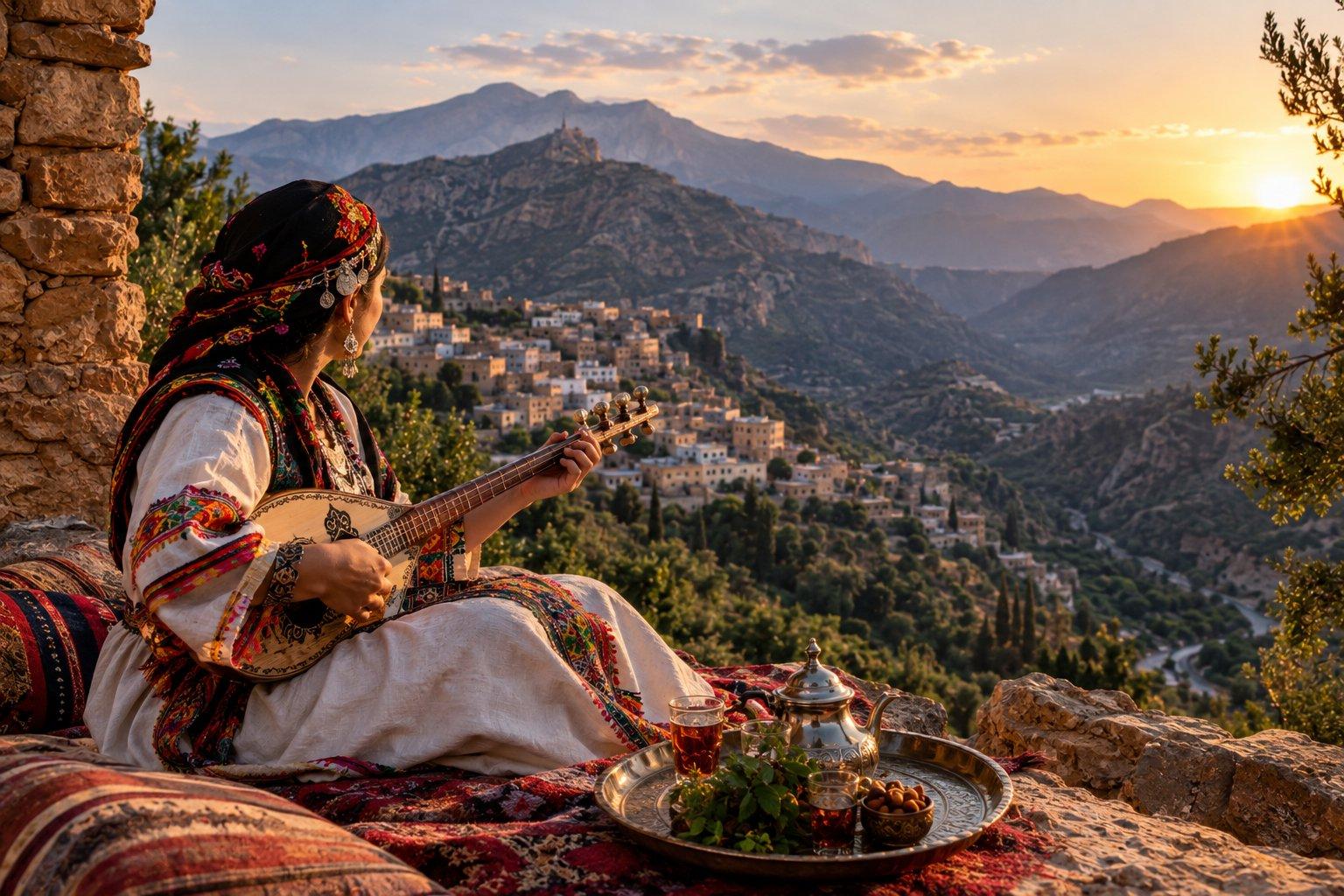
On June 25, 1998, the Kabyle singer Lounès Matoub was assassinated on a mountain road in northern Algeria, shot dead in an ambush during the country's brutal civil war. Matoub had spent his career singing in the Amazigh Kabyle language about freedom, political power, Amazigh identity, religion and social life. His outspoken defence of freedom of conscience and Amazigh cultural rights made him a prominent public figure during a period when Islamist armed groups were attacking intellectuals, artists and other people whose work or public positions challenged their worldview. His assassination was officially attributed to the Armed Islamic Group, or GIA, although the circumstances and responsibility remain controversial. His death triggered major demonstrations and unrest across Kabylie, and his grave and music remain important sites of memory for people who identify with his work and his defence of Tamazight, freedom and dignity.
Matoub was one name among many. Writers, journalists, musicians and intellectuals were among those targeted during Algeria's violence in the 1990s, particularly people associated with independent political expression, secularism, cultural rights or opposition to Islamist movements. Novelist and journalist Tahar Djaout was murdered in 1993, while musicians and other cultural figures were also killed during the conflict. The violence drove many journalists, writers, academics and artists to leave Algeria, particularly for France.
Algeria is Africa's largest country by land area, covering about 2.38 million square kilometres. Its modern identity was shaped by Amazigh societies that existed long before Arab conquest, centuries of Arab and Ottoman influence, French colonization and the eight-year war that ended French rule in 1962. It is also a country where language, music and literature have repeatedly become ways of arguing about who belongs, whose history is remembered and what kind of society Algeria should be.
Where the culture came from
Long before Arab or French arrival, the territory now known as Algeria was home to Amazigh peoples whose languages and cultural traditions developed across North Africa. Communities were spread across the Mediterranean coast, the Atlas Mountains and the Sahara, and their histories were preserved through oral traditions as well as archaeological and written evidence from later periods.
One of the most famous figures associated with the ancient Sahara is Tin Hinan, an ancestral figure in Tuareg tradition. At Abalessa in the Ahaggar, archaeologists discovered a richly furnished tomb containing the remains of a woman dating to late antiquity. The burial became associated with Tin Hinan, and the remains and objects from the tomb are held at the Bardo National Museum in Algiers. The identification of the woman with the legendary Tin Hinan is part of the historical tradition surrounding the site rather than a fact that can be established with complete certainty.
Phoenician settlements later established trading links along the North African coast, followed by Roman rule. Under Rome, parts of northern Algeria became heavily urbanized, with roads, farms, towns and military settlements connecting the region to the wider Roman world. Timgad, founded as a Roman military colony around AD 100, is one of the clearest surviving examples. The city later became a Christian centre before Roman rule in North Africa gave way to Vandal and then Byzantine control.
Arab conquest began in the 7th century and introduced Islam, but neither Islamization nor Arabization happened immediately. They unfolded over centuries and varied considerably by region. Amazigh communities adopted Islam while retaining distinct languages, local traditions and political identities. In places such as Kabylie, the Aurès and the Sahara, Amazigh identity remained an important part of community life.
Ottoman rule began in the early 16th century, and Algeria developed into the Regency of Algiers, an Ottoman province that exercised considerable autonomy from Istanbul. By the late 17th century, the dey, the ruler based in Algiers, had become the central political authority. Ottoman Algeria was not governed like a modern centralized state: authority varied across regions and depended heavily on relationships with local rulers, tribes and communities.
The Ottoman period also formed part of the history through which Andalusian cultural traditions reached Algeria. Muslims and Jews who left Iberia in different waves settled in North African cities, including Tlemcen and other urban centres, contributing to musical, religious, architectural and culinary traditions that remain visible today.
French colonization began with the conquest of Algiers in 1830. France subsequently expanded its control across the territory. In 1848, the civilian areas of the three northern provinces were organized into the departments of Algiers, Oran and Constantine and formally incorporated into the French state. That legal incorporation did not mean that Algerians and European settlers had equal political or legal status. Muslim Algerians were governed under a separate legal regime and did not automatically receive the same citizenship rights as European settlers.
European settlement expanded during the colonial period, accompanied by land confiscation, agricultural colonization and the restructuring of Algeria's economy around French interests. The result was a deeply unequal society in which a European settler minority possessed political and economic privileges that the Muslim majority largely did not.
That inequality became one of the central conditions behind the Algerian independence struggle. The war began in November 1954 and ended with a ceasefire in March 1962, followed by independence in July. French forces used torture and other forms of coercion during the conflict, while the National Liberation Front, or FLN, and other nationalist forces fought French forces through guerrilla warfare, attacks and political mobilization. Estimates of the number of Algerians killed vary considerably, with scholarly estimates reaching into the hundreds of thousands and some historical estimates approaching one million. The precise number remains disputed.
The conflict left deep political and cultural consequences. The FLN, the organization that had led the armed independence movement, became the dominant political force after independence and established a single-party system. Political pressure for greater pluralism grew during the 1980s, contributing to constitutional and electoral reforms.
The crisis that followed was particularly severe. In parliamentary elections held in December 1991, the Islamic Salvation Front, or FIS, won the first round. The second round was cancelled in January 1992 amid military intervention and the resignation of President Chadli Bendjedid. The political crisis developed into an armed conflict between the state and several Islamist armed groups. The conflict lasted through the 1990s and into the early 2000s, with estimates of deaths varying substantially; one academic study places the total at roughly 165,000 by the end of 2001, while other contemporary estimates ranged higher or lower.
Civilians were repeatedly targeted, including in massacres, assassinations and attacks on villages and towns. Journalists, writers, musicians, academics and other public figures were also among those killed. Tahar Djaout, one of Algeria's best-known writers and journalists, was shot in 1993 and died several days later. The conflict also contributed to the departure of many members of Algeria's intellectual and artistic communities, particularly to France.
More recently, Algeria's Hirak protest movement brought large numbers of people into the streets beginning in February 2019. The demonstrations opposed Abdelaziz Bouteflika's proposed fifth presidential term and then expanded into broader demands for political change. After weeks of demonstrations and growing pressure from the military leadership, Bouteflika resigned on April 2, 2019. The movement demonstrated that large-scale political mobilization could still take place through largely peaceful public protest after decades marked by political violence.
Ethnic groups and languages
Algeria's population includes both Arab and Amazigh communities, with extensive mixing between them over centuries. There is no reliable modern census that divides the population neatly into separate Arab and Amazigh percentages, so precise ethnic percentages should be treated cautiously.
Kabyle communities are concentrated particularly in the mountainous region of Kabylie, east of Algiers. Kabyle is one of Algeria's major Amazigh languages, while other Amazigh communities include the Chaoui of the Aurès, the Mozabites of the M'zab Valley and Tuareg communities in the Sahara.
The history of Amazigh cultural recognition is closely connected to language. In March 1980, authorities cancelled a planned lecture by the writer and scholar Mouloud Mammeri on ancient Kabyle poetry at the University of Tizi Ouzou. Demonstrations followed, developing into what became known as the Berber Spring, a major movement for Amazigh cultural and linguistic recognition. The protests were suppressed, but they helped bring Amazigh identity and language rights into public political debate.
Arabic is an official language of Algeria, while Tamazight is also a national and official language. The constitutional recognition of Tamazight followed decades of cultural activism and political pressure, including the Berber Spring and later mobilization for Amazigh rights. The 2016 constitution formally recognized Tamazight as a national and official language, and that status was retained in the 2020 constitution.
French occupies a different position. It is not an official language, but it remains widely used in education, business, administration, media and intellectual life. That creates a complicated linguistic inheritance: a language associated with colonial rule continues to be an important practical language in an independent Algeria, alongside Arabic and the country's Amazigh languages.
Algerian literature illustrates this tension particularly well. Writers such as Kateb Yacine and Mohammed Dib used French extensively, while other writers and artists worked in Arabic, Kabyle and other languages. For many Algerian writers, language has therefore been more than a means of communication. It has also been connected to questions about colonial history, identity, education and cultural belonging.
Religion and belief
Algeria is overwhelmingly Muslim. The U.S. Department of State estimates that more than 99 percent of the population is Sunni Muslim, predominantly following the Maliki school of Sunni Islamic jurisprudence. Smaller religious communities include Christians, Jews, other Muslim traditions and an Ibadi community concentrated principally in Ghardaia Province.
The constitution states that Islam is the religion of the state. At the same time, religious practice and attitudes vary between communities and individuals, so it is more accurate to describe Islam as deeply embedded in Algerian public and social life than to assume that all Algerians relate to religion in the same way.
The M'zab Valley in the northern Sahara is particularly important because its historic communities are predominantly Ibadi Muslims. Ibadism is a distinct branch of Islam with its own religious traditions and institutions. The five fortified settlements, or ksour, of the M'zab Valley developed from the 11th century and preserved a distinctive form of urban planning adapted to the desert environment and to the community's religious and social organization. UNESCO recognizes the M'zab Valley as a World Heritage site.
Algeria also had a substantial Jewish population before independence. Jewish communities had lived in North Africa for many centuries, and during French rule the 1870 Crémieux Decree granted French citizenship collectively to Algeria's indigenous Jewish population, while Muslim Algerians remained under a different legal system. Most Algerian Jews left the country around the time of independence, with France becoming the principal destination and smaller numbers moving to Israel and elsewhere.
Older Amazigh customs and local practices also survive in some communities, sometimes alongside Islamic traditions rather than as separate religious systems. Sufi brotherhoods, which historically played important religious and political roles in Algeria, also remain part of the country's religious history. Emir Abdelkader, the 19th-century leader of resistance to French conquest, drew on religious authority and networks associated with the Qadiriyya Sufi tradition as he organized resistance.
Food
Couscous is one of Algeria's most important traditional foods, but it is not uniquely Algerian. It is prepared in different forms across the Maghreb, with ingredients and techniques changing by region, season and occasion. In 2020, UNESCO inscribed the knowledge, skills and practices associated with producing and consuming couscous as shared intangible cultural heritage of Algeria, Mauritania, Morocco and Tunisia. The inscription covers not only the finished dish but also the knowledge involved in preparing the semolina, steaming it, choosing accompaniments and passing the techniques between generations.
Chorba, a soup prepared in several regional variations, is commonly associated with Ramadan meals, while merguez, a highly seasoned sausage traditionally made from lamb or beef, is another familiar part of North African cuisine. Algerian cooking varies considerably by region and reflects influences from Amazigh, Arab, Ottoman, Andalusian, Mediterranean and French culinary histories.
French colonial influence is also visible in everyday eating habits, particularly in the widespread presence of bread and French-style pastries alongside traditional Algerian dishes. That does not make Algerian cuisine a French-derived cuisine. Instead, it shows how a long period of political domination can leave everyday practices behind even after political independence.
Dates remain especially important in Algeria's Saharan and oasis regions. The country is one of the major producers of dates, including the widely known Deglet Nour variety associated particularly with the Biskra region. Dates also have an important place in Ramadan, when they are commonly eaten to break the daily fast.
Along the Mediterranean coast, seafood forms part of local cuisine, while Saharan and oasis communities have historically relied more heavily on ingredients suited to dry environments, including dates, grains, milk and products that can be stored or transported over long distances. The differences are practical as much as cultural: Algeria's enormous geography means that the food available in a coastal city does not necessarily resemble what is common in a desert settlement.
Music, dance, and art
Raï is Algeria's best-known modern musical export, but its history is older and more geographically complicated than the familiar association with Oran suggests. UNESCO describes raï as a popular Algerian folk song that was originally practised in rural settings by singers performing poetic texts in vernacular Arabic. During the early 20th century, performers introduced more transgressive themes, including love, desire and social constraints. The genre later became strongly associated with Oran and eventually reached international audiences through artists including Khaled and Cheb Mami.
Raï's subject matter helped make it controversial. It could address love, relationships, freedom, despair and social pressures without the restraint associated with more formal musical traditions. During Algeria's civil war, musicians and other cultural figures faced serious threats. Some prominent raï artists worked increasingly from France and other parts of the diaspora, while the genre itself continued to develop outside Algeria as well as within it.
Kabyle music provides another important example of how music and identity became connected. Artists such as Idir, Aït Menguellet and Lounès Matoub used Kabyle-language music to explore love, family, memory, politics and Amazigh identity. Matoub in particular became known for directly addressing political power, religion, freedom of conscience and the status of the Kabyle language.
Chaabi, associated particularly with Algiers, developed as an urban popular music tradition and became closely associated with musicians such as El Hadj M'Hamed El Anka. Andalusi classical music, meanwhile, preserves musical traditions that developed in North Africa through centuries of cultural exchange with Muslim and Jewish communities from Iberia.
Algeria's literary and visual arts were shaped by the same historical pressures. Writers such as Mohammed Dib and Mouloud Feraoun documented different aspects of Algerian life during the colonial period. Feraoun's Le Fils du pauvre, published in 1950, drew on his experience growing up in Kabylie and offered a detailed portrait of rural Kabyle life. Feraoun himself was assassinated by the Organisation armée secrète, or OAS, in March 1962, shortly before Algerian independence.
Visual artists also developed ways of addressing the violence and disruption surrounding colonialism and independence. Mohamed Issiakhem became one of the leading figures of modern Algerian painting and was among the artists involved in the National Union of Plastic Arts, established in 1963. His work frequently confronted themes of suffering, memory and the human consequences of violence.
Clothing, textiles, and craft
Traditional Algerian clothing varies considerably by region, community and occasion. The karakou, an embroidered velvet jacket associated particularly with Algiers, is one of the best-known forms of Algerian ceremonial dress. Kabyle clothing has its own regional forms, including woven garments and elaborate silver jewellery traditionally produced by artisans in Kabylie.
The M'zab Valley has preserved not only a distinctive form of dress and craft but also an unusually coherent built environment. Its five historic ksour were developed from the 11th century and organized around religious, residential and communal structures adapted to the desert climate. Their compact layouts, narrow streets and use of local materials helped create settlements suited to extreme heat while reflecting the community's social and religious organization. UNESCO recognizes the M'zab Valley for the way these settlements preserve architectural and cultural traditions dating back many centuries.
Algerian carpet weaving also varies by region, with different Amazigh and other communities maintaining distinct patterns and techniques. Traditional metalwork and jewellery are likewise important craft traditions. UNESCO's current list of Algerian intangible cultural heritage includes practices associated with engraving gold, silver and copper.
These traditions are not confined to museums. Craft techniques are passed through families, apprenticeships and local artisan communities, although the way they are produced and sold has changed as Algeria has urbanized and as traditional crafts have entered modern markets.
Festivals, ceremonies, and rites of passage
Ramadan and Eid al-Fitr remain important parts of Algeria's religious calendar, while Yennayer, the Amazigh New Year, has become an officially recognized national holiday. Algeria recognized Yennayer as a national holiday in 2017, making January 12 an official public holiday from 2018 onward. The decision was part of the broader institutional recognition of Amazigh cultural identity.
Algeria's festivals also show how historical sites and contemporary culture can exist side by side. The Timgad International Cultural Festival returned in July 2026 after a three-year absence, with its 43rd edition held from July 9 to 13 at a new open-air theatre beside the archaeological site in Batna Province. The program included Algerian and international performers and combined contemporary music with heritage and folkloric performances.
The choice of Timgad as a cultural setting is significant because the site itself is a reminder of Algeria's Roman past. But the modern festival does not present that history as something isolated from contemporary Algerian life. Music, performance and public events take place beside an archaeological landscape created almost two thousand years ago.
Wedding traditions also vary considerably across Algeria. In Tlemcen, for example, a traditional wedding costume and the practices surrounding it have been recognized by UNESCO as intangible cultural heritage. The ceremony can involve henna, embroidered garments, jewellery and a sequence of clothing associated with different stages of the wedding. The knowledge required to make and use these garments is transmitted across generations.
In other parts of the country, weddings have different musical traditions, clothing and ceremonial practices. A Kabyle wedding is not identical to a wedding in Tlemcen, the M'zab Valley or the Sahara. That regional variation is part of what makes it difficult to describe "Algerian culture" as a single set of customs.
A war France did not officially call a war
The Algerian War of Independence was fought from 1954 to 1962, but the French state did not officially use the word "war" in its legal terminology for the conflict at the time. Official language instead referred to the fighting through terms such as operations to maintain order. France formally recognized the conflict as a war in 1999, through legislation adopted 37 years after Algerian independence.
The terminology mattered because France had treated Algeria differently from most of its other colonial possessions. Northern Algeria had been incorporated into the French state and divided into departments, but the Muslim majority did not enjoy the same citizenship rights as European settlers. Describing the conflict as a matter of maintaining order therefore reflected the legal and political framework through which the French state understood its relationship with Algeria at the time.
The 1999 recognition did not resolve the historical disagreements surrounding the war. Questions about colonial violence, torture, responsibility, memory and access to archives continue to affect relations between Algeria and France.
What Algeria's culture looks like now
Raï has continued to evolve beyond the musical environment in which it first developed. UNESCO describes it as a living genre whose performers continue to use it to express feelings, social pressures and the desire for greater freedom. Artists associated with earlier generations, including Khaled and Cheb Mami, helped establish its international reach, while newer Algerian and diaspora musicians continue to work with raï alongside other genres.
Amazigh cultural recognition has also moved considerably from the period when public discussion of Kabyle poetry could trigger demonstrations and state repression. Tamazight is now constitutionally recognized as an official language, and Yennayer is a national holiday. Those developments followed decades of activism, cultural production and political pressure rather than one single event.
The Hirak movement of 2019 added another chapter to Algeria's long history of public political expression. Demonstrators filled streets and public squares with chants, banners, drawings and slogans. The movement eventually contributed to the political pressure that preceded Bouteflika's resignation, although the army leadership also played a decisive role in the political transition.
That makes the present-day cultural landscape difficult to separate neatly from Algeria's political history. The country has repeatedly experienced periods when language, music, literature and public expression became closely connected to arguments about identity and power. Matoub expressed those arguments through Kabyle songs. Djaout did so through journalism and literature. Issiakhem did so through painting. In 2019, a new generation used chants, banners, drawings and public demonstrations.
The forms changed. The questions did too. But the country's cultural life continues to provide one of the clearest ways to understand how Algerians have negotiated language, religion, memory, colonial history and political change across generations.