On December 17, 2010, a 26-year-old street vendor named Mohamed Bouazizi, whose fruit and vegetable cart had been confiscated by local authorities in the impoverished town of Sidi Bouzid, set himself on fire outside the local governorate headquarters in protest. He died weeks later, but the act became a catalyst for protests that spread first through Sidi Bouzid, then across the country, and by January 2011, President Zine El Abidine Ben Ali, after more than twenty-three years in power, had fled Tunisia. The uprising became widely known internationally as the Jasmine Revolution, although Tunisians themselves more commonly refer to it simply as the Tunisian Revolution. The events in Tunisia were followed within weeks by major uprisings in Egypt, Libya, Yemen and, later, Syria, contributing to the regional wave of protests and political upheaval now remembered collectively as the Arab Spring.
Bouazizi's self-immolation did not create Tunisia's grievances from nothing. The country was already dealing with unemployment, corruption, regional economic inequality and restrictions on political freedoms. What his death did was turn those frustrations into a national mobilisation that the government struggled to contain. The fact that it happened in Sidi Bouzid, a relatively small town far from Tunisia's political centre in Tunis, also mattered: it showed how strongly the grievances of the country's interior had been building beneath a political system that had presented itself as stable for decades.
That capacity to set off something much bigger than its own size would suggest runs through Tunisia's history in more than just its politics. This is the smallest country in the Maghreb, the North African region that includes Tunisia, Algeria, Morocco and Libya, and it sits at a strategic crossroads between Europe, Africa and the Mediterranean. It has repeatedly played a larger role than its physical size might suggest, first as Carthage, a Phoenician-founded city that became one of the western Mediterranean's major commercial and naval powers, and much later as the country whose post-2011 political transition became the Arab Spring's most sustained experiment with competitive multiparty politics before that system began to weaken after 2021. UNESCO recognises ten Tunisian sites on the World Heritage List, including Carthage, Kairouan, Dougga and the amphitheatre at El Jem.
Where the culture came from
Human habitation in what is now Tunisia stretches back deep into prehistory. The Capsian archaeological culture, named after the area around Gafsa, developed in parts of what are now Tunisia and eastern Algeria during the early Holocene, roughly from the 8th to the 5th millennium BCE. Archaeological evidence from this period includes distinctive stone tools, ornaments and other remains that help document the lives of communities living in North Africa thousands of years before the emergence of the historical states that would later dominate the region.
The indigenous populations of North Africa developed long before the arrival of Phoenician settlers, and the peoples later known collectively as Amazigh became an enduring part of the region's history. Amazigh is the preferred modern term for the Indigenous peoples historically often called Berbers. Their communities were never one single political group, and their languages, identities and political organisation varied across North Africa. Over centuries, these populations interacted with and absorbed influences from Phoenician, Punic, Roman, Vandal, Byzantine, Arab, Ottoman and European powers rather than simply disappearing when new rulers arrived.
Phoenician settlers associated with the city of Tyre founded Carthage on the coast of what is now Tunisia, traditionally dated to 814 BC, although archaeological and historical scholarship more broadly places the city's foundation in the 9th century BC. Carthage grew into one of the ancient Mediterranean's great commercial and naval powers, developing networks of settlements and trading connections across North Africa, Iberia and the western Mediterranean. Its rivalry with Rome produced the three Punic Wars, the last of which ended in 146 BC when Rome destroyed Carthage and took control of its territory.
The Second Punic War produced one of antiquity's most famous military campaigns. Hannibal, Carthage's commander, crossed the Alps with an army that included war elephants and invaded Italy, defeating Roman armies in several major battles before Rome eventually recovered and forced Carthage to surrender. When Rome destroyed Carthage in 146 BC, the territory became part of the Roman world and remained under Roman rule for centuries. Roman North Africa became one of the empire's important agricultural regions, producing grain, olive oil and other goods for Mediterranean markets. The physical remains of that period are still visible in Tunisia, from the enormous amphitheatre at El Jem, built in the 3rd century AD, to the remarkably preserved Roman city of Dougga.
Arab conquest arrived in the 7th century, bringing a new political and religious order to North Africa. The process was not an overnight replacement of one population by another. Arab armies established political control over time, while the conversion of local populations to Islam and the spread of Arabic took place gradually over subsequent centuries. Indigenous Amazigh communities remained an important part of North African society, and many adopted Islam while retaining elements of their existing languages, identities and social structures.
Kairouan, founded in 670, became central to this new order. Under the Aghlabid dynasty in the 9th century, it flourished as a political and cultural centre and became the principal holy city of the Maghreb. Its Great Mosque remains one of the major monuments of early Islamic architecture in North Africa, and UNESCO describes Kairouan as the oldest Arab-Muslim base in the Maghreb and one of the region's principal holy cities.
Tunisia subsequently passed through several Islamic dynasties before coming under Ottoman control in 1574. In 1881, France established a protectorate over Tunisia. A protectorate differed from outright annexation: Tunisia retained a nominal local ruler, the Bey, but France controlled much of its foreign policy, administration and political direction. French rule reshaped Tunisian education, infrastructure, agriculture, administration and urban development while also producing resistance and nationalist movements that eventually demanded independence.
Tunisia became independent in 1956. Habib Bourguiba, the leading figure of the independence movement, became the country's first president and pursued an aggressively modernising programme. One of his government's most consequential reforms was the Personal Status Code of 1956, which prohibited polygamy, required mutual consent for marriage and established judicial divorce procedures. These reforms significantly changed the legal position of women within Tunisian family law.
Bourguiba ruled until 1987, when he was removed in a bloodless takeover led by his prime minister, Zine El Abidine Ben Ali. Ben Ali remained president for more than twenty-three years. His government presided over periods of economic development and infrastructure expansion, but political opposition was tightly restricted, independent criticism faced significant limits, and corruption became a major public grievance. Those conditions formed part of the background to the protests that eventually brought his rule to an end.
The 2011 revolution opened Tunisia's most politically pluralistic period in decades. The country held competitive multiparty elections and adopted a new constitution in 2014 that established a political system with a directly elected president, a parliament with substantial powers and a prime minister responsible for government administration. Political parties that had previously been restricted or banned were able to organise openly, independent media expanded, and civil-society organisations became more active.
That period did not last unchanged. In July 2021, President Kais Saied dismissed the prime minister and suspended the elected parliament, invoking emergency powers. He subsequently concentrated more authority in the presidency, and Tunisia adopted a new constitution in 2022 that strengthened presidential powers and reduced the checks previously exercised by parliament and other institutions. The parliamentary electoral system was also changed, moving away from the proportional representation used under the previous system toward single-member constituencies. Saied won another presidential term in October 2024 amid significant restrictions on opposition candidates and political activity. By 2026, independent assessments described Tunisia as partly free and documented continued pressure on political opponents, journalists, civil society and other institutions.
That makes Tunisia's post-revolution story more complicated than the idea of a revolution that produced a lasting democracy. The country genuinely did establish competitive political institutions and a considerably freer civic environment after 2011. But the concentration of executive power after 2021 changed how those institutions function. Independent media, civil-society organisations and political groups that developed during the more open period continue to form part of Tunisian public life, even as formal checks on presidential authority have weakened.
Ethnic groups and languages
Tunisia is generally described in demographic estimates as overwhelmingly Arab, although the country does not have a modern census that provides a precise breakdown of ethnic self-identification. The CIA World Factbook has historically estimated the population as approximately 98 percent Arab, with smaller European, Jewish and other communities. That figure should be understood as a demographic estimate rather than a direct measurement of how every Tunisian identifies.
At the same time, modern Tunisian identity developed from a population history that predates Arabisation by many centuries. Indigenous North African ancestry and historical continuity remain important parts of the country's past, even though most Tunisians today identify culturally and linguistically as Arab. Amazigh communities and cultural traditions survive in several parts of Tunisia, including areas of the south and the island of Djerba. Some communities continue to preserve Tamazight varieties and other elements of Amazigh heritage.
Modern Standard Arabic is the official language of Tunisia and is used in formal writing, government and much of the country's media and education. Tunisian Arabic, commonly called Derja, is the dominant language of everyday conversation. It developed from Arabic but also contains vocabulary and influences accumulated through Tunisia's long history of contact with Amazigh languages, French, Italian, Turkish and other Mediterranean languages.
French remains widely used, particularly in higher education, science, business, medicine and professional settings. The CIA has historically estimated that French is spoken by roughly two-thirds of the population. Many Tunisians therefore encounter both Arabic and French regularly, although the degree of fluency varies considerably between individuals and regions.
The name Tunisia derives from Tunis, the country's capital. The deeper origin of the name is debated, with several explanations connected to ancient North African languages and place names. A popular theory links Tunisia to the Carthaginian goddess Tanit, but that connection should be treated as a proposed etymology rather than established historical fact.
Religion and belief
Tunisia is overwhelmingly Sunni Muslim. The U.S. government estimated that approximately 99 percent of the population was Sunni Muslim in 2023, while Christians, Jews, Shia Muslims, Baha'is and people who do not identify with a religion together represented less than 1 percent. Sunni Islam in Tunisia has historically been associated with the Maliki school of Islamic jurisprudence, which has long been influential across the Maghreb.
Islamic traditions remain important to religious and social life, but modern Tunisian law does not simply operate as an application of classical Islamic jurisprudence. Family matters, for example, are governed extensively through the country's statutory legal system, particularly the Personal Status Code introduced after independence. This distinction helps explain how Tunisia can have a population that is overwhelmingly Muslim while also maintaining family laws that differ substantially from traditional Islamic legal rules in some areas.
Kairouan's historical role as a centre of Islamic learning gave Tunisia a particularly important place in the religious history of the Maghreb. Sufi traditions, religious brotherhoods and the veneration of local saints have also formed part of Tunisian religious culture, with shrines and associated traditions remaining visible in different parts of the country. The importance of these practices varies among Tunisians, particularly as religious attitudes differ between individuals and generations.
A small but historically significant Jewish community has deep roots in Tunisia, particularly on the island of Djerba. The El Ghriba synagogue there is one of the most important Jewish heritage sites in North Africa and is associated with a Jewish presence on the island dating back to antiquity. The present structure is much later than those ancient traditions, so claims that the current building itself has operated continuously for two thousand years should be treated cautiously.
The annual El Ghriba pilgrimage brings Jewish visitors from Tunisia's diaspora and from countries including France and Israel. The community itself is now much smaller than it was before the mass emigration of Tunisian Jews in the decades surrounding independence. According to the U.S. State Department, community leaders estimated around 1,500 Jewish citizens in Tunisia in 2023, with approximately 1,100 living on Djerba and in neighbouring Zarzis.
The synagogue has also experienced serious attacks. In 2002, a truck bomb attack at El Ghriba killed 21 people, including 17 tourists. In May 2023, another attack killed four people before the attacker was killed by security forces. Despite these attacks, the pilgrimage has continued.
Christianity was once deeply rooted in Roman North Africa. The region produced major Christian thinkers including Augustine of Hippo, whose writings became enormously influential in Christian theology. Christian communities did not disappear immediately after the Arab-Muslim conquest, but they declined substantially over the following centuries as political structures changed and Islam became dominant. Christianity in Tunisia today is represented largely by foreign and expatriate communities rather than by a large indigenous Christian population. The U.S. State Department estimated around 30,000 Christian residents in 2023, most of them foreigners.
Food
Couscous, made from steamed semolina and commonly served with vegetables, meat, fish or a rich sauce, is one of Tunisia's defining staple foods. Tunisian couscous shares its basic foundation with versions found across the Maghreb, but recipes vary considerably by region and household. It is therefore more useful to think of couscous as part of a wider North African food tradition than as a dish belonging exclusively to one country.
Harissa is one of the defining flavours of Tunisian cooking. The fiery red chilli paste is used as a condiment, marinade and cooking ingredient, and its importance is recognised beyond Tunisia's borders. UNESCO added the knowledge, skills and culinary and social practices associated with Tunisian harissa to its Representative List of the Intangible Cultural Heritage of Humanity in 2022.
Brik, a thin pastry typically filled with ingredients such as egg, tuna, parsley and capers before being fried until crisp, is another familiar Tunisian dish. It is particularly associated with Ramadan meals, although it is eaten at other times as well. The appeal is partly in the contrast between the crisp pastry and the soft filling, especially when a whole egg is cooked inside.
Olive oil production runs deep in Tunisian agricultural history. Tunisia is one of the world's major olive-oil producers and exporters, although its position in global production rankings changes from year to year because olive harvests vary significantly according to rainfall and other conditions. Olive cultivation has ancient roots in North Africa and became especially important during the Roman period, when olive oil was one of the region's major agricultural products.
Mechouia, a smoky salad made from grilled peppers, tomatoes and other vegetables, and lablabi, a hearty chickpea soup commonly eaten with bread, garlic, cumin, harissa and other additions, are part of everyday Tunisian food culture. Mint tea, sometimes served with pine nuts, is also associated with Tunisian hospitality.
Along the coast, seafood plays an important role in local cooking, particularly in fishing communities such as Sfax and Mahdia. Southern oasis regions around Tozeur and Kebili are strongly associated with date cultivation, and dates remain both an important agricultural product and a familiar part of everyday food culture.
Music, dance, and art
Malouf is Tunisia's major classical Andalusian-derived musical tradition. Its history is connected to the movement of Muslim and Jewish communities from Islamic Spain to North Africa, particularly during and after the Christian reconquest of Iberia. Once established in North Africa, the music developed locally and absorbed regional influences, so Tunisian malouf is not simply a preserved piece of medieval Spanish music. It is a North African tradition that evolved over generations.
Regional folk music varies considerably across Tunisia. Different communities have maintained their own songs, instruments and performance traditions for weddings, religious occasions, work and other social events. Amazigh communities in the south, coastal communities and populations in the country's interior have all contributed distinct traditions to Tunisia's musical landscape.
The Carthage International Festival, first established in 1964, is held during the summer at the Roman amphitheatre of Carthage and brings Tunisian, Arab and international performers to the historic site. The festival is separate from the Carthage Film Festival, which was established in 1966.
The Carthage Film Festival, known as the Journées Cinématographiques de Carthage, was established in 1966 and has a particular focus on African and Arab cinema. Its highest prize, the Golden Tanit, takes its name from Tanit, one of the principal deities of ancient Carthage. The festival has therefore become one of the places where Tunisia's ancient history and contemporary African and Arab cultural production meet without requiring the two to be treated as the same thing.
Contemporary Tunisian music has continued evolving beyond classical malouf. Hip-hop and rap became especially important forms of youth expression in the years before and after the 2011 revolution, giving artists a way to address unemployment, political repression, inequality and everyday life.
Emel Mathlouthi's "Kelmti Horra", meaning "My Word Is Free", became closely associated with the Tunisian Revolution and the wider Arab Spring. Importantly, the song itself was not written after the uprising began. Mathlouthi had developed the work before 2011, and its themes of freedom and resistance took on new meaning when protesters filled Tunisia's streets. The song subsequently became one of the best-known musical expressions associated with the uprising.
Clothing, textiles, and craft
Tunisia's traditional craft economy remains active, particularly in carpet weaving, textiles, ceramics, metalwork and jewellery. Kairouan is especially associated with handmade carpets, where traditional geometric patterns and weaving techniques continue to be used by artisans.
Chechia, the soft red felted cap traditionally worn by Tunisian men, is another distinctive craft tradition. Production has historically been concentrated in specialised workshops in Tunis, particularly around the old medina. Traditional jewellery, including pieces made from silver and decorated with materials such as coral and enamel, also forms part of Tunisia's regional craft heritage.
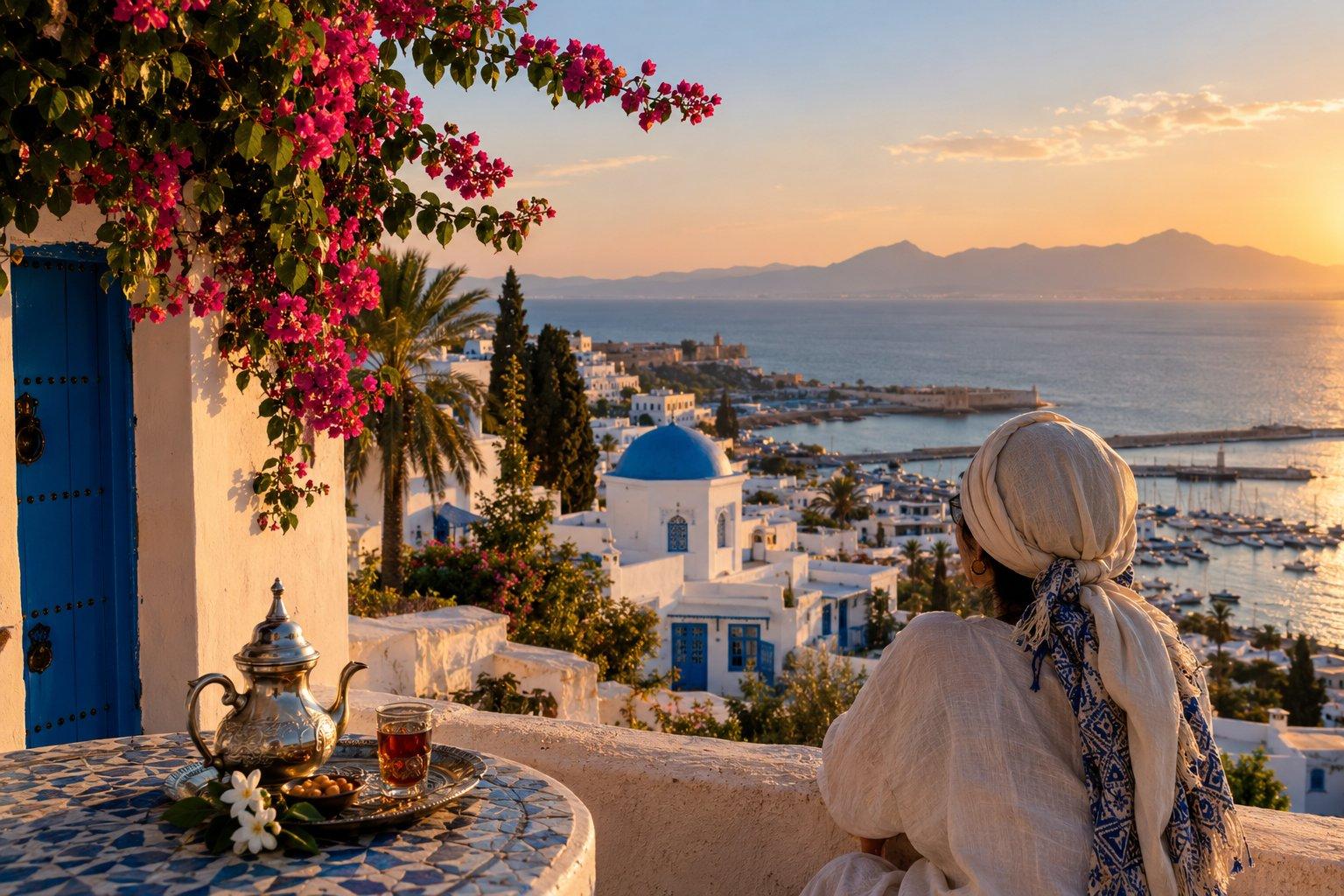
The blue-and-white architecture of the coastal village of Sidi Bou Said has become one of Tunisia's most recognisable visual symbols. Its whitewashed buildings, blue doors and windows and views over the Mediterranean have made it a major destination for artists, photographers and visitors. The visual character of the village has been deliberately preserved, although the precise rules governing individual buildings and renovations have changed over time.
Tunisia's Roman-era mosaic heritage is particularly significant. The Bardo Museum in Tunis holds one of the world's important collections of Roman mosaics, many depicting mythology, animals, hunting scenes and aspects of everyday life in Roman North Africa. The museum itself occupies a former royal palace, which adds another historical layer to a collection already spanning several centuries.
The Bardo Museum was attacked by gunmen in March 2015, killing 22 people, most of them foreign tourists. The attack severely affected international perceptions of Tunisia's security environment and contributed to a sharp downturn in tourism at a time when the sector was already facing difficulties. The museum later reopened and remains one of the country's principal cultural institutions.
Festivals, ceremonies, and rites of passage
Ramadan and Eid al-Fitr anchor the Tunisian Muslim religious calendar. During Ramadan, Muslims who are able to do so fast from dawn until sunset, then gather for evening meals after the daily fast ends. Tunisian households prepare a wide range of foods during the month, with dishes such as brik commonly appearing at iftar, the meal that breaks the daily fast. Eid al-Fitr marks the end of Ramadan and is generally associated with family gatherings, visits and festive meals.
The pilgrimage to the El Ghriba synagogue on Djerba is one of the most distinctive minority religious traditions in contemporary Tunisia. Jewish visitors from Tunisia's diaspora and from abroad gather for prayers, ceremonies and communal celebrations. Its continuation is particularly notable because the Jewish population living permanently in Tunisia is now a small fraction of the community that existed before the mass emigration of the mid-20th century.
Wedding celebrations across Tunisia can extend over several days and vary considerably by region and family. Traditional ceremonies may include henna rituals, music, family gatherings and elaborate clothing. In some communities, brides wear several different outfits during the wedding celebrations, with each outfit associated with a particular stage of the ceremony or a particular regional tradition. These practices are not uniform across the country, but where they continue, clothing becomes part of the ceremony itself rather than merely something worn for appearance.
One More Thing About Tunisia
The Tunisian uprising is often called the "Jasmine Revolution" outside the country, but the name is more complicated than it sounds. Many Tunisians refer to the event simply as the Tunisian Revolution, while "Jasmine Revolution" became particularly popular in international reporting because jasmine was already strongly associated with Tunisia.
The flower itself has a long place in Tunisian everyday culture, appearing in gardens, perfumes, decoration and small gestures of hospitality. What makes the name interesting is therefore not that the revolution was somehow built around jasmine, but that an ordinary Tunisian cultural symbol became attached to an event whose significance eventually reached far beyond Tunisia.
The better-known symbol of the uprising was not a flower at all. It was Mohamed Bouazizi's act of self-immolation in Sidi Bouzid on December 17, 2010, which became a catalyst for protests against unemployment, corruption, political repression and unequal economic opportunity. Within weeks, Ben Ali had fled the country, and Tunisia had entered a political transition that would become one of the defining stories of the Arab Spring.
And Tunisia Today?
Tunisia's post-revolution cultural scene continues to produce film, literature, music and visual art that engage with the country's political and social changes. The Carthage Film Festival remains an important platform for African and Arab cinema, while musicians and filmmakers continue to work in a country whose political environment has changed considerably since the freer years immediately after 2011.
Amazigh cultural organisations and communities also continue to preserve and promote aspects of Tunisia's Indigenous heritage, particularly in parts of southern Tunisia and Djerba. Tamazight language and cultural traditions remain part of the country's broader historical landscape, even though Arabic dominates public life and the majority of Tunisians identify culturally as Arab.
And every summer, performers still take the stage inside the Roman amphitheatre of Carthage, where the Carthage International Festival brings contemporary Tunisian, Arab and international music into a site built nearly two thousand years ago. The amphitheatre is not the same monument as the much larger Roman amphitheatre at El Jem, but both belong to the extensive Roman architectural heritage that remains visible across modern Tunisia.
That same sense of historical continuity can be found throughout the country without pretending that the different periods were seamless. Carthage was destroyed by Rome. Roman North Africa eventually became part of a different political and religious world. Arabic became dominant while Indigenous Amazigh languages and identities survived in parts of the country. French rule reshaped institutions that an independent Tunisia later transformed again. The 2011 revolution opened political space that expanded for a decade before presidential power was strengthened again after 2021.
Tunisia's history is therefore not a straight line from ancient civilisation to modern democracy. It is a record of repeated political and cultural changes in which older traditions were often altered rather than erased. A Roman amphitheatre can become a concert venue. An ancient Carthaginian name can appear on a modern film prize. A language can absorb vocabulary from several empires while remaining recognisably itself. And a revolution that began in a small town can change the political conversation of an entire region.
Those continuities and changes are what make Tunisia worth understanding beyond the familiar image of the Jasmine Revolution. Its history is not only about the moment when Tunisia lit the match. It is also about everything that was already there before the flame appeared, and everything the country has been trying to build, preserve and renegotiate since.