Before the Suez Canal opened in 1869, the coast that is now Djibouti was already home to pastoral communities, trading networks and established political authorities. France had actually acquired its first foothold there seven years earlier, purchasing the anchorage of Obock in 1862 from local rulers around the Gulf of Tadjoura. What the canal changed was the value of the geography.
When the Suez Canal connected the Mediterranean to the Red Sea in 1869, ships travelling between Europe and the Indian Ocean no longer had to sail around the southern tip of Africa. The narrow Bab el-Mandeb, where the Red Sea opens into the Gulf of Aden, became part of one of the world's most important maritime routes. French interest in the territory grew alongside British activity in Egypt and Aden, and in the 1880s France expanded its protectorate around the Gulf of Tadjoura and the Somali coast.
Djibouti's modern history was already underway before the canal opened. The canal gave that history a much larger strategic stage.
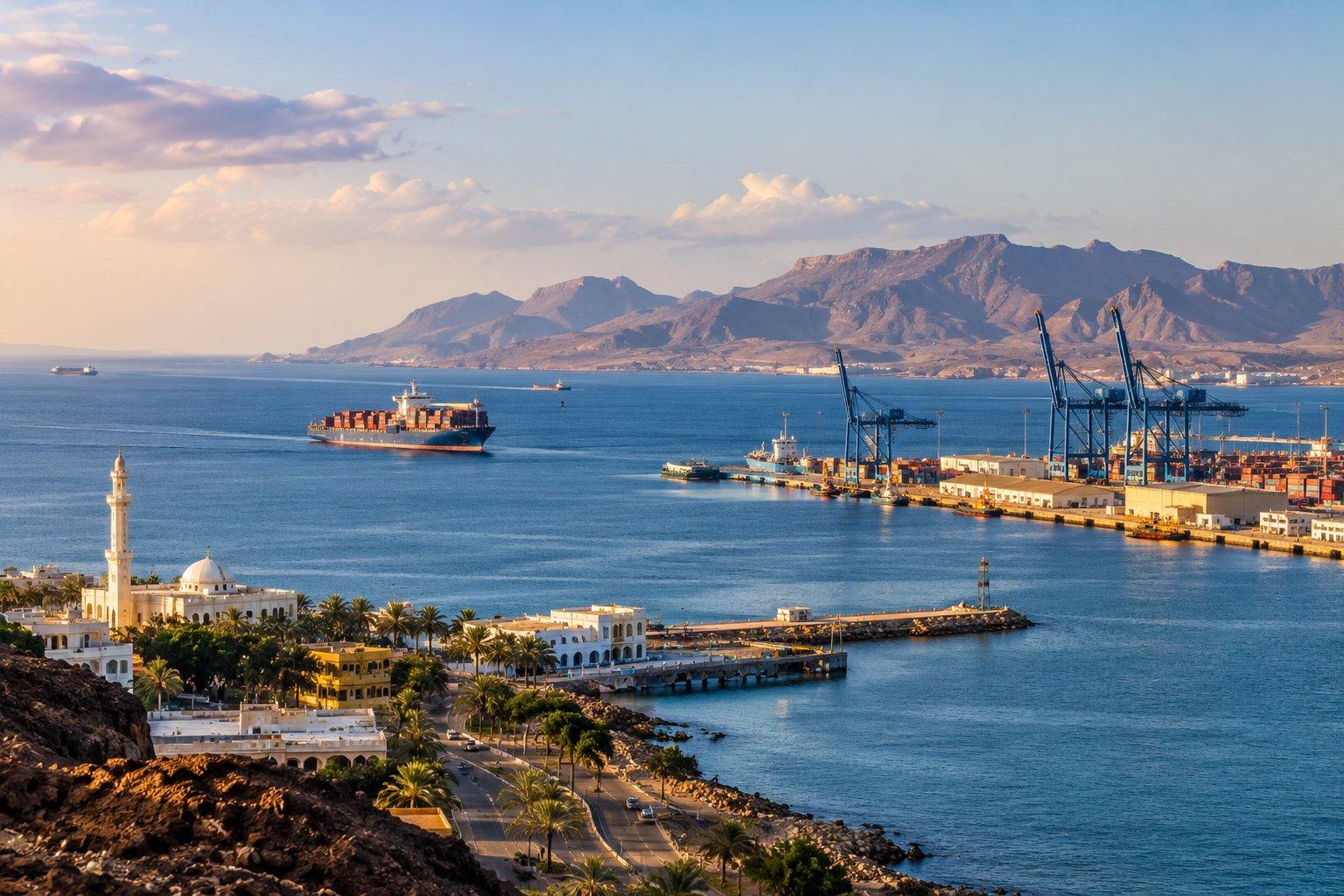
Today, Djibouti is a small country with an outsized role in shipping, military strategy and regional trade. It sits beside the Bab el-Mandeb, controls access to ports serving one of Africa's largest landlocked economies, and hosts military facilities belonging to the United States, France, Japan, Italy and China. China's facility, opened in 2017, was its first overseas military base.
The same geography that drew European powers to this coast in the nineteenth century still shapes Djibouti's place in the world.
But geography is only part of the story. Before there were ports, railways and military compounds, there were Afar and Somali-Issa communities living across this harsh stretch of the Horn of Africa, with their own languages, customary laws, poetry, religious traditions and ways of moving through an environment where water and pasture could determine the route of an entire season.
Where the culture came from
The two largest communities in Djibouti are Somali and Afar. Common demographic estimates put the population at roughly 60 percent Somali and 35 percent Afar, with smaller communities making up the remainder. The Somali population is predominantly associated with the Issa clan, although other Somali communities also live in the country.
The Afar have historically lived across what is now Djibouti, northeastern Ethiopia and Eritrea. Their political organization included several sultanates and other local authorities rather than one centralized Afar state. The Somali-Issa, meanwhile, belonged to a much wider Somali social and linguistic world stretching across today's Djibouti, Somalia and Ethiopia.
Pastoralism shaped much of this history. Camels, goats and other livestock were not merely sources of food or wealth. They determined movement, trade and access to grazing and water in a region where rainfall is scarce and highly uneven.
Customary law developed alongside those ways of life. Among Somali-Issa communities, Xeer Ciise is an oral system of customary law covering political organization, community justice, reconciliation, compensation and social conduct. UNESCO inscribed Xeer Ciise on its Representative List of the Intangible Cultural Heritage of Humanity in 2024, recognizing it as a tradition shared by Somali-Issa communities in Djibouti, Ethiopia and Somalia. Knowledge is transmitted through stories, proverbs, games, poetry and initiation practices as well as through contemporary educational and cultural programs.
Afar communities also have their own customary legal traditions. UNESCO's Djibouti program currently lists the Madqa, the Afar system of oral customary law, among its ongoing nominations.
Islam arrived in the Horn of Africa through the region's longstanding connections with Arabia and the Red Sea. By the time European colonial powers began competing for territory in the nineteenth century, Islam was already deeply established among the communities living around the Gulf of Tadjoura and the wider Horn.
France's first territorial acquisition came in 1862, when it obtained the anchorage of Obock through an agreement involving the sultans of Raheita, Tadjoura and Gobaad. The agreement also gave France rights concerning salt from Lake Assal.
Seven years later, the Suez Canal opened.
French interest expanded during the following decades. In 1884 and 1885, France extended its protectorate to the shores of the Gulf of Tadjoura and the Somali coast. Djibouti's harbor and its position on the route toward the Ethiopian highlands made the settlement increasingly useful for commerce. In 1892, the administrative capital was moved from Obock to Djibouti, and in 1896 the territory was formally named French Somaliland.
The railway pushed the transformation further.
Construction of the Franco-Ethiopian railway began in 1897. It eventually reached Addis Ababa in 1917, connecting Djibouti's port directly to the Ethiopian interior and giving the settlement a commercial role that extended far beyond its coastline.
Djibouti was becoming a place through which other countries moved their goods.
Colonial rule and the road to independence
French rule lasted for more than eight decades, but the question of who should govern the territory became increasingly difficult as political movements developed among its different communities.
In 1958, residents voted in a referendum on whether the territory should remain within the French Community created under France's new constitution. The result favored continued association with France, but the vote was heavily contested. Somali political forces alleged manipulation, while United Nations records document controversy surrounding the conduct of the referendum.
Nine years later, another referendum was held.
On 19 March 1967, voters again chose continued association with France. The result was approximately 60 percent in favor. The territory was subsequently renamed the French Territory of the Afars and Issas, a name that explicitly placed its two largest communities in the official title.
By the middle of the 1970s, however, the political situation had changed. Across the continent, most former European colonies had become independent states, and pressure for self-determination in Djibouti had grown.
The final referendum took place on 8 May 1977.
The result was overwhelmingly in favor of independence. On 27 June 1977, Djibouti became an independent country. The referendum and Independence Day therefore mark two different dates: May 8 was the vote; June 27 was independence.
Hassan Gouled Aptidon, an Issa-Somali politician, became the country's first president. The People's Rally for Progress, or RPP, dominated political life after independence. Constitutional changes in 1992 formally allowed opposition parties, ending the previous one-party arrangement, although political power remained highly concentrated.
The ethnic balance that had shaped colonial politics did not disappear with independence.
In 1991, an armed rebellion led by the Afar-dominated Front for the Restoration of Unity and Democracy, known as FRUD, developed into a civil war against the government. The conflict lasted several years. In December 1994, the government signed a peace agreement with one major FRUD faction and brought representatives of that faction into formal politics. A remaining armed faction continued its opposition until further negotiations produced a new agreement in 2000 and a final peace accord on 12 May 2001.
The peace process did not erase the political history that had produced the conflict, but it brought the remaining armed opposition into a political settlement.
Ismail Omar Guelleh succeeded Hassan Gouled Aptidon in 1999 and remains president. Under his government, Djibouti has pursued ports, railways, roads, free-trade infrastructure and foreign investment as major parts of its economy.
The strategy has brought infrastructure and revenue. It has also left the country heavily dependent on international trade and foreign financing.
The country built around a port
Djibouti has one of those geographical advantages that can be seen on a map before it is explained.
The country sits beside the Bab el-Mandeb Strait, the narrow maritime passage connecting the Red Sea with the Gulf of Aden and, beyond it, the Indian Ocean. Ships using the Suez route pass through this corridor.
Djibouti also sits across the sea from Yemen and beside Ethiopia, a country of more than 100 million people with no coastline of its own.
That second fact may be even more important to Djibouti's economy.
The World Bank says that more than 95 percent of Ethiopia's import-export trade by volume uses the Addis-Djibouti corridor. Djibouti's ports therefore serve as Ethiopia's main connection to international maritime trade.
That makes the port economy unusually dependent on what happens across the border.
When Ethiopian trade grows, Djibouti's roads, railways, trucking companies, warehouses and ports have more work. When Ethiopia develops alternative routes through places such as Berbera or Port Sudan, Djibouti faces new competition.
The country's economic model has also attracted China.
Chinese companies have been involved in major infrastructure projects, including ports, railways and other transport infrastructure. China is also Djibouti's largest source of imports and has become one of its most important creditors and investors. The Congressional Research Service describes Djibouti as a country whose economy depends heavily on port trade and says leases for foreign military facilities are an important source of government revenue.
The relationship comes with financial pressure. Djibouti has taken on substantial debt while building infrastructure, making its economic fortunes closely tied to the continued movement of trade through its ports.
The port, in other words, is both an asset and a dependency.
The people and the languages
The numbers give a useful starting point: about 60 percent of the population is Somali and 35 percent Afar, according to CIA estimates. About 78.6 percent of the population lives in urban areas, meaning the pastoral image of Djibouti tells only part of the country's present-day story.
Djibouti City is where many of these histories meet.
The city contains Somali and Afar communities alongside people of Yemeni, Ethiopian, French and other backgrounds. Its position on the Red Sea has brought merchants, sailors, migrants, soldiers, diplomats and traders through the city for generations.
The official languages are Arabic and French. Somali and Afar are widely spoken community languages and remain central to family and cultural life.
French entered the country through colonial administration and remains important in government, education and formal institutions. Arabic reflects Djibouti's religious and regional connections. Somali and Afar belong to the Cushitic branch of the Afroasiatic language family and connect Djibouti linguistically to neighboring communities across the Horn.
The result is a country where a government document may be written in French, a religious discussion may take place in Arabic, and a family conversation may happen in Somali or Afar.
Religion and customary law
Islam is the state religion of Djibouti under Article 1 of the constitution. The same constitution guarantees equality before the law regardless of language, origin, race, sex or religion and states that the country respects different beliefs.
An estimated 94 percent of the population is Sunni Muslim, according to CIA demographic estimates.
Religion is woven into ordinary life through prayer, fasting, marriage, family customs and the two major Eid celebrations. At the same time, Djibouti's legal traditions are not derived from one source alone. State institutions operate within a system shaped by civil law, Islamic law and customary practices.
Xeer Ciise provides one of the clearest examples of customary law continuing into the present.
It has rules governing political authority, social conduct and community justice. Reconciliation and compensation are important parts of its approach to disputes. Knowledge of the system is passed through poetry, proverbs, stories, rituals and formal cultural programs. UNESCO describes it as a structured system of governance rather than a loose collection of customs.
Djibouti is therefore home to several forms of authority at once: the state, religious institutions and community-based customary traditions.
Food
Djiboutian food makes sense when you look at the map.
The country sits between Ethiopia, Somalia and Yemen, with the Red Sea running along its coast. Its food reflects those connections without belonging entirely to any one of them.
Skoudehkaris is one of the dishes most closely associated with Djibouti. It is a spiced rice dish commonly prepared with lamb, although other meats or fish may be used. Cardamom, cumin, cloves, cinnamon, tomatoes and other seasonings give the rice its distinctive character.
Then there is lahoh, a soft fermented flatbread with a porous surface. It is common across Djibouti, Somalia and Ethiopia and can be eaten with honey, sugar, stews or soups. Unlike Ethiopian injera, which is traditionally made with teff, lahoh is generally made with wheat or other cereal flours.
Pastoral traditions have also shaped the consumption of meat and dairy, particularly among communities whose livelihoods historically depended on livestock.
Along the coast, seafood has a natural place in the cuisine. Djibouti's relationship with Yemen and other Red Sea ports has also meant that spices, cooking methods and ingredients have moved across the water for centuries.
French influence remains visible in the capital's food culture as well. French-style bread and pastries sit comfortably alongside dishes whose roots lie much further east.
A plate of skoudehkaris can therefore contain several histories at once: rice and spices moving through Red Sea trade, meat associated with pastoral life, and cooking traditions shaped by generations of contact between the Horn and Arabian Peninsula.
Music, poetry and performance
Djibouti's Somali cultural heritage connects it to one of the world's great oral poetry traditions.
Among Somali communities, poetry has historically carried information that elsewhere might have been preserved in books: genealogies, political arguments, praise, criticism, memories of conflict and observations about people and places.
Gabay, one of the major forms of Somali poetry, is especially associated with formal composition and performance. Somali poetry also has a strong tradition of alliteration, with poets working within demanding linguistic structures rather than treating poetry as casual speech.
Women have their own important poetic tradition in buraanbur, which is commonly associated with women's performances at weddings and other social occasions.
These traditions have never belonged exclusively to the written page. Poetry can be remembered, recited, performed and passed between generations.
Afar cultural traditions have their own forms of music, ceremony and oral knowledge. UNESCO's work in Djibouti includes projects documenting and safeguarding traditional games and cultural practices of Afar and Somali communities.
The result is a country where oral culture remains closely tied to identity, memory and community life even as formal education and urban living have changed how people work and communicate.
Clothing, homes and everyday craft
Traditional clothing across Djibouti reflects the climate as much as cultural identity. Loose garments and fabrics suited to intense heat are common, with styles varying between communities and occasions.
Among Somali pastoralists, the aqal is a portable dwelling designed for movement. Its construction allows a household to dismantle and transport the structure when a family moves in search of pasture and water.
The dwelling belongs to a wider Somali pastoral tradition found across the Horn, where mobility has long been part of economic life.
Other forms of craft include woven mats, baskets, leatherwork and household objects made for use rather than display. Some traditional crafts have also entered the small tourist and urban market.
Lake Assal adds another piece to this history. The lake is one of the lowest points in Africa, and salt extraction has long been associated with the area. The French treaty of 1862 specifically addressed French rights to obtain salt from Lake Assal, showing that the resource already had economic value before the territory became a modern colony.
Weddings, festivals and public life
The Muslim calendar shapes much of Djibouti's public religious life.
Eid al-Fitr marks the end of Ramadan, while Eid al-Adha is associated with the Islamic pilgrimage season and the story of Abraham's willingness to sacrifice his son. Families gather, dress for the occasion, share food and visit relatives.
Weddings bring another set of traditions into view.
Among Somali communities, poetry and music can form part of wedding celebrations, while Djibouti's cultural heritage program has also documented the zaffa, a traditional wedding procession, as an element of intangible cultural heritage. UNESCO lists the zaffa in the traditional wedding among Djibouti's cultural heritage elements.
Independence Day comes on June 27, when Djibouti marks the end of French colonial rule in 1977.
The date carries a political history that is difficult to separate from the two earlier referenda. In 1958 and 1967, voters had been asked whether the territory should remain connected to France. In 1977, the question was independence.
The answer was finally yes.
A country with five foreign military powers
There are few places where the military interests of so many countries sit so close together.
Djibouti hosts a substantial French military presence and the United States' Camp Lemonnier, the primary U.S. base for operations in the Horn of Africa. Japan established its first overseas military base since the Second World War there in 2011. Italy followed with a military facility in 2013. China opened its first overseas military base in Djibouti in 2017.
German, Spanish and British personnel have also operated from French or U.S. facilities in the country.
The American and Chinese facilities are separated by only several miles, placing two major military powers unusually close to one another.
China's base has attracted particular attention because it was the first overseas military base established by the People's Liberation Army. China's presence is also tied to a much wider commercial relationship with Djibouti, including infrastructure projects and trade.
For Djibouti, foreign military facilities bring lease payments and jobs alongside the wider diplomatic and economic relationships attached to them.
The country has managed to host competing powers without becoming formally aligned with only one of them.
That balancing act is one of the defining features of modern Djibouti.
A country living with its geography
Djibouti has fewer than a million people, according to CIA estimates, but the country's location places it beside a maritime route used by ships travelling between Europe, Asia and the Middle East. Its ports serve Ethiopia, its military facilities host several foreign powers, and its rail and road connections tie it to a much larger inland economy.
The economic consequences are visible in everyday life.
A truck carrying Ethiopian cargo toward the port is part of the same system that connects a landlocked country to global markets. A railway leaving Djibouti toward Ethiopia is part of the same corridor. A French soldier, an American service member, a Japanese maritime security officer or a Chinese military contingent represents another layer of the international traffic that has accumulated around this small country.
And beyond the port, railway and military compounds, people continue to live within the older cultural structures that existed before Djibouti became a country.
Somali-Issa customary law continues to be documented and transmitted. Afar cultural traditions continue to be recorded and safeguarded. Somali poetry remains part of cultural life. Muslim festivals structure the calendar. Pastoral livelihoods continue in parts of the country even as most Djiboutians now live in urban areas.
Djibouti's modern identity was shaped by several forces arriving at different times.
Afar and Somali communities were already here. Islam had already crossed the Red Sea. France arrived in the nineteenth century. The Suez Canal opened in 1869 and made the surrounding maritime route far more valuable. The railway connected the coast to Ethiopia. Independence created a new state. Civil war tested it. Ports, military bases and foreign investment then turned its geography into one of its most valuable national resources.
Djibouti's national seal carries its own version of that story.
The official seal shows a shield and a lance topped by a five-pointed star, surrounded by a laurel wreath. Two hands hold traditional Djiboutian daggers on either side. According to the Djiboutian presidency, the laurel represents the peace associated with independence; the shield, lance and star represent the defence of national sovereignty and territorial integrity; and the daggers represent the culture and traditions of the Djiboutian people as a foundation of national solidarity.
There is no need to give the symbol a different meaning.
Djibouti has already spent more than a century turning the geography of a small stretch of Red Sea coast into something the rest of the world cannot easily ignore.