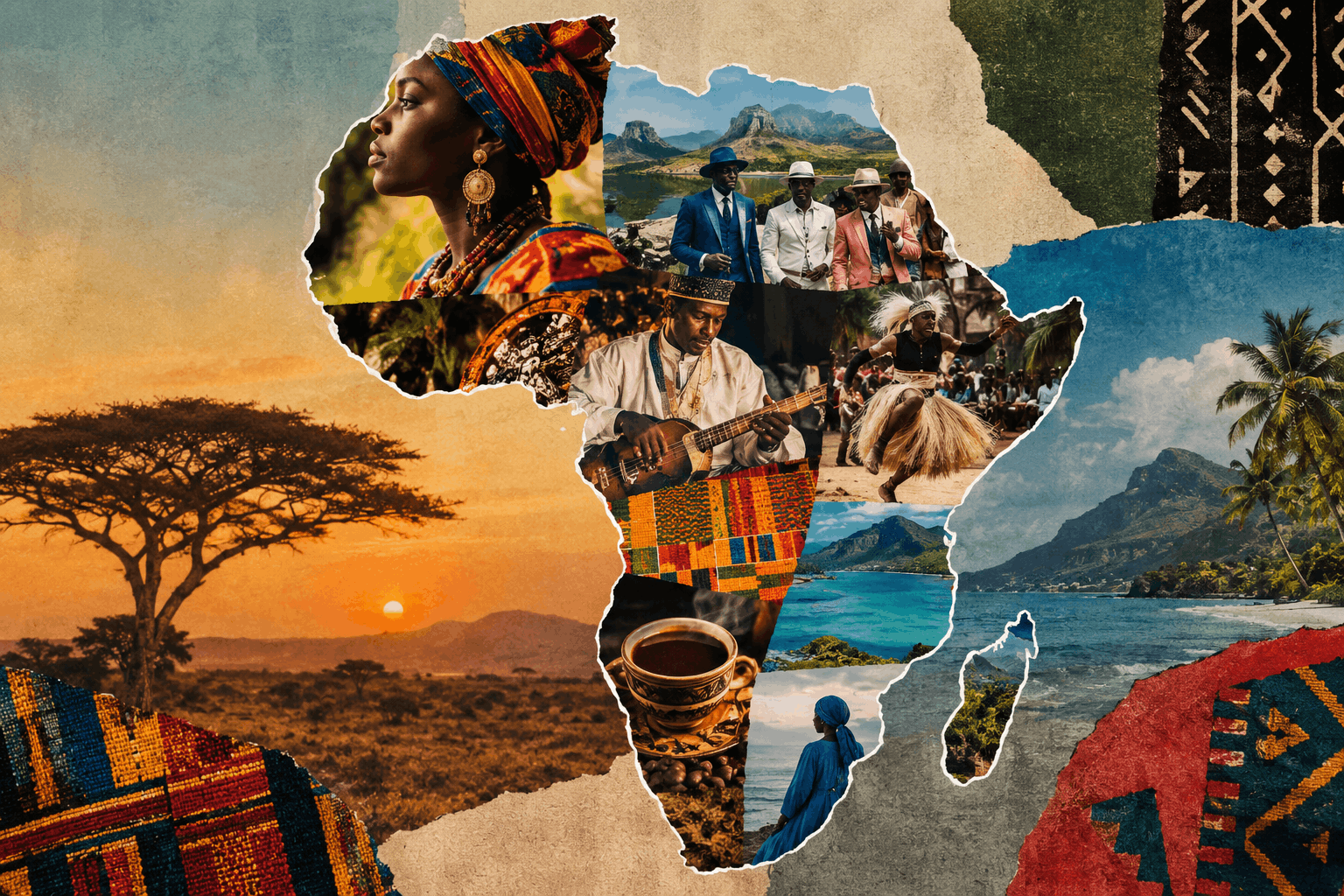
When we started this series, we wanted to write about every African country without pretending that one country could stand in for the whole continent. So we went country by country, looking for the histories, traditions, people, places, and details that made each one distinct.
After fifty-four countries, one thing became difficult to ignore: the more we learned about individual countries, the harder it became to talk about them as neatly separate stories.
The same questions kept coming back. What happened to these traditions after colonial rule? What did people carry across borders? What survived attempts to suppress it? What do people remember, and how do they remember it? And how much history can still be found in things people do every day?
This isn't a summary of all fifty-four countries. It is what stayed with us after writing about them.
"Traditional" rarely meant something that belonged to the past
In this section
Today, it is performed by cultural groups and taught in different educational and community settings.
One of the things that changed for us while writing this series was the way we thought about the word "traditional."
It is very easy to hear the word and imagine something old, fixed, and carefully preserved in exactly the same form for generations. The countries in this series kept making that picture harder to maintain.
Take Rwanda's Intore dance. Intore has roots in the training and traditions associated with the royal court and warriors. Today, it is performed by cultural groups and taught in different educational and community settings. It is not something that disappeared when the monarchy ended.
Gnawa music in Morocco has its own complicated history. It developed among communities descended in part from enslaved West Africans brought to North Africa. Today, Gnawa musicians perform within Morocco's living musical culture, while musicians from jazz and other traditions have also worked with Gnawa artists and drawn from its rhythms and instruments.
Then there are the Sapeurs of Kinshasa and Brazzaville. Their highly deliberate approach to clothing developed from a much longer history of Congolese engagement with European fashion. What began within a colonial environment became something distinctly Congolese, with its own rules, personalities, rivalries, and sense of style.
None of these examples make sense if "traditional" means unchanged.
People keep using culture, so culture keeps changing.
The borders are newer than many of the cultures inside them
A country map can make Africa look much more neatly divided than its history actually is.
The Kongo Kingdom did not fit inside the borders of the countries that now occupy its former territory. The history of the Ashanti is not contained entirely within modern Ghana. Mande-speaking peoples and Mande cultural traditions extend across several present-day countries.
The same is true of communities and languages.
The Ewe live on both sides of the Ghana-Togo border. Fang communities are found across Gabon, Equatorial Guinea, and Cameroon. Kinyarwanda is spoken in Rwanda and by communities in neighbouring parts of the Democratic Republic of the Congo and Uganda.
These borders are important today. They determine citizenship, laws, governments, passports, and political institutions. But they do not erase the older relationships that existed before those borders were drawn.
That became difficult to ignore throughout the series. Sometimes understanding a country meant looking beyond the country itself.
Some countries were shaped by people who were brought there against their will
Cape Verde, São Tomé and Príncipe, Seychelles, and Mauritius have very different histories, but they share an important fact: they were uninhabited before European colonisation and settlement.
Their later populations were shaped by colonial rule, the transatlantic slave trade, and, in some cases, indentured labour and other forms of migration. People arrived under circumstances they had not chosen, and over generations their descendants created societies with their own languages, music, food, religions, and customs.
Look at the music that emerged from these histories.
Mauritian sega. Cape Verdean morna. Seychellois moutya.
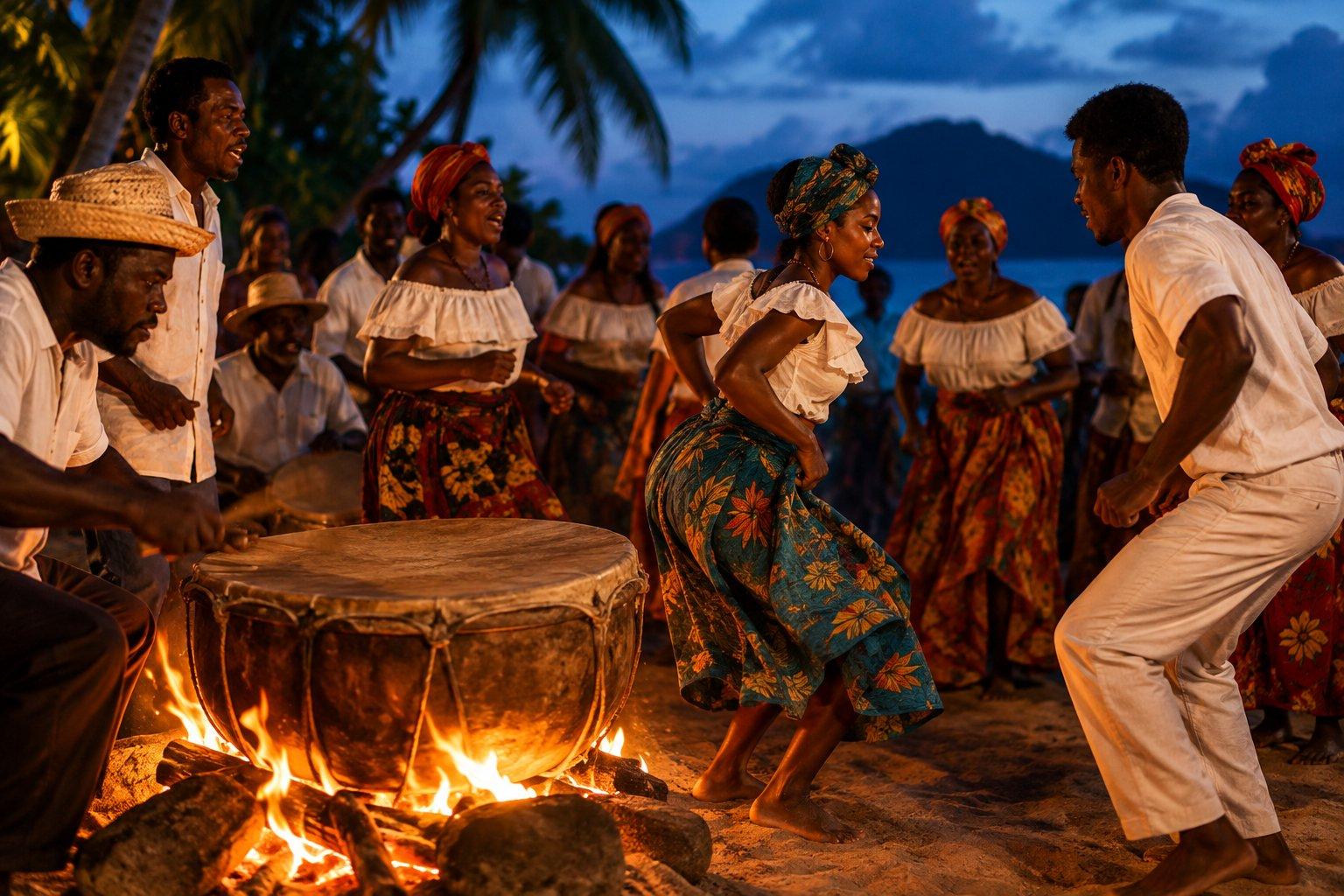
These are not simply songs that happened to develop on islands. They carry histories of displacement, work, memory, relationships, and survival. Moutya, for example, developed among enslaved Africans in Seychelles and was used as a form of expression under the conditions of slavery and colonial rule. Morna became closely associated with Cape Verdean identity, while sega became one of the defining musical traditions of Mauritius.
The people who created these societies did not begin with a blank slate. They brought languages, beliefs, memories, skills, and traditions with them. They also encountered other people and cultures once they arrived.
What emerged was new, but it was not created from nothing.
Suppressing a tradition did not always make it disappear
In this section
In the Americas and Caribbean, those traditions encountered new conditions and other religious systems.
Colonial governments and Christian missionaries tried to suppress a number of African religious and cultural practices. What happened afterwards was rarely as simple as "the tradition survived unchanged."
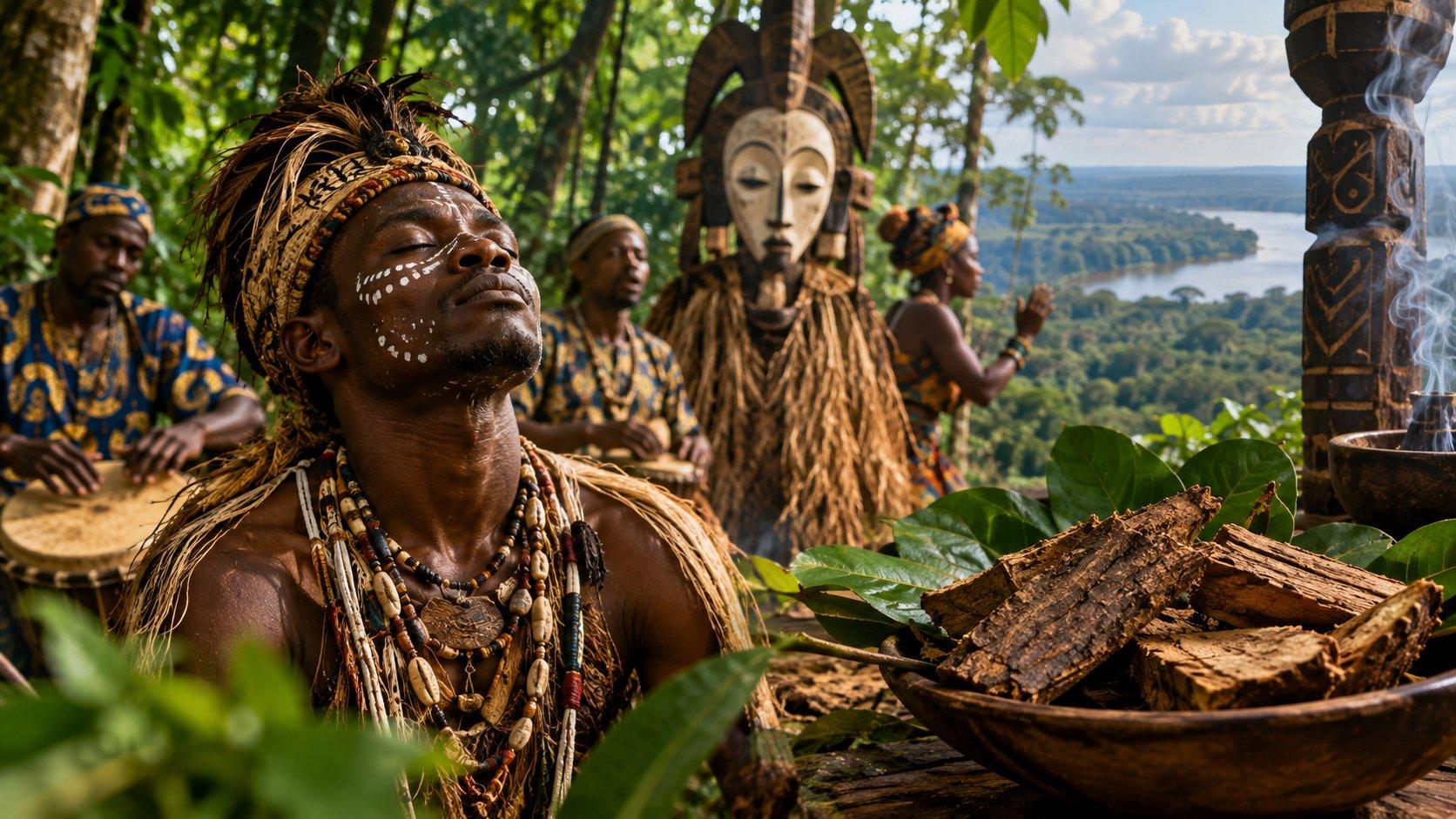
Bwiti in Gabon is a good example. Christianity spread through the region during the colonial period, but Bwiti remained an important religious tradition. Some forms of Bwiti also incorporated Christian ideas and symbols rather than existing completely separately from them.
Gule Wamkulu in Malawi followed another path. The masked dance tradition faced opposition from Christian missionaries, but performers adapted aspects of the practice over time, including the use of Christian imagery in some masks.
Moutya in Seychelles also survived restrictions imposed during the colonial period. The dance and music were associated with enslaved Africans and later working communities, and performances could take place away from the spaces where colonial authorities had greater control.
Vodun provides an even larger example. Religious traditions associated with Vodun in present-day Benin and Togo were carried across the Atlantic by enslaved West Africans. In the Americas and Caribbean, those traditions encountered new conditions and other religious systems. They did not remain identical to the practices from which they came, but elements of them became part of traditions such as Haitian Vodou, Cuban Santería, and Brazilian Candomblé.
That distinction matters. Survival did not necessarily mean keeping everything exactly as it was.
Sometimes survival meant changing enough to continue.
Countries have found different ways to remember violence and loss
Some histories are too painful to leave as a vague reference to "the past."
Rwanda has Kwibuka, the annual period of remembrance for the 1994 genocide against the Tutsi. Eritrea marks Independence Day, Martyrs' Day, and Revolution Day, each associated with its history of armed struggle and independence. Zimbabwe observes Heroes' Day in remembrance of people who fought in the country's liberation struggle.
Algeria's modern history also contains many individual and collective memories of violence. Lounès Matoub, the Kabyle singer and political figure who was assassinated in 1998, remains an important figure in Kabyle cultural memory. Writers and intellectuals killed during Algeria's civil conflict in the 1990s are also remembered.
The details differ from country to country. So do the politics surrounding memory.
But again and again, history appeared in specific forms: a date on the calendar, a memorial, a ceremony, a name, a song, a public holiday, or a person whose life became part of how later generations understood what had happened.
Sometimes history is easier to find in a cup, a piece of cloth, or a song
In this section
In Somalia, oral genealogies can preserve knowledge of family and clan relationships across generations.
Some of the most revealing details in this series were not found in political histories or official accounts. They were found in ordinary things.
In Ethiopia, the coffee ceremony is a social practice as well as a way of preparing and serving coffee. The ceremony can bring relatives, neighbours, and guests together and can take place over a considerable period of time.
In Ghana, kente is more than a colourful fabric. Different patterns and designs have names and meanings, and the cloth has long been connected to Akan social and political life.
Among Herero communities in Namibia, the Victorian-style dress worn by many women became part of a distinct cultural identity during and after the colonial period. The clothing has also taken on significance in remembering the violence of German colonial rule and the Herero and Nama genocide.
In Somalia, oral genealogies can preserve knowledge of family and clan relationships across generations. A genealogy is not simply a list of names. In societies where lineage can influence social relationships and ideas about belonging, knowing where a family comes from can carry practical significance.
This was one of the things we found ourselves noticing more as the series went on: history is not always sitting inside a textbook waiting to be opened. Sometimes it is being served to a guest, worn to a ceremony, sung at a gathering, or remembered aloud.
What comes next
In this section
A country can contain dozens of languages, communities, histories, religions, landscapes, political experiences, and cultural traditions.
Fifty-four countries sounds like a lot until you start looking at what is inside each one.
A country can contain dozens of languages, communities, histories, religions, landscapes, political experiences, and cultural traditions. A city can have a completely different story from a rural region a few hours away. A tradition can look different from one community to the next. Even within the same family, memories of the past can differ.
So this series covered every country on the continent, but it did not come close to covering Africa.
There are towns we never got to write about. There are languages we could only mention briefly. There are traditions that deserved an entire article but received a paragraph. There are families, musicians, writers, historians, craftspeople, religious communities, and ordinary people whose experiences would tell a different story again.
That is probably the most honest place to end.
Africa is not one culture divided into fifty-four countries. And it is not fifty-four self-contained cultures either.
The countries have their own histories and identities, but those histories overlap, cross borders, borrow from one another, remember different things, and continue to change.
After fifty-four countries, we came away knowing more about the continent. We also came away with a much longer list of things we still want to understand.