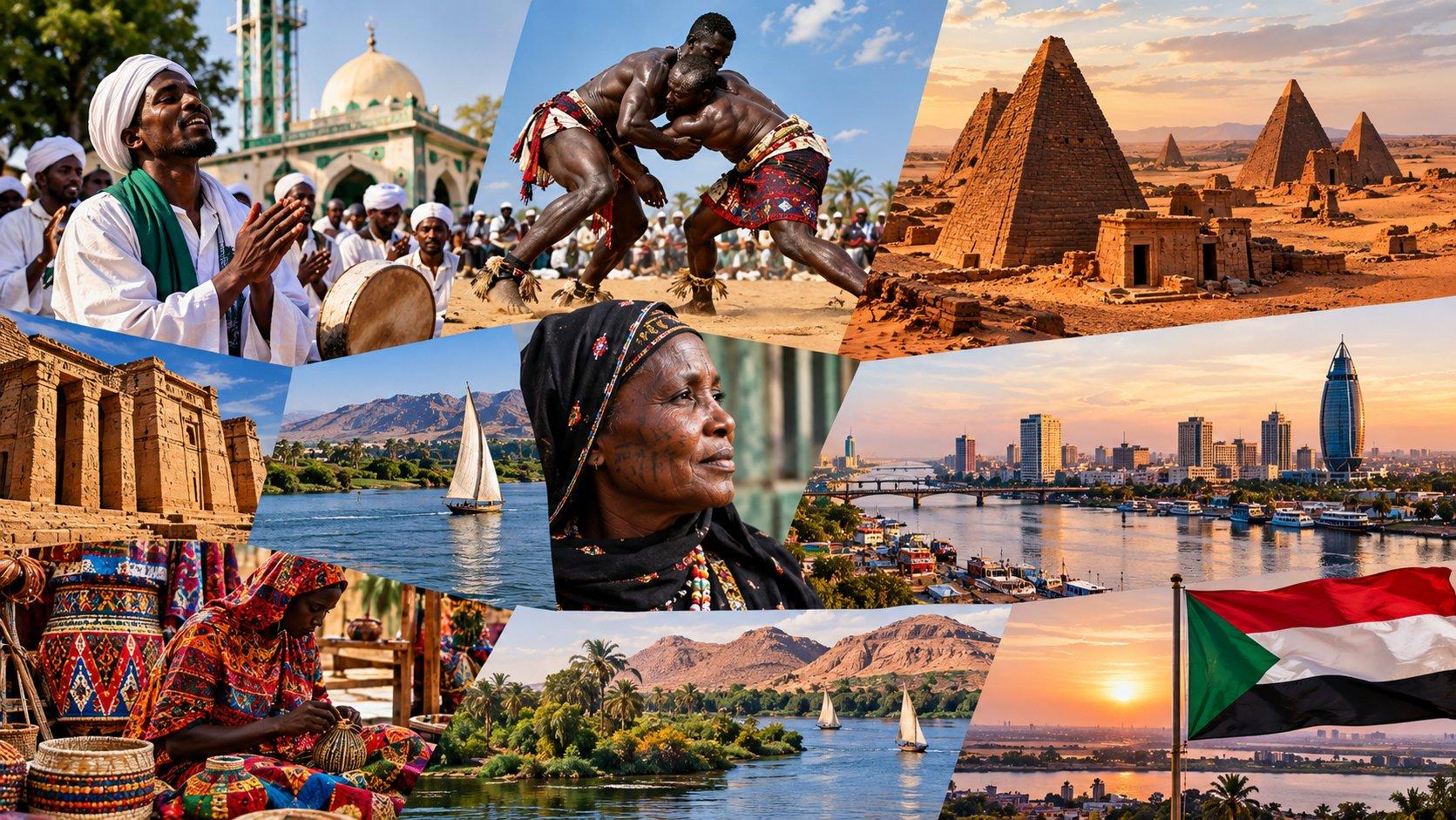
On a Friday in Omdurman, before Sudan's current war made ordinary public gatherings increasingly difficult, worshippers could gather at the tomb of Sheikh Hamed al-Nil, a 19th-century Sufi figure associated with the Qadiriyya order. Drums accompanied chanting and rhythmic movement as participants performed dhikr, an Arabic word meaning the remembrance or invocation of God. The gathering was not an unusual form of worship imported from elsewhere. Sufi orders have been deeply embedded in Sudanese religious life for centuries, and public dhikr remains one of the country's most recognizable expressions of that tradition.
Elsewhere in the greater Khartoum area, Nuba wrestlers could be competing on a Friday as well. Nuba wrestling comes from the Nuba Mountains of South Kordofan, a region inhabited by many distinct communities. Traditionally, wrestling was connected to community celebrations, planting and harvest seasons, weddings and displays of physical ability. In refugee communities in South Sudan, the sport also became an important link to home. National Geographic documented large gatherings of displaced Nuba around wrestling competitions in Yida, where thousands of people from the mountains had sought refuge.
These two scenes make a useful introduction to Sudan, but not because one represents an "Arab Sudan" and the other an "African Sudan." That division is too neat for the country it describes.
Sudanese Arabs are African. Darfur is Muslim but contains many non-Arab ethnic groups. The Nuba Mountains contain Muslims, Christians and followers of traditional religions. The Nile Valley has been shaped by Nubian, Arab, Ottoman-Egyptian, British and other influences over many centuries. Sudan's cultural map is therefore less a line separating two populations than a collection of overlapping histories.
Understanding that complexity requires going much further back than the modern state.
Before modern Sudan, there was Kush
Long before the Republic of Sudan existed, the Middle Nile was home to powerful African kingdoms.
The Kingdom of Kush emerged as one of the major civilizations of the ancient Nile Valley. Its history stretched across more than a thousand years, and at its height Kush controlled territory extending from what is now northern Sudan into Egypt. Kushite rulers conquered Egypt in the 8th century BCE and established what historians call the Twenty-Fifth Dynasty of Egypt. They are sometimes popularly called the "Black Pharaohs," although that is a modern description rather than the formal name of the dynasty.
Later, the centre of Kushite power moved south to Meroe. The archaeological remains there include royal cemeteries, temples, palaces, industrial sites and large numbers of pyramids. UNESCO describes Meroe as the heartland of the Kingdom of Kush, which was a major power from the 8th century BCE to the 4th century CE.
This is where one of Sudan's most surprising archaeological facts comes from.
Sudan has more ancient pyramids than Egypt.
The exact number depends on how researchers define and count the structures, but estimates commonly place the number of surviving Sudanese pyramids at more than 200, with some counts reaching roughly 255. Most are associated with Kushite royal and elite cemeteries, particularly around Meroe, Nuri and other sites in the ancient Nile Valley.
They are generally smaller and steeper than the Great Pyramids of Giza, and they served a different funerary tradition. Their significance, however, is not measured by size. They are evidence of a civilization that developed its own political institutions, religious practices, architecture, writing and long-distance trade networks while also exchanging ideas with Egypt and the wider Mediterranean and Middle Eastern worlds. UNESCO describes the Meroe sites as exceptional evidence of the wealth, power and international connections of Kush.
The history did not end when Kush declined.
Christianity came to Nubia, and stayed for centuries
From the 6th century CE, Christianity became established in Nubia, the Nile region stretching across parts of present-day southern Egypt and northern Sudan. Several Christian kingdoms developed in the region, including Makuria, Nobatia and Alodia.
Old Dongola, in present-day Sudan, became the capital of Makuria. The archaeological site contains churches, houses, administrative buildings, mosques and other remains showing that the region's religious and political life changed over time rather than switching from one faith to another overnight. UNESCO describes Old Dongola as the capital of the Christian Kingdom of Makuria from approximately the 7th to the 14th century.
Christian Nubia therefore survived for centuries after Egypt to the north had come under Muslim rule.
Islam spread gradually through trade, migration, political relationships and conversion. The process was not a single conquest followed by an immediate change in population. Muslim communities developed along the Nile, commercial networks expanded and political power shifted over successive centuries.
By the modern period, Islam had become dominant across northern and central Sudan and was also deeply established in Darfur. Southern Sudan developed a different religious history, with Christianity and indigenous religious traditions remaining particularly important there. The Nuba Mountains developed their own mixed religious landscape.
That distinction matters because Sudan's modern religious geography cannot be reduced to a simple north-south religious border.
The Mahdi and the creation of a Sudanese state
By the 19th century, Sudan was governed through the Turco-Egyptian administration, a system established after Egypt's conquest of much of Sudan in the 1820s. Egypt itself was increasingly subject to British influence, and Britain became deeply involved in Sudan's affairs.
In 1881, Muhammad Ahmad, a Sudanese religious leader, declared himself the Mahdi, a messianic figure in Islamic belief who is expected by many Muslims to appear before the end of the world. His declaration launched the Mahdist movement, which challenged Turco-Egyptian rule and attracted supporters from different parts of Sudan.
The Mahdists defeated government forces in a series of battles and captured Khartoum in January 1885. Muhammad Ahmad died later that year, but his movement established a state that controlled much of Sudan.
The movement emerged from a Sudanese Islamic environment in which Sufi orders already had considerable influence. Muhammad Ahmad himself had been associated with the Sammaniyya Sufi order. This provides an important connection between Sudan's Sufi history and the Mahdist movement, although it should not be confused with the claim that particular modern dhikr ceremonies directly descend from Mahdist battle rituals.
Britain eventually intervened militarily. In 1898, an Anglo-Egyptian army commanded by Herbert Kitchener defeated the Mahdist forces at the Battle of Omdurman, one of the decisive battles in the history of modern Sudan.
The following year, Britain and Egypt established the Anglo-Egyptian Condominium, formally making Sudan a territory governed jointly by the two powers. In practice, Britain exercised the dominant political and administrative authority.
The arrangement lasted until Sudan became independent in 1956.
But colonial rule had consequences that continued long after the British left.
How colonial rule reinforced the North-South divide
Sudan's regional differences existed before British rule. Colonial administration did not invent the country's ethnic, linguistic or religious diversity.
It did, however, organize that diversity in particular ways.
For much of the first half of the 20th century, British authorities administered northern and southern Sudan differently. The North was predominantly Muslim and Arabic-speaking, while the South was more religiously and linguistically diverse. Education policy followed the same division: government schools were concentrated in the North, while Christian missionary organizations played a major role in education in the South for much of the colonial period. Oxford's research on colonial education describes the administration as effectively treating the territory as "two Sudans" for much of this period.
The policy was later changed. During the final colonial decade, Britain moved toward educational and administrative unification. But the earlier separation had already contributed to very different political and educational experiences in the two regions.
Independence did not erase those differences.
The first Sudanese civil war began in 1955, shortly before independence, and lasted until 1972. It was followed by a second and much longer war from 1983 to 2005. The first conflict killed an estimated 500,000 people, while the second killed more than two million according to widely cited estimates.
The wars were driven by several overlapping issues, including political exclusion, regional inequality, disputes over autonomy, land, resources, religion and the role of Arabic-speaking northern elites in the national government. Describing the conflicts as nothing more than a religious war or an Arab-versus-African struggle misses much of what was happening.
The Comprehensive Peace Agreement of 2005 ended the second north-south civil war and established a framework under which southern Sudan would eventually vote on whether to remain part of Sudan.
In January 2011, the referendum produced an overwhelming vote for independence.
On 9 July 2011, South Sudan became an independent country.
The creation of South Sudan ended the principal north-south civil war, but it did not end conflict inside Sudan.
Darfur changed the story again
While the north-south war was moving toward a peace settlement, another conflict had already begun in western Sudan.
In 2003, armed rebel movements in Darfur launched an insurgency against the Sudanese government. The government responded with military operations and support for militias commonly known as the Janjaweed.
The conflict produced mass killings, village destruction and displacement. A 2004 U.S. State Department investigation documented extensive attacks against civilians and concluded that the Sudanese government and Janjaweed forces had participated in systematic abuses.
In September 2004, U.S. Secretary of State Colin Powell formally stated that genocide had been committed in Darfur and that the Sudanese government and Janjaweed bore responsibility. The United States later continued to describe the situation as genocide.
The ethnic language surrounding Darfur needs care.
The region contains both Arab and non-Arab communities, and the distinction does not map perfectly onto religion. Many of the communities attacked during the Darfur conflict were Muslim. The Fur, Masalit and Zaghawa are among the major non-Arab groups associated with Darfur, while Arab communities themselves are not a single homogeneous population.
That is one reason the phrase "Arab versus African" can be misleading. In Darfur, the combatants and communities involved had overlapping identities, and the conflict was also shaped by competition over land, political power, security and access to resources.
The violence displaced millions of people.
And the legacy of Darfur is still present in Sudan's current war.
Sudan's many peoples and languages
There is no single ethnic group that can adequately represent Sudan.
The population includes Sudanese Arabs, Nubians, Beja, Fur, Zaghawa, Masalit, Nuba communities and many other groups. Some identities are primarily ethnic, some linguistic, some regional and some built around combinations of all three.
Even the category "Nuba" needs explanation. It refers to a large collection of distinct communities living primarily in the Nuba Mountains of South Kordofan. They do not all speak the same language or share identical customs. Their common identity has been strengthened in part by shared political experiences and cultural practices, including wrestling.
The Nubians of northern Sudan are also not one linguistic group. Languages such as Nobiin and Dongolawi belong to the region's older linguistic traditions, while Arabic has become dominant in wider national communication.
Eastern Sudan is home to the Beja, whose languages and pastoral traditions are distinct from those of the Nile Valley.
Darfur contains numerous ethnic and linguistic communities, including the Fur, Masalit and Zaghawa.
This diversity is one reason population percentages should be treated cautiously. Sudan does not have a reliable contemporary census that allows precise claims about the current ethnic proportions of the population. Estimates frequently describe Sudanese Arabs as the largest broad identity category, but those figures should not be presented as precise census measurements.
Arabic is the dominant language of national public life, while numerous indigenous languages remain in use. English also has an important historical and institutional role, particularly because it was used extensively in education and government during the Anglo-Egyptian period and remained important in some sectors after independence.
Sudan's linguistic diversity is therefore not a footnote. It is one of the reasons national identity has never been entirely uniform.
Sufism and the religious life of Sudan
Sudan is overwhelmingly Muslim, and most Muslims in the country are Sunni. Sufi orders have historically played a particularly important role in Sudanese Islam.
A Sufi order is a religious network organized around a particular spiritual tradition, teacher or lineage. Followers may gather for teaching, prayer and dhikr, the remembrance of God through repeated prayers, names of God or other devotional practices.
The Qadiriyya is one of the major Sufi orders associated with Sudan. The Friday gathering at Sheikh Hamed al-Nil's tomb in Omdurman became one of the country's best-known examples of public Sufi devotion.
Visitors and worshippers have documented drumming, chanting, incense, rhythmic movement and communal participation around the ceremony.
It is important, however, not to describe the gathering as representative of every Muslim in Sudan. Sudanese Islam contains different traditions, and religious practice varies between communities and regions.
The same is true outside Islam.
Christianity remains present in Sudan, although the Christian population is much smaller than it was before South Sudan became independent because a large proportion of Sudan's historically Christian southern population became citizens of the new South Sudan.
Indigenous religious practices also continue among some communities, sometimes alongside Christianity or Islam rather than existing as completely separate systems.
Under Omar al-Bashir, who ruled Sudan from 1989 until 2019, the state pursued an Islamist political and legal project that included the implementation of sharia-based laws. Sudan's religious and political landscape changed significantly after the 2019 political transition, although the country has since been engulfed by another period of war and political instability.
Food tells a different story
Sudanese food makes the country's regional connections easier to see.
Ful medames, cooked fava beans seasoned with ingredients such as oil, lemon and spices, is a familiar breakfast food across Sudan and other parts of the Nile Valley.
Kisra, a thin fermented flatbread made principally from sorghum, is another major Sudanese staple. It is commonly eaten with stews and sauces.
Asida, a thick porridge made from grain flour, is also part of Sudanese cuisine, while different forms of mullah, a broad term used for cooked sauces and stews, accompany staple grains and breads.
Sorghum is particularly important. The crop has been cultivated in Sudan for centuries and remains central to the country's food system, especially because it performs relatively well under the country's dry and variable climatic conditions. The Food and Agriculture Organization identifies sorghum as Sudan's special agricultural product and describes it as an important staple supporting food security and rural livelihoods.
Along the Nile, fish contributes to local diets. Pastoral communities in different parts of Sudan have historically relied more heavily on livestock products, including meat and milk.
Hospitality has its own food ritual.
Tea and coffee are widely associated with Sudanese social life, and serving drinks to visitors is an important form of hospitality. Sudanese coffee is often called jabana and is traditionally prepared in a clay coffee pot, while tea is commonly served strong and sweet.
In urban Sudan, women running tea stalls, often referred to as sittat al-shai, became a recognizable part of street life. These informal businesses have provided income for many women and have also become social spaces in their own right.
The practice is significant partly because it shows how ordinary economic activity can become cultural tradition. A tea stall is not an ancient institution, but repeated everyday behaviour can become one of the recognizable features of a city's social landscape.
Nuba wrestling is sport, ceremony and identity
Nuba wrestling is one of the clearest examples of a cultural practice that has changed without disappearing.
The Nuba Mountains contain many different communities, and wrestling traditions vary between them. Historically, wrestling could be associated with agricultural festivals, weddings and other community events. It was also a way for young men to demonstrate strength, skill and social standing.
Traditional wrestling could look very different from the sport seen in modern urban competitions.
Historical photographs show wrestlers covered in ash or cow butter, while contemporary wrestlers generally compete in athletic clothing. National Geographic documented this transformation among Nuba communities in South Sudan and described wrestling as a cultural practice that helped connect displaced people to their communities of origin.
That change is important.
A tradition does not have to remain frozen in its oldest form to remain meaningful.
For Nuba people displaced by conflict, the wrestling arena can provide something that displacement removes: a recognizable social setting in which people from different Nuba communities gather, compete, support their teams and reproduce a cultural practice associated with home.
This is why wrestling can function as more than sport without requiring us to describe every match as a religious ceremony or formal rite of passage.
Music carries the same history in another form
Sudanese popular music developed through the interaction of older local traditions with Arab musical forms and instruments such as the oud.
During the 20th century, musicians in Khartoum and Omdurman helped develop distinctive forms of modern Sudanese music. The result was not a single national sound but a broad musical field shaped by different regional traditions, languages, instruments and rhythms.
The country's cultural diversity can be heard in the same way it can be seen in its languages.
The oud may place a song within a wider Arab musical tradition. Percussion and rhythmic structures can draw on African musical traditions. Lyrics may move between Sudanese Arabic and other languages. A single performance can therefore carry several historical influences without needing to be assigned to only one cultural category.
The war has also changed how Sudanese music circulates.
Artists living outside the country have become increasingly important in maintaining and sharing Sudanese music internationally. Sudanese musicians and cultural organizations in countries including Egypt and across Europe and North America have created spaces for performances, recordings and cultural exchange while Sudan's domestic cultural infrastructure has been disrupted by war.
The diaspora is therefore not separate from contemporary Sudanese culture. It has become one of the places where that culture continues to be produced.
Clothing and craft
The jalabiya, a long loose robe commonly worn by men in Sudan, is one of the country's most recognizable forms of clothing. It is often worn with a turban or other head covering.
Women commonly wear the toub, a long piece of fabric wrapped around the body and worn in different styles. The garment belongs to a wider clothing tradition found across northeastern Africa, although Sudan has developed its own distinctive ways of wearing and decorating it.
In Nubian communities along the Nile, brightly painted houses have become an especially recognizable visual tradition. Facades may feature geometric patterns, plants, animals and other decorative motifs.
Other craft traditions include pottery, basketry, leatherwork, weaving and jewellery. Their forms and meanings differ between regions and communities.
These crafts are not merely museum objects. They have historically been connected to ordinary domestic life, trade, clothing, ceremonies and household production.
War and displacement, however, make the continuation of these traditions more difficult when communities are separated from their homes, workshops, markets and sources of raw materials.
Friday, Eid and the calendar of community life
Sudan's cultural calendar is not built around one national tradition.
For Muslims, Eid al-Fitr, which marks the end of Ramadan, and Eid al-Adha, associated with the Islamic pilgrimage season, are major occasions for prayer, family gatherings, food and new clothing.
Friday itself has particular importance in Islam as the day of the congregational Friday prayer. But the way Friday is experienced varies enormously.
For some Sudanese Muslims, it can include mosque prayer, family meals and visits to relatives. For Sufi communities, it can also be associated with devotional gatherings such as the dhikr at Sheikh Hamed al-Nil.
For Nuba communities, Friday wrestling competitions have at different times provided a setting for sport and community gathering.
These are not interchangeable traditions. Their importance comes from different histories.
Putting them beside each other is useful because it shows something that statistics alone cannot: Sudanese culture has never been one thing.
Sudan's pyramids are extraordinary, but they are not untouched
There is a temptation to talk about Sudan's archaeological heritage as though it has been sitting untouched in the desert, waiting for the world to discover it. That is not accurate.
Sudan's archaeological sites have faced environmental pressures, limited conservation resources, flooding, looting and the consequences of political instability for decades.
The current war has made those risks much more serious.
UNESCO has reported extensive damage and looting at the Sudan National Museum in Khartoum. In 2026, the organization reported that more than 20 museums across Sudan had been looted or damaged since the outbreak of the war in 2023, with thousands of objects stolen, destroyed or trafficked. UNESCO and Sudanese authorities have also been working to document collections, protect surviving objects and strengthen measures against illicit trafficking.
The archaeological sites themselves have also faced wartime risks.
In January 2024, UNESCO called for the protection of the Archaeological Sites of the Island of Meroe after reports of military activity in the area.
The danger is not only physical destruction. When museums are looted and archives are scattered, researchers lose the records needed to understand what survived, where objects came from and how they relate to one another.
Preserving Sudanese heritage therefore involves more than protecting buildings.
It means protecting the evidence through which Sudanese history can be reconstructed.
Sudan is still living through another war
On 15 April 2023, fighting broke out between the Sudanese Armed Forces (SAF) and the Rapid Support Forces (RSF), a powerful paramilitary organization.
The RSF developed from armed forces that included former Janjaweed networks involved in the Darfur conflict. The relationship between the earlier Janjaweed militias and the later RSF is therefore an important part of understanding why the history of Darfur remains relevant to Sudan's present conflict.
The war quickly spread across the country and transformed Khartoum into a major battlefield. Fighting and insecurity have also affected Darfur, Kordofan and other regions.
The humanitarian consequences have been enormous.
According to UNICEF, by the middle of 2026 around 15 million people had been displaced, including approximately five million children. An estimated 19.5 million people were facing high levels of acute food insecurity, while around 70 percent of health facilities were non-functional. UNICEF describes Sudan as one of the world's most severe humanitarian crises.
Those numbers are not just measurements of a war.
Displacement separates families from farms, schools, workplaces, graves, religious institutions, markets and community gatherings. It can also interrupt the ordinary processes through which cultural knowledge is passed from one generation to another.
That is why cultural preservation matters during war.
A wrestling tournament, a song, a language, a cooking practice or a painted house may look small beside a military campaign. But these are among the ways communities reproduce themselves after institutions and places have been disrupted.
What remains
Sudan's history cannot be reduced to the headlines of the current war.
Along the Nile are the remains of Kush, including the pyramids and temples of Meroe. Old Dongola preserves evidence of the Christian kingdom of Makuria. Omdurman carries the history of the Mahdist state and remains associated with important Sufi traditions. Darfur, the Nuba Mountains and eastern Sudan contain their own languages, social systems and cultural histories.
But neither can Sudan's heritage be separated from the present.
UNESCO's work in 2026 includes rehabilitation of the Sudan National Museum, emergency conservation, documentation of surviving and missing objects, training for heritage professionals and efforts to prevent stolen artefacts from leaving the country.
That work matters because Sudan's cultural record is not only about ancient history.
It also documents the people who came after Kush, the Christian kingdoms that followed, the spread of Islam, the rise of Sufi orders, the Mahdist revolution, colonial rule, independence, civil wars, Darfur and the many communities that continued building lives through all of them.
The two Fridays from the beginning of this story therefore do not represent two separate Sudans.
They represent two of the many ways Sudanese communities have created meaning, belonging and continuity.
One gathers around remembrance of God.
Another gathers around wrestling.
Between them lies a country whose history has never fitted neatly into one category, and whose cultural life continues to exist even while war is destroying many of the places that once gave that life a physical home.