Among the Maasai, age is not only a matter of how many years a person has lived. For men in communities that maintain the traditional age-set system, the stage of life a person occupies has historically been tied to a cohort: a group of males inducted into the system around the same period and expected to move through important stages of social life together.
That system has its own vocabulary. Young men who enter warriorhood are known as morans, and their transition through life is marked by ceremonies with specific purposes. Enkipaata is an induction rite associated with the preparation of boys for initiation. Eunoto marks an important transition as morans move toward adulthood, while Olng'esherr, a later meat-eating ceremony, marks the end of moranism and the beginning of eldership. The ceremonies do more than mark age. They transmit knowledge about livestock, conflict management, responsibilities, traditions and community life from one generation to the next.
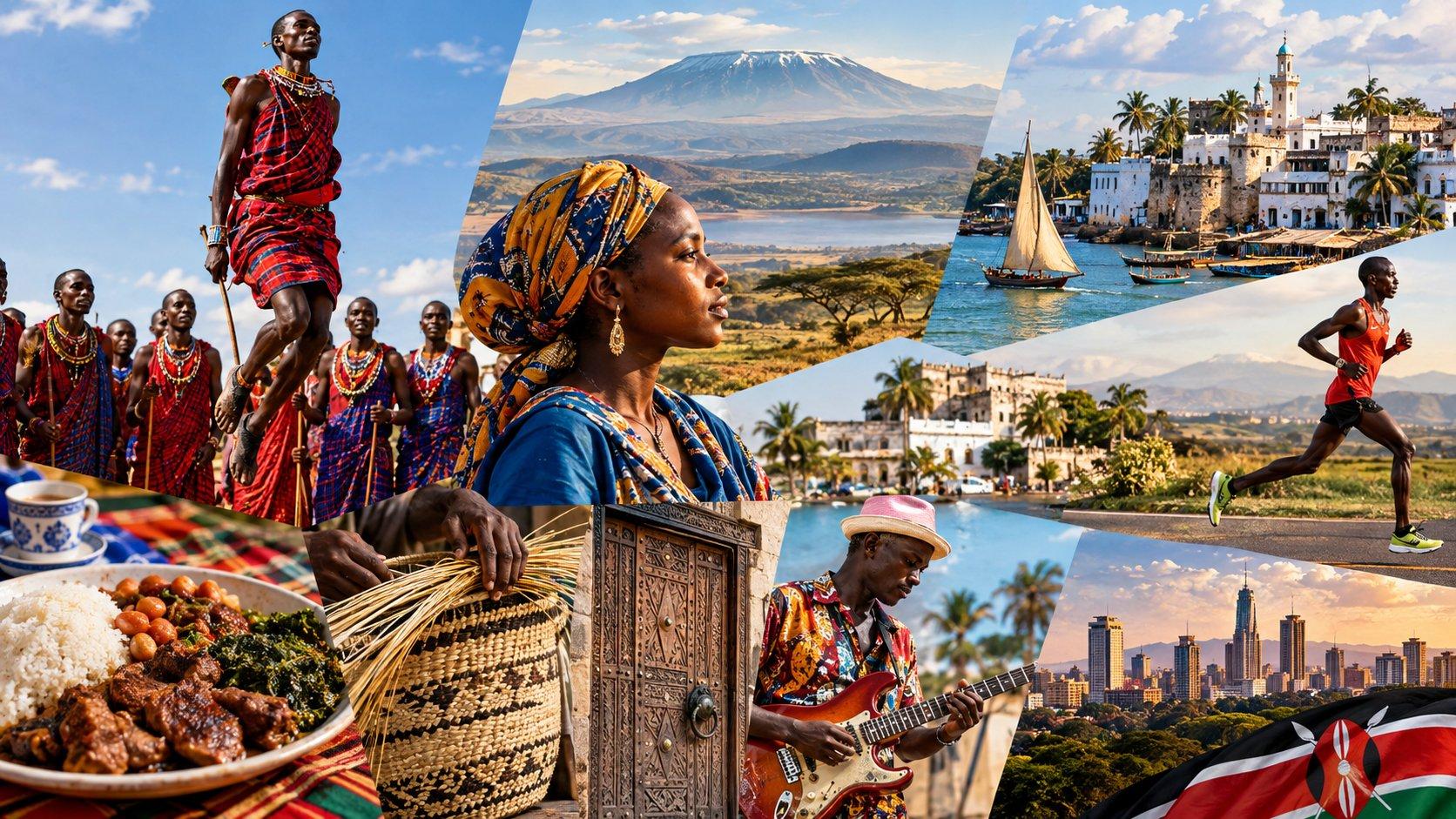
One of the practices most familiar to outsiders is adumu, the Maasai jumping dance. During the performance, young men form a group, sing and chant, and take turns making high vertical jumps from a standing position. It has become one of the most recognizable images associated with Maasai culture, appearing frequently in tourism campaigns and popular representations of East Africa.
But the jumping is only one visible part of a much larger social system.
And that distinction matters because the Maasai are not Kenya, any more than the Swahili coast, the Kikuyu highlands or Kenya's famous running culture can represent the country by themselves. Kenya is home to more than 40 recognized ethnic communities, although the exact number depends on how communities and subgroups are classified. The 2019 census identified the Kikuyu, Luhya, Kalenjin, Luo and Kamba as the five largest ethnic affiliations.
The country also contains more than 60 living languages, grouped broadly within Bantu, Nilotic and Cushitic linguistic traditions. Kiswahili is the national language, while Kiswahili and English are the country's official languages under the Constitution.
So understanding Kenya requires looking beyond the most recognizable image and asking how its different histories, languages and social systems developed.
A country shaped by several migrations
Kenya's human history reaches deep into the archaeological record. The northern part of the country, particularly the Lake Turkana region, has produced major discoveries relevant to the study of human evolution. But the peoples who make up modern Kenya emerged much later through many different movements, interactions and processes of cultural change.
Bantu-speaking populations moved into parts of eastern Africa over a long period rather than in a single migration. Over generations, their movement and interaction with earlier populations contributed to the emergence of communities that today include the Kikuyu, Kamba, Luhya, Mijikenda and other Bantu-speaking peoples of Kenya.
Nilotic-speaking populations also moved through the region over several centuries. These movements were not a single southward migration that produced today's communities in one step. Different Nilotic-speaking populations arrived and expanded at different times, interacting with people already living in the region.
The Maasai themselves belong to the broader Eastern Nilotic linguistic group. Their expansion southward occurred later, with major movements through the Rift Valley and into present-day Kenya and Tanzania taking place over subsequent centuries. By the 19th century, Maasai communities occupied substantial areas of the Rift Valley and neighbouring rangelands.
The Kalenjin communities of western Kenya have a different history again. The term Kalenjin refers to a group of related communities that speak Southern Nilotic languages, including the Nandi, Kipsigis, Tugen and others. Their settlement histories are connected to movements through the western highlands and Rift Valley rather than to a single migration event.
These distinctions matter because modern ethnic identities are not fossils from a single moment in the past. Communities formed through migration, marriage, political alliances, conflict, trade, absorption of neighbouring populations and changes in how people identified themselves.
Kenya's cultural map is therefore better understood as something that developed over centuries than as a collection of groups that arrived once and remained unchanged.
How the Swahili coast became part of the Indian Ocean world
The coast tells a different story.
For centuries, communities along the East African coast participated in an Indian Ocean trading network connecting eastern Africa with Arabia, Persia, India and, eventually, Europe. Out of these interactions developed Swahili civilization, a coastal culture whose language and local foundations were African but whose history was deeply shaped by international trade, migration, Islam and cultural exchange.
Kiswahili itself is a Bantu language. It developed on the East African coast and absorbed vocabulary from Arabic and other languages through centuries of contact. Archaeological and genetic research also complicates the old idea that Swahili civilization was primarily the result of foreign settlers arriving on an otherwise empty coast. Ancient-DNA research published in Nature in 2023 found that medieval Swahili populations had predominantly African ancestry alongside substantial ancestry associated with Persian and Indian Ocean populations. The researchers found evidence of African and Persian-associated populations mixing by around AD 1000, followed by further Arabian and Indian Ocean connections.
The result was a coastal society that was African in its foundations and international in its connections.
Places such as Mombasa, Malindi and Lamu became part of a wider commercial world in which merchants moved goods, ideas, languages and religious traditions across the ocean. Islam became central to Swahili society, while local architectural traditions developed alongside influences from Arabia, Persia and India.
Lamu Old Town offers one of the clearest surviving examples of this history. UNESCO describes it as the oldest and best-preserved Swahili settlement in East Africa, and says it has remained continuously inhabited for more than 700 years. Its coral-stone buildings, narrow streets, courtyards and carved wooden doors preserve architectural traditions shaped by centuries of African and Indian Ocean exchange.
The important point is that outside influence did not erase the local culture and replace it with something foreign. The Swahili world developed through interaction between them.
Colonial rule changed the relationship between land and power
British colonial rule introduced another major transformation.
Kenya became a British colony in 1920 after decades of British control and settlement. European settlers acquired large areas of fertile agricultural land, particularly in the central highlands. The consequences were particularly significant for Kikuyu communities, whose livelihoods and social organization were closely connected to land.
Land alienation became one of the major grievances underlying resistance to colonial rule. Political exclusion, labour conditions, racial discrimination and disputes over land combined with wider demands for African political rights.
These tensions contributed to the Mau Mau uprising, which began in the 1950s during the period known officially by the British administration as the Emergency. The movement was strongly associated with Kikuyu communities, although people from other communities also participated.
The conflict became extremely violent. The colonial government detained large numbers of Kenyans and established a system of detention and forced rehabilitation. Evidence later presented in British legal proceedings documented torture and other forms of ill-treatment.
In 2013, the British government formally expressed regret for abuses committed during the Emergency and acknowledged that Kenyans had been subjected to torture and ill-treatment. Britain reached an out-of-court settlement covering 5,228 claimants, with the total value of the settlement and legal costs stated by the British government as £19.9 million. The government also supported a memorial in Nairobi to victims of torture and ill-treatment during the colonial period.
The legal settlement did not amount to a court judgment establishing British legal liability for the colonial administration's actions. That distinction is important. The British government expressed regret and provided compensation under an out-of-court agreement rather than accepting legal liability for the claims.
Kenya became independent on 12 December 1963, with Jomo Kenyatta becoming the country's first prime minister. One year later, Kenya became a republic and Kenyatta became its first president.
Independence ended colonial rule, but it did not erase the problems created during it. Land distribution, regional inequality and the political importance of ethnic identity remained significant issues in the decades that followed.
Ethnic identity is part of Kenyan politics, but Kenya is not divided into simple ethnic blocks
The importance of ethnicity in Kenya is often discussed from the outside as though the country consists of a fixed collection of competing tribes.
The reality is more complicated.
Ethnic identity can influence political alliances, language, family networks, local belonging and access to historical claims over land and resources. At the same time, people have multiple identities. A Kenyan can be identified simultaneously through nationality, county, language, religion, profession, family, generation and ethnic community.
The country's five largest ethnic affiliations in the 2019 census were Kikuyu, Luhya, Kalenjin, Luo and Kamba. The census also recorded many smaller communities, including the El Molo, Dahalo, Konso, Gosha and Wayyu.
The El Molo, who live around Lake Turkana, are among Kenya's smallest recognized ethnic communities. Their traditional economy has been closely associated with fishing and life around the lake rather than the cattle-based pastoralism associated with communities farther south.
In the northeast, Somali, Borana and Gabra communities belong to linguistic and cultural worlds that extend across Kenya's modern borders into Somalia and Ethiopia. National boundaries drawn in the colonial period therefore do not always correspond to the older geographic networks through which communities moved, traded and maintained relationships.
The same is true along the coast, where Swahili communities have historical connections across the wider Indian Ocean world.
Kenya's diversity is therefore geographical as well as ethnic. The country contains humid coastal environments, highland farming regions, the Great Rift Valley, Lake Victoria's basin and extensive arid and semi-arid lands in the north and east. Different environments helped shape different economic systems, from farming and fishing to pastoralism and trade.
What language tells you about Kenya
The country's linguistic diversity makes this especially visible.
Kiswahili and English occupy national institutional roles, but many Kenyans grow up speaking an indigenous language at home. The Constitution specifically requires the state to protect Kenya's linguistic diversity and promote indigenous languages.
Kiswahili is particularly important because it allows communication across communities that do not share a first language. It is not simply a language imported from elsewhere. Kiswahili developed from Bantu-speaking coastal societies and became increasingly widespread through trade, religion, education, administration, media and urbanization.
In Nairobi and other cities, another form of linguistic mixing is especially visible in Sheng, an urban way of speaking that draws heavily on Kiswahili and English while incorporating vocabulary from several Kenyan languages. Sheng is not a single standardized language, and its vocabulary changes across generations and neighbourhoods. Its existence illustrates something important about Kenyan identity: languages are not sealed containers. People constantly adapt them to new social environments.
Religion is diverse too
Kenya is predominantly Christian, but the country's religious landscape is more varied than that headline suggests.
The 2019 census recorded 85.5 percent of the population as Christian and 11 percent as Muslim. Christians include Protestant, Catholic and Evangelical communities among others. Muslims are particularly concentrated along the coast and in northeastern Kenya, although Muslim communities are also found elsewhere in the country.
The Constitution does not establish a state religion.
Islam has particularly deep historical roots along the coast because Swahili society developed within the wider Indian Ocean Muslim world. Mombasa and Lamu therefore have religious histories that are much older than the arrival of European Christianity in the region.
Christianity expanded substantially through 19th- and 20th-century missionary activity and later through African-led churches. Today Kenya has a large Pentecostal and evangelical presence alongside Catholic, Anglican and other Protestant traditions.
Indigenous religious traditions have not disappeared simply because Christianity and Islam became dominant. Their forms vary substantially between communities. Some include beliefs about God or creator beings, ancestors, spirits, sacred places and relationships between people, animals and the natural environment.
Among the Maasai, for example, Enkai is central to traditional religious belief. Maasai religious life cannot, however, be reduced to one formula, just as Kenyan traditional religions as a whole cannot be treated as a single belief system.
Some Kenyans also combine elements of older indigenous practices with Christian or Muslim identities. The result is a religious landscape in which formal affiliation and cultural practice do not always fit into completely separate categories.
What Kenyans eat depends heavily on where they live
There is no single Kenyan cuisine.
Ugali is one of the country's most widespread staple foods. Made from maize flour cooked with water until it becomes a firm porridge, it is commonly eaten with vegetables, beans, meat, fish or stew.
In central Kenya, githeri, a combination of boiled maize and beans, has long been an important food. In many households it remains a practical, filling meal because maize and beans provide relatively inexpensive sources of energy and protein.
Nyama choma, usually grilled meat, particularly goat or beef, has become one of Kenya's best-known social foods. It is commonly served at gatherings, celebrations and informal meals where the preparation and sharing of meat are part of the occasion.
Pastoral communities have traditionally had a different food system. Among Maasai communities, cattle have historically supplied milk, meat and, on particular occasions, blood. Livestock therefore have nutritional, economic and social importance at the same time.
Along the coast, food tells another part of Kenya's history.
Swahili cuisine makes extensive use of coconut, seafood and spices such as cardamom and cloves. Dishes such as biryani and coastal curries reflect centuries of contact with the wider Indian Ocean world. The result is a cuisine that cannot be understood solely through either African or Asian influence because its development took place through sustained interaction between them.
Tea is another important part of everyday life. Kenya's modern tea industry developed during the colonial period, while Indian migration and South Asian culinary traditions also contributed to the development of contemporary chai culture. Today, tea prepared with milk and sugar is deeply embedded in everyday Kenyan hospitality.
Mandazi, a lightly sweetened fried bread often flavoured with cardamom, is widely eaten as a breakfast or snack. It is commonly served with tea.
The food map therefore follows the country's geography and history: maize and beans in farming regions, livestock products among pastoralists, fish and coconut along the coast, and increasingly blended urban food cultures in cities.
Music carries local histories into modern Kenya
Kenyan music is similarly diverse.
Benga, strongly associated with Luo communities around Lake Victoria, developed into a major Kenyan popular music style in the 20th century. Electric guitars became central to its sound, while musicians adapted older East African musical structures to new instruments and recording technologies.
The style spread beyond Kenya and influenced popular music elsewhere in East Africa.
Along the coast, taarab developed within the wider Swahili cultural world. Its musical history includes Arabic, Indian and other Indian Ocean influences, and it remains associated with weddings and other important social occasions along the East African coast.
The Maasai musical tradition is different again. Singing, chanting and dance are integrated into age-set ceremonies and other communal activities. Adumu is only one visible element of a much larger body of performance traditions.
Storytelling is another widespread form of cultural transmission. Kenyan communities have long used folktales, proverbs, riddles, songs and oral histories to teach social expectations, entertain audiences and pass knowledge between generations.
The trickster hare appears repeatedly in Kenyan folklore, often as a small and apparently vulnerable character who succeeds through intelligence rather than physical strength. The figure appears in traditions from multiple communities, although the stories and meanings differ between them.
Ngũgĩ wa Thiong'o and the politics of language
Few Kenyan writers demonstrate the connection between language, culture and political power more clearly than Ngũgĩ wa Thiong'o.
His early novels, including Weep Not, Child and A Grain of Wheat, established him as an internationally influential African writer. But his relationship with language changed significantly during the 1970s.
Ngũgĩ increasingly rejected the idea that African literature should primarily be produced in European languages. He began writing in Gĩkũyũ and argued that African writers should take seriously the languages spoken by the communities whose experiences they were describing.
The decision was not merely literary.
In 1977, Ngũgĩ co-wrote the Gĩkũyũ-language play Ngaahika Ndeenda (I Will Marry When I Want), which was performed at Kamiriithu in Limuru. The play addressed inequality and exploitation in post-independence Kenya. Authorities subsequently stopped the performances, and Ngũgĩ was detained without trial.
His experience became part of a much larger debate about language and power: if colonial languages remain dominant in education, publishing and government, who gets to define African experience, and who is able to participate in producing knowledge about it?
That question remains relevant in Kenya because English and Kiswahili occupy powerful national roles while dozens of indigenous languages continue to be spoken across the country.
Beadwork, carving and weaving are not just decoration
Maasai and Samburu beadwork is one of Kenya's most recognizable craft traditions, but its significance goes beyond appearance.
Different forms of jewellery and beadwork can communicate information associated with age, marital status, life stage and social position. The meanings are culturally specific rather than a universal colour code in which every bead has one fixed interpretation.
The craft is also economic. Beadwork is produced for community use and for commercial markets, including tourism.
The same is true of other Kenyan crafts.
Kamba woodcarving is a major craft tradition, particularly known for figurative sculpture and carved objects. Along the coast, elaborately carved wooden doors form part of the architectural heritage of Swahili towns such as Lamu.
Basket weaving is another important tradition. Kiondo baskets are associated with several communities, including Kikuyu and Kamba makers, and basketry has moved from household production into domestic and international commercial markets.
These crafts demonstrate why describing traditional culture as something frozen in the past is misleading. Techniques can remain old while the markets around them change.
A basket that was once made primarily for household use can now be sold to customers thousands of kilometres away. A beadwork tradition can retain cultural meaning while also becoming a source of income. A carved door can remain part of a historic building while contemporary artisans produce new work for new buyers.
Tradition can therefore survive partly because it changes how it is used.
Initiation rites have also changed
Several Kenyan communities historically used circumcision and other initiation rites to mark the transition from childhood into adulthood.
These ceremonies were not identical from one community to another. They could involve teaching, seclusion, instruction, ritual, physical tests and the formal recognition of a new social status.
Some forms of female initiation became associated with female genital mutilation (FGM). Kenya prohibited FGM through the Prohibition of Female Genital Mutilation Act of 2011. The law defines FGM broadly to include procedures involving removal or injury to female genital organs for non-medical reasons.
The practice has declined nationally, although major differences remain between communities and regions. The 2022 Kenya Demographic and Health Survey reported that 15 percent of women aged 15–49 had undergone FGM, compared with 21 percent in 2014 and 32 percent in 2003.
This is an important distinction when discussing initiation traditions. Cultural initiation and FGM are not synonymous, and communities have been changing or abandoning harmful practices while retaining other elements of initiation, including teaching, celebration and the recognition of adulthood.
The question is therefore not simply whether a tradition survives. It is also which parts communities preserve, which they change and why.
The Maasai age system is still alive, but it is changing
This is particularly clear in the Maasai case.
UNESCO inscribed Enkipaata, Eunoto and Olng'esherr, the three connected male rites of passage, on its List of Intangible Cultural Heritage in Need of Urgent Safeguarding in 2018.
The listing is important because it avoids two misleading extremes.
The ceremonies are not merely performances invented for tourists. They continue to carry social functions within Maasai communities, including teaching responsibilities, transmitting knowledge and marking movement between stages of life.
But neither are they unchanged relics operating exactly as they did centuries ago.
UNESCO reports that traditional transmission of the rites has weakened, particularly since the 1980s, as formal education, changes in land tenure, the growing importance of agriculture and climate pressures affecting livestock have altered Maasai life. The ceremonies continue to attract substantial participation, but their frequency and transmission have declined.
That is a more useful way to understand living culture.
A tradition does not have to remain unchanged to remain meaningful.
Festivals and national memory
Kenya's cultural calendar includes both community ceremonies and national holidays.
Bomas of Kenya, established by the Kenyan government in 1971, was created to preserve and promote the cultural heritage of different Kenyan ethnic communities. Its programme includes traditional homesteads, music and dance performances, making it one of the country's most visible institutional efforts to present cultural diversity in one location.
National holidays provide another way of organizing historical memory.
Jamhuri Day, observed on December 12, marks the date Kenya gained independence from Britain in 1963 and also commemorates the country's transition to a republic in 1964. The word jamhuri means “republic” in Kiswahili.
Mashujaa Day, observed on October 20, is a national day for remembering Kenyan heroes and heroines. Its historical associations include the struggle against colonial rule, but its scope is broader than the Mau Mau movement alone. The Constitution lists Mashujaa Day among Kenya's three national days.
These holidays show how Kenya continues to negotiate its history publicly. Independence is celebrated, colonial violence is remembered, and the definition of who counts as a national hero continues to expand.
Why Kenya produces so many elite distance runners
Few modern Kenyan stories have travelled as far internationally as the country's distance-running tradition.
The concentration of elite runners is particularly notable among Kalenjin communities, and especially among athletes from parts of the Rift Valley.
One influential study examined 404 elite Kenyan endurance runners and found that 76 percent of the international-level athletes in its sample were Kalenjin, compared with 8 percent of the Kenyan control group. The study also found that 81 percent of the international athletes reported running to school each day, compared with 22 percent of controls, and that the athletes generally reported covering longer distances on the journey.
Those numbers establish an important pattern, but they do not establish a single cause.
Researchers have examined several possible contributors, including altitude, childhood physical activity, body morphology, training environments, economic incentives, running culture and genetics. None of these factors, on its own, explains the entire phenomenon.
That is why claims that Kenyan running success is simply the result of “good genes” are inadequate. The evidence points toward a combination of biological, environmental, social and institutional factors, and researchers continue to debate the relative importance of each.
The running economy that has developed around this success also matters. Training centres in places such as Iten, high in Kenya's Rift Valley, have become international destinations for distance runners. Kenyan athletes train alongside runners from other countries, creating a feedback loop in which local expertise has become part of a global endurance-running network.
The result is a sport that is simultaneously local and international.
Kenya's modern culture keeps changing
The same pattern can be seen in popular music.
Older forms such as benga continue to influence musicians, while newer genres have developed in Nairobi and other urban centres. Genge, for example, emerged from Nairobi's urban music scene and is closely associated with Sheng and other forms of multilingual urban expression.
This is not a replacement of traditional culture by modern culture.
It is one generation using the cultural material available to it and changing it for its own environment.
The same thing happens with language. Sheng changes as speakers introduce new words and expressions. It happens with fashion when traditional motifs appear alongside contemporary clothing. It happens with food when coastal dishes, international ingredients and urban restaurant culture meet. And it happens with crafts when artisans produce objects for customers who may never have encountered the communities from which those techniques originated.
Kenyan culture is therefore not best understood as a museum collection of separate traditions.
It is a living set of systems that people continue to modify.
A country that cannot be reduced to its postcard
Return to the Maasai age-set system and the reason for starting there becomes clearer.
The image most outsiders recognize is the young man jumping high in a circle while others sing around him. But the jump is not the whole story.
Behind it is a system of age organization. Behind that system are ceremonies that transmit knowledge and responsibilities. Behind those ceremonies is a pastoral society that has itself been changing because of education, land-tenure reforms, economic pressures and climate conditions. And behind the modern tourist image is a community deciding, like communities everywhere, which parts of its cultural inheritance it wants to preserve, adapt or leave behind.
The same principle applies elsewhere in Kenya.
Lamu's carved doors are not merely beautiful architecture. They are evidence of a coastal civilization that developed through African and Indian Ocean connections over centuries.
Benga is not simply an old musical genre. It is part of a continuing process in which local musical traditions respond to new instruments, technologies and audiences.
Kalenjin running is not a mysterious national trait. It is a measurable concentration of athletic achievement whose causes involve environment, culture, training and individual ability, without one explanation accounting for everything.
And Eliud Kipchoge's famous run in Vienna illustrates the same mixture of local history and global reach. On October 12, 2019, he ran 42.2 kilometres in 1:59:40.2, becoming the first person to cover the marathon distance in under two hours. Because the event used specially arranged conditions, including rotating pacemakers and other assistance that would not be permitted for an official record, the performance was not ratified as a world record.
Kenya's story is therefore not about a country with one defining culture.
It is about a country where several histories developed alongside one another: pastoral societies organized partly through age, farming communities shaped by land and lineage, coastal communities connected to the Indian Ocean, multilingual cities producing new forms of speech and music, and sporting communities that turned local circumstances into international achievement.
The Maasai jumping dance may be one of the images most familiar to people outside Kenya. But understanding Kenya requires going further than the image.
The more revealing question is what the people performing it, speaking the language, making the basket, preparing the food, writing the story or running the race are doing with their inherited traditions now.
That is where Kenyan culture is easiest to see: not as something frozen in the past, but as something people continue to use, change, teach and argue over in the present.