Explore Senegal's culture through teranga, its history, ethnic groups, religion, food, music, fashion, festivals, wrestling and the traditions shaping Senegal today.
Step off a plane in Dakar, get lost trying to find a taxi, and within minutes someone will likely have stopped to help, invited you for tea, or waved off any thanks with the same word that shows up on tourism brochures, football jerseys, and ordinary conversation alike: teranga.
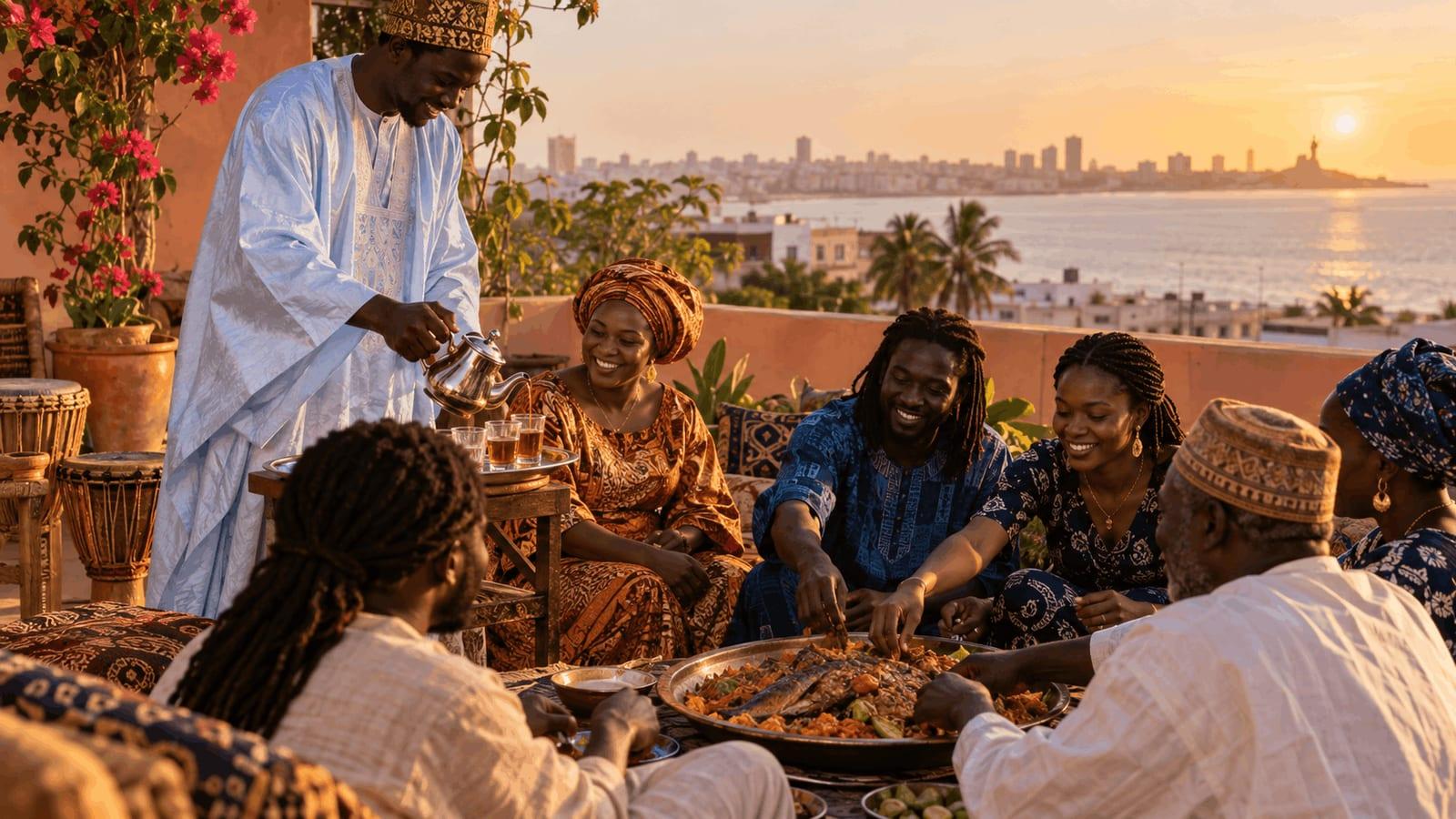
It gets translated as hospitality, but that undersells it. Teranga is a Wolof word, and its meaning stretches beyond simply being nice to a guest. It carries ideas of generosity, reciprocity, respect, and the obligation to make another person feel that they have a place among you. In its fullest sense, teranga is about how people are expected to live with one another. A guest is not tolerated; they are received. Food is not just served; it is shared. Generosity is not always treated as an exceptional act of kindness but as something that builds one's standing within a community.
The idea did not emerge from a tourism campaign or a modern attempt to brand Senegal. Long before independence, societies across the region depended heavily on networks of family, trade, migration, and mutual support. Travellers could spend days moving between settlements, and welcoming a stranger with food, safety, and shelter was not simply polite but part of the social systems that made movement and communal life possible. Over time, those older traditions of exchange and hospitality were reinforced by Islamic teachings on charity and generosity and absorbed into the social fabric of Senegalese life.
Teranga began as a Wolof concept but gradually became something larger: a way Senegal came to describe itself. Today, it belongs to the country's national vocabulary, crossing ethnic and religious boundaries and appearing everywhere from family life to political language to the nickname of the national football team, the Lions of Teranga.
Teranga has also lived through Senegal's changing history. Kingdoms rose and fought, colonial powers took control of the coast and interior, religions and communities met and reshaped one another, and the country has experienced its own periods of political and social tension. Yet the value placed on welcoming others remained part of everyday life, passed through families, communities, religious traditions, and social customs.
That helps explain why teranga means more than being friendly to visitors. It is tied to the way people understand community itself: sharing what you have, making room for others, offering food and conversation, and treating relationships beyond your immediate family as something worth cultivating. A visitor, a neighbour, a traveller, or a stranger can all become part of that social circle, even if only for a moment.
Senegal's culture did not develop from one influence alone. For centuries, the country has been shaped by trans-Saharan trade, Islamic scholarship, contact with Europe and the Atlantic world, and French colonial rule. All of these influences have played a role in shaping the Senegal that exists today.
Where the culture came from
In this section
European countries competed for Senegal’s coastal trading posts for centuries.
Before France arrived, the area that is now Senegal, it was already home to several kingdoms and political communities. Wolof-speaking states became especially influential, with the Jolof Empire emerging as the most powerful. By the 14th and 15th centuries, Jolof controlled much of present-day central and northern Senegal through a group of smaller Wolof kingdoms that recognised a central ruler.
But Jolof was not the only power in the region. Further south, the Serer kingdoms of Sine and Saloum developed their own political systems, traditions, and religious practices. They maintained a strong sense of independence and held on to aspects of Serer religion even as Islam spread through the region. These older traditions remain an important part of Serer identity today.
Then the Atlantic slave trade changed the coastline dramatically.
From the 15th century onward, European traders established posts along the Senegalese coast, buying and selling goods that included enslaved people. Gorée Island, just off Dakar, became one of the best-known sites connected to this history. Its House of Slaves and the famous Door of No Return are now preserved as places of remembrance, visited by people from Africa and the African diaspora. Historians continue to debate exactly how large Gorée's role was in the wider Atlantic slave trade, but its importance as a symbol of that history is undeniable.
European countries competed for Senegal’s coastal trading posts for centuries. Portuguese, Dutch, English, and French traders established and fought over these important trading centres before France eventually established stronger colonial control in the 19th century. Dakar eventually became the capital of French West Africa, turning it into far more than a port city. It became an important centre for administration, politics, education, and culture, a role that continues to influence Dakar's position in West Africa today.
The 19th century brought another major transformation, this time from the spread of powerful Islamic movements. El Hadj Umar Tall, a Tukulor religious leader, launched a jihad around 1850 and built an Islamic state that stretched across parts of what is now Senegal and Mali. His state did not last long, but his influence on the region was significant.
A few decades later, another religious leader would leave an even deeper mark on Senegalese society: Amadou Bamba.
Bamba was a Wolof Islamic teacher who founded the Mouride movement. He avoided direct armed confrontation with French colonial rule, but his growing religious following made French authorities increasingly concerned. He was exiled to Gabon in 1895, but the exile did not stop his movement from growing. Instead, Mouridism became deeply rooted in Senegalese society and eventually developed extensive religious, social, and economic networks. Its influence is still visible today, particularly in the city of Touba and during the Grand Magal.
Senegal became independent from France in 1960, with Léopold Sédar Senghor as its first president. Senghor was an unusual political figure: he was not only a nationalist and statesman but also a poet and intellectual who had helped develop the Négritude movement in Paris, a literary and cultural movement that celebrated Black identity and African culture in response to colonial ideas about Africa. His influence meant that Senegal's early national identity was shaped as much by literature and culture as by politics.
Senegal has also had several peaceful transfers of presidential power through elections. In 2000, Abdoulaye Wade defeated incumbent president Abdou Diouf. In 2012, Macky Sall defeated Wade. And in 2024, Bassirou Diomaye Faye won the presidency, replacing Macky Sall. The country has remained under civilian rule and has avoided the military coups that have disrupted politics in several other West African countries. Power changed hands through elections in 2000, 2012, and again in 2024.
But that record was seriously tested between 2021 and 2024. In 2021, the arrest of opposition leader Ousmane Sonko triggered violent protests that left at least 14 people dead. Tensions grew over the next two years as Sonko faced criminal cases, was imprisoned, and saw his political party dissolved. His supporters accused the government of using the courts to weaken the opposition, while the government maintained that the cases were legal matters.
The crisis reached its peak in February 2024, when President Macky Sall postponed the presidential election just weeks before it was due to take place. Parliament approved the delay, but Senegal's Constitutional Council ruled that the postponement was unconstitutional. After further political pressure and protests, the election was eventually held on March 24. Opposition candidate Bassirou Diomaye Faye won in the first round and was sworn in as president on April 2, marking another peaceful transfer of power.
The period was a reminder that Senegal's democratic reputation was not simply the result of having elections. It also depended on institutions such as the courts, opposition parties, civil society, and voters being able to push back when political rules were challenged.
Ethnic groups and languages
In this section
A separatist conflict began there in 1982, led by the Mouvement des Forces Démocratiques de la Casamance (MFDC).
Senegal is home to several major ethnic and language communities, and the largest is the Wolof. They make up roughly 40 percent of the population, but the influence of Wolof culture and language extends far beyond that number. Wolof has become Senegal's most widely used everyday language, spoken by people from different ethnic backgrounds, while French remains the country's official language and is used in government, education, and formal settings.
Another major group is the Pular- or Pulaar-speaking population, which includes Fulani and Toucouleur communities. Many live across northern and central Senegal, with some communities maintaining long-standing pastoral traditions. The Serer are another major group, with their own language, cultural traditions, and religious heritage.
In the south is Casamance, a greener and more humid region separated from much of the rest of Senegal by The Gambia. The Jola are one of the region's major ethnic groups and have their own languages, cultural traditions, and farming practices. Rice cultivation has long been particularly important in Jola communities, supported by the region's wetter climate and landscape.
Casamance has also had a very different political history from much of the country. A separatist conflict began there in 1982, led by the Mouvement des Forces Démocratiques de la Casamance (MFDC). It became one of West Africa's longest-running insurgencies. The conflict has become far less intense than it was during its worst periods, and in February 2025 the Senegalese government signed a peace agreement with an MFDC faction. The agreement did not include every faction of the movement, so the process of turning the agreement into lasting peace remains important.
Language tells another part of Senegal's story. French remains dominant in government, formal education, and official communication, but Wolof is widely used in markets, homes, workplaces, music, television, and everyday conversation. Its use has expanded well beyond the Wolof ethnic group, making it an important shared language across the country.
That expansion has also created concerns about smaller Senegalese languages. As Wolof becomes more widely spoken, researchers and cultural advocates have raised questions about how well languages such as Serer and Jola will survive across future generations, particularly as urbanisation, education, and migration bring different communities into closer contact.
Religion and belief
In this section
The movement places strong emphasis on faith, discipline, work, service, and devotion to religious teachers.
Islam is the religion of about 97 percent of Senegal's population, while Christians make up roughly 3 percent. Much of Senegalese Islam is connected to Sufism, a tradition within Islam that places strong emphasis on spiritual development, religious discipline, and guidance from spiritual teachers. Senegal's Sufi brotherhoods are organised communities of Muslims who follow particular spiritual traditions and religious leaders. They have an unusually strong influence on religious and social life in the country. In a major Pew Research survey, 92 percent of Senegalese Muslims surveyed said they belonged to a Sufi brotherhood.
The Mouride brotherhood, founded by the Senegalese religious leader Amadou Bamba in the late 19th century, is one of the country's most influential Sufi communities. Mourides are Muslims who follow Bamba's spiritual teachings and recognise the religious authority of the khalifa-general, the senior leader of the brotherhood who succeeds him. The movement places strong emphasis on faith, discipline, work, service, and devotion to religious teachers.
At the heart of Mouride life is Touba, a city founded by Amadou Bamba in the late 19th century. What began as a religious settlement grew into one of Senegal's largest cities and the spiritual centre of the Mouride brotherhood. The city is home to the Great Mosque of Touba and attracts followers throughout the year, but its population expands dramatically during major religious gatherings.
The Mouride network also extends far beyond Touba. Followers have built businesses, community organisations, and social networks across Senegal and among the country's diaspora. Senegalese traders and Mouride communities can be found in cities including New York and Paris, linking religious life with commerce, migration, and community support.
The Grand Magal is one of the most important events in Mouride life. Held every year in Touba, it commemorates Amadou Bamba's exile to Gabon by the French colonial authorities in 1895. Millions of followers travel to the city to pray, honour Bamba, and take part in religious gatherings. In 2025, the organising committee reported 6.58 million participants, although other contemporary estimates were considerably lower. The difference reflects the difficulty of accurately counting a crowd that arrives and leaves over several days and moves continuously through the city.
The gathering also shows how Mouride communities organise around one another. Families, religious organisations, and community groups provide food and accommodation for visitors, while the Senegalese government provides security, transport, healthcare, and infrastructure. For several days, Touba becomes the centre of one of Senegal's largest annual movements of people.
The Tijaniyya is another major Sufi brotherhood in Senegal. It has important religious centres in cities such as Tivaouane and Kaolack, where large gatherings bring together followers from Senegal and beyond.
Christianity is a minority religion in Senegal, making up about 3 percent of the population. Christian communities have existed in the region for centuries, with Catholic missionary activity becoming particularly established during the period of French colonial rule. Today, Christians include communities among groups such as the Serer and Jola. Muslims and Christians have also maintained a long tradition of interfaith dialogue, with religious leaders and communities participating in shared social and civic life.
Islam and Christianity are not the only religious traditions found in Senegal. Among the Serer, some older religious beliefs and practices have survived alongside the country's major religions. Traditional Serer religion centres on Roog, the supreme creator, and includes beliefs about ancestors, spiritual beings known as Pangool, and the spiritual importance of certain places in the natural world.
Ancestors have an important place in these traditions. Some are remembered as people who lived exemplary lives and are believed to remain connected to their families and communities. Certain trees, ponds, stones, and other natural sites can also hold spiritual significance. These beliefs form part of a wider understanding of the relationship between people, the natural world, ancestors, and the divine.
One of the traditions that has survived into the present is Xooy, an annual Serer divination ceremony. Traditional diviners known as Saltigues gather to interpret signs, make predictions, and offer guidance on matters affecting the community. UNESCO recognised Xooy in 2013 as part of Senegal's living intangible cultural heritage.
For some Serer communities, these traditions are therefore not simply remnants of a pre-Islamic past. They remain part of the cultural and spiritual heritage passed between generations, sometimes alongside Islam or Christianity.
Religion in Senegal is therefore woven into everyday life in many different ways. Islam shapes much of the country's social and public life, while Sufi brotherhoods, Christianity, and traditional Serer beliefs have also influenced how communities practise their faith, relate to one another, and preserve their cultural identity.
Food
In this section
The rice is then cooked in the rich broth left from the fish and vegetables, allowing it to absorb the flavour.
Food is another part of Senegalese culture where sharing and community are easy to see.
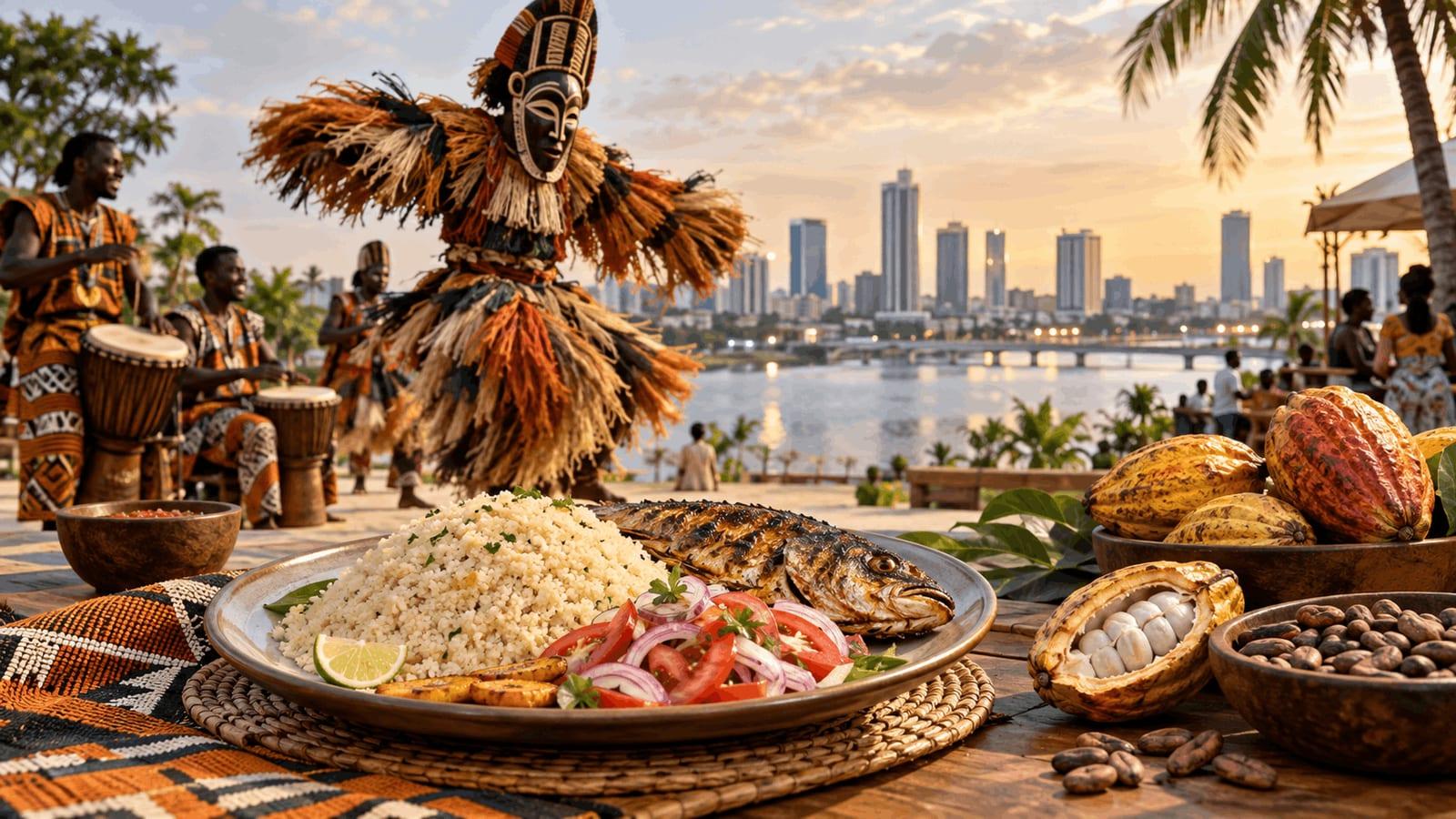
Ceebu jën, which means “rice and fish” in Wolof, is widely regarded as Senegal's national dish. UNESCO added its culinary tradition to the Representative List of the Intangible Cultural Heritage of Humanity in 2021. The dish is made with fish, often filled with a mixture of herbs and spices, and cooked with vegetables such as cassava, carrot, and cabbage. The rice is then cooked in the rich broth left from the fish and vegetables, allowing it to absorb the flavour. Ceebu jën is traditionally served on a large communal platter, with people gathered around the same dish and eating with their right hand.
Yassa is another Senegalese favourite. Chicken or fish is marinated and cooked slowly with plenty of onions, lemon, and mustard, creating the sharp, tangy flavour that makes the dish distinctive. Mafé is a rich stew made with a peanut-based sauce and can be prepared with meat, fish, or vegetables. It is part of a wider West African and Sahelian food tradition in which peanuts are used to create thick, savoury sauces.
Senegal's drinks are just as closely tied to everyday life. Bissap is made from hibiscus flowers and is usually served cold and sweetened, giving it its deep red colour and tart flavour. Bouye is made from the pulp of the baobab fruit and has a creamy, slightly tangy taste.
Then there is attaya, the green tea that turns drinking tea into a social ritual. It is commonly prepared in three rounds, with the tea becoming progressively sweeter. The tea is poured from a height to create a layer of foam in the glass, and preparing each round takes time. That time is part of the point: people sit together, talk, and catch up while the tea is being prepared. In Senegal, tea is not simply something to drink. It is also a reason to pause and spend time with other people.
Music, dance, and art
In this section
The performance is not simply something people watch; the dancers and musicians actively respond to one another.
Music is one of the most visible parts of Senegalese culture, and few sounds are more closely associated with the country than mbalax.
Mbalax developed in Senegal during the 1970s as musicians began combining traditional Senegalese rhythms with popular music from around the world. The sound drew heavily on the complex rhythms of the Wolof sabar drum, while also incorporating influences from Afro-Cuban music and other international styles. Singing in Wolof gave the music a distinctly Senegalese character and helped move popular music away from simply copying foreign sounds.
Youssou N'Dour became the genre's most internationally recognised figure. He built his career around mbalax before taking the music to audiences outside Senegal through collaborations with artists such as Peter Gabriel. He also entered politics and served as Senegal's Minister of Culture and Tourism. Mbalax has continued to evolve, with younger Senegalese musicians adding new sounds while keeping its traditional rhythmic foundations.
To understand mbalax, it helps to understand the sabar. The sabar is a family of drums central to Wolof music and dance. It is traditionally played by griots, known in Wolof as géwël, families who have historically served as musicians, praise singers, storytellers, and keepers of oral traditions. Sabar drumming is highly rhythmic, and experienced drummers can use different patterns and rhythmic phrases to signal dancers and shape what happens on the dance floor.
The relationship between the drummer and dancer can almost become a conversation. A drummer plays a particular rhythm, a dancer responds with a movement, and the drummer can change the rhythm again to challenge or encourage the dancer. At weddings, naming ceremonies, and other celebrations, these exchanges can continue for hours.
Sabar dancing is energetic and physically demanding, with dancers responding closely to the drum. It is particularly prominent at women's social gatherings, where dancers combine familiar movements with improvisation. The performance is not simply something people watch; the dancers and musicians actively respond to one another.
Senegal has also made an important contribution to African cinema. Ousmane Sembène, a writer and filmmaker from Senegal, is widely described as the father of African cinema. Beginning in the 1960s, his films explored colonialism, social inequality, corruption, religion, and the tension between tradition and modern life. His work helped establish Senegal as one of the early centres of African filmmaking and gave Senegalese cinema an influence that extended far beyond the country's borders.
Clothing, textiles, and craft
The boubou, a flowing wide-sleeved robe worn over matching trousers by men and a similar style adapted for women, remains one of the defining forms of formal dress across Senegal, made from richly patterned or embroidered fabric and often paired, for women, with an elaborately tied head wrap. Damask and bazin fabric, heavy cotton treated and finished to a glossy sheen and then dyed in bold colors, particularly indigo, has become closely associated with high-status Senegalese formal dress, worn at weddings, naming ceremonies, and religious festivals, with skilled tailoring and fabric quality often functioning as visible markers of prestige in a way immediately legible to anyone at the event.
Dakar has also become a major fashion and creative hub in West Africa, home to a growing scene of designers who blend traditional boubou silhouettes and fabric techniques with modern cuts, showcased through Dakar Fashion Week and the city's broader creative scene, which also includes the Dakar Biennale, one of the continent's major contemporary art events, held every two years and drawing artists and curators from across Africa and its diaspora. The 2026 edition is scheduled for November 19 to December 19.
Festivals, ceremonies, and rites of passage
In this section
Tabaski, the name commonly used in West Africa for Eid al-Adha, is another major celebration across Senegal.
The Grand Magal of Touba, mentioned earlier, is one of Senegal's largest annual gatherings. Millions of Mouride pilgrims travel to Touba to pray, honour Amadou Bamba, and commemorate his exile by French colonial authorities. For several days, the city's normal routine changes as it receives the huge number of visitors. Families, religious organisations, and community groups provide food and places to stay, while government agencies help with security, transport, healthcare, and infrastructure.
Tabaski, the name commonly used in West Africa for Eid al-Adha, is another major celebration across Senegal. The holiday marks the Islamic tradition of sacrifice and is usually centred on the slaughter of a sheep, with meat shared among family, friends, neighbours, and people in need. People also wear new or specially chosen clothes, visit relatives, share meals, and spend time together. Because Islam is practised by about 97 percent of Senegal's population, Tabaski is an important part of the country's national calendar.
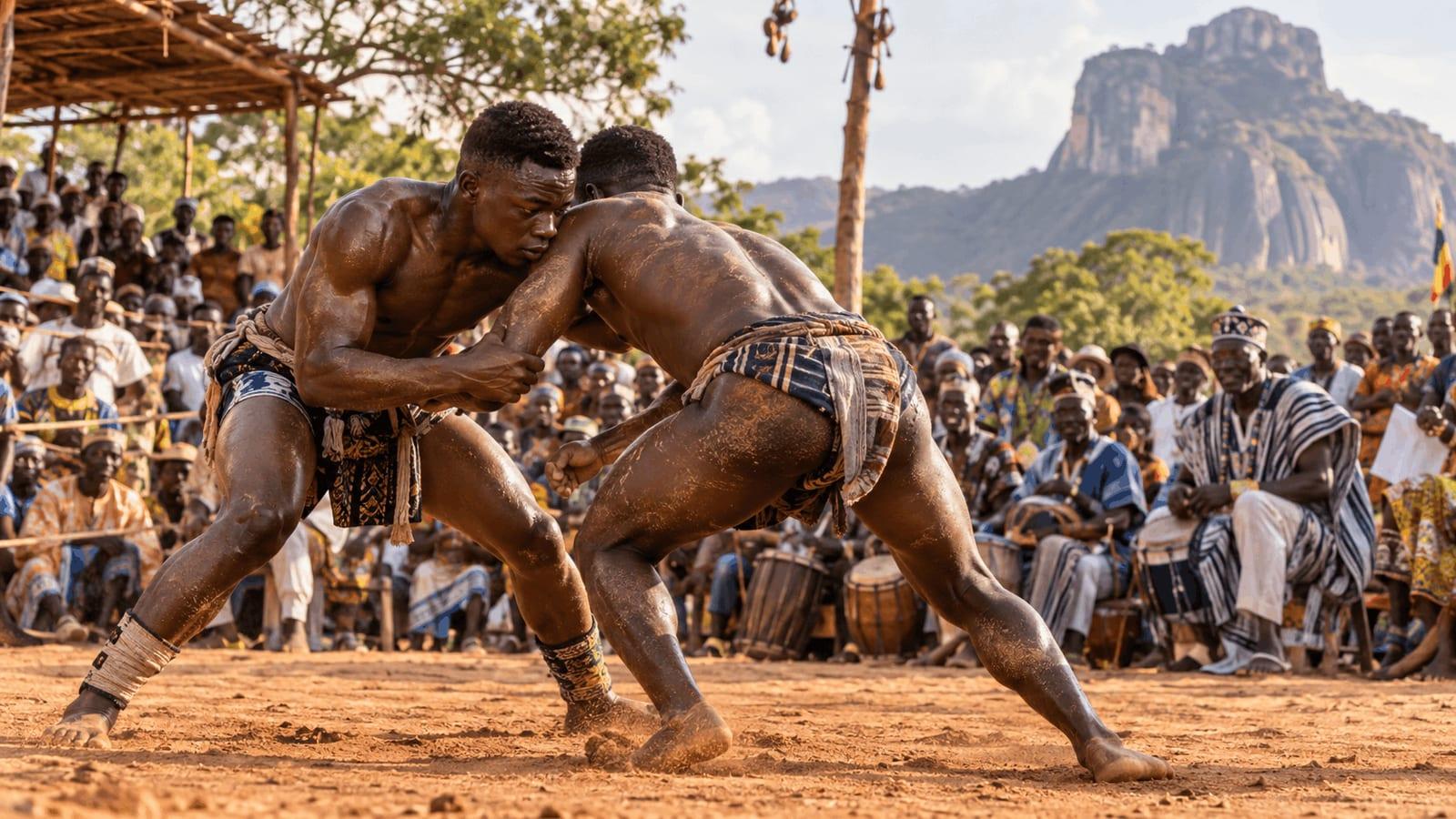
Then there is laamb, Senegalese traditional wrestling. Wrestling is more than a sport in Senegal; it is a major form of entertainment and a significant part of popular culture. The biggest wrestlers are national celebrities, and major bouts can attract huge crowds and large television audiences.
The contest also involves much more than what happens in the wrestling arena. Before a major bout, wrestlers may take part in prayers, blessings, and protective rituals with the help of marabouts and other religious or traditional specialists. These preparations can include spiritual practices, special clothing, and rituals intended to protect the wrestler and strengthen their confidence before the fight. For many wrestlers and fans, this spiritual preparation is part of the experience of laamb itself, alongside the physical training and competition.
A different side of Mouride life
In this section
Many Mouride followers built businesses and trading networks that stretched far beyond Senegal.
The influence of the Mouride brotherhood extends beyond religious gatherings and pilgrimage. One of the more interesting parts of its history is the way religious affiliation became closely connected to work, trade, and migration.
Many Mouride followers built businesses and trading networks that stretched far beyond Senegal. As Senegalese traders moved abroad, they often maintained strong connections with other members of the brotherhood, creating communities where religious ties could also provide social and commercial support. These networks developed across cities in Europe, North America, and elsewhere, linking people living abroad with families, businesses, and religious institutions back home.
The relationship works in both directions. Money sent home by Senegalese migrants can support families and businesses, while commercial activity abroad can also contribute to religious and community institutions in Senegal. Touba, in particular, has benefited from these connections as the city has expanded its religious institutions, schools, roads, businesses, and other community infrastructure.
This gives the Mouride brotherhood an unusual presence in everyday economic life. For many followers, religion is not confined to the mosque or religious ceremonies; it can also shape who they work with, where they build communities, how they support one another, and how they remain connected to Senegal while living abroad.
What Senegal Looks Like Today
In this section
A language once associated primarily with one ethnic group becomes a shared means of everyday communication.
Senegal's cultural life is not sitting still. Mbalax remains a major part of the country's popular music, while artists continue to mix Senegalese rhythms and Wolof with sounds from around the world. Youssou N'Dour, born in 1959, remains an active cultural figure, but he is no longer the whole story. A younger generation of musicians has taken Senegalese music in new directions, just as earlier generations did before them.
Hip-hop has become another important part of that story. Dakar developed a politically engaged rap scene in which musicians have used music to comment on everyday life, inequality, elections, and government. The Y'en a Marre movement, founded in 2011 by rappers and journalists, became particularly influential during the political tensions surrounding the 2012 election, showing how music could become a vehicle for youth participation as well as entertainment.
Laamb is changing too. Once associated primarily with traditional wrestling grounds and local competitions, the sport now reaches audiences through television, social media, and international broadcasting. In 2026, Canal+ expanded its broadcasting of major Senegalese wrestling events, giving the sport a larger audience beyond Senegal.
And perhaps that is what makes Senegal so interesting: its traditions are not simply being preserved in the form in which they were inherited. They are being carried into new places and given new forms. A rhythm becomes a modern song. A traditional wrestling match becomes a televised spectacle. A religious network stretches across continents. A language once associated primarily with one ethnic group becomes a shared means of everyday communication.
Even teranga continues to live within that changing culture. It is not just the welcome offered to a visitor. It can be found in the way people make room for one another, share food, maintain relationships, support communities, and carry those relationships with them when they move elsewhere.
Senegal's culture, then, is not simply something preserved from the past. It is something Senegalese people continue to make, share, adapt, and pass on — carrying old rhythms into new music, old traditions into modern life, and an old idea of welcome into a country that is still changing.