Explore Côte d’Ivoire’s culture, ethnic groups, history, food, music, festivals, religion, textiles and cocoa economy, from Dipri to attiéké and zouglou.
In the town of Gomon, once a year, the Abidji people hold a ceremony that looks very different from ordinary village life. Known as Dipri, the festival usually takes place in April, around the end of the long dry season and the beginning of the rains. For the Abidji, this timing is important because Dipri represents the end of one cycle and the beginning of another. It is a time to leave behind what is considered spiritually unclean or troubling from the previous year, repair relationships within the community, and begin again. This is what purification means in the context of the festival. It is not just about washing the body. It is about cleansing and renewal in a religious and communal sense. Local descriptions of Dipri explain that water represents the removal of impurity, while the festival more broadly is associated with reconciliation with oneself, with other people, and with the spiritual world.
Early in the morning, people from Gomon go to a sacred river for a ritual bath. The bath is understood as the first stage of that cleansing process. After they return, the festival becomes more intense. Some initiated participants enter trance at around the same time as prayers or invocations, libations, drumming, singing and dancing continue around them. Here, a trance means an altered state in which a participant is no longer behaving in his ordinary everyday manner. In the religious understanding surrounding Dipri, the state is connected with spiritual power. Calling it a collective trance simply means that several initiated participants can enter this state during the same part of the ceremony rather than it happening to only one person.
One of the most striking parts of Dipri comes after the visit to the river. Accounts from Gomon describe initiated men cutting or piercing their bodies with knives as part of demonstrations of the spiritual power they believe they receive during the ceremony. These displays are treated seriously within the religious tradition of the community. For an outside reader, the important distinction is that the festival participants understand what is happening through their own spiritual beliefs. The physical actions themselves can be observed, but claims about the supernatural power behind them belong to the religious interpretation of the people performing the ritual.
There is also a story of survival behind the festival. Abidji oral tradition connects Dipri with the memory of an ancestor who is said to have sacrificed himself during a period of famine so that the community could survive. So when Dipri is described as commemorating that sacrifice, it simply means that the festival keeps the story alive from one generation to the next. The people are not only celebrating a new year. They are remembering an ancestral story about what survival cost their community and using that memory as part of a yearly ceremony of cleansing, reconciliation and renewal.
Dipri is also a useful way into understanding Côte d'Ivoire itself because there is no single cultural tradition that represents everyone in the country. Côte d'Ivoire is one nation politically, but culturally it is made up of more than sixty ethnic groups, including Akan, Gur, Northern Mandé, Southern Mandé and Kru peoples, each containing smaller communities with their own languages, histories, religious practices, food, music, ceremonies and systems of social organisation. A Dipri ceremony among the Abidji, for example, is not an “Ivorian tradition” in the sense that every Ivorian practises it. It belongs specifically to the Abidji, just as other communities have traditions of their own.
That helps explain what national identity means here. Being Ivorian is the shared identity that comes from belonging to the modern country of Côte d'Ivoire, with the same state, citizenship, national institutions, official language, borders and national symbols. But that national identity sits alongside older identities that existed before the modern country's borders were drawn under French colonial rule. Someone can therefore be Ivorian nationally and Baoulé, Senufo, Dan, Abidji or another identity culturally at the same time. The two do not cancel each other out.
There is also no equivalent of Dipri, one language, one religion or one traditional system that historically bound all of these communities together. What eventually connected them within one state was partly political: French colonial rule brought different peoples and territories inside the same administrative borders, and independence in 1960 turned those borders into the Republic of Côte d'Ivoire. Over time, other things created stronger points of common experience, including French as the official language, national institutions, cities such as Abidjan, football, popular music and, economically, cocoa. Cocoa became especially important because it shaped the country's jobs, migration, exports, political decisions and relationship with the rest of the world for generations.
What makes Côte d'Ivoire interesting is that all of these identities exist at the same time. A person can be Ivorian and still belong deeply to a particular ethnic group, language, community and set of traditions. One identity does not replace the other.
Côte d'Ivoire was never built around one culture that everyone already shared. More than sixty ethnic groups came to live within the borders of one modern state, and over time they also developed things they could share at a national level, from French as the official language to football, popular music, national institutions and, economically, cocoa.
Cocoa became especially important after independence. Together with coffee, it helped turn Côte d'Ivoire into one of West Africa's strongest economies and created the period often described as the Ivorian economic miracle. But the same country later went through economic decline, political disputes over citizenship and belonging, and two periods of civil war.
So the story of Côte d'Ivoire is not really about choosing between unity and difference. Both have always existed together. The country has a national identity, but underneath it are older Baoulé, Senufo, Dan, Abidji, Bété, Dyula and many other identities that have not simply disappeared because a national border was created around them. Understanding Côte d'Ivoire starts with seeing how all of those layers fit together, sometimes easily and sometimes less easily, inside one country.
Where the culture came from
In this section
Arguments about who was Ivorian became connected to land, voting and even who was allowed to run for president.
The communities that live in Côte d'Ivoire today did not begin their histories when the modern country was created. Long before the present borders were drawn, different peoples were already living across the area, speaking different languages and organising their communities in different ways.
There was no single government controlling all of the territory that is now Côte d'Ivoire. Instead, different political systems existed in different places.
In the north, for example, Kong developed into an important state in the early 18th century under the Watara, or Ouattara, dynasty. Kong was closely connected to the Dyula, a largely Muslim network of merchants whose trading routes stretched across West Africa. Merchants travelling through these routes carried goods between the savanna and Sahel to the north and the forest areas farther south. Kong therefore mattered for two reasons. It was a centre from which rulers exercised authority over surrounding areas, but it was also a busy commercial centre where merchants met, exchanged goods and continued their journeys to other parts of West Africa. Its importance came as much from the movement of trade through it as from the rulers based there.
The Senufo, who lived across parts of what are now northern Côte d'Ivoire, Burkina Faso and Mali, organised many of their communities differently. Rather than one Senufo king ruling the entire population, individual communities had their own systems of leadership and social organisation.
In some Senufo communities, an initiation association known as Poro became particularly important. Poro was a system through which boys and men moved through stages of learning and initiation. During those stages, senior members taught younger members about responsibilities to their families and communities, community history, religious knowledge and the behaviour expected of adults. Some ceremonies took place in sacred groves away from ordinary village activity.
Poro could also influence how a community was governed. Senior members and elders could take part in discussions about community affairs and help guide younger members. So when Poro is described as having a social, religious or political role, it does not mean that it operated like a modern government department. It means that the same institution involved in religious initiation also helped pass on knowledge, establish responsibilities and give respected older members a role in community decisions. The exact system differed between communities, and not every Senufo community historically had Poro.
The centre and east of the territory had their own histories. One of the largest groups there became the Baoulé, part of the wider Akan cultural and linguistic world found across present-day Côte d'Ivoire and Ghana.
The Baoulé trace an important part of their history to an 18th-century migration from the area of present-day Ghana during a period of conflict connected with the expansion of the Asante kingdom. According to Baoulé oral tradition, the migrants were led by Queen Abla Pokou. The best-known version of the story says that when her people reached the Comoé River and could not cross, Pokou sacrificed her son, after which they were able to continue their journey.
There is an important difference between saying that this story exists and saying that historians have proved every part of it happened exactly as told. The sacrifice belongs to Baoulé oral tradition, passed down over generations as part of the community's account of its origins. Its importance today comes partly from what the story represents to Baoulé people, including migration, leadership, sacrifice and the founding of a new community.
Baoulé society also developed strong matrilineal traditions. This means that family descent and some rights to inheritance were traditionally traced through the mother's family. It did not mean that women automatically ruled the community. Rather, a person's mother's relatives could play an important role in questions such as inheritance, family membership and succession.
Centuries later, the Baoulé would also become important to the political history of the whole country. Félix Houphouët-Boigny, who became Côte d'Ivoire's first president after independence, was Baoulé.
In western Côte d'Ivoire, the Dan, also called Yacouba, developed another set of institutions and practices. Masks became important in religious and social life, but they did not all serve the same purpose. Some masks appeared in dances and entertainment. Others were associated with authority, protection, settling disputes or, historically, warfare.
This also explains why describing them simply as “art” can miss part of their meaning. A carved mask may look like an artwork to someone viewing it in a museum, but within the community that used it, its purpose could be connected to religion, social authority or a particular ceremony. Some of the knowledge about who may wear certain masks, how they are used and what they represent is restricted to initiated members of the communities responsible for them.
Closer to the coast and the lagoons, communities such as the Ebrié and Abidji relied heavily on fishing and farming and developed their own ways of organising community life. They also had their own ceremonies and accounts of their past. Dipri, for example, belongs specifically to the Abidji. A Baoulé, Senufo or Dan community would not automatically practise it simply because all of these groups now live inside Côte d'Ivoire.
This is an important point in understanding how the country came together. The French did not arrive and create the Baoulé, Senufo, Dan, Abidji or the other peoples who lived there. These communities already existed. What colonial rule eventually did was place many of them inside the same political territory.
Côte d'Ivoire formally became a French colony in 1893 and later formed part of French West Africa, the larger federation France used to govern several of its colonies in the region. The borders of the colony gradually defined which communities and territories would later become part of independent Côte d'Ivoire.
Colonial rule also changed how the economy worked.
French authorities encouraged farmers to produce increasing quantities of crops for sale overseas. These were known as cash crops, because they were grown mainly to be sold for money rather than primarily to feed the household that produced them. Coffee became important, and cocoa eventually became even more important.
As more land was turned over to cocoa and coffee, more workers were needed. Colonial authorities recruited workers from other parts of the territory and from neighbouring French colonies, particularly what are now Burkina Faso and Mali. Migration into the farming areas therefore became closely connected with the growth of Côte d'Ivoire's plantation economy. The movement did not stop when colonial rule ended.
Côte d'Ivoire became independent from France on 7 August 1960, with Félix Houphouët-Boigny as its first president.
Houphouët-Boigny had already spent years in politics before independence. He trained as a doctor, became an important political figure in French West Africa and later served as a minister in the French government. He would remain president of Côte d'Ivoire from independence until his death in 1993.
During much of the first two decades after independence, Côte d'Ivoire's economy grew rapidly. This period became known as the Ivorian economic miracle.
The word “miracle” can make the growth sound mysterious, but there were identifiable reasons for it. Cocoa and coffee production expanded. International demand brought export earnings into the country. Foreign companies invested. The government spent heavily on roads and other infrastructure. Houphouët-Boigny also maintained close economic and political ties with France and continued policies that made it relatively easy for workers from neighbouring West African countries to settle and work in Côte d'Ivoire.
Migrants were important because a rapidly expanding economy needed people to work in cocoa and coffee farms, but also in industry, shops and other services. The number of non-Ivorians living in the country grew considerably during this period. The World Bank notes that Côte d'Ivoire actively viewed migration and labour mobility as contributors to economic growth.
For years, this arrangement helped the economy expand.
But there was a weakness. A large part of the country's income depended on cocoa and coffee, and Côte d'Ivoire could produce those crops without being able to decide their international prices.
When world prices fell, the country earned less from exports. Government finances came under pressure, farmers earned less and an economy that had grown rapidly during years of high agricultural earnings became much harder to manage.
By the 1980s and early 1990s, Côte d'Ivoire was no longer experiencing the prosperity associated with the earlier economic miracle. At the same time, competition over jobs and farmland was becoming more intense. Some migrant families had already lived in Côte d'Ivoire for decades, worked on farms, raised children there and built permanent communities. In the cocoa-growing regions, some had also acquired or worked land for many years.
This background became especially important when Houphouët-Boigny died in 1993.
His death meant Côte d'Ivoire had to deal with something it had not experienced since independence: political life without the president who had governed the country for 33 years. Different politicians were now competing to control the presidency, while the economy was weaker than it had been during the country's boom years.
Henri Konan Bédié succeeded Houphouët-Boigny. Under Bédié, an idea known as Ivoirité, roughly meaning “Ivorian-ness”, became increasingly important in politics.
The basic question behind it was: Who should be regarded as fully Ivorian?
That was not a simple question in a country where governments had spent decades encouraging people from neighbouring countries to come and work. Some migrants had settled permanently. Some of their children had been born in Côte d'Ivoire. Families and ethnic communities in the north also extended across modern national borders, meaning a person's relatives might live in both Côte d'Ivoire and Burkina Faso or Mali.
So stricter arguments about nationality had real consequences. They could affect whether someone was legally recognised as Ivorian, whether their family was treated as foreign, what claims they could make to land and, in the case of politicians, whether they were allowed to compete for the presidency. Land disputes in the cocoa-growing regions became particularly serious because migrant farmers and families considered indigenous to those areas sometimes made competing claims over the same land.
The issue became even more important because one of Bédié's main opponents was Alassane Ouattara, a former prime minister who wanted to run for president.
Bédié and his allies questioned whether Ouattara was Ivorian enough to qualify as a presidential candidate, arguing that his family connections placed his nationality in doubt. In 1995, Ouattara was prevented from contesting the presidential election on nationality grounds. So the debate over Ivoirité was no longer only a discussion about national identity. It was being used in the actual contest over who could become president.
That changed the importance of the nationality debate.
For an ordinary person, being classified as Ivorian or foreign could affect how the state and other communities regarded their right to belong in the country. For Ouattara, it determined whether he could even appear on the ballot for the presidency. And because many people in northern Côte d'Ivoire felt that the debate also cast suspicion on them because of their family origins, religion or links with neighbouring countries, the argument increasingly divided people along regional, ethnic and religious lines.
Political instability continued. Bédié was removed in a military coup in December 1999. Questions about nationality and presidential eligibility did not disappear with him. They continued under the governments that followed.
In September 2002, an attempted uprising developed into a civil war. Rebel forces took control of much of northern Côte d'Ivoire, while the government of President Laurent Gbagbo remained in control of much of the south. The country was therefore not officially divided into two new countries, but for several years different armed and political authorities controlled different parts of the same state.
Peace agreements gradually reduced the fighting and Côte d'Ivoire eventually held a presidential election in 2010. The hope was that the election would finally settle the struggle over political leadership.
Instead, it produced another crisis.
The electoral commission declared Alassane Ouattara the winner, a result recognised by the United Nations and much of the international community. Laurent Gbagbo, the sitting president, rejected the result and refused to leave office.
Both men claimed the presidency.
The dispute turned into months of violence. Forces supporting Ouattara and forces loyal to Gbagbo fought for control, while civilians were also targeted in serious abuses committed by both sides. Around 3,000 people were killed in the 2010 to 2011 crisis, and hundreds of thousands were forced to leave their homes.
Pro-Ouattara forces eventually advanced into Abidjan. United Nations and French forces also carried out military operations against heavy weapons being used by Gbagbo's forces. Gbagbo was arrested in April 2011, and Ouattara took office.
Ouattara has remained president since then and won a fourth term in October 2025.
The economy has also recovered strongly from the years of conflict. But several issues that featured in the earlier crises have not simply become irrelevant. Land ownership still matters in cocoa-producing communities. Côte d'Ivoire still has a large population with family origins in neighbouring West African countries. And citizenship and political inclusion remain subjects that have to be managed in a country whose economic development has depended heavily on migration.
Looking at the history this way makes the connection between the different parts easier to see.
First, many peoples with their own languages, systems of leadership and histories were brought inside the borders of one French colony. Then cocoa and coffee transformed that colony and later the independent country into a major agricultural economy. Expanding the farms required workers, so large numbers of people moved into Côte d'Ivoire from neighbouring countries. For decades, that migration helped the economy grow.
Later, when the economy weakened and politicians were competing for power, questions about those same migrants and their descendants became useful political weapons. Arguments about who was Ivorian became connected to land, voting and even who was allowed to run for president. Those divisions were not the only causes of Côte d'Ivoire's conflicts, but they were an important part of the conditions in which the conflicts developed.
And becoming part of one country did not mean that everyone began living in the same way. The Abidji continued to have ceremonies such as Dipri. Baoulé communities maintained their own histories and family systems. Senufo and Dan communities continued practices of their own. At the same time, people from all of these communities increasingly shared things that came with belonging to the same country: the same national government, schools and institutions, French as the official language, an economy heavily shaped by cocoa, national football teams, popular music and eventually a stronger sense of being Ivorian as well as belonging to a particular community.
That is what makes Côte d'Ivoire easier to understand today. An Ivorian does not have to choose between a national identity and a Baoulé, Abidji, Senufo, Dan or other identity. Both can exist together. The national identity connects people through the country they share, while family and community identities can still shape language, ceremonies, food, beliefs and everyday life.
Ethnic groups and languages
In this section
Côte d'Ivoire has many local languages, but French is the country's official language.
Côte d'Ivoire is home to more than sixty ethnic groups, but the national census does not list all of them separately when presenting the country's broad demographic picture. Instead, it places related communities into larger groups, mainly according to shared language families and historical connections.
This does not mean, for example, that every Akan person belongs to the same ethnic group or follows the same traditions. Akan is the larger category. Within it are separate peoples such as the Baoulé, Agni and Abron, each with their own histories and local identities.
According to Côte d'Ivoire's 2021 census, the Akan were the largest of these broad groupings, making up 38 percent of Ivorian nationals. The Gur, sometimes called Voltaic peoples, accounted for about 22 percent, as did the Northern Mandé. The Kru represented 9.1 percent and the Southern Mandé 8.6 percent. These percentages refer specifically to people counted as Ivorian nationals, not everyone living in the country.
The Akan are found particularly in the centre and east and include communities such as the Baoulé, Agni and Abron. The Northern Mandé include groups such as the Malinké and Dyula, while the Gur grouping includes the Senufo and other communities concentrated mainly in the north. Kru peoples include groups such as the Bété and Dida in western and southwestern Côte d'Ivoire. The Dan, also known as Yacouba, belong to the Southern Mandé grouping.
These categories are useful when looking at the country's population as a whole, but they should not be mistaken for five uniform cultures. Two communities placed in the same broad category may speak related languages while having different ceremonies, histories, systems of inheritance or ways of choosing community leaders. The categories help statisticians organise a very diverse population. They do not erase the smaller identities inside them.
Language works in a similar way. Côte d'Ivoire has many local languages, but French is the country's official language. In practical terms, that means it is the language used by the state for official communication and administration and serves as a common language between people who may have different mother tongues. A Baoulé speaker and a Senufo speaker, for example, may not speak each other's community languages but can communicate in French. French therefore became one of the ways people from different parts of the country could speak to one another without having to share the same ethnic background.
French is not the only language that performs this connecting role. Dioula, a Mandé language historically associated with traders, is widely used as a common language across Côte d'Ivoire and other parts of West Africa, particularly in trade and in many northern and urban communities. A common language used between people with different first languages is sometimes called a lingua franca. In simple terms, it is the language people choose because both sides can understand it, even if neither grew up speaking it at home.
Then there is Nouchi.
Nouchi developed in Abidjan from around the late 1970s and 1980s, initially among young people in the city's popular neighbourhoods. It grew from French but absorbed vocabulary and influences from languages spoken around Côte d'Ivoire, including Dioula and other Ivorian languages. Researchers do not all describe it in exactly the same way. It has been called urban slang, a youth language, a contact variety and, by some linguists, a language in its own right. What is clear is that it did not remain confined to the young people and neighbourhoods where it began. It spread through music, conversation, advertising and popular culture and is now heard far beyond its original setting.
That makes Nouchi interesting for another reason. The country contains dozens of languages, yet Nouchi takes words and expressions from several of them and uses them inside a form of speech that people from different backgrounds can recognise. It therefore grew out of the everyday reality of a city such as Abidjan, where people from many parts of Côte d'Ivoire and neighbouring countries live and interact with one another.
Language is only one part of that mixing. Migration has changed the population just as significantly.
The 2021 census counted about 29.4 million people living in Côte d'Ivoire. Of these, approximately 22.8 million, or 78 percent, were Ivorian nationals, while about 6.4 million, or 22 percent, were nationals of other countries. Burkinabè made up by far the largest foreign-national population, followed by Malians.
But the word foreign can be misleading if it makes you picture six million people who recently crossed the border into Côte d'Ivoire.
The census found that 66.9 percent of the people classified as foreign nationals had actually been born in Côte d'Ivoire. Out of about 6.4 million foreign nationals, roughly 4.3 million were born inside the country. Among Burkinabè nationals alone, more than 2.7 million had been born in Côte d'Ivoire. Around 750,000 Malian nationals recorded in the census were also born there.
That distinction matters. Nationality and birthplace are not the same thing. The census is describing people's legal nationality, not simply asking where they were born. Someone can therefore have been born and raised in Côte d'Ivoire while still being recorded as a national of Burkina Faso, Mali or another country.
This becomes easier to understand when you return to the country's economic history. Côte d'Ivoire spent decades attracting workers from neighbouring West African countries, particularly as cocoa and coffee farming expanded. Many of those workers did not simply arrive, work for a few years and leave. They settled. They had children. Their children sometimes had children of their own. Communities that began through migration therefore became permanent parts of towns, farming areas and cities across Côte d'Ivoire.
So when the census says 22 percent of residents were foreign nationals in 2021, it is not describing a clean division between “Ivorians who have always been there” and “foreigners who recently arrived.” The reality is much more complicated. Some people counted as foreign nationals were born in Côte d'Ivoire and had spent their entire lives there, while their legal nationality remained connected to another West African country.
This is also why arguments over citizenship and belonging became so important in Ivorian politics. The question was never simply about immigration at the border. It involved people whose families had been part of Côte d'Ivoire's farms, towns and economy for decades, sometimes generations, but whose nationality or right to be regarded as fully Ivorian could still become politically contested.
Côte d'Ivoire today is therefore shaped by several kinds of identity at once. Someone may belong to a particular ethnic community, speak one language at home, use French or Dioula with people from other backgrounds, use Nouchi with friends, and at the same time identify strongly with Côte d'Ivoire as a country. Those identities do not have to replace one another. They are simply different parts of how people live in a country created from many communities and continually changed by migration.
Religion and belief
In this section
One of the country's most visible Christian landmarks is the Basilica of Our Lady of Peace in Yamoussoukro.
Religion in Côte d'Ivoire is not dominated by one faith. The country has large Muslim and Christian populations, alongside people who follow traditional religions or do not identify with a religion at all.
According to the 2021 census, Muslims made up 42.5 percent of the population and Christians 39.8 percent. Another 12.6 percent reported having no religion. The census classified 2.2 percent of the population as animists and 0.7 percent as followers of other religions.
The word animist is used by the census as an umbrella category for a range of traditional religious beliefs. It does not describe one single Ivorian religion, because different communities have their own practices and understandings.
Religion also varies geographically. Islam has a particularly strong presence in northern Côte d'Ivoire. This is partly connected to centuries of trade across the Sahel and the movement of Muslim merchants and communities through West Africa, including the Dyula trading networks discussed earlier. Christianity became more established in many parts of the south and centre, particularly during and after the colonial period.
The result is that religious identity can look quite different depending on where you are in the country. A town in the north may have a large Muslim population, while Christianity may be more visible in parts of the south or centre. Abidjan, because it draws people from across Côte d'Ivoire and neighbouring countries, contains large communities of both.
One of the country's most visible Christian landmarks is the Basilica of Our Lady of Peace in Yamoussoukro.
Yamoussoukro was the home town of Côte d'Ivoire's first president, Félix Houphouët-Boigny, and he later made it the country's political capital. A devout Catholic, Houphouët-Boigny commissioned the enormous basilica there in the 1980s. It was completed in 1989.
Its scale is difficult to miss. Guinness World Records recognises it as the world's largest church by area. Its design was strongly inspired by St Peter's Basilica in Vatican City, although the two buildings are not exact copies of each other.
The basilica also attracted criticism because of what it cost and where it was built. Côte d'Ivoire was experiencing serious economic difficulties during the 1980s, yet an enormous religious building was being constructed in the president's home city. That made the project more than a matter of architecture or faith. It also raised questions about government priorities, public spending and Houphouët-Boigny's decision to invest so heavily in Yamoussoukro.
Christianity and Islam, however, do not tell the whole story of religion in Côte d'Ivoire.
Religious practices that existed before either faith became widespread continue in a number of communities. These are not one single national religion. A Senufo religious practice may have little in common with a Dan practice, even though both might be placed broadly under the label of traditional religion.
Among some Senufo communities, for example, Poro has historically been connected not only with initiation but also with religious learning. Members could be taught about spiritual responsibilities, community rules and knowledge that was not normally shared openly with people who had not gone through the initiation process. As explained earlier, Poro does not operate in exactly the same way in every Senufo community.
Among the Dan, masks provide another example of how religion can be connected to everyday community life. A mask used in a ceremony may look to an outsider like a carved object worn for a dance. Within the tradition, however, the mask can represent or embody a spiritual being or force. This is why some masks are treated differently from ordinary costumes and why rules may exist about who can wear them, when they can appear and how they should be handled.
There are also communities where people consult diviners. A diviner is someone believed to have a way of seeking spiritual explanations or guidance about a problem, such as illness, misfortune, family difficulties or an important decision. Protective objects or rituals may also be used because people believe they can guard a person, household or community from spiritual harm.
Ancestor-related practices work differently again. In some traditions, deceased family members are understood to remain connected to the living. Remembering or honouring them can therefore involve more than preserving family history. Certain ceremonies may recognise ancestors as continuing members of the wider spiritual and family community.
The important point is that these practices do not fit neatly into a simple choice between Christianity, Islam and traditional religion.
Someone may officially identify as Christian or Muslim while still taking part in a family ceremony with older cultural origins. Another person from the same ethnic group may reject those practices completely. Others may follow a traditional religion as their main faith.
So religion in Côte d'Ivoire is better understood as several systems existing alongside one another, sometimes separately and sometimes overlapping in people's lives. The census tells us how people formally identified themselves in 2021, but those categories do not capture every way religion, family tradition and community practice can interact in everyday life.
Food
In this section
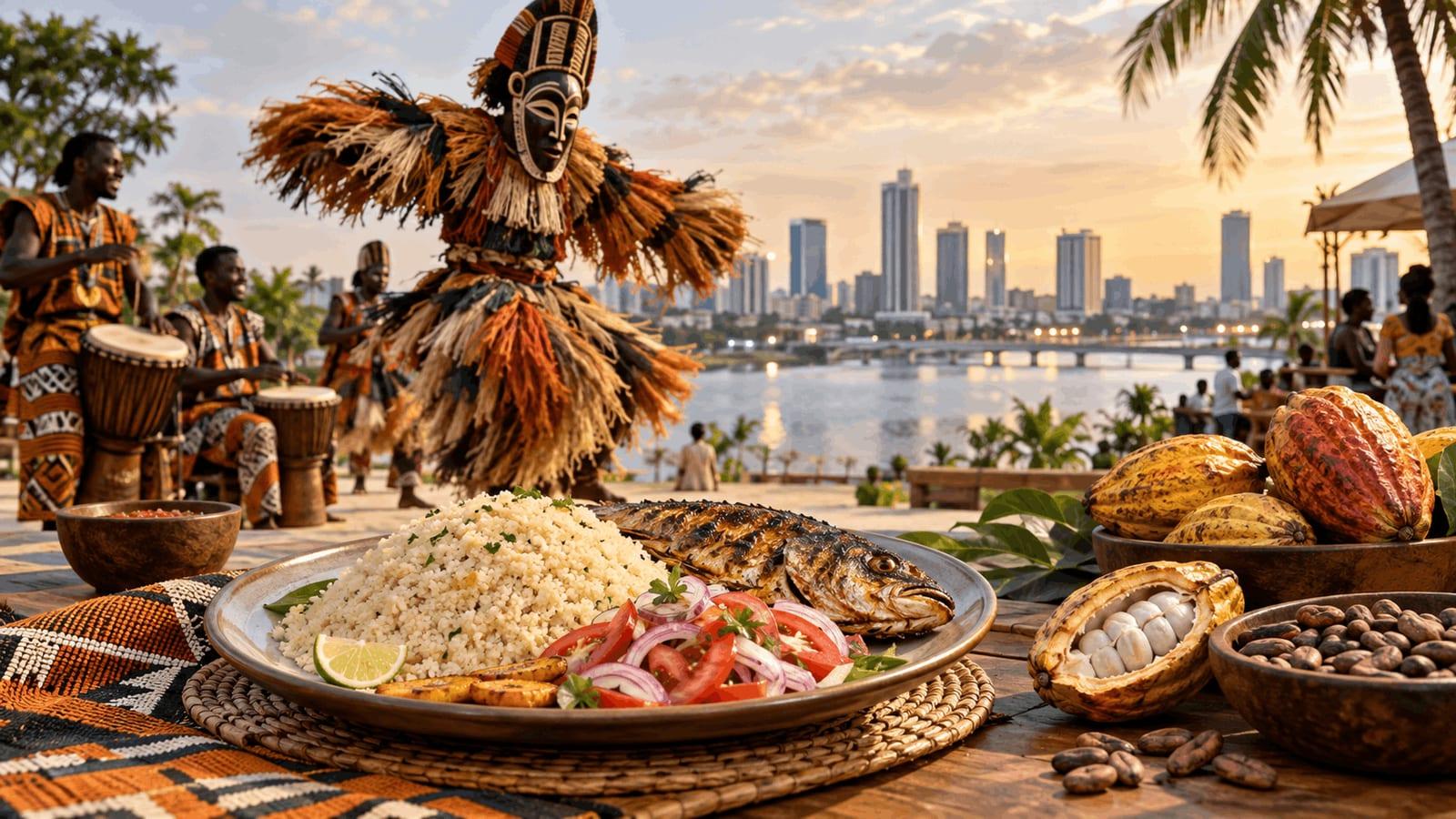
Attiéké is commonly eaten with grilled or fried fish, meat, onions, tomatoes, chilli and other accompaniments.
One of the foods most closely associated with Côte d'Ivoire is attiéké, made from cassava.
Cassava is a starchy root crop eaten across much of Africa, but making attiéké involves much more than simply boiling or pounding it. The cassava is peeled, grated and mixed with a small amount of previously fermented cassava. Fermentation means allowing naturally occurring microorganisms to act on the cassava for a period of time, changing its flavour and texture. The mixture is then pressed, sieved into small grains and steamed. The finished attiéké is light and slightly grainy, which is why it is sometimes compared with couscous, although the two are made from completely different ingredients.
Attiéké is commonly eaten with grilled or fried fish, meat, onions, tomatoes, chilli and other accompaniments. It appears in everyday meals, street food and restaurants, so it is not a dish reserved only for ceremonies or special occasions.
In 2024, UNESCO added the skills involved in producing attiéké to its Representative List of the Intangible Cultural Heritage of Humanity. UNESCO did not simply recognise a plate of food. The listing covers the knowledge required to grow and select the cassava, ferment it, prepare the grains and steam them correctly, as well as the way those skills are passed between generations. UNESCO specifically traces the production tradition to Côte d'Ivoire's lagoon peoples.
Another well-known Ivorian dish is kedjenou, a stew traditionally cooked slowly in a covered pot. Chicken is now one of the most common versions, although other meats are also used. The meat cooks with ingredients such as tomatoes, onions and spices, and the pot is kept tightly covered so that much of the cooking happens in the steam and juices released by the ingredients themselves. Versions of kedjenou are particularly associated with Akan communities, including the Baoulé, although recipes differ from one household to another.
Then there is foutou. Plantain, yam or cassava is cooked and pounded until it becomes a smooth, dense dough that can be pulled apart by hand and eaten with sauce. It is similar to the wider family of pounded foods often called fufu in other parts of West Africa, although the ingredients and preparation vary from place to place.
One common accompaniment is sauce graine, a sauce made from the pulp of oil-palm fruit. The palm fruit is cooked and processed to produce a rich sauce that may be prepared with meat, fish or other ingredients. Foutou and sauce graine are among the combinations commonly found in Ivorian cooking.
But eating in Côte d'Ivoire is not only about individual dishes. There is also the maquis.
A maquis is a type of casual restaurant or eating place found throughout Côte d'Ivoire, particularly in cities such as Abidjan. Some are simple open-air establishments with plastic tables and grills outside. Others have grown into larger restaurants with music, televisions and substantial menus. Typical food can include grilled fish, braised chicken, attiéké, alloco and other Ivorian dishes.
People also go to a maquis for reasons that have little to do with eating quickly and leaving. Friends meet there after work. Groups spend evenings talking over food and drinks. Music may continue late into the night. Some maquis function partly as restaurants, partly as bars and partly as neighbourhood meeting places. That social role is why describing a maquis simply as an “informal restaurant” misses part of what it means in Ivorian urban life.
Food also brings the country's cocoa story back into view.
Côte d'Ivoire grows more cocoa than any other country, but growing cocoa beans is only the first stage in producing chocolate. After cocoa pods are harvested, the beans are fermented and dried. They can then be ground and processed into products such as cocoa liquor, cocoa butter and cocoa powder. Further manufacturing turns those ingredients into chocolate and other finished products, which are then packaged, branded and sold.
For many years, Côte d'Ivoire earned most of its cocoa income closer to the beginning of that chain, by producing and exporting beans, while a much larger share of the money made from chocolate came later, during processing, manufacturing, branding and retail outside the country. The World Bank has noted that much of the profit in the global cocoa-to-chocolate chain is concentrated after the initial production of the beans.
This is why Côte d'Ivoire has been trying to process more cocoa at home.
Processing locally means doing more of the work after the beans leave the farm inside Côte d'Ivoire instead of immediately exporting them in their raw form. That can include grinding the beans into cocoa paste, butter, cake or powder and, further along the chain, manufacturing products for consumers.
The change is already measurable. According to the IMF, Côte d'Ivoire's installed cocoa-processing capacity increased from about 826,000 tonnes in 2022 to 1.08 million tonnes in 2025, while the share of cocoa processed domestically rose from 32 percent in 2022 to 42 percent in 2024.
Processing more cocoa inside the country does not automatically mean Côte d'Ivoire captures all of the profit from chocolate. Grinding beans is still only one stage. Much of the higher value can come later from making finished chocolate, developing brands, packaging the products and selling them directly to consumers. But moving further along the chain gives Côte d'Ivoire a better chance of creating processing businesses and jobs at home rather than earning mainly from the agricultural raw material.
So the connection between attiéké, maquis and cocoa is not simply that they are all associated with Côte d'Ivoire. They show different sides of how food works in the country. Attiéké carries knowledge passed through communities. Maquis show how eating becomes part of social life. Cocoa shows how something grown in Côte d'Ivoire can become part of an international industry whose most valuable stages may happen far from the farm where it began.
In 2008, Magic System's lead singer, Salif Traoré, better known as A'Salfo, launched the Festival des Musiques Urbaines d'Anoumabo, or FEMUA.
Two of Côte d'Ivoire's best-known modern music styles, zouglou and coupé-décalé, came from very different moments in the country's recent history.
Zouglou began to take shape around the end of the 1980s and became widely known in 1990, particularly among students living at the university residence in Yopougon, Abidjan.
At the time, university students were dealing with difficult living conditions, unemployment was a growing concern, and Côte d'Ivoire itself was going through economic and political change. In 1990, the country moved from a one-party political system to multiparty politics, meaning opposition parties were finally allowed to compete openly against the ruling party. Students were also protesting over conditions at the universities and broader problems in the country. The university residence in Yopougon became one of the important centres of that student activism.
Zouglou gave students another way to talk about what they were experiencing.
Instead of delivering political speeches, performers could turn everyday frustrations into songs. Early zouglou dealt with problems such as poverty, unemployment, university life, government, relationships and the difficulties of getting by in Abidjan. The lyrics often used humour, exaggeration and satire, meaning serious problems could be criticised through jokes, clever observations and stories people immediately recognised from ordinary life.
The music itself grew partly from earlier forms of communal singing and percussion sometimes described as Wôyô or Ambiance facile. Students adapted these forms to urban life, combining percussion, group singing and dance with lyrics about contemporary problems. Zouglou therefore sounded modern and urban, but some of the musical ideas behind it had older roots.
Language was part of what made it feel close to everyday life too. Zouglou singers did not restrict themselves to formal French. They increasingly used Nouchi and other ways of speaking heard in the streets of Abidjan. That allowed songs to sound more like the conversations people were actually having rather than the language of government offices, classrooms or formal broadcasting.
This also explains why zouglou became more than music for university students. The problems being sung about were not limited to campus. Workers, unemployed young people and families across Abidjan could recognise many of the same frustrations. What began around student communities gradually became part of a wider Ivorian popular culture.
One group eventually carried zouglou far beyond Côte d'Ivoire: Magic System.
Formed in Abidjan, Magic System became internationally successful in the early 2000s, introducing audiences in France and elsewhere to a style rooted in Ivorian zouglou. Their connection to Anoumabo, a neighbourhood in the Marcory area of Abidjan, later became important for another reason.
In 2008, Magic System's lead singer, Salif Traoré, better known as A'Salfo, launched the Festival des Musiques Urbaines d'Anoumabo, or FEMUA. The festival began with the idea of bringing major artists to the neighbourhood associated with the group's early story. It later expanded into a much larger cultural event involving concerts, discussions, training activities and social projects.
Coupé-décalé came later, and from a very different setting.
It emerged around 2002, not initially from a university residence in Abidjan but among young Ivorians living between Paris and Abidjan. A group known as the Ivorian Jet Set, associated especially with Douk Saga, became central to its creation. They were known in Parisian nightlife for expensive clothes, energetic dancing and very public displays of spending money.
Even the name says something about the attitude surrounding the early movement. In Nouchi, couper can mean to cheat or take something, while décaler means to move away or leave. The phrase was associated with a culture of appearing clever, successful and difficult to hold back. That did not mean every coupé-décalé song was literally about fraud. The wider image was one of finding success, showing it openly and refusing to appear defeated.
The timing is important.
Coupé-décalé reached Côte d'Ivoire just as the country entered civil war in 2002. Daily life was being affected by fighting, political division and curfews. Against that background, coupé-décalé offered almost the opposite mood. The music was fast, energetic and deliberately celebratory. Its artists promoted dancing, expensive clothes, confidence and visible success at a time when the country itself was going through a deeply difficult period. Some scholars have interpreted that contrast as part of the reason the movement connected so strongly with young audiences.
Dance was just as important as the music. Coupé-décalé artists regularly introduced named dance moves, sometimes drawing inspiration from everyday gestures, football, older dances or other African popular music, particularly Congolese styles such as ndombolo. A new song could therefore arrive with a new movement for people to copy in clubs, at parties and eventually in other countries.
DJ Arafat, whose real name was Ange Didier Houon, later became one of the most important figures in the genre. Through his music, performances and constant creation of new dance concepts, he helped keep coupé-décalé popular with a younger generation.
He died in August 2019 at the age of 33 after a motorcycle crash in Abidjan. The scale of the response showed just how important he had become. Tens of thousands of people gathered at the Félix Houphouët-Boigny Stadium for an overnight musical tribute before his burial, with major African artists performing in his honour.
Music and dance in Côte d'Ivoire, however, did not begin with zouglou or coupé-décalé.
In western Côte d'Ivoire, Dan mask traditions show a much older relationship between performance, religion and community authority.
To someone seeing a Dan mask in a museum, it may simply look like a carved wooden face. Within Dan traditions, that is only part of what it is.
Dan beliefs describe certain masks as giving visible form to spiritual beings associated with the forest. The person wearing the mask is therefore not understood simply as an actor pretending to be a character. During the performance, the mask, costume, dancer and spiritual identity are treated together as something with a particular role in the community.
And not every mask has the same job.
Some Dan masks are connected with entertainment. Others appear in competitions. Certain masks have historically been linked with maintaining authority, while another documented type accompanied men into battle. The Metropolitan Museum of Art, for example, records Gunyege masks worn by champion foot racers, Tankagle and Bagle masks associated with entertainment, and Bugle masks historically connected with warfare.
This is why the rules surrounding a mask can matter as much as its appearance. Who is allowed to wear it, when it can be brought out, what role it performs and how it is treated between appearances can all be connected to its meaning.
So when Dan masks are displayed today as works of art, that is only one way of looking at them. Their carved forms can certainly be appreciated artistically, but within the communities that created and used them, many also belonged to systems of religion, authority, competition and community life. Removing the mask from that setting can make it difficult to understand what it originally did, not just what it looked like.
Clothing, textiles, and craft
In this section
In 2023, UNESCO added the traditional skills of loincloth weaving in Côte d'Ivoire to its Representative List of the Intangible Cultural Heritage of Humanity.
In everyday life, people in Ivorian cities wear the same wide range of clothing you would expect in other modern cities, from jeans and T-shirts to suits, dresses and sportswear. Traditional textiles become especially visible during weddings, funerals, festivals and other ceremonies, but there is no single cloth or style worn by every community in Côte d'Ivoire.
One important textile tradition is narrow-strip weaving.
Instead of weaving one large piece of fabric from the beginning, a weaver produces long, narrow bands of cloth on a hand loom. These strips are then sewn together side by side until they form a much wider piece of fabric that can be wrapped around the body or made into clothing.
The process begins with cotton thread, which can be dyed in different colours before weaving. The patterns are created as the threads are arranged and woven, so the finished cloth can contain stripes, blocks of colour and other designs. Different communities developed their own combinations of patterns, colours and ways of using the cloth.
In 2023, UNESCO added the traditional skills of loincloth weaving in Côte d'Ivoire to its Representative List of the Intangible Cultural Heritage of Humanity. The recognition covers weaving traditions maintained by Gouro, Baoulé, Malinké, Senufo, Koulango, Nafana and Abron communities. UNESCO notes that the techniques differ between these groups and that the finished textiles are used during occasions including weddings, celebrations and funerals.
Here, loincloth does not necessarily mean the small garment the English word may suggest. It is a translation of the French word pagne, which in West Africa usually refers to a larger piece of cloth that can be wrapped around the body or sewn into clothing.
The UNESCO recognition is therefore not simply saying that Ivorian fabric is beautiful. It recognises the knowledge needed to prepare the threads, operate the loom, create particular designs and teach those skills to another generation. The cloth itself can eventually wear out. The cultural heritage is also the knowledge of how to make it.
Northern Côte d'Ivoire has another textile closely associated with the city and region of Korhogo.
Korhogo cloth is usually made from cotton strips sewn together to create a larger surface. Artists then paint figures onto the cloth, often using dark pigments against a light background. Common designs include people, birds and other animals, as well as geometric shapes.
The finished cloth can look very different from the colourful woven textiles described above because much of the visible design is painted onto the woven cotton rather than created entirely during the weaving process.
Korhogo cloth is closely associated with Senufo artists and northern Côte d'Ivoire, but its history needs some care. Museum records show that the large figurative painted cloths widely sold as Korhogo cloth today developed particularly from the 1960s and became strongly connected to the tourist and export market. Early examples used brown vegetable dyes, while later versions also used darker inks and, in some cases, mud and other natural materials.
So it would be misleading to describe every Korhogo cloth design seen today as an ancient ceremonial textile preserved unchanged for centuries. The modern form is better understood as a craft that draws on local Senufo artistic knowledge and textile-making skills but has also changed in response to buyers, tourism and international demand.
That commercial development does not make it less Ivorian. It shows how a local craft can change when the audience for it changes. A textile made in northern Côte d'Ivoire may now be produced for a home, hotel, gallery or overseas buyer rather than for the same purpose it might once have served within a community.
The difference between these two textile traditions is useful. Narrow-strip weaving shows how particular communities have passed down the skill of making cloth itself, while Korhogo cloth shows what can happen when locally woven cloth becomes a surface for painted art and develops a market far beyond the place where it is produced.
Festivals, ceremonies, and rites of passage
In this section
Others have historically been connected with authority, protection, settling disputes or religious ceremonies.
In western Côte d'Ivoire, especially around Man and the wider Tonkpi region, masks are not limited to museums or private ceremonies. They also appear during festivals and public celebrations.
These events can bring together dancers and masks associated with Dan, Wê, Toura and other western communities. But a “mask festival” should not be understood as one single tradition shared by everyone in the region. Different masks have different meanings, and the reason a mask appears depends on the community and the occasion. Côte d'Ivoire's tourism authorities describe western mask traditions as an important part of ceremonies and spiritual life in the region.
Some masks are used mainly for dancing or entertainment. Others have historically been connected with authority, protection, settling disputes or religious ceremonies. So when several masks appear together at a public festival, the audience may be seeing performances that come from traditions with very different original purposes.
Public festivals can also change the setting in which people encounter these masks. A mask that was traditionally used in a particular village ceremony may appear before a much larger audience during a cultural festival. That does not mean its earlier meaning disappears, but it does mean the same tradition can now have both a community role and a public cultural role.
The Dipri ceremony at Gomon works differently.
As described at the beginning of this article, Dipri belongs specifically to the Abidji people. It is centred on cleansing, reconciliation and beginning a new cycle. The early-morning ritual bath represents the removal of what participants consider spiritually troubling or impure from the previous period. Later parts of the ceremony include prayer, libations, music, dancing and trance among some initiated participants.
The knife demonstrations described in accounts of Dipri also belong to this religious setting. Initiates may pierce or cut parts of their bodies during the ceremony, actions that participants interpret as demonstrations of spiritual power. For someone outside the tradition, the important distinction is that the physical acts can be observed, while the spiritual explanation for them comes from the beliefs of the people taking part.
Not every major celebration in Côte d'Ivoire is religious.
In Bouaké, one of the country's largest cities, the Foire Forum Carnaval de Bouaké combines a carnival with a commercial fair. The event has existed in different forms since the early years after independence and usually lasts about a week. During that period, the city hosts parades, music and dance performances, exhibitions, traders and other public activities. The regional government describes the carnival as including a fair and parade and ending with the burning of a figure made for the celebration.
The word foire means fair, which explains the commercial side of the event. Traders and businesses can display and sell goods alongside the cultural programme. So it is not simply a street parade. It combines entertainment, local culture and commerce in the same celebration.
Football creates another kind of public gathering, but on a much larger national scale.
Côte d'Ivoire's men's national team, known as the Elephants, has won the Africa Cup of Nations three times. The Africa Cup of Nations, usually shortened to AFCON, is the main international football championship for African men's national teams. Countries qualify to compete, and the tournament is organised by the Confederation of African Football, or CAF.
Côte d'Ivoire won its first title in 1992 and its second in 2015. The 2015 victory became a major national celebration, in part because it came only a few years after the 2010 to 2011 political crisis and civil conflict. Football did not erase the country's political or social divisions, but the national team gave people from different regions and communities one team to support at the same time.
The third title was even more unusual because Côte d'Ivoire won it while hosting the tournament itself.
Officially, the competition was called the 2023 Africa Cup of Nations, even though the matches were played from 13 January to 11 February 2024. It had originally been planned for June and July 2023, but CAF moved it because that period falls during Côte d'Ivoire's heavy rainy season and organisers were concerned that the weather could disrupt the tournament. The competition kept the “2023” name after the dates changed.
Côte d'Ivoire's route to the final was far from straightforward. The team came close to being eliminated during the group stage, changed coach during the tournament and still recovered to reach the final against Nigeria.
On 11 February 2024, Nigeria scored first, but Côte d'Ivoire came back to win 2-1 at the Alassane Ouattara Stadium in Abidjan. Franck Kessié equalised before Sébastien Haller scored the winning goal. The victory gave Côte d'Ivoire its third African championship after the titles in 1992 and 2015.
Winning mattered not only because of the trophy. The tournament had taken place across several Ivorian cities, including Abidjan, Yamoussoukro, Bouaké, San Pedro and Korhogo, after years of investment in stadiums and other infrastructure. For several weeks, the national team became a shared focus of attention across a country containing many languages, ethnic communities and religious backgrounds.
That makes festivals and football useful for understanding different kinds of belonging in Côte d'Ivoire. Dipri connects one community to its own religious history. Western mask celebrations bring particular local traditions into public view. The Bouaké carnival gathers people around a city and its commercial and cultural life. AFCON works at another level again, giving millions of people who may have very different local identities the same national team to celebrate.
Why producing cocoa is only part of the value
In this section
Further processing, chocolate manufacturing, packaging, branding and retail have often taken place elsewhere.
Côte d'Ivoire produces more cocoa than any other country in the world. According to the International Cocoa Organization, the country produced about 1.681 million tonnes in the 2024/25 cocoa year, out of global production of about 4.698 million tonnes. That means roughly 36 percent of the world's cocoa came from Côte d'Ivoire.
But producing the cocoa bean is only the beginning of the journey from a cocoa farm to the chocolate bar sold in a supermarket.
After cocoa pods are harvested, the beans have to be fermented and dried. They can then be ground and processed into products such as cocoa liquor, cocoa butter and cocoa powder. Those ingredients may then be turned into chocolate, packaged under a brand, transported to shops and finally sold to consumers.
Money is made at every one of those stages.
The problem for Côte d'Ivoire is that, historically, much of its role in this chain has been concentrated near the beginning. Farmers grow and harvest the cocoa, and large quantities of beans are then exported. Further processing, chocolate manufacturing, packaging, branding and retail have often taken place elsewhere.
That matters because the price paid for raw cocoa beans represents only one part of what the finished product eventually earns. A chocolate company can add more value by processing the cocoa, developing a product, putting its own brand on it and selling it directly to consumers. If most of those activities happen outside Côte d'Ivoire, much of the money created after the beans leave the farm is also earned outside the country.
Côte d'Ivoire has been trying to change that by processing more cocoa domestically. This means keeping more beans inside the country long enough to grind them into cocoa liquor, butter, powder and other products instead of exporting all of them in their raw form. There are also efforts to produce more finished chocolate locally.
The aim is not simply to make more chocolate for Ivorians to eat. It is economic. If more stages of the cocoa business happen inside Côte d'Ivoire, the country has a greater opportunity to create processing and manufacturing jobs, build local businesses and earn income from more than the sale of the raw bean.
That does not mean processing cocoa automatically gives Côte d'Ivoire most of the money in the global chocolate industry. Branding, distribution and retail can still account for important parts of the final value. But each additional stage carried out inside the country gives Côte d'Ivoire an opportunity to keep more of the economic activity generated by the crop it already produces on such a large scale.
What these traditions look like today
In this section
More than 100 artists performed on the Anoumabo stage during the 2026 edition, according to the organisers.
Many of the traditions and music styles discussed in this article are not simply parts of Côte d'Ivoire's past. They are still being performed, adapted and passed on today.
FEMUA is one example. What began in connection with Magic System and Anoumabo has grown into a major music festival with a much wider reach. The eighteenth edition ran from 28 April to 3 May 2026. Its main festival site was at the National Institute of Youth and Sports, or INJS, in Marcory, Abidjan, while activities also took place in Dimbokro and remained connected to Anoumabo, the Abidjan neighbourhood that gave the festival its name.
More than 100 artists performed on the Anoumabo stage during the 2026 edition, according to the organisers. But FEMUA is no longer only about concerts. Its programme also includes discussions, training, social projects and activities aimed at young people. What started from the story of a music group and its neighbourhood has therefore become an event that brings together performers, audiences and communities from different parts of Côte d'Ivoire and beyond.
Coupé-décalé has also changed. DJ Arafat, one of the artists most closely associated with the genre, died in 2019, and newer Ivorian music styles have since competed for the attention of younger audiences. But coupé-décalé did not simply disappear with him. Its fast rhythms, emphasis on dance, named dance moves and style of performance can still be heard and seen in newer Ivorian music and in popular music across French-speaking Africa.
Older traditions remain visible too, although in very different settings.
In Man and other communities in western Côte d'Ivoire, masks still appear in ceremonies, festivals and public performances. To a visitor, the most noticeable things may be the carved masks, costumes, drumming and dancing. For the communities involved, however, some of these masks have meanings that go beyond what an audience sees during a performance. Depending on the mask and the community, it may be connected with religion, authority, protection, competition, entertainment or the memory of earlier generations.
This is one reason Côte d'Ivoire cannot be understood only through the events that created the modern country. French colonial rule brought many communities inside the same borders. Cocoa and coffee transformed the economy and drew workers from across West Africa. Political arguments over nationality and belonging later contributed to years of instability and conflict.
But those national events did not cause people to stop being Baoulé, Abidji, Senufo, Dan, Bété, Dyula or members of the country's many other communities.
People continued speaking community languages, preparing familiar foods, telling family histories, observing ceremonies and passing particular skills and beliefs to younger generations. At the same time, they were also building things they increasingly shared as Ivorians, from popular music and football to French, national institutions and life in cities where people from many different backgrounds meet every day.
That combination is still visible in Côte d'Ivoire now. A festival such as FEMUA can bring together people from across the country around contemporary music, while a mask ceremony in western Côte d'Ivoire may still belong to the history and beliefs of one particular community. Neither is somehow more genuinely Ivorian than the other. They simply show two different ways culture continues to live inside the same country.