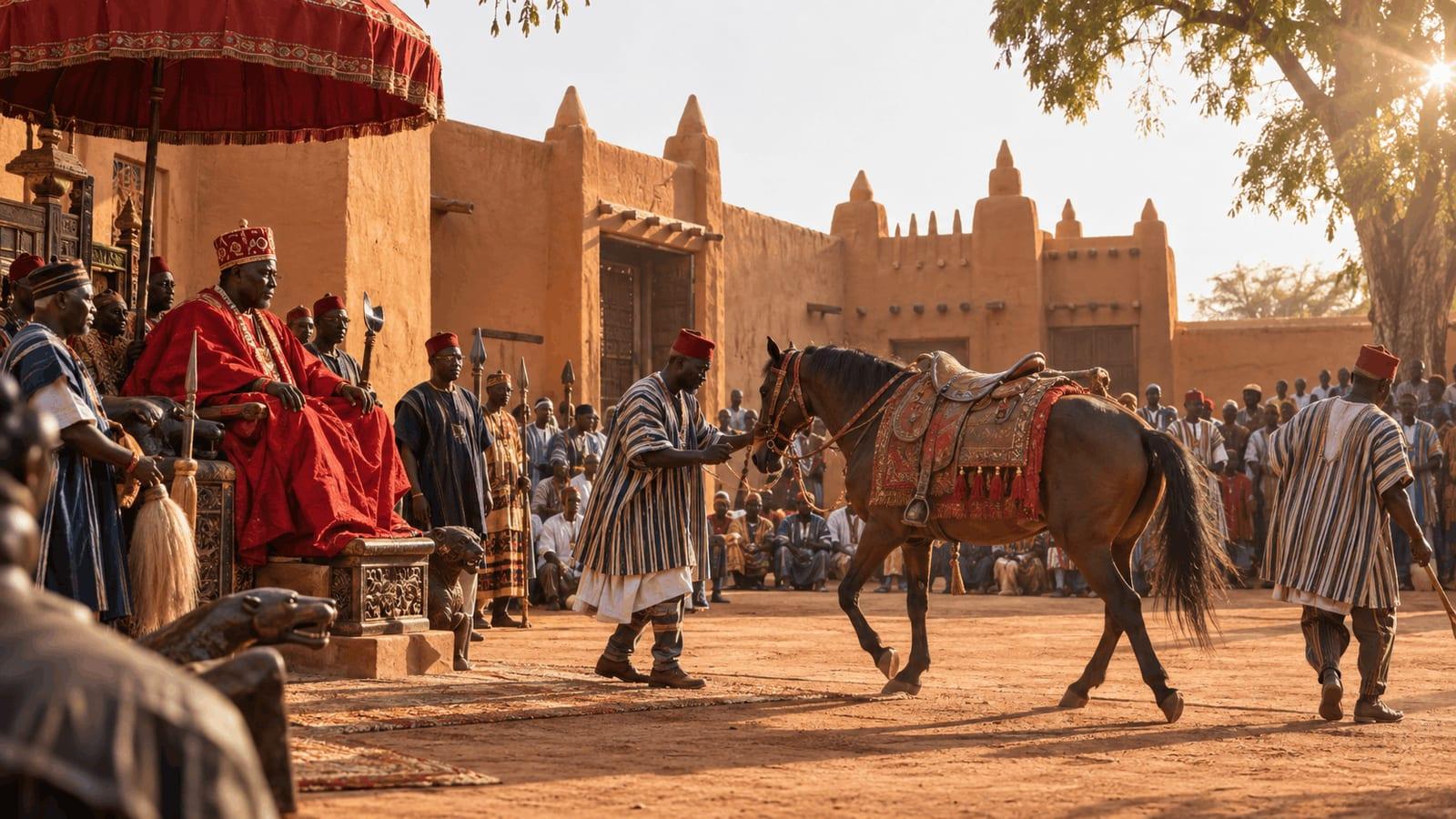
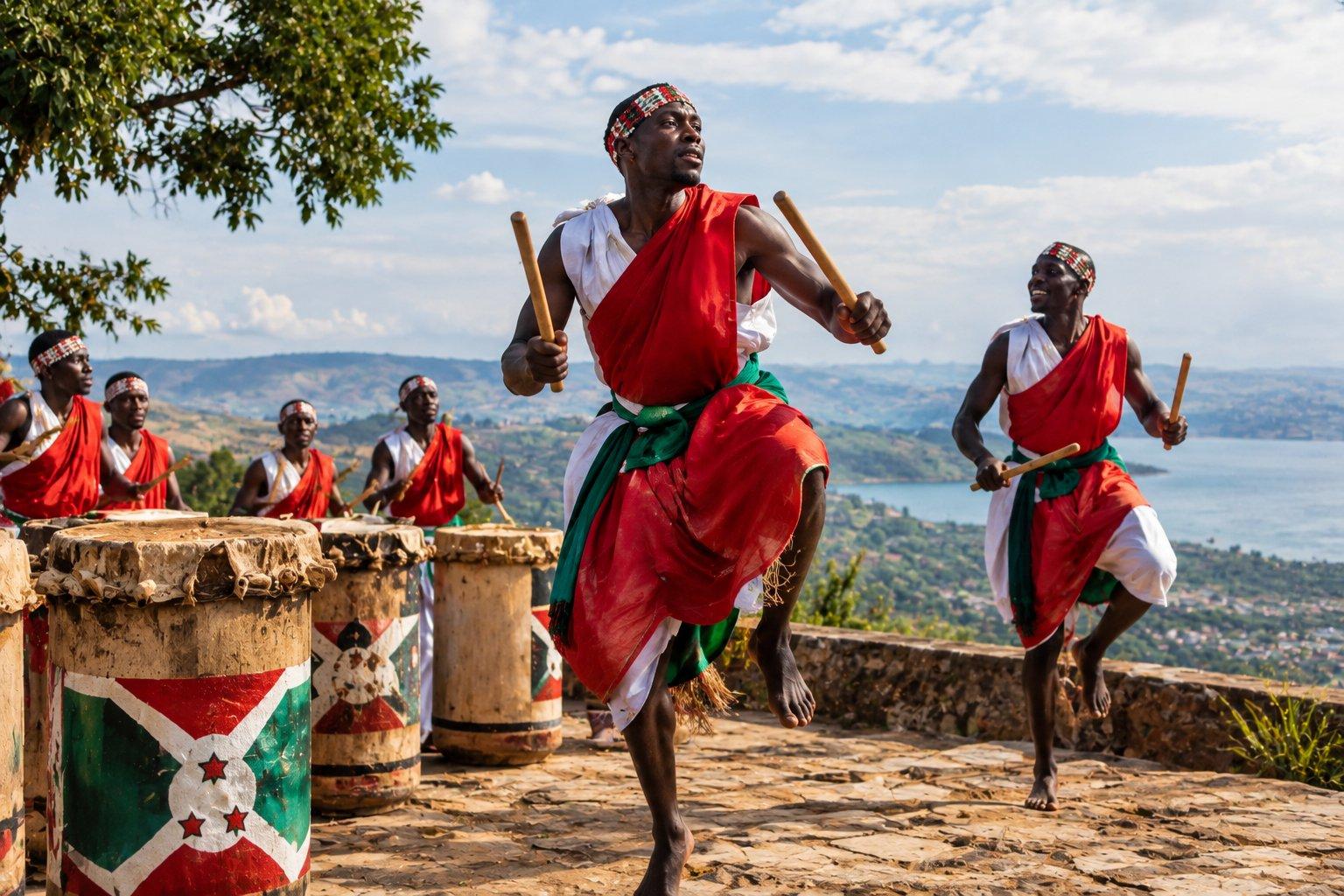
Every Friday morning in Ouagadougou, Burkina Faso's capital, a ceremony that has survived for generations begins at the palace of the Moro Naba, the traditional ruler of the Mossi people, the country's largest ethnic group. The king appears before his court dressed in red. A horse is brought before him, saddled and ready, as if he is about to leave the palace on urgent business. He refuses it. The horse is led away, the court disperses, and everyone goes back to their day.
The ceremony is often called the "false departure." The exact story behind it is not certain. It has been passed down through generations in different versions rather than through one documented account of how the ritual began. In some versions, the king is preparing to pursue a wife who has left the palace; in others, advisers persuade him to abandon a journey or refrain from acting on impulse. What remains consistent is the lesson: a ruler is expected to control his anger, listen to his advisers, and put responsibility before personal impulse.
That lesson comes from a much older political tradition. Long before Burkina Faso existed as a country, the Mossi built powerful kingdoms across the region, with rulers, courts, provincial authorities, cavalry, and systems of governance that survived for centuries. The Moro Naba is the present-day traditional ruler of the Mossi, and the royal court and its ceremonies have survived even though the Mossi kingdoms no longer govern Burkina Faso.
The Mossi are one of several major peoples whose histories are tied to the territory that is now Burkina Faso. Communities such as the Bobo, Bwa, Gurunsi, Senufo, Lobi, Dagara and Fulani developed their own languages, political systems, religious practices, music, textiles, dances and crafts. Some lived under kings and chiefs; others organised their communities through village elders, age groups or religious societies. Their traditions are still part of life in Burkina Faso today.
The country itself is landlocked, meaning it has no coastline and is surrounded by seven other countries. It is home to roughly sixty ethnic groups and more than 60 languages. But alongside that cultural diversity, Burkina Faso has faced a serious armed conflict since the mid-2010s. Jihadist violence, particularly in the north and east, has killed civilians, disrupted communities and forced more than two million people from their homes.
Yet Burkina Faso's cultural life has continued to produce work that reaches well beyond its borders. One of the best examples is FESPACO, the Panafrican Film and Television Festival of Ouagadougou, which has brought African filmmakers and audiences together since 1969.
The country's name also comes from this period of change. When Thomas Sankara came to power in 1983, he wanted to break with the country's colonial past and reshape how Burkina Faso was governed. In 1984, his government renamed the country Burkina Faso, combining Burkina, from Mòoré, with Faso, from Dioula. The name is generally translated as “land of upright people” or “land of incorruptible people.”
Sankara chose that name deliberately. He wanted the new country to represent honesty, self-reliance and responsibility, and his government tried to put those ideas into practice. It promoted local production, challenged corruption and government privilege, encouraged women to take a greater role in public life, and pushed back against dependence on foreign powers.
The Moro Naba ceremony comes from a very different period of Burkinabè history, centuries before Sankara came to power. But both tell us something concrete about ideas of leadership in the country: the Moro Naba ceremony presents a ruler being persuaded to control his impulse and listen to others, while Sankara used the country's new name to set expectations for how those in power should behave.
Where the culture came from
In this section
Sankara was assassinated in 1987 in a coup led by forces that brought his former ally Blaise Compaoré to power.
Long before Burkina Faso existed as a country, the Mossi built several kingdoms across the central part of what is now Burkina Faso. The most important were centred around Ouagadougou, Yatenga and Tenkodogo. Each had its own ruler and political hierarchy, including royal advisers, provincial chiefs and cavalry. Each had its own ruler and political hierarchy, including royal advisers, provincial chiefs and cavalry. This way of governing helped the Mossi kingdoms remain independent for centuries, even as larger states and empires expanded around them, across the wider Sahel.
The Mossi also resisted repeated attempts by Muslim-led states and reform movements to bring their kingdoms under their political or religious control. Their rulers maintained the political structures of the kingdoms and many of their traditional religious practices well into the colonial period. That history helps explain why the institution of the Moro Naba still exists today, even though the Mossi kingdoms themselves no longer govern the country.
But the history of Burkina Faso is not only the history of the Mossi. The area that is now the country has long been home to many other peoples, including the Bobo, Bwa, Gurunsi, Senufo, Lobi, Dagara and Fulani. They did not all organise their societies in the same way. Some relied on village elders and extended family groups, some had chiefs, while others used age groups and religious societies to organise community life. Their differences matter because Burkina Faso's culture did not develop from one tradition, but from many communities living across the same territory.
French colonial expansion reached the region in the late 19th century. The territory became a French colony known as Upper Volta in 1919, named after the Volta river system. Its borders changed several times, and in 1932 the colony was dissolved and its territory divided among neighbouring French colonies before Upper Volta was re-established in 1947.
Burkina Faso became independent in 1960. More than two decades later, another major change came when Thomas Sankara, a young army captain, took power in 1983. His government introduced major changes in areas including healthcare, women's rights, local production and government spending.
In 1984, Sankara renamed the country Burkina Faso, combining Burkina, from Mòoré, with Faso, from Dioula. The name is generally translated as “land of upright people” or “land of incorruptible people.” The choice reflected the kind of society Sankara said he wanted to build: one in which public officials were expected to act with integrity and the country relied more on its own people and resources.
Sankara was assassinated in 1987 in a coup led by forces that brought his former ally Blaise Compaoré to power. Compaoré remained president for 27 years. Sankara, however, continued to be remembered long after his death, particularly for his emphasis on self-reliance, anti-corruption, women's rights and African political independence.
Ethnic groups and languages
In this section
Fulani civilians have also been killed, displaced and accused of supporting jihadists because of their ethnicity.
The Mossi are the country's largest ethnic group and are concentrated mainly in central Burkina Faso. Their language, Mòoré, is one of the most widely spoken local languages. The Fulani, a West African people whose communities extend across several countries, including Nigeria, Mali, Niger and Burkina Faso, are particularly numerous in the north. Historically, many Fulani communities in the region were involved in livestock keeping and pastoralism. The Gurunsi, Senufo, Bobo, Bwa, Lobi and Dagara are concentrated largely in the west and southwest. Each of these communities has its own languages, traditions and ways of organising community life, as well as distinctive forms of music, dance, weaving, masks and other crafts.
French remains widely used in government, formal education and public life. Dioula is widely used for trade and commerce, particularly in and around Bobo-Dioulasso.
These different communities have faced major disruption since armed jihadist groups began expanding into Burkina Faso from neighbouring Mali around 2015. Groups affiliated with al-Qaeda and the Islamic State have attacked soldiers, police, civilians, villages, schools, churches and other public places. The violence has been particularly severe in the north and east, where attacks and insecurity have made some areas difficult for the government to reach.
The consequences are visible in everyday life. More than two million people have been forced from their homes, while insecurity has made it difficult for many people to farm, attend school, travel safely or access healthcare and other basic services. These different communities have faced violence since armed jihadist groups began expanding into Burkina Faso from neighbouring Mali around 2015. One of the first major groups to emerge inside Burkina Faso was Ansarul Islam. Other groups, including the al-Qaeda-linked JNIM and the Islamic State Sahel Province, later expanded their operations in the country. They have attacked soldiers, police, civilians, villages, schools and religious sites, particularly in the north and east. (cfr.org)
Some of these groups have recruited Fulani men, particularly in areas where pastoral communities (communities that depend on livestock herding) have faced longstanding disputes with local authorities and other groups. But this does not mean that the Fulani as a whole are part of the insurgency. Fulani civilians have also been killed, displaced and accused of supporting jihadists because of their ethnicity. Government forces and civilian militias have also been accused of carrying out violence against Fulani communities.
The violence has forced more than two million people from their homes and made it difficult for many others to farm, attend school, travel safely or access healthcare and other basic services.
Religion and belief
Islam is the largest religion in Burkina Faso, having spread through trade and contact with Muslim communities over many centuries. Its spread took longer to spread among the Mossi and did not become as widely established there as it did in some neighbouring Sahelian societies, partly because Mossi rulers resisted attempts to bring their kingdoms under outside religious and political control. Christianity also has a substantial following, particularly in parts of the south and west, where missionary activity expanded during the colonial period. Indigenous religious traditions remain an important part of cultural and ceremonial life in many communities, especially in the west and southwest. These traditions include mask ceremonies, communication with spirits, rituals connected to farming, respect for ancestors, and rites marking important stages of life.
These religious traditions do not always exist separately. In some communities, people who identify as Muslim or Christian may also take part in family ceremonies, funerals and cultural practices that have roots in older indigenous traditions. The result is that religious life in Burkina Faso can be more layered than the three broad categories of Islam, Christianity and indigenous religion suggest.
Food
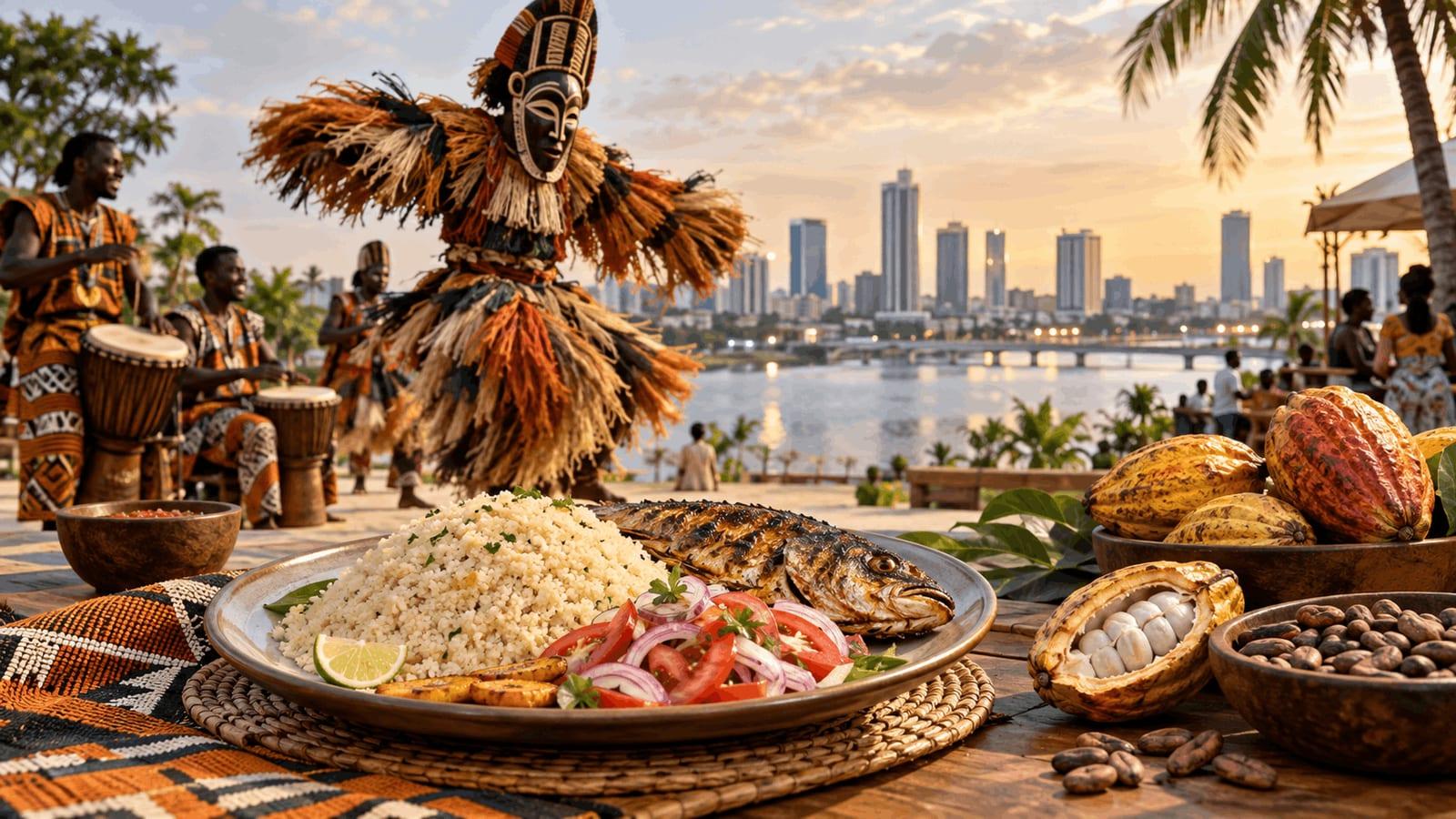
Tô, a thick, smooth porridge made from millet, sorghum, or corn flour, forms the base of many everyday meals across the country, served with a sauce built from baobab leaf, okra, or peanut, and eaten by tearing off a piece with the fingers and dipping it directly into the sauce. Rice dishes, including a Burkinabè take on the regional riz gras, rice cooked in a rich, tomato-based sauce with meat or fish, are also widely eaten, particularly at celebrations and in urban households. Grilled meat, particularly mutton and beef seasoned simply with salt and pepper and cooked over open charcoal, called brochettes when served skewered, is sold widely from roadside stalls in Ouagadougou and Bobo-Dioulasso in the evening, often alongside dolo, a traditional beer brewed from red sorghum that remains deeply tied to Mossi and other local cultural life, brewed largely by women who run dedicated dolo bars called cabarets that double as informal community gathering spots.
Shea butter, extracted from the nuts of the shea tree that grows across much of the country's savanna, plays a major role both in cooking, used as a cooking fat in many households, and as an economic backbone for rural women, who have historically played a central role in its production and sale, a role that has become the focus of numerous cooperative and fair-trade initiatives aimed at giving Burkinabè women a stronger position in the international shea market that supplies the global cosmetics and personal-care industries.
Music, dance, and art
In this section
The balafon, a wooden xylophone with calabash resonators, is particularly important in western Burkina Faso, including among the Bobo.
Burkina Faso's most internationally recognised cultural export may be its film industry. FESPACO, the Panafrican Film and Television Festival of Ouagadougou, was founded in 1969 and is held every two years. It has become one of Africa's most important film festivals, bringing filmmakers, critics and audiences from across the continent and its diaspora to Ouagadougou. The festival gives African filmmakers a major platform to present their work to African audiences and to the wider world. During FESPACO, screenings, concerts, exhibitions and public discussions take place across the city, turning Ouagadougou into a major meeting point for African cinema.
Music is just as deeply rooted in the country's different communities. The balafon, a wooden xylophone with calabash resonators, is particularly important in western Burkina Faso, including among the Bobo. Different communities have their own musical traditions, using drums, flutes, string instruments and other forms of percussion for ceremonies, celebrations and everyday entertainment. Contemporary Burkinabè musicians have also combined these local traditions with influences from reggae, hip-hop and other popular African and international genres, creating music that connects older traditions with modern life.
Dance has taken Burkina Faso's culture beyond the country as well. Contemporary dance companies such as Compagnie Salia ni Seydou have gained international recognition for performances that draw from West African dance traditions while exploring contemporary subjects and ideas.
Clothing, textiles, and craft
In this section
Among the Bobo, for example, masks appear in initiation ceremonies, funerals, harvest ceremonies and performances.
Faso dan fani, a handwoven cotton cloth whose name refers to the homeland, became a powerful cultural and political symbol during Thomas Sankara's government in the 1980s. His government promoted locally made cloth as part of its push for local production and economic self-reliance, and civil servants were required to wear Faso dan fani rather than imported fabric. The policy also created a larger market for local weavers, many of them women working through cooperatives and home-based workshops.
The cloth is traditionally woven in narrow strips that are later joined together. Its importance has continued beyond the Sankara era. Government officials have continued to promote it at official events, and it has been used for everything from contemporary clothing to official judicial robes. In 2023, the government also considered using Faso dan fani for school uniforms, while a 2024 government initiative introduced Faso dan fani judicial robes.
Masks are another important part of Burkina Faso's artistic and cultural heritage, particularly among communities such as the Bobo and Bwa. Masks can represent humans, animals or other spiritual figures, and their roles vary between communities. Among the Bobo, for example, masks appear in initiation ceremonies, funerals, harvest ceremonies and performances. Some are used for ritual purposes, while others are made for entertainment.
For the communities that use them in ceremonies, masks are not simply decorative objects. They can be connected to ancestors, spirits, initiation and the wellbeing of the community. That distinction matters when these objects are later displayed in museums or reproduced for tourists, because the meaning they carry within their communities can be very different from the way they are viewed as works of art elsewhere.
Festivals, ceremonies, and rites of passage
In this section
National Culture Week, known as Semaine Nationale de la Culture (SNC), is held every two years in Bobo-Dioulasso.
Mask ceremonies among communities such as the Bobo, Bwa and Gurunsi are connected to different parts of community life, including funerals, agricultural ceremonies and rites of passage. Dancers may wear elaborate costumes that cover the body and perform movements specific to the tradition. Some of the knowledge surrounding these ceremonies is reserved for initiated members of the community. During a performance, the masked figure may be understood as representing an ancestor, spirit or force of nature rather than simply a person wearing a costume. The meaning and purpose of the mask varies from one community to another.
National Culture Week, known as Semaine Nationale de la Culture (SNC), is held every two years in Bobo-Dioulasso. It brings together performers and artists from across Burkina Faso for competitions and exhibitions in areas including music, dance, theatre, visual arts and traditional cuisine. The festival gives different communities a national platform to present their cultural traditions and allows people from different parts of the country to encounter traditions they may not otherwise see.
The weekly Moro Naba ceremony in Ouagadougou, described at the beginning of this article, is another tradition that has survived major political changes. The ceremony continued through French colonial rule, independence and Thomas Sankara's revolutionary government, and it remains part of public cultural life today. The Moro Naba no longer governs Burkina Faso as a political ruler, but the royal court and its ceremonies continue to preserve an important part of Mossi history.
The vaccination campaign that reached 2.5 million children
One of Thomas Sankara's most remarkable achievements came in public health. In November 1984, his government organised a nationwide vaccination campaign that reached about 2.56 million children in just 15 days, protecting them against measles, meningitis and yellow fever. The campaign involved teams travelling across the country to reach children in schools, villages and other communities, and was later cited by the World Health Organization as an example of what could be achieved through a large-scale, coordinated vaccination effort.
The campaign was part of Sankara's wider attempt to make basic healthcare more accessible to ordinary Burkinabè people. At a time when Burkina Faso had limited resources and a large rural population, reaching millions of children in two weeks required an unusually large logistical effort.
What remains alive today
More than five decades after it began, FESPACO still brings African filmmakers and audiences to Ouagadougou, with the Étalon de Yennenga remaining one of the major prizes in African cinema. The festival is a reminder that Burkina Faso's cultural influence is not only something preserved from the past; it continues to create spaces where new African stories are made, shown and discussed.
Thomas Sankara's ideas have also outlived his government. His name and image continue to appear in African political and cultural conversations, particularly around questions of corruption, self-reliance and how leaders should use public office. His legacy remains debated, but his influence has clearly extended far beyond the four years he spent in power.
And every Friday in Ouagadougou, the Moro Naba ceremony continues. A horse is brought before the king, and he turns it away. The political world around the ceremony has changed many times, but the ritual remains.
That may be one of the simplest ways to understand Burkina Faso: its history is not kept only in museums or textbooks. Some of it is still being performed, woven, filmed and worn.