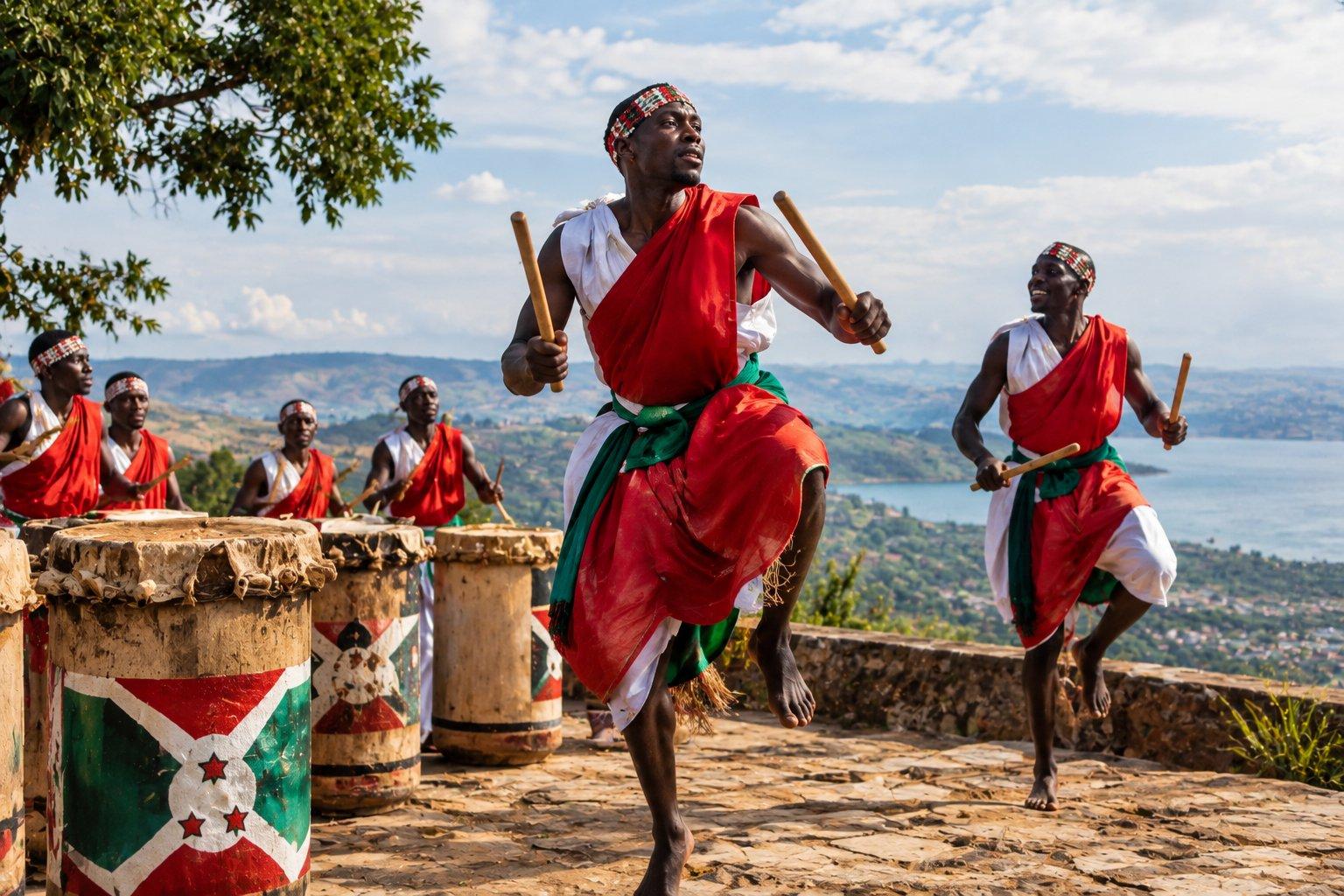
At Gishora, on a hill about seven kilometres from Gitega, Burundi's famous royal drums are still played.
The setting matters. Gishora is not simply a performance venue. It was part of the royal landscape of the Kingdom of Burundi, and its sacred drum sanctuary remains associated with the ritual specialists known as the Batimbo, who preserve knowledge connected to the royal drumming tradition. The site was established in the nineteenth century and was connected to the annual Umuganuro, the royal sowing festival associated with the cultivation of sorghum.
When the drummers perform today, several drums are arranged in a semicircle around a central drum. Some maintain the underlying rhythm while others take turns at the centre, combining powerful drumming with leaps, dancing and tightly controlled movement. UNESCO describes the tradition as a combination of synchronized drumming, dance, heroic poetry and traditional songs. The performance was added to UNESCO's Representative List of the Intangible Cultural Heritage of Humanity in 2014.
To understand why this matters, it helps to understand what a drum meant in the old Burundian kingdom.
The drum was not merely an instrument. Certain royal drums were connected to the monarchy, ritual authority and the well-being of the kingdom. Their use was regulated, their keepers occupied a specialized social role, and sacred drums were kept at designated sanctuaries. Gishora's sanctuary, for example, contains sacred drums associated with the royal tradition.
The monarchy itself disappeared in 1966. The drum did not.
That is what makes Burundi's drumming tradition such an unusually useful way into the country's history. It connects the precolonial kingdom to colonial rule, the violence that followed independence, the reconstruction of the state after civil war, and the way Burundians represent their country today.
A kingdom built around a Mwami
Before European colonial rule, Burundi developed into a centralized kingdom headed by a Mwami, the title used for the king. The monarchy was supported by a hierarchy of chiefs, local authorities and princely families known as the Ganwa. The Ganwa were closely connected to the royal dynasty and played an important role in political administration and succession.
The kingdom was not a modern nation-state with fixed borders and a bureaucracy like today's Burundi. Political authority was exercised through relationships between the royal court, provincial and local authorities, agricultural communities, pastoralists and other social groups. Tribute, land, cattle, kinship and political allegiance all formed part of this system.
The royal drum belonged to this political world.
The drum was associated with important royal occasions and with the authority of the monarchy. At Gishora, the royal residence included a dedicated sanctuary for sacred drums, and the annual Umuganuro agricultural ceremony brought together the royal court and the ritualists responsible for the drums. UNESCO's current documentation of Gishora describes the site as a sacred royal residence and identifies its drum sanctuary as one of its central features.
This is why the phrase "royal drum" should not be understood as a decorative name. In the old kingdom, particular drums occupied a ceremonial position within the political and religious order.
The distinction between the royal drums and the drums used in the modern performance also matters. The ensemble includes different types of drums, with a central lead drum and supporting drums working together. The central performance drum is known as the inkiranya. It should not automatically be treated as identical to the sacred royal karyenda, whose historical significance was tied specifically to kingship.
That distinction helps prevent one of the easiest mistakes to make when describing Burundian drumming: treating every drum in the performance as though it had exactly the same historical function.
Hutu, Tutsi and Twa before colonial rule
Burundi's population has historically been divided into three broad social categories: Hutu, Tutsi and Twa.
The proportions often cited are approximately 85 percent Hutu, 14 percent Tutsi and 1 percent Twa, although reliable contemporary ethnic statistics are difficult to establish and these figures should be understood as conventional historical estimates rather than a recent population census.
The important point is that these categories did not begin with European colonialism.
Hutu, Tutsi and Twa identities existed before Europeans arrived. What changed dramatically under colonial rule was the way these identities were interpreted, classified and used by the state.
The three categories also cannot be reduced to three occupations.
Hutu communities were predominantly associated with agriculture. Tutsi communities were disproportionately represented in cattle ownership and political authority. Twa communities historically included hunting and pottery traditions alongside other forms of economic activity. But these associations were never absolute. Hutu could own cattle. Tutsi could farm. Economic position, political status, lineage and local circumstances could overlap in ways that make the simple image of three separate occupational groups misleading.
There were also clans and lineages that cut across the broader Hutu, Tutsi and Twa categories. In other words, a person's social identity did not consist of one label.
This becomes important when discussing colonialism.
It is inaccurate to say that Europeans invented the Hutu and Tutsi categories. They did not. But German and, especially, Belgian colonial administration changed their political meaning. Colonial authorities increasingly interpreted the categories through European racial theories, gave them greater administrative importance and used them in governing education, political authority and access to state institutions.
The result was not the creation of an entirely new distinction. It was the hardening and racialization of distinctions that already existed.
That difference matters because Burundi's later history cannot be explained either by saying that ethnic identities were completely invented by colonialism or by pretending that colonial rule had little effect on them.
German and Belgian rule changed the political system
Germany incorporated Burundi into German East Africa in the late nineteenth century. After Germany's defeat in the First World War, Belgium administered Burundi and Rwanda together as the territory of Ruanda-Urundi under a League of Nations mandate and later a United Nations trusteeship.
Belgian rule strengthened the use of existing social distinctions as tools of administration. Tutsi elites received disproportionate access to education and administrative positions, while the colonial state increasingly treated Hutu and Tutsi as fixed categories rather than overlapping social identities.
This did not mean that every Tutsi supported colonial rule or that every Hutu opposed it. Colonial society was more complicated than that. But the system created political inequalities that became increasingly difficult to separate from ethnic identity.
When Burundi became independent in 1962, it inherited a state whose political institutions had already been shaped by decades of colonial administration.
Independence did not erase those structures.
Instead, the country entered a period of intense political competition in which ethnic identity, access to government, military power and struggles within the political elite became increasingly connected.
The monarchy survived independence for several years. It was abolished on 28 November 1966, when Prime Minister and army officer Michel Micombero overthrew King Ntare V and proclaimed Burundi a republic.
The end of the monarchy therefore did not mean the end of the political importance of the royal drum.
The institution that had once given the drums their royal setting disappeared. The cultural practice associated with them continued.
The violence that followed independence
Burundi's post-independence history includes repeated episodes of mass political and ethnic violence.
One of the most devastating occurred in 1972.
After a Hutu-led rebellion in parts of the country, the government and security forces carried out extensive killings, disproportionately targeting Hutu civilians, intellectuals, political figures and other members of the Hutu population. Estimates vary, but United Nations documentation has cited figures ranging from roughly 100,000 to 300,000 Hutu killed. A UN report later referred to the 1972 killings as an example of genocidal repression.
The violence was not an isolated event. Burundi experienced further political killings and ethnic violence over the following decades.
In October 1993, Burundi's first democratically elected president, Melchior Ndadaye, was assassinated during a failed military coup only months after taking office. Large-scale killings followed, including attacks against Tutsi civilians and subsequent government and military violence against Hutu communities. A UN commission later concluded that acts of genocide had been committed against the Tutsi minority in the days following Ndadaye's assassination.
The assassination helped trigger the civil war that lasted through the 1990s and into the 2000s.
This history is one reason comparisons between Burundi and Rwanda are common. The two countries share a language, geographical region, closely related social categories and parts of the same colonial history. But their political histories were never identical, and Burundi's experience deserves to be understood in its own right.
How the civil war ended
The Arusha Peace and Reconciliation Agreement, signed in 2000, became the central framework for negotiating Burundi's postwar political system.
But Arusha did not instantly stop the fighting.
Some armed groups remained outside the initial settlement, and fighting continued. Subsequent negotiations produced further agreements, including arrangements with the CNDD-FDD and eventually the Forces Nationales de Libération (FNL).
In September 2006, the Burundian government and the FNL signed a comprehensive ceasefire agreement. The United Nations described this agreement as an important step in bringing the country's long conflict toward an end.
The peace process also produced an important political idea: power-sharing.
Rather than assuming that peace could be secured by allowing one group to dominate the state, the postwar constitutional system built ethnic representation into several public institutions.
Burundi's 2018 Constitution, for example, specifies that the National Assembly should include at least 60 percent Hutu and 40 percent Tutsi deputies, with three seats for representatives of the Twa community co-opted according to electoral law. The Constitution also establishes ethnic-balancing requirements in other institutions.
This is an unusual feature of Burundi's political system.
Ethnicity is not merely treated as a private identity. In certain state institutions, it is part of the constitutional architecture designed to prevent one group from monopolizing political power.
That approach emerged directly from the country's history.
Why Burundi's language tells another part of the story
Burundi has a strong linguistic commonality that cuts across its ethnic categories.
Kirundi is the national language and is spoken throughout the country. It is also an official language alongside French. Burundi's 2018 Constitution states that Kirundi is the national language and that official languages are Kirundi and other languages determined by law. In practice, French remains an important official and administrative language, while English has gained regional importance through Burundi's membership in the East African Community.
This shared language is significant because Hutu, Tutsi and Twa communities have historically used Kirundi as a common means of communication.
It does not mean that ethnic differences were insignificant. It means that those differences existed inside a society with a substantial common cultural and linguistic foundation.
That is one reason Burundi cannot be understood as three separate populations living in isolation from one another.
They shared villages, institutions, language, cultural practices and, in many circumstances, kinship and marriage ties.
The country's history was therefore not a story of three completely separate peoples suddenly forced into one country. It was a history of communities that had long interacted with one another, followed by political systems that increasingly attached state power to ethnic categories.
Religion: Christianity alongside older traditions
Christianity is now the dominant religious affiliation in Burundi.
The most recent national census figures used in U.S. government religious-freedom reporting come from the 2008 census. That census recorded approximately 62 percent Roman Catholic, 21.6 percent Protestant, 2.5 percent Muslim and 2.3 percent Seventh-day Adventist, while 6.1 percent reported no religious affiliation and 3.7 percent were classified as belonging to indigenous religious groups. These figures are old, so they should not be mistaken for a current 2026 religious survey. Muslim community representatives have also argued that the census substantially undercounted the country's Muslim population.
Christianity expanded through missionary activity during the colonial period and became deeply established in Burundian society.
At the same time, older Burundian religious concepts did not simply disappear.
Traditional belief systems included Imana, a creator figure, as well as practices involving ancestors, ritual specialists and sacred places. These beliefs should not be treated as a single standardized religion with one uniform doctrine. Traditional religious practices varied and also interacted with Christianity and Islam.
The history of the royal drum belongs partly to this older religious world.
UNESCO's documentation describes the ritual dance as having spiritual dimensions, including beliefs concerning ancestral spirits and the protection of the community. Gishora itself is described by UNESCO as a sacred site associated with the royal drum tradition and the spiritual world of the Batimbo.
That is why describing the drum merely as "traditional music" misses an important part of its historical meaning.
What happened when the king disappeared?
The monarchy was abolished in 1966, but the royal drum tradition survived because its cultural significance was not dependent entirely on the continued existence of the monarchy.
The drums continued to exist as objects of heritage, ritual knowledge and performance.
At Gishora, the relationship between the physical site and the tradition is particularly important. UNESCO's documentation describes the residence as a royal complex containing a sacred drum sanctuary. The site is associated with the Batimbo, the ritual specialists who preserve knowledge of sacred drumming, and with the annual Umuganuro sowing festival of the former kingdom.
The tradition therefore survived by changing context.
A practice once connected directly to the royal court could become part of national cultural life.
That transformation is visible in the way the drums are used today. UNESCO notes that the tradition is performed at major celebrations and that knowledge is transmitted through practice, education and participation.
The drum no longer announces the authority of a reigning Mwami.
It now represents something broader: a cultural tradition associated with Burundi itself.
The food of Burundi
Burundian food reflects the country's agricultural environment and its connections to the wider Great Lakes region.
One of the most common staples is ubugali, a thick cooked porridge made from flour. In Bujumbura, cassava flour is commonly used, while maize and sorghum flour are also used elsewhere in the country. Burundi's Ministry of Tourism describes ubugali as a common staple served with beef, fish sauces, cassava leaves, amaranth and other vegetables.
Isombe, made from cassava leaves, is another important dish. It can be served with rice, cooked or fried green bananas, potatoes and beans.
Beans, plantains, cassava, potatoes, maize, sorghum and vegetables are important components of the diet, although what people eat varies according to location and agricultural production. Burundi's own tourism authorities note that cuisine differs between urban and rural areas and according to the agricultural specialization of different regions.
Fish are also important, particularly around Lake Tanganyika, which forms much of Burundi's western border.
Cattle have a different kind of significance. They have historically carried economic and social importance, including within pastoral traditions associated disproportionately with Tutsi communities. But cattle should not be treated as belonging exclusively to one ethnic group. Agriculture, pastoralism and trade have long overlapped.
Burundi also has a long tradition of producing fermented beverages, including urwarwa, a traditional banana-based beer, while coffee is one of the country's important agricultural export products.
Food, like language, shows how closely Burundi's culture connects to the wider Great Lakes region. Similar ingredients and cooking traditions appear across Rwanda, eastern Democratic Republic of Congo, Tanzania and Uganda, even though each country has its own local versions.
Music, dance and the language of the body
The royal drum is only one part of Burundi's performance culture.
The UNESCO-inscribed tradition combines percussion with dance, songs and heroic poetry. The physical movement of the drummers is as important as the sound: performers leap, turn and coordinate their movements with the rhythm while other drummers maintain the ensemble's underlying structure.
That combination helps explain why a royal drum performance can look so different from a conventional concert.
The drummer is not standing behind an instrument and remaining physically separate from it. The body is part of the performance.
Burundian cultural traditions also include dances associated with warriors and royal ceremonies. Burundi's tourism authorities, for example, describe the Intore tradition as preserving elements of the military parade once associated with royal warriors returning from battle. Contemporary performances retain the symbolic movement and presentation without functioning as military exercises.
The result is a performance culture in which rhythm, movement, history and political memory overlap.
The modern Royal Drummers of Burundi also helped take this tradition far beyond the country. Burundian drumming ensembles have toured internationally for decades, introducing audiences around the world to a musical form whose origins are much older than the modern stage on which many people encounter it.
The international popularity of Burundian drumming does not mean the tradition became detached from its history. It means that a practice once embedded in the royal court acquired another life as a cultural representation of Burundi.
The craft behind the drum
The drum tradition is also a tradition of making.
The instrument is not an interchangeable object that can be replaced without consequence. Wood selection, shaping, construction and maintenance all form part of the knowledge surrounding the drum.
One tree with particular importance is umuvugangoma, a species used in drum construction. Burundi's Ministry responsible for culture has linked the protection and planting of this tree to the safeguarding of the country's drum heritage.
Historical accounts also identify other locally used woods, including umurama, in the construction of royal drums.
This matters because cultural preservation is not only about teaching someone how to perform a rhythm. It also requires preserving the materials, techniques and environmental knowledge needed to make the instrument itself.
The drum tradition therefore connects music to forestry, craftsmanship, ritual knowledge and education.
Gishora and Umuganuro
Gishora provides one of the clearest examples of how these elements once operated together.
UNESCO's 2026 World Heritage Centre documentation describes Gishora as a sacred royal residence founded in the nineteenth century. The site includes the royal compound and a sanctuary for sacred drums. It also records the annual Umuganuro, the royal festival associated with the sowing of sorghum, as an important event held there.
Agriculture was central to the kingdom's survival, so a ceremony connected to the beginning of the agricultural cycle was also politically significant.
The king's authority was tied to the welfare of the kingdom. Rituals surrounding agriculture therefore belonged to the political and spiritual order rather than being separate from it.
The Batimbo brought the drums into this ceremonial world.
Today the monarchy is gone, but Gishora remains a place where the relationship between the drums, royal history and cultural memory can still be seen physically.
Visitors can see the sanctuary, learn about the tradition and watch performances by contemporary drummers. Burundi's tourism authorities identify Gishora as one of the country's major cultural sites and place it about seven kilometres from central Gitega.
The Batimbo and the people who preserve the tradition
The people who maintain the royal drumming tradition are known as Batimbo.
Historically, particular lineages and communities held specialized responsibilities connected to the royal drums. Gishora's heritage is especially associated with ritual specialists and drum custodians who inherited knowledge through particular social lineages.
That history is important, but it should not be turned into a simple story in which the tradition belongs permanently to one ethnic group.
The history of the drum itself demonstrates why such a conclusion would be too narrow.
Some historical accounts associate drum-guardian lineages with Hutu communities. The existence of Hutu-linked custodians within a tradition so closely associated with the monarchy illustrates the limits of treating Burundian history as a straightforward division between a Tutsi royal elite and a Hutu population with no role in the royal cultural system.
The historical social structure was more complicated.
And the contemporary tradition has changed again.
UNESCO describes the practice as being transmitted through both inherited knowledge and wider forms of education and participation. The Gishora site continues to function as a place where people can encounter and learn the tradition rather than merely observe it as an artifact from a vanished kingdom.
That distinction is important.
A heritage tradition survives not because every part of its original social structure remains unchanged, but because communities continue to find ways to transmit its knowledge.
What Burundi's political system looks like after the war
The peace settlement did not erase Burundi's ethnic history. Instead, it attempted to prevent that history from becoming a reason for one group to control the state permanently.
The constitutional system therefore contains formal power-sharing mechanisms.
The National Assembly's composition is constitutionally structured around a 60 percent Hutu and 40 percent Tutsi allocation, with three co-opted Twa representatives. The Constitution also establishes ethnic-balancing provisions for other public institutions.
This is different from treating ethnic identity as irrelevant to government.
It acknowledges that ethnicity has been politically consequential and attempts to manage that fact institutionally.
The approach has not eliminated political conflict.
In 2015, President Pierre Nkurunziza's decision to seek a third term triggered a major constitutional and political crisis. Supporters argued that his first term should not count toward the constitutional limit because he had been selected by Parliament rather than directly elected by voters. Opponents argued that a third term violated the constitutional order and the principles established by the Arusha peace settlement.
Burundi's Constitutional Court ruled in favor of the interpretation that allowed him to run. The controversy was followed by protests, an attempted coup and serious human-rights abuses, as well as large-scale displacement. The dispute therefore cannot accurately be described as an uncontested legal violation; it was a major constitutional disagreement with competing interpretations of the country's postwar settlement.
The country's political environment remains important to understanding its present.
In 2025, Burundi held legislative and local elections in an environment that Human Rights Watch described as severely restricting political opposition, free expression and independent media. The ruling CNDD-FDD won all contested National Assembly seats and 96.5 percent of the vote according to the country's electoral commission.
That contemporary political reality belongs in the story because Burundi's history of conflict did not end with the signing of peace agreements. The country avoided a return to the nationwide civil war of the 1990s and early 2000s, but political competition, human rights and the balance between state authority and opposition remain contested issues.
Gitega, the political capital
The geography of Burundi's modern state also connects directly to its royal past.
In 2019, Burundi's parliament approved legislation establishing Gitega as the political capital and Bujumbura as the economic capital.
Gitega is close to Gishora, the former royal site associated with the country's drum tradition.
That proximity gives the city an unusual relationship with Burundi's past. The place that now serves as the political capital sits in the same broader region where the monarchy once maintained its royal institutions and where the drum sanctuary continues to operate as a cultural site.
Bujumbura remains the country's largest and major commercial city, while Gitega has taken on the formal political-capital role.
The distinction is useful because Burundi's history is not confined to the former capital on Lake Tanganyika. The central highlands, including Gitega and its surrounding royal sites, remain important to understanding the country's political and cultural history.
A tradition that survived the monarchy
In the old kingdom, the royal drum belonged to a system in which political authority, ritual and agriculture were closely connected.
Then the political system changed.
Colonial rule altered the kingdom. Independence produced new political institutions. The monarchy disappeared. Mass violence followed. A civil war divided the country. A peace agreement produced a new constitutional order.
Through all of those changes, the drum remained.
Not unchanged. Its political function changed. Its audience changed. Its place in public life changed. Its meaning expanded from a royal institution into a national cultural symbol.
That is why UNESCO's 2014 inscription is significant. UNESCO does not describe the royal drum merely as an old performance preserved for tourists. It recognizes a living practice involving music, movement, poetry, transmission and social identity.
Burundi has also continued to invest in the tradition. The country's Ministry responsible for culture has organized national events dedicated to the royal drum dance and has linked the protection of the trees used to make drums with the safeguarding of the heritage itself.
The preservation challenge is therefore larger than keeping a performance alive.
It involves keeping knowledge alive.
Someone must know which materials are suitable for a drum. Someone must know how the instrument is made. Someone must know the rhythms. Someone must understand the choreography. Someone must know the history attached to the sanctuary. And someone must be willing to teach all of this to the next generation.
That is what turns a historical artifact into living heritage.
The drum after the kingdom
The last Burundian king, Ntare V, was deposed in 1966. The monarchy disappeared from the country's political system that same year.
But the cultural institution surrounding the drum survived that political rupture.
Today, when the Batimbo perform at Gishora, there is no Mwami waiting to receive the sound.
The performance belongs to a different Burundi.
It belongs to a republic whose history includes colonial rule, independence, political assassinations, mass violence, civil war, negotiated power-sharing and continuing political disputes. It also belongs to a country where people still recognize the drum as one of the clearest expressions of Burundian cultural identity.
Gishora makes that continuity visible.
The sanctuary is part of a former royal landscape, but it is not frozen in the nineteenth century. People still visit it. Drummers still perform. Knowledge is still transmitted. Burundi's tourism authorities continue to present Gishora as a major cultural destination, while UNESCO recognizes the wider royal-drum tradition as living intangible heritage.
The monarchy that once gave the royal drum its political authority is gone.
The drum itself remains.
And perhaps that is the most useful way to understand Burundi's royal drumming tradition. It is not evidence that the old kingdom survived unchanged. It is evidence of something more concrete: a cultural practice can outlive the political institution that originally gave it meaning, while acquiring new meanings along the way.
At Gishora, the beat no longer announces the arrival of a king.