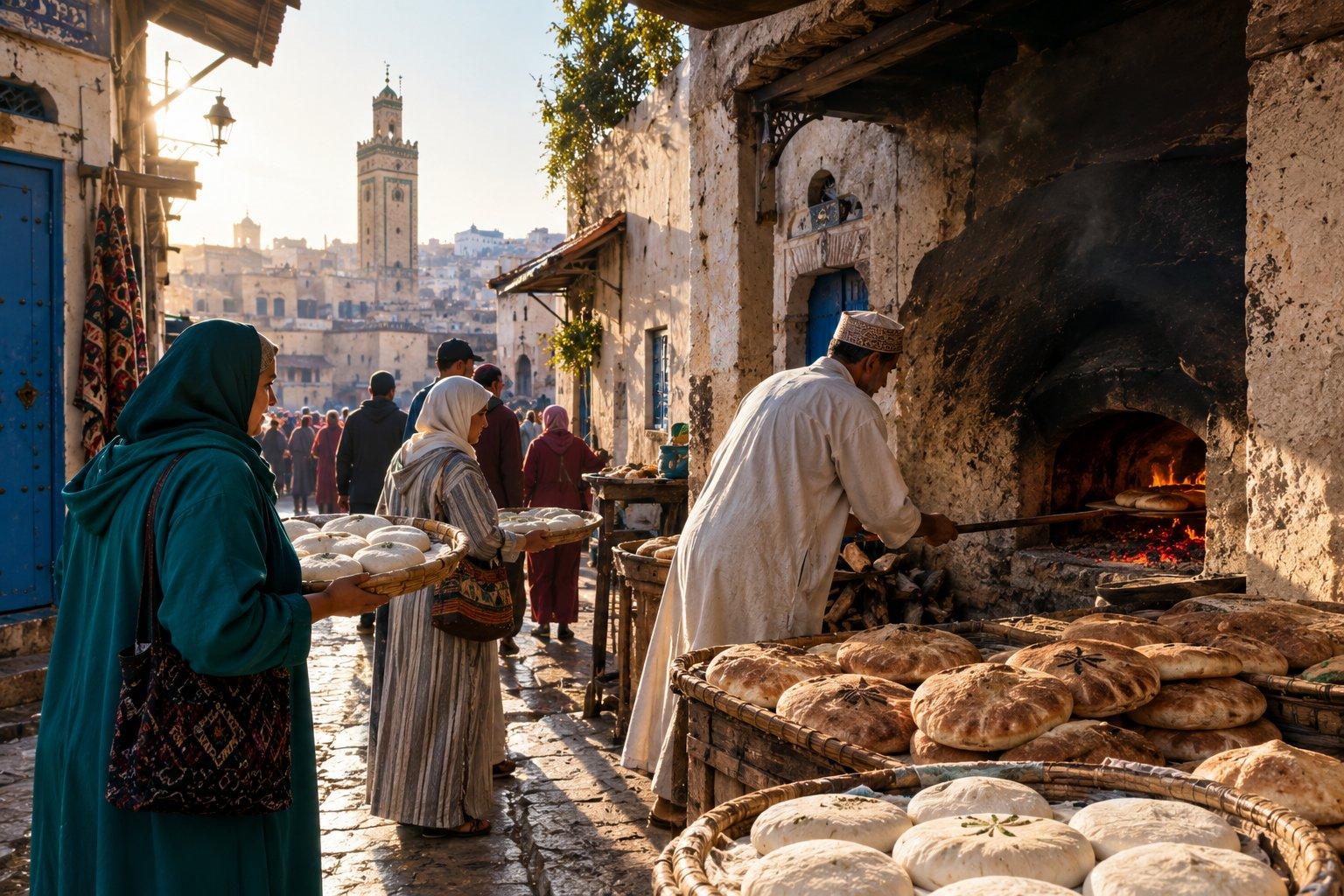
Stand outside a neighbourhood ferran in Fes at half past seven in the morning, and you can watch families arrive carrying trays of dough to be baked. Some loaves are marked in small, recognisable ways so the baker can tell them apart from the bread belonging to other households. The ferran is a communal wood-fired oven, traditionally found in the neighbourhoods of Moroccan medinas, where households bring dough prepared at home to be baked rather than maintaining an oven themselves. It is part of the old infrastructure of Moroccan urban life, a system built around the practical realities of neighbourhood living rather than around tourism. In miniature, it offers a useful way of understanding Moroccan culture: many traditions have survived because they remained useful, adapting to new circumstances without necessarily disappearing when something newer arrived.
Morocco sits at a genuine crossroads, Amazigh peoples whose roots in North Africa long predate the Arab-Islamic conquests, Arab-Islamic dynasties that expanded into the region from the 7th century onward, Andalusi refugees who moved south from Iberia over several centuries, trans-Saharan networks that carried goods and people between West Africa and North Africa, a Jewish community with roots in Morocco stretching back roughly two thousand years, and French and Spanish colonial rule layered onto all of it in the 20th century. What makes Morocco distinctive within this series is not that none of these historical forces displaced or transformed what came before. They did. What is striking is how many older languages, customs, artistic traditions, religious practices and forms of craftsmanship survived by being incorporated into later Moroccan society.
Where the culture came from
The Amazigh peoples are indigenous to North Africa, with communities and cultural traditions rooted in the region long before the Arab-Islamic conquests. Across what is now Morocco, Amazigh communities developed their own languages, social structures, agricultural systems and artistic traditions in regions including the Rif, the Atlas Mountains and the pre-Saharan south. Phoenician and later Roman contact affected parts of the region, particularly along the Mediterranean coast and in the north, but it was the Arab-Islamic expansion beginning in the late 7th century that transformed the region most fundamentally. Islam gradually spread among the population, while Arabic became increasingly important alongside existing Amazigh languages. The result was not the disappearance of Amazigh society. Several Amazigh-led Islamic dynasties, including the Almoravids and Almohads, later ruled extensive territories across the Maghreb and al-Andalus, making medieval Morocco a major political and cultural centre of the western Islamic world.
The conquest of Granada in 1492 intensified a much longer history of movement between Iberia and Morocco. Muslim and Jewish refugees, and later Moriscos, settled in Moroccan cities, with places such as Fes and Tetouan absorbing strong Andalusian influences in architecture, music, crafts and food. Tetouan in particular was rebuilt by Andalusian refugees after the Reconquista, and UNESCO describes its historic urban fabric as strongly shaped by that migration. The influence is still visible in the city's architecture and cultural traditions rather than existing only as a historical footnote.
Morocco's Jewish community has roots stretching back roughly two thousand years, and its numbers grew through successive periods of migration, including the arrival of Jews expelled from Iberia in the late 15th century. In several Moroccan cities, Jewish communities lived in quarters known as mellahs, although the history and character of these neighbourhoods varied from city to city. Jewish communities developed religious, commercial and cultural institutions of their own, and Jewish and Muslim Moroccans participated in the same wider urban economies and cultural life. The community declined dramatically during the 20th century as hundreds of thousands of Moroccan Jews emigrated, particularly to Israel and France. Today the community is small, with recent U.S. government estimates putting the Jewish population at around 1,500 people, but synagogues, cemeteries, former mellahs and other heritage sites remain part of Morocco's historical landscape, and the Moroccan state has invested in preserving and restoring a number of them.
The trans-Saharan slave trade connected Morocco with West African societies for centuries, moving enslaved people north across the Sahara alongside commercial networks that also carried gold, salt and other goods. The trade did not end in the 17th century; forms of slave trading and slavery continued into the 19th century and declined gradually thereafter. Some of the people brought north through these networks, and their descendants, became associated with the Gnawa tradition, one of Morocco's most distinctive musical and spiritual traditions. The history is therefore inseparable from both movement across the Sahara and the forced movement of people through those same routes.
Morocco avoided direct European colonial rule for longer than some of its neighbours, but it did not remain untouched by European power. In 1912, France established a protectorate over most of the country, while Spain controlled smaller zones in the north and south, alongside the internationally administered Tangier zone. The protectorate ended in 1956, when Morocco regained full sovereignty under the Alaouite monarchy, which had continued to exist during the protectorate period. The Alaouite dynasty traces its lineage to the Prophet Muhammad, and the Moroccan monarch also holds the constitutional title of Commander of the Faithful, giving the monarchy an important religious role as well as its political one.
King Mohammed V, who reigned through the transition to independence, became a central symbol of Moroccan nationalism. French authorities removed him from the country in 1953 and replaced him with a different ruler, but political pressure eventually contributed to his return in 1955 and Morocco's independence the following year. His son Hassan II ruled from 1961 until 1999. His reign combined major state-led economic and infrastructure projects with periods of severe political repression, including imprisonment, disappearances and restrictions on political opposition. Mohammed VI became king in 1999. His reign has included significant legal and institutional reforms, including the 2004 revision of the Moudawana, Morocco's family code, which changed rules concerning marriage, divorce and women's rights within the family.
Ethnic groups and languages
Morocco's population has deep Arab-Amazigh roots, but the exact size of the population that identifies specifically as Amazigh is difficult to establish because ethnic identity and language use are not the same thing. Morocco's 2024 census found that 24.8 percent of the population uses an Amazigh language: 14.2 percent use Tachelhit, 7.4 percent use Tamazight and 3.2 percent use Tarifit. The same census found that 91.9 percent of the population uses Moroccan Arabic, commonly called Darija, in everyday life. These figures describe language use rather than ethnicity, so they should not be treated as a direct measure of how many Moroccans are ethnically Amazigh.
Amazigh communities themselves are not culturally or linguistically identical. The Rifians of the northern Rif, speakers of Central Atlas Tamazight, and Chleuh communities of the south and Souss region have distinct linguistic and cultural traditions, even though they share the broader Amazigh identity.
Moroccan Arabic, known as Darija, functions as the main everyday spoken language for most of the population. It is sufficiently different from Modern Standard Arabic that an Arabic speaker from another country may find Moroccan conversations difficult to follow without prior exposure. Darija developed through long contact between Arabic and the languages and cultures around it, including Amazigh languages and, in different regions and periods, French and Spanish.
French remains widely used in business, higher education, professional life and parts of administration, even though it is not an official language under the Constitution. Spanish has a stronger presence in northern Morocco, reflecting the history of Spanish-controlled territories in the country. In cities, it is common for speakers to move between Darija, French, Spanish and Amazigh depending on the person they are speaking to, the subject being discussed and the setting. The result is a linguistic environment in which switching between languages can be an ordinary part of everyday communication rather than a formal decision about which single language represents Moroccan identity.
Morocco is overwhelmingly Sunni Muslim. U.S. government estimates place Sunni Muslims at more than 99 percent of the population. Islam also occupies a specific constitutional position: the king is Commander of the Faithful, or Amir al-Mouminine, and the Constitution gives him responsibility for ensuring respect for Islam while guaranteeing the exercise of religious beliefs.
The monarchy's religious role is tied partly to the Alaouite dynasty's claim of descent from the Prophet Muhammad, but Moroccan religious life extends far beyond the palace. Sufi traditions, local saints and religious brotherhoods have historically played important roles in different parts of the country. Moussems, festivals associated with particular saints or religious sites, can combine pilgrimage with markets, music, horse displays and community gatherings. Their character varies considerably from one region to another.
Morocco's historic Jewish community, though dramatically reduced from its mid-20th-century size, remains the largest remaining Jewish community among Arab countries. The Moroccan state has in recent years placed greater emphasis on preserving Jewish heritage, including restoring synagogues and cemeteries and incorporating Jewish history into official presentations of Moroccan heritage. This approach became particularly visible after Morocco restored formal diplomatic relations with Israel in 2020, although the preservation of Jewish heritage had begun earlier.
Gnawa spiritual practice adds another dimension to Morocco's religious landscape. The tradition developed among Black Moroccan communities whose histories are connected to West Africa, slavery and trans-Saharan movement. Gnawa ceremonies can involve music, prayer, rhythmic repetition and ritual practices associated with healing and communication with spiritual beings. An important form of ceremony is the lila, an extended night-time ritual in which music and spiritual practice continue for hours. These ceremonies have religious and community significance beyond their later presentation on concert stages.
Amazigh communities across the Atlas Mountains and pre-Saharan regions also maintain local customs surrounding saints, shrines, seasonal celebrations and protective practices. These traditions vary from one community to another. Moroccan Islam has therefore never existed as a single identical practice carried out in exactly the same way everywhere. Local history, geography and community traditions have shaped how religious life is experienced from one place to another.
Food
Tagine, a slow-cooked dish named for the distinctive conical clay vessel in which it is traditionally prepared, stands as Morocco's most internationally recognised food. It comes in countless regional and family variations, using ingredients such as lamb, chicken, fish, vegetables, olives, preserved lemons and dried fruit. Spices can include ginger, cinnamon, saffron, cumin and turmeric, depending on the recipe. The combinations reflect both local agricultural traditions and centuries of commercial and cultural exchange across the Mediterranean, the Sahara and the wider Islamic world.
Couscous carries a different kind of significance. Traditionally made from semolina and steamed several times, it is commonly associated with Friday family meals in Morocco, although the exact customs surrounding it vary between households and regions. Preparing couscous properly is a skilled process, and the dish is often served communally, with the grain arranged around vegetables, meat or another stew.
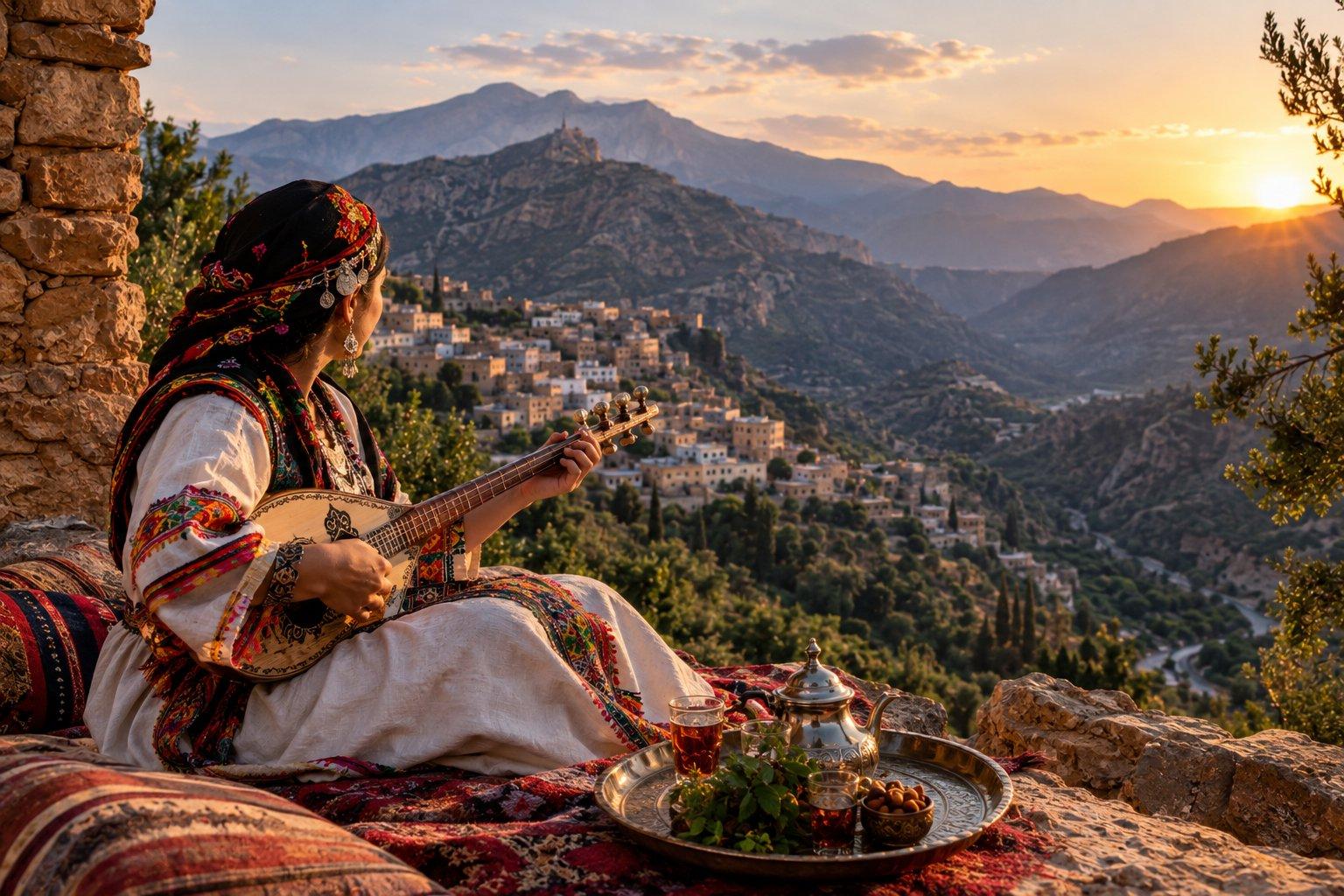
Mint tea, usually made with green tea, fresh mint and sugar, is one of Morocco's most recognisable hospitality practices. The tea is traditionally poured from a height into small glasses, creating a light foam. Offering tea to a guest is common across Moroccan society, although the details of preparation, sweetness and frequency vary between households. The ceremony is practical as well as social: sitting down for tea creates a reason to pause, talk and welcome someone into the home.
Preserved lemons, harira, a soup commonly eaten to break the Ramadan fast, and pastilla round out some of the country's best-known dishes. Pastilla is a layered pastry traditionally associated with poultry, especially pigeon, although chicken is now common, combined with ingredients such as almonds, eggs, spices and sugar. Its precise history is debated, but its development is strongly associated with Morocco's long culinary connections with al-Andalus.
Street food culture is particularly visible in Marrakech's Jemaa el-Fna, where food stalls operate alongside musicians, storytellers, performers and other vendors. The square is not merely a market. UNESCO inscribed Jemaa el-Fna on the Representative List of the Intangible Cultural Heritage of Humanity in 2008, recognising the traditions of oral performance and cultural activity associated with the space.
Music, dance, and art
Gnawa music emerged from the history of Black Moroccan communities whose ancestors were connected to West Africa and to the trans-Saharan slave trade. The tradition is built around instruments including the guembri, a three-stringed bass lute, and qraqeb, large metal castanets whose repeated rhythms help drive the music. Gnawa combines musical performance with spiritual practice, and its repertoire is connected to Sufi traditions, healing ceremonies and memories of displacement and forced migration.
UNESCO inscribed Gnawa on its Representative List of the Intangible Cultural Heritage of Humanity in 2019. The tradition continues to exist both within its community religious settings and on public stages. The annual Gnaoua and World Music Festival in Essaouira, established in 1998, has helped introduce Gnawa musicians to international audiences and has created collaborations with jazz, blues and world-music artists.
Al-Ala, Morocco's Andalusi classical musical tradition, developed from the musical culture carried south from al-Andalus and preserved in Moroccan cities including Fes, Tetouan, Rabat, Salé and Tangier. Its major musical structures are called nuba, extended suites built around particular modes and organised sequences. The music is not simply a relic of medieval Spain. It has been maintained through Moroccan musical institutions, ensembles and teaching traditions.
Malhun is another major Moroccan musical and poetic tradition. It consists of sung poetry in Moroccan Arabic, historically associated with urban craftsmen and guild culture. Some Malhun repertoire also exists in Hebrew. UNESCO inscribed Malhun on its Intangible Cultural Heritage list in 2023, recognising it as a popular poetic and musical art that developed through Moroccan urban culture.
Amazigh musical traditions add another major regional layer. Ahwash and Ahidous involve communal singing, rhythm and coordinated movement, although the forms vary considerably between communities. Reggada, associated particularly with northeastern Morocco, developed from regional Amazigh dance traditions and is now performed at celebrations and cultural events. Chaabi, meanwhile, developed as a form of Moroccan popular music and differs from the Algerian genre that shares the same name. It remains closely associated with weddings and celebrations, while contemporary Moroccan hip-hop and fusion musicians have created newer spaces for addressing social and political themes.
The djellaba, a loose-fitting robe with a hood, remains one of Morocco's most recognisable traditional garments and is worn by both men and women. The kaftan occupies a more formal place in Moroccan dress, particularly at weddings and other major celebrations. Moroccan wedding clothing can involve several outfit changes, with families drawing on regional and family traditions rather than following one single national format.
Moroccan leatherwork, particularly in Fes, remains one of the country's best-known traditional crafts. The city's historic tanneries are part of the broader artisanal economy that continues to operate within the medina, alongside metalwork, woodworking, embroidery, weaving and pottery. Carpet production also varies significantly by region, with different Amazigh and urban communities developing distinct patterns, techniques and materials.
Zellige, the geometric mosaic tilework associated especially with Moroccan architecture, is another highly specialised craft. Artisans cut coloured glazed tiles into precise geometric pieces and assemble them into larger patterns. Fes has remained an important centre for the craft, and master artisans continue to train apprentices through practical work rather than relying entirely on written instruction.
The craft is still actively being practised and commissioned. In 2025, Morocco launched a formal project seeking UNESCO Intangible Cultural Heritage recognition for the zellige traditions of Fes and Tetouan, describing the craft as a living tradition passed from master artisans to apprentices.
The hammam, Morocco's traditional public bathhouse, has also remained part of everyday social life. Historically, neighbourhood hammams provided a place to wash at a time when many homes did not have modern bathrooms, but their role went beyond bathing. They became places where neighbours met, exchanged news and prepared for important occasions. Women's hammams in particular have been studied as important social spaces, and pre-wedding hammam visits remain part of Moroccan wedding customs in many families.
Festivals, ceremonies, and rites of passage
Moussems associated with local saints combine religious observance with community activity, although their exact form varies widely. Some involve pilgrimage, others markets, music, horse displays or other local traditions. The important point is that these gatherings often connect religious practice with ordinary community life.
Ramadan and Eid al-Fitr remain central to Morocco's Islamic calendar, while the country also hosts major cultural festivals with very different histories and purposes. The Fes Festival of World Sacred Music began in 1994. The Gnaoua and World Music Festival in Essaouira began in 1998. Mawazine in Rabat was established in 2001. Together with regional Amazigh celebrations and other local events, they form a calendar in which religious, musical, artistic and community traditions overlap without being identical.
Moroccan weddings can bring several of the country's cultural traditions into a single family event. The exact programme differs between regions and families, but weddings may include Andalusi music, Amazigh songs or dances, Gnawa performances and several changes of traditional clothing. Rather than representing a single standard Moroccan wedding, these combinations show how families draw from different regional and cultural traditions when marking one of the most important events in their lives.
Morocco officially recognised Amazigh New Year as a paid national holiday in 2023, designating 14 January as the annual public holiday. The celebration itself draws on older Amazigh traditions whose foods, rituals and customs vary across communities. In Morocco, the new holiday has also become an important public expression of Amazigh cultural identity.
A constitutional statement about Moroccan identity
Morocco's 2011 Constitution, adopted during a period of political protest and constitutional reform across the Arab world, formally recognised Tamazight as an official language alongside Arabic. But the constitutional text went further than language.
Its preamble describes Moroccan identity as having Arab-Islamic, Amazigh and Saharo-Hassani components, while also describing it as enriched by African, Andalusian, Hebraic and Mediterranean influences. That wording is significant because it gives legal recognition to several historical strands that have shaped Moroccan society.
The Constitution does not say that these identities have always existed peacefully or that every Moroccan experiences them in the same way. It does, however, provide a formal description of Morocco as a country whose national identity has been formed from several historical and cultural sources rather than from one single origin story.
That idea helps explain why Moroccan culture can contain practices with very different histories without requiring one of them to cancel the others out.
What remains in everyday life
Gnawa music continues to draw audiences in Morocco and abroad, particularly through the Essaouira festival, while lila ceremonies remain part of Gnawa religious and community life. The music has moved into concert halls and international collaborations without disappearing from the settings in which its spiritual traditions developed.
Fes's zellige workshops, leatherworkers and other artisans continue to train new generations, even as the economics of traditional craftsmanship change. The techniques are no longer protected simply because modern life has left them untouched. They survive because artisans, customers, families, restoration projects and cultural institutions continue to give them reasons to exist.
And in neighbourhoods where the old ferran still operates, families continue a routine that has survived generations: dough prepared at home, carried to the communal oven, marked so the baker can identify it, baked alongside the loaves of neighbours, and brought home warm.
The same pattern appears elsewhere. The hammam remains a social institution as well as a bathing space. Zellige continues to be cut by hand. Mint tea is still poured for guests. Gnawa musicians still perform for their own communities as well as for international audiences. Amazigh languages are spoken alongside Darija, French and Spanish. Jewish heritage sites remain part of the country's historical landscape.
Morocco has changed repeatedly. Its dynasties changed, its borders changed, its languages evolved, its religious life developed, its cities expanded and its population moved. Some traditions disappeared and others were transformed beyond recognition.
But many older practices did not have to remain frozen in order to survive. They adapted, moved into new settings and acquired new meanings while retaining enough of their original form to remain recognisable.
That is perhaps the more useful way to understand Morocco's cultural history: not as a country where nothing was ever replaced, but as a place where successive historical layers have often remained visible inside what came after them.