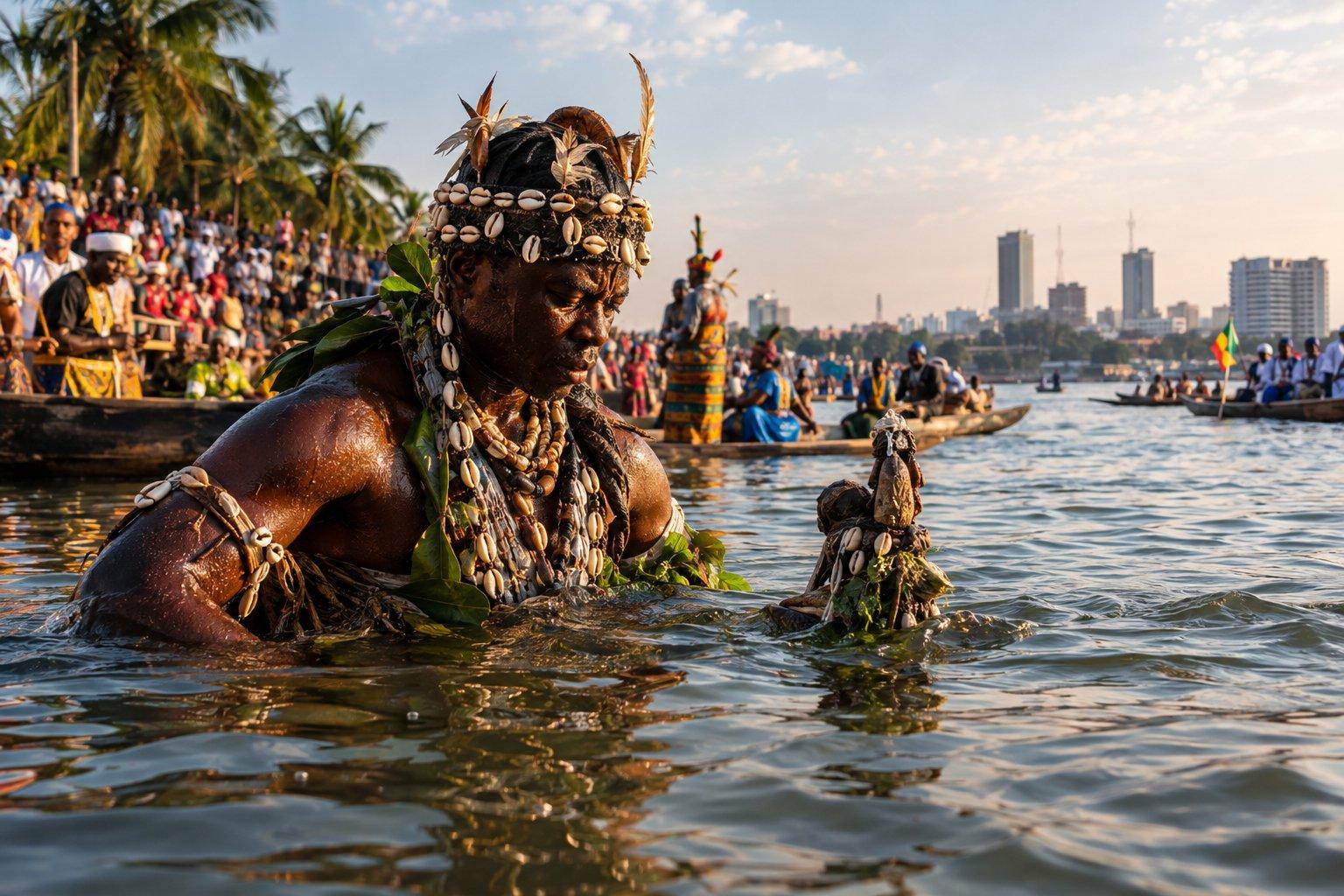
Once a year in December, along the banks of the Wouri River in Douala, an initiated participant in the Ngondo enters the water as part of a sacred ceremony associated with the Sawa people's traditional beliefs. The ritual is understood as a journey into the underwater realm of the jengu, or miengu, water spirits often represented in mermaid-like form and associated with good fortune, healing and spiritual knowledge. According to the tradition, the participant can remain beneath the water for an extended period and return with his clothing apparently dry, having communicated with the spirits and returned with their blessing for the community.
This is the Ngondo, the annual cultural festival of Cameroon's coastal Sawa communities. The festival was prohibited by the government in 1981 and revived in 1991. It has continued as an annual December gathering, combining the sacred water ceremony with pirogue races, traditional dances and other cultural performances along the Wouri River.
That history captures something important about Cameroon as a whole: a country so geographically, linguistically and culturally varied that it has long been described, including by Cameroon's own Ministry of Tourism, as "Africa in miniature." Within its borders are humid Atlantic and equatorial forests, highland landscapes, savanna and semi-arid Sahelian environments, alongside around 250 ethnic groups and roughly 250 local languages. Its colonial history also left behind two official languages and two distinct legal and educational traditions, creating a political structure whose tensions are still visible today.
Where the culture came from
Long before European colonial rule, the territory now called Cameroon contained a wide range of political systems. Northern Cameroon was influenced by several major Islamic states and political movements, including the Kanem-Bornu tradition to the northeast and, in the 19th century, the Fulani-led jihad associated with the Sokoto Caliphate. The latter helped establish the Adamawa Emirate under Modibo Adama and brought large parts of the region into a political and religious system based on Islam.
This did not mean that the entire north became Muslim or that all non-Muslim communities responded to the new political order in the same way. In the Mandara Mountains and surrounding areas, numerous communities maintained their own political and religious traditions alongside Muslim emirates. Some resisted or avoided incorporation into Fulani-led states, with the difficult mountainous terrain helping some communities preserve a degree of autonomy.
The term "Kirdi," historically used by Muslim communities and later colonial writers for various non-Muslim peoples of northern Cameroon, is itself an outsider category rather than the name of one ethnic group. It has commonly been associated with the idea of non-believers or pagans, and it groups together communities with very different histories and identities. That distinction matters because the peoples placed under the label maintained their own languages, political systems and religious traditions rather than forming one unified community.
In the western highlands, meanwhile, the Grassfields developed complex systems of chieftaincy, court administration, ritual authority and specialized craft production. The Bamileke and the Bamoun kingdom of Foumban developed particularly well-known royal institutions, with palace communities, hereditary rulers, specialized artisans and societies involved in political and ceremonial life. The Bamoun kingdom traces its history back roughly six centuries, and its royal institution remains active as a traditional cultural authority within the modern Cameroonian state.
European contact began along the coast in the late 15th century. Portuguese navigators reached the Wouri estuary in 1472 and encountered large quantities of shrimp and prawns in its waters. They called the river Rio dos Camarões, meaning "River of Shrimp," a name that eventually gave Cameroon its modern name in several European languages.
German colonial rule formally began in 1884. Germany developed plantations, trading networks and infrastructure before losing its colonies during the First World War. After Germany's defeat, the former German colony of Kamerun was divided into French and British League of Nations mandates.
France administered the much larger portion, while Britain administered a smaller territory along the border with Nigeria. The two administrations developed different systems of education, government and law. French Cameroon inherited a civil-law tradition, while British Cameroons developed institutions influenced by English common law. The distinction survived colonial rule and became particularly important after reunification because the two regions entered the new state with different institutional histories.
French Cameroon became independent on 1 January 1960, with Ahmadou Ahidjo becoming its first president. The following year, the British-administered territory was divided politically through a United Nations-supervised plebiscite. Northern British Cameroons voted to join Nigeria, while Southern Cameroons voted to join the Republic of Cameroon.
Southern Cameroons therefore did not become part of Cameroon through a simple administrative merger. The 1961 reunification created a federal state in which two federated states, East Cameroon and West Cameroon, retained separate institutions while sharing a federal government. French and English were both recognized as official languages.
That federal arrangement did not last.
In 1972, President Ahidjo pushed for a return to a unitary state. A referendum held on 20 May 1972 approved a new constitution that replaced the federation with a centralized state. This was a decisive constitutional change because the two federated states were replaced by one national political structure.
Paul Biya succeeded Ahidjo as president in 1982 and has remained in office ever since. During the decades that followed, Anglophone grievances continued to develop around questions of political representation, the use of English, education, the legal system and the relationship between the English-speaking regions and the central government in Yaoundé.
The crisis became much more visible in 2016, when lawyers and teachers in the English-speaking North-West and South-West regions protested what they described as the erosion of the region's common-law and English-language institutions. Security forces responded with arrests and other forms of repression. By 2017, the crisis had escalated into an armed separatist conflict, with armed groups seeking an independent state commonly referred to by separatists as Ambazonia.
The conflict remains active. As of 30 June 2026, UNHCR reported an estimated 493,402 internally displaced people in Cameroon's North-West and South-West regions. The country also had more than 412,000 refugees and more than 2.2 million forcibly displaced people across all displacement categories. The figures include displacement caused by more than one crisis, including violence in the Far North, so they should not be treated as a measure of the Anglophone conflict alone.
The history of the conflict therefore reaches much further back than the violence of the past decade. The 1961 federal arrangement, its gradual weakening, the abolition of federalism in 1972 and later disputes over language, law, political representation and regional autonomy all form part of the history that helps explain why protests in 2016 developed into a much larger conflict.
Ethnic groups and languages
Cameroon's roughly 250 ethnic groups are often discussed through broad cultural and geographical groupings, although those categories should not be mistaken for rigid boundaries between communities.
The Bamileke and related Grassfields peoples are concentrated in the western highlands and have long been prominent in agriculture, trade and commerce. Bamileke communities have established extensive commercial networks inside Cameroon and beyond their home region. Their political and economic prominence has also intersected with local disputes over land, political representation and belonging in some parts of the country.
Beti-speaking peoples, including the Ewondo, are particularly prominent in the Centre and southern parts of Cameroon, including Yaoundé. The Sawa is a broad cultural designation associated with many of the peoples of Cameroon's coastal region, including the Duala and other communities whose histories are connected to the Atlantic coast and the Wouri estuary.
In the north, Fulani communities coexist with numerous other peoples, including communities historically grouped under the external term Kirdi. The result is not a simple division between Muslim Fulani and non-Muslim mountain peoples. Northern Cameroon contains a much more complicated mixture of ethnic, linguistic, religious and political histories.
French and English are Cameroon's two official languages. The country is divided administratively into ten regions, eight predominantly Francophone and two, the North-West and South-West, predominantly Anglophone.
Alongside the official languages are hundreds of local languages. The World Bank estimates that Cameroon has around 250 local languages, illustrating why language in Cameroon is about much more than the French-English divide. A person may grow up speaking an indigenous language at home, use Cameroonian Pidgin English in commercial or social settings, encounter French or English in education and government, and move between several of these linguistic systems during an ordinary day.
Camfranglais developed partly out of this multilingual environment. It is an urban form of speech that combines French, English, Cameroonian Pidgin English and vocabulary drawn from Cameroonian languages. It is particularly associated with young people and urban settings and does not replace the country's official languages. Instead, it gives speakers another way of communicating across linguistic boundaries.
Cameroonian Pidgin English has a different history and role. It developed within wider West and Central African patterns of contact and became especially important in the English-speaking regions and in commercial environments. It is also used beyond the formal boundaries of the two Anglophone regions, making it an important practical language of interaction.
In southeastern Cameroon, the Baka are among the Indigenous forest peoples whose lives and cultural knowledge remain deeply connected to the forest. Hunting, gathering, ecological knowledge, ritual and music have historically been closely linked to the forest environment. Those traditions have come under pressure from changing land use, conservation restrictions, logging and other economic pressures, while Baka communities increasingly combine forest-based practices with agriculture, wage work and participation in wider markets.
Cameroon's linguistic diversity therefore goes considerably deeper than its two official languages suggest. French and English describe the country's colonial and state institutions. They do not describe the full linguistic life of the people who live there.
Religion and belief
Christianity is the largest broad religious affiliation in Cameroon. Estimates cited by the U.S. State Department put Roman Catholics at about 38.3 percent of the population, Protestants at about 25.5 percent and other Christians at about 6.9 percent. Muslims account for about 24.4 percent. These figures are estimates rather than the result of a recent comprehensive national religious census.
Christianity is particularly prominent in the southern and western parts of the country. Catholic communities are especially strong in the South, Centre, East, Littoral and West regions, while Protestant traditions are particularly important in the North-West and South-West.
Islam is concentrated more heavily in the northern regions, including the Far North and Adamawa, although Muslim communities also exist elsewhere. The Mbororo, a Fulani pastoralist community, are predominantly Muslim, while the Bamoun of the West Region are also predominantly Muslim.
Traditional religious practices do not disappear neatly when Christianity or Islam becomes dominant. The same religious landscape can contain older local practices, beliefs about ancestors and ritual traditions alongside Christianity or Islam. The available demographic estimates classify only a small percentage of Cameroonians as formally following traditional religions, but the same sources note that many Christians, Muslims and followers of other religions also observe aspects of traditional belief.
Among the Sawa, for example, the Ngondo continues to provide a public setting for traditional beliefs surrounding water spirits and ancestral relationships. In Grassfields communities, traditional authority and ceremonial practice remain closely connected to royal histories and the memory of previous generations.
This makes religious identity in Cameroon difficult to understand through percentages alone. A national religious statistic tells you how people identify institutionally. It does not necessarily tell you every ritual, family practice or cultural tradition that remains meaningful to them.
Food
Ndolé, made from bitter leaves cooked with groundnuts and commonly combined with meat, shrimp or dried fish, is widely regarded as one of Cameroon's national dishes. It is particularly associated with the coastal region and the Sawa, although it is eaten far beyond its regional origins. Preparing the bitter leaves requires careful cooking to reduce their bitterness, while the groundnut base gives the dish its characteristic richness. It is commonly eaten with plantain or other staple foods.
Achu is strongly associated with the Grassfields and western regions. It is made from pounded cocoyam or taro and served with a yellow soup based on palm oil and spices. The dish is especially associated with traditional gatherings and the food culture of the western highlands.
Poulet DG, short for "Directeur Général," is a modern Cameroonian dish combining chicken, fried plantain, vegetables and sauce. The name is commonly associated with the idea of a dish suitable for executives or people of status, reflecting the restaurant culture in which it became popular. It has since become familiar well beyond the social group implied by its name.
The country's geography also shows up in its everyday food. In the northern regions, millet and sorghum are important staples in areas where rainfall is lower and farming conditions differ sharply from those of the humid south. Among pastoral Fulani communities, dairy products have historically played an important role alongside grains and other foods.
In the Anglophone Southwest, eru is a well-known dish made from leafy greens and often combined with waterleaf, groundnuts and meat or fish. Koki, a steamed bean pudding traditionally wrapped in banana or plantain leaves, is another widely eaten Cameroonian food.
Palm wine is also part of the social life of many communities in the southern forest and coastal regions. Fresh palm wine is collected from tapped palm trees and is used in both everyday gatherings and ceremonies, although the way it is produced and consumed varies between communities.
Cameroonian food therefore follows the same pattern as the country's geography. There is no single cuisine that explains the whole country. Coastal dishes, Grassfields cooking, northern grains, pastoral food traditions and forest-region ingredients all belong to the same national food culture.
Music, dance, and art
Makossa developed in Douala during the 20th century, drawing on local Sawa musical traditions as well as influences from jazz, highlife and other African and international styles. The genre became one of Cameroon's most recognizable musical exports.
Manu Dibango took that sound to a much larger international audience with "Soul Makossa," released in 1972. The song became a major international dance record after New York DJs began playing it, eventually reaching the US Billboard Hot 100. It also became part of a much wider history of African music entering American and European popular culture during the 1970s.
Its influence can be traced through later popular music. Michael Jackson used the song's distinctive vocal refrain in "Wanna Be Startin' Somethin'," and Rihanna later used the same refrain in "Don't Stop the Music." Dibango's work therefore created a direct musical link between Douala's makossa tradition and some of the most commercially successful popular music of the following decades.
Bikutsi developed among Beti-speaking communities in central Cameroon and grew from older Beti musical and dance traditions into a major modern popular genre. Its fast rhythms and prominent percussion and balafon traditions became the foundation for modern arrangements. Les Têtes Brûlées helped take a highly electrified version of bikutsi to international audiences in the late 1980s and 1990s.
Music is only part of Cameroon's artistic landscape. In the Grassfields, royal courts have supported specialized forms of carving, beadwork, textile production and ceremonial mask-making. Art was not simply decoration. Objects could communicate royal status, lineage, authority and membership in particular social institutions.
The Bamoun royal tradition of Foumban is especially notable for its long relationship between political authority and artistic production. Palace artisans produced objects for ceremonies, rulers and court institutions, helping transmit particular techniques and visual traditions across generations.
Forest communities have their own musical traditions as well. Baka communities in southeastern Cameroon maintain complex vocal practices and ritual music connected to healing, education, ceremony and the transmission of knowledge. UNESCO notes that Baka musical and ritual practices, like those of the related Aka communities farther east, remain closely connected to forest life and intergenerational knowledge.
Cameroon's football culture belongs in this story too, because football has repeatedly created moments of national celebration across linguistic and regional boundaries. The national team's historic 1990 World Cup run, when Cameroon became the first African team to reach the World Cup quarter-finals, remains one of the country's defining sporting achievements.
Ndop is a distinctive textile tradition associated with the Grassfields, particularly Bamileke communities. The cloth is traditionally produced from cotton and decorated with indigo and resist-dyeing techniques that create geometric patterns. It is associated with identity, status and ceremonial use, and particular forms of the textile have been connected to royal and chieftaincy traditions.
The Kaba Ngondo, a loose full-length dress associated particularly with Sawa women, is especially visible during the Ngondo festival and other coastal cultural occasions. It has become an easily recognizable expression of Sawa cultural identity.
The western highlands also have long traditions of mask carving, beadwork and ceremonial objects. In the Bamoun kingdom, Foumban became particularly well known for brass casting, beadwork and other palace-linked crafts. These traditions were supported by the royal court and were used in ceremonies, political representation and the production of objects associated with royal authority.
Many of these objects now exist in museums and private collections outside Cameroon. Their movement into international collections has also raised wider questions about colonial-era collecting, ownership and the return of African cultural heritage, issues that extend beyond Cameroon but are especially relevant to royal and ceremonial objects.
Festivals, ceremonies, and rites of passage
The Ngondo remains the central annual cultural festival of the Sawa communities of Cameroon's coast. Held in December in Douala, it combines the sacred water ceremony with pirogue races, traditional dances and other public celebrations.
The water ritual is the part most closely associated with Sawa spiritual tradition. The initiate who enters the water is understood, according to the belief system surrounding the ceremony, to communicate with the jengu and return with a message or blessing for the community. The physical details attributed to the ritual belong to that tradition and should be understood as matters of belief rather than independently established supernatural fact.
The festival's modern history is also significant. The Ngondo was prohibited in 1981 during the government of Ahmadou Ahidjo and revived in 1991. Its continuation illustrates how a cultural institution can disappear from public life for a period and later return as part of a community's effort to maintain its traditions.
The Bamoun kingdom's Nguon is another important example, but its significance lies in something different.
Nguon is more than six centuries old and takes place every two years in early December. It is a set of rituals involving the Mfon, the Bamoun monarch, and the wider Bamoun community. Ritual chiefs first consult members of the community about the state of the kingdom. They then take those views to the palace in a secret meeting with the monarch.
The following day, the Mfon faces a public ritual "trial" concerning his governance. The ritual chiefs read out accusations based on the community's feedback. According to the tradition, the monarch can be fined or even removed from office. If his mandate is renewed, he gives an acceptance speech and receives a renewed expression of allegiance from the community.
The ritual ends in public celebration and a procession back to the palace.
UNESCO describes Nguon as a system for dialogue, accountability, freedom of expression and social cohesion. That makes it particularly interesting because it shows that traditional institutions were not necessarily structured only around unquestioned royal authority. In the Bamoun case, the relationship between ruler and community also contains a formal ritual mechanism for criticism and accountability.
Bamileke funerals have their own elaborate traditions. They can involve extended preparation, large family gatherings, distinctive clothing, masks, music and dance. The ceremony provides a public setting for relatives and community members to recognize the deceased, reaffirm family relationships and participate in traditions associated with ancestors and social continuity.
The exact form of these ceremonies varies from one community and family to another, but throughout the Grassfields, funerals can be major social events rather than private family gatherings.
The Danger Beneath Lake Nyos
Cameroon has a lake that can release gas from beneath its own water.
In 1986, Lake Nyos in the northwest suddenly released a huge amount of carbon dioxide that had built up deep below the lake. The gas spread into nearby valleys, where it displaced the air people and animals needed to breathe. About 1,700 people and thousands of animals died.
The strange part is that there was no dramatic volcanic eruption. The lake itself looked like a lake. The danger was hidden underneath it.
Scientists now use pipes to draw deep water upward and gradually release the trapped gas, reducing the amount that can build up again.
It is a haunting piece of Cameroon’s natural history, and a reminder that some of the country’s most remarkable landscapes have stories beneath the surface that you cannot see.
What Cameroon looks like today
Cameroon's diversity is not only a historical story. It remains visible in the country's institutions, languages, festivals, food, music and political tensions.
The same country that contains the coastal Sawa traditions of Douala also contains the Grassfields kingdoms around Foumban and Bafoussam, the Muslim communities of the northern regions, the forest cultures of the southeast and the urban multilingualism of Yaoundé and Douala.
Some of these traditions have adapted to modern life. Others have become symbols of cultural identity precisely because the communities preserving them have had to negotiate rapid political, economic and social change.
The Ngondo continues to return to the Wouri River every December. The Nguon continues to bring the Bamoun community together every two years, including its unusual ritual process of questioning the monarch's governance. The Bamoun royal institution continues to function as a traditional cultural authority, while Cameroon itself remains a modern republic with elected national institutions.
The country's contemporary challenges are just as tangible. The Anglophone conflict continues to displace people in the North-West and South-West, with UNHCR estimating 493,402 internally displaced people in those two regions as of June 2026. The Far North faces another major displacement crisis, while refugees from neighbouring countries also live in Cameroon. These crises exist alongside a country whose cultural institutions continue to operate, adapt and change.
That is why "Africa in miniature" is useful when it is treated as a description rather than a slogan. Cameroon brings together an unusually broad range of ecological environments, languages, religious traditions, political histories and cultural institutions within one country.
Its diversity is also part of the country's difficulty. The same linguistic and institutional differences that make Cameroon culturally distinctive have also produced serious political tensions, particularly between the English-speaking and French-speaking parts of the country.
But the country's history cannot be reduced to that conflict either.
The Ngondo survived suppression. The Bamoun court developed its own writing system and preserved its historical records. Nguon continues a centuries-old ritual in which a monarch can be publicly questioned about his governance. Languages that existed long before the modern state remain spoken alongside French, English and newer urban forms such as Camfranglais.
Cameroon is therefore "Africa in miniature" in a more useful sense than the phrase's tourism slogan might suggest. Its borders contain several ecological zones and an extraordinary number of cultural and linguistic communities, but they also contain histories that have not always moved in the same direction.
Understanding Cameroon means holding those histories together: the kingdoms and the republic, the French and British legacies, Christianity and Islam alongside enduring traditional practices, the forest and the Sahel, Douala's music and Foumban's royal archives, and a country still trying to manage the political consequences of having so many different histories inside one state.