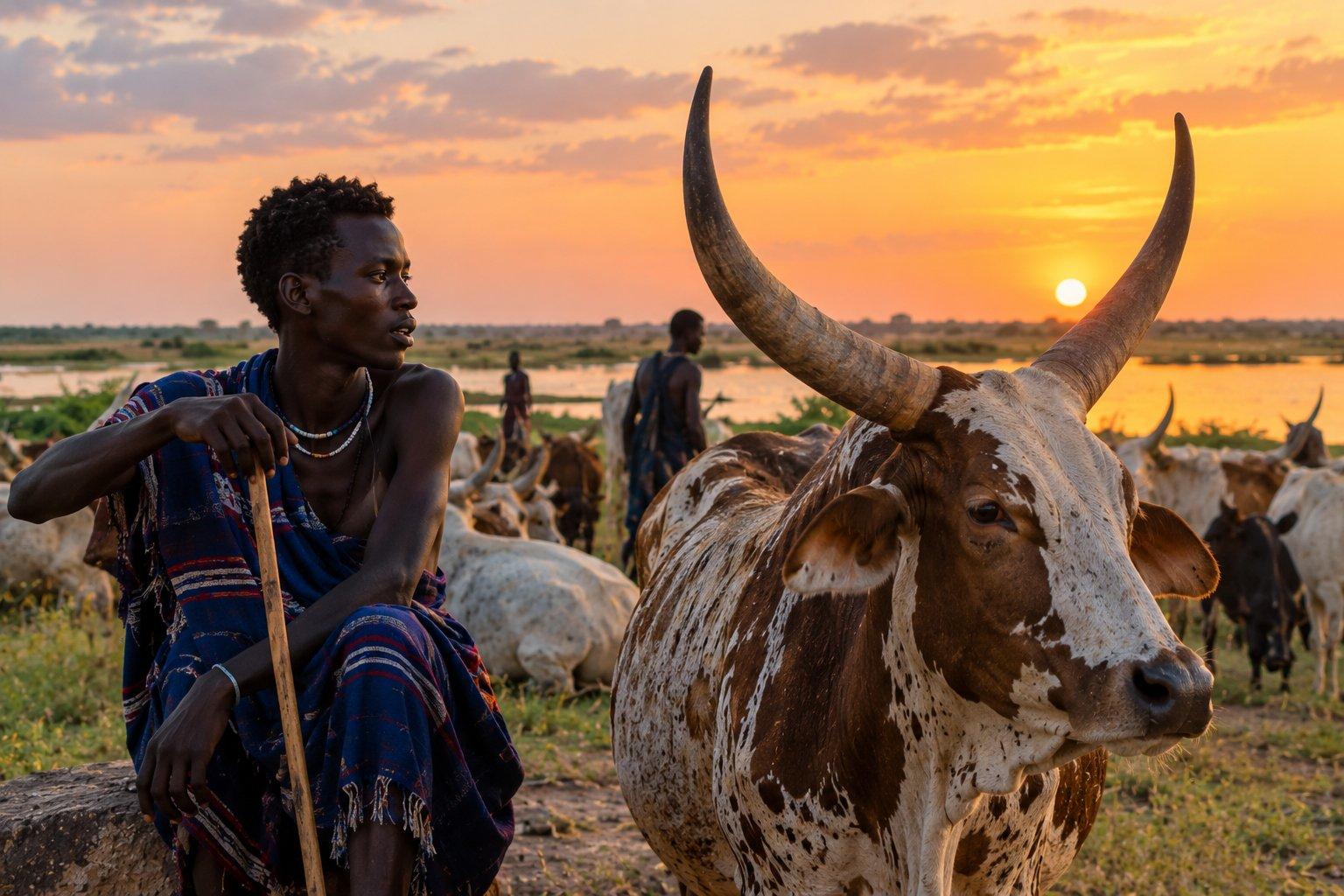
Explore Chad’s history and culture, from the Sahara and Lake Chad to Kanem-Bornu, colonial rule, languages, religions, food and life today.
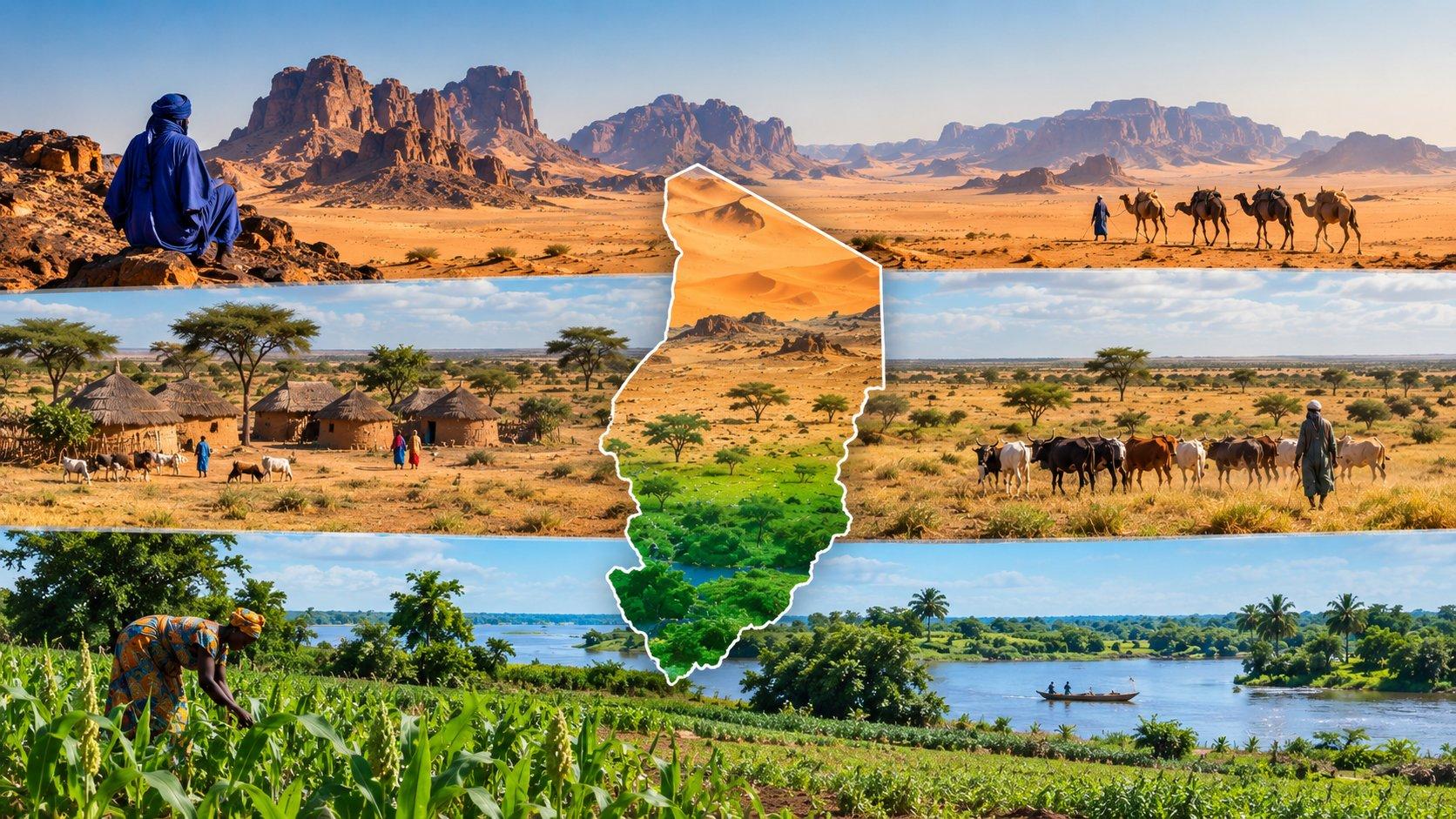
Chad is one of the largest countries in Africa. It has no coastline and stretches across a huge part of the continent, from the Sahara Desert in the north to the wetter savanna regions that border the Central African Republic and Cameroon in the south.
That means Chad does not have one landscape because the north, centre and south of the country look very different from one another.
In northern Chad, the Sahara shapes almost everything about the landscape. The region includes the Tibesti Mountains and the Ennedi Massif, but outside the areas where water is available, much of the land is very dry and supports little vegetation. Growing crops is difficult, so livestock has traditionally been important to many communities. Camels, goats and other animals can survive in conditions that are much harder for crops, but they still need water and pasture. That is why moving animals between available grazing and water sources has been part of life for many communities in the north.
As you move south from the Sahara, rainfall increases and water becomes more available. You enter the Sahel, the wide belt of semi-arid land that stretches across Africa between the Sahara and the wetter regions farther south.
The Sahel gets more rainfall than the desert, but the rain comes mainly during a short wet season and can vary from year to year. This makes it possible to grow crops in many parts of central Chad, especially millet and sorghum, while livestock remains important too. Farmers and livestock keepers often depend on the same land, although they use it differently. Livestock may be moved from one grazing area to another as grass and water become available.
There are also places where water supports fishing. Around rivers, lakes and wetlands, fishing can be an important part of people's livelihoods, particularly around the Lake Chad basin.
Keep travelling south and the climate becomes wetter again. Southern Chad receives much more rainfall than the northern and central parts of the country, and the landscape has more grassland, trees and farmland.
The Chari and Logone rivers are especially important here. They provide water for communities and agriculture, and the wetter climate allows farmers to grow crops on a much larger scale than is possible in the desert north.
So, if you move from northern Chad to the south, you are moving through three broad environments. First comes the Sahara, where water and vegetation are scarce. Then comes the Sahel, where seasonal rainfall supports a mixture of farming and livestock keeping. Farther south is the wetter savanna, where farming is much more widespread.
These differences in the environment help explain some of the differences in how people have lived across Chad. They do not determine people's cultures or identities, but they have shaped the kinds of work, food production, settlement and movement that have been possible in different parts of the country.
Chad's three main ecological regions are usually described as the Saharan north, the Sahelian centre and the wetter savanna in the south. You can see the difference as you travel across the country. The north is extremely dry, the centre receives seasonal rainfall, and the south gets considerably more rain.
People have had to adapt to these conditions in different ways. In the desert north, water is scarce and vegetation is limited, so knowing where water and grazing land can be found has been essential for communities that keep livestock. In the Sahel, the rainy season is short and rainfall can vary from year to year. Farmers grow crops such as millet and sorghum, while livestock keepers move animals between areas where water and pasture are available. In the wetter south, there is enough rainfall for more extensive farming, and many communities have traditionally lived in more settled agricultural areas.
These differences have affected everyday life for generations. The environment has influenced which crops can be grown, which animals can be kept, what people can eat and where settlements can develop. It has also shaped the routes people use to move, trade and maintain connections with communities in other parts of the country.
But this does not mean that Chad can be divided neatly into separate cultural regions. People have been moving across these areas for centuries. Pastoralists have travelled with their animals in search of water and pasture. Traders have moved between settlements and across long-distance routes. Farmers and livestock keepers have met in markets, where each group could exchange what the other needed. People have also moved because of marriage, work, conflict and changes in the environment.
The same movement continues today. Many Chadians live in cities, while others have relatives, businesses or other connections in different parts of the country. Someone's language, religion, family history or livelihood may therefore connect them to more than one region.
This helps explain why Chad has such a large number of languages and communities, as well as different religious traditions and ways of life. The country's diversity developed over a very long period. People adapted to different environments, moved between regions, traded with one another, married across communities and became part of larger kingdoms, states and trading networks.
Those connections are much older than the country of Chad itself. To see where some of them began, we need to go back thousands of years, to a time when people were living around the lakes, rivers and mountains of this region long before Chad became a modern state.
Before There Was a Country Called Chad
In this section
In northeastern Chad, the Ennedi Massif is a vast area of sandstone cliffs, valleys and natural rock formations.
Thousands of years before Chad became the country we know today, people were already living across this region. They hunted, farmed, kept livestock and traded with communities living around the lakes, rivers and mountains.
Some of the clearest evidence of those earlier communities can still be seen on the rocks.
In northeastern Chad, the Ennedi Massif is a vast area of sandstone cliffs, valleys and natural rock formations. More than 900 rock-art sites have been recorded there. UNESCO estimates that the artwork represents about 7,000 years of human activity, including a long period in which communities moved from hunting and gathering towards keeping livestock.
The paintings and engravings show people and animals from different periods. They include wild animals, cattle, horses and camels, as well as people wearing clothing and using different kinds of equipment. The images cannot tell us everything about the people who made them, but they give archaeologists evidence about the animals they knew, the activities they carried out and the ways life in the region changed.
There is another large collection of ancient rock art in the Tibesti Mountains in northern Chad. Some of the paintings and engravings there date to as far back as the fourth millennium BC, more than 5,000 years ago. They include cattle, wild animals and scenes connected to human life.
The cattle are particularly interesting because cattle need water and vegetation to survive. The places where these images were made are extremely dry today, so the artwork provides evidence of a time when people were keeping cattle in an environment that could support them.
The Sahara has not always been as dry as it is today. The climate of North Africa changed several times over thousands of years. During wetter periods, parts of the region had more vegetation and water, allowing people and animals to live in places that are now desert.
The rock art was also made over a very long period. Different generations added their own paintings and engravings, so the images show changes in the animals people kept, the ways they travelled and the activities that were important to them. Early images include cattle, while later ones include horses and camels.
By looking at these images alongside archaeological and environmental evidence, researchers can piece together parts of a much older history of northern Chad.
People were also living around Lake Chad thousands of years ago. The lake and the rivers around it provided water and supported fishing, farming, hunting and trade. Over time, communities living around the lake developed their own settlements, technologies and political systems. One of the ancient societies associated with this region is known as the Sao.
The Sao and the World Around Lake Chad
In this section
The communities around the lake lived across a region that today falls within several different countries.
In west-central Chad lies Lake Chad, a large, shallow lake surrounded by rivers, floodplains and other areas of seasonal water. The lake extends into the territories of Chad, Cameroon, Nigeria and Niger, and the wider Lake Chad basin covers an even larger area.
People have lived around the lake for thousands of years. They have fished in its waters, farmed the surrounding land, kept livestock and traded with other communities. Because the amount of water in the lake and surrounding areas has changed over time, people have also had to adjust where and how they farmed, fished and kept animals.
Archaeologists have found evidence of ancient communities around the Lake Chad basin, including pottery, terracotta objects, metalwork and other remains. One of the best-known ancient traditions in the region is called the Sao.
The Sao were communities that lived around the Lake Chad basin. Archaeological evidence places Sao culture at least as far back as around the fifth century BC. Sao sites have produced distinctive terracotta figures and vessels, as well as evidence of fishing, farming, metalworking and other activities.
The Sao were part of the long history of the Lake Chad region, rather than a society confined to what is now the country of Chad. The communities around the lake lived across a region that today falls within several different countries. The Kotoko, a group living mainly around the Lake Chad basin, also maintain cultural traditions connected to Sao heritage.
Long before Chad, Cameroon, Nigeria and Niger became modern states, people were already moving around this region. They travelled between settlements, traded goods, married across communities and exchanged ideas. The lake, its rivers and the surrounding land connected people across a much larger area than any one modern country.
Then Came Kanem
In this section
Different communities adopted Islam at different times, and older religious practices continued alongside it.
By around the ninth century, a powerful state had developed around the Lake Chad basin. It became known as Kanem.
Kanem was a political kingdom whose rulers controlled territory around the eastern side of Lake Chad and took part in the trade that crossed the central Sahel. Its position connected it to routes running north towards the Sahara and south and west towards other parts of the Sahel.
The rulers of Kanem eventually adopted Islam. Islam had already been spreading across parts of North and West Africa through merchants, scholars and travelling communities, and Kanem became part of these wider networks. Muslim scholars and traders could move between the kingdom and other centres of learning and commerce, linking Kanem to societies much farther away.
The spread of Islam was gradual. The conversion of the ruling court did not mean that everyone living in Kanem immediately became Muslim. Different communities adopted Islam at different times, and older religious practices continued alongside it.
Kanem also changed politically over the centuries. In the late fourteenth century, attacks by the Bulala put the ruling dynasty under serious pressure. The rulers eventually moved their political centre westward, into the area known as Bornu. The state that developed there is usually called the Kanem-Bornu Empire.
Kanem-Bornu became one of the major states of the Lake Chad region and remained politically important for centuries. Its history was closely tied to trade. Merchants moved goods such as salt, livestock and agricultural products between the Sahara, the Sahel and the lands around Lake Chad. People also carried languages, religious ideas, political practices and knowledge along these routes.
The kingdom was therefore connected to places far beyond the Lake Chad basin. Its rulers maintained relationships with other Muslim states and North African powers, and Bornu later had contact with the Ottoman authorities who controlled Tripolitania, the region around modern-day Libya's capital, Tripoli.
This is part of why the history of northern and central Chad cannot be separated completely from the wider Sahara and Sahel. People living in the region were trading with, travelling to and exchanging ideas with communities far beyond the area that is now Chad. Those connections had been developing for centuries before the modern country existed.
Another Kingdom in the East
While Kanem-Bornu was developing around Lake Chad, another state was taking shape farther east.
The Sultanate of Ouaddaï grew in what is now eastern Chad. Its capital, Abéché, later became an important centre of political power and trade. The sultanate was connected to routes leading west towards the Lake Chad region and east towards the Nile Valley, bringing merchants and travellers into contact with communities across a large part of the Sahel.
People moved between different kingdoms and communities. Merchants travelled to markets in other territories, pastoralists moved their animals in search of water and pasture, and families sometimes settled in new areas. Through these movements, people exchanged goods, languages, religious ideas and cultural practices.
So when France began extending its colonial control into the region around the end of the nineteenth century, it encountered societies that already had their own rulers, political systems, trade routes, religious institutions, languages and communities.
French colonial rule then reorganised these territories under a new administrative system and eventually brought them together within the territory that became Chad.
Modern Chad came later. The people, communities and political systems within its present territory had already been developing for centuries before French colonial rule.
France Drew a New Political Map
In this section
Southern Chad had more rainfall and was better suited to large-scale agriculture than much of the north.
From the late nineteenth century, France began sending military forces into the region and taking control of territories that were already governed by African rulers and communities. In 1900, French forces fought Rabih az-Zubayr, a military leader who had built a powerful state around the Lake Chad region. Rabih was defeated and killed at the Battle of Kousséri, across the Chari River from what is now N'Djamena.
In 1900, French forces defeated Rabih az-Zubayr at the Battle of Kousséri, near present-day N'Djamena. France then began establishing colonial control over the territory, although it took years to extend that control across the whole region.
The settlement that is now N'Djamena was then called Fort-Lamy. It grew into an important centre for the French administration and later became the capital of Chad.
French rule did not affect every part of the territory in the same way. Southern Chad had more rainfall and was better suited to large-scale agriculture than much of the north. The colonial government therefore developed agricultural production there, including cotton, which became an important cash crop. Schools and other parts of the colonial administration also expanded, although access to them varied greatly from one part of the territory to another.
In northern and eastern Chad, French officials were dealing with societies that had different economic and political structures. Pastoralism was important in many areas, while Muslim rulers, scholars and religious institutions already had established roles in community life. French control was therefore imposed on top of existing systems rather than replacing them everywhere in the same way.
By the time Chad became independent in 1960, people in different parts of the country had experienced colonial rule differently. Some areas had greater access to colonial schools and administrative institutions. Others remained more closely connected to existing Muslim institutions, pastoral economies and regional trading networks.
These differences became relevant after independence because the new government had to bring together people from regions with different experiences of education, administration, religion and economic development. They were not evidence that northern and southern Chadians had always been enemies. The divisions developed through a combination of older regional differences, colonial policies and the political struggles that followed independence.
Independence Did Not End the Struggle Over Power
In this section
Libya intervened militarily in northern Chad several times, particularly during the 1970s and 1980s.
Chad became independent from France in 1960. The new country inherited the territory created under French colonial rule, but building a stable national government proved difficult.
Armed rebellions began in the years after independence, and Chad went through repeated periods of civil war and political violence. Different groups competed for control of the government, the army and the country's resources. Regional loyalties, religious differences, ethnic identities and personal political alliances all played roles, but they did not always line up neatly.
It is therefore too simple to describe Chad's conflicts as a fight between a Muslim north and a Christian south. Many people in the north and centre were Muslim, while Christianity was particularly widespread in the south, but neither region had one single political position. Communities within the same region could support different leaders or armed groups, and alliances could change as political circumstances changed.
Other countries also became involved. Libya intervened militarily in northern Chad several times, particularly during the 1970s and 1980s. France, meanwhile, continued to support successive Chadian governments at different points. This meant that fighting inside Chad was also connected to competition and conflicts involving neighbouring countries and wider regional interests.
One of the men who became central to this period was Hissène Habré.
Hissène Habré and the Years of Repression
In this section
Libya, under Muammar Gaddafi, was involved in the conflict in Chad and supported forces opposed to Habré.
Hissène Habré came to power in 1982 after overthrowing President Goukouni Oueddei. He remained president until 1990.
During those eight years, his government carried out widespread political repression. People suspected of opposing Habré were arrested, imprisoned and tortured. Some were killed, while others were forcibly disappeared and never seen again. His security forces also targeted people from communities that the government considered hostile.
Human Rights Watch has documented these abuses in detail, including through records from the archives of Habré's security service and testimony from survivors.
Habré's government was also closely connected to the regional politics of the time. Libya, under Muammar Gaddafi, was involved in the conflict in Chad and supported forces opposed to Habré. The United States and France, meanwhile, supported Habré because they saw him as an important opponent of Gaddafi and Libyan influence in Chad.
This support continued despite the abuses committed by Habré's government.
In 1990, Idriss Déby led an armed movement that overthrew Habré. Habré fled Chad and eventually settled in Senegal.
For years, survivors and families of people killed or disappeared under his government campaigned for him to be prosecuted. The case took decades to reach court.
In 2016, Habré was convicted in Senegal by the Extraordinary African Chambers, a special court created within Senegal's judicial system with the support of the African Union. The court found him guilty of crimes against humanity, war crimes and torture and sentenced him to life imprisonment. His conviction was upheld on appeal in 2017.
The case was also important beyond Habré himself. Senegal's courts had prosecuted a former ruler of another country for crimes committed while he was in power in Chad. This was possible under the principle of universal jurisdiction, which allows certain national courts to prosecute particularly serious international crimes even when those crimes were committed in another country.
Habré's trial therefore became an important example of how serious human rights crimes committed by African governments could be pursued through African courts.
Idriss Déby and Another Three Decades
In this section
In April 2021, Déby was killed after travelling to the front line to visit government troops fighting rebels in northern Chad.
Idriss Déby ruled Chad for roughly three decades after taking power in 1990. During his presidency, his government faced repeated rebellions and armed challenges. Chad was also drawn into conflicts and security struggles involving neighbouring countries and the wider Sahel and Central Africa.
In April 2021, Déby was killed after travelling to the front line to visit government troops fighting rebels in northern Chad. His death created an immediate political crisis because the constitution had provided a different process for transferring presidential power.
Instead, a transitional military council took control, led by his son, Mahamat Idriss Déby. The council suspended the constitution and dissolved the government and parliament. Mahamat Idriss Déby later became president of the transitional government.
Chad held a presidential election in May 2024. Mahamat Idriss Déby won the election and was formally sworn in as president later that month.
The country's political system has continued to change since then. In October 2025, constitutional amendments extended the presidential term from five years to seven and removed the previous limit on the number of presidential terms. The World Bank has also described continuing political tensions following the 2024 election.
These events help explain why Chad's recent history cannot be understood through geography alone. The country's politics have also been shaped by repeated armed conflicts, involvement from neighbouring countries, struggles over control of the government and security forces, competition over resources, and the concentration of political power under successive governments.
Those factors have affected how the state operates and how different groups relate to the government. They are part of the political history that Chad has carried from independence into the present day.
So Who Are the People of Chad?
In this section
Crops, livestock, settlement patterns and local economies have developed partly in response to these conditions.
Chad is home to a very large number of ethnic and linguistic communities. The World Bank describes more than 180 ethnic groups and more than 100 languages, while other sources give higher figures depending on how particular communities, languages and dialects are classified. French and Arabic are the country's official languages.
It can be difficult to imagine what that means in everyday life. A person in northern Chad may speak a local language with family members and use Chadian Arabic when communicating with people from other communities. Someone in another part of the country may speak Sara, Ngambay, Moundang, Kanembou or another Chadian language, and may use more than one language depending on where they live, work and who they are speaking to.
French has an important role in government, formal administration and education. Arabic is particularly important among many Muslim communities and is widely used for communication across parts of northern, central and eastern Chad. Chadian Arabic is itself an important language of wider communication in many parts of the country.
This means that language in Chad is often connected to where someone grew up, their family and community, their religion, their work and the people they interact with. Someone may therefore use one language at home, another in the market and another in school or government offices.
The Toubou
In northern Chad, one of the major groups is commonly known as the Toubou. The term includes communities generally identified as Teda and Daza. Teda communities are strongly associated with the Tibesti region in the far north, while Daza communities are found farther south and east.
Many Toubou communities have traditionally practised pastoralism, keeping livestock and moving between areas where animals can find water and pasture. This way of life developed in an environment where rainfall is limited and farming is difficult in many areas.
Pastoralism does not mean that every Toubou person is nomadic today. Many Toubou people live in towns and cities, work in different occupations and have lifestyles that are very different from those of earlier generations. The community's history of movement and pastoralism remains part of its cultural identity, but it does not describe every Toubou person's life today.
The Sara and Southern Chad
In southern Chad, the Sara are one of the country's largest broad ethnic groupings. But Sara should not be treated as another name for everyone who lives in southern Chad.
The south is home to many other communities, including the Moundang, Massa and Moussey, among others. Each has its own history, language and cultural traditions.
The environment also differs from northern Chad. Southern Chad receives considerably more rainfall, and the land is more suitable for settled agriculture. Farming has therefore been an important part of life for many communities in the region. Crops, livestock, settlement patterns and local economies have developed partly in response to these conditions.
Even these regional descriptions have limits. People move between towns and rural areas, languages spread beyond the communities where they originated, and families from different ethnic backgrounds marry and raise children together. Cities also bring people from many parts of the country into the same schools, workplaces, markets and neighbourhoods.
So Chad's population cannot be understood as a simple map of separate groups occupying separate parts of the country. Its ethnic and linguistic diversity has developed through centuries of migration, trade, marriage, religious exchange, political change and adaptation to very different environments.
Islam, Christianity and Older Religious Traditions
In this section
Muslim merchants, scholars and travelling communities helped spread Islam through trade and religious networks.
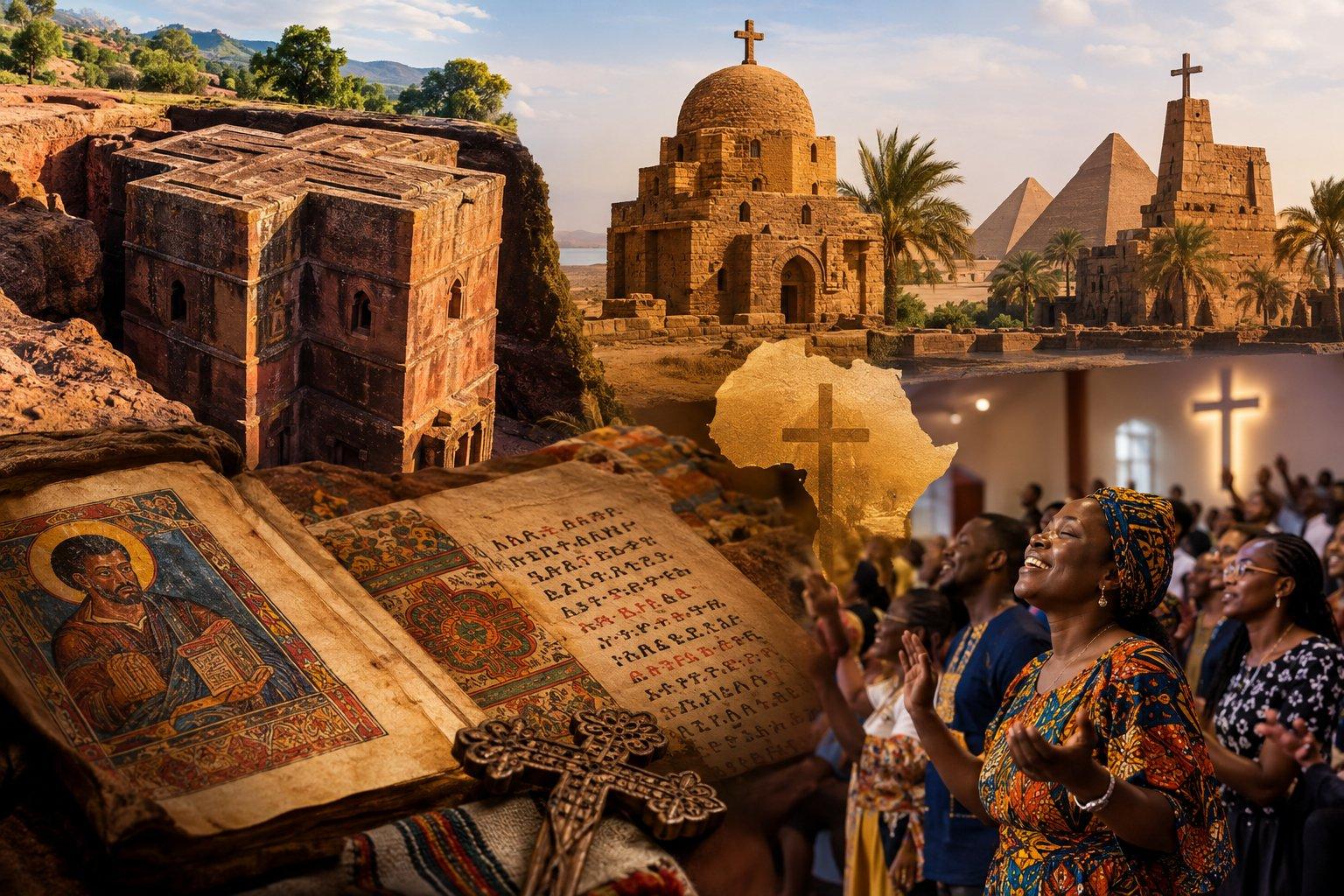
Religion in Chad varies considerably from one part of the country to another. Islam is more common in northern, central and eastern Chad, while Christianity is more widespread in the south. There are also Chadians who maintain indigenous religious traditions, either as their main religious practice or alongside another faith.
Islam has been present in the Lake Chad and Sahel regions for many centuries. Muslim merchants, scholars and travelling communities helped spread Islam through trade and religious networks. The rulers of Kanem eventually adopted Islam, and the kingdom became part of the wider Muslim world. This did not mean that everyone living in Kanem immediately became Muslim. Different communities adopted Islam at different times, while older religious practices continued in some areas.
Christianity became much more widespread in southern Chad later. During the colonial period and the twentieth century, Christian missionaries established churches and schools, particularly in the south. Chadians joined these churches, became Christian leaders and established their own Christian communities. Over time, Christianity also spread beyond the areas where missionary activity had first been concentrated, particularly through towns and growing urban communities.
The two religions therefore have different histories in Chad. Islam has much deeper roots in the history of the Lake Chad and Sahel regions, while the expansion of Christianity in southern Chad is more closely connected to the colonial and post-colonial periods.
But religious identity does not automatically follow ethnic identity. Knowing which ethnic community a person belongs to does not necessarily tell you whether that person is Muslim, Christian or follows an indigenous religious tradition. Religious communities can also change over time, and individual families may have different religious backgrounds.
Geography does not create fixed religious boundaries either. Muslims live in southern Chad, Christians live in northern and central parts of the country, and people from different religious backgrounds live together in many towns and cities. People have also moved between regions for work, marriage, education, trade and other reasons, bringing different religious traditions with them.
For this reason, describing Chad as a Muslim north and a Christian south is useful only as a broad description of where each religion is more common. It should not be treated as a dividing line between two religious populations.
Religion has also affected institutions and everyday life. Islamic schools and religious teachers played an important role in education in parts of Chad long before French colonial rule. Christian missions later established schools and churches, particularly in the south. Religious beliefs have also influenced marriage ceremonies, festivals, dietary practices and how children are taught within different communities.
Religion has been connected to politics as well. Before colonial rule, some Muslim-ruled states in the region had political systems in which rulers and religious authorities had important roles. After independence, religious identity sometimes became connected to political alliances and conflicts, but Chad's political struggles cannot be explained by religion alone. Ethnic identity, regional interests, control of the state, military power, economic resources and relationships with neighbouring countries have also played major roles.
This is why religion is an important part of understanding Chad, but it is only one part of how Chadians identify themselves and how communities have developed. Language, ethnicity, family history, occupation, where someone lives and the communities they have lived among can all shape a person's identity at the same time.
What Do Chadians Eat?
In this section
In communities that keep large numbers of livestock, milk and other dairy products can also be part of the diet.
Food in Chad varies from one region to another because people cook with what they can grow, raise, catch or obtain through trade.
Millet and sorghum are important staple grains across much of the country, particularly in areas where rainfall is limited. In southern Chad, where rainfall is higher, farmers can grow a wider range of crops, including cassava, maize, peanuts and vegetables. Rice is also eaten in many parts of the country.
Fish is an important food around Lake Chad and other areas where fishing is possible. In communities that keep large numbers of livestock, milk and other dairy products can also be part of the diet. Meat is eaten in many parts of Chad, although what people eat and how often they eat it varies between communities and households.
Hence, there is no single dish or cooking style that represents all of Chad. A family's food can depend on the climate where they live, the crops farmers can grow, the animals people keep, the fish available from nearby waterways and the ingredients that traders bring from other areas.
One example is daraba, a Chadian dish made with vegetables and a peanut-based sauce. It can be served with rice or with grains such as millet or sorghum.
Trade also means that people are not limited to whatever grows immediately around them. Traders move food between farming areas, towns and regions, allowing ingredients to reach places where they cannot be produced easily. A household in a dry area, for example, can obtain foods produced in wetter regions, while farmers can sell their crops in places where those crops are not grown.
Chadian food has developed from both local production and exchange. The environment influences what people can produce, while trade, migration and contact between communities determine what else can reach their kitchens.
Cotton Was Once Central to the Economy
In this section
During French colonial rule and for decades after independence, cotton was an important part of southern Chad's agricultural economy.
During French colonial rule and for decades after independence, cotton was an important part of southern Chad's agricultural economy. French colonial authorities promoted cotton production in the south, where higher rainfall made the crop more suitable than in the country's drier northern regions.
After independence, cotton remained an important agricultural activity in the south, providing income for farmers and supporting jobs in processing and related businesses.
During French colonial rule and for decades after independence, cotton was an important part of southern Chad's agricultural economy. French colonial authorities promoted cotton production in the south, where higher rainfall made the crop more suitable than in the country's drier northern regions. Cotton provided income for farmers and supported jobs in processing and related activities.
Today, oil plays a much larger role in Chad's national economy. The World Bank estimates that oil accounts for around 15 percent of GDP, 41 percent of government revenue and 76 percent of exports. Agriculture accounts for roughly 40 percent of GDP and supports the livelihoods of a large share of the population.
Agriculture provides livelihoods for a large share of the population, while oil provides most of Chad's export earnings and a large share of government revenue.
Millions of people depend on farming and livestock for their livelihoods, while petroleum provides most of the country's export earnings and a substantial share of government revenue.
Cotton belongs mainly to the history of Chad's agricultural economy. Oil is now central to the country's export economy and public finances.
The Sound of Chad
In this section
Songs can be used for entertainment, religious expression, praise, storytelling or commentary on social life.
Music in Chad varies across the country's different regions and communities. The instruments people use, the languages they sing in and the subjects they sing about are connected to the histories of the communities where those traditions developed.
In northern and central Chad, long trumpets known as the kakaki are used in ceremonial and traditional settings. The kakaki is not unique to Chad. Similar long trumpets are found across parts of the Sahel, where they have traditionally been associated with ceremonies, rulers and public occasions.
Other Chadian musical traditions use drums, string instruments and wind instruments. Songs can be used for entertainment, religious expression, praise, storytelling or commentary on social life.
Music is also connected to Chad's oral traditions. In communities where knowledge has traditionally been passed on through spoken performance, singers, storytellers and other performers can preserve information that might otherwise be lost. They may recite family histories, remember genealogies, praise important people, tell stories about past events or pass knowledge from older generations to younger ones.
These performers do not all have the same role or belong to the same tradition. This is why it is better to describe them in terms of the particular Chadian oral traditions they belong to rather than calling every traditional storyteller or musician a "griot." The word is most strongly associated with particular West African traditions and does not describe every form of oral history across Africa.
Chadian music changes from one community and region to another. The languages people speak, the instruments they make and use, the ceremonies they perform and the histories they remember all contribute to the country's different musical traditions.
Clothing That Makes Sense in the Climate
In this section
People may wear different clothes for everyday work, religious ceremonies, weddings, festivals and other important events.
Clothing in northern Chad is partly shaped by the desert environment. People need protection from strong sunlight, blowing sand, dust and large changes in temperature between day and night.
Loose, layered garments and head coverings are therefore practical in many northern communities. They can cover the skin from direct sunlight and provide protection from dust and sand while remaining suitable for movement in hot conditions. Different communities have their own ways of wearing and styling these garments.
Farther south, clothing traditions vary between communities and between different occasions. People may wear different clothes for everyday work, religious ceremonies, weddings, festivals and other important events.
Clothing can also indicate aspects of a person's identity and social setting. The garments someone chooses may reflect their religion, community, age, gender or the type of occasion they are attending. These meanings vary between communities, so the same style of clothing does not necessarily carry the same meaning everywhere in Chad.
There is no single traditional outfit that represents all Chadians. Clothing worn in the Tibesti region can look very different from clothing worn in a southern town, while people attending an urban event in N'Djamena may wear a mixture of traditional garments, contemporary African styles and Western-style clothing.
N'Djamena Changes the Picture
In this section
Many people who live in N'Djamena still have close family or other ties to villages and rural communities.
N'Djamena is another place where people from different parts of Chad live and interact in the same city.
N'Djamena is in southwestern Chad, near the border with Cameroon and on the Chari River. It is the country's capital and the main centre of government. It is also an important centre for trade, transport and employment.
People from different ethnic groups and people who speak different languages share neighbourhoods, markets, schools and workplaces. Several languages can be heard in everyday life. Traditional clothing is worn alongside contemporary African and Western-style clothing, and people from different religious backgrounds live and worship in the same urban area.
Many people who live in N'Djamena still have close family or other ties to villages and rural communities. They may travel between the city and rural areas for work, education, marriage, trade or family responsibilities. Someone can therefore live in the capital while still being closely connected to people and places in another part of Chad.
The same movement is happening in other Chadian towns. People move from rural areas to towns for work, education, markets and public services, while others continue to move between towns and villages.
Mobile phones and internet access give people another way to stay in contact across long distances. People can call relatives, send messages, share information and keep up with events in other parts of the country. Access is still limited, however. The World Bank estimates that about 13 percent of Chad's population used the internet in 2024.
The older ways people connect, through family, trade, migration and movement between rural and urban areas, continue to exist. At the same time, cities, schools, mobile phones and internet access are changing how people communicate and work.
These opportunities are not available equally. People living in larger towns and cities generally have better access to internet services, formal employment and some public services than people living in remote rural areas.
A Country That Is Larger Than Its Stereotypes
In this section
People also have clothing, food, music and building traditions that reflect the environments in which they live.
The Sahara covers much of northern Chad, but the country also includes the Sahel in the centre and a much wetter region in the south. This includes the Tibesti and Ennedi regions. Farther south, the environment changes into the Sahel, where there is more seasonal rainfall and enough vegetation for farming and livestock keeping. Southern Chad is wetter still, with more rainfall, rivers, grasslands and land suitable for agriculture.
The country's landscapes therefore include desert mountains, dry plains, seasonal grasslands, rivers, areas of seasonal water and productive farming regions. People have developed different ways of living in response to these conditions.
Chad's modern history also includes long periods of political violence and armed conflict. Wars, rebellions, changes of government and involvement by neighbouring countries have had a major effect on the country and on the lives of many Chadians.
But everyday life in Chad has always involved much more than conflict.
People farm crops such as millet, sorghum, rice and cassava. They raise cattle, goats, sheep and other livestock. Communities around Lake Chad and other waterways fish. Traders move goods between rural areas, towns and neighbouring countries.
Chadians speak more than 100 languages. They practise Islam, Christianity and indigenous religious traditions. Families and communities pass knowledge from one generation to another through stories, songs, performances and other forms of oral history.
People also have clothing, food, music and building traditions that reflect the environments in which they live. Some communities have traditionally depended heavily on pastoralism, while others have relied more on settled agriculture. Many Chadians now live in towns and cities, where people from different regions and communities live, work and study together.
All of this has continued through major political changes. The kingdoms and states that once governed parts of this region eventually gave way to French colonial rule, and the modern Republic of Chad became independent in 1960. The political boundaries and systems of government changed, but the people living in the region continued to farm, trade, raise families, practise their religions, speak their languages and maintain their cultural traditions.
That is the fuller picture of Chad: a country shaped by very different environments, many communities and languages, long histories of movement and trade, and a complicated modern political history.
One Detail That Changes How You See Chad
In this section
The result is a country in which regional differences exist alongside long-standing connections between communities.
Chad's different environments have influenced how people live.
The country stretches from the Sahara in the north, through the Sahel in the centre, to a much wetter region in the south. The conditions in these areas are very different, so people have had to find different ways to grow food, raise animals, find water and move from place to place.
In the north, water is scarce. People and livestock have to move according to where water and pasture are available. In the Sahel, rainfall comes mainly during a short rainy season, so farmers plan their planting around the rains, while livestock keepers move their animals between areas where there is enough water and grass. In the south, higher rainfall allows farmers to grow a wider range of crops and supports more settled agricultural communities.
These differences affect everyday life. They influence where people build settlements, what they grow, which animals they keep, what foods are available and where people travel to trade.
Over many generations, these ways of living became connected to local languages, foods, clothing, religious practices and other cultural traditions. But communities were never completely separated from one another.
People traded across regions. Pastoralists moved with their animals. Families moved because of marriage, work or conflict. Religious teachers and scholars travelled between communities. Kingdoms and states brought different populations under the same political authority. Later, French colonial rule placed many of these communities within the same colonial territory, which became the independent country of Chad in 1960.
Chad has clear differences between its northern, central and southern regions. These differences can be seen in the environment, livelihoods, languages, religions, food and cultural traditions.
At the same time, people have moved between these regions for centuries. Pastoralists have travelled in search of water and pasture. Traders have carried goods between communities. Families have moved through marriage, work and settlement. Religious teachers, scholars and other travellers have also moved between regions.
The result is a country in which regional differences exist alongside long-standing connections between communities. The Sahara, Sahel and wetter southern regions have each influenced how people live, while trade, migration, marriage and travel have connected people across the country.