Explore the Central African Republic’s history, people, languages, food, music, archaeology and cultural traditions, including the Aka and Bouar megaliths.
The Aka are an Indigenous forest-dwelling people who live in the southwestern forests of the Central African Republic and across the border in the Republic of the Congo. Many Aka communities have traditionally depended on the forest for food and other materials, with hunting, gathering and fishing forming important parts of everyday life.
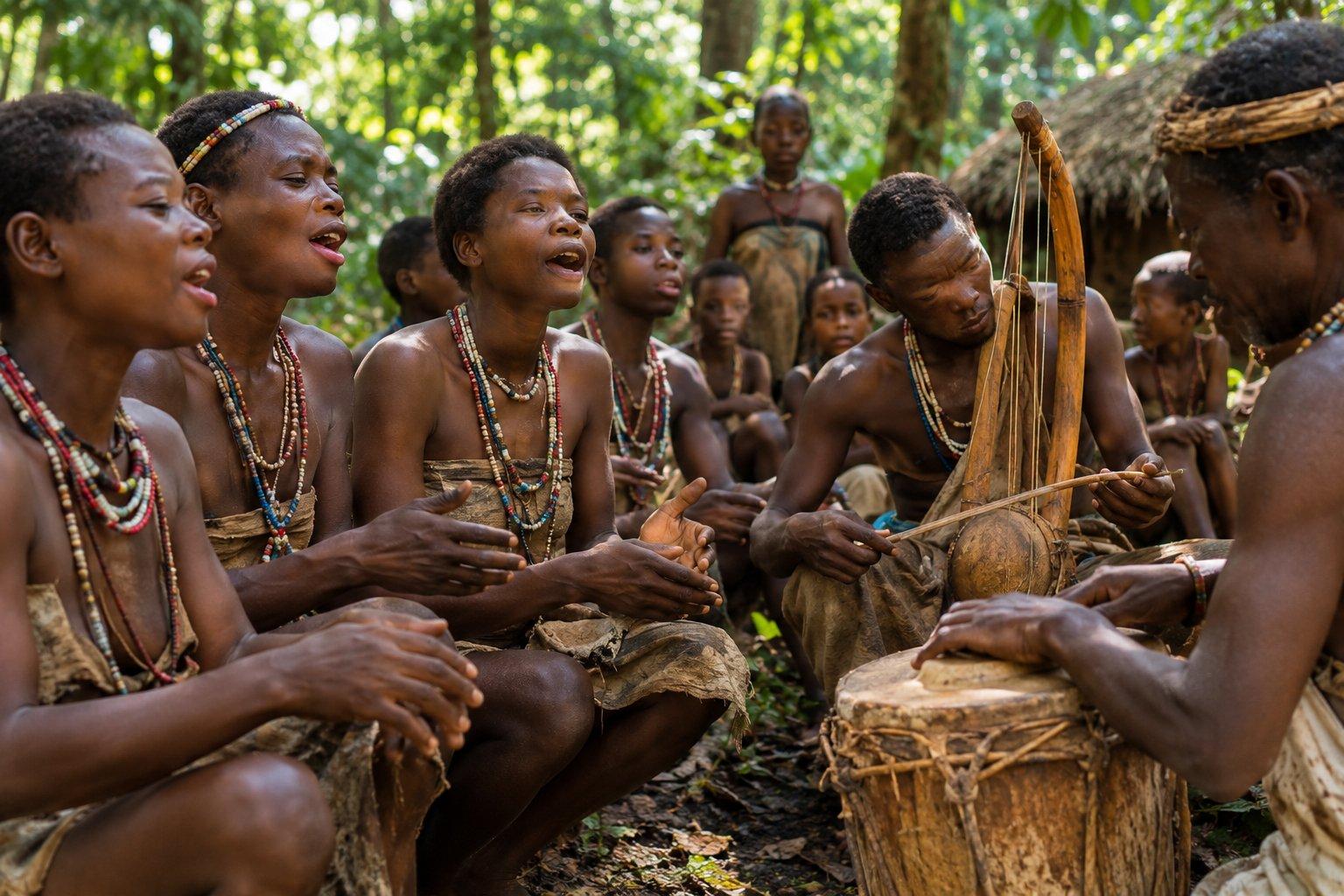
Because so much of daily life takes place within the community and its surrounding forest environment, music has also become part of how people mark important moments and share knowledge. One of the best-known Aka traditions is a style of singing in which several people sing different parts at the same time. There is no written set of instructions telling each singer which notes to sing. Instead, people learn the songs by listening to others, joining in and taking part in community life. Singers can also change and improvise their parts while the music is being performed.
UNESCO describes this as four-part polyphony. In simple terms, several vocal lines are happening together, with each singer contributing a different part to the overall sound. In this style of singing, people do not all sing the same tune at the same time. Different singers or groups of singers contribute different vocal parts, and those parts are performed together. Some voices may repeat a pattern while others add another line above or around it. The singers can also change their parts and improvise during the performance. UNESCO classifies the tradition as four-part contrapuntal polyphony, meaning that several independent vocal parts are deliberately combined to create one piece of music.
The singing is connected to things that happen in Aka community life. It can accompany hunting, funerals and ceremonies held when people establish a new camp. Singing and dancing are therefore part of activities in which people participate together, rather than something reserved for a separate group of musicians performing for an audience.
Children encounter these songs and rituals from an early age. They learn by listening to older people, joining in and taking part in community activities. There is no need for written musical notation because the knowledge is passed from one generation to another through participation and oral teaching.
The songs can also communicate knowledge and reinforce ideas about how the community should live together. UNESCO describes them as a way of transmitting knowledge and reaffirming community values. In other words, learning the music also means learning something about the community itself: its practices, its expectations and the occasions on which particular songs are used.
But the circumstances in which this tradition developed are changing. Deforestation has affected the forest environment and the availability of game in some areas. Some people have also moved away from rural forest communities, while economic and social changes have altered parts of Aka life. UNESCO has identified these changes, along with the presentation of Aka culture mainly for tourism, as pressures on the tradition.
The Aka are one of many communities that make up the Central African Republic.
More than 80 ethnic communities live in the country, with many languages spoken across its different regions. Sango is the national language and is widely used as a common language between people from different communities. French is the official language and is used in government and formal institutions.
People have lived in the area that is now the Central African Republic for thousands of years, long before the country became an independent state in 1960. Communities farmed, hunted, fished, gathered food, traded with one another and moved between different parts of the region. They also developed their own political systems. Some communities were organised around villages and local leaders, while others formed larger kingdoms and chiefdoms.
The Central African Republic as we know it today did not exist as one country during this earlier period. The borders of the modern state were established during the colonial period, when France took control of the territory and later incorporated it into French Equatorial Africa. The people living there already had their own communities, languages, political systems and connections with neighbouring regions.
The geography varies across the country. The southwest is largely covered by tropical forest. Farther north, the landscape becomes more open, with woodland and savanna, while the far north is drier. People adapted their livelihoods to these different environments. Hunting, gathering and fishing were particularly important to some forest communities, while farming and livestock keeping played larger roles in other areas.
People living in these different areas were also connected to one another. They traded goods, moved between communities and sometimes formed political alliances. Their connections did not stop at the borders of the country that exists today. Trade routes linked parts of the region with areas farther north and east, including networks connected to the Lake Chad basin.
By the 18th and especially the 19th centuries, some of these wider networks had become connected to the trade in enslaved people. Armed raiders and traders captured people from communities across parts of the region and transported them toward markets and trading centres farther north and east. Some people were killed or displaced during these raids, while others fled their homes to avoid being captured. Political groups also competed for control of people, land and trade routes.
The raids changed communities across the region. Some settlements were abandoned, populations moved to safer areas, and political authorities were weakened or reorganised. In some places, local rulers and armed groups also became involved in capturing and trading people. These changes were already reshaping the population and political landscape before European colonial rule was imposed.
France began taking control of the territory at the end of the 19th century. In 1894, it declared Ubangi-Shari a French possession and gradually extended its control over the area. In 1910, Ubangi-Shari became part of French Equatorial Africa, the group of French territories that included several parts of Central Africa.
French rule changed how the territory was governed and how people worked. The colonial authorities introduced taxes and required people to provide labour for roads, transport and other projects. Private companies were also given large concessions to extract resources such as rubber and other forest products. People could be forced to carry goods over long distances, work on colonial projects or collect resources for companies. The system was often extremely harsh, and forced labour became one of the defining features of colonial rule.
French rule also brought Christian missionaries into more parts of the territory. Missionaries established churches and schools, and Christianity gradually spread through many communities. It eventually became the religion of a large majority of the population.
Islam had a different history. Muslim traders, migrants and political networks had already connected parts of the region with areas farther north and east before the French arrived. Islam therefore did not begin with colonial rule. Muslim communities became particularly established in northern parts of the country and in some trading centres.
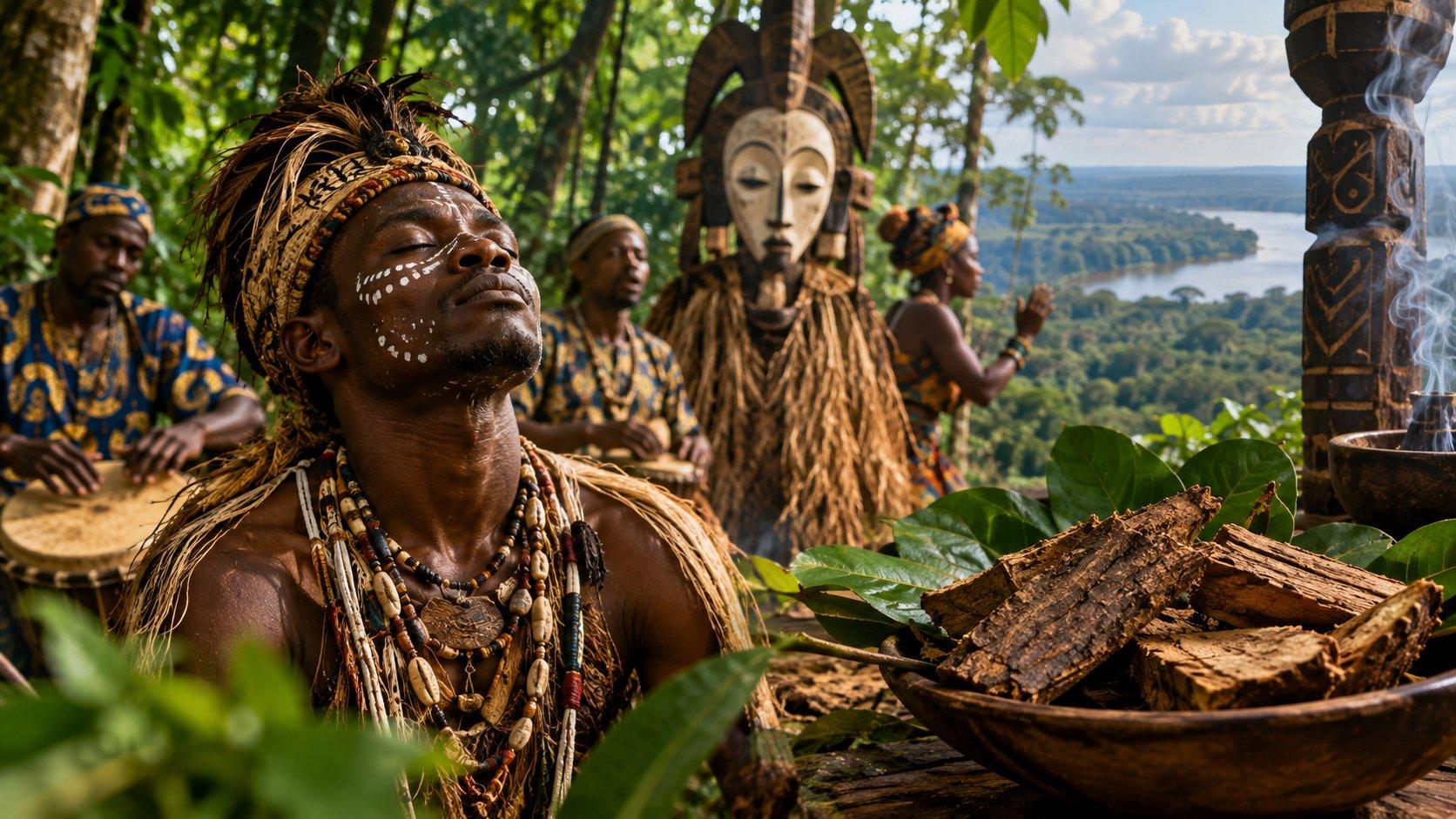
Christianity and Islam did not completely replace the religious beliefs that existed before them. In some communities, people continued to observe traditional practices alongside Christianity or Islam. These practices can include beliefs about ancestors, spirits and the spiritual importance of particular places.
You can still see those different histories in the country today. Christianity is the dominant religion, Islam has long-established communities in parts of the country, and older religious traditions continue to influence cultural and spiritual life in some communities.
The Central African Republic became independent in 1960, but independence did not bring political stability. The country went through several coups and periods of authoritarian rule, followed by further periods of armed conflict. Violence and displacement have affected many communities, particularly since the conflict that began in 2012.
At the same time, people have continued to make music, speak their languages, cook their local foods, practise their religions and pass knowledge from one generation to the next. The Aka continue to perform their polyphonic singing tradition. The Bouar region contains a large concentration of ancient megalithic monuments. Across the country, different communities maintain their own customs while also sharing languages, foods, religious practices and other parts of everyday life.
That is what makes the country's history so layered. Some traditions began long before the Central African Republic became an independent country, while also carrying influences from trade, migration, Christianity, Islam, colonial rule and the political changes that came after independence. These histories did not happen separately. They happened in the same places, involving communities that were already connected to one another in different ways.
The Central African Republic today is the result of all of that history. Its forests, languages, music, food, religious life and archaeological sites all tell different parts of the story.
Where the Central African Republic's History Begins
In this section
In some places, local rulers and military groups also became involved in capturing and trading enslaved people.
People have lived in the area that is now the Central African Republic for thousands of years, long before the country became independent in 1960. Archaeological evidence shows that the region has a long human history, although the evidence is uneven and does not provide a complete account of how every community came to live where it does today.
The region was home to many different communities, each with its own language, customs, leaders and ways of making a living. Some communities farmed, while others depended more heavily on hunting, fishing, gathering or livestock. People also traded with neighbouring communities, moved between settlements and sometimes migrated in response to changes in land, political power or security.
The area was connected to several larger regions of Central Africa. To the north, people and goods moved through networks connected to the Lake Chad basin. To the east, there were connections with communities and trading routes extending toward the Nile basin. To the south and west, other routes connected communities with the Congo River basin. Through these networks, people traded goods, migrated, formed political relationships and came into contact with communities living far beyond the area that is now the Central African Republic.
Population movements also changed the region over time. During the 18th and 19th centuries, groups including the Zande, Banda and Gbaya-Mandjia became established in different parts of the territory. Their arrival and expansion took place alongside the movement of other populations already living there. Communities sometimes settled in new areas, merged with neighbouring populations, came under new political authorities or moved because of conflict.
The 19th century brought widespread violence to parts of the region through the expansion of slave raiding and trading.
Slave raiding involved armed groups capturing people and transporting them to places where they could be sold or transferred through wider trading networks. These networks connected parts of Central Africa with markets farther north and east, including areas that are now in Chad and Sudan.
The effects reached beyond the people who were captured. Raids could destroy settlements, separate families and force communities to leave their homes. People moved into forests and other less accessible areas to escape attacks, while political leaders and armed groups competed for territory, people and control of trade routes. In some places, local rulers and military groups also became involved in capturing and trading enslaved people.
The World Bank's historical research identifies slave raiding as one of the forces that contributed to population displacement and weakened social ties in parts of the region. Repeated attacks could therefore change where communities lived, how they were organised and who held political power.
One political formation that became involved in this regional trade was Dar al-Kuti. It emerged during the 19th century in the northern part of what is now the Central African Republic. Its rulers became involved in slave-raiding and trading networks that extended toward present-day Chad and Sudan.
Dar al-Kuti developed within a region where political power, warfare and long-distance trade were closely connected. Its history forms part of the wider history of northern Central Africa during the 19th century, when political authorities and armed groups competed for territory, people and access to trade routes.
By the time France began taking control of the territory at the end of the 19th century, the region already had a long and complicated history. People had established communities, developed political systems, traded across long distances and moved between different parts of Central Africa. They had also experienced warfare, displacement and slave raiding.
The communities living in the area later brought together as the Central African Republic therefore had histories that stretched far beyond the country's independence in 1960. Many of the languages, cultural traditions and local identities found in the country today have roots that predate both colonial rule and the creation of the independent republic.
From Oubangui-Chari to Independence
In this section
In Ubangi-Shari, companies used these concessions to collect resources such as rubber and other forest products.
France began taking control of the territory at the end of the 19th century. In 1889, French authorities established a post at Bangui on the Ubangi River. In 1894, France formally declared Ubangi-Shari, also written as Oubangui-Chari, a French possession. French control expanded over the following years.
In 1910, Ubangi-Shari became one of four territories that made up French Equatorial Africa, the French colonial federation covering what are now the Central African Republic, Chad, the Republic of the Congo and Gabon. France governed the federation, while each territory had its own colonial administration.
French rule changed both the political system and the way the territory's economy worked. The colonial administration introduced taxes and required people to provide labour for roads, transport and other projects.
French authorities also gave large areas of land to private companies through concession agreements. A concession was an official grant giving a company the right to use a particular area and extract resources from it. In Ubangi-Shari, companies used these concessions to collect resources such as rubber and other forest products.
People living in these areas could be forced to work for the companies. They might be required to collect rubber, carry goods or perform other labour. The work was often carried out under extremely harsh conditions, and colonial authorities and companies used coercion and violence to obtain labour and resources.
The colonial economy later placed greater emphasis on crops such as cotton and coffee. These were cash crops, meaning crops grown primarily to be sold rather than eaten by the farmers who produced them. Much of the production was intended for buyers outside the territory.
This affected rural communities because farming was no longer only about producing food for households and local communities. Farmers were also expected to participate in a colonial economy that required them to produce particular crops and pay taxes to the administration. Cotton and coffee could then be sold through trading systems connected to markets outside the territory.
By the time independence approached, the territory had therefore been governed for decades through institutions created by the French colonial administration. Its economy had also been shaped around agriculture, taxation and the extraction of natural resources. The independent country inherited those administrative structures and an economy whose links to colonial-era production and trade did not disappear when French rule ended.
The movement toward independence produced one of the most important political figures in the territory's history: Barthélemy Boganda.
Boganda was a Catholic priest who later became a politician and one of the leading advocates for African political rights in French Equatorial Africa. He argued for greater political representation and equality for Africans under French colonial rule.
Boganda also wanted the territories of French Equatorial Africa to remain politically connected after colonial rule ended. He proposed a Central African federation, meaning that the territories that later became the Central African Republic, Chad, the Republic of the Congo and Gabon would govern themselves together through a larger political union rather than becoming four completely separate countries.
The federation was never created.
Boganda died in a plane crash on 29 March 1959, before independence. The Central African Republic became independent on 13 August 1960, with David Dacko, Boganda's cousin and political associate, becoming the country's first president.
Boganda remained an important figure in the country's national history after his death. His death anniversary, 29 March, is observed as Boganda Day in the Central African Republic.
A Country with More Than 80 Ethnic Communities
In this section
Sango, however, became deeply rooted in everyday communication among people from different linguistic communities.
The Central African Republic is home to more than 80 ethnic groups. An ethnic group is a community whose members may share a language, ancestry, customs, history or sense of identity. These groups include the Gbaya, Banda, Mandjia, Sara, Mbum, Ngbaka, Yakoma and Zande, among many others.
There is no single set of customs that describes everyone in the country. Different communities have their own languages, traditions, histories and ways of life. At the same time, these communities have lived alongside one another for generations, so cultural boundaries are not always clear-cut. People have moved between different areas, married people from other communities, traded with their neighbours and adopted languages spoken around them.
Sango is a good example of how these connections developed over time.
Sango is now one of the main languages used for communication across the Central African Republic. It serves as a lingua franca, which means a language that people with different first languages use to communicate with one another.
For example, someone who speaks one ethnic language at home can use Sango when speaking with a person whose first language is different. This makes Sango useful in everyday situations where people from different communities meet, including markets, workplaces, schools and other public settings.
Sango has its own history within the Ubangi region. It developed from African languages spoken in the area and became increasingly useful for communication between people from different communities. Trade and movement along the Ubangi River helped create situations in which people needed ways to communicate across language differences.
Christian missionaries later helped Sango spread further and played an important role in developing ways to write the language. They produced written materials in Sango and used it in religious education and communication. They therefore contributed to its wider written use, but Sango existed before missionary activity and was not created by missionaries.
French also became important because it was the language of the colonial administration and remains an official language of the Central African Republic. Sango, however, became deeply rooted in everyday communication among people from different linguistic communities.
The history of Sango shows how languages can grow beyond the community in which they first developed. As people trade, migrate, work, worship and live alongside people who speak different languages, a shared language can become useful across community boundaries. In the Central African Republic, Sango developed into that kind of shared language while the country's many ethnic communities continued to maintain their own languages and cultural identities.
The Aka and life in the forest
In this section
UNESCO inscribed the Polyphonic Singing of the Aka Pygmies of Central Africa on the Representative List of the Intangible Cultural Heritage of Humanity in 2008.
Among the many communities of the Central African Republic, the Aka have a particularly close relationship with the southwestern rainforest.
The Aka are traditionally hunter-gatherers. Their lives have historically involved mobility within the forest, hunting, gathering wild foods and maintaining relationships with neighbouring farming communities. Their culture cannot be reduced to the idea of people who "live in the forest," however. It is a complex social system with its own knowledge, relationships, ceremonies, music and ways of teaching children.
Their music is perhaps the best-known part of this cultural system internationally.
UNESCO inscribed the Polyphonic Singing of the Aka Pygmies of Central Africa on the Representative List of the Intangible Cultural Heritage of Humanity in 2008. UNESCO describes the music as a complex four-voice contrapuntal tradition. Because there is no written score telling each singer exactly what to perform, singers can improvise and modify their voices during a performance.
That does not mean that Aka music is random.
A listener unfamiliar with the tradition might hear several people singing at once and assume that everyone is simply improvising independently. In reality, the singers work within a shared musical tradition that they learn through participation. Each person's contribution becomes part of a larger structure.
This is one reason the tradition is so interesting to ethnomusicologists. The complexity does not come from written notation. It comes from shared knowledge held within the community.
The music also has a practical social role. UNESCO identifies hunting, funerals and the establishment of new encampments among the contexts in which music and dance are performed. The songs also carry knowledge connected to community cohesion and values.
The instruments used alongside the singing include the enzeko, a local drum; the geedale-bagongo, a harp-like instrument; and the mbela, a single-string bow.
The Aka tradition therefore gives us a useful way of thinking about culture in the Central African Republic. A cultural practice does not have to be separated from everyday life to count as heritage. In this case, music can be part of hunting, ritual, teaching, communication and social life at the same time.
Religion is more complicated than the numbers suggest
In this section
Traditional beliefs remain particularly important among some forest communities, including the Aka and Bofi.
Christianity is the majority religion in the Central African Republic.
The most recent Pew figures cited by the U.S. State Department are based on 2019 data and estimate the population at approximately 61 percent Protestant, 28 percent Roman Catholic and 9 percent Muslim, with other groups and people without a religious affiliation making up the remainder. Other estimates put the Muslim share somewhat higher, so these figures should be treated as estimates rather than a precise religious census.
The geographical pattern is also uneven. Christianity is particularly prominent in central, western and southern parts of the country, while Muslim communities are more concentrated in northern areas and in particular urban neighbourhoods, including Bangui's PK5 district.
Islam has a much longer history in the region than European colonialism. Muslim traders, pastoralists and political authorities were part of the wider networks connecting the territory to Chad, Sudan and the Lake Chad basin before French colonial rule.
Traditional religious practices also continue to exist alongside Christianity and Islam.
This does not always mean that a person identifies as an adherent of a separate traditional religion. The boundaries can be much less rigid in everyday life. The U.S. State Department notes that some Christians and Muslims incorporate aspects of traditional spiritual beliefs into their practices. Traditional beliefs remain particularly important among some forest communities, including the Aka and Bofi.
This is worth explaining because religious statistics can make a society look more neatly divided than it actually is.
A person can identify as Christian while also retaining practices or ideas inherited from an older local tradition. Another person can participate in a Muslim community while maintaining cultural practices that existed before conversion. Religious identity, cultural identity and community identity do not always occupy separate compartments.
How religion became entangled with conflict
In this section
The anti-balaka movement that emerged against Séléka included predominantly Christian and animist elements.
Religion became particularly sensitive during the armed conflict that began in 2012.
The Séléka coalition, which seized Bangui in 2013, included several predominantly Muslim armed groups. The anti-balaka movement that emerged against Séléka included predominantly Christian and animist elements.
That description is useful, but it is not a complete explanation of the conflict.
The armed groups were not religious organizations in a simple sense, and their members did not all fight for religious reasons. Political power, control of territory, access to resources, local disputes, insecurity and longstanding grievances all contributed to the conflict. Even within the major coalitions, different armed groups had different interests.
Religion nevertheless became an important way in which communities were identified and targeted.
The result was severe violence against civilians and large-scale displacement. Muslims were particularly affected by violence and displacement in several phases of the conflict, while Christian and other civilian communities were also attacked by armed groups. The overlap between religious and ethnic identities made the situation even more complicated. The U.S. State Department has noted that local militias have fought over political and economic power along ethnic lines that overlap significantly, but not completely, with religion.
This is why describing the conflict simply as "Muslims versus Christians" gives the reader the wrong picture.
Religion was part of the conflict. It was not the whole conflict.
Food follows the geography
In this section
For people living near rivers and other waterways, fish has traditionally been an important source of food.
The food people eat in the Central African Republic is closely connected to what is available where they live. Some foods are grown locally, while others are caught, gathered, raised or bought from markets.
Cassava is an important staple. It can be prepared in different forms and eaten with sauces or other foods made from ingredients such as leafy vegetables, groundnuts, meat and fish. The way these foods are prepared varies between communities and households.
For people living near rivers and other waterways, fish has traditionally been an important source of food. In forest areas, people have also gathered wild foods such as edible plants, mushrooms, honey and other forest products. Hunting has been important in some forest communities, including the Aka, whose knowledge of the forest helps them identify and locate different sources of food.
Where people live also affects what they can buy and how their meals are changing. Someone living in Bangui has access to urban markets and a wider range of commercially produced and imported foods. Someone living in a remote forest settlement may depend much more on locally available foods. Farming communities may build meals around crops that grow well in their area, while pastoral communities in the north have historically had greater access to livestock products.
Food in the Central African Republic therefore varies with geography, livelihoods, markets and household circumstances. The ingredients available to a family, the foods they can afford and the environment around them all influence what eventually appears on the plate.
Music beyond the Aka
In this section
The music therefore has an established structure while still allowing variation between performances and rituals.
The Aka are not the only Central Africans with strong musical traditions. Across the Central African Republic, music forms part of ceremonies, social gatherings and other aspects of community life, although the instruments, styles and occasions differ between communities.
The Aka tradition is particularly well documented internationally because UNESCO inscribed its polyphonic singing on the Representative List of the Intangible Cultural Heritage of Humanity. That recognition refers to a specific tradition belonging to the Aka, who live in the southwestern forests of the Central African Republic and across the border in the Republic of the Congo. It does not represent the musical traditions of the entire country.
Other communities, including the Banda, Gbaya, Zande and Ngbaka, have their own histories, musical practices and ceremonial traditions. Their music developed within different communities and environments, so there is no single musical style that represents everyone in the Central African Republic.
Within the Aka tradition, UNESCO identifies instruments including the enzeko drum, the geedale-bagongo, a harp-like instrument, and the mbela, a single-string musical bow. Singing and dancing are also performed differently depending on the occasion. UNESCO notes that some dances involve men, some involve mixed couples and others are performed by individual dancers.
The music therefore has an established structure while still allowing variation between performances and rituals. Singers can contribute different vocal parts, and some performances include improvisation within the shared tradition.
This is one reason oral musical traditions are difficult to describe fully in writing. A written account can explain how the music is organised, when it is performed and how it is learned, but hearing the different voices and instruments together gives a fuller sense of how the tradition works.
Craft and clothing
In this section
Making these objects therefore involves knowledge of both local materials and the tasks they need to perform.
Craft traditions across the Central African Republic include wood carving, basketry, pottery, beadwork and other forms of making. The materials and techniques used vary between communities and are often connected to the resources available in the surrounding environment.
For forest communities such as the Aka, some handmade objects have practical uses in everyday life. Nets, baskets and containers can be made from materials gathered in the forest and used for activities such as hunting, gathering and carrying food or other belongings. Making these objects therefore involves knowledge of both local materials and the tasks they need to perform.
Aka shelters provide another example of how the needs of forest life can influence the way things are made. Mobile communities have traditionally built shelters from materials available in their surroundings. These structures can be assembled for use in a particular place and rebuilt when a community moves. Their design reflects a way of life in which people may relocate rather than remain in one permanent settlement.
The same connection between everyday life and material culture can be seen in clothing, although urban life has introduced a much wider range of styles. In Bangui and other towns, people wear contemporary clothing alongside garments and fabrics associated with particular cultural or ceremonial settings. Wax-print fabrics, tailored clothing and styles shared across parts of Central and West Africa are part of urban fashion, while locally meaningful forms of dress continue to appear at ceremonies and other important occasions.
Crafts, buildings and clothing therefore show how people adapt materials and styles to the lives they lead. In forest communities, locally available materials can be used to make objects and shelters suited to movement and daily work. In cities, markets, tailoring and wider regional influences have created a more varied clothing culture.
Bouar and the country's archaeological heritage
In this section
The area is known for its megalithic monuments, large stones that were deliberately placed or erected by people.
One of the most remarkable archaeological landscapes in the Central African Republic is around Bouar, in the northwest of the country.
The area is known for its megalithic monuments, large stones that were deliberately placed or erected by people. And there are a lot of them. UNESCO describes a megalithic zone stretching about 130 kilometres from north to south and around 30 kilometres from east to west, covering roughly 7,500 square kilometres.
You may come across claims that some of these stones are older than the pyramids of Egypt. The dating is actually more complicated than that. Older research gave some monuments very early dates, but later archaeological work has produced different interpretations of when they were built. So it is better not to attach one dramatic age to the entire landscape.
What we do know is that the Bouar area contains a remarkably large collection of stone monuments. Building them would have required people to find, move and position heavy stones, which tells us something about the communities living in the area and their ability to organize labour for large construction projects.
Bouar has been on UNESCO's World Heritage Tentative List since 2006. Being on this list does not mean that a site is already a World Heritage Site. It means the country has identified it as a place that could be considered for nomination in the future.
The Central African Republic currently has two sites on the World Heritage List, Manovo-Gounda St Floris National Park and the Sangha Trinational, and both are natural sites. Bouar is therefore an important archaeological site, but it is not currently a World Heritage Site.
What makes Bouar interesting goes beyond the stones themselves. They are evidence of people living in this part of Central Africa long before European colonial rule. The history of the region did not begin when Europeans started writing about it. People were already building communities, farming, trading, making tools and developing ways of organizing their societies long before colonial administrators arrived.
National memory and public life
In this section
The Central African Republic became independent on 13 August 1960, with David Dacko as its first president.
Barthélemy Boganda remains an important figure in the Central African Republic's national history. Boganda Day is observed every year on 29 March, the anniversary of his death in a plane crash in 1959. He was one of the leading figures in the movement for self-government and independence, and his image and political ideas remain part of the country's public memory.
Boganda did not live to see independence. The Central African Republic became independent on 13 August 1960, with David Dacko as its first president. The new country was therefore entering independence without the politician who had been one of its most prominent advocates.
Political instability soon became a recurring part of the country's post-independence history. In 1966, Jean-Bédel Bokassa seized power in a coup. He ruled first as president and later declared himself emperor in 1976, taking the title Emperor Bokassa I. His coronation followed in 1977. His government was marked by serious human-rights abuses, and he was removed from power in 1979 after France intervened militarily.
Bokassa's removal did not bring lasting political stability. The following decades included further coups, armed rebellions and struggles over political power, while state institutions remained weak in many parts of the country.
By the time large-scale armed conflict began in 2012, the Central African Republic had already experienced decades of political upheaval. The violence that followed was connected to this longer history, but it also involved newer disputes over political power, territory, resources and local grievances.
What has changed since the 2012 conflict?
In this section
The Union for Peace in the Central African Republic, known as the UPC, and the 3R movement agreed to a ceasefire in April.
The Central African Republic is still dealing with armed violence, but the situation in 2026 is different from what it was when the current phase of conflict began in 2012. Fighting has declined in some areas, peace agreements have brought some armed groups back into political and disarmament processes, and the country held presidential, legislative, regional and municipal elections in 2025 and 2026. At the same time, armed groups remain active in parts of the country and civilians continue to face attacks and displacement.
The 2019 Political Agreement for Peace and Reconciliation created a framework for the government and armed groups to negotiate, disarm and take part in political life. The agreement did not end the conflict, but it did lead to the dissolution of several armed groups and some improvements in security.
There were further developments in 2025. The Union for Peace in the Central African Republic, known as the UPC, and the 3R movement agreed to a ceasefire in April. In July, their leaders announced the dissolution of their political and military structures. Former members were subsequently brought into government positions. These developments were part of a wider effort to move former combatants away from armed activity and into civilian or political life.
Violence has not disappeared. Human Rights Watch reported attacks on civilians, including killings, abductions, sexual violence and the recruitment and use of children by armed groups and government forces in 2025. The security situation also differs considerably from one part of the country to another.
The northeast has been particularly affected by the war in neighbouring Sudan. Cross-border movements and attacks have created additional insecurity along the frontier, while the southeast has continued to experience attacks and abductions by armed groups. In June 2026, UN officials told the Security Council that security had generally improved across the country but remained fragile, particularly in these border regions.
Russia has also become an important part of the country's recent security story. Wagner personnel have operated in the Central African Republic since 2018, providing military support to the government while also becoming involved in commercial activities. Human Rights Watch has documented serious abuses involving Wagner personnel.
In August 2025, Russia moved to replace Wagner's formal military role with the Africa Corps, which is under the Russian Ministry of Defence. The change did not mean that every Russian-linked operation suddenly disappeared. Human Rights Watch reported that Wagner personnel continued to be involved in commercial activities and in parts of the disarmament process during 2025.
So when discussing Russia's role in the Central African Republic today, it is more accurate to describe a transition from Wagner's established presence toward Africa Corps and other Russian-linked structures. The situation is still developing, and the names and responsibilities attached to Russia's presence have not remained completely fixed.
The country is not frozen in its conflict
In this section
Political institutions, elections and peace efforts have continued to develop alongside the security problems.
There is another part of the Central African Republic's recent history that can easily get lost when the country is discussed mainly through the lens of armed conflict: people have continued to take part in political and civic life while peace efforts have continued alongside the violence.
The country completed a major electoral cycle in 2025 and 2026. Presidential, legislative, regional and municipal elections were held on 28 December 2025. A second round of legislative, regional and municipal elections, along with by-elections, followed in April 2026. The United Nations reported that all 3,435 polling stations opened during the April elections, including locations where voting had not been possible during the December elections.
The elections did not end the country's security problems. UN officials have continued to describe parts of the northeast and southeast as fragile, particularly in areas affected by armed groups and insecurity along the borders. They do, however, show why the country's recent history cannot be reduced to the violence of 2013 and 2014. Political institutions, elections and peace efforts have continued to develop alongside the security problems.
The UN peacekeeping mission, MINUSCA, also remains in the country. Its mandate was extended until 15 November 2026. Its work includes protecting civilians, supporting state authority, helping implement the peace process and assisting with electoral and security-related processes.
Peace efforts are also taking place at a much smaller level. Along the border with Sudan, for example, UN-supported community dialogue helped produce a local agreement in Am-Dafock in 2025 after insecurity and cross-border attacks had displaced more than 2,000 people. The agreement could not resolve the wider conflict affecting the region, but it addressed specific local disputes and showed how communities can negotiate practical solutions even while larger security problems remain.
These developments give a fuller picture of the country today. The Central African Republic is still dealing with armed groups and serious insecurity in some areas, but elections, peace agreements, local dialogue and the gradual expansion of state authority are also part of the country's current story.
A culture under pressure, not a culture that disappeared
In this section
Archaeological sites such as the megalithic landscape around Bouar remain evidence of much older societies.
The Aka musical tradition offers a good way to think about the Central African Republic's cultural history today.
UNESCO describes Aka polyphonic singing as a living oral tradition. It is passed from one generation to another and continues to be practiced by communities whose lives are also changing. The forest environment is changing, people move for different reasons, economic conditions change, and communities live alongside other languages and religions. The tradition exists within all of these changes.
This means that preserving a tradition does not necessarily mean keeping every part of it exactly as it was in the past. It can also mean making sure that people still have the knowledge and freedom to pass it on, practice it and decide how it develops within their own communities.
UNESCO has supported work documenting Aka oral traditions and has also worked with communities in Lobaye Prefecture to document other forms of intangible cultural heritage. Museums, universities and researchers contribute to this wider effort to record and teach aspects of Central African history and culture, including institutions such as the Boganda National Museum and the University of Bangui.
These efforts take place in a country where cultural institutions have had to work through political instability, limited resources and periods of armed conflict. Yet cultural life has continued alongside those difficulties.
Sango is still widely spoken. Communities continue to maintain their own languages, customs and identities. Religious practices continue to change and overlap. Archaeological sites such as the megalithic landscape around Bouar remain evidence of much older societies. Musicians, artists, researchers and cultural institutions continue to create, teach and document culture in the present.
The Aka tradition makes that continuity particularly easy to hear.
There is no written score telling every singer exactly what to sing. The music depends on knowledge held within the community. Children hear it, participate in it and learn from people who already know the tradition. Singers can also improvise within that shared musical system.
That does not make the music frozen in the past. It is precisely what allows it to continue as a living tradition.
The Central African Republic has experienced political upheaval, armed conflict, displacement and major social change. Those events are part of its history, but they are not the whole of it. Older languages, music, craft traditions, religious practices and forms of knowledge have continued to exist alongside everything that has changed.
The Aka singers are still singing.
And perhaps that is one of the clearest ways to understand the country's cultural life: not as something left behind in an earlier era, but as something people are still practicing, teaching and making today.