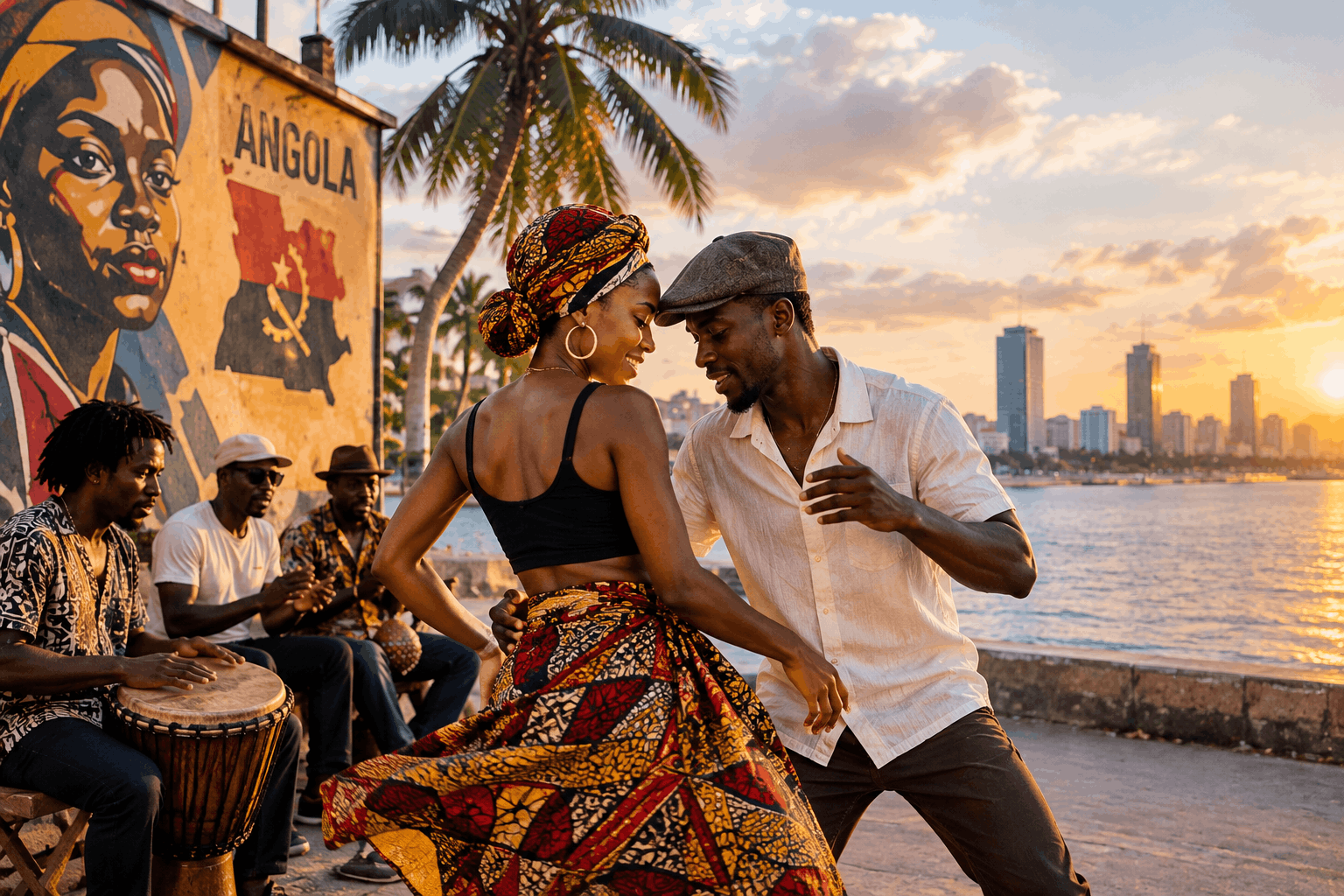
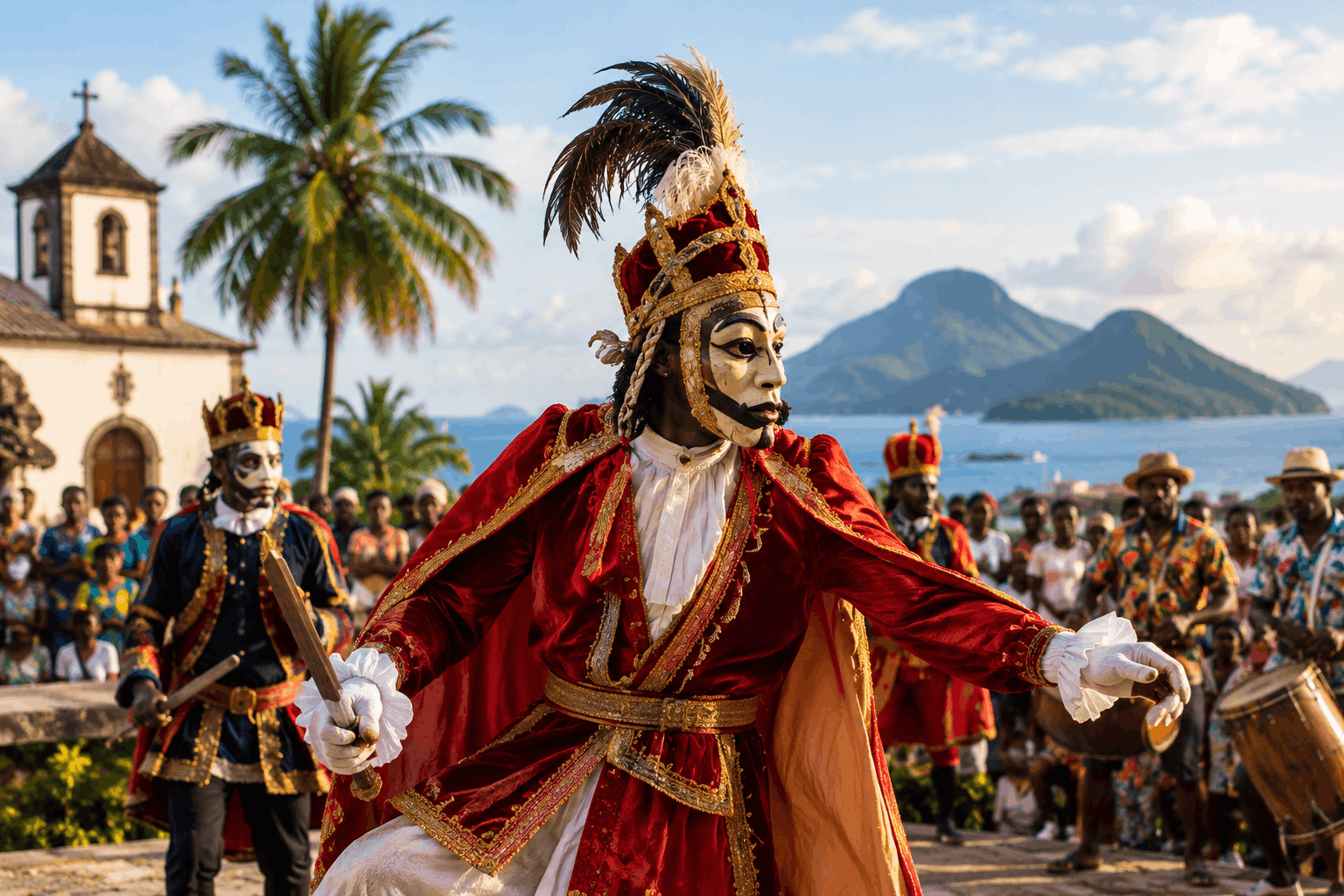
Explore Angola’s history, culture and connection with Brazil through semba, samba, kizomba, religion, food, art, capoeira and the Atlantic slave trade.
Semba, the Atlantic and the Story of Samba
In Luanda, music has long been part of how people describe everyday life. It has carried stories about work, love, relationships, celebration, frustration and the experience of living in a city where African traditions were constantly meeting Portuguese colonial culture and influences from elsewhere. One of the most important traditions to emerge from this environment is semba, a form of music and dance that became particularly associated with Luanda's working-class neighbourhoods, known as musseques, during the 20th century.
Semba did not appear out of nowhere. It grew from older Angolan musical and dance traditions as musicians adapted them to the changing life of the city. The word semba is generally connected to a Kimbundu term associated with the umbigada, a movement in which dancers bring their bodies together, traditionally described as a belly-to-belly gesture.
The movement is older than the modern musical genre called semba today. That is an important part of the story because modern Angolan semba took shape in 20th-century Luanda, particularly from the 1940s onward. Musicians were drawing from existing Angolan traditions while also responding to the sounds, languages and experiences of an increasingly urban population.
Groups such as Ngola Ritmos, formed in the 1940s, became especially important. They performed music in Angolan languages and helped create popular songs that spoke about everyday life, African identity and the experience of Portuguese colonial rule. In this way, music became one of the places where people could express what life in Luanda actually felt like.
UNESCO describes semba as a traditional Angolan musical genre and dance rooted in working-class neighbourhoods and connected to the country's identity-building and anticolonial history. Angola's nomination of semba for UNESCO's Representative List is currently being processed for the 2026 cycle, so it has not yet been inscribed on the list.
Now, this is where the story takes us across the Atlantic.
For centuries, Angola and the wider region of West Central Africa were major sources of Africans who were forcibly transported to the Americas through the transatlantic slave trade. Luanda became one of the largest embarkation points in the Atlantic slave trade, while Benguela became another major port. The numbers were enormous. For the period from 1780 to 1867, researchers estimate that almost one million enslaved Africans were embarked from Luanda and another 500,000 or so from Benguela.
Brazil received a particularly large share of the people transported from West Central Africa.
Those people carried more than what they could physically take with them. They carried languages, religious beliefs, musical knowledge, dances, food traditions, ways of organising communities and memories of the places they had come from. Once in Brazil, these traditions met others brought by Africans from different parts of the continent, as well as Indigenous and European traditions. Over generations, people created new forms of music, dance, religion, food and community life from these different influences.
This is part of the background to one of the most interesting connections between Angola and Brazil: semba and samba.
The two words look remarkably similar, and there are also similarities in some of the dance movements associated with them. More importantly, Brazil had received hundreds of thousands of people from West Central Africa over several centuries, so Angolan and broader Central African cultural influences were already part of Brazilian life long before modern Angolan semba emerged in Luanda.
But that does not mean that modern Angolan semba travelled to Brazil and became Brazilian samba.
The timeline makes that difficult to explain. The modern Angolan genre known as semba developed in 20th-century Luanda, especially from the 1940s onward. Brazilian samba had already been developing in Brazil through Afro-Brazilian musical and cultural traditions for generations. So the story cannot be reduced to a single Angolan genre crossing the ocean and eventually being renamed.
There are several things being connected here, and they happened at different times.
There are the older Angolan dance traditions associated with the word semba. There is the movement of people from West Central Africa to Brazil during the slave trade. There is the development of Afro-Brazilian music and dance in Brazil. And much later, there is the emergence of modern Angolan semba as a popular urban genre in Luanda.
That is why the connection between semba and samba is so fascinating. The two traditions developed on opposite sides of the Atlantic, but they did so in places that had been connected for centuries through the movement of people and culture.
Researchers have therefore continued to examine whether the similarity between the words points to an older linguistic or cultural connection, while also looking at the much wider influence of West Central African traditions on Brazilian music and dance. The exact origin of the Brazilian word samba is still not settled, and there is no straightforward chain of evidence showing that modern Angolan semba directly became Brazilian samba.
What we do know is that Angola was deeply connected to the making of Afro-Brazilian culture. People from West Central Africa became part of Brazilian society in enormous numbers, and the cultural knowledge they carried with them did not disappear when they crossed the Atlantic. It changed as people lived, worshipped, worked, danced and raised families in a new environment.
Then, centuries later, Angola and Brazil began creating new cultural connections as independent countries, including exchanges involving music and dance.
So when you hear the words semba and samba together, there is a much larger story sitting behind those five letters. It is a story that begins with older Angolan traditions, passes through the forced movement of millions of Africans across the Atlantic, continues through the creation of Afro-Brazilian culture, and eventually comes back to modern Angola and Brazil meeting each other again.
To follow that story properly, though, we first need to understand the Angola from which so many of these traditions emerged.
The States That Existed Before Colonial Angola
In this section
From Luanda, Portuguese merchants and officials became increasingly involved in the trade in enslaved Africans.
Angola occupies about 1.25 million square kilometres along the Atlantic coast of southwestern Africa, stretching from the Congo River in the north to the southern border with Namibia. Today, it is one country with a defined territory and internationally recognised borders. Those borders, however, are relatively recent. They do not describe how people in the region organised their societies before European colonial rule.
There was no single state called Angola before the Portuguese established colonial control over the territory. Instead, the region was home to different kingdoms, chiefdoms and other political communities, each with its own rulers, languages, economic networks and relationships with neighbouring societies. Some controlled large territories and long-distance trade routes, while others were organised on a smaller scale.
One of the most important states in the north was the Kingdom of Kongo. By the late 15th century, when Portuguese sailors first reached the Kongo coast, the kingdom had become a major political power in Central Africa. Its territory extended across parts of what are now northern Angola, the Democratic Republic of the Congo, the Republic of the Congo and, at different points, areas farther west and north. Its capital, Mbanza Kongo, was located in what is now northern Angola.
The arrival of the Portuguese created a new relationship between Kongo and Europe. Portuguese and Kongo rulers exchanged diplomatic missions, goods and religious ideas, and Christianity became an important part of the relationship after the conversion of Kongo's ruler Nzinga a Nkuwu in 1491. Over time, however, the relationship also became entangled with Portuguese demands for enslaved people and with competition over trade and political influence. The history of Kongo therefore cannot be reduced to either peaceful contact or immediate conquest. It changed considerably over the centuries as African rulers and Portuguese authorities pursued their own interests.
Further south, around the region of the Kwanza River and the areas east of present-day Luanda, another important state emerged: the Kingdom of Ndongo. Its population was predominantly Mbundu, and its rulers were known by the title Ngola.
That title eventually gave Angola its name.
When Portuguese sources referred to the ruler as the Ngola, they adapted the word into forms such as Angola. Over time, the name stopped referring to the ruler and came to be used for the wider territory under Portuguese influence and, eventually, for the country itself. So the name Angola does not come from the name of an ethnic group. It comes from the title associated with the rulers of Ndongo.
This distinction helps explain why it is misleading to look at a modern map and assume that the country existed in its present form before colonialism. The political landscape was much more complicated. Kongo, Ndongo and other states had their own territories and systems of authority, and their borders and influence changed over time.
The Portuguese presence also developed gradually.
Portuguese ships had been reaching the coast of Central Africa since the late 15th century, but Portugal's involvement around Luanda became more permanent in the following century. In 1575, Paulo Dias de Novais established a Portuguese settlement at Luanda, and the settlement became an important base for Portuguese military, commercial and political activity.
From Luanda, Portuguese merchants and officials became increasingly involved in the trade in enslaved Africans. They did not introduce the existence of slavery to Central Africa. Different forms of enslavement, dependency and captive-taking already existed in parts of the region, as they did in many societies around the world at different points in history. What changed dramatically was the scale of the Atlantic trade and the demand created by European colonies in the Americas.
Brazil was at the centre of that demand.
Portuguese colonists in Brazil were building an economy that depended heavily on enslaved labour, first in sugar production and later across other sectors of the colonial economy. As the demand for labour grew, merchants and political authorities expanded the networks through which Africans were captured, sold and transported to the coast. Local wars, political rivalries and commercial relationships became increasingly connected to this expanding Atlantic market.
Luanda became the most important Portuguese embarkation point in the region. Farther south, the Portuguese established Benguela in 1617, and it eventually became another major port in the trade. Through these ports, enormous numbers of Africans were forcibly transported across the Atlantic.
The exact numbers depend on the period and historical dataset being used. One widely cited estimate puts the number of enslaved people embarked from Luanda at nearly 1.2 million between 1710 and 1830, while several hundred thousand more were transported through Benguela during the 18th and early 19th centuries.
Most of the people who left these ports were not from one single community. They came from different societies across West Central Africa, including areas connected to Kongo, Ndongo and many other political and cultural communities. Once they reached Brazil, they found themselves living alongside Africans from other parts of the continent, Indigenous peoples and Europeans.
That is where the Angola-Brazil story becomes much larger than a story about ships travelling between two ports.
People were being taken from their homes and transported into a completely different social environment, but they brought knowledge with them. Languages survived. Religious practices changed and survived. Foods, agricultural knowledge, musical ideas, dance movements, craft traditions and ways of organising community life travelled with people and were adapted to their new circumstances.
Over generations, those traditions became part of Brazilian society and interacted with influences from other African regions, Indigenous peoples and Europe. Some cultural forms remained recognisably connected to their African origins, while others developed into new forms that had never existed in quite the same way before.
This is the historical setting we need before returning to semba and samba.
The Angola-Brazil connection began, on a massive scale, through forced migration. The cultural exchange that followed was shaped by that violence, but the people who were transported were not culturally empty passengers. They carried knowledge, memories and traditions with them, and those things became part of the societies they were forced to enter.
Centuries later, Angola and Brazil would develop cultural connections as independent countries. But many of the links between them had already been formed much earlier, through the movement of people across the Atlantic.
Queen Nzinga and the Struggle Against Portuguese Expansion
In this section
Merchants participated in expanding trade networks, while soldiers fought for different political authorities.
By the early 17th century, Portuguese involvement in the region had become increasingly disruptive to the political states around Luanda and the Kwanza River. Portuguese authorities wanted access to land, trade routes and, above all, a larger supply of enslaved people for the Atlantic trade. Ndongo was one of the states caught in the middle of this expansion.
This was the political environment in which Queen Nzinga, also known as Njinga or Ana Nzinga, rose to power.
Nzinga came from the ruling family of Ndongo and first became prominent as a diplomat. In 1624, she became ruler of Ndongo after the death of her brother, Ngola Mbande. By then, the Portuguese had already established Luanda as an important base and were supporting military campaigns into the interior. Ndongo's rulers were trying to maintain control over their territory while dealing with Portuguese demands and the growing trade in captives.
Nzinga understood that fighting was only one way to deal with the Portuguese. She also used negotiation.
Before becoming ruler, she had famously travelled to Luanda in 1622 to negotiate with the Portuguese governor on behalf of her brother. The meeting became an important episode in her political career. She negotiated a temporary peace and was baptised as Ana de Sousa, although the extent to which her conversion reflected personal religious commitment, diplomacy or both is difficult to determine from the surviving sources.
The agreement did not last.
Portuguese expansion continued, and Nzinga eventually broke with the Portuguese and moved her political base away from Ndongo. She established herself in Matamba, a neighbouring kingdom to the east of Ndongo, where she built a new centre of power. From there, she continued to challenge Portuguese expansion and worked to bring together different groups that could strengthen her position.
Her alliances changed according to the circumstances. During the 1640s, when the Dutch seized Luanda from the Portuguese, Nzinga allied with the Dutch and used the opportunity to put additional pressure on the Portuguese. She also supported resistance within Ndongo and continued trying to regain territory and political influence that had been lost to Portuguese forces.
Matamba became increasingly important under her rule. Nzinga developed it into a state that participated in regional and Atlantic commerce and provided a base from which she could negotiate with, fight against and sometimes cooperate with European powers. She also received people fleeing Portuguese-controlled areas and incorporated soldiers and military specialists into her forces.
Her position was not based on military resistance alone. Nzinga was operating in a political environment where rulers had to manage trade, diplomacy, warfare, shifting alliances and the movement of people at the same time. Her ability to move between those different forms of power helped her remain politically significant for several decades.
Nzinga died in 1663, after a long reign during which she had negotiated and fought with successive Portuguese authorities. Matamba remained an important political power after her death, and her successors continued to deal with the Portuguese from a position that was considerably stronger than it had been when she first came to power.
Her legacy has grown far beyond the events of her lifetime. In Angola today, Nzinga is widely remembered as a major historical figure associated with resistance to Portuguese expansion. Her image has appeared in education, monuments, literature and other forms of national culture, making her one of the most recognisable figures in Angola's history.
Her life also gives us a better sense of how politics worked in Central Africa during this period. The people living through Portuguese expansion were not all making the same choices. Rulers formed alliances, negotiated treaties, fought wars and competed with neighbouring states. Merchants participated in expanding trade networks, while soldiers fought for different political authorities. At the same time, countless people were captured, displaced or forced into systems of labour and trade over which they had little control.
Nzinga's story sits within all of this. She was a ruler defending and expanding her political power in a period when Portuguese military and commercial interests were transforming the region. Understanding her choices means looking not only at resistance to European expansion, but also at the African political world in which that resistance took place.
How Portuguese Rule Changed Angolan Society
In this section
Portuguese rule also left behind something that would become much more deeply rooted: the Portuguese language.
Portuguese control over Angola developed over several centuries, and it was never as complete or as uniform as the modern map of the country might suggest. For long periods, Portuguese authority was concentrated around coastal settlements, trading centres and particular areas of the interior. Control expanded through a combination of military campaigns, alliances and rivalries with African political authorities, taxation, trade and systems of forced labour.
This meant that colonial Angola was not a society in which everyone experienced Portuguese rule in the same way. The closer a community was to a Portuguese-controlled town, military post or commercial centre, the more directly people were likely to encounter colonial officials and institutions. In other areas, African political and social structures remained important even as Portuguese authorities gradually extended their reach.
Over time, however, Portuguese rule changed the economic and social organisation of the territory. Land, labour and trade became increasingly tied to the colonial economy, while Christian missions and Portuguese-language schools introduced institutions that had not previously existed in the same form. Africans were also subjected to discriminatory laws and labour systems, including forms of forced labour that remained part of Portuguese colonial policy well into the 20th century.
The colonial population itself was also changing.
By the 20th century, Angola had a substantial Portuguese settler population alongside the much larger African population. There was also a smaller population of people of mixed African and European ancestry, whom colonial authorities commonly classified as mestiços. These groups did not occupy identical social positions, and colonial society was structured by legal, racial and economic inequalities that gave Europeans significant advantages.
The Portuguese presence became particularly visible in cities such as Luanda, where African residents, Portuguese settlers and people of mixed ancestry lived within the same urban environment but did not necessarily have equal access to housing, education, employment or political power.
By the final years of Portuguese rule, Angola had one of the larger European settler populations in sub-Saharan Africa. When Portuguese colonial rule collapsed in 1975, the political transition was accompanied by severe violence and instability. A large majority of Portuguese settlers left Angola around independence, particularly during 1975 and the early months of 1976. Their departure had major effects on the country's economy because many businesses, farms, technical positions and administrative roles had been heavily dependent on the colonial population.
Portuguese rule also left behind something that would become much more deeply rooted: the Portuguese language.
Portuguese became the official language of independent Angola, and its use expanded considerably during the colonial period, particularly through administration, education, Christianity and urban life. Today, it is the language that allows people from Angola's many different linguistic communities to communicate across regional and ethnic boundaries, especially in the country's cities.
The 2024 census gives us a much clearer picture of this linguistic diversity than older estimates often did. Among Angola's population, Portuguese is reported as the mother tongue of 45.5 percent of people. Umbundu follows at 17.1 percent, Kimbundu at 10.8 percent, Chokwe at 6.9 percent and Kikongo at 6.8 percent. Other languages, including Nyaneka, Oxikwanyama, Nganguela, Fiote and Muhumbi, are also spoken.
The figures become even more interesting when we look beyond language.
Angola is home to many different ethnic and cultural communities, reflecting the political and social landscape that existed long before the country became a Portuguese colony. According to the 2024 census, among people aged two and above, the largest recorded groups are Ovimbundu, at 29.1 percent, and Kimbundu, at 27 percent. They are followed by Kikongo, at 14.4 percent, and Lunda-Chokwe, at 8.9 percent. Other groups include Nhaneca-Humbe, Ambó, Herero and several smaller communities.
These figures should be read with some care. Ethnicity, language, region and family background do not always line up neatly. A person may identify with an ethnic community while speaking Portuguese as their first language, while another person may speak several African languages without fitting neatly into a single linguistic category. Census categories can describe broad patterns, but they cannot capture every layer of how people understand their own identities.
Even so, the numbers give us a useful starting point. Modern Angola is a multilingual and culturally diverse country whose population reflects both the older societies of the region and the profound changes brought by centuries of Portuguese rule.
And that brings us to one of the most visible legacies of this history: the fact that Portuguese is now spoken alongside a wide range of African languages across the same country.
The result is an Angola where colonial history is still present in the language used in government, education and much of urban life, while older linguistic and cultural traditions remain deeply rooted in families and communities.
Independence, Civil War and Reconstruction
In this section
The war finally entered its last stage after the death of Jonas Savimbi, the leader of UNITA, in February 2002.
By the early 1970s, Portuguese rule in Angola was becoming increasingly difficult to sustain. The independence struggle had been underway for years, with three major movements competing for influence: the MPLA, the FNLA and UNITA. When Portugal's dictatorship fell in 1974, the new Portuguese government began the process of withdrawing from its African colonies. Angola was set to become independent, but the question of who would govern the new country had not been settled.
Angola became independent on 11 November 1975. The transition was accompanied by fighting between the three movements, and by the time independence was declared, the country was already moving into a much larger conflict.
The MPLA emerged as the government in Luanda, while the FNLA and UNITA challenged its authority from different parts of the country. Their competition was not only about political ideology. It was also shaped by regional networks, ethnic and social constituencies, control of territory, access to resources and the political relationships that each movement had developed during the independence struggle.
The conflict soon became part of the wider Cold War.
The MPLA received substantial military and political support from the Soviet Union, while Cuba sent tens of thousands of troops to support the Angolan government. UNITA received support at different points from the United States and apartheid South Africa, while other foreign governments and regional actors also became involved. The involvement of these outside powers supplied the weapons, money and military support that helped turn Angola's political conflict into a war that lasted for decades.
But describing the conflict only as a Cold War struggle between competing foreign powers leaves out much of what was happening inside Angola. The different Angolan movements had their own political goals, regional bases and constituencies, and the war was shaped by struggles over power within the country itself. Foreign intervention intensified the conflict, but it did not create all of the divisions that sustained it.
The fighting continued, with periods of negotiation and temporary agreements followed by renewed warfare. Civilians bore much of the cost. Communities were displaced as front lines moved, agricultural areas were abandoned, infrastructure was destroyed and access to basic services became extremely difficult in many parts of the country.
The war finally entered its last stage after the death of Jonas Savimbi, the leader of UNITA, in February 2002. On 4 April 2002, the Angolan government and UNITA signed a ceasefire agreement. The agreement brought the main phase of the civil war to an end after almost three decades of fighting.
The scale of the destruction was enormous. Human Rights Watch estimates that around one million people were killed during the conflict. During the later years of the war, approximately 4.1 million people were internally displaced, while hundreds of thousands more fled across Angola's borders into neighbouring countries.
And ending the war did not mean that life immediately returned to normal.
Millions of people had been displaced from their homes. Roads, bridges, schools and health facilities had been destroyed or badly damaged. Land mines remained in many rural areas, making farming and movement dangerous. Families who had spent years away from their communities had to decide whether, and how, to return.
The government therefore faced the enormous task of rebuilding a country whose infrastructure had been damaged by decades of war.
At almost the same time, Angola was entering a very different period economically.
Oil had been discovered in Angola decades earlier, but production expanded dramatically during the later years of the civil war and after peace was restored. Rising oil production and high international oil prices brought the government enormous revenues. That money helped finance major reconstruction projects, including roads, housing, airports and public buildings.
Luanda changed particularly quickly.
Construction transformed parts of the capital. New office buildings, hotels, roads and residential developments appeared as oil revenues flowed through the economy. Luanda also became an increasingly important business centre, attracting international companies, expatriate workers and investment.
But the transformation of the capital did not mean that prosperity reached everyone at the same pace.
Angola's oil industry generated large national revenues, yet poverty remained widespread and access to housing, water, sanitation, healthcare and other basic services remained uneven. The contrast was particularly visible in Luanda, where expensive new developments existed alongside neighbourhoods where infrastructure and public services were far more limited.
During the oil boom, Luanda repeatedly appeared among the world's most expensive cities for expatriate workers. At the same time, many Angolans were living on incomes that were far removed from the costs faced by people earning international salaries.
Part of the city's population lived in neighbourhoods known as musseques. The term has a much older history, and these communities became an important part of Luanda's social and cultural landscape. They were home to generations of working-class Angolans and became places where people created their own networks, businesses, music and forms of social life.
The musseques also take us back to the story of semba.
It was in these changing urban communities that musicians developed and popularised music that spoke directly to Angolan life. Semba grew within a city shaped by colonialism, migration, poverty, cultural mixing and political change. Understanding the neighbourhoods where it developed helps explain why the music became about much more than dancing.
The country is home to several large cultural and linguistic communities, including the Ovimbundu, Mbundu, Bakongo, Lunda-Chokwe and Nyaneka-Humbe, alongside many smaller groups.
The diversity of Angola becomes much easier to understand when you look at its languages. The country is home to several large cultural and linguistic communities, including the Ovimbundu, Mbundu, Bakongo, Lunda-Chokwe and Nyaneka-Humbe, alongside many smaller groups. These communities are spread across different parts of the country and have their own languages, histories and cultural traditions.
Most of Angola's major African languages belong to the Bantu language family, a large family of languages spoken across much of Central, Eastern and Southern Africa. That does not mean that all Bantu languages are the same, or even that speakers of one can automatically understand another. Umbundu, Kimbundu, Kikongo and Chokwe, for example, are distinct languages with their own vocabularies, sounds and histories.
Geography has played a major role in where these languages are spoken.
Kimbundu has deep historical connections to the area around Luanda and the Kwanza River and is closely associated with the Mbundu people. It was also one of the African languages that came into sustained contact with Portuguese during the colonial period. Umbundu is particularly important in central Angola and among the Ovimbundu. Kikongo is widely spoken in northern Angola and across a much larger cultural region that extends beyond Angola's present borders into the Democratic Republic of the Congo and the Republic of the Congo. Further east, Chokwe and related languages are important among communities connected to the Lunda-Chokwe cultural area.
Other languages are important in Angola's south and southeast, including languages spoken by Nyaneka-Humbe and related communities. The country's linguistic map therefore does not follow its political borders neatly. Many of the communities living in Angola have cultural and linguistic connections that extend into neighbouring countries.
Then there is Portuguese.
Its position in Angola is the result of colonial history. Portuguese became the language of colonial administration, education and formal government, and its use expanded significantly in the cities. After independence, it remained the country's official language. For a country with so many different African languages, Portuguese also became an important way for people from different linguistic backgrounds to communicate with one another.
This is particularly noticeable in Luanda. Portuguese became deeply embedded in urban life, and many people who grew up in the capital use it as their first or most comfortable language. For younger generations in particular, Portuguese can be the language of school, work, government, media and everyday conversation, even when another African language remains important within the family.
That does not mean the African languages disappeared.
Far from it. They continue to carry family histories, local knowledge, humour, songs, ceremonies and ways of expressing ideas that do not always translate neatly into Portuguese. A person may use Portuguese at school or work and speak an African language with relatives. Another person may grow up speaking more than one African language. In some families and communities, language can also change across generations as younger people become more comfortable in Portuguese.
The 2024 census gives us a useful picture of this multilingual society. Portuguese is the reported mother tongue of 45.5 percent of the population, followed by Umbundu at 17.1 percent, Kimbundu at 10.8 percent, Chokwe at 6.9 percent and Kikongo at 6.8 percent. Nyaneka, Oxikwanyama, Nganguela, Fiote, Muhumbi and other languages account for additional parts of the population.
These numbers do not mean that 45.5 percent of Angolans speak only Portuguese. The census question concerns mother tongue, while people can speak, understand or use several languages during their lives. It is therefore possible for an Angolan to have Portuguese as a first language while also speaking an African language, or to have an African language as a mother tongue and use Portuguese extensively at school, work or in public life.
Language also connects closely to culture.
The same communities whose languages survived colonial rule have maintained distinctive traditions in music, dance, food, clothing, storytelling, religious practice, craftsmanship and social life. Some traditions are closely associated with particular communities, while others have travelled across regions and become part of a broader Angolan culture.
Semba is one example of how these layers can come together. Its roots are strongly connected to Kimbundu-speaking areas and to the cultural life of Luanda, but the modern music that developed in the city was shaped by an urban population with different backgrounds and experiences. The same city could therefore bring together people whose families came from different parts of Angola, each carrying their own language and cultural traditions.
This helps explain why Angolan identity cannot be reduced to one language or one ethnic group.
There is an Angola of Portuguese-speaking cities, an Angola where African languages remain central to everyday life, and many Angolans move between these worlds without necessarily seeing them as separate identities. A person can be Mbundu, Ovimbundu, Bakongo or Lunda-Chokwe, for example, while also identifying strongly with Angola as a country and using Portuguese every day.
The result is a country where language tells us something about both the past and the present. Portuguese reflects centuries of colonial rule and the development of a national state whose administration operates in one common language. Angola's African languages carry much older histories and remain central to the cultural life of the communities that speak them.
You can hear that combination in Angolan music, and you can see it in the country's food, religious practices, literature and everyday conversations. To understand modern Angola, you have to listen to both parts of that story.
Religion in Contemporary Angola
In this section
Christianity is the dominant religious tradition today, particularly Catholicism and Protestant Christianity.
Religion is another part of Angola's culture where different periods of the country's history sit alongside each other.
Christianity is the dominant religious tradition today, particularly Catholicism and Protestant Christianity. But describing Angola only as a Christian country can hide some of the complexity of how people understand religion and practise it in everyday life.
The 2024 census provides the clearest recent picture. Among Angolans aged two and above, 44.2 percent identified as Catholic and 34.9 percent as Protestant. Another 11.5 percent reported having no religion. Smaller proportions identified as Muslim, Jewish or animist, while 6.4 percent were recorded under other religions and 2.4 percent either did not know or did not provide a response.
Catholicism has a particularly long history in Angola.
Portuguese contact with the Kingdom of Kongo in the late 15th century brought Christianity into the region, and Kongo's ruler Nzinga a Nkuwu was baptised in 1491. Christianity subsequently developed through relationships between African rulers, Portuguese authorities and Catholic missionaries. Over the centuries, Catholic missions expanded into other parts of the territory, while Protestant missions became increasingly important from the 19th century onward.
But the arrival and spread of Christianity did not mean that older African ways of understanding the spiritual world disappeared.
Across different communities, people continued to maintain traditions involving ancestors, healing, divination, sacred places and relationships with spiritual forces. These practices were not identical across Angola, and they changed over time as communities encountered Christianity, Islam, colonial institutions and one another.
The result was not always a clean separation between Christianity and older African traditions. In some communities, Christian belief became part of a wider religious world in which older understandings of family, ancestors, healing and spiritual protection continued to influence how people made sense of life.
This wider Central African religious history also travelled across the Atlantic.
During the centuries of the transatlantic slave trade, millions of Africans were forcibly taken from West Central Africa to the Americas. People from the region carried religious knowledge and practices with them, but what developed in Brazil was not a collection of African religions preserved exactly as they had existed in Angola or elsewhere.
People from different African societies were brought together. Their traditions came into contact with Indigenous American practices, Catholicism and other forms of Christianity. Under those conditions, communities created new religious traditions that retained important African elements while developing in distinctly Brazilian ways.
One example is Candomblé Angola, a branch of Brazilian Candomblé with strong connections to Bantu-speaking traditions from the Angola-Congo region. Its religious world includes concepts, ritual practices and sacred traditions associated with Central African heritage, although it developed within Brazil rather than being a direct continuation of one particular Angolan religious system.
Umbanda is more difficult to trace to one source. It developed in Brazil from several religious and cultural currents, including elements of Catholicism, Spiritism, Indigenous traditions and African-derived practices. Some of those African influences came from Bantu traditions, but describing Umbanda as an Angolan religion carried across the Atlantic would leave out much of its Brazilian history.
This is an important part of the Angola-Brazil story because it shows what happens when people, rather than abstract ideas, move between places.
The people taken from West Central Africa did not reproduce their religious lives in Brazil exactly as they had known them at home. They adapted, combined traditions, created new communities and passed parts of their spiritual knowledge to later generations. Some of the resulting traditions are now recognised as important parts of Brazilian religious and cultural life.
At the same time, Angola developed its own religious landscape. Christianity became dominant, while African languages, family traditions and older understandings of the spiritual world continued to shape cultural life in different ways.
So when religion appears in Angola today, it is often connected to a much longer story than the census categories alone can show. Catholicism and Protestant Christianity are numerically dominant, but Angola's religious culture also carries traces of the societies, beliefs and practices that existed before Portuguese rule and the ways those traditions changed through centuries of contact.
Food: Cassava, Palm Oil, Fish and Local Crops
In this section
In 1974, production reached roughly 210,000 tonnes, placing Angola fourth among global coffee-producing countries at the time.
Angolan food varies considerably from one region to another, but some ingredients appear again and again: cassava, maize, palm oil, groundnuts, leafy vegetables, fish and other locally available crops. Geography helps explain some of this variety. Angola has a long Atlantic coastline, fertile areas along several river systems and large differences in climate between the north, central highlands and drier south.
One of the foods most closely associated with everyday Angolan cooking is funge, a smooth, thick staple made by cooking flour with water. The flour can come from cassava or maize, depending on the region and the type of funge being prepared. It is usually eaten alongside a stew, sauce or other strongly flavoured dish rather than by itself.
Cassava became particularly important because it grows well in many of Angola's farming environments and can provide a reliable source of carbohydrates. Maize is also widely cultivated and used in different forms. Groundnuts, vegetables and leafy greens add other flavours and nutrients to meals, while the country's rivers and Atlantic coast provide access to fish and seafood.
That combination of a filling staple with a richly seasoned sauce is common across much of Central Africa. The ingredients and names change from place to place, but the basic idea of serving a starchy food alongside a stew or sauce appears in many neighbouring food traditions.
Calulu is one example from Angola. Recipes differ according to the region and the cook, but the dish commonly combines fish or meat with vegetables such as okra, eggplant and leafy greens, often with palm oil and other seasonings. Because recipes have developed across communities and generations, there is no single version of calulu that represents every Angolan household.
Another well-known dish is muamba de galinha, chicken cooked with palm oil and commonly prepared with ingredients such as garlic and okra. Palm oil gives the dish much of its characteristic colour, richness and flavour, and palm-based cooking has a long history in Central and West Central Africa.
The country's coastal location adds another dimension to the food. Fish is important in many coastal communities, while prawns and other seafood are also available. Inland communities have traditionally relied more heavily on crops and livestock suited to their local environments, although modern food distribution means that ingredients now travel much farther across the country than they did in the past.
Some ingredients that are now completely familiar in Angolan cooking actually arrived from other parts of the world.
Chilli peppers, for example, originated in the Americas. They reached Africa after the beginning of sustained European contact with the Americas in the late 15th and 16th centuries and were gradually incorporated into cuisines across the continent. Today, spicy peppers are so familiar in many African dishes that it can be easy to forget that the plants themselves are not native to Africa.
Cassava also has an Atlantic story of its own. It originated in South America and was introduced to Africa through Portuguese-connected trade networks after the 15th century. It spread widely because it could grow in a range of conditions and became an important food crop in many parts of Central and West Africa, including Angola.
So even some of the ingredients that now seem deeply rooted in Angolan cooking are part of much older movements of plants, people and agricultural knowledge across the Atlantic.
Coffee tells a different kind of story because it connects food and agriculture directly to Angola's colonial economy and its later economic disruption.
Before independence, Angola was one of the world's major coffee producers. In 1974, production reached roughly 210,000 tonnes, placing Angola fourth among global coffee-producing countries at the time. Coffee plantations had become an important part of the colonial agricultural economy, particularly in the northern parts of the country.
Independence and the civil war that followed severely disrupted that industry. Many farms were abandoned, agricultural infrastructure deteriorated and insecurity made it difficult for farmers and traders to move safely between production areas and markets. Coffee production fell dramatically from its colonial-era peak.
The industry has recovered to some extent since the end of the war, but production remains far below the levels Angola reached in the early 1970s. Government programmes and private investment have sought to rehabilitate plantations, support smallholder farmers and expand processing and exports.
That makes coffee part of a larger story about Angolan agriculture. The country has a long history of producing crops for both local consumption and international markets, but decades of conflict disrupted many of those systems. Rebuilding agriculture therefore involves more than planting crops again. It also means restoring farms, roads, processing facilities, supply chains and the livelihoods connected to them.
And this is why food offers another way into understanding Angola. A bowl of funge, a palm-oil-based stew or a plate of fish can tell us about local crops, regional environments and cooking traditions. The history of cassava, chilli peppers and coffee takes that story further, showing how plants and agricultural systems have also moved across borders and been reshaped by trade, colonialism, war and changing economies.
Semba and the Making of Modern Angolan Music
In this section
Over time, however, semba came to refer not only to a dance movement but also to a broader musical tradition.
By the middle of the 20th century, Luanda was becoming an important centre of Angolan popular culture. People from different parts of the territory were moving into the city, colonial rule was changing the way people worked and lived, and new forms of entertainment were developing in neighbourhoods, clubs and other urban spaces.
Music grew alongside all of this.
Musicians were working with older Angolan songs, dances and rhythms while also experimenting with guitars, percussion and other instruments that had become part of urban popular music. Radio, records and live performances helped these sounds reach audiences beyond the neighbourhoods where they first developed.
One of the most important groups in this period was Ngola Ritmos, formed in the 1940s around musicians including Liceu Vieira Dias. The group became known for combining elements of Angolan musical traditions with modern instrumentation and for performing songs in Kimbundu as well as Portuguese.
Ngola Ritmos became particularly important because its music connected everyday urban life with questions of African identity. Its songs could draw from local musical traditions while addressing the experiences of people living under Portuguese colonial rule. Music therefore became part of a much larger cultural world in which Angolan writers, musicians and other artists were finding ways to express what life under colonialism felt like.
This was the environment in which modern semba developed.
Semba was not suddenly created in one particular year. The modern genre grew out of older Angolan musical and dance practices that were being adapted within the changing social environment of Luanda. Musicians took existing rhythms, melodies and dance traditions and worked them into new arrangements that suited guitars, percussion, recording studios, radio broadcasts and urban performance spaces.
The word semba itself is older than the modern genre. It is generally associated with a Kimbundu term connected to a dance movement known as the umbigada, in which dancers make a characteristic contact movement with one another. Over time, however, semba came to refer not only to a dance movement but also to a broader musical tradition.
That distinction helps explain why the music can have both an old foundation and a distinctly modern sound.
People in Luanda were listening to music that drew from traditions inherited from earlier generations, but they were also living in a changing city. Songs could talk about love, relationships, work, money, neighbourhood life, humour and the difficulties of everyday life. Musicians could also use songs to comment on colonial rule, African identity and the political changes taking place around them.
For listeners, this made the music part of ordinary life rather than something reserved for formal ceremonies or elite spaces. Semba could be danced, heard at social gatherings, performed in neighbourhoods and shared through recordings and radio.
The genre therefore became closely connected to the cultural life of modern Luanda.
It also developed during a period when Angola's political situation was becoming increasingly tense. As independence movements grew stronger, cultural expression became one of the ways people discussed identity and the society they wanted to build. Not every semba song was a political statement, but the wider musical scene gave artists space to express ideas about being Angolan at a time when colonial authorities controlled much of public life.
Among the musicians who later brought this music to audiences outside Angola was Bonga, born José Adelino Barceló de Carvalho. He began his career in the Angolan music scene before independence and became internationally known after leaving Angola in the 1970s.
Bonga's music carried Angolan sounds and Portuguese-language lyrics to audiences far beyond Luanda. His songs addressed subjects including colonialism, displacement, migration and political power, while continuing to draw from Angolan musical traditions.
By this point, semba had become more than one style of dancing or one sound associated with a particular neighbourhood. It had become part of the musical language through which modern Angola described itself.
And once that music travelled beyond Angola, it became part of another story too: the long and complicated cultural connection between Angola and Brazil.
Did Semba Become Brazilian Samba?
In this section
Earlier, people from Central Africa had been forcibly taken to Brazil and carried cultural knowledge with them.
This is where the Angola-Brazil connection becomes especially interesting, because the words semba and samba sound remarkably similar.
Semba is associated with a Kimbundu word connected to the umbigada, a characteristic movement found in some Angolan dances. Samba, meanwhile, became the name of one of Brazil's most recognisable musical and dance traditions.
The similarity between the two names has led people to ask whether Brazilian samba came directly from Angolan semba.
There is a strong reason to look for African connections in Brazilian music. During the centuries of the Atlantic slave trade, millions of Africans were forcibly transported to Brazil, including very large numbers from West Central Africa. People from the Angola-Congo region made up a significant part of this population, particularly during important periods of the trade.
They arrived carrying languages, religious traditions, musical practices, dance knowledge and other forms of cultural knowledge. Once in Brazil, however, they did not live in communities made up only of people from Angola. Africans from different parts of the continent were brought together, while Indigenous Brazilian and European influences were also present.
Over generations, these different traditions interacted and produced new Brazilian forms of music, dance and religious practice.
This gives us a strong historical basis for talking about African influence on Brazilian samba. It does not, however, establish that the modern Angolan genre called semba travelled to Brazil and became samba.
The timeline is important here.
The modern musical genre known as Angolan semba developed in 20th-century Luanda, particularly as musicians adapted older Angolan traditions within the city's growing popular-music scene. The large-scale forced migration of Africans to Brazil had begun centuries earlier. Brazilian samba therefore developed before modern Angolan semba existed in the form we recognise today.
That does not remove the possibility of older connections. The word semba predates the modern genre, and Angolan dance and musical traditions are much older than the 20th century. But moving from that observation to a direct line from modern Angolan semba to Brazilian samba would skip over several centuries of cultural change.
Brazilian samba itself developed through a long process involving African-descended communities, Brazilian urban culture, European musical influences and traditions from different parts of Brazil. The exact origin of the word samba is also not completely settled, so the similarity between the two words does not, by itself, establish a direct linguistic or musical genealogy.
There is another part of the story that is easy to overlook.
The cultural exchange between Angola and Brazil did not end with the Atlantic slave trade.
By the 20th century, Brazilian music was circulating in Angola, including through recordings, radio and other forms of popular culture. Angolan musicians were therefore hearing Brazilian music at the same time that they were developing their own modern musical styles. Brazilian samba became part of the wider musical environment in which Angolan musicians worked.
This means the musical relationship eventually moved in more than one direction. Earlier, people from Central Africa had been forcibly taken to Brazil and carried cultural knowledge with them. Centuries later, Brazilian music travelled back across the Atlantic and became one of the outside influences encountered by musicians in Angola.
So, did semba become Brazilian samba?
The evidence does not support describing it as a straightforward story in which a modern Angolan genre crossed the Atlantic and turned into Brazil's samba. What we can see much more clearly is a much longer connection.
People from West Central Africa were forcibly dispersed to Brazil on an enormous scale. They carried cultural traditions that became part of new Brazilian forms, alongside influences from other African communities, Indigenous peoples and Europeans. The older word semba, Angolan dance traditions and Brazilian samba all belong to a much larger Atlantic story, but the exact linguistic and musical connections between them are not settled enough to reduce that story to one direct line.
And then, centuries later, Angola and Brazil began exchanging music voluntarily, creating new connections on top of the older ones.
That is why the resemblance between semba and samba is worth exploring. It opens a window onto centuries of movement between Central Africa and Brazil, while also reminding us that cultures do not remain unchanged when people, music and ideas move from one place to another.
Kizomba and the New Angolan Sound
In this section
Eduardo Paim became one of the central figures associated with the development and popularisation of kizomba.
By the late 1970s and 1980s, Angola's popular music scene was changing again.
A new sound was developing from the musical world that had produced semba, while Angolan musicians were also listening to music coming from elsewhere. One of the most important outside influences came from the French Caribbean, particularly zouk, a style that emerged in Guadeloupe and Martinique in the late 1970s.
This was the environment in which kizomba developed in Angola.
Kizomba drew from semba and other Angolan musical traditions, while incorporating influences from Caribbean music. Zouk was particularly important to the development of the sound that became associated with kizomba, especially its slower tempo, electronic instrumentation and smoother arrangements.
The name kizomba comes from Kimbundu and is generally associated with the idea of a party or celebration.
The music also changed the way people danced together.
Semba can be energetic and fast-moving, with dancers responding to the rhythm through more pronounced movements. Kizomba developed a slower style in which partners stay close and move together through controlled steps and subtle changes in direction. That close connection between partners eventually became one of the defining features of kizomba as a social dance.
But kizomba was not just Angolan music with zouk placed on top of it.
Angolan musicians were working with several influences at once and developing something within their own musical environment. The genre continued to draw on Angolan rhythms and musical ideas even as its sound incorporated elements that had arrived from outside the country.
Eduardo Paim became one of the central figures associated with the development and popularisation of kizomba. His work helped establish the sound in Angola and contributed to its spread beyond the country.
During the 1990s and 2000s, kizomba travelled increasingly through the Portuguese-speaking world. Angola's diaspora helped carry the music to Portugal, where it found new audiences and became closely associated with social dancing. From Portugal, kizomba spread further through dance schools, clubs, workshops and festivals across Europe and eventually to other parts of the world.
The international version of kizomba also developed its own life. As dancers outside Angola learned the music and created classes around the dance, different teaching styles and interpretations emerged. Some people encountered kizomba primarily as a social dance rather than through Angolan music and culture.
That created an interesting situation for the genre.
A style that had developed in a particular Angolan musical and social environment was becoming an international dance culture. People could learn the steps thousands of kilometres from Angola without necessarily knowing much about the musicians, languages, neighbourhoods and musical traditions from which the genre emerged.
Kizomba therefore became another part of Angola's much larger musical story: local musicians taking existing traditions, encountering new sounds and creating something that eventually travelled far beyond the place where it began.
Kuduro and Luanda's Younger Generation
In this section
Kuduro was particularly suited to this environment because it did not require a large band or expensive collection of instruments.
By the late 1980s and 1990s, another sound was emerging from Luanda.
Kuduro developed within the city's younger urban culture, drawing on electronic music, dance, hip-hop and existing Angolan musical traditions. It sounded very different from the guitar-led popular music associated with earlier generations, partly because new technology was changing what musicians could produce and how quickly they could share it.
The timing is important.
Kuduro began developing during the final years of Angola's civil war. It was not a genre that appeared only after the war ended in 2002. Its early development belongs to a period when Luanda was still dealing with the effects of conflict, rapid urbanisation and large movements of people into the capital.
The genre became much more visible after the war, however.
With the fighting over, musicians and producers were working in a more stable national environment, while television, radio, recordings and increasingly accessible digital technologies helped music circulate more widely. Angola was also becoming more connected to international popular culture, giving young artists access to sounds and production techniques from outside the country that they could adapt to their own work.
Kuduro was particularly suited to this environment because it did not require a large band or expensive collection of instruments.
Producers could build tracks electronically, combine programmed rhythms with samples and recorded voices, and create music designed specifically for energetic dancing. The sound could be produced and changed quickly, allowing young musicians to experiment with rhythm, language, humour and electronic effects.
The dance itself became an important part of the culture. Kuduro was energetic and highly physical, with dancers developing distinctive movements that could spread through neighbourhoods, parties, music videos and later through the internet.
The music also gave young Angolans a way to talk about their surroundings.
Songs could draw on everyday experiences in Luanda, including relationships, money, neighbourhood life, social problems and the pressures of growing up in a rapidly changing city. The language could be playful, direct and sometimes deliberately provocative.
As the genre developed, different producers and artists gave it their own sounds, while the music continued to absorb influences from both Angola and the wider world.
This is part of what made kuduro such an important expression of contemporary Luanda. It belonged to a generation growing up with electronic technology, global media and a rapidly changing city, while still drawing on local rhythms, languages and experiences.
Semba had emerged from an earlier generation's urban musical world. Kizomba had brought together Angolan traditions and Caribbean influences. Kuduro took the story into a new technological era, showing how quickly Luanda's musicians could turn changes in the city into new forms of music and dance.
Masks, Sculpture and the Chokwe Artistic Tradition
In this section
Chokwe artistic traditions also include representations of rulers and other figures connected with political authority.
Angola's cultural history can also be seen in wood, particularly in the artistic traditions of Chokwe communities in the country's east and in neighbouring parts of the wider Lunda-Chokwe cultural region.
Chokwe artists became known for highly developed traditions of wood carving, producing masks, human figures, staffs, thrones and other objects used in political, social and ceremonial settings. Some objects were associated with rulers and courts, while others belonged to initiation societies, dances and other community institutions.
This is important when looking at Chokwe art today because many of these objects were never intended to be displayed as artworks in the modern museum sense.
A carved figure could represent a ruler, an ancestor or another important person. A staff could communicate political authority. A throne could be part of the visual language of kingship. A mask could be used during a particular performance or ceremony and could take on a meaning that would not be obvious from its physical appearance alone.
The object and the setting therefore belonged together.
Who was allowed to use a particular object, when it appeared, who saw it and what happened during its performance could all affect its meaning. The same is true of the people who made and maintained these traditions. Knowledge about carving, performance and ceremony was passed between generations rather than existing only in the finished object.
One of the most important examples is mukanda, a male initiation tradition practised among Chokwe and several related communities in the region.
Mukanda involves a period of seclusion during which boys undergoing initiation receive instruction and take part in activities that prepare them for new responsibilities within their communities. The process can include teaching about social behaviour, relationships, community expectations and other forms of knowledge considered important for adult life.
Masks play an important role in the performances associated with mukanda. Masked figures can appear during dances and other parts of the initiation process, and different masks have particular identities, forms and functions.
This means that a mukanda mask cannot be fully understood by looking at its carving alone.
Its significance comes from the ceremony in which it is performed, the people involved, the knowledge attached to it and the social transition that the initiation process represents. The carving is one part of a much larger system of performance, instruction and community life.
Chokwe artistic traditions also include representations of rulers and other figures connected with political authority. Some carved objects communicate ideas about leadership, status and the relationship between rulers, ancestors and the wider community. Artists therefore worked within a visual language that could communicate social and political ideas as well as aesthetic ones.
Over time, some Chokwe objects were removed from their original communities and entered European and North American collections. They later became widely recognised internationally as important examples of Central African sculpture.
Seeing these objects in a museum today can therefore give only part of the story. The carved wood may survive, but the ceremony, performance, social institution and community relationships that gave the object its original meaning may be separated from it.
That is why Chokwe art is useful for understanding Angola beyond music and food. It shows that artistic expression was also woven into political authority, education, initiation and community life. A mask was not necessarily made to be admired on a wall. A sculpture could be part of a court, a ceremony or a system through which knowledge and social responsibilities were passed from one generation to another.
Engolo and the Question of Capoeira
In this section
Enslaved people from Angola were taken to Brazil, they carried engolo with them, and the practice eventually became capoeira.
Angola appears in another important part of the Atlantic story through capoeira, the Brazilian martial art and cultural practice that combines fighting techniques, movement, music and performance.
One Angolan practice that has attracted particular attention is engolo, a combat game associated with communities in southwestern Angola. Engolo involves low movements, kicks, evasive techniques and movements close to the ground. Some of these movements look strikingly similar to techniques found in capoeira.
That resemblance has led to a much larger question: could an Angolan combat tradition have contributed to the development of capoeira in Brazil?
For a long time, the answer was often presented as a straightforward story. Enslaved people from Angola were taken to Brazil, they carried engolo with them, and the practice eventually became capoeira.
The historical evidence does not allow the story to be stated that confidently.
Historian Matthias Röhrig Assunção has examined the proposed connection through historical research and fieldwork in southwestern Angola. His work takes the similarities between engolo and capoeira seriously, while also looking closely at when and where engolo was practised and how little direct documentation exists connecting the two traditions across the Atlantic.
Engolo itself had a particular social and cultural setting in southwestern Angola. It was associated with specific communities and, historically, with pastoral life and practices connected to young men. Capoeira developed in a very different environment: among Afro-Brazilian communities living under slavery and later in post-slavery Brazil, where African practices were being combined with other forms of movement, music and social life.
This makes a direct line from engolo to capoeira difficult to demonstrate.
It does not mean that the similarities are meaningless. Enslaved Africans from West Central Africa were transported to Brazil in enormous numbers, and people from the regions that now make up Angola and the wider Angola-Congo area contributed to Brazilian society. They brought different forms of knowledge with them, including ways of moving, dancing, fighting and organising social life.
But those practices did not arrive in Brazil and remain unchanged.
People from different African societies were brought together, and their traditions developed alongside Indigenous Brazilian and European influences. Under slavery, people also had to adapt cultural practices to circumstances very different from those in which they had originally developed.
Capoeira emerged from that Brazilian environment.
Its history therefore belongs to Afro-Brazilian society as a whole, rather than being reducible to one African practice. African combat and movement traditions are part of the wider cultural setting from which capoeira developed, but identifying the exact contribution of engolo, or of any other individual Angolan tradition, requires more evidence than resemblance alone can provide.
This is another example of why the Angola-Brazil connection is so interesting.
The Atlantic slave trade moved people across enormous distances, and with them came languages, religious ideas, music, dance, food knowledge and physical practices. Once those traditions entered Brazil, they became part of new communities and were changed by the conditions people encountered there.
So the connection between engolo and capoeira is best understood as a question about possible cultural links rather than a settled story of one practice becoming the other.
What is much clearer is the larger movement of Central African people and cultural knowledge into Brazil, and the new forms of music, religion, dance and social life that developed there as a result.
Literature and Political Expression
In this section
The cultural world around the independence movement was therefore broader than the work of any single writer.
Music was not the only way Angolans expressed ideas about identity and colonial rule. Poetry and literature became important forms of cultural expression, particularly during the decades when the independence movement was growing.
One of the most important figures was António Agostinho Neto, a poet and physician who became one of the leading figures of the Angolan independence movement and, after independence, the country's first president.
Neto was born in 1922 in Icolo e Bengo, near Luanda, and studied medicine in Portugal. While living there, he became involved with African students and political movements opposed to Portuguese colonial rule. His political activities eventually brought him into conflict with the Portuguese authorities, and he was imprisoned and placed under restrictions at different points during the colonial period.
His poetry dealt with subjects that were closely connected to the lives of people living under colonial rule. He wrote about African identity, poverty, imprisonment, suffering, colonial violence and the desire for freedom. His writing therefore existed alongside his political work rather than being completely separate from it.
Neto's career also helps explain why culture became so closely connected to political mobilisation in late colonial Angola.
Colonial rule did not control only territory and government institutions. It also shaped education, language, employment and public life. Writers and musicians created spaces where Angolans could describe themselves, their communities and their experiences in ways that did not depend entirely on Portuguese colonial ideas.
Poetry could do this through images and personal experiences. Music could do it through language, rhythm and stories about everyday life. Newspapers, political writing and other forms of cultural expression provided additional ways for people to discuss what was happening around them.
Neto's writing became part of that wider movement.
At the same time, Angolan literature was never limited to one political voice. Writers came from different backgrounds and expressed different experiences of colonial society, independence and the country that emerged afterwards. The cultural world around the independence movement was therefore broader than the work of any single writer.
Independence in 1975 changed the circumstances in which Angolan writers were working, but it did not bring an end to the country's political difficulties.
The new government inherited a country in the middle of a violent struggle between competing political movements. As the civil war continued, writers and artists increasingly had to deal with subjects that had become part of everyday life: displacement, death, separation, political division and the destruction of communities.
There was also a much larger question running through this period: how could a country with many different regional, linguistic and cultural communities develop a shared national identity after centuries of colonial rule and decades of political conflict?
Literature became one of the places where that question could be explored.
Angolan writers could write about individual lives while also engaging with the country's larger political and social changes. Some looked back at precolonial societies and colonial experiences; others wrote about war, memory, migration and the difficulties of life after independence.
This connects literature to the other forms of culture we have already encountered. Semba and other musical traditions gave Angolans ways to describe urban life and identity. Chokwe sculpture carried political, social and ceremonial knowledge through objects and performance. Religious traditions preserved ideas and practices across generations. Literature provided another space where Angolans could record, question and interpret what was happening around them.
In that sense, Angola's cultural history is not separate from its political history. Poetry, music, visual art and other forms of expression developed alongside the country's struggles over colonial rule, independence, war and the difficult process of creating a national identity after independence.
Festivals, Carnival and Initiation Traditions
In this section
Carnival has a long history in Angola and developed its own local forms within Luanda's changing urban culture.
Angolan public life brings together several different kinds of celebration. There are national holidays, Christian festivals, urban events, music and dance competitions, and ceremonies connected to particular communities and stages of life.
Carnival in Luanda is one of the country's most visible public celebrations.
Carnival has a long history in Angola and developed its own local forms within Luanda's changing urban culture. Groups prepare costumes, music and choreography and take part in organised parades, bringing together dance, percussion, singing and theatrical performance.
Portuguese colonial rule is part of the story because Carnival was connected to the wider Portuguese Catholic festival tradition. But the celebration that developed in Angola was shaped by Angolan communities and by the music, dance and social life of Luanda itself.
This is also where the connection with Brazil becomes interesting.
Angola and Brazil both inherited elements of Portuguese Catholic festival culture, and both societies were shaped by centuries of movement across the Atlantic. Brazilian Carnival became a major cultural tradition in its own right, while Luanda developed its own Carnival traditions within a different historical and social environment.
So Angolan Carnival should not be described simply as a version of Brazilian Carnival brought back across the Atlantic. The two traditions have connections, but each developed through its own local communities, musicians, dancers and institutions.
The national calendar adds another kind of public celebration.
11 November is Independence Day, marking Angola's declaration of independence from Portugal in 1975. The date is particularly significant because independence came after decades of anti-colonial struggle and at the beginning of the conflict that would eventually become Angola's long civil war.
Alongside these national and urban celebrations, many communities continue to maintain ceremonies connected to important stages of life.
Initiation traditions are one example. Their forms differ considerably between communities, and they should not be treated as one Angolan ceremony practised in the same way everywhere. Some involve periods of seclusion, instruction, performance and the transmission of knowledge from older generations to younger ones.
Mukanda, associated with Chokwe and several related communities, is one of the best-known examples. As discussed earlier, it involves seclusion and instruction and can include masked performances. The process is connected to a transition in social status and to the transmission of knowledge and responsibilities within the community.
Marriage traditions also vary widely across Angola.
A couple may have a civil or religious wedding, while families may also take part in customary processes involving introductions, negotiations, gifts, bridewealth or other obligations. The details differ between communities, and urban families may combine customary practices with Christian or civil ceremonies in ways that reflect their own circumstances.
There is therefore no single ceremony that can be described as the traditional Angolan wedding, just as there is no single initiation ceremony or festival that represents every community.
That variety runs through Angolan culture more generally. The country has a shared political identity and national institutions, but its cultural traditions developed among many different societies, languages and regions.
You can see that diversity in a Luanda Carnival parade, hear it in the country's music, encounter it in initiation ceremonies and family traditions, and find it in the languages spoken across the country.
Angola's public culture is therefore both national and local. Some celebrations bring people together around the identity of the country, while others remain closely connected to particular communities and the knowledge they have passed between generations.
The Atlantic Connection Is Larger Than One Word
In this section
Luanda and Benguela became major Portuguese embarkation ports for the Atlantic slave trade, and Brazil received enormous numbers of enslaved people from West Central Africa.
By now, it is easy to see why the words semba and samba attract so much attention.
They sound similar. Angola and Brazil have an enormous shared history. Millions of people were forcibly moved from West Central Africa to Brazil, and people from the region that includes present-day Angola and the wider Angola-Congo area contributed deeply to Brazilian music, religion, food and social life.
But the story does not fit neatly into one word.
Modern Angolan semba developed in 20th-century Luanda from older Angolan musical and dance traditions as musicians adapted them to the city's changing urban culture. Brazilian samba developed through a much longer process within Brazil, particularly among African-descended communities, and was shaped by musical traditions from different parts of Africa alongside European and Brazilian influences.
The similarity between the names is therefore interesting, but it cannot by itself tell us exactly how the two musical traditions are connected.
There are good reasons to look for older connections. The word semba is associated with a Kimbundu term connected to the umbigada, while West Central African people and cultural traditions were present in Brazil in enormous numbers during the centuries of the Atlantic slave trade. Scholars continue to examine whether particular words, movements and musical practices can be traced across that history and, where the evidence does not allow a direct connection to be established, how they fit into the wider Central African influence on Brazilian culture.
The larger movement of people is much easier to document.
Luanda and Benguela became major Portuguese embarkation ports for the Atlantic slave trade, and Brazil received enormous numbers of enslaved people from West Central Africa. These people came from many different societies and carried languages, religious knowledge, agricultural practices, food traditions, musical ideas and forms of movement with them.
Once they arrived in Brazil, those traditions changed.
People from different African communities were brought together. They encountered Indigenous Brazilian societies, Portuguese colonial culture and other European influences. They formed new communities under extremely violent conditions, and the cultural practices that emerged from those communities were often different from anything that had existed in Africa before the Atlantic trade.
That is why it is possible to see strong Central African influence in Brazilian culture without treating Brazilian traditions as unchanged versions of Angolan ones.
The connection also did not end with the abolition of the slave trade or with the end of colonial rule.
Angola and Brazil became independent countries, and their musicians, artists and cultural institutions later began creating new forms of contact that were voluntary rather than forced. Brazilian music circulated in Angola during the 20th century, while Angolan musicians and genres eventually reached Brazilian and international audiences.
Kizomba offers one example of a modern Angolan genre that travelled widely. Kuduro offers another, emerging from Luanda's younger urban culture and later reaching audiences far beyond Angola. Semba continues to be performed as both music and dance and remains closely associated with Angolan cultural identity.
The country's older artistic traditions continue alongside these modern genres. Chokwe sculpture and masked traditions remain important parts of Angola's cultural heritage, while contemporary artists continue to reinterpret the country's experiences of colonialism, independence, war and social change.
The relationship between Angola and Brazil therefore contains several different kinds of movement.
Some began with the forced transportation of people across the Atlantic. Others developed later through music, migration, media, diplomacy and cultural exchange. Some connections are well documented, while others, including the precise relationship between semba and samba or between engolo and capoeira, remain questions that historians continue to investigate.
That does not leave us without a story.
It gives us a more interesting one.
In Luanda today, semba belongs to a modern Angolan musical tradition that grew from older cultural practices and changed through urban life, colonial rule, independence and the country's political and social transformations. Across the Atlantic, Brazilian samba followed its own path within a society profoundly shaped by people from West Central Africa and by the traditions they carried into Brazil.
The two places were connected long before either modern genre took its present form.
The Atlantic slave trade forcibly separated families and communities, but it also carried cultural knowledge across the ocean. Languages, religious ideas, food traditions, musical practices and ways of moving through the world travelled with people. In Brazil, those traditions became part of new cultural forms. In Angola, older traditions continued to change within the country itself.
That is why the Angola-Brazil connection cannot be reduced to one word becoming another.
It is a story about people who moved, often without choosing to move. It is about traditions that survived, changed and combined with others. It is about music that travelled in both directions centuries later. And it is about two societies that continue to create culture from histories that connect them across the Atlantic.
The ocean separated Angola and Brazil geographically.