Discover Great Zimbabwe, the ancient stone city that gave Zimbabwe its name, and explore the history, cultures, music and traditions that shaped the country.
There is something unusual about a country taking its name from the remains of an ancient city, especially when that city was built centuries before the country itself existed. In southeastern Zimbabwe, the stone walls of Great Zimbabwe still stand across a landscape of granite hills and open woodland, offering a glimpse into a society that was already wealthy, organised and connected to distant parts of the world long before European colonial rule reached southern Africa.
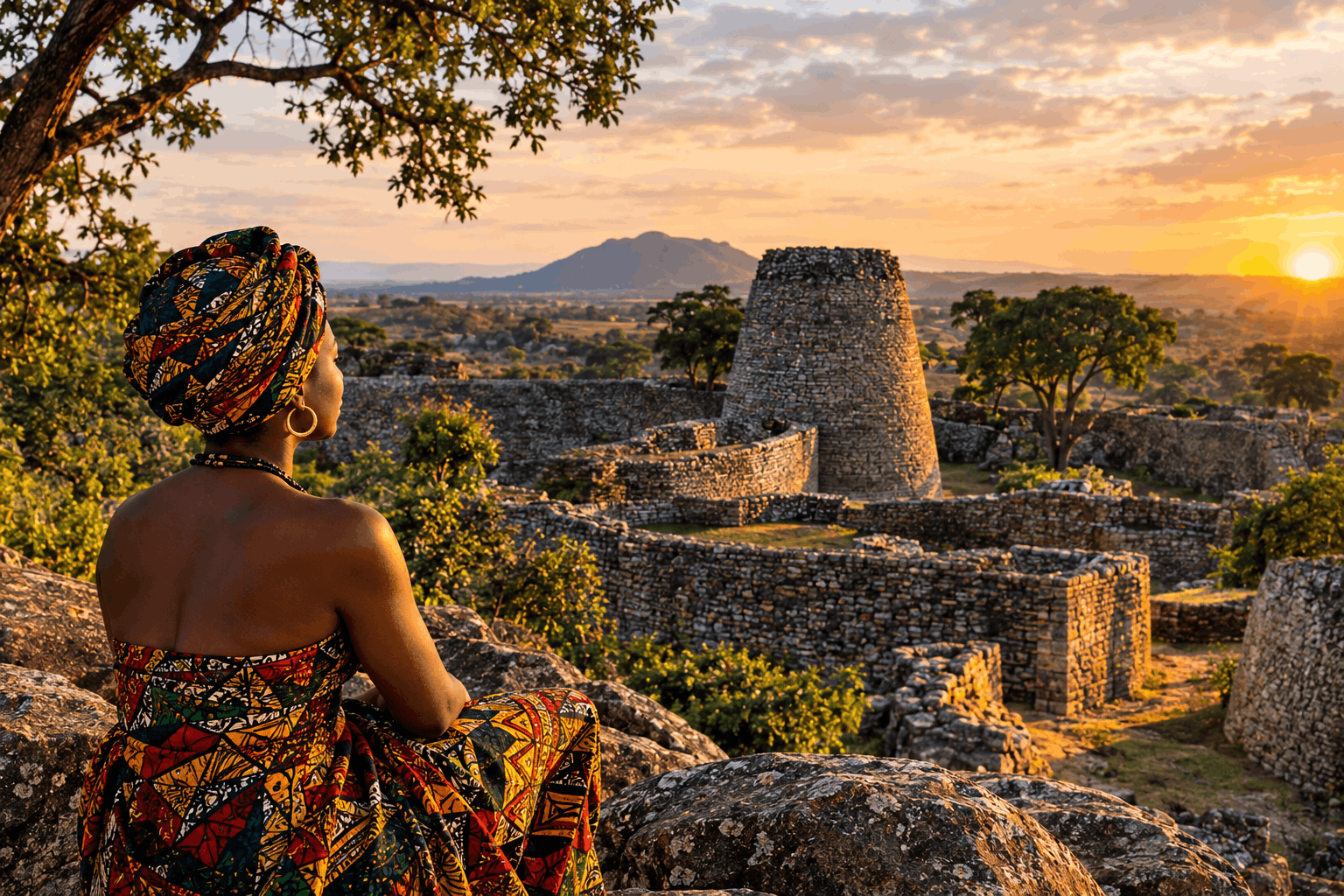
The builders of Great Zimbabwe worked mainly with granite blocks and constructed the great walls without mortar. Instead of binding the stones together with cement or another material, they arranged and balanced them carefully so that the walls could support themselves. The settlement was built and occupied between about 1100 and 1450, by African communities associated with the ancestors of today's Shona-speaking peoples. By the 14th century, Great Zimbabwe had become the principal city of a major state in the region, and UNESCO estimates that its population eventually exceeded 10,000 people.
The city was also part of a much wider trading world. Archaeological excavations have uncovered Chinese and Persian ceramics, glass beads and coins associated with Kilwa on the East African coast, alongside evidence of gold production in the surrounding region. These finds show that Great Zimbabwe was connected to trade networks that reached from the interior of southern Africa towards the Indian Ocean.
That evidence became particularly significant because later generations would argue fiercely about who had built the city. During the colonial period, some European writers and officials found it difficult to accept that an African society had constructed such monumental architecture. Various theories attributed Great Zimbabwe to Phoenicians, Arabs, biblical peoples or other outsiders. Archaeological research did not support those explanations, but they influenced how the ruins were described and understood for decades.
The name of the modern country eventually came from the ancient site itself. "Zimbabwe" is a Shona name associated with Great Zimbabwe and is commonly explained through words referring to houses or buildings of stone. The precise linguistic history is more complicated than a single neat translation, but the connection between the ancient settlement and the country's modern name is well established.
Great Zimbabwe therefore gives us a useful starting point for understanding Zimbabwe because the site brings together several parts of the country's history at once. It tells us about African political organisation and architecture, but it also opens a conversation about trade, language, colonialism and the struggle over how African history has been represented.
Great Zimbabwe was a large settlement with political and economic importance
In this section
The imported ceramics, beads and coins found at Great Zimbabwe provide physical evidence of those connections.
When people first see photographs of Great Zimbabwe, it is usually the walls that attract their attention. Those walls are extraordinary, but they were only one part of a much larger settlement in which people lived, produced food, kept livestock, worked with different materials and participated in political and economic life.
The site covers almost 800 hectares and is generally divided into three main areas known as the Hill Ruins, the Great Enclosure and the Valley Ruins. The Great Enclosure is particularly famous because of its enormous curved outer wall, which extends for roughly 250 metres. Building something on that scale without mortar required considerable knowledge of stonework as well as the ability to organise large amounts of labour.
The settlement's importance also came from what was happening beyond its walls. Gold was produced in the surrounding region, and cattle, crops and other goods supported the communities living there. Some of these products entered long-distance trade networks, eventually reaching the East African coast and connecting the interior with merchants operating across the Indian Ocean. The imported ceramics, beads and coins found at Great Zimbabwe provide physical evidence of those connections.
The presence of imported objects has sometimes been misunderstood as evidence that outsiders must have built the city. Archaeology shows something quite different. The architecture, settlement remains, agricultural systems and other material found at Great Zimbabwe place the development of the city within the history of African societies in southern Africa. Foreign goods indicate trade, not foreign authorship.
Great Zimbabwe eventually declined as a political centre around the 15th century. Archaeologists have considered several possible reasons for this change, including pressure on local resources and the effects of deforestation, although the evidence does not point to one single explanation that accounts for everything that happened.
The political world of the region continued to develop after Great Zimbabwe's decline, and other centres became important in the centuries that followed.
Other African states developed after Great Zimbabwe
In this section
Other political formations developed across the region as well, including the Torwa state and the Mwene Mutapa state.
One of the clearest examples is Khami, located near present-day Bulawayo. Khami became an important political centre after Great Zimbabwe and continued the region's tradition of monumental dry-stone construction. Its walls and terraces show that skilled stone building did not disappear when Great Zimbabwe declined. Archaeological discoveries at Khami also include imported ceramics, demonstrating that long-distance trade remained part of the region's economy. UNESCO recognises Khami as a World Heritage site alongside Great Zimbabwe.
Other political formations developed across the region as well, including the Torwa state and the Mwene Mutapa state. These states had their own histories and forms of political authority, so Zimbabwe's precolonial past is better understood as a changing collection of societies and centres of power rather than as one kingdom that appeared, disappeared and left the region empty.
The people who lived in these societies also had different identities and political affiliations. The term "Shona" is widely used today to describe Zimbabwe's largest ethnolinguistic population, but it should not be projected backwards as though every community in the region belonged to one unified Shona nation throughout the entire precolonial period.
This distinction becomes particularly useful when looking at another major population that became established in what is now Zimbabwe during the 19th century: the Ndebele.
Mzilikazi established an Ndebele state in the southwest
In this section
The people who became part of this state did not all share the same background.
The history of the Ndebele in Zimbabwe is connected to the political upheavals that affected southern Africa during the early 19th century. Mzilikazi Khumalo had been associated with the Zulu kingdom under Shaka before leaving the area with his followers. After years of movement and conflict, he travelled north and west and eventually established an Ndebele state in what is now southwestern Zimbabwe.
The people who became part of this state did not all share the same background. As Mzilikazi's forces moved through the region and established political control, different communities were incorporated into the new state in different ways. Over time, the Ndebele kingdom therefore became a diverse society rather than a community consisting only of people who had migrated with Mzilikazi.
The Ndebele state became a significant political power in the region, while Shona-speaking societies continued to exist across other parts of the territory. Their relationships varied according to circumstances and included conflict, competition, alliances and the incorporation of communities.
This is why the history is more complicated than a straightforward story of Shona people on one side and Ndebele people on the other. Both labels describe populations whose histories developed over time, and both existed within political systems that were themselves changing.
European colonial expansion would soon introduce another political system altogether, one that transformed land ownership and political authority across the region.
Colonial rule transformed land ownership and political power
In this section
The resulting land inequality became one of the central political issues of the territory's later history.
The British South Africa Company established control over the territory during the 1890s, after which European settlement expanded and the colonial administration developed institutions that gave settlers increasing control over land and political power.
The unequal distribution of land did not happen through one single event. It developed over decades through legislation, settlement and restrictions on African land ownership and use. One of the most consequential laws was the Land Apportionment Act of 1930, which formally divided land according to race and reserved large areas for white ownership while restricting Black Africans to designated areas.
The resulting land inequality became one of the central political issues of the territory's later history. At the same time, the colonial government restricted African political participation and maintained a political system in which the white minority exercised disproportionate power.
The territory was known as Southern Rhodesia during this period. In 1965, the white-minority government led by Ian Smith declared unilateral independence from Britain because it opposed a transition to majority rule. The declaration became known as the Unilateral Declaration of Independence, or UDI.
The political conflict did not end with UDI. Instead, armed nationalist movements became increasingly important during the following decade. ZANU's military wing, ZANLA, and ZAPU's military wing, ZIPRA, became the two principal African nationalist forces involved in the liberation war.
The war was fought through military campaigns, but political organisation and rural communities were also central to it. In some areas, religious beliefs and traditional authorities became part of the way communities understood the conflict, which brings us back to the role of spirit mediums.
Spirit mediums influenced how some communities experienced the liberation war
In this section
Historians have documented these relationships in studies of spirit mediums, guerrilla fighters and war veterans.
Christian missionary activity had expanded considerably during the colonial period, but traditional religious practices continued to play an important role in many Zimbabwean communities. Among Shona-speaking communities, a svikiro is a spirit medium who may be understood as an intermediary between living people and ancestral spirits.
During the liberation war, some spirit mediums became important figures within communities involved in the nationalist struggle. Fighters and civilians sometimes sought guidance through mediums, while some guerrilla leaders recognised the authority that these religious figures held within rural communities.
For the people who participated in these practices, the spiritual dimension of the war was not separate from everyday political and military life. Religious beliefs could influence how people understood their obligations to their communities, how they interpreted events during the conflict and whom they considered legitimate sources of authority. Historians have documented these relationships in studies of spirit mediums, guerrilla fighters and war veterans.
Zimbabwe achieved independence in 1980, bringing an end to white-minority rule and creating a new political state. Robert Mugabe became prime minister and later president, beginning a period of leadership that would last for 37 years.
The new government inherited a country in which political independence had been achieved, but many of the inequalities created under colonial rule remained, particularly the unequal distribution of agricultural land.
Independence brought expanded public services and a difficult struggle over land
In this section
The Fast Track Land Reform Programme, launched in 2000, dramatically changed that pattern of land ownership.
The early years after independence saw significant expansion in access to education and healthcare. The government also faced the question of how to redistribute agricultural land in a country where large areas of productive farmland remained concentrated in the hands of a relatively small number of white commercial farmers.
The Fast Track Land Reform Programme, launched in 2000, dramatically changed that pattern of land ownership. According to World Bank analysis, more than ten million hectares were transferred to hundreds of thousands of households through different resettlement schemes.
The programme addressed a longstanding colonial land imbalance, but the way it was implemented also caused serious disruption to commercial agriculture. Agricultural production declined substantially during the early years, while the country was simultaneously dealing with political conflict, international pressure and other economic problems.
The results were not identical everywhere. Later research has documented cases in which farmers who received land through the reform programme established productive farms and improved their livelihoods. The long-term agricultural effects therefore varied between regions, farmers and types of landholding.
At the same time, Zimbabwe's wider economy was entering an extremely difficult period. By 2008, the country was experiencing hyperinflation at a level that made ordinary economic activity increasingly difficult. The IMF estimated that inflation reached roughly 500 billion percent in September 2008. The Zimbabwe dollar became effectively unusable for most everyday transactions, and foreign currencies, particularly the US dollar, became widely used.
The economic crisis contributed to a period of large-scale migration, with Zimbabweans establishing communities in neighbouring countries and farther abroad. The political situation also changed significantly in 2017, when Mugabe resigned after a military intervention and mounting political pressure. Emmerson Mnangagwa subsequently became president.
The political system has continued to change since then, including through a significant constitutional amendment in 2026.
Zimbabwe changed its constitutional arrangements in 2026
In 2026, Zimbabwe enacted the Constitution of Zimbabwe Amendment (No. 3) Act, which changed several aspects of the country's political system.
Among the changes, the amendment provides for the president to be elected by members of Parliament sitting jointly rather than through a direct popular presidential election. It also changes the terms of the presidency, Senate, National Assembly and National Council of Chiefs from five years to seven years. The Act was signed and published in July 2026.
The amendment has also been the subject of a legal dispute. Veritas, a Zimbabwean legal and parliamentary-monitoring organisation, has argued that provisions affecting the length of terms required a referendum under the Constitution and therefore did not properly come into force without one. That is Veritas's legal position on the matter, rather than an uncontested description of the amendment's legal status.
These constitutional changes form part of a much longer political history in which the way Zimbabwe is governed has changed repeatedly, from colonial rule to independence and then through successive constitutional arrangements after 1980.
Political institutions are only one part of how Zimbabwe is organised, however. Everyday life is also shaped by the country's considerable linguistic diversity.
Zimbabwe has 16 officially recognised languages
Shona and Ndebele are the two most widely spoken mother tongues in Zimbabwe, but they represent only part of the country's linguistic picture.
The 2022 Population and Housing Census recorded Shona as the mother tongue of 80.9 percent of the population and Ndebele as the mother tongue of 11.5 percent. Ndau accounted for 2.7 percent and Tonga for 1.7 percent, while smaller proportions reported languages including Shangani, Venda, Kalanga, Nambya, Sotho, Chewa and Xhosa.
These figures describe people's reported mother tongues rather than their ethnic identities. That matters because language, ancestry and cultural identity do not always correspond perfectly, particularly in a country where communities have interacted, migrated and intermarried over many generations.
English remains widely used in government, formal education and business, while local languages continue to be central to family life and community communication.
One of those languages, Tonga, is closely connected to one of the country's most significant stories of displacement and development.
The construction of Kariba Dam displaced Tonga communities
In this section
Families were moved away from the river and from settlements where they had lived for generations.
The Tonga people have lived for generations along the Zambezi River, including in areas that are now part of northern Zimbabwe and southern Zambia. Their lives were closely connected to the river through farming, fishing and other forms of local economic and cultural activity.
The construction of Kariba Dam in the 1950s transformed that environment. The dam created Lake Kariba and became an enormous infrastructure project, but creating the reservoir also required the relocation of Tonga and Goba communities from areas that would be flooded.
Families were moved away from the river and from settlements where they had lived for generations. The consequences went beyond losing houses. Relocation changed access to farmland and fishing grounds and disrupted connections to places that held cultural and spiritual significance.
The effects of the original displacement also continued for decades. Research on Tonga communities has documented long-term social and economic consequences, as well as later periods of secondary displacement associated with the liberation war, independence and other changes affecting the region.
The history of Kariba is therefore part of Zimbabwe's story of infrastructure and development, but it is also part of the country's history of communities adapting to changes imposed on the places where they had built their lives.
Questions of land, ancestry and community appear again in Zimbabwe's religious traditions.
Christianity and traditional religious practices have existed alongside each other
In this section
The mbira provides one of the clearest examples of how music can carry both cultural and religious meaning.
Christianity is the largest religious affiliation in Zimbabwe. The 2022 census recorded about 85 percent of the population as Christian, while around 5 percent reported African traditional religion and about 8 percent reported no religion.
Census categories, however, cannot capture every aspect of religious life. Some Zimbabweans attend Christian churches while also maintaining family practices connected to ancestors and traditional religious beliefs.
Among some Shona communities, mhondoro can refer to powerful ancestral spirits, while svikiro refers to a spirit medium who acts as an intermediary between living people and the spirit world. These concepts belong to particular religious traditions and should not be assumed to describe every Zimbabwean community.
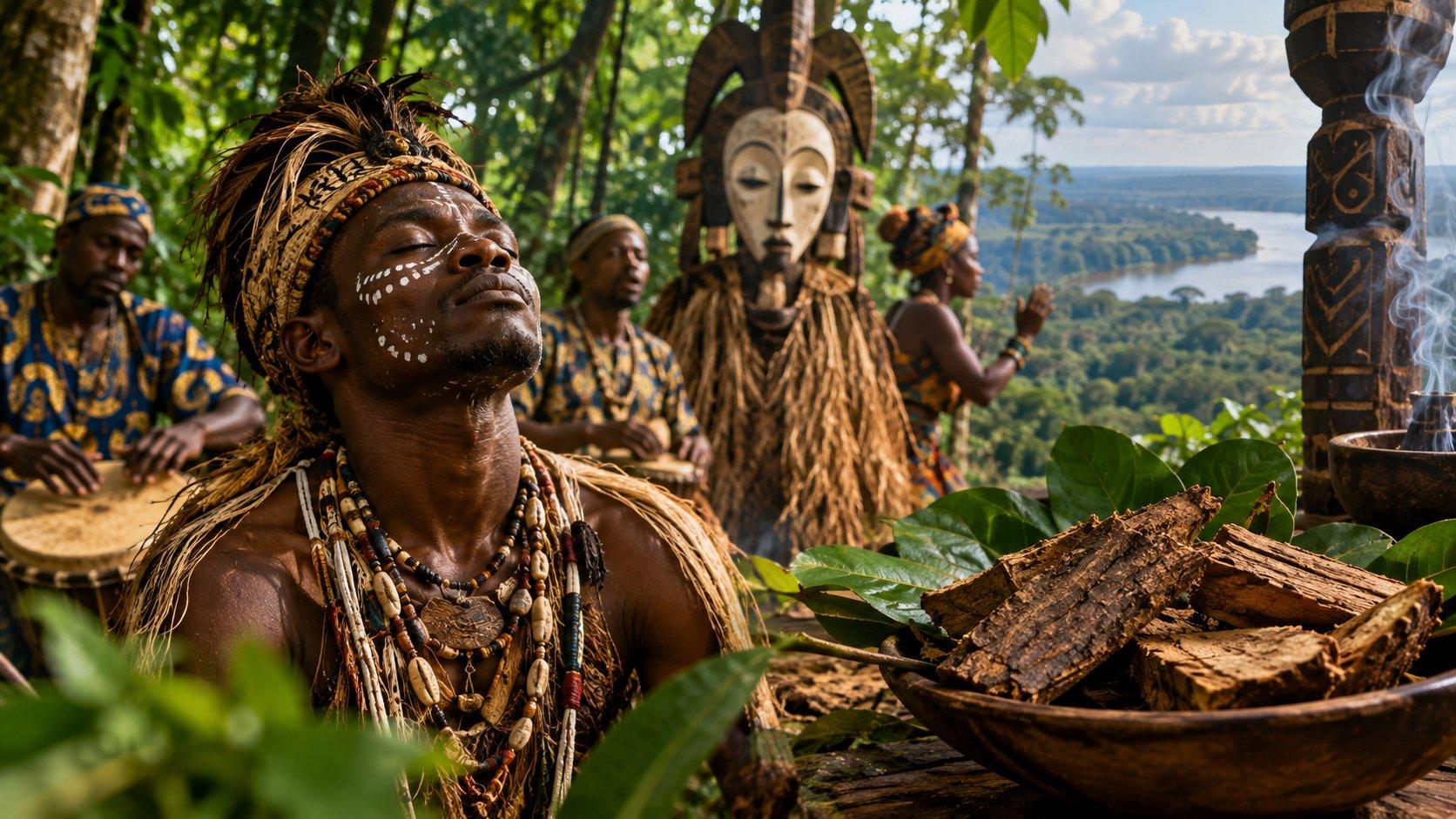
The bira is one ceremony in which these traditions may come together. It can involve singing, dancing, drumming, mbira music, food and communication with ancestors, although the exact form and purpose of a bira can vary between communities and families.
This is one reason Zimbabwean religious life cannot always be understood by treating Christianity and traditional religion as completely separate categories. For some families, Christian worship and older cultural practices have existed alongside one another, while others follow one tradition more exclusively.
The mbira provides one of the clearest examples of how music can carry both cultural and religious meaning.
The mbira carries centuries of musical tradition into modern Zimbabwe
The mbira is one of Zimbabwe's best-known musical instruments and is particularly associated with Shona musical traditions.
The instrument is a type of lamellophone, meaning that its sound comes from a series of thin metal keys attached to a wooden soundboard. A mbira is often placed inside a large calabash resonator called a deze, which amplifies the sound.
In ceremonies such as the bira, mbira music can form part of communication with ancestral spirits. The instrument, however, is not restricted to religious ceremonies. Mbira players also perform for entertainment, teaching, recording and contemporary musical projects.
That flexibility has allowed the instrument to move between traditional settings and modern musical life. Musicians have incorporated mbira patterns into new compositions, worked with electric instruments and introduced the sound to audiences outside Zimbabwe. Collections such as those held by the Smithsonian also document the instrument and the traditions surrounding it.
Zimbabwean musicians have also used traditional musical ideas to respond to the country's political history, most famously through the work of Thomas Mapfumo.
Thomas Mapfumo brought Chimurenga music to a wider audience
Thomas Mapfumo became one of Zimbabwe's most influential musicians through a style widely known as Chimurenga music. The word is associated with struggle and resistance, and Mapfumo used it to create music that connected Zimbabwean musical traditions with modern instruments and contemporary political concerns.
His music drew on patterns associated with traditional music, including ideas connected to the mbira, while using electric guitars, drums and other instruments. During the liberation struggle, his songs became associated with the nationalist movement and the political aspirations of people fighting colonial rule.
After independence, Mapfumo continued to address political issues through his music. His work eventually brought him into conflict with the government, and he later spent many years living in the United States.
His career demonstrates how Zimbabwe's cultural traditions have continued to change rather than remaining confined to older forms. The same process can be seen in the country's visual arts, particularly in its internationally recognised stone sculpture.
Zimbabwean stone sculpture developed into an international art movement
In this section
The sculptures themselves have explored subjects including human figures, animals, spirits and family relationships.
Zimbabwe developed a distinctive modern stone-sculpture movement during the 20th century, with local stone becoming an important material for artists working in and around the country's growing art institutions.
The National Gallery of Rhodesia, under its first director Frank McEwen, played a significant role in promoting artists working with stone during the 1950s and 1960s. Artists such as Nicholas Mukomberanwa later became internationally recognised for their work.
A large amount of this sculpture was marketed internationally under the label "Shona sculpture." The term became widely established, but it can also make a diverse group of artists appear more culturally uniform than they actually were. Individual artists have drawn from different experiences, beliefs and artistic influences, even when their work has been grouped together by galleries and collectors.
The sculptures themselves have explored subjects including human figures, animals, spirits and family relationships. Some artists have worked directly with traditional themes, while others have developed more personal interpretations of Zimbabwean life.
Tengenenge, an artists' community established in northern Zimbabwe in 1966, also became an important centre for stone sculpture. Together, these developments helped make Zimbabwean sculpture known to audiences far beyond the country.
Another Zimbabwean artistic tradition has become equally recognisable for the way it transforms everyday spaces.
Ndebele women turned house walls into large-scale works of art
Ndebele women are particularly known for painted houses and beadwork, traditions that have become closely associated with Ndebele cultural identity.
Exterior walls can be covered with geometric designs arranged in carefully defined shapes and colours. The designs vary between artists, families and communities, so there is no single pattern or fixed meaning that applies to every Ndebele house.
Beadwork has similarly deep connections to social life. Necklaces, aprons, garments and other objects can communicate information about identity, age, marital status and social position, depending on the particular tradition and the object being made.
These art forms are sometimes presented internationally as examples of African decorative design, but within Ndebele communities they have developed through everyday cultural practices and have carried meanings connected to family, identity and social relationships.
Those connections between culture and community become particularly visible during ceremonies.
Ceremonies bring together family, community and cultural traditions
In this section
The bira, for example, can bring together singing, dancing, drumming and mbira playing as part of a ceremony connected to ancestors in some Shona communities.
Zimbabwe has many ceremonial traditions, and the details vary considerably between ethnic groups, religions, regions and families.
The bira, for example, can bring together singing, dancing, drumming and mbira playing as part of a ceremony connected to ancestors in some Shona communities. Its form and purpose can differ depending on the people involved, which is why it is better understood as a family of related practices than as one identical ceremony performed everywhere.
Marriage traditions also vary, although lobola, or bridewealth, has historically been part of marriage negotiations in many Zimbabwean families and in other southern African societies. The process generally involves discussions between families about gifts or payments associated with the marriage, with the details depending on the community and the circumstances of the families involved.
Funerals can bring together another combination of traditions. A Zimbabwean funeral may include a Christian service, traditional customs, speeches, music, food and extended family obligations, depending on the beliefs of the family.
These practices have also changed as Zimbabwean families have moved between rural and urban areas, migrated to other countries, joined different churches and adapted older customs to contemporary life.
That ability to carry older traditions into new circumstances is part of what makes Great Zimbabwe itself so significant to the country.
Great Zimbabwe became a powerful symbol of Zimbabwean history
In this section
European theories that attributed the ruins to outsiders were eventually contradicted by archaeological evidence.
The significance of Great Zimbabwe is not limited to the fact that its walls have survived for centuries. The site became important because of what it revealed about African history and because of the way its history was contested during colonial rule.
European theories that attributed the ruins to outsiders were eventually contradicted by archaeological evidence. Excavations, dating techniques, architectural analysis, settlement evidence and the study of artefacts established Great Zimbabwe as an African centre of political and economic life that developed within the societies of southern Africa.
Archaeology has also shown that the city was connected to long-distance trade. The imported ceramics, beads and coins found there demonstrate that people living at Great Zimbabwe participated in commercial networks reaching the Indian Ocean, while the architecture and settlement itself demonstrate the capacity of African societies in the region to organise large-scale construction and urban life.
There are still questions that archaeologists cannot answer with complete certainty. Researchers continue to investigate how political authority was organised, how different groups within the settlement lived and worked, and why the city eventually ceased to function as the region's principal political centre.
The site also retains spiritual significance for some communities. UNESCO notes that parts of Great Zimbabwe continue to have traditional spiritual associations, meaning that the ruins are not only an archaeological resource but also a place that remains connected to living cultural traditions.
That combination of ancient history, archaeological evidence and continuing cultural meaning helps explain why the site became such an important national symbol.
Zimbabwe still carries the name of an ancient African city
In this section
People have moved, cities have grown, families have migrated and new influences have entered everyday life.
Great Zimbabwe is now one of the most important archaeological sites in Africa and a UNESCO World Heritage site, but its significance extends well beyond the stone walls themselves.
The site takes us into the history of African state formation and long-distance trade, while the modern country carries its name into a very different era shaped by colonialism, independence, migration, economic crisis and constitutional change.
Zimbabwe's cultural life has developed through the interaction of many communities and traditions. Shona, Ndebele, Tonga and other languages continue to be spoken across the country. Christian churches exist alongside older religious practices in some families and communities. The mbira continues to be played in ceremonial and contemporary settings, while stone sculpture, Ndebele painting, beadwork, food and other traditions continue to evolve.
None of these traditions exists exactly as it did centuries ago. People have moved, cities have grown, families have migrated and new influences have entered everyday life. Older practices have been adapted rather than left untouched.
That makes the name Zimbabwe particularly fitting. The ancient city of Great Zimbabwe belongs to a history that began long before the modern state, but its name continues to be carried by millions of people living in the country today.
The walls remain in the landscape, while the history they represent continues to be part of how Zimbabwe understands itself.