Discover Kuomboka, Zambia’s famous royal ceremony, and explore the country’s Lozi heritage, ethnic diversity, languages, traditional chiefs, food, music and culture.
Each year, toward the end of the rainy season in western Zambia, the Zambezi River rises and spreads across the Barotse floodplain. Water covers large parts of the plain, changing the routes people use and the places where they can move easily. For the Lozi people who live in this part of Zambia, the annual flood has always been part of the landscape around which life is organized.
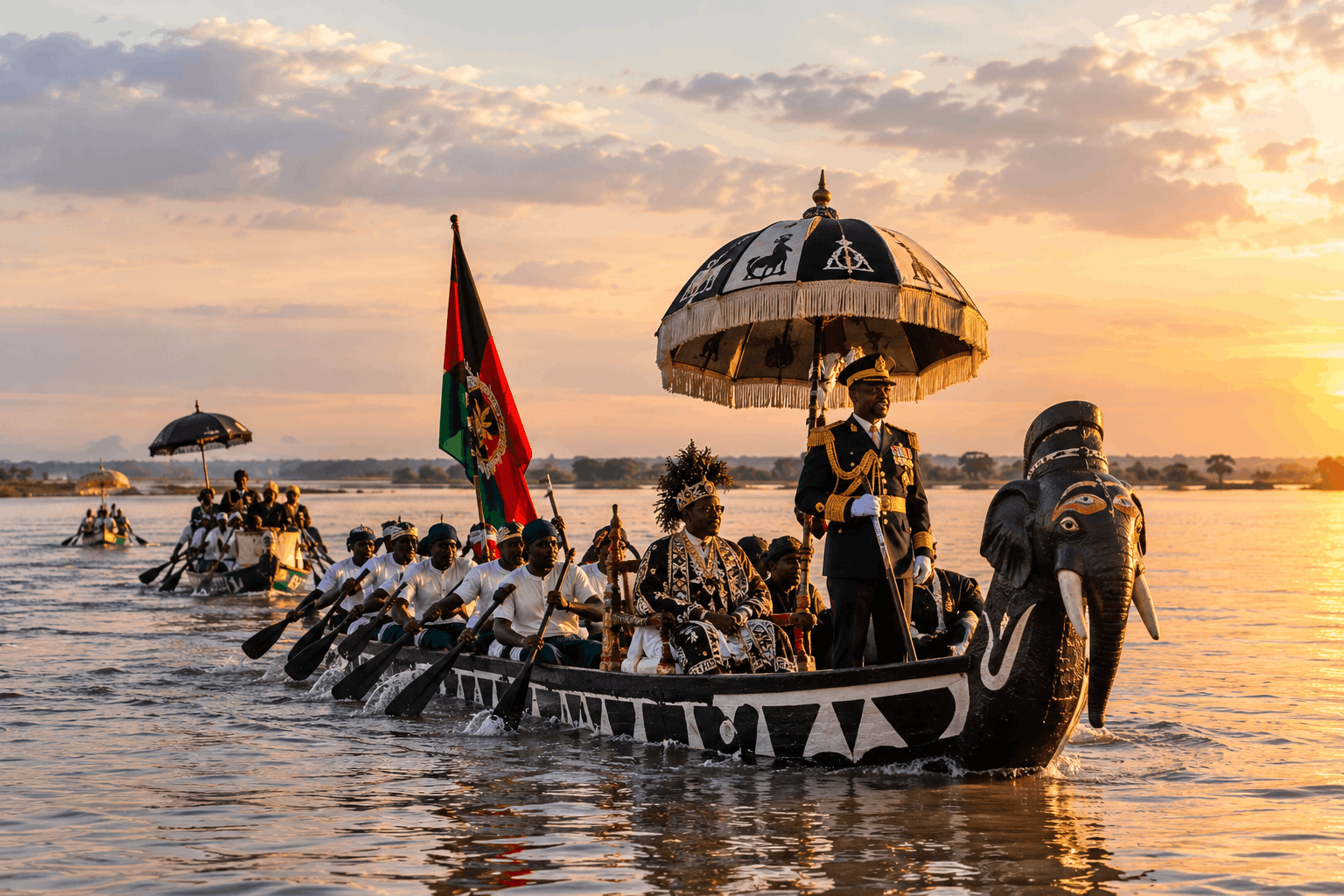
It is also the time when the Litunga, the traditional ruler of the Lozi people, leaves his residence at Lealui and travels to Limulunga, which sits on higher ground. The journey is known as Kuomboka, a Lozi word generally translated as "getting out of the water."
The journey has become one of Zambia's best-known traditional ceremonies. The Litunga travels aboard the Nalikwanda, a large black-and-white royal barge paddled by about 100 men. A carved elephant stands on the boat, drums accompany the procession, and separate boats carry the Litunga's wife and his Prime Minister. Scout canoes travel ahead of the main procession to check the waterway before the royal boats begin their journey.
The movement takes several hours, turning what began as a seasonal journey into a large public occasion. Along the way, the Litunga changes from traditional clothing into the full uniform of a British admiral. King Edward VII presented the uniform to the Litunga in 1902, and it has remained part of the ceremony ever since.
There is a lot of history contained in that one moment. The floodplain is ancient, the Lozi monarchy predates British colonial rule, and the royal procession follows a route shaped by the seasonal movement of the Zambezi. Yet the Litunga also wears an object that arrived during the colonial period. Over time, these different periods have become part of the same ceremony.
Kuomboka therefore offers a natural introduction to Zambia because it brings together several things that appear throughout the country's history: geography, political authority, older traditions and newer influences. The flood determines when the journey takes place. The monarchy gives the journey its political meaning. The community gives the ceremony its social life, and history has added new layers to the way it is performed.
The Lozi are one of many communities whose history now falls within the borders of Zambia. The country's tourism authorities describe Zambia as home to 73 ethnic tribes and more than 100 traditional ceremonies, with more than 30 taking place annually. Each community has its own history, and those histories produced different forms of leadership, language, belief and social organization long before Zambia became an independent country.
Understanding Zambia means following those histories across the territory and then seeing how they came together within the modern state.
The societies that existed before Zambia
In this section
One of its best-known expressions is Gule Wamkulu, a ritual dance performed in Zambia, Malawi and Mozambique.
The communities living in present-day Zambia developed over long periods of migration, settlement, exchange and interaction across central and southern Africa. Many are Bantu-speaking, but their political systems and social institutions developed differently according to their own histories and environments.
In western Zambia, the Lozi developed a centralized monarchy headed by the Litunga. The kingdom became closely connected to the upper Zambezi floodplain, and the seasonal movement between Lealui and Limulunga eventually became one of the clearest public expressions of that relationship.
Further north, Bemba-speaking communities developed their own systems of chiefly authority and political organization. The Bemba are now Zambia's largest ethnic group, accounting for 25.4 percent of the population in the 2022 census. Tonga people accounted for 14.9 percent, Chewa 8.9 percent and Lozi 6.5 percent.
The Tonga developed along a different political path. Communities were organized through local leaders, kinship structures and social and ritual institutions rather than a single centralized monarchy. Authority was distributed through these local relationships, giving communities ways to organize social life, settle matters and maintain relationships across different settlements.
Further east, Chewa communities became part of the wider Maravi political world, which extended across territory that now lies in Zambia, Malawi and Mozambique. The history of the Chewa is therefore closely connected to a region that existed long before the borders of those three countries were drawn.
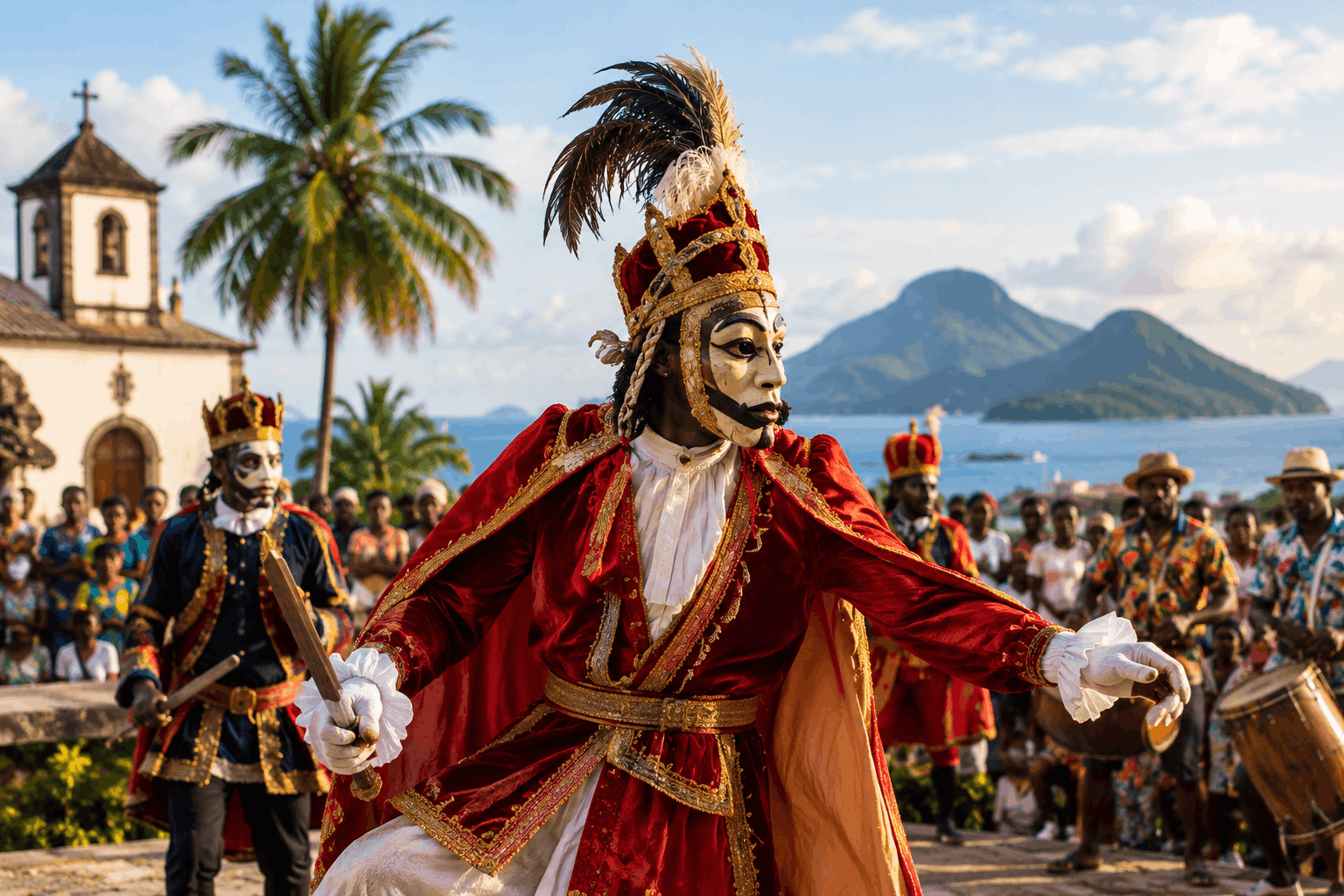
That wider history can still be seen in cultural practices today. Among Chewa communities, the Nyau tradition includes initiation, ritual knowledge and masked performances. One of its best-known expressions is Gule Wamkulu, a ritual dance performed in Zambia, Malawi and Mozambique.
The masked dancers represent different figures within the tradition's ritual world, including spirits, the dead and animals. Performances can communicate ideas about morality, social conduct and community responsibilities, while also forming part of the wider ritual life of the communities that practice them.
Looking at Gule Wamkulu alongside Kuomboka reveals how different Zambia's cultural histories can be. In the west, a royal procession follows the seasonal flooding of the Zambezi. In the east, a masked ritual tradition connects communities across three modern countries. Both developed within societies that existed long before Zambia had its present borders.
Those borders came much later, during the period of European colonial expansion.
How Northern Rhodesia changed the map
In this section
Through all of these changes, the identities that existed before independence continued to shape everyday life.
British colonial rule gradually reorganized the territory politically and economically. The area became known as Northern Rhodesia, with the British South Africa Company playing an important role in its earlier administration before direct British rule was established.
The growth of copper mining then brought another major transformation. Large-scale mining expanded in the Copperbelt, creating employment and attracting workers from different parts of the territory. New towns grew around the mines, bringing together people who had previously lived in very different communities.
Urban life created new kinds of social contact. People speaking different languages worked alongside one another, formed families, joined churches, built neighborhoods and developed new forms of cultural expression. The experience of living in a mining town was different from life in a rural chiefdom, and both became part of the society that would eventually form independent Zambia.
By the time independence arrived, therefore, the territory already contained several layers of identity. There were ethnic communities with long histories, traditional authorities with established responsibilities, new urban populations shaped by wage labor and migration, and a growing sense of belonging to a common political territory.
On 24 October 1964, Northern Rhodesia became the independent Republic of Zambia. The new name came from the Zambezi River, with the Zambian government noting that the word "Zambezi" may mean "grand river."
Kenneth Kaunda became the country's first president. He remained in office until 1991, while his government promoted Zambian Humanism and used "One Zambia, One Nation" as a central expression of national unity.
Building that national identity required bringing together communities that already had strong identities of their own. People continued to speak their local languages, observe community traditions and recognize traditional leaders while participating in the institutions of the new republic.
The country was also becoming part of a much larger regional struggle. Kaunda's government supported liberation movements fighting colonial and white-minority rule elsewhere in southern Africa. Zambia hosted political organizations and activists, and its territory became an important base for movements operating in neighboring countries.
That regional role brought Zambia into conflicts beyond its borders. The country experienced economic disruption and security pressures as neighboring white-minority governments sought to weaken liberation movements operating from Zambian territory.
At home, the political system later changed as well. In 1991, Frederick Chiluba defeated Kaunda in a multiparty presidential election, ending Kaunda's long period in office and beginning a new phase of competitive party politics.
Through all of these changes, the identities that existed before independence continued to shape everyday life. One of the social traditions that helped connect different communities was the idea of ethnic cousinship.
The people who call one another cousins
In this section
The humor created room for familiarity and interaction while acknowledging the history between the groups.
In several Zambian communities, cousinship describes a socially recognized relationship between groups rather than a biological family connection. The relationship can involve joking, teasing, mutual obligations and cooperation, giving people a familiar way to interact across community boundaries.
One documented example is ichimbuya in Bemba contexts. Historical research describes cousinship relationships involving groups such as the Bemba and Ngoni, as well as relationships among communities in western Zambia. Some of these relationships grew out of earlier encounters, alliances and conflicts between neighboring communities.
Over generations, those histories became social relationships with their own rules. A person could joke with a recognized cousin in ways that might be inappropriate with someone outside the relationship. The humor created room for familiarity and interaction while acknowledging the history between the groups.
Scholars have examined these relationships as part of the social foundations of cooperation and integration in Zambia. Their significance varies from one community to another, but they offer an interesting example of how historical relationships can become part of everyday social life.
The idea becomes even more interesting when placed alongside Zambia's linguistic diversity. Communities could maintain their own languages and identities while developing social institutions that connected them to people from elsewhere.
A country speaking many languages
English is Zambia's official language, but much of everyday communication takes place in Zambian languages.
The 2022 census recorded Bemba as the most widely reported language of communication at home, at 34 percent of the population. Tonga accounted for 12.8 percent, Nyanja 11.4 percent, Chewa 6.7 percent and Lozi 5.4 percent. Other widely used languages include Nsenga, Tumbuka, Kaonde, Lunda and Luvale.
The figures become even more revealing when the country is divided between urban and rural populations. Bemba was reported as the main home language by 46.7 percent of the urban population, compared with 23.8 percent in rural areas. Nyanja was reported by 21.8 percent of urban residents and 3.1 percent of rural residents.
Migration and urbanization help explain part of this difference. Cities bring together people from different provinces and communities, creating multilingual environments in which people may use one language at home, another at work and English in particular formal settings.
Language also provides one of the clearest ways to see how identity works in Zambia. A person's ethnic identity, home language and everyday language may overlap, but they do not always match perfectly.
The same layered identity appears in traditional leadership.
Traditional chiefs in the modern state
When Zambia became independent, traditional chiefs remained part of community life. The Constitution recognizes the institution of chieftaincy and gives traditional institutions a defined place within the state.
Chiefs continue to hold customary authority within their chiefdoms, particularly in matters connected to community traditions and customary law. Their role exists alongside Zambia's elected government and constitutional institutions.
The House of Chiefs provides one of the clearest examples of this arrangement. It is constitutionally established and consists of five chiefs elected from each province. Through the House, traditional leaders have a formal institution through which matters concerning custom, tradition and customary law can be considered at the national level.
The arrangement reflects the way Zambia developed after independence. Modern state institutions were built across a country where traditional forms of leadership already had social legitimacy and local importance.
That same mixture of older institutions and newer national structures can be seen in religion.
Christianity and older cultural traditions
Zambia is overwhelmingly Christian. The 2022 census recorded Christianity as the religious affiliation of 98.0 percent of the population, while Islam accounted for 0.5 percent, African Traditional religion for 0.2 percent and 1.3 percent reported no religious affiliation.
Christianity also has a place in the country's constitutional identity. Zambia's Constitution declares the country a Christian nation while protecting freedom of conscience, belief and religion and recognizing its multi-religious and multi-cultural character.
Religious identity, however, does not capture every cultural practice. Someone may identify as Christian while also taking part in a customary ceremony, recognizing a traditional chief or maintaining cultural practices whose histories reach back to periods before Christianity became dominant.
Gule Wamkulu offers a good example of this continuity. The tradition developed within Chewa social and religious life and has continued among communities living in a predominantly Christian society. UNESCO has documented both its continuing importance and the changes it has experienced as social and economic conditions have changed.
Food offers another way to see how older traditions continue in everyday life.
The food people share
In this section
The dish has become commercially popular and can now be found in markets, supermarkets and restaurants.
Nshima is one of Zambia's most widely eaten staple foods. Made from maize meal, it is cooked into a firm porridge and served with a relish containing ingredients such as vegetables, groundnuts, fish or meat.
The combination is familiar across much of the country, while the relish changes according to region, household and available ingredients. This gives nshima a national presence without making Zambian food a single standardized cuisine.
Chikanda is quite different in preparation and history. It is made from the tubers of wild terrestrial orchids, combined with groundnuts and other ingredients to produce a firm cake.
The dish has become commercially popular and can now be found in markets, supermarkets and restaurants. That wider demand has also brought attention to the plants used to make it.
Research has identified 16 orchid species from six genera being traded for chikanda. Because the orchids are harvested from the wild, increased demand can place pressure on their populations, particularly where harvesting is intensive.
The story of chikanda connects the kitchen to Zambia's natural environment. A food tradition depends on particular plants, those plants are gathered from particular ecosystems, and changes in demand can affect the resources on which the tradition depends.
Other parts of Zambian cooking reflect the country's geography. Fish is important around major rivers and lakes, groundnuts appear in many sauces and vegetable dishes, and meat and vegetables are prepared in numerous regional styles.
Music follows a similarly varied path.
Music shaped by communities and changing times
Zambian musical traditions are closely connected to ceremonies, social gatherings and community life. Drums, singing and dance remain important, while other styles developed through urbanization, migration and the experience of colonial-era wage labor.
UNESCO records that the Kalela dance originated in Luapula Province during the colonial period and was adopted by mine workers. It later became part of ceremonies, funerals, harvest celebrations and other public occasions.
The dancers move in organized lines to a drumbeat, with lead dancers directing the formation. The tradition therefore grew out of a relatively recent historical experience and gradually became part of wider cultural life.
Other Zambian performance traditions have also received international recognition. UNESCO's intangible cultural heritage listings for Zambia include Gule Wamkulu, Makishi masquerade, Mooba dance of the Lenje, Budima dance and Kalela. Mangwengwe dance was added to the Representative List in 2024.
These traditions now exist alongside modern Zambian popular music, which draws from local languages, African musical influences, urban culture and international sounds.
Clothing provides another everyday expression of this mixture of local identity and wider exchange.
Chitenge and the things people wear
Chitenge is one of the fabrics most closely associated with everyday life in Zambia. The brightly patterned textile is used to make dresses, skirts, shirts and other clothing, and it can also be worn or wrapped without being made into a tailored garment.
The term covers more than one type of fabric. Research into contemporary Zambian textile culture shows that chitenge can include cotton, wax print, combinations of materials and synthetic fabrics.
Its uses are equally varied. People wear it for ordinary daily activities, church gatherings, ceremonies and family occasions. Designs change with fashion and textile markets, giving the fabric a place in both long-standing cultural practices and contemporary life.
Other crafts, including basketry, pottery, woodcarving and beadwork, are associated with particular communities and regions. The materials available locally, the history of a community and the purpose of an object all influence the forms these crafts take.
This regional variation is also visible in Zambia's ceremonial calendar.
A country with more than 100 traditional ceremonies
In this section
Zambia's tourism authorities describe more than 100 traditional ceremonies across the country, with more than 30 taking place annually.
Kuomboka is perhaps the ceremony most closely associated with Zambia outside the country, but it belongs to a much larger calendar of traditional events.
The Ngoni celebrate N'cwala, associated with the first-fruits season. The Bemba hold Ukusefya Pa Ng'wena. The Chewa observe Kulamba. The Luvale celebrate Likumbi Lya Mize, while the Lozi hold Kuomboka.
Zambia's tourism authorities describe more than 100 traditional ceremonies across the country, with more than 30 taking place annually.
The ceremonies mark different moments in community life. Some are connected to harvests and agriculture. Others affirm the role of a traditional leader, commemorate history, transmit knowledge through initiation or bring communities together through dance and ritual.
Their public visibility has also grown through tourism. Visitors can now encounter ceremonies that were once primarily experienced within their own communities, bringing new audiences and economic opportunities into the picture.
That increased visibility can also change how a tradition is presented. UNESCO's documentation of Gule Wamkulu, for example, describes the social and economic changes affecting the practice and notes the possibility of ritual performances being reduced to entertainment when separated from their wider context.
The ceremonies therefore continue to live in the communities that practice them while also becoming part of the way Zambia presents its cultural heritage to the wider world.
And this brings the story back to the floodplain where it began.
What Kuomboka reveals about Zambia
In this section
The Litunga travels from Lealui to Limulunga, following a route that has become part of Lozi royal tradition.
When the Litunga boards the Nalikwanda, several layers of Zambian history come together in one journey.
The water comes first. The Zambezi floods the Barotse plain, creating the environmental conditions for the annual movement.
The monarchy gives that movement its political meaning. The Litunga travels from Lealui to Limulunga, following a route that has become part of Lozi royal tradition.
The community turns the journey into a ceremony. Drums sound across the water, paddlers move the Nalikwanda forward, and the royal household travels together.
History appears in the details. The elephant on the boat belongs to the visual language of Lozi royalty, while the British admiral's uniform recalls the colonial period and the relationship established between the British monarchy and the Litunga in 1902.
The ceremony has therefore accumulated layers over time. Its meaning comes from the floodplain, the Lozi monarchy, the community that continues to practice it and the history that has become attached to it.
That combination can be found throughout Zambia.
Traditional institutions exist alongside constitutional government. Christianity is dominant while older cultural practices continue in different forms. English is the official language while many Zambian languages remain central to everyday communication. Nshima is widely shared across the country while regional foods retain their own histories. Traditional music continues alongside contemporary genres shaped by cities and global exchange.
Zambia's cultural life has developed through all of these layers.
Zambia today
In this section
Religious life is overwhelmingly Christian, while cultural practices with much older roots remain visible.
The country that exists today contains more than 70 ethnic communities, numerous languages and more than 100 traditional ceremonies. The 2022 census records Bemba as the largest ethnic group, alongside substantial Tonga, Chewa, Lozi, Tumbuka, Nsenga, Ngoni, Kaonde, Lunda, Namwanga, Lala, Luvale, Mambwe and many other communities.
Those identities continue to shape language, food, family life, ceremonies and local institutions. At the same time, people participate in a common national state, share cities and workplaces, use national institutions and develop cultural forms that cross older community boundaries.
The result is a country whose history can rarely be explained through one tradition alone.
A journey across the Barotse floodplain can lead into the history of the Lozi monarchy. That history opens onto the wider story of Zambia's many precolonial societies. Those societies were reorganized under colonial rule, brought into closer contact through mining and urbanization, and eventually became part of an independent republic.
The languages spoken across the country carry those histories forward. Traditional chiefs continue to hold customary roles. Religious life is overwhelmingly Christian, while cultural practices with much older roots remain visible. Food, music, clothing and ceremonies continue to change as people move, trade, worship, work and create new forms of expression.
And then, each year, the Zambezi rises again.
The water spreads across the plain, the route to higher ground opens, the drums begin, and the Nalikwanda moves across the floodwater carrying the Litunga towards Limulunga.
A ceremony that began as part of the seasonal life of the floodplain has become one of the clearest expressions of Zambian cultural continuity.
The landscape changes. The country around it has changed even more.