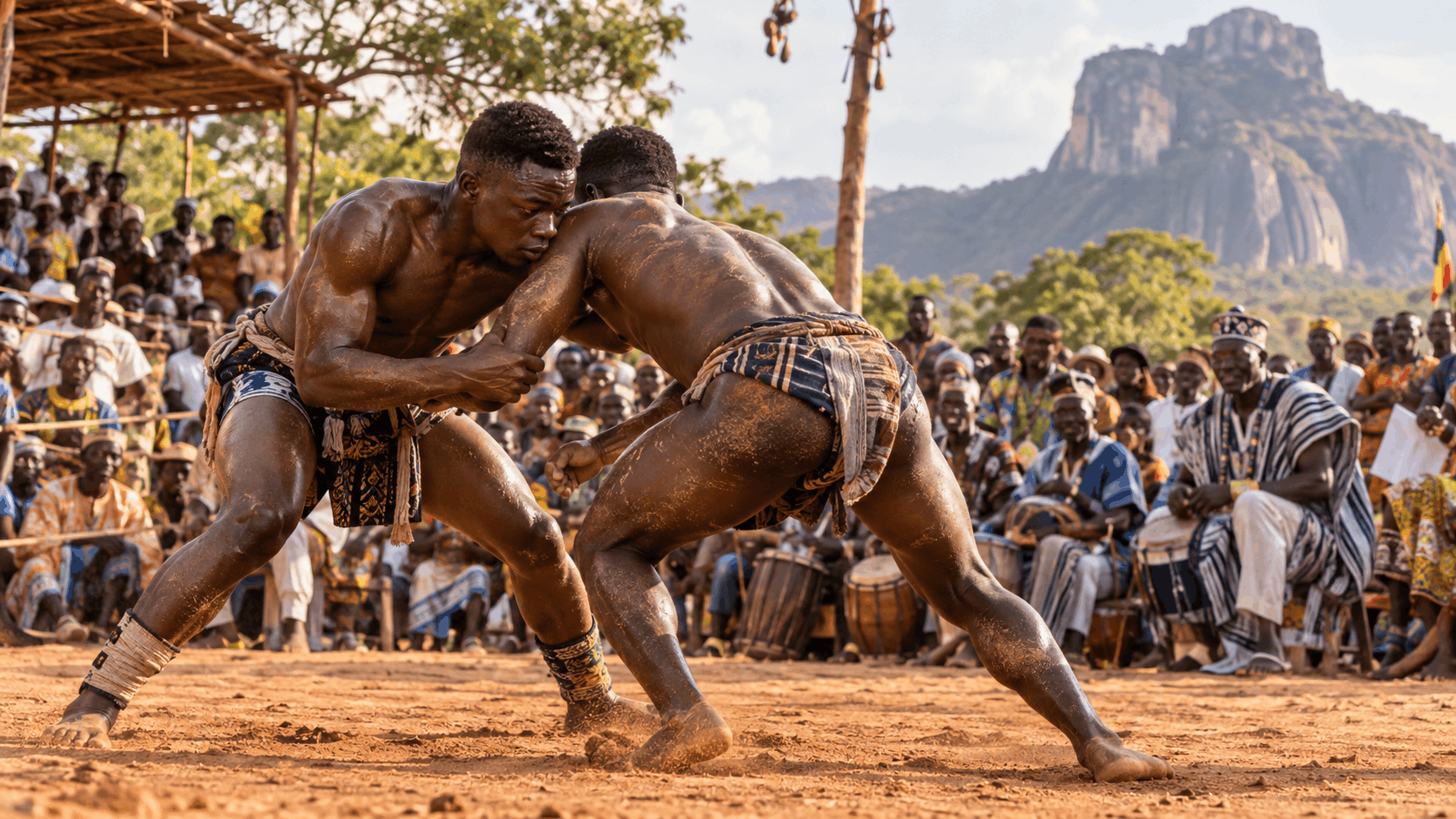
Every July, in the Kara region of northern Togo, young Kabye men enter wrestling arenas as part of Evala, an initiation tradition that marks their movement towards adulthood.
The wrestling is the part most visible to outsiders, but Evala lasts much longer than a single match. Initiation generally begins around the age of eighteen and unfolds over a three-year cycle. During that period, young men go through different stages of preparation, discipline and public participation before completing the Evala phase of the wider Kabye initiation system. Togolese cultural authorities describe the process as one through which young men gradually enter the adult age group. (atop.tg)
Some of the preparations are physical. Initiates traditionally eat dog meat, which Kabye explanations associate with qualities such as strength and endurance. Recent reporting has also documented three small ceremonial scarifications made near each ear. When the wrestling begins, participants compete for their communities while relatives and other spectators gather around the arenas with songs, dancing and encouragement. (atop.tg)
The wrestling therefore sits inside a much longer process. Physical ability matters, but the rite is equally about reaching a recognised stage of life within Kabye society.
Evala remains visible in Togolese public life. Faure Essozimna Gnassingbé regularly attends the celebrations. In July 2026, he was present when the year's wrestling began at Pya and later attended the closing matches in the Kara region.
His political position has changed since Togo adopted a new constitutional system. Since May 2025, Gnassingbé has served as President of the Council, the head of government and the country's principal executive authority. Jean-Lucien Kwassi Lanyo Savi de Tové is President of the Republic, a separate office with more limited powers under the new parliamentary system. (republiquetogolaise.tg)
Togo is a narrow country stretching roughly 600 kilometres from the Gulf of Guinea in the south towards Burkina Faso in the north. Much of its width falls between about 50 and 100 kilometres. Ghana lies to the west and Benin to the east. Within that small territory are communities with different languages, histories, religious traditions and systems of social organisation. (digitallibrary.un.org)
Where the culture came from
The territory that became modern Togo did not develop around one dominant precolonial kingdom or one cultural group.
In the south, Ewe-speaking and related communities established towns, chiefdoms and trading settlements linked to populations across what are now Ghana, Togo and Benin. Ewe migration into the region took place over several centuries, long before today's national borders existed. (2001-2009.state.gov)
Further north, Kabye communities developed in the mountainous areas around present-day Kara. Farming on steep and rocky land required methods suited to the terrain. One of them was terrace farming, where slopes are reshaped into flatter steps, often reinforced with stone. This makes steep land easier to cultivate and helps reduce soil erosion and water loss. The practice remains visible in Kabye farming areas today. (open.edu)
Kabye society also developed systems that organised people by age and stage of life. Initiation rites such as Evala formed part of that structure, marking the gradual movement from youth into adult responsibilities. (irepository.aua.ac.ke)
European colonial rule later reshaped the political map.
In 1884, Germany established a protectorate following a treaty signed at Togoville and gradually extended its authority inland. German Togoland was later described in colonial records as a "model possession", mainly because the territory became financially self-supporting. The phrase referred to the colony's usefulness to the colonial administration, not to the absence of exploitation or coercion. (1997-2001.state.gov)
Germany lost control of Togoland during the First World War. The territory was later divided between Britain and France under League of Nations mandates. Western Togoland was administered alongside the British Gold Coast, while the eastern territory came under French administration.
British Togoland later joined the Gold Coast, which became Ghana in 1957. French-administered Togo became independent on 27 April 1960. (history.state.gov)
The partition divided communities that had existed long before the border. Ewe-speaking populations, for example, ended up on both sides of what became the Ghana-Togo boundary. Shared language, family histories and cultural practices continued despite the new political division.
Togo's first years after independence were unstable.
Sylvanus Olympio, the country's first president, was assassinated during a military coup in January 1963. The coup is widely regarded as one of the earliest military seizures of power in postcolonial Africa. (loc.gov)
Gnassingbé Eyadéma took power in another coup in 1967 and remained president until his death in 2005. His 38 years in office made him one of Africa's longest-serving leaders.
His son, Faure Gnassingbé, succeeded him during a disputed political transition and remained President of the Republic until Togo's constitutional system changed.
Under the new constitution, Togo moved towards a parliamentary system. In May 2025, Faure Gnassingbé became the country's first President of the Council. The office leads the government and holds extensive executive power. Parliament elected Jean-Lucien Savi de Tové President of the Republic on the same day. (presidenceduconseil.gouv.tg)
The constitutional change remains politically contested. Opposition groups have argued that the new arrangement allows Gnassingbé to remain in power without the presidential term limits that applied under the previous system. The government presents the reform as Togo's transition to a parliamentary Fifth Republic.
Those disagreements follow years of demands for political reform. Large opposition protests in 2017 and 2018 called for presidential term limits and challenged the long rule of the Gnassingbé family.
Ethnic groups and languages
Togo is home to many ethnic and linguistic communities. Ewe-related groups in the south and Kabye communities in the north are among the most prominent, but they are far from the whole picture.
One published demographic estimate groups Adja, Ewe and Mina peoples at 42.4 percent of the population and Kabye and Tem at 25.9 percent. Other communities include Para-Gourma and Akan peoples, Akposso and Akebu communities, Ana-Ife and others. These categories simplify identities that can be more detailed at local level, but they give a clearer sense of the country's ethnic diversity. (cia.gov)
The Kabye are concentrated mainly in and around the Kara region. Their political prominence increased under Gnassingbé Eyadéma, who was Kabye, as is his son Faure Gnassingbé. During Eyadéma's rule, northern groups, particularly the Kabye, became strongly represented in the military and security establishment. (2009-2017.state.gov)
French is Togo's official language and is used in government, administration and formal education. Ewe and Mina are widely spoken in the south, while Kabye and other African languages are common in the north. (cia.gov)
Lomé sits directly beside the Ghanaian border, within a wider area where Ewe-speaking communities live on both sides. The border divides two countries, but it does not neatly divide language, family histories or culture.
Religion and belief
Religion in Togo includes Christianity, Islam and several indigenous religious traditions.
One published estimate places Christians at 42.3 percent of the population, followers of folk or traditional religions at 36.9 percent, Muslims at 14 percent and people with no religious affiliation at 6.2 percent. These figures describe religious identification, but they do not always capture how belief is practised. (cia.gov)
Religious identities can overlap. A person who identifies as Christian, for example, may still participate in family ceremonies linked to ancestral belief or Vodun. The US State Department has noted similar overlap in reports on religious life in the country. (2021-2025.state.gov)
Vodun, sometimes written Vodou, refers to a family of religious traditions with deep roots in this part of West Africa. Worship can involve divinities, ancestors, priests, ritual specialists and sacred places. Related traditions are practised across the border in Benin and among communities whose histories predate the boundaries separating the two countries.
January 10 is sometimes mentioned in discussions of Vodun in the region, but the date belongs specifically to Benin's national Vodun observance. It is not a Togolese national public holiday. Togo has its own Vodun ceremonies, communities and sacred sites.
Christianity expanded through European missionary activity. Islam spread through regional trade and contact with Muslim communities further north and across the Sahel. Today, formal religious affiliation and older family or ancestral practices can exist side by side.
Food
Togolese food varies by region, household and available crops, while sharing many ingredients and cooking methods with neighbouring parts of West Africa.
Two common staples are pâte and fufu.
Pâte is a thick dough-like food eaten with different sauces. Official Togolese tourism material lists versions served with spinach sauce, adémé, which is made from jute leaves, and kodoro, made with baobab leaves.
Fufu is prepared by boiling and pounding starchy foods until they become smooth and elastic. Yam and cassava are both used in Togo. It may be served with peanut sauce or other soups and sauces. (togotourisme.tg)
Other foods include ablo, a steamed fermented dough often eaten with sauce, and gaou, bean fritters commonly served with pepper. Maize, cassava and yam appear frequently across Togolese cooking. (togotourisme.tg)
There is considerable regional variation. Food in coastal communities and Lomé does not look exactly like food in the Plateaux region or northern Togo. The cuisine also shares ingredients and techniques with Ghana, Benin and other countries in the region because food traditions developed across communities that existed before today's borders.
Music, dance, and art
Music in Togo often accompanies ceremonies, celebrations and community gatherings.
Among Ewe-speaking communities, traditions such as Agbadza and Bobobo combine singing, percussion and dance. Bobobo developed as a social dance and became widely performed among Ewe communities in Ghana and Togo during the twentieth century. Agbadza has older links to Ewe war-dance traditions but is now performed in a range of social and ceremonial settings. (ir.ucc.edu.gh)
Music is part of Evala as well. Wrestling is accompanied by songs, dances and encouragement from relatives and supporters gathered around the arena. (republicoftogo.com)
Togo has produced musicians whose careers have reached audiences outside the country.
Bella Bellow, born Georgette Nafiatou Adjoavi Bellow, became one of the leading figures in Togolese popular music during the 1960s and early 1970s. She performed internationally, worked with musicians including Manu Dibango and built a career beyond Togo before dying in a road accident in 1973 at the age of 28. In 2023, the Togolese government marked the fiftieth anniversary of her death and recognised her place in the country's musical history. (republiquetogolaise.tg)
King Mensah belongs to a later generation. His work combines contemporary music with Togolese traditions, including elements of Ewe styles such as Agbadza and Akpessé, as well as Kabye dance and percussion. He performs in languages including Ewe, Mina and French and has built an international career. (agoenyive.mairie.tg)
Traditional music in Togo continues both inside ceremonies and through musicians who adapt older rhythms and styles for contemporary audiences.
Clothing, textiles, and craft
Textile trading has played a major role in Lomé's commercial history.
The city's Grand Market became known for the sale of pagne, the colourful printed cloth used widely for clothing across West Africa. The trade was closely associated with the Nana Benz, Togolese women traders who built powerful textile businesses and became some of the most successful merchants in the region. Official tourism material still links the Grand Market with this history. (togotourisme.tg)
Printed cloth can be wrapped or sewn into dresses, skirts, shirts and formal outfits. Clothing varies by region, age, religion, income, occasion and personal taste, so there is no single form of dress that represents everyday life across Togo.
Lomé is also home to the Akodessewa Fetish Market, where materials connected to traditional medicine and Vodun practice are sold. These include plants, animal materials, statuettes, amulets and other ritual objects. Togolese tourism authorities describe the market as a place associated with Vodun practice and traditional practitioners. (togotourisme.tg)
Many of the objects have specific religious or medicinal uses. Some are used in divination, healing, protection or ritual practice. The market continues to serve people who use these traditions rather than functioning only as a tourist attraction.
Festivals, ceremonies, and rites of passage
Evala is held every July in Kabye communities around Kara.
A young male initiate is known as an Evalou. He normally passes through three years of the Evala cycle before moving on to later stages within the age-grade system. Other rites, including Waah and Kondona, can follow at later stages of adult life and ritual status. (atop.tg)
The Kabye also practise Akpéma, a female initiation tradition associated with the transition of young women into adulthood. Historically, it has included ideas about womanhood, maturity and readiness for marriage, although its meaning and practice should not be assumed to be identical for every participant or generation. (irepository.aua.ac.ke)
Evala is promoted within Togo as an important part of Kabye cultural heritage. As of September 2026, however, it is not on UNESCO's Representative List of the Intangible Cultural Heritage of Humanity. (ich.unesco.org)
One Togolese tradition that has received UNESCO recognition comes from the south.
In 2025, UNESCO inscribed “The bearing of the sacred stone or the rites of the New Year in the Guin country in Togo.” The tradition involves a series of ceremonies carried out by the Guin people to honour divinities and ancestors and mark the beginning of the traditional New Year. Around twenty rituals take place over several months. (ich.unesco.org)
One of the best-known moments takes place during Épé-Ekpé at Glidji-Kpodji, near Aného. The ceremony includes the taking or revelation of the sacred stone, known as Kpessosso. Within the tradition, the stone's colour is interpreted as carrying a message about the year ahead.
On 3 September 2026, the Guin-Mina community celebrated the 363rd edition of Épé-Ekpé at Glidji-Kpodji. The stone revealed that year was white, which traditional authorities interpreted as a symbol of peace. (republiquetogolaise.tg)
Épé-Ekpé is the major traditional celebration associated with Glidji. Gbagba, another Togolese festival sometimes confused with it, is associated with communities elsewhere in the country rather than the sacred-stone ceremony at Glidji.
Some fun facts
The exact beginnings of Evala are difficult to establish because the tradition developed before detailed written records about it were available.
One Kabye oral account traces the wrestling back to an older contest involving sticks. In that telling, competitors once used batons while trying to bring their opponents to the ground, and the practice later developed into the unarmed wrestling seen today. It remains an oral account of the tradition's origin rather than a history that can be independently confirmed from written evidence. (myafricanmagazine.com)
The three-year structure of modern Evala is much better documented.
An Evalou normally participates for three years before completing that stage of initiation. Some former Evala participants later enter ceremonies such as Waah and Kondona, which belong to later stages of adult ritual life. (atop.tg)
A wrestler therefore does not complete the entire process simply by winning a match. The public contest forms part of a longer system organised around age, endurance, responsibility and participation in community life.
The ceremonial scars near the ears of initiates are another documented part of the preparation. They are associated with the rite itself rather than with success or failure in an individual wrestling match.
What these traditions look like today
Evala continues to take place each year in the Kara region.
On 11 July 2026, wrestlers entered the arenas at Pya for that year's celebrations. Over the following days, communities across the region held matches alongside songs, dances and other cultural activities. Faure Gnassingbé attended the opening and later the closing matches. (republiquetogolaise.tg)
Further south, another major ceremony took place on 3 September. Guin communities gathered at Glidji-Kpodji for Épé-Ekpé and the sacred-stone rites that UNESCO recognised in 2025. (republiquetogolaise.tg)
The two traditions belong to different communities and serve different purposes.
Evala forms part of the Kabye initiation system in northern Togo. Épé-Ekpé belongs to the religious and cultural traditions of the Guin in the south.
Both remain part of life in Togo today.
In Kara, young men still enter the Evala cycle and wrestle before their communities as part of a three-year passage through initiation.
In Glidji, families, priests, traditional authorities and other members of the community still gather for ceremonies marking the Guin New Year.
These are not traditions reconstructed for history books. They are practices that people in Togo are still carrying out in 2026.