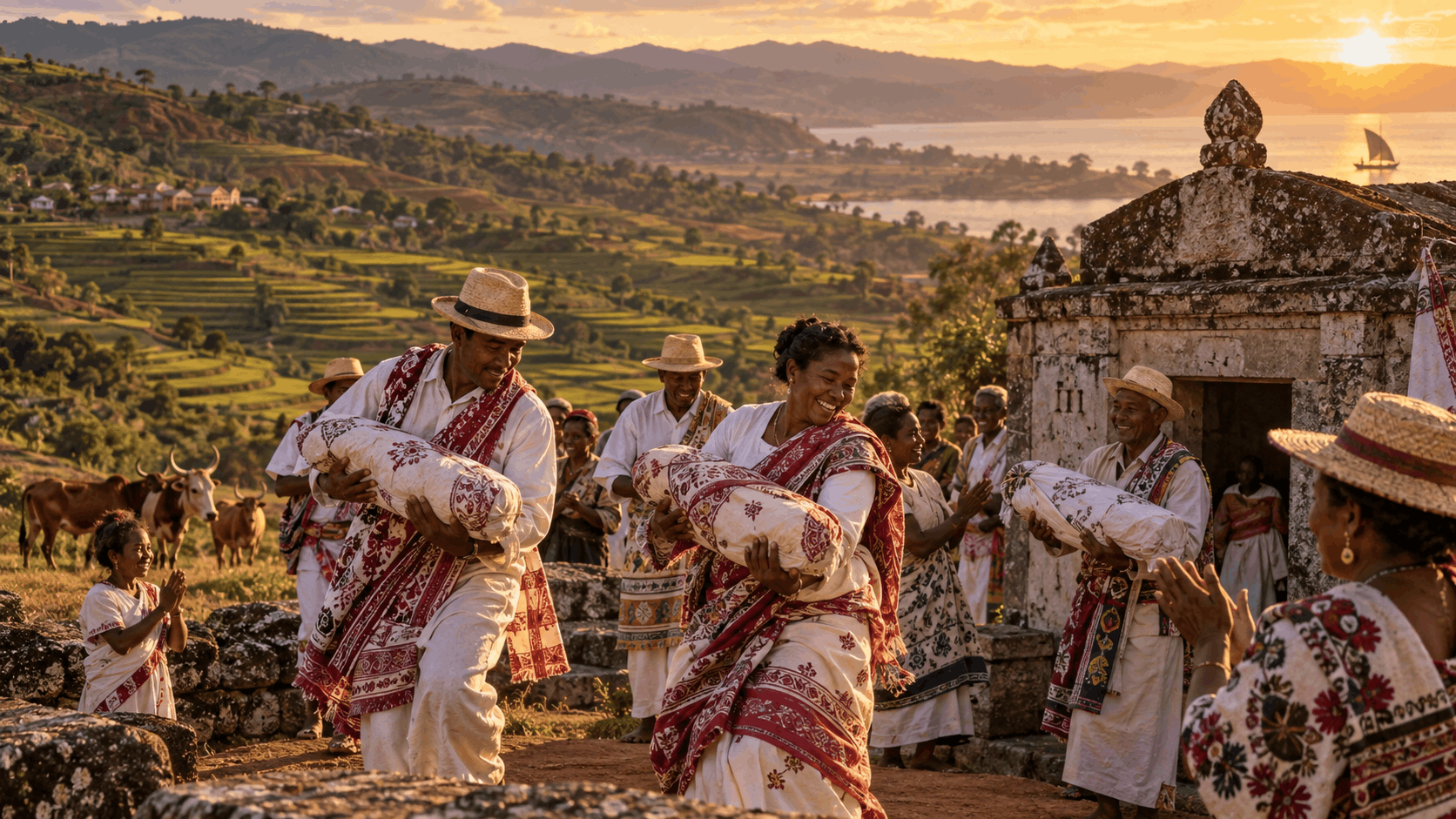
In the highlands around Antananarivo, some families periodically gather at an ancestral tomb, open it, and lift out the wrapped remains of relatives who died years or decades earlier. The remains are rewrapped, carried on shoulders through a music-filled procession, danced with, spoken to, and then returned to the tomb until the next ceremony. This is famadihana, often translated as "turning of the bones," and it is most strongly associated with Merina and Betsileo communities in the central highlands. The timing varies from family to family rather than following a fixed national schedule, and the ceremony can be expensive enough that families may spend years preparing for it.
The practice makes more sense once you understand the belief underneath it. In many Malagasy traditions, death does not mark the end of a person's relationship with the living. The razana, or ancestors, can remain socially and spiritually significant to their descendants, and burial can therefore be understood as part of an ongoing relationship rather than a single event that ends when the grave is closed.
Madagascar offers a different perspective on African history. Geographically and politically, it is an African country, sitting off the southeastern coast of the continent. But its population history reaches across the Indian Ocean. Linguistic, archaeological and genetic evidence points to Austronesian-speaking settlers from Island Southeast Asia, particularly the region of southeastern Borneo, alongside populations with East African and Bantu ancestry. As people continued to move through the Indian Ocean, contact with Arab and other traders, South Asians and Europeans added further layers to the island's history.
Where the culture came from
Madagascar’s population history connects Africa and Southeast Asia. Linguistic and genetic evidence shows that some of the island’s early settlers came from Island Southeast Asia, with southeastern Borneo being one of the strongest points of connection. At the same time, genetic studies show that African ancestry is present throughout the Malagasy population. The exact date and route of these migrations are still being studied, but the evidence points to major Austronesian settlement during the first millennium CE.
We also do not know that people simply sailed from Borneo straight to Madagascar. Austronesian-speaking peoples were already moving through Southeast Asia and across the Indian Ocean, and there are different theories about the routes they took. What we do know is that people from Island Southeast Asia eventually settled in Madagascar, bringing their language and some of their cultural and agricultural practices with them. Their descendants ended up thousands of kilometres from the communities whose languages are most closely related to Malagasy.
These settlers brought agricultural practices that became central to life in Madagascar, including rice cultivation. Their language also survived. Malagasy belongs to the Austronesian language family and is closely related to languages spoken in southeastern Borneo. The language itself is therefore strong evidence of Madagascar’s connection to Island Southeast Asia. Over time, Malagasy also took in words from African Bantu languages, Arabic, French and other languages through migration, trade, religion and colonial rule.
Genetic studies tell a similar story. A major study of Malagasy populations found both African and Asian ancestry across the island, although the proportions vary from one region to another. In the study, African ancestry made up about 59% of the population on average, while Asian ancestry accounted for about 37%. Highland populations generally had more Southeast Asian ancestry, while many coastal populations had more African ancestry. Madagascar’s population, then, reflects centuries of movement and mixing across the Indian Ocean, with both African and Southeast Asian ancestry forming part of Malagasy history.
By the 16th century, Madagascar was made up of several kingdoms. One of the most powerful was Imerina, in the central highlands, where the Merina people lived. Under King Andrianampoinimerina in the late 18th century and his son, Radama I, in the early 19th century, the Merina kingdom expanded through warfare, alliances and diplomacy. Over time, it brought much of Madagascar under one monarchy. This expansion was not peaceful. It involved the conquest of other kingdoms and, in some areas, the use of force to bring communities under Merina rule.
The expansion of the Merina kingdom had a lasting effect on Madagascar's political history. The central highlands became the centre of political power, while communities in the coastal and southern regions continued to maintain their own histories, institutions and identities.
During the 19th century, the Merina monarchy also developed closer relationships with European powers, missionaries and traders. Christianity and Western education gained ground, while the monarchy adopted some European ideas about administration, clothing and government. Several monarchs played a role in these changes, including the queens who ruled for much of the later 19th century.
Ranavalona I, who ruled from 1828 to 1861, took a different approach. She resisted growing European influence, expelled foreign missionaries and severely persecuted Malagasy Christians. These policies were part of a wider effort to protect the kingdom's independence. Later monarchs were more open to European influence, but the kingdom eventually lost its independence.
In 1896, France formally made Madagascar a colony. The last monarch, Ranavalona III, was exiled first to Réunion and later to Algeria, where she died in 1917. Her remains were returned to Madagascar in 1938 and reinterred in the royal tombs. In 2020, France returned a crown-like ornament from her royal dais to Madagascar, an object associated with her reign and the country's royal history.
Madagascar became independent in 1960. The country remained closely connected to France in its early years, but its politics changed in the 1970s under Didier Ratsiraka. His government followed a socialist path, nationalised parts of the economy and strengthened relations with the Soviet bloc. Since then, Madagascar has experienced several periods of political crisis, disputed elections and unrest.
These periods of political instability have also affected the economy. According to the World Bank, 75.2% of Madagascar's population lived below the national poverty line in 2022. In rural areas, the figure was almost 80%. So while Madagascar has enormous cultural and natural wealth, a large part of its population continues to live with severe economic hardship.
Ethnic groups and languages
Madagascar is commonly described as having eighteen main ethnic groups. These groups have their own histories, traditions and regional identities, but they are not completely separate populations, and many Malagasy people have mixed backgrounds. They also share a common language. Malagasy is spoken across the island, although it has developed into different regional varieties.
Malagasy is an Austronesian language, which means its origins can be traced to the same broad language family found across parts of Southeast Asia and the Pacific. It is particularly closely related to languages spoken in southeastern Borneo. Over centuries, however, Malagasy also absorbed words from African Bantu languages, Arabic, French and other languages through migration, trade, religion and colonial rule.
The Merina, who live mainly in the central highlands around Antananarivo, became the island's dominant political power during the expansion of the Imerina kingdom in the 18th and 19th centuries. Genetic studies also show that many highland populations have higher levels of Southeast Asian ancestry than many coastal populations, although both African and Southeast Asian ancestry are found across Madagascar.
The Betsileo, another highland group, are known for their intensive rice cultivation and hillside terraces. Further east are the Betsimisaraka, while the Sakalava have historically lived across much of the west. In the south are groups including the Antandroy and Bara. Each has its own history, economy and cultural practices, shaped in part by the region where they live. Genetic studies have found higher levels of African ancestry among many coastal populations, although there is considerable variation.
These regional differences developed over centuries of migration, intermarriage, trade, political expansion and local history. They are part of the same Malagasy story, which carries both African and Southeast Asian ancestry.
Religion and belief
Christianity is the largest religious tradition in Madagascar, with both Catholic and Protestant churches having a strong presence. Islam is also practised, particularly in communities with long histories of trade and contact across the Indian Ocean, including connections with the Comoros and the East African coast.
But Christianity and Islam did not simply replace older Malagasy beliefs. Many Malagasy people practise Christianity or Islam alongside traditions involving ancestors, sacred places and taboos. A person may attend church or identify as Muslim while also observing customs connected to the razana and to their community's ancestral traditions.
The razana are not simply remembered relatives. In many Malagasy traditions, ancestors remain part of the social and spiritual world of the living. They may be honoured through burial practices, ceremonies and family obligations. This helps explain why rituals such as famadihana can carry such importance.
Fady, a system of taboos, is another important part of Malagasy cultural life. A fady may prohibit a particular food, animal, place, action or behaviour. These rules vary considerably between communities, so something forbidden in one place may be completely ordinary somewhere else. A fady may come from ancestral instructions, local history or an event remembered by a particular community.
Breaking a fady is therefore more than simply breaking a social rule. In communities where these traditions remain important, violating a taboo may be believed to bring misfortune or disturb the relationship between people, ancestors and the wider community. This is why visitors are often advised to learn local customs before entering sacred places or taking part in local activities.
Food
Rice sits at the centre of Malagasy food culture. It is the staple food for much of the population and is commonly eaten several times a day, including at breakfast. In the highlands, rice cultivation has produced extensive terraces and irrigation systems, particularly among communities such as the Betsileo and Merina.
Romazava, a light meat and leafy-green stew or broth, is widely regarded as one of Madagascar's national dishes. It is commonly served with rice, which occupies the central place in the meal. The combination illustrates something fundamental about Malagasy food: rice is not simply another item on the plate but the staple around which many meals are organised.
Ravitoto is made from pounded cassava leaves, often cooked slowly with pork. Vary amin'anana combines rice with leafy greens and can be prepared with meat depending on the recipe. Both are important parts of Malagasy cuisine, particularly in the highlands. Along the coasts, fish and other seafood are important parts of local diets. Cooking traditions vary by region, and some coastal cuisines use coconut and other ingredients associated with the wider Indian Ocean world.
Zebu, the humped cattle found throughout Madagascar, have a role that extends far beyond food. Cattle ownership can represent wealth, prestige and social standing, particularly in rural communities. Zebu are also important in ceremonies involving marriage, funerals and other major life events. Among some southern communities, cattle and the horns incorporated into funerary displays can communicate the social standing of the deceased and their family.
Music, dance, and art
Malagasy music has developed differently across the island, so there is no single style that represents all of Madagascar. Music from the central highlands, the western coast, the north, the east and the south can sound quite different, reflecting the histories and communities of each region.
One of the instruments most closely associated with Madagascar is the valiha. It is made from a length of bamboo with strings stretched along the outside, creating a sound similar to that of a zither. The instrument is particularly associated with the central highlands and is often used in traditional Malagasy music. Its construction is also one of the clearest examples of Madagascar's connection to Southeast Asia. Bamboo zithers with related forms are found in parts of Island Southeast Asia, and the valiha is generally understood to have an Austronesian connection.
The kabosy is another familiar Malagasy instrument. It is a small, box-shaped string instrument that looks somewhat like a simple guitar and is especially common in rural and regional music. Different communities have developed their own musical traditions around instruments such as these, as well as drums and other percussion instruments.
Salegy is one of the best-known musical styles to come from Madagascar. It developed mainly in the north and northwest and is built around a fast dance rhythm, electric guitars, bass and percussion. The style grew from older Malagasy musical traditions but developed a modern sound as electric instruments and amplification became more widely used. Jaojoby, one of Madagascar's most famous musicians, became internationally associated with the genre and is widely known as the "King of Salegy."
Hiragasy comes from the central highlands and is different from a conventional stage concert. It is a form of public performance in which groups of musicians, singers, dancers and speakers perform together. A hiragasy performance can include songs, dancing, dialogue, humour, storytelling and commentary on social life. The performances have traditionally been used to entertain audiences while also passing on ideas about behaviour, community and Malagasy values. In 2023, UNESCO inscribed Hiragasy, the performing art of the central highlands of Madagascar, on its Representative List of the Intangible Cultural Heritage of Humanity.
Clothing, textiles, and craft
The lamba is one of the most recognisable forms of traditional Malagasy clothing. It is a rectangular piece of woven cloth that can be worn or wrapped around the body in different ways, depending on the region, occasion and type of lamba. People have used different materials to make them, including cotton, raffia and silk. A simple lamba can be part of everyday clothing, while finely made textiles may be reserved for ceremonies, important occasions or gifts.
Silk has a particularly long history in the Malagasy highlands. Madagascar has native silkworms that produce wild silk, and silk is also made from domesticated silkworms introduced from Asia. The two types of silk have been used for different kinds of textiles. Silk became especially important for ceremonial and funerary cloth, including the fabric used to wrap the dead during famadihana.
One type of highland textile is the lamba akotofahana, a finely woven cloth traditionally associated with royalty and other people of high social status. Its patterns can include intricate geometric designs created through the weaving process. The time and skill required to produce such textiles meant that the cloth itself could communicate wealth, position and the skill of the person who made it. Weaving therefore became more than a way to produce clothing. It was also a way of preserving techniques, patterns and knowledge across generations.
Woodcarving has a different role in southern Madagascar. Among the Mahafaly, one of the most recognisable forms is the aloalo, a tall carved wooden sculpture placed on a tomb. Aloalo can show people, animals, objects associated with the deceased and scenes or symbols connected to their life and social position. The sculptures are part of a larger funerary tradition in which the tomb itself can communicate information about the person who died and the family they came from.
The Mahafaly cultural landscape is on Madagascar's UNESCO Tentative List, which means Madagascar has identified it as a site that could be considered for World Heritage inscription in the future. The aloalo themselves are not UNESCO World Heritage. Some have entered museums and international art collections, while others have been removed from their original funerary settings and sold through the art market. This has created questions about who should control and benefit from these objects, particularly when something made for a specific community and sacred setting is treated elsewhere primarily as an artwork.
Festivals, ceremonies, and rites of passage
Famadihana, which we saw at the beginning of this piece, is most strongly associated with Merina and Betsileo communities in the highlands. Families hold the ceremony when they decide it is time to revisit the ancestral tomb. They open the tomb, take out the remains of relatives who have died, wrap them in new cloth and spend time together before returning them to the tomb. There is usually food, music and dancing, and relatives who live far away may travel home for the occasion.
Holding a famadihana is not cheap. The family may have to pay for the new burial cloth, food, musicians and other parts of the celebration. Some families save for years before they can afford it, while others have reduced or postponed the ceremony because of the cost. For families who continue the practice, however, the expense is part of maintaining a tradition that connects living family members with those who came before them.
Alahamady Be is another traditional celebration, associated particularly with Malagasy communities in the highlands. It marks the beginning of a new year according to a traditional Malagasy calendar. The calendar has influences from Arabic and Islamic systems of naming months and interpreting dates. Traditional Alahamady Be celebrations have included prayers and rituals, attention to ancestors, communal meals and activities intended to welcome the new year with good fortune.
This is different from the New Year's Day people observe nationally today. January 1 is Madagascar's official New Year's Day. Alahamady Be is instead a traditional celebration that some communities and cultural groups have revived as part of keeping older Malagasy customs alive.
Circumcision is also an important part of life in many Malagasy communities. The ceremony marks an important stage in a boy's life, but the way it is carried out depends on the community. Among the Antambahoaka in southeastern Madagascar, circumcision is connected to the Sambatra, a large communal festival held every seven years. Families and relatives come together for the occasion, with ceremonies, music, dancing and other celebrations taking place over the course of the festival.
Why Madagascar has so many unique species
Madagascar began separating from Africa roughly 160 million years ago. It later became isolated from other major landmasses for tens of millions of years. During that time, its plants and animals evolved separately from species on the African mainland and elsewhere.
This is why Madagascar has so many species that are found nowhere else in the world. WWF estimates that about 95% of Madagascar's reptiles, 92% of its mammals and 89% of its plants are endemic. In other words, these species are native to Madagascar and do not naturally occur anywhere else.
Lemurs are probably the best-known example. Every living species of lemur is native to Madagascar, and wild lemurs naturally occur only on the island.
All of this began long before humans arrived. When people eventually settled Madagascar, they were entering an ecosystem that had already been developing on its own for tens of millions of years. They then built their own communities on the island, with people arriving from different parts of the Indian Ocean, including populations from Island Southeast Asia and East Africa.
Over generations, these populations mixed and developed new societies, traditions and a language of their own. Malagasy would eventually become an Austronesian language spoken on an African island, with its closest linguistic relatives found in southeastern Borneo.
Madagascar today
Famadihana is still practised in parts of the highlands, although families and communities do it in different ways and at different intervals. It can be an important time for relatives to come home, including family members who now live in other parts of Madagascar or abroad. The ceremony is about the dead, but it also brings the living together.
Madagascan culture also travels with the people who leave the island. France has a large Malagasy community, and people living there continue to maintain connections with Madagascar through family, music, language and cultural organisations. Musicians have also carried Malagasy music to audiences outside the country, with genres such as salegy becoming part of the country's cultural presence abroad.
In southern Madagascar, funerary traditions face another issue. Aloalo and other objects made for tombs have entered museums and international art markets. Some have been removed from their original funerary settings, separating them from the communities and traditions that give them their meaning. At the same time, people in southern communities continue to maintain the funerary practices for which these objects were made.
By now, the different parts of Madagascar's history should be easier to see. The country is in Africa, but its population history reaches across the Indian Ocean. Its language has Austronesian roots, while its people also carry substantial African ancestry. Kingdoms developed on the island before French colonial rule changed its political history. Christianity and Islam became important, but older Malagasy traditions involving ancestors and taboos continued alongside them. Rice, zebu, music, textiles and ceremonies all developed within these different histories.
Madagascar is therefore part of both the African continent and the wider Indian Ocean world. People crossed the ocean and settled on the island. Different populations met there, built communities and developed traditions of their own. Those connections can still be seen in the language people speak, the food they eat, the music they make, the clothes they wear and the ways they remember their dead.
Madagascar did not simply inherit these different histories. Over generations, people made something of their own from them. That is the story of Madagascar.