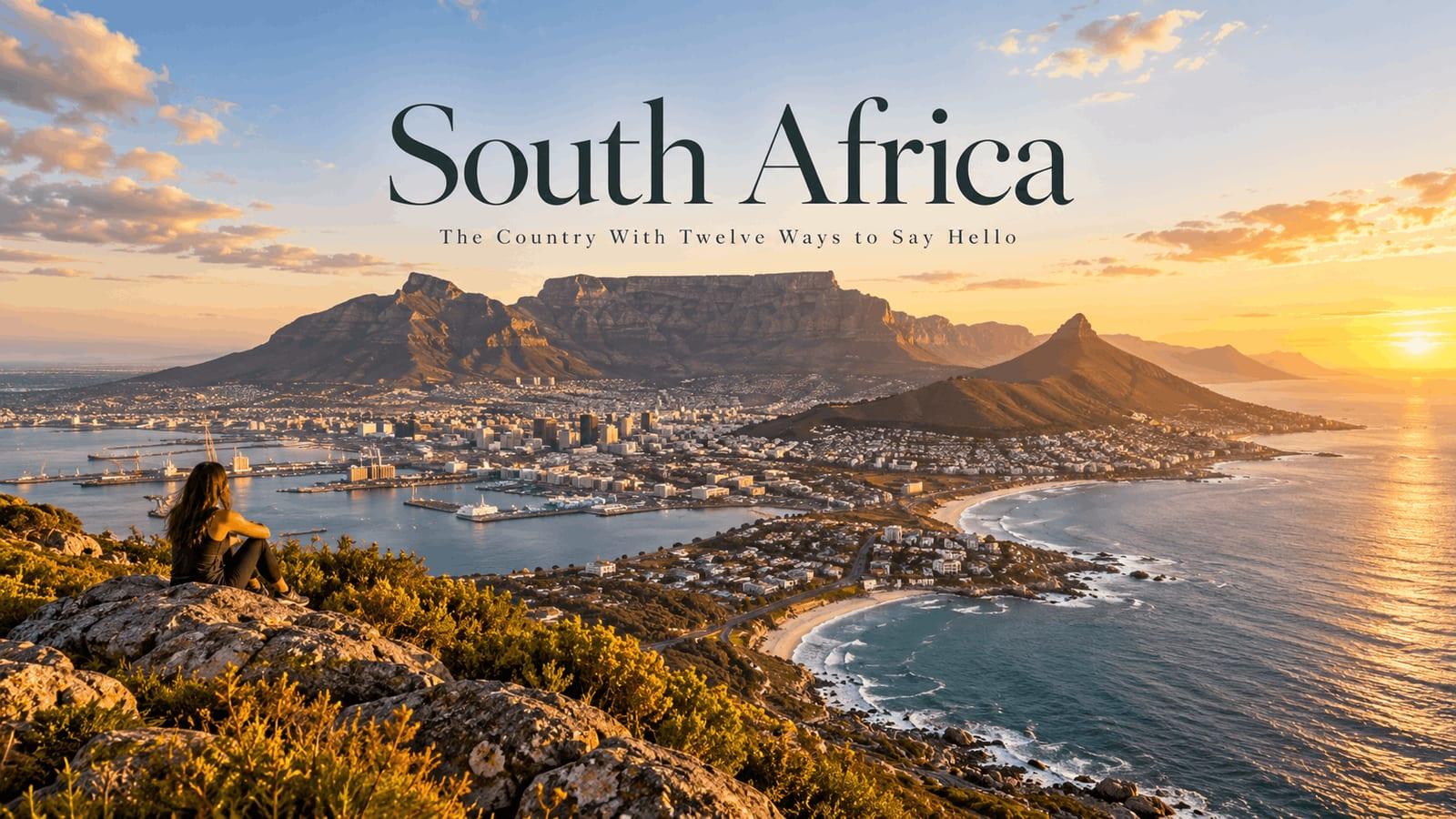
Explore South Africa’s 12 official languages, history, food, music, traditions and cultural identity, from apartheid to amapiano and Heritage Day.
Walk into a government office in Johannesburg and you may hear several languages before you reach the front desk. A greeting might be sawubona in isiZulu, molo in isiXhosa, dumela in Sesotho or Setswana, or “good morning” in English. In many multilingual South African communities, people move between languages during everyday conversations, particularly in cities where speakers from different linguistic backgrounds live and work alongside one another.
South Africa's Constitution recognised eleven official languages in 1996. South African Sign Language became the country's twelfth official language in 2023, after President Cyril Ramaphosa signed the constitutional amendment recognising it.
That language policy was part of the process of rebuilding South Africa after apartheid, the system of racial segregation and white minority rule that governed the country from 1948 until the democratic transition of the early 1990s. Apartheid did not only separate people by race. It also shaped where people could live, which schools they could attend, what rights they had, and which languages and cultures held greater institutional power.
When apartheid was being dismantled, South Africa needed a new set of laws and institutions for a democratic country. This included a new Constitution, the country’s highest legal framework, which set out the rights of citizens and how the new government would operate. Section 6 of that Constitution recognised that indigenous languages had been historically diminished and required the state to take practical and positive measures to elevate their status and advance their use.
The decision to give multiple languages official status was therefore part of an attempt to change how power was distributed after apartheid.
Language had never been a neutral issue in South African history. Under apartheid, language policy could affect what children were taught, which languages carried institutional power, and whose culture was treated as authoritative. The new constitutional system recognised that South Africa had always been linguistically diverse and created a legal framework intended to give that diversity greater protection and equality.
South Africa is often described as the “Rainbow Nation”, a phrase that became closely associated with the country’s transition out of apartheid, the system of racial segregation and white minority rule that ended with the country’s first democratic election in 1994. Archbishop Desmond Tutu helped popularize the term as a way of describing the possibility of people from different racial, linguistic and cultural backgrounds living together as one country after decades of enforced separation.
The “Rainbow Nation” is an ideal, rather than a description of everyday life in South Africa. The country continues to face tensions around race, language, inequality, culture and belonging. The gap between the equality promised by the Constitution and the realities experienced by people is also part of South Africa’s ongoing story.
Where the culture came from
In this section
Of the 7,112 applications recorded by the Commission, 849 had been granted and 5,392 refused by November 2000.
South Africa’s human history goes back thousands of years. The country is home to San communities whose ancestors were among the earliest known hunter-gatherer populations in southern Africa. Across the region, rock paintings and engravings also provide evidence of people who lived there thousands of years before European colonisation.
About 2,000 years ago, Bantu-speaking farming communities began moving into southern Africa. Over time, different societies developed across the region, including communities that would later be associated with the Zulu, Xhosa, Swazi and Ndebele, as well as Sotho and Tswana communities. They developed their own languages, political systems, economies and cultural practices. Some built powerful kingdoms and chiefdoms, while others organised their communities in different ways.
In 1652, the Dutch East India Company established a settlement at the Cape as a place where ships travelling between Europe and Asia could stop for food, water and other supplies. The settlement grew over time, bringing European settlers, enslaved people and indigenous communities into closer contact and creating a new colonial society.
Many of the Dutch, German and French Huguenot settlers who came to the Cape over the following decades became part of the population later known as Afrikaners. Afrikaans also developed at the Cape from Dutch, shaped by centuries of contact between settlers, enslaved people and indigenous communities.
British control of the Cape expanded from the late 18th and early 19th centuries, followed by further British expansion across southern Africa. This brought the British into conflict with Boer communities, who were descendants of Dutch-speaking settlers, as well as African kingdoms and societies. One of the best-known conflicts was the Anglo-Zulu War of 1879. Zulu forces defeated a British army at the Battle of Isandlwana, although Britain later defeated the Zulu Kingdom that same year.
The discovery of diamonds in 1867 and gold in 1886 changed South Africa's economy. Mining brought workers and investors from across southern Africa and other parts of the world, helped drive industrialisation and created enormous wealth. But the mining industry also relied heavily on controlled and unequal labour systems, helping to deepen the racial and economic inequalities that would shape South Africa's politics for generations.
Racial segregation and discrimination existed in South Africa before apartheid. But when the National Party came to power in 1948, it expanded these practices into a much more extensive system of racial control known as apartheid.
Under apartheid, the government classified people by race and used laws to control where they could live, work, study and travel. It also created the homeland system, which divided Black South Africans into designated territories. The government claimed these territories were separate countries where Black South Africans would have their citizenship, but they remained economically and politically dependent on South Africa. This allowed the government to deny many Black South Africans full citizenship and political rights in the country where they lived.
Language became part of this system too. In 1976, the government required Afrikaans, alongside English, to be used as a language of instruction in Black secondary schools. Many students opposed the policy because they saw it as another way the government was imposing its authority on them and their education.
On 16 June 1976, more than 20,000 students marched in Soweto to protest the language policy. Police opened fire on the protesters, killing students including 13-year-old Hector Pieterson. The protests spread to other parts of the country and became a major turning point in the struggle against apartheid.
Resistance continued for decades. The African National Congress, Pan Africanist Congress, trade unions, student movements, community organisations and many other groups challenged the government in different ways. International sanctions and pressure, economic difficulties, political changes inside South Africa and the growing strength of the anti-apartheid movement all contributed to negotiations over the country's future.
Nelson Mandela, one of the best-known leaders of the anti-apartheid movement, had spent 27 years in prison. He was released in 1990. Four years later, South Africa held its first national election in which people of all races could vote. Mandela became the country's first democratically elected president.
The transition to democracy had already begun before that election. In 1993, South Africa adopted an Interim Constitution that provided the legal framework for the transition. A final Constitution was adopted in 1996 and came into effect in 1997. It established a democratic system built around principles including human dignity, equality, human rights, non-racialism and non-sexism. It also made the Constitution the highest law in the country, meaning that government laws and actions must comply with it.
The Constitution's language provisions were part of this wider effort to build a different kind of South Africa. They recognised the country's linguistic diversity and required the government to address the historically disadvantaged position of indigenous languages.
Another important part of the transition was the Truth and Reconciliation Commission, chaired by Archbishop Desmond Tutu. The Commission investigated serious human rights violations committed between 1960 and 1994 and gave victims, survivors and witnesses an opportunity to tell their stories publicly.
It also allowed people who had committed politically motivated abuses to apply for amnesty, meaning they could be legally protected from prosecution if they met specific requirements. They had to make full disclosure of the relevant acts and show that those acts were politically motivated. Amnesty was therefore not automatic. Of the 7,112 applications recorded by the Commission, 849 had been granted and 5,392 refused by November 2000. Other cases were withdrawn, still pending or dealt with through other procedures.
The Commission's public hearings received extensive attention in South Africa and abroad and became one of the most studied examples of how a country can try to deal with serious abuses after a period of political violence and repression. But the process was not without criticism. Some victims and survivor groups believed that perpetrators had not faced enough punishment and that compensation and accountability had fallen short. Those disagreements have continued to shape debates about justice in South Africa.
Ethnic groups and languages
In this section
Coloured South Africans are a diverse community with roots in different parts of southern Africa and beyond.
South Africa's population includes Black African, Coloured, White and Indian/Asian communities, categories that are still used in official population statistics. According to Census 2022, Black Africans accounted for 81.4% of the population, Coloured people 8.2%, White people 7.3%, and Indian/Asian people 2.7%. These categories describe South Africa's official statistical classification and do not capture the full range of identities within each group.
Black South Africans belong to many different linguistic and cultural communities. Among the largest are the Nguni-language communities, including Zulu, Xhosa, Swazi and Ndebele speakers, and Sotho-Tswana-speaking communities, including Sotho, Tswana and Pedi speakers. Xitsonga and Tshivenda represent other major indigenous language communities.
isiZulu is the country's largest home language. Census 2022 found that it was spoken most often in the household by 24.4% of the population, followed by isiXhosa at 16.3% and Afrikaans at 10.6%. English accounted for 8.7%. These figures describe the language spoken most often in households, not every language a person can speak.
Coloured South Africans are a diverse community with roots in different parts of southern Africa and beyond. They are particularly concentrated in the Western Cape, where they make up a significant part of the population.
Many Coloured communities have ancestry connected to indigenous Khoisan populations, enslaved people brought to the Cape from different parts of Africa and Asia, and European settlers. The community has developed distinctive cultural traditions and varieties of Afrikaans. In Cape Town, one of these varieties is known as Kaaps.
White South Africans include Afrikaners, whose history is connected to Dutch, German and French Huguenot settlement at the Cape, as well as English-speaking South Africans whose ancestry includes British settlers. There are also smaller communities with Portuguese, Greek, Jewish and other European backgrounds.
South Africa's Indian community is concentrated particularly in KwaZulu-Natal. Most Indian South Africans are descendants of people brought from India as indentured labourers to work in Natal's sugar industry between 1860 and 1911. Nearly 152,184 indentured workers arrived during that period, while other Indians came independently as traders, professionals and other migrants.
Mahatma Gandhi spent more than two decades in South Africa, arriving in 1893 to work as a lawyer. His experiences with racial discrimination there influenced the political ideas and methods he later developed in India.
English has a disproportionately strong role in business, higher education, national media and communication between people who do not share the same first language. Afrikaans also remains an important language in education, media and cultural life. The Constitution does not place one official language above another. All 12 are meant to be respected and treated fairly. At the same time, governments can decide which languages to use in practice based on the languages people speak in their area, the cost and practicality of providing services in different languages, and what local communities prefer.
Having official status does not mean that all 12 languages are used equally in everyday life. South Africa has twelve official languages, but a government office, school, business or university may use only some of them, depending on where it is and who it serves.
The Constitution requires national and provincial governments to use at least two official languages and to have rules for how they choose and use those languages. In practice, some languages are used more widely than others in education, government, business and media.
South Africa’s cities have also created new ways of speaking as people from different language backgrounds live and interact together. One example is Tsotsitaal, a type of urban speech that developed in multilingual townships. It combines words and expressions from languages such as isiZulu, isiXhosa, Sesotho, Setswana, Afrikaans and English.
Switching between languages during the same conversation is also common in multilingual communities. Someone might use one language with a family member, another at work and a mixture of languages when speaking with friends. In cities where people from different linguistic backgrounds interact every day, this kind of language mixing has become a normal part of communication.
Religion and belief
In this section
The Zion Christian Church is one of the country's largest African-initiated Christian movements.
Christianity is the majority religion in South Africa. Census 2022 found that 85.3% of the population reported Christianity as their religious affiliation or belief, while 7.8% reported Traditional African religion and 2.9% reported no religious affiliation. Islam accounted for 1.6% of the population and Hinduism for 1.1%.
Christianity in South Africa includes Catholic, Anglican, Methodist, Presbyterian and other historic denominations, as well as a large African Independent Church tradition. These are churches founded and led within African communities, often combining Christian theology with African forms of worship, music and community organisation.
The Zion Christian Church is one of the country's largest African-initiated Christian movements. Its annual Easter pilgrimage to Moria in Limpopo attracts very large crowds and is regarded as one of the largest religious gatherings in Africa.
Traditional African religious practices also remain important for some South Africans. These may include relationships with ancestors, rituals connected to family and community, and consultation with traditional healers. A sangoma is generally associated with divination and healing, while an inyanga is traditionally associated more closely with herbal medicine, although the names and practices can differ from one community to another, that is, different communities may use different names and follow different practices. Some South Africans combine Christian religious practice with traditional healing or ancestral practices rather than treating them as mutually exclusive.
South Africa also has Muslim, Hindu and Jewish communities with long histories in the country. The Cape Muslim community, often referred to historically as Cape Malay, developed partly from enslaved and exiled people brought to the Cape from South and Southeast Asia, Madagascar, India and other parts of the Indian Ocean world.
In KwaZulu-Natal, the Indian community has maintained Hindu, Muslim and other religious traditions alongside the cultural practices that developed within South Africa itself. In Cape Town, the Bo-Kaap remains closely associated with Cape Muslim history, their own style of buildings, which is very unique, and traditional foods.
Food
In this section
Bunny chow, a hollowed-out loaf of bread filled with curry, is closely associated with Durban's Indian community.
South African cuisine reflects the country's layered history. Braai, the South African tradition of cooking meat over an open fire, is one of the country's best-known social food traditions. It can include boerewors, a spiced sausage, steak, chicken and other meats, often served with bread, pap, salads or sauces. Braais take place across different communities and have become a widely shared part of social life.
Bunny chow, a hollowed-out loaf of bread filled with curry, is closely associated with Durban's Indian community. Its exact origin remains disputed, although several stories connect the dish to Indian workers and the need for a practical way to carry curry. It became closely associated with Durban's Indian population and is now recognised as a distinctly South African dish.
Among Black South African communities, a maize porridge that can be prepared as a soft, smooth porridge or cooked until it is firm, remains a common staple. It is often served with meat, vegetables, beans or a stew, and is also common alongside grilled meat at braais.
Biltong is air-dried, cured meat (meat that has been preserved using salt and sometimes other ingredients before it is dried or stored) traditionally associated with Afrikaner farming and hunting communities. Drying and curing meat as a preservation method existed in many parts of the world long before biltong developed in southern Africa. Biltong became particularly associated with South African settlers who needed food that could be stored without refrigeration, and it is now eaten across the country.
Cape Malay cuisine developed from the history of the Cape's Muslim communities and includes dishes such as bobotie, a spiced minced-meat dish traditionally topped with an egg-based custard (a creamy dessert made by gently cooking eggs, milk and sugar until thick). The cuisine reflects ingredients and techniques carried through the Indian Ocean world and adapted to life at the Cape. Cape Malay cuisine grew from the history of Cape Town, where enslaved and exiled people were brought from places including Southeast Asia, South Asia, Madagascar and other parts of the Indian Ocean world. They brought cooking methods, spices and ingredients from their different homelands and adapted them to what was available at the Cape. Over generations, these influences came together to form a unique Cape Muslim food tradition, known for dishes such as bobotie, bredie, samoosas and pickled fish. In all of this, the Bo-Kaap remains one of the best-known places to encounter this culinary tradition. The Bo-Kaap is a historic Cape Muslim neighbourhood in Cape Town.
Music, dance, and art
In this section
Musicians such as Hugh Masekela and Miriam Makeba built international careers while drawing attention to apartheid.
South African music has often reflected the country’s social and political history. One example is isicathamiya, a style of Zulu a cappella singing known for its close harmonies and carefully blended voices. It developed in migrant-worker communities, particularly among Black men who left their homes to work in South Africa’s mines and lived in hostels away from their families. Singing became an important part of social and cultural life in these communities.
The style later reached audiences far beyond South Africa through Ladysmith Black Mambazo. The group became internationally known, especially after appearing on Paul Simon’s 1986 album Graceland. The collaboration helped introduce isicathamiya to a much wider audience, but it was also controversial because Graceland was recorded and released during the international cultural boycott of apartheid South Africa. Critics argued that working with South African musicians during the boycott could undermine the pressure being placed on the apartheid government, while others pointed to the opportunities the project created for the musicians involved.
Isicathamiya also grew from an older tradition of Zulu vocal music known as mbube. Mbube influenced later South African choral and popular music, while choral singing itself remains an important part of community life. It can be heard in churches, schools, weddings, competitions and other gatherings across the country.
Kwaito emerged in the late 1980s and early 1990s, developing into one of the defining musical forms of South Africa's post-apartheid generation. It drew on house music but slowed the tempo and incorporated township slang, spoken vocals and local production styles. For young Black South Africans coming of age around the democratic transition, kwaito offered a musical language connected to the new social environment around them.
More recently, amapiano has taken South African music to a much larger international audience. The genre emerged during the 2010s, with strong roots in Gauteng's township music scenes. It combines elements of house music with deep basslines, melodic piano lines and the distinctive log-drum sound that became one of its defining features. It spread from local parties and music scenes across South Africa before becoming a major African export, with artists and producers reaching audiences in Europe, North America and elsewhere.
Traditional Zulu and Xhosa dances also remain part of weddings, ceremonies and other community events. Some Zulu dances feature high kicks and movements historically associated with military display, while Xhosa communities maintain dance traditions connected to weddings, celebrations and rites of passage.
Jazz has a particularly important place in South African cultural history. Musicians such as Hugh Masekela and Miriam Makeba built international careers while drawing attention to apartheid. Makeba became one of the most recognised South African voices abroad and spent decades outside the country after her passport was revoked. She returned to South Africa in 1990 following Nelson Mandela's release.
Clothing, textiles, and craft
In this section
The Bo-Kaap, a historic neighbourhood in Cape Town, is known for its brightly painted terraced houses and streets.
Ndebele beadwork and geometric wall painting are among South Africa’s best-known visual traditions. The painted houses most commonly associated with Ndebele art come from the Ndzundza Ndebele communities of Mpumalanga and Gauteng. The tradition took shape in the late 19th century, with influences from neighbouring Pedi architecture and decorative practices following the Ndebele land wars of 1882–83. Over time, Ndebele women developed increasingly recognisable geometric designs using bold colours, lines and repeated patterns.
Beadwork also became an important part of Ndebele clothing and decoration. Women used beadwork to make and decorate items worn for different occasions, and it also became a way for some women to earn an income by selling their work. In the 20th and 21st centuries, artists such as Esther Mahlangu brought Ndebele visual traditions to international audiences, adapting the geometric patterns and colours of traditional house painting for contemporary art, fashion and design.
Zulu beadwork uses colours, patterns and arrangements to communicate meaning. Beads are used in clothing, jewellery and other ornaments, and can express things about a person’s identity, relationships, age or social position. The meanings are not the same in every situation, however. They can change depending on the community, the design and the context in which the beadwork is used.
Shweshwe is a printed cotton fabric known for its small, repeated patterns, often in deep blue, although it is now made in many colours. Its history is linked to indigo-dyed fabrics that reached southern Africa through trade and missionary networks in the 19th century. Over time, Shweshwe became closely associated with Sotho and Xhosa clothing and was incorporated into local styles of dress. Today, it is worn for weddings and other ceremonies as well as in contemporary fashion.
The Bo-Kaap, a historic neighbourhood in Cape Town, is known for its brightly painted terraced houses and streets. The area developed as a centre of Cape Muslim life, particularly from the 18th and 19th centuries, when enslaved and exiled Muslims and their descendants lived there. Its buildings and streets reflect that history and have made the Bo-Kaap one of Cape Town’s best-known cultural and architectural landmarks.
Festivals, ceremonies, and rites of passage
In this section
Traditional Xhosa male initiation, known as ulwaluko, is an important rite of passage for many Xhosa families.
The annual Easter gathering of the Zion Christian Church at Moria in Limpopo is one of the largest religious gatherings in Africa. Large numbers of church members travel to Moria for worship, prayer and other religious activities, making it an important event in the church’s calendar and in the region.
Heritage Day is a public holiday held on 24 September. It was created to recognise South Africa’s cultural heritage and is marked in different ways across the country, including through food, music, traditional clothing, public events and community gatherings. “Braai Day” became a popular nickname for the holiday because of the widespread practice of gathering with friends and family around a braai, a South African-style barbecue. Braai Day is not the official name of the public holiday.
Traditional Xhosa male initiation, known as ulwaluko, is an important rite of passage for many Xhosa families. The process can include circumcision, teaching about adulthood and a period of seclusion under the care of an initiation practitioner. The practice has also raised serious health and safety concerns because unsafe initiation practices have led to deaths and severe injuries. South Africa’s Customary Initiation Act of 2021 established rules for initiation practices, initiation schools and the people responsible for conducting them.
Zulu wedding traditions can include lobola, a negotiated transfer of cattle or an agreed monetary equivalent from the groom’s family to the bride’s family. It is part of a wider process through which the two families formally establish a marriage relationship. Weddings may also involve traditional clothing, ceremonies involving both families and celebrations. The practice vary between families, and many couples combine customary traditions with a Western-style wedding.
Ubuntu and the language of reconciliation
In this section
Ubuntu became particularly prominent in South Africa during the transition out of apartheid.
Ubuntu is a southern African idea about what it means to be human and how people relate to one another. The word appears in several Nguni languages and is often understood through the idea that a person's humanity is connected to the humanity of others. In practice, it can involve values such as community, responsibility, dignity, compassion and mutual care.
Ubuntu became particularly prominent in South Africa during the transition out of apartheid. Archbishop Desmond Tutu often used the idea when speaking about forgiveness and reconciliation, including in his work with the Truth and Reconciliation Commission. It provided a way to talk about how a society could deal with the harm of the past while still recognising the humanity of both victims and perpetrators.
This approach was not accepted by everyone. Some victims and survivor groups felt that people responsible for serious abuses were not held sufficiently accountable, especially when perpetrators received amnesty instead of facing prosecution. Others valued the Commission because its public hearings gave victims an opportunity to speak about what had happened and created a record of abuses that might otherwise have remained hidden.
The Truth and Reconciliation Commission did not settle every question about how South Africa should deal with the legacy of apartheid. Questions about reparations, prosecutions, accountability and institutional reform have continued to shape debates about justice in the country.
South Africa's language promise today
In this section
South Africa has twelve official languages, but they are not all used to the same extent in everyday life.
Amapiano is one example of how South African culture continues to develop and travel. The sound emerged from South African music scenes in the 2010s and quickly found audiences far beyond the communities where it began. South African artists and producers now work with musicians around the world, while artists elsewhere have incorporated amapiano into their own music.
Heritage Day offers another way these different traditions appear in public life. On 24 September, people across the country mark the holiday through food, music, traditional clothing, community events and gatherings with family and friends. The braai has become closely associated with the day, but the holiday is about South Africa's wider cultural heritage.
Language brings many of these questions together. South Africa has twelve official languages, but they are not all used to the same extent in everyday life. English remains particularly influential in higher education, business and national communication, while indigenous languages are widely spoken in homes and communities. Census 2022 recorded isiZulu as the most widely spoken home language, followed by isiXhosa and Afrikaans.
The Constitution recognises this difference and requires the state to treat the official languages equitably while taking practical steps to support languages whose status was weakened by earlier policies. That does not mean every school, university, business or government office uses all twelve languages. It means the country has made linguistic equality a legal commitment, even while the practical use of those languages remains unequal.
This is part of what makes South Africa's cultural landscape so layered. Its languages, religions, food, music, clothing and traditions have been shaped by thousands of years of history, migration, conflict, colonialism, apartheid and democratic change. Some traditions have been preserved, others have changed, and new ones continue to emerge.
South Africa's twelve-language system, the popularity of amapiano, the traditions celebrated on Heritage Day and the many cultural practices found across the country all point to the same broader reality: South African culture is not one thing. It is made up of many communities and histories that continue to exist, influence one another and change over time.