Explore Benin's history and culture, from the Kingdom of Dahomey and the Atlantic slave trade to Vodun, royal traditions, food, music, art and life in Benin today.
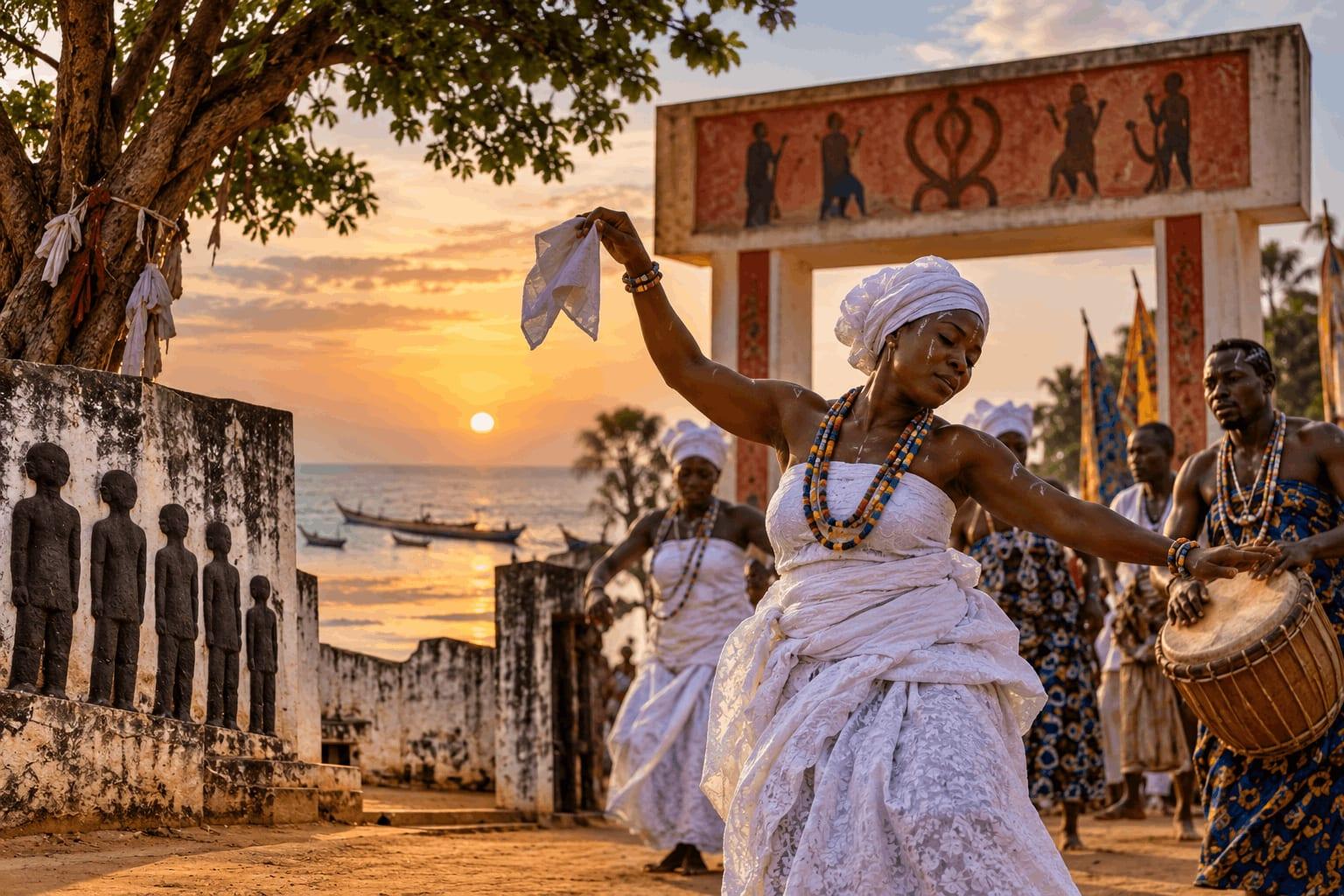
On January 10 each year, Ouidah, a historic coastal city in southern Benin and one of the country's important centres of Vodun, fills with drumming, performances, ceremonies, and worshippers dressed in traditional clothing. The celebrations are centred on Vodun, a group of related West African religious traditions that much of the outside world still associates almost entirely with horror films and pop culture caricatures. The January 10 National Vodun Day has grown into Vodun Days, a multi-day cultural and spiritual festival that brings together religious ceremonies, music, performances, and public celebrations. In 2026, Vodun Days ran from January 8 to 10 in Ouidah, while the annual traditional-religions holiday was observed nationally.
What happens here is not a performance for tourists. These are religious practices that people continue to observe as part of their lives and communities. Vodun is a living religious tradition in Benin, where the state is secular and the constitution provides for freedom of religion. It is practised alongside Christianity, Islam, and other traditional religions, although census categories do not fully capture the ways some people combine religious affiliations and practices. In the 2013 census, 11.6 percent of the population identified as Vodun, compared with 28 percent Muslim and roughly 49 percent belonging to various Christian denominations.
Benin is one of Vodun's principal historical homelands, particularly among the Aja and Fon peoples and the related cultural traditions that developed across present-day southern Benin and neighbouring Togo. Centuries ago, enslaved people taken from ports and communities along the Bight of Benin, the section of the Gulf of Guinea stretching broadly from present-day Ghana toward Nigeria, carried Aja-Fon, Yoruba, and other West and Central African religious traditions across the Atlantic. In Haiti, traditions associated with Dahomey, the kingdom that was centred in present-day Benin, became part of the development of Haitian Vodou alongside other African traditions and Catholic influences. In Brazil, Ewe and Fon traditions contributed to Candomblé alongside Yoruba, Bantu, and other influences, while Cuban Santería developed primarily from Yoruba religious traditions. These religions are historically connected because the forced movement of Africans across the Atlantic also carried religious ideas, practices, languages, and cultural traditions with them. They are not, however, simply different names for the same religion.
Understanding Benin therefore means understanding that this small country, wedged between Nigeria and Togo, Benin is part of the story of the African diaspora itself. It is one of the places from which people, beliefs, languages, and cultural traditions were carried across the Atlantic, while many of those traditions continued to evolve and endure at homeis not simply a footnote to the history of the African diaspora. It is one of the places from which important religious and cultural traditions travelled across the Atlantic, while those traditions continued to be practised and transformed at home.
Where the culture came from
In this section
The name also had a connection to the older Kingdom of Benin, whose capital was in present-day southern Nigeria.
The most powerful precolonial kingdom in much of what is now southern and central Benin was Dahomey. It took shape on the Abomey plateau in the 17th century among the Fon and other communities whose histories were closely connected to the Aja peoples of present-day southern Benin and Togo. Royal traditions say that the ruling family came from the Aja-speaking region to the west, although the kingdom's origins were shaped by several communities and political traditions. Abomey became the seat of the royal court, and over time the king and his government brought more of the surrounding territory under their authority. King Wegbaja is traditionally regarded as the founder of the ruling dynasty. Under later kings, Dahomey expanded considerably. King Agaja, who ruled in the early 18th century, conquered Allada in 1724 and Hueda, centred on Ouidah, in 1727. Taking control of Ouidah gave Dahomey access to one of the most important trading ports on the Atlantic coast and strengthened the kingdom's position in the trade in enslaved people.
As Dahomey grew, political power became concentrated around the king and the royal court. The kingdom developed an organized government and a powerful army, which allowed its rulers to control territory, conduct trade, and wage wars against neighbouring states. Among the soldiers serving the kingdom were the Mino, a specially trained group of female soldiers whose name means "our mothers."
The Mino were trained soldiers who fought in the kingdom's wars. They were part of Dahomey's fighting force and also served in the king's royal security system. They underwent military training and fought in battles, including the wars against the French in the 1890s. Their close connection to the king and their position within the royal army gave them a distinctive place in Dahomeyan society. European observers later called them the "Dahomey Amazons," comparing them to the female warriors of ancient Greek mythology.
Dahomey's expansion also brought the kingdom into the growing trade in enslaved Africans along the West African coast. When Dahomey defeated neighbouring states, it took prisoners of war. Some of these captives were sold to European traders at coastal ports such as Ouidah, where they were eventually transported across the Atlantic and enslaved in the Americas. European traders paid for enslaved people with goods that included firearms, ammunition, textiles, and other products. The kingdom's rulers used the wealth and weapons they acquired through this trade to strengthen the state and its army, helping them maintain and expand Dahomey's power.
Dahomey was not the only state or trading network involved in this system. European merchants had been buying enslaved Africans along this coast for centuries, working through different African rulers, merchants, and intermediaries. But Dahomey became one of the most powerful states involved in the trade along this part of the West African coast in 1727. European merchants later called this stretch of the West African coast the "Slave Coast" because of the scale of the trade in enslaved people there.
Ouidah became one of the major ports from which enslaved Africans were taken to the Americas. Historians estimate that more than a million enslaved people were embarked through Ouidah during the centuries of the Atlantic slave trade. Today, the Route des Esclaves, or Slave Route, is a memorial route of roughly four kilometres that follows the final part of the journey from Ouidah toward the coast. It ends at the Door of No Return, a later memorial monument marking the coastline from which captives were taken onto ships bound across the Atlantic.
During the 19th century, European countries increasingly moved to end the transatlantic slave trade. As the trade came under greater pressure, Dahomey began to rely more on palm oil and other forms of trade. The change did not happen overnight. For several decades, the kingdom continued to take part in the slave trade while also expanding its trade in palm oil. By the middle of the 19th century, palm oil had become an important part of Dahomey's economy.
Dahomey remained independent until the 1890s, when it fought two wars against France. The second war ended with French forces taking Abomey in 1892 and the kingdom's final defeat in 1894. The Mino fought alongside Dahomey's army and suffered heavy losses during the fighting.
When the country gained independence from France in 1960, it was called Dahomey, after the former kingdom. But the years that followed were politically unstable. Between 1960 and 1972, the country experienced several coups and changes of government before Mathieu Kérékou took power in a military coup in 1972. In 1974, his government adopted Marxism-Leninism as its official political ideology, and in 1975 the country was renamed the People's Republic of Benin.
The name change was partly an attempt to give the country a name that was less closely tied to the former Dahomey kingdom and its Fon royal history. "Benin" referred to the wider Bight of Benin, the stretch of the West African coast along the Gulf of Guinea. The name also had a connection to the older Kingdom of Benin, whose capital was in present-day southern Nigeria. The modern country of Benin and the historic Kingdom of Benin are therefore not the same place, even though they share the name.
Kérékou's Marxist-Leninist government lasted for nearly two decades. By the late 1980s, however, Benin was facing a serious economic crisis. Government finances were under pressure, and the political system was losing support. At the same time, many African countries were moving away from one-party and military rule and toward multiparty politics.
In 1990, Benin held a National Conference that brought together politicians, religious leaders, civil society groups, trade unions, and other representatives of the country. The conference agreed on major political changes, including a return to multiparty democracy. Kérékou accepted the decisions, and the country held presidential elections in 1991. He lost to Nicéphore Soglo and handed over power peacefully.
Kérékou's political comeback was remarkable. In 1996, he won the presidential election and returned to power, this time as an elected civilian president in a multiparty democracy rather than the military ruler who had seized power in 1972. He was re-elected in 2001 and left office in 2006 after reaching the constitutional limit on presidential terms.
For many years, Benin was held up as one of West Africa's strongest examples of a country moving from military rule to democracy without returning to widespread political violence. That reputation has become more complicated in recent years. Since Patrice Talon became president in 2016, changes to electoral rules, restrictions on opposition parties, the prosecution and imprisonment of political opponents, and limits on some civil liberties have raised concerns about the state of democracy. Freedom House currently classifies Benin as "Partly Free," giving it a score of 61 out of 100 in its 2026 assessment.
Ethnic groups and languages
In this section
The region was also known for cavalry forces, which played an important role in warfare and political power.
The Fon are the largest ethnic group in Benin and are concentrated mainly in the south and centre of the country, including areas around Abomey and Ouidah. Their history is closely connected to the rise of the Dahomey kingdom, which was built largely within the Fon-speaking world. The Fon also share a longer history with the Aja peoples of southern Benin and Togo, whose communities and traditions helped shape the region before and during the rise of Dahomey.
The Yoruba are another major ethnic group, particularly in southeastern Benin. Their communities extend across the border into southwestern Nigeria, and people on both sides share Yoruba language, religious traditions and cultural practices. Porto-Novo, Benin's official capital, has a strong Yoruba presence and has long been an important centre of Yoruba cultural and political life.
Further north, the Bariba are one of Benin's major ethnic groups, particularly around Nikki and other parts of northeastern Benin. Their history developed separately from the Dahomey kingdom and included their own systems of kingship and political authority. The region was also known for cavalry forces, which played an important role in warfare and political power.
Fulani communities are found across northern Benin as well. Many Fulani communities have historically been involved in cattle herding and other forms of livestock keeping, connecting them to wider Fulani communities across the Sahel and West Africa.
In the northwest, the Betammaribe are known for their distinctive tata somba, fortified earthen houses built with thick walls, multiple levels and defensive features. These houses were designed to protect families, livestock and food stores, and their design reflected the conditions in which earlier generations lived. The buildings are therefore not just architectural landmarks. They offer a glimpse into how families organized their homes, work and security.
French remains Benin's official language as a legacy of French colonial rule, but it is spoken alongside many African languages. Fon and Yoruba are widely spoken in the south, while Bariba, Fulfulde and other regional languages are important in the north. Many Beninese therefore grow up navigating more than one language, with the language they use depending on their family, community, location and the situation. There is no single African language that dominates the whole country.
Religion and belief
In this section
Islam has a long history in Benin as well, with Muslim communities particularly prominent in the north.
Benin is religiously diverse. The 2013 national census recorded Islam as the largest single religious affiliation at 28 percent, followed by Catholicism at 25.8 percent. Other Christian denominations brought the Christian total to about 49 percent, while 11.6 percent identified with Vodun and another 2.6 percent with other traditional religions. About 5.9 percent reported no religion.
These figures tell us how people described their religious affiliation during the census. They do not necessarily show every religious or cultural practice that takes place within a family or community.
Vodun remains an important religious tradition in Benin, particularly in the south. The word refers to a group of related West African religious traditions rather than one standardized religion with a single set of beliefs and ceremonies. In Aja-Fon traditions, Mawu and Lisa are associated with the supreme creator, while different vodun, or spiritual powers, are connected to particular forces, places, families and aspects of life. Communities have their own priests, priestesses, ceremonies, initiation practices and relationships with particular vodun.
This also helps explain why religious identity in Benin cannot always be understood through census categories alone. Some people who identify as Christian or Muslim may also maintain family traditions, visit traditional religious practitioners or take part in ceremonies connected to their community's traditional practices. Others practise Vodun as their primary religion. These experiences are not universal, and identifying as Christian or Muslim does not automatically mean someone also practises Vodun. It simply means that, for some people, religious affiliation and inherited cultural practices can exist alongside each other.
Christianity has a particularly strong presence in southern Benin. Catholic and Protestant missions expanded during the colonial period, establishing churches, schools and other institutions that continued to grow after independence. Islam has a long history in Benin as well, with Muslim communities particularly prominent in the north. Trade routes linking northern Benin with the wider Sahel helped facilitate the spread of Islam and the development of Muslim communities and institutions.
Benin's religious landscape therefore includes several traditions that have developed alongside one another over centuries. Some people belong firmly to one religious tradition, while others maintain practices inherited from their families alongside their formal religious affiliation.
The state is officially secular, meaning it does not establish one religion as the state religion. Benin also recognizes January 10 as a national holiday for traditional religions. The date has become closely associated with the country's annual Vodun celebrations in Ouidah, which have grown into the multi-day Vodun Days festival.
Food
In this section
Fish may be grilled, smoked or cooked in sauces made with ingredients such as tomatoes, onions, pepper and palm oil.
Pâte, a smooth dough made from maize, cassava, yam or other starchy ingredients, is a staple across Benin. The particular ingredient depends on the region and what is grown locally. Pâte is usually eaten with a sauce, stew or soup, alongside fish, meat, poultry or vegetables.
Food also varies across the country. Maize is especially important in the south, while yam becomes more prominent in many parts of central and northern Benin. Millet and sorghum are also important in northern communities, where the drier climate supports different crops from those grown closer to the coast.
Along the coast, fish and other seafood are common. Fish may be grilled, smoked or cooked in sauces made with ingredients such as tomatoes, onions, pepper and palm oil. Further inland and northward, meals make greater use of grains, tubers and other crops suited to the local environment.
Akassa is a fermented maize dough commonly eaten with sauce, while amiwo is a red maize dough prepared with ingredients such as tomato, onion, pepper and oil. Both are part of the country's everyday food culture and can also appear at gatherings and celebrations.
Palm wine has long been consumed in parts of southern Benin. It is also used to produce sodabi, a distilled spirit made from palm wine. Both drinks can have a social role, while sodabi also appears in some traditional ceremonies. In certain communities and religious settings, alcohol may be used for libation, where a small amount is poured as an offering to ancestors or spiritual forces. This is a ritual practice rather than something that accompanies every meal or ceremony, and its meaning varies between communities.
Music, dance, and art
In this section
The designs could communicate ideas and preserve historical memories, rather than serving only as decoration.
Music and visual art have long been part of religious ceremonies, royal life and community gatherings in Benin. In the former Kingdom of Dahomey, music was also part of court life. Drummers and performers took part in ceremonies connected to the king, royal events and important occasions. Songs and performances helped preserve stories about the kingdom and its rulers.
Gelede is one of the best-known living performance traditions found in Benin. Practised among Yoruba-Nago communities in Benin, Nigeria and Togo, Gelede combines carved masks, elaborate costumes, music and dance. The performances honour the power and social importance of women, particularly elder women, and can also use humour and satire to comment on behaviour within the community. UNESCO added the oral heritage of Gelede to its Representative List of the Intangible Cultural Heritage of Humanity in 2008.
Another important tradition is appliqué, a form of textile art historically associated with the royal court of Dahomey. Artisans created brightly coloured cloth panels decorated with symbols representing kings, animals, historical events, proverbs and aspects of royal power. The designs could communicate ideas and preserve historical memories, rather than serving only as decoration. Appliqué work continues to be produced in Benin today, particularly in and around Abomey.
Benin has also produced musicians whose work has carried elements of the country's musical traditions to international audiences. Angélique Kidjo, who grew up in Cotonou, is one of the country's most internationally recognized musicians. Her music draws from Beninese and wider West African traditions while incorporating genres including funk, jazz and Afrobeat. She has also used her international career to speak about African culture and her connection to Benin.
Clothing, textiles, and craft
Wax-print fabrics are widely worn in Benin, as they are across much of West Africa. They are made into boubous, skirts, dresses and other garments for everyday wear, celebrations and ceremonies. The word pagne is broader. It refers to cloth used as a wrapper or garment and is not simply another name for wax print. Fabrics, colours and patterns can also carry different meanings depending on the occasion and the community.
Abomey is also known for traditions of metalworking that developed around the royal court of Dahomey. Skilled artisans produced ceremonial objects, statues and items of royal regalia, and metalwork was used to represent people, animals, symbols and aspects of royal power. Some contemporary Beninese artists continue to draw on this older artistic heritage.
One striking example is the use of discarded metal, machinery and automobile parts to create sculpture. Artists including Calixte and Théodore Dakpogan have incorporated salvaged materials into works depicting deities, animals and human figures, drawing on Fon artistic traditions and Vodun imagery. The result is a form of contemporary art that uses materials associated with modern urban life while continuing to draw from older symbols and techniques.
Festivals, ceremonies, and rites of passage
In this section
Zangbeto ceremonies offer another example of the way religious traditions have also been connected to community life.
The January 10 celebration of traditional religions has become one of Benin's most visible annual cultural events. What was traditionally observed as National Vodun Day has developed into Vodun Days, a multi-day programme centred on Ouidah that brings together religious ceremonies, music, performances and other cultural activities. The 2026 edition took place from January 8 to 10, while the next edition is scheduled for January 2 to 9, 2027.
The event attracts people from across Benin as well as visitors from abroad, including members of African diaspora communities whose histories are connected to the Bight of Benin and the Atlantic slave trade. Ouidah was an important port in that trade, and millions of Africans were forcibly transported from the wider region to the Americas. For some members of the diaspora, visiting Ouidah is therefore also an opportunity to learn about places and traditions connected to their ancestral histories.
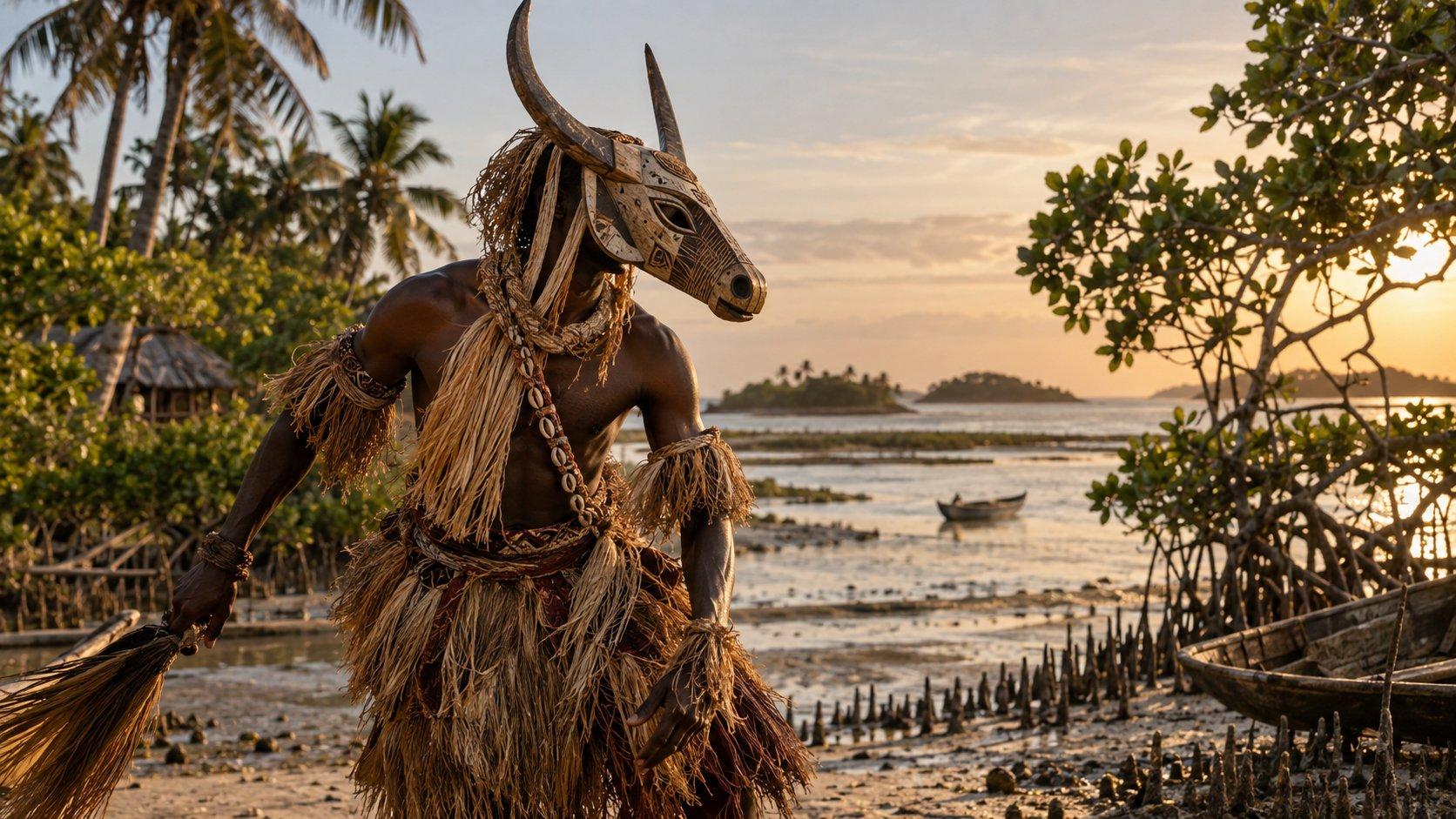
Zangbeto ceremonies offer another example of the way religious traditions have also been connected to community life. Zangbeto are traditional guardian institutions associated particularly with Ogu communities. During performances, figures wearing distinctive raffia costumes move and rotate while music and ceremony accompany them. Within Ogu religious traditions, Zangbeto are associated with spiritual protection. Historically, the institution also had a practical community role, with Zangbeto guardians helping to patrol communities at night and maintain social order.
In Abomey, members of royal families and descendants of the former Dahomey court continue to hold ceremonies connected to the kingdom's historic rulers. These events may include songs, dances, offerings and other traditional practices. They do not mean that the Dahomey kingdom continues to exist as a political state. Instead, they show how institutions and traditions associated with a former royal system can continue through families and communities after the political system itself has ended.
The Mino: Women in Dahomey's Military
In this section
The kingdom had incorporated women into a permanent military institution within a centralized royal state.
Among the most distinctive institutions of the Dahomey kingdom was its all-female military corps, commonly known today as the Dahomey Amazons. The women called themselves Mino, meaning “our mothers” in Fon. They served as soldiers within the kingdom's standing army and also had responsibilities connected to protecting the king.
The Mino were not created for ceremonial display. They were trained to fight and took part in military campaigns as Dahomey expanded its territory and defended itself against neighbouring states. Their training included physical conditioning, weapons practice and combat exercises. Some historical accounts also describe methods used to build endurance and prepare recruits for the dangers of battle.
Their military role became particularly visible during the conflicts between Dahomey and France in the 1890s. The women fought alongside other Dahomean forces, including during the final battles of the kingdom. French forces recorded their resistance in their accounts of the campaigns, while the regiment suffered severe casualties during the fighting that preceded the French conquest of Dahomey in 1894.
The Mino are often presented today primarily as an unusual example of women who fought in war. Their history tells us something more specific about Dahomey. The kingdom had incorporated women into a permanent military institution within a centralized royal state. The corps was connected to the monarchy, the army and the kingdom's wider system of territorial expansion and defence.
When French forces conquered Dahomey, the political system that had sustained the Mino was dismantled, and the regiment ceased to exist as a military institution. Their legacy, however, has continued to shape how Dahomey's history is remembered, both in Benin and internationally.
Benin Today
In this section
In Abomey, members of former royal families continue ceremonies connected to the Dahomey court.
Angélique Kidjo continues to perform and record internationally, drawing on the music she encountered growing up in Cotonou while bringing elements of Beninese and West African culture to audiences around the world.
In Ouidah, that cultural inheritance is also being presented on a much larger public stage. Vodun Days combines religious ceremonies with concerts, performances and cultural programming, while January 10 remains the national holiday associated with traditional religions. The festival brings practitioners, local communities and visitors into the same public space, making Ouidah a place where religious traditions are practised and publicly represented at the same time.
The same sense of continuity can be seen elsewhere in Benin. In Abomey, members of former royal families continue ceremonies connected to the Dahomey court. Gelede remains part of the cultural life of Yoruba-Nago communities. Traditional foods, languages, textiles and artistic practices continue to be used and adapted. None of this means that Benin has remained unchanged. Its political systems, economy, religions and communities have all been transformed by war, the Atlantic slave trade, French colonial rule, independence and decades of political change.
What remains is therefore not a frozen version of the past. It is a collection of traditions that people continue to practise, adapt and give meaning to in the present.
That is why Benin's history cannot be reduced to the story of the Dahomey kingdom or to the history of Vodun alone. The country carries the legacy of a powerful precolonial state, a difficult history of participation in the Atlantic slave trade, the disruption of colonial rule and the religious and political changes that followed. At the same time, its people continue to make use of inherited languages, ceremonies, artistic forms, religious practices and cultural institutions.
Benin's history is ultimately visible in what people still do. A ceremony in Ouidah, a royal gathering in Abomey, a Gelede performance, a piece of appliqué or a song performed on an international stage can all connect the present to histories that stretch back generations. The past is not being recreated exactly as it was. It is being carried forward by the people who continue to practise, reinterpret and pass these traditions on.