Explore Guinea's history, from the Fouta Djallon and French colonial rule to its 1958 independence, Guinean music, culture, traditions and politics today.
In 1958, French President Charles de Gaulle asked France’s West African territories to vote in a referendum — a public vote in which people are asked to decide directly on a major political question. The question was whether to accept France’s new constitution and remain linked to France through a new French Community, or reject it and move toward immediate independence outside that arrangement.
France made clear that territories rejecting the new constitution would no longer receive the same financial, technical and administrative support.
Almost every French territory in sub-Saharan Africa voted yes.
Guinea, led by a young trade union leader named Ahmed Sékou Touré, voted no. Touré famously declared that Guineans preferred “poverty in freedom” to “riches in slavery.” The decision had consequences almost immediately. France withdrew administrators, teachers, technicians and security personnel, cut off financial assistance, and removed or destroyed significant amounts of equipment, records and other administrative materials as it ended its colonial presence.
Guinea formally became independent on 2 October 1958, making it the first French territory in sub-Saharan Africa to take that route. Most of France’s remaining sub-Saharan African territories followed into independence within the next two years, with 1960 becoming the great year of African decolonization.
That decision in 1958 became a defining part of Guinea’s national identity: the moment when it chose independence rather than remain tied to France. But what followed was far more complicated than the triumph of independence might suggest.
Sékou Touré, who had led Guinea’s break with France, became the country’s first president and remained in power until his death in 1984. His government set out to build a state that was politically and economically independent from France, embracing socialism, Pan-Africanism and a strong vision of national sovereignty. But political power became increasingly concentrated in the ruling party. Guinea became a one-party state, opposition was suppressed, and accusations of plots against the government became a recurring feature of political life.
The consequences were severe. People accused of opposing the government — including politicians, military officers, intellectuals and ordinary citizens, could be arrested and imprisoned. The security system relied heavily on surveillance and informants, while political prisoners were subjected to torture and other forms of abuse. Camp Boiro, a prison in Conakry, became the most notorious symbol of the period. Thousands of Guineans were imprisoned during the Touré era, and many died in detention or were executed. Large numbers of others left the country, creating a Guinean diaspora across West Africa and beyond.
But there was another side to the state-building project taking place at the same time.
Having rejected French colonial rule, the government was determined to create a national identity that was not simply an imitation of Europe. Culture became one of the ways it tried to do this. Music, dance and performance were no longer treated simply as entertainment; they were brought into the wider project of defining what a modern, independent Guinea could sound and look like.
The government introduced a cultural policy often associated with Authenticité, encouraging musicians to draw on Guinea’s own musical traditions and histories rather than simply reproduce foreign popular styles. Traditional melodies and instruments were combined with electric guitars, saxophones, drums and other modern instruments. Regional orchestras were established across the country, and musicians were encouraged to reinterpret older traditions for a new generation.
The results were remarkable. By the mid-1960s, more than 35 regional orchestras had been established, alongside national ensembles. One of the most influential was Bembeya Jazz, which began as a regional orchestra in Beyla before becoming a nationally recognised band. Its music combined Guinean traditions with modern African and Cuban influences and travelled well beyond the country’s borders. The state recording label Syliphone also played an important role in recording and distributing Guinean music.
This cultural success, however, came with a contradiction. TThe same government that severely restricted political freedom also gave music an important place in its nation-building efforts, creating orchestras, supporting musicians and establishing systems for recording and promoting Guinean music. Artists were encouraged to develop Guinean music and performance, but their work was also expected to reflect the government’s vision for the country and its national identity.
Guinea’s post-independence story was shaped by political hardship, but it was also a period when music and the arts were deliberately transformed. After breaking from French colonial rule in 1958, Sékou Touré’s government wanted Guinea to develop a culture that reflected its own African history rather than simply continuing colonial-era influences. The state established regional and national orchestras, supported musicians and encouraged them to draw from older Guinean traditions while using modern instruments and arrangements. Traditional melodies and instruments such as the balafon and kora were brought into new styles of dance music, while groups such as Bembeya Jazz became widely known beyond Guinea. The Syliphone record label also recorded and distributed Guinean music, helping these sounds reach audiences across West Africa.
This is a major part of what Guinea contributed to the region after independence: it helped turn traditional Guinean musical traditions into a modern, widely circulated form of African popular music. So Guinea’s post-independence story is not only about the political difficulties that followed independence. Through its orchestras and the Syliphone record label, Guinea recorded and distributed music that reached audiences far beyond the country.
Where the culture came from
In this section
Condé was removed from power by another military coup in September 2021, led by Colonel Mamadi Doumbouya.
The region that is now Guinea has been part of the wider Mandé cultural and political world for centuries. Parts of Upper Guinea were connected to the Mali Empire from the 13th century onward, while Mandé languages, Islam, political traditions and oral histories spread across a much wider area than the borders of any modern country. This is also the cultural world from which Guinea’s jeli tradition emerged. Jelis are hereditary musicians, storytellers, genealogists and keepers of historical memory, and the tradition remains important across much of the Mandé region.
By the 18th century, another major state had emerged in the Fouta Djallon highlands of central Guinea. Fulani Muslim communities established the Fouta Djallon Imamate, an Islamic state centred on Timbo. Its political system was organised around two ruling lineages, known as the Alfaya and Soriya, whose rivalry shaped the state's leadership for generations. The Imamate became an important centre of Islamic learning and political power in the region, although its rulers also faced repeated struggles over succession and control.
European traders reached Guinea's Atlantic coast in the 15th century. Over the following centuries, coastal communities including the Susu and Baga became increasingly connected to trade with European merchants. This included the trade in enslaved Africans. People were captured or sold into slavery, transported to the coast and then shipped across the Atlantic to the Americas. Guinea's coast therefore became part of the wider Atlantic slave-trading system that connected West Africa, Europe and the Americas.
French involvement in the region grew during the 19th century. French officials, traders and military forces gradually expanded their control from the coast into the interior, using treaties with some local rulers as well as military campaigns against others. They encountered established states and leaders who resisted French control. One of the strongest opponents was Samory Touré, a Malinké military leader who built the Wassoulou Empire across parts of what are now Guinea, Mali and Côte d'Ivoire. From the 1880s, Samory fought French forces while also expanding and defending his own state. The French captured him in 1898, ending one of the longest and most determined armed challenges to French expansion in the region.
France formally established the colony of French Guinea in 1891. In 1895, Guinea became part of French West Africa, a federation through which the French colonial government administered several territories in West Africa. French rule lasted until 1958.
Independence brought Ahmed Sékou Touré to power. He wanted Guinea to reduce its economic and political dependence on France and developed close relations with the Soviet Union, the communist state that rivalled the United States and Western Europe during the Cold War. At home, Touré's government also made culture an important part of building the new country. It established regional and national orchestras, supported dance and performance groups, and encouraged musicians to use Guinean musical traditions while experimenting with electric guitars, saxophones and other modern instruments. The Syliphone record label recorded and distributed this music, while groups such as Bembeya Jazz became influential beyond Guinea.
The same government became increasingly repressive. Guinea became a one-party state, meaning that only the ruling Democratic Party of Guinea, or PDG, was permitted to dominate political life. Political opposition was suppressed, and the government used surveillance, arrests and imprisonment against people it considered enemies. Camp Boiro, a prison in Conakry, became the most notorious symbol of this repression. Thousands of people were detained during Touré's rule, including politicians, government officials, intellectuals and people accused of plotting against the government. Many were tortured or killed, while others fled the country. Human Rights Watch describes Camp Boiro as a place where thousands were imprisoned and where torture, starvation and death became associated with the prison. Estimates of the total number killed during Touré's 26 years in power vary widely, so there is no single death toll that can be presented as definitive.
When Touré died in 1984, Guinea's military took power and Lansana Conté became president. Conté ruled for almost 25 years. His government eventually introduced multiparty politics, but political opposition continued to face restrictions and security forces were accused of abuses. When Conté died in 2008, another military takeover followed. In 2009, security forces opened fire on opposition supporters gathered at a stadium in Conakry, killing and injuring large numbers of people. In 2010, Alpha Condé won Guinea's first presidential election of the new multiparty era.
Condé was removed from power by another military coup in September 2021, led by Colonel Mamadi Doumbouya. Guinea then entered another military-led transition. Presidential elections were eventually held on 28 December 2025. Doumbouya won the election with 86.72% of the vote, according to the announced results, and was inaugurated as president on 17 January 2026. His move from military ruler to elected president formally ended the transition, but the election took place after more than 50 political parties had been dissolved and major opposition figures had been prevented from running or had gone into exile. Critics therefore questioned how competitive the election really was.
Guinea's political history is only part of the country's modern story. Beneath the country's soil is one of the world's most valuable deposits of bauxite, the main ore used to make aluminium. Guinea has about 7.4 billion tonnes of bauxite reserves, the largest known reserves in the world. In 2024, it produced 33.2% of the world's bauxite, making it the world's largest producer that year.
The scale of that mineral wealth is striking when placed beside the country's wider economic picture. Guinea's GDP was about US$25 billion in 2024, while GDP per person was about US$1,695. The World Bank also estimated that 52% of Guineans were living below the international poverty line of US$3.65 a day in 2024 under its 2017 purchasing-power measure.
So the question facing Guinea is not whether the country has valuable natural resources. It clearly does. The harder question is how much of that wealth reaches ordinary Guineans through jobs, public services, infrastructure and higher living standards. That question remains central to Guinea's story today.
Ethnic groups and languages
In this section
The Susu are particularly prominent in Lower Guinea, including the area around Conakry and the coastal region.
Guinea is home to several major ethnic communities, with the Fulani, Malinké and Susu making up the largest groups, alongside communities such as the Kpelle, Kissi and Toma.
The Fulani, also known as Peul or Fulbe, are Guinea’s largest ethnic group. They are particularly concentrated in the Fouta Djallon highlands, the region where the Fulani-led Fouta Djallon Imamate developed in the 18th century. Fulani communities have historically been associated with cattle herding, but farming, trade and other occupations have long been part of life in the region as well. Fouta Djallon also became an important centre of Islamic learning, and Fulani cultural traditions include a rich heritage of poetry, oral literature and music.
The Malinké, also called Mandinka, are concentrated particularly in Upper Guinea, including around Kankan. They belong to the wider Mandé cultural world that stretches across Guinea, Mali, Senegal, Côte d’Ivoire and other parts of West Africa. Their history is closely connected to the Mali Empire, and the jeli tradition remains important in many Malinké communities. Jelis are musicians, storytellers, genealogists and oral historians who preserve and pass down knowledge about families, rulers and important events.
The Susu are particularly prominent in Lower Guinea, including the area around Conakry and the coastal region. Historically, Susu communities participated in coastal trade, fishing, farming and commerce, and their location along the Atlantic coast helped connect them to trade routes linking the interior with coastal markets.
In southeastern Guinea, particularly in the Forest Region, communities including the Kpelle, Kissi and Toma have their own languages, histories and artistic traditions. The region also shares cultural connections with neighbouring Liberia and Sierra Leone, where related communities live across the borders created during the colonial period. Masks, initiation traditions, music and other forms of performance remain important in parts of the region, although these practices vary considerably between communities.
French is Guinea’s official language, a legacy of the colonial period. But it is not the language most Guineans use in every part of daily life. Pular, the language associated particularly with Fulani communities, Maninka, spoken widely among Malinké communities, and Susu are among the country's most widely spoken African languages. Many Guineans use more than one language, choosing between French and local languages depending on where they are, who they are speaking with and what they are discussing. French is particularly important in government, education, formal business and communication between people from different language communities.
Ethnicity has also played an important role in Guinea’s politics. Political competition has at times followed ethnic lines, with different governments accused of favouring particular communities. During Lansana Conté’s presidency, for example, Susu communities were often seen as having greater political influence, while the 2010 presidential election was widely viewed through competition between Fulani and Malinké political constituencies. These divisions have sometimes contributed to political tension and violence, but they do not mean that Guinea’s ethnic communities live separately from one another. People from different communities work, trade, study and live alongside one another, and intermarriage and family connections also cross ethnic boundaries. Ethnicity in Guinea is therefore both an important part of political competition and one part of much more interconnected everyday lives.
Religion and belief
In this section
In parts of the Forest Region, older community traditions remain important alongside the major world religions.
Guinea is overwhelmingly Muslim. About 85 to 90 percent of the population is estimated to be Muslim, making Islam the country's dominant religion. Islam has deep historical roots in Guinea. In the Fouta Djallon highlands, Fulani Muslims established the Fouta Djallon Imamate in the 18th century, creating an important centre of Islamic political power and religious learning. Islam also spread through trade, scholarship and migration across the wider Mandé world, including communities connected to the old Mali Empire.
Christians make up a much smaller share of the population and are concentrated particularly in parts of southern and southeastern Guinea. Christianity became more established in these areas through missionary activity during the colonial period, although Christian communities remain a minority within the country.
Religious life in Guinea is not limited to the formal practice of Islam or Christianity. In parts of the Forest Region, older community traditions remain important alongside the major world religions. Among several forest-region peoples, initiation societies such as Poro and Sande, also known as Bondo in some communities, have historically played roles in teaching young people about community responsibilities, social expectations and adulthood. Their activities can include initiation ceremonies, masked performances and knowledge that is restricted to members of the societies. These traditions are not identical everywhere, and their importance today varies from one community to another.
Some communities also maintain older beliefs and practices involving ancestors, spirits and sacred places. These traditions have not simply disappeared because most Guineans are Muslim. In some communities, elements of older practices continue through ceremonies, family traditions and forms of artistic expression, although the way people understand and practise them varies considerably.
Islamic religious specialists known as marabouts also have an important place in many Guinean Muslim communities. A marabout is generally a Muslim scholar or religious teacher, although the term can describe people with different roles depending on the community. Some are respected for their Quranic knowledge and teaching, while others may also prepare written prayers or amulets for people seeking protection or spiritual help. Their presence reflects the long history of Islamic scholarship and local religious practice in Guinea, where Islamic traditions have developed alongside older community customs over many generations.
Food
In this section
In coastal Guinea, fish is an important part of the diet because of the region’s access to the Atlantic Ocean.
Rice is a staple across Guinea and appears in the cooking of many of the country’s ethnic groups. It is commonly eaten with sauces made from ingredients such as peanuts, palm oil, okra and leafy vegetables, including cassava and sweet potato leaves. Fish, meat and smoked fish are often added to these sauces for flavour. Riz gras is another popular preparation, in which rice is cooked together with tomatoes, oil, meat or fish, rather than being served separately from the sauce.
Other traditional dishes vary by region. Fouti, also known as lafidi in some contexts, is associated with preparations that can include fonio, okra and soumbara, a fermented seasoning made from the seeds of the African locust bean tree. Fonio is particularly important in the Fouta Djallon highlands, where it has long been cultivated and eaten by Fulani communities. Dairy foods also have a place in Fulani foodways because of the region’s long history of cattle herding. Fresh milk and fermented milk are consumed as everyday foods and may be eaten with grains such as fonio.
In coastal Guinea, fish is an important part of the diet because of the region’s access to the Atlantic Ocean. It is commonly grilled, smoked or cooked into sauces with rice and other staple foods. In parts of southern Guinea, palm wine has also traditionally been produced by tapping certain palm trees, although its use varies between communities and regions.
Kola nuts are another food with significance beyond eating. They have long been used across Guinea and other parts of West Africa in social and ceremonial settings. Offering kola nuts can be a way of showing respect, welcoming a guest, marking an agreement or beginning a formal discussion. The meaning and importance of the practice vary between communities, but the small nut can carry considerable social meaning.
Bembeya Jazz developed from a regional orchestra in Beyla and became one of Guinea’s best-known bands after moving to Conakry.
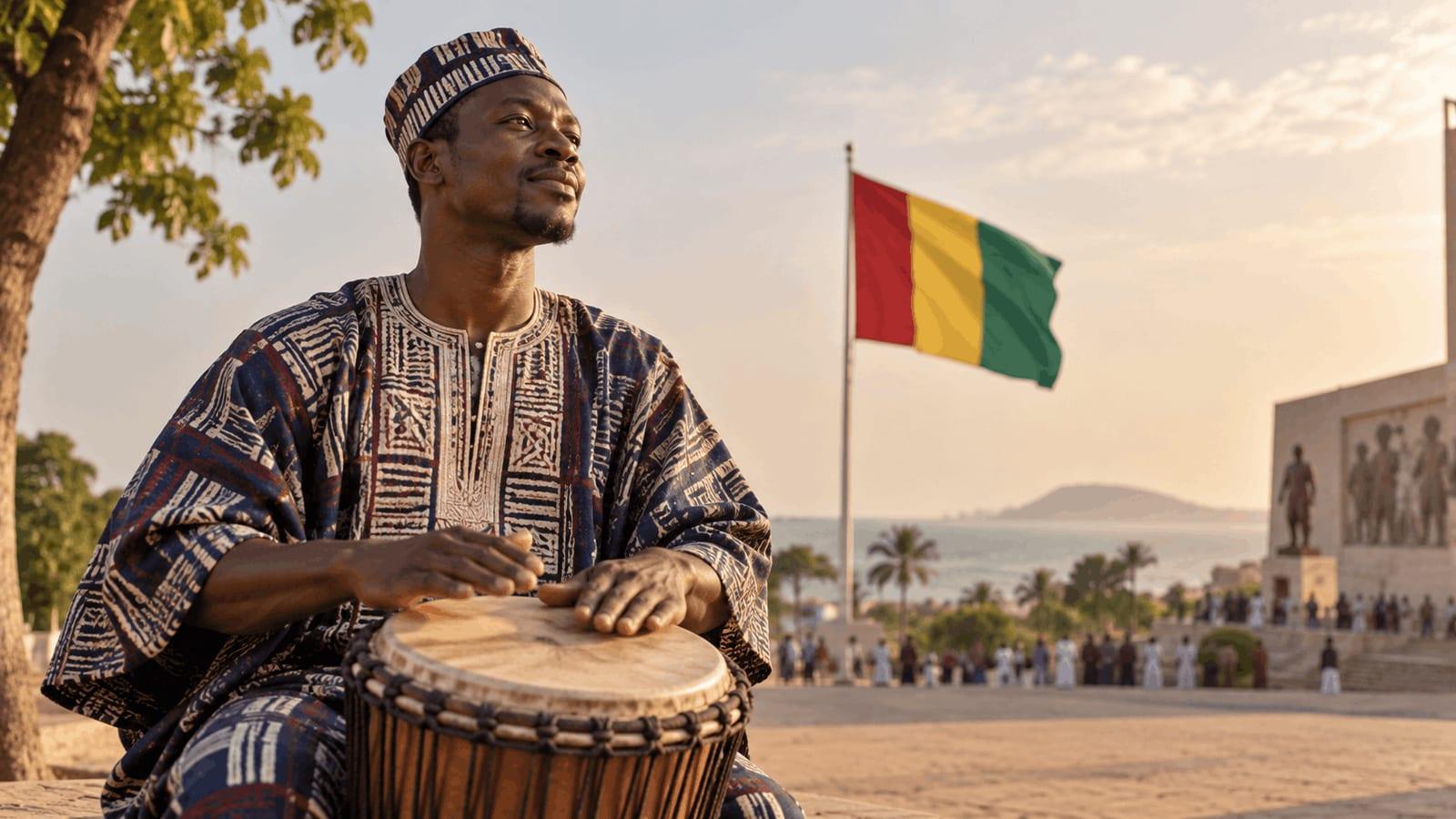
One of Guinea’s most influential cultural exports is the djembe, a goblet-shaped hand drum associated with the Mandé peoples of West Africa. Guinea is particularly important to the instrument’s history and performance traditions. Djembe playing developed within Mandé communities and was traditionally performed by specialist musicians, although it later spread far beyond hereditary musical families. Drums were used at weddings, harvest celebrations, dances and other community events, with different rhythms associated with particular occasions and places. Learning the repertoire and the techniques used to accompany dancers can take years.
Music became especially important after independence. Sékou Touré’s government promoted a cultural policy that encouraged Guinean musicians to draw on older musical traditions while creating modern forms of performance. Regional and national orchestras were established, traditional melodies were arranged for electric guitars, saxophones and other modern instruments, and dance groups performed Guinean traditions on national and international stages.
Two of the best-known ensembles were Bembeya Jazz National and Les Ballets Africains. Les Ballets Africains had been founded before independence and became Guinea’s national dance company, touring internationally with performances featuring traditional Guinean dance, music and drumming. Bembeya Jazz developed from a regional orchestra in Beyla and became one of Guinea’s best-known bands after moving to Conakry. Its music combined Mandé melodies and vocal traditions with electric guitars, horns and modern dance-band arrangements, helping make Guinean music influential across West Africa.
The government also supported a large network of regional and local music and dance groups. Cultural competitions gave musicians and performers opportunities to represent their communities and gain national recognition. The state promoted these activities because it wanted music and performance to help build a national identity rooted in Guinea’s own traditions rather than French colonial culture.
This support came with political expectations. Musicians and performers were encouraged to develop Guinean traditions, but their work was also expected to reflect the government's vision of the country and its national identity. The Syliphone record label, established by the state in the 1960s, recorded and distributed Guinean music, helping some of these artists reach audiences beyond Guinea.
The result was a remarkable period in Guinean music. Even though cultural production operated under an authoritarian government, musicians created recordings, bands and performances that became influential well beyond the country. Bembeya Jazz, Les Ballets Africains and other Guinean ensembles helped carry Mandé musical traditions into modern popular music and onto international stages.
Clothing, textiles, and craft
In this section
Some are used during initiation, while others are associated with particular ritual activities or members of the society.
Guinea’s clothing and craft traditions vary across its regions and communities, while also sharing many features with neighbouring West African countries. Among Fulani communities in the Fouta Djallon, cotton weaving, indigo dyeing and embroidered clothing form part of the region’s textile traditions. Women’s hairstyles can also carry social and cultural meaning, with braided styles forming part of Fulani dress and identity across Guinea and the wider Fulani communities of West Africa.
Among Mandé communities, leatherworking, weaving and metalworking have historically been carried out by specialist hereditary artisans. These crafts could include the production of leather goods, jewellery, tools and other objects used in everyday and ceremonial life. Similar artisan traditions are found across the wider Mandé region, including neighbouring Mali.
Along the coast, including among Susu communities, boubou-style garments are commonly worn for weddings, religious celebrations and other formal occasions. These flowing garments may be made from embroidered cotton, dyed fabrics or commercially produced wax prints, linking Guinean fashion to broader West African clothing traditions.
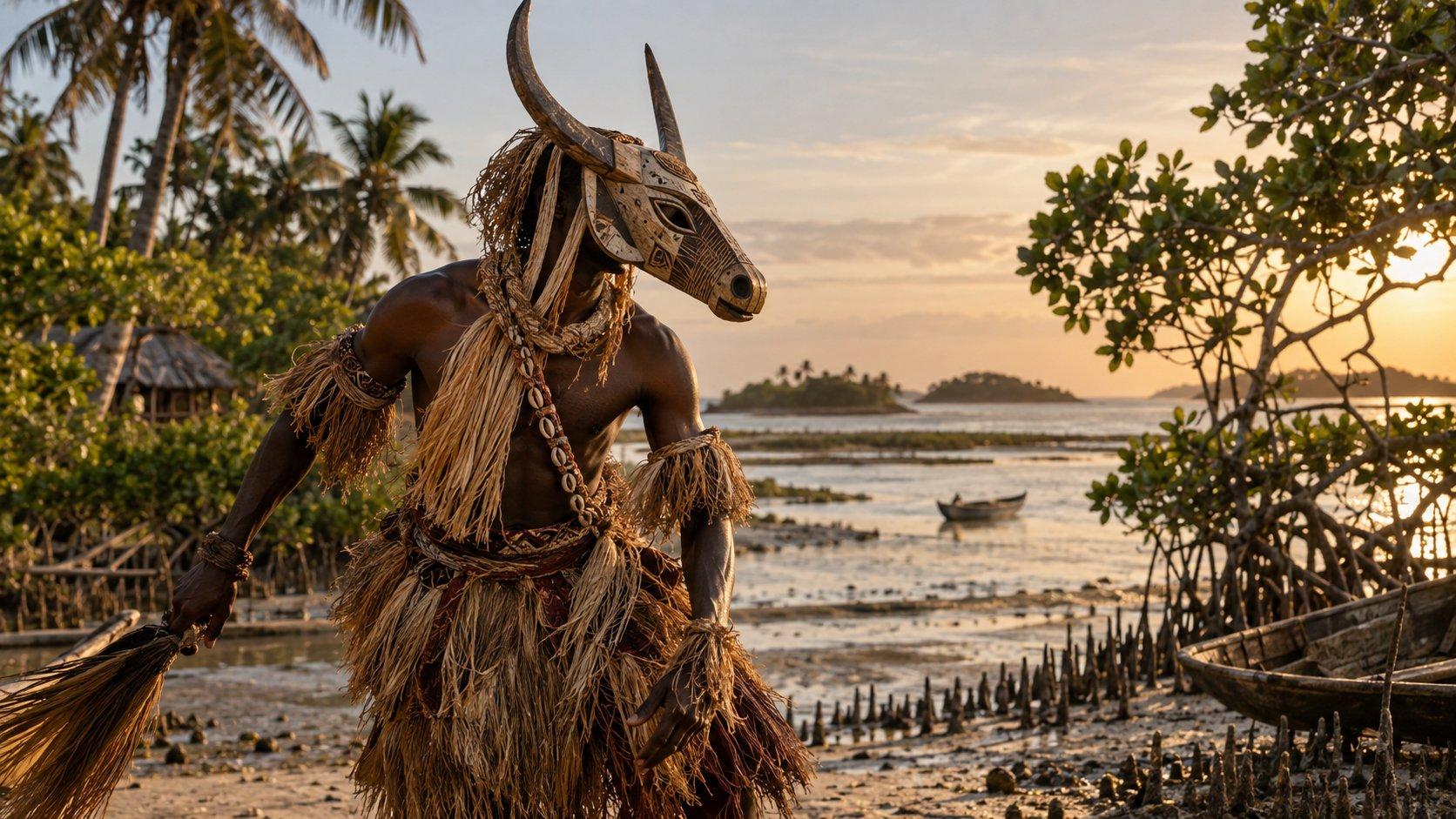
In southeastern Guinea, masks and other carved objects are connected in some communities to initiation societies such as Poro and Sande, also known as Bondo in some areas. These masks are not made only for decoration. In the communities where they are used, particular masks can have specific roles in initiation ceremonies and other rituals. Some are used during initiation, while others are associated with particular ritual activities or members of the society. Because these traditions remain connected to living community practices, their meaning cannot always be understood from the object alone. Some masks and other ritual objects are now held in museums and private collections outside Guinea. Removed from the ceremonies and communities for which they were made, these objects can be difficult to understand without the cultural and ritual knowledge surrounding their original use.
Festivals, ceremonies, and rites of passage
Among communities in southeastern Guinea that practise them, Poro and Sande, also known as Bondo in some areas, are important initiation societies. Their initiation ceremonies can mark a young person’s transition into adult life and involve teaching about community responsibilities, expected behaviour and traditional knowledge. The ceremonies and rules surrounding these societies vary from one community to another.
Because most Guineans are Muslim, Islamic holidays are also an important part of public and family life. Tabaski, the West African name commonly used for Eid al-Adha, and Eid al-Fitr, which marks the end of Ramadan, are major celebrations. Families attend communal prayers, wear new or special clothes, prepare food and visit relatives and friends. These celebrations bring together people from different ethnic communities across the country.
Among some Malinké communities, the dozo tradition is associated with groups of traditional hunters who have existed across the wider Mandé region, including Guinea, Mali and Côte d’Ivoire. Dozo hunters traditionally learn hunting skills, knowledge of local plants and other practices through apprenticeship. In some rural communities, they continue to be respected for their knowledge of the forest and may also be consulted for traditional protective or spiritual practices associated with the dozo tradition.
When France Left, It Took More Than Its Officials
In this section
French officials were concerned that the decision could encourage others to make the same choice.
When Guinea rejected the proposed French Community in 1958 and chose independence, France responded by withdrawing much of the personnel and infrastructure that had supported its colonial administration. French officials, teachers, technicians and security personnel left the country, while government records, equipment and supplies were also removed or destroyed. Contemporary and later accounts describe telephones being taken away, files and maps disappearing, and medical supplies and other government property being removed. Some accounts also report that light bulbs were unscrewed from their fittings before officials left, although this detail is less firmly documented than the removal of government equipment and records.
The result was an abrupt disruption for the new Guinean government. Guinea had chosen independence, but it had to begin running the country while rebuilding administrative systems that had depended heavily on French personnel and resources.
The episode also mattered beyond Guinea. France had hoped its former territories would remain within the French Community, a political arrangement that would have preserved close links with France after colonial rule. Guinea's rejection showed that an African territory could instead choose immediate independence. French officials were concerned that the decision could encourage others to make the same choice.
Most of France's remaining sub-Saharan African territories became independent in 1960. Guinea's decision in 1958 was therefore an early and highly visible break with the French colonial system, although it was one part of a much larger movement that led to independence across Africa.
What Guinea Still Carries
In this section
The country that said no first did not immediately become the free and prosperous nation that independence promised.
You can still hear Guinea’s history.
The djembe is played and taught around the world today, but its roots are in Mandé communities across West Africa, including Guinea. Guinean drummers and dancers continue to perform internationally, keeping techniques and traditions that were passed down through generations alive.
You can also see the past in the hills of Fouta Djallon, in central Guinea. The Fouta Djallon Imamate was destroyed during the French conquest, but the Fulani communities who lived there did not disappear with it. Their language, Islamic traditions, food and knowledge of their history remain part of life in the region.
And then there is 1958.
Guinea was the only French territory in sub-Saharan Africa to reject Charles de Gaulle's proposed French Community and choose immediate independence. But the country’s history after independence was far from simple. Sékou Touré's government became brutally repressive, later governments struggled with political instability, and Guinea experienced several military coups.
That is what makes Guinea's story worth remembering.
The country that said no first did not immediately become the free and prosperous nation that independence promised. But the choice it made in 1958 remains one of the clearest moments in Africa's struggle to break from colonial rule.
And more than sixty years later, you can still hear that history in its music, see it in its traditions, and find it in the communities that carried them forward.