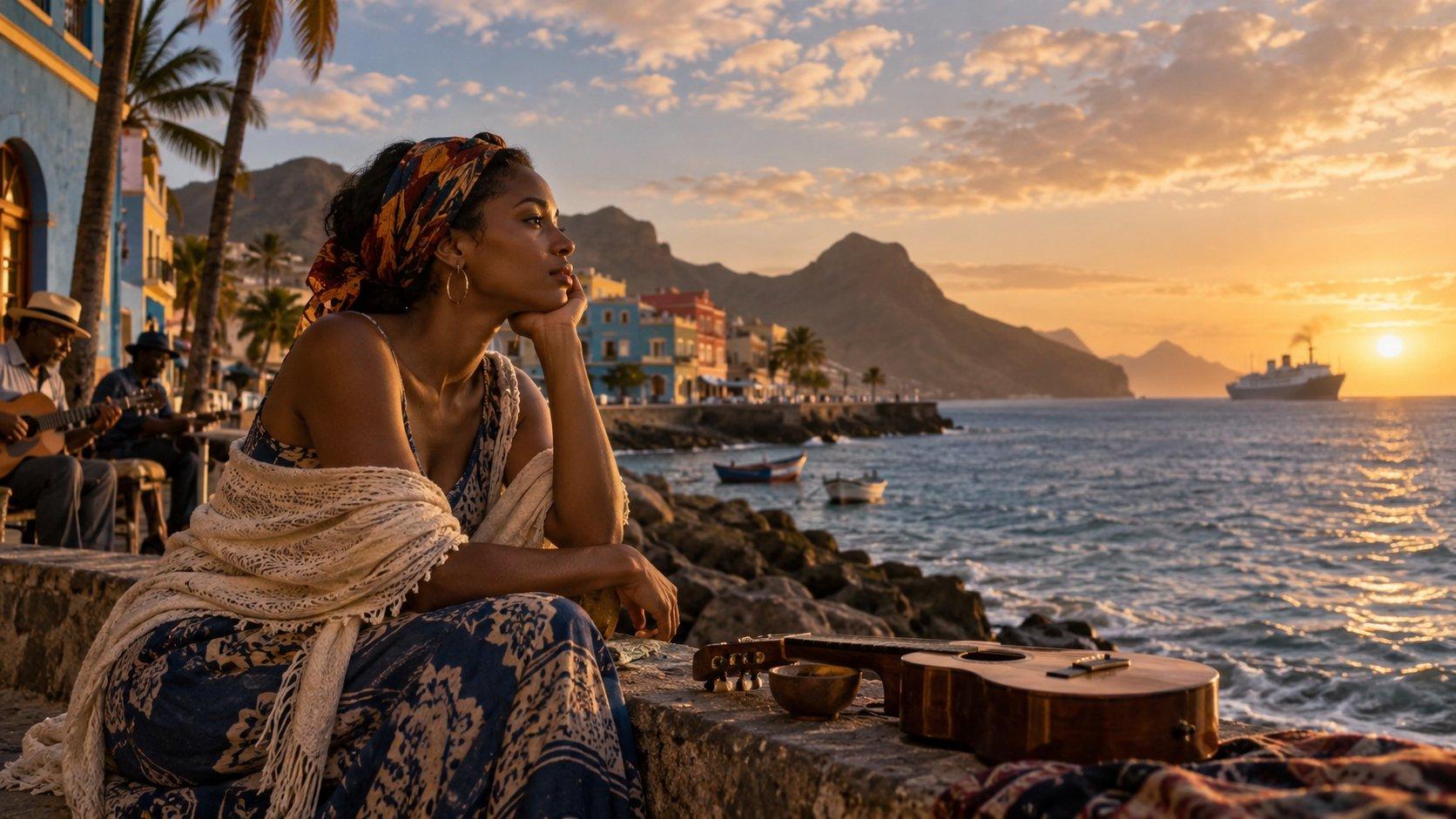
In 1954, on the island of São Vicente, a young man named João was preparing to leave Cape Verde. Before he left, he sang a song to his girlfriend, Mariana. The song was about sodade, a Cape Verdean word associated with longing, homesickness, separation and the ache of missing someone who is far away.
Years later, the singer Cesária Évora recorded that song. Her version appeared on her 1992 album Miss Perfumado and helped carry Cape Verdean music far beyond the islands. A member of her touring band later recalled performing Sodade in Japan and seeing people in the audience cry even though they did not understand the Kriolu lyrics.
The story is fitting because leaving has been part of Cape Verdean life for generations. Cape Verde is an island country in the Atlantic, roughly 500 kilometres from the coast of West Africa. Its ten volcanic islands were uninhabited when Portuguese navigators reached them in the 15th century. The population that developed there came from people who arrived from different parts of Europe and West Africa, including Africans who were brought to the islands through the slave trade.
The country that emerged from those movements developed its own language, food, music, religious traditions and social customs. Later, large numbers of Cape Verdeans left again, travelling to Portugal, the United States, the Netherlands, France and other countries in search of work and better opportunities.
That history gives sodade a very concrete meaning. Someone leaves. Someone stays behind. Years pass. Families continue across the distance.
Cape Verdean culture grew around those experiences.
Where the culture came from
Portuguese navigators reached the Cape Verde islands in 1460. The country's Ministry of Foreign Affairs says there are no indications of human presence before that period, and settlement began on Santiago in 1462.
The first settlements quickly became connected to the Portuguese Atlantic trading system. Cape Verde's location made the islands useful as a provisioning point and as a centre for the slave trade. Africans were brought to the islands from the West African mainland, while Portuguese settlers and administrators established permanent communities.
Over generations, these populations mixed. The Cape Verdean government describes the process as the formation of a Cape Verdean people from Europeans and enslaved Africans, with Creole emerging as the language of the community.
The language that developed is known today as Cape Verdean Creole, or Kriolu. It belongs to the Portuguese-lexified Creole languages of the Upper Guinea region. Portuguese provides most of its vocabulary, while African languages also influenced its development. Linguists have identified African influences in parts of its grammar and structure, although the history of the language is more complicated than saying that it is a mixture of Portuguese and any two particular African languages.
Cape Verde's environment made life difficult as well. The islands are dry, agricultural land is limited, and rainfall can be highly unreliable. Drought therefore had consequences far beyond a poor harvest.
Several famines caused extraordinary population losses. Historical estimates compiled by economist Jean Drèze and Amartya Sen's Hunger and Public Action put famine mortality at 44 percent of the population between 1773 and 1776, 42 percent between 1830 and 1833, and 40 percent between 1863 and 1866. The authors also note that these historical figures may contain some exaggeration, so they should be treated as estimates rather than exact death counts.
The later famines of the 20th century were also severe. Estimates for 1940–43 put famine mortality at about 15 percent of the population, followed by an estimated 18 percent between 1946 and 1948.
For families living through these conditions, leaving could become a way of surviving. People went where work was available, and the islands became connected to migration routes that stretched across the Atlantic.
Portugal remained the colonial power until Cape Verde became independent in 1975. During the colonial period, Cape Verdeans also occupied administrative positions elsewhere in the Portuguese empire, including in Guinea-Bissau. This created a complicated position for some Cape Verdeans. They were themselves living under Portuguese colonial rule, while some also worked within the colonial administration in other parts of Africa.
The independence movement grew around the PAIGC, the African Party for the Independence of Guinea and Cape Verde, founded by Amílcar Cabral in 1956. Cabral was born in Bafatá, in Portuguese Guinea, to Cape Verdean parents and became one of the central figures in the struggle against Portuguese colonial rule.
The PAIGC originally sought independence for Guinea-Bissau and Cape Verde as a united political project. Cabral was assassinated in 1973 and did not live to see either country become independent.
Cape Verde declared independence on 5 July 1975. After independence, the country was governed under a one-party system. In 1991, it held its first multiparty elections and established a parliamentary democracy.
The political history of the islands therefore runs from Portuguese settlement and the slave trade through colonial administration, an independence movement shared with Guinea-Bissau, one-party government and finally multiparty democracy.
The country is now widely regarded as one of Africa's more stable democracies.
Ethnic groups and languages
Most Cape Verdeans identify with a mixed African and European heritage, commonly described as mestiço or Creole. That does not mean every island has exactly the same history or that everyone has the same ancestry.
The islands developed their own regional identities, and differences can be heard particularly in Kriolu.
Portuguese is the country's official language and is used in government, formal education and official documents. Kriolu is the language most widely used in ordinary conversation.
There are several varieties of Cape Verdean Creole. The broadest distinction is usually made between the varieties spoken in the Barlavento, or Windward Islands, and those spoken in the Sotavento, or Leeward Islands. Within those groups, individual islands have their own pronunciation and vocabulary.
Someone from São Vicente may therefore speak Kriolu differently from someone from Santiago, even though both are speaking the same Cape Verdean language.
Kriolu also has a complicated written history. Portuguese has had centuries of institutional support as the language of administration and education, while Kriolu developed primarily through everyday speech. Linguists and language activists have worked on standardising its written form, including the Unified Alphabet for the Writing of Cape Verdean, known as ALUPEK. The writing system continues to coexist with different spelling practices.
The question of language is therefore also a question of history. Portuguese arrived with colonial power. Kriolu developed within Cape Verdean society itself and became the language through which generations of people spoke to one another at home, in markets, on the street and within their communities.
That is why Cape Verdean musicians have so often chosen Kriolu when singing about love, departure, family and home.
Religion and belief
Catholicism has been part of Cape Verdean public and private life since Portuguese settlement. Churches, Catholic festivals, baptisms, marriages and patron-saint celebrations remain visible throughout the islands.
The 2021 national census recorded 73 percent of the population as Roman Catholic. The same census recorded 16 percent with no religious affiliation. Smaller groups included Seventh-day Adventists, Nazarenes, Christian Rationalists and Muslims.
Cape Verde's religious history also includes African traditions carried to the islands by enslaved people. These traditions did not survive as one clearly defined, separate indigenous religion, because the islands had no known permanent population before European settlement. Instead, elements of African spiritual practice became part of a wider religious and cultural environment that developed alongside Christianity.
The result is a society where Catholic traditions can sit alongside family customs and local practices that have much older African roots.
Religious festivals are particularly important because they bring together religion and community life. A patron-saint celebration may involve Mass, processions, music, food, dancing and gatherings that continue well beyond the church itself.
Food
If you ask about Cape Verdean food, cachupa will come up very quickly.
Cachupa is a slow-cooked dish made from corn, beans and vegetables, with meat or fish added depending on the version and what is available. It is commonly described as Cape Verde's national dish.
There are different versions of the dish. Cachupa rica contains more ingredients, particularly meat and other additions, while simpler preparations use fewer ingredients.
The dish makes sense in a country where food has historically had to stretch a long way. Corn and beans provide the base. Vegetables can change according to availability. Meat and fish can be added when a household has access to them.
Leftover cachupa can also be fried the next day, often with eggs. This preparation is commonly known as cachupa refogada.
Fish is another important part of the country's food culture because Cape Verde is surrounded by the Atlantic. Tuna and other locally caught fish appear in everyday cooking, especially in coastal communities.
There are also traditional drinks associated with the islands. Grogue is a sugarcane spirit produced locally, particularly on Santo Antão and other islands where sugarcane is cultivated. Pontche is made by combining grogue with ingredients such as honey and citrus.
Other familiar foods include pastel com diabo dentro, a fried pastry filled with spiced fish, and cuscuz, a steamed corn-based food whose name should not be confused with the North African grain dish.
Cape Verdean food carries the same history found elsewhere in the culture. Ingredients are limited by the island environment, recipes have been adapted to what families could obtain, and dishes have travelled with migrants.
Food therefore became one more way of carrying home across the Atlantic.
Music, dance and art
Music is where Cape Verde's history of migration, distance and cultural mixing becomes especially easy to hear.
Morna is the country's best-known musical tradition. UNESCO inscribed Morna, musical practice of Cabo Verde on the Representative List of the Intangible Cultural Heritage of Humanity in 2019. UNESCO describes morna as a musical and choreographic practice combining voice, poetry, music and dance, traditionally performed with instruments such as the guitar, violin and cavaquinho. Its lyrics often deal with love, departure, separation, reunion and the homeland.
Morna's precise origins are debated. Scholars have discussed African musical traditions, Portuguese music, Brazilian forms such as modinha and other influences that travelled through the Atlantic. Cape Verde was connected to several ports and maritime routes, so musicians encountered sounds from different places over generations.
The music that developed in Cape Verde cannot therefore be reduced to one outside source.
Cesária Évora became the person most closely associated with taking morna to an international audience. She was born in Mindelo in 1941 and spent years performing in Cape Verde before her international career developed in the late 1980s.
She became known as the Barefoot Diva because she often performed without shoes, a habit associated with her connection to poor Cape Verdeans. Her international career eventually took her to major concert venues around the world.
In 2004, her album Voz D'Amor won the Grammy for Contemporary World Music Album.
Her importance goes beyond the award. She sang largely in Cape Verdean Creole, allowing an international audience to hear a language that had developed in a small Atlantic archipelago and was rarely heard on major international stages.
Morna is not the only important musical tradition.
Coladeira is generally livelier and more rhythmic. Funaná is strongly associated with Santiago and is built around the gaita, a type of accordion, and percussion. Batuku is another important tradition from Santiago, combining singing, rhythm and dance and historically associated particularly with women.
These traditions have not all had the same history under colonial rule. Some African-rooted musical practices were restricted or marginalised by colonial authorities. After independence, they became increasingly visible as expressions of Cape Verdean cultural identity.
Cape Verdean musicians continue to work across these traditions. Artists such as Mayra Andrade and Elida Almeida have brought Cape Verdean music to newer audiences while experimenting with contemporary sounds.
Clothing, textiles and craft
Cape Verde does not have one traditional national costume comparable to the clothing traditions associated with some mainland African societies.
The reason is partly historical. The population developed through Portuguese settlement and the forced movement of people from different parts of West Africa, rather than from one indigenous society with an established dress tradition that continued unchanged.
One important textile tradition is pánu di téra.
Pánu di téra is a cotton fabric associated with Cape Verde. Research published in the Island Studies Journal traces the weaving technique to African, particularly Guinean, enslaved weavers who brought it to the islands in the 15th century. The cloth was later used as a form of trading currency in transactions involving enslaved people on the West African coast. After independence, it acquired a stronger role as a symbol of Cape Verdean cultural identity.
That history gives the cloth an unusual place in Cape Verdean culture. It is a piece of material culture that carries several periods of the country's history at once: African craftsmanship, the slave trade, colonial commerce and the search for national symbols after independence.
Modern Cape Verdean art also includes painting, sculpture, photography, design and other forms of contemporary expression. Artists work with subjects that range from ordinary island life to migration, politics, landscape and identity.
The sea appears frequently because it is impossible to separate Cape Verdean life from the Atlantic. It has carried people away, brought people back and connected the islands to other parts of the world for centuries.
Festivals, ceremonies and rites of passage
Carnival is one of the largest cultural celebrations in Cape Verde, and São Vicente's Mindelo Carnival is particularly famous.
Its Brazilian influence is obvious in the costumes, music, parade structures and samba-inspired performances seen in Mindelo today. But the story is more interesting than saying that Cape Verde copied Brazil.
Mindelo grew around Porto Grande, a busy harbour that brought sailors, merchants, travellers and cultural influences into the city. Brazilian music was among those influences.
Research on São Vicente's carnival records Brazilian influence from at least the early 20th century. Carnival groups in the 1910s and 1920s used Brazilian names and musical references, while musicians such as B. Léza were influenced by Brazilian musicians they encountered in Mindelo. Brazilian films, songs and carnival styles also circulated in the city.
Over time, Cape Verdeans took those influences and made them part of Mindelo's own carnival.
The result today looks recognisably Brazilian in some respects, particularly in its samba-school-style organisation, costumes and parade structure, while remaining firmly identified by residents as Mindelo's own carnival. Scholars who have studied the festival caution against treating its Brazilian appearance as proof that Cape Verdean and Brazilian culture are the same. The relationship is better understood through years of contact, adaptation and local creativity.
Religious festivals form another major part of the calendar. Towns and islands celebrate their patron saints with combinations of religious ceremonies, processions, music, food and public gatherings.
These celebrations can also become occasions for families living abroad to return home.
Weddings, baptisms and other family events have the same pull. Cape Verde's migration history means that relatives may live thousands of kilometres apart, so a major family event can bring people together who have spent months or years living in different countries.
A country with a large population abroad
Cape Verde's population is small. The World Bank estimates that about 527,326 people lived in the country in 2025.
The number of Cape Verdeans and people of Cape Verdean descent living outside the country is much harder to measure because different estimates count different groups. Some figures refer to Cape Verdean citizens abroad, while others include descendants born outside the country.
The diaspora is nevertheless large enough to be central to the country's economic and social life.
One of the oldest major Cape Verdean communities outside the islands developed in New England.
American whaling ships regularly stopped at Cape Verde for supplies and crew during the 19th century. Cape Verdean sailors joined those ships, and many later settled in New Bedford and surrounding communities in Massachusetts. The relationship continued after the decline of whaling. Cape Verdean mariners became involved in packet trade, carrying passengers and goods between New England and the islands.
This created a community that was connected to Cape Verde by more than family ancestry. Ships carried people, letters, money, goods and news between the two places.
Other large Cape Verdean communities developed in Portugal, the Netherlands, France and the United States.
Migration therefore changed the meaning of distance.
A person could leave Santiago and settle in Massachusetts while remaining connected to relatives in Praia. Someone in São Vicente could have siblings in Lisbon and cousins in Rotterdam. Money earned abroad could support a family at home. A child could grow up outside Cape Verde while learning Kriolu from parents or grandparents.
Cape Verdean identity consequently exists in many places at once.
The government continues to treat the diaspora as an important part of the country's economic future. In 2026, for example, Cape Verde introduced tax incentives specifically aimed at diaspora investment and described the diaspora as something to be integrated into national development rather than treated as an afterthought.
That policy reflects something Cape Verdeans have been living with for generations: the country extends beyond the islands themselves.
Cape Verde today
Cape Verde today is a country of about half a million residents spread across nine inhabited islands, with a much larger community abroad.
Its history began with settlement after European arrival and the forced movement of Africans through the Atlantic slave trade. From there came a society with its own language, food, music and social traditions.
Drought and famine pushed people to leave. Colonial rule connected the islands to Portugal and other parts of the empire. Independence created a new national state. Migration then carried Cape Verdean families and culture into cities across Europe and North America.
You can still hear all of those periods in Cape Verdean music.
Morna remains part of contemporary Cape Verdean life. Its themes of love, departure, separation, reunion and homeland are not historical subjects that have disappeared. They are still relevant to a country where migration remains part of many families' lives. UNESCO notes that morna is performed at weddings, christenings and family reunions, placing the music inside ordinary social life as well as on concert stages.
Carnival in Mindelo continues to bring together music, dance, costume and public celebration, with Brazilian influence visible in its modern form while its organisers and participants continue to treat it as a Cape Verdean tradition.
And sodade still gives Cape Verdean music a word for something that is difficult to separate from the country's history.
It can describe missing someone who has left. It can describe longing for a place. It can carry the feeling of remembering a person or home from far away.
Cape Verde was built by people who arrived from elsewhere, people who were brought there by force, people who settled, people who left, and people who came back. Over several centuries, those movements produced a culture that could belong to the islands while also travelling far beyond them.
That is why a song sung in Kriolu in Mindelo can reach someone in Boston, Lisbon or Rotterdam and still sound like home.