In 1976, American writer Alex Haley published Roots: The Saga of an American Family, the story of a family he said he had traced through generations of enslavement in the United States to a young Mandinka man called Kunta Kinte, who, according to Haley's reconstruction, came from Juffureh on the north bank of the Gambia River. Haley believed that Kinte had been captured in 1767 and transported across the Atlantic aboard the Lord Ligonier, a slave ship that sailed from the Gambia River in July of that year and arrived at Annapolis, Maryland, on 29 September. The ship and its voyage are documented, including an advertisement in the Maryland Gazette announcing the sale of enslaved Africans brought on board, but Haley's identification of one of those people as his own ancestor Kunta Kinte has never been established with the same certainty. Historians and genealogists have since found serious problems in the oral testimony and American records he used to connect Kinte to later generations of his family, including evidence that the enslaved man Haley identified as Kinte in Virginia appeared in records before the Lord Ligonier arrived. The genealogy at the centre of Roots therefore remains disputed even though the ship, the slave trade through the Gambia River and the wider historical world Haley described were very real.
What happened after the book appeared is much easier to establish. The television adaptation broadcast in the United States in January 1977 became a cultural event, with an estimated 140 million Americans watching some or all of the series, and it brought questions of slavery, African ancestry and family history into millions of homes. For many African Americans, the idea that a family history broken apart by slavery might still be followed back to a particular African place had an enormous emotional force, regardless of the later arguments over Haley's own family tree. Juffureh, the river beside it and the small island once known as James Island became internationally associated with that search for origins, and the journey to the area developed into a form of heritage tourism centred on memory, ancestry and return rather than on the ordinary expectations of a holiday. UNESCO now describes Kunta Kinteh Island and its related sites as having symbolic and emotional importance for the African diaspora, and records the journey to the island as a pilgrimage to ancestral roots.
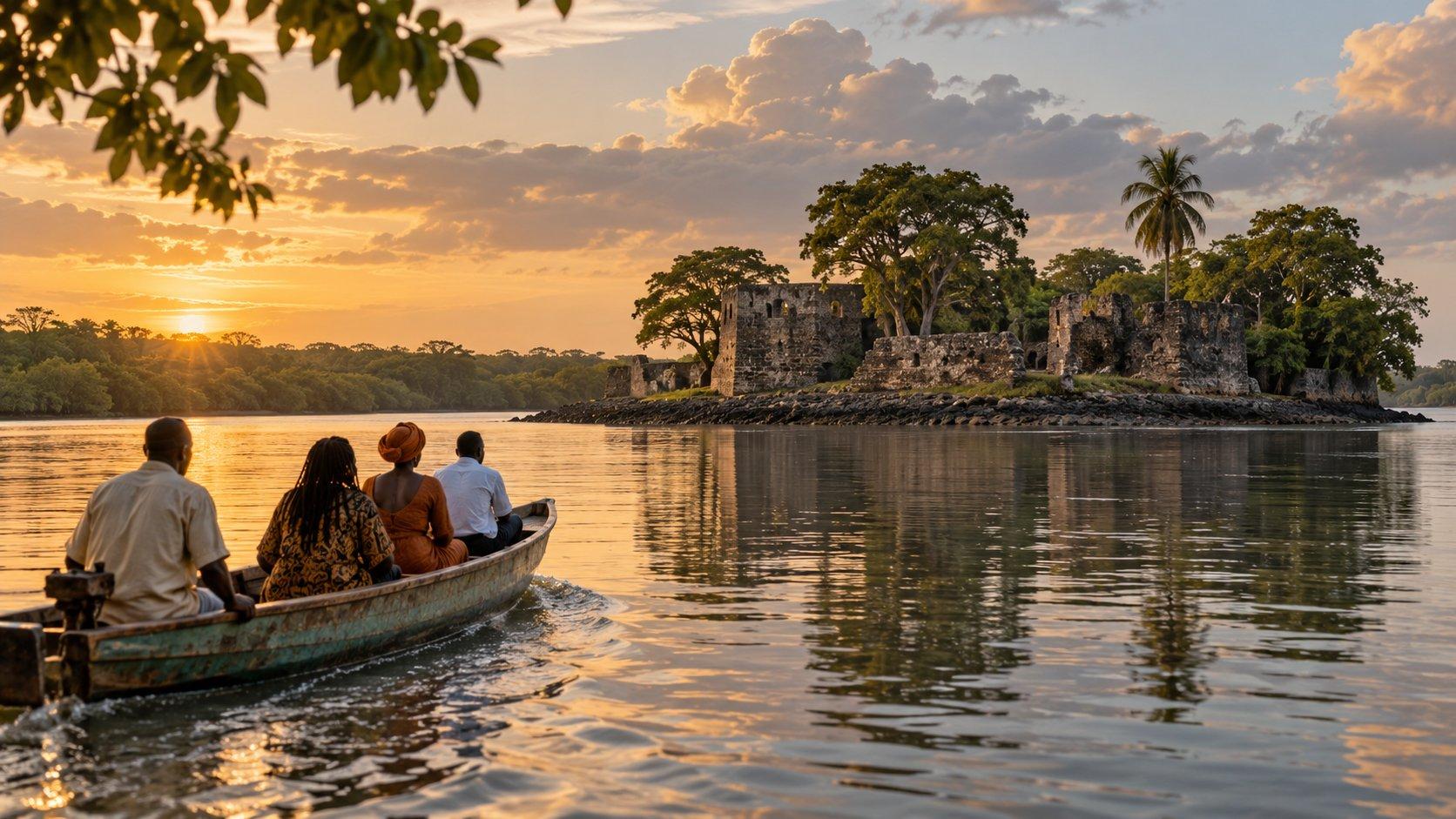
The island itself carries a history much larger than the story of Roots. It was inscribed on UNESCO's World Heritage List in 2003 as part of James Island and Related Sites, before the World Heritage Committee approved the name Kunta Kinteh Island and Related Sites in 2011. The property includes the island as well as places in Juffureh, Albreda and at the mouth of the river that document several stages of contact between West Africans and Europeans, from early trade and settlement through the Atlantic slave trade, British efforts to suppress that trade after abolition, colonial rule and eventual independence. The island's position in the middle of the river made it valuable because whoever controlled it could watch and influence movement along a waterway that connected the Atlantic coast to communities far inland. Its present importance to diaspora visitors therefore does not depend on proving that one particular captive was Haley's ancestor. The physical landscape belongs to a documented history in which people were traded, transported and separated from places and families whose names later became difficult or impossible for their descendants to recover.
The same river explains much of the country's geography. The Gambia is the smallest country on mainland Africa, stretching eastward from the Atlantic while Senegal surrounds it on its northern, eastern and southern sides. The country follows the Gambia River for hundreds of kilometres, and for much of that distance the land extends only a relatively short distance away from either bank. Its shape can look strange on a modern map, but it reflects the political importance of the river during the colonial period rather than any natural division between the communities living on either side. Britain wanted to preserve control over the waterway while France controlled the much larger territory of Senegal around it, and the negotiations between the two colonial powers eventually produced the narrow territory that became modern The Gambia.
That geography gives the river an unusual place in the country's history. Long before Roots made it famous to an international audience, the Gambia River connected settlements within West Africa, carried trade between the interior and the Atlantic, attracted merchants from outside the region and eventually became part of the infrastructure of the Atlantic slave trade. It later influenced the boundaries of a British colony and, after independence, remained the physical line around which a modern country was organised. To follow the river is therefore to move through several different periods of Gambian history rather than through one story beginning with slavery.
Where the culture came from
The societies of the Gambia River valley were connected to wider West African political and commercial networks centuries before Europeans established permanent positions along the waterway. People traded agricultural produce, salt, textiles, livestock, metals and other goods across routes linking settlements in the interior with one another and, eventually, with the coast. Gold, ivory and kola also circulated through wider West African trading systems, although the routes and relative importance of different commodities changed over time. When European merchants entered these networks from the Atlantic, they did not introduce the idea of long-distance trade to the region. They joined commercial systems that already existed and gradually changed their scale, direction and consequences as Atlantic demand became more important.
Mandinka settlement forms a large part of this earlier history. The Mandinka are part of the wider Mande-speaking world of West Africa, and historian Assan Sarr's work on the Gambia River basin describes Mandinka movement westward before the thirteenth century, followed by further migrations from areas connected to the Mali Empire during the thirteenth century. Those communities mixed, competed and formed political relationships with people already living in the region, and by the time Portuguese observers were writing about the Gambia in the late sixteenth century, Mandinka communities were firmly established on both banks of the river. Their presence therefore developed across a regional landscape much wider than the modern Gambian state, which helps explain why Mandinka language, family networks and cultural traditions continue across the present border with Senegal.
Portuguese navigators reached the Gambia River during the fifteenth century as Portugal expanded its commercial activity along the Atlantic coast of Africa. UNESCO records that by 1456 the Portuguese had acquired the island later known as James Island from local rulers and began establishing a position there. The attraction of the river was not simply that goods could be collected near the coast. The waterway provided access toward inland markets, making settlements and islands along it useful points from which merchants could participate in regional commerce. Over the following centuries, European powers competed for positions along the river, while local African rulers and merchants negotiated, resisted, traded and fought according to their own interests within a political environment that changed repeatedly.
The Atlantic slave trade eventually became one part of this commercial system, and its expansion transformed the consequences of contact between the region and overseas markets. Kunta Kinteh Island and other fortified positions were used at different periods to control commerce in commodities and enslaved people, while the Gambia River made it possible for Atlantic traders to reach farther into the interior than they could from a coastal fort alone. The island passed through different periods of occupation and destruction, involving Portuguese, Courlander, English and French interests, which is why the ruins that survive today should not be understood as the remains of one uninterrupted British slave fort. The wider World Heritage property includes structures associated not only with the expansion of slave trading but also with British attempts to suppress it after Britain abolished its transatlantic slave trade in 1807. Fort Bullen and the Six-Gun Battery at the river mouth, for example, were built in the nineteenth century to help prevent slave ships from using the river.
The stone circles at Wassu and Kerbatch belong to an even older layer of the region's history and should not be treated as monuments of the Mali Empire. They are part of a much wider Senegambian tradition of stone-circle construction found across areas of modern The Gambia and Senegal, with archaeological evidence showing that burial monuments were created and used over a period spanning more than a thousand years. Some of the archaeological material associated with the wider landscape reaches back to the centuries before the Common Era, while dated burials at particular sites fall within later periods. The monuments therefore cannot be assigned neatly to one kingdom, one ethnic group or one migration. What archaeologists can say with greater confidence is that the societies responsible for them quarried laterite stone, shaped large pillars using iron tools, transported them into position and arranged them around burial sites in a landscape that required considerable labour and organisation.
British colonial rule developed much later and in stages rather than through one conquest of the entire country. Bathurst, the city now called Banjul, was established as a British settlement in 1816, and British authority gradually extended to other areas along the river. By the late nineteenth century, Britain and France were competing over their territorial claims in West Africa, with French-controlled Senegal surrounding the British positions on the Gambia. An Anglo-French convention in 1889 established the basis of the country's northern, southern and eastern boundaries, which were subsequently demarcated between 1891 and 1905. The arrangement gave Britain strips of territory on either side of the river while much of the surrounding land remained under French control, turning a colonial agreement over access and influence into the basic shape of the modern Gambian state.
The Gambia gained independence from Britain on 18 February 1965 under Prime Minister Dawda Jawara, and relations with Senegal remained central because neither geography nor the shared communities on either side of the border disappeared with independence. After an attempted coup against Jawara in 1981 and the intervention of Senegalese troops, the two governments created the Senegambia Confederation in 1982, which was intended to deepen cooperation in areas including defence, foreign policy and economic relations. The arrangement never developed into a full political union, and disagreements over the extent of integration eventually led to its dissolution in 1989.
Another major change came in July 1994, when a military coup removed Jawara and brought Yahya Jammeh to power. Jammeh remained the country's dominant political figure for more than two decades, during which human rights organisations and, later, The Gambia's own Truth, Reconciliation and Reparations Commission documented unlawful killings, torture, enforced disappearances, attacks on journalists and political opponents, sexual violence and other abuses committed under his government. When opposition candidate Adama Barrow defeated Jammeh in the December 2016 presidential election, Jammeh initially accepted the result before rejecting it and refusing to leave office, producing a political crisis that drew in the Economic Community of West African States. Barrow was sworn in at the Gambian embassy in neighbouring Senegal, regional forces entered The Gambia and negotiations continued until Jammeh eventually left the country for exile in January 2017. The transfer avoided the large-scale conflict many feared, but it was achieved through sustained diplomatic pressure backed by the possibility and presence of regional military force rather than through an ordinary change of government.
The work of addressing abuses from that period continued after Jammeh left. The Truth, Reconciliation and Reparations Commission submitted its final report on 25 November 2021 after investigating violations committed between 1994 and January 2017, and its work produced 265 recommendations covering accountability, reparations, institutional reform and reconciliation. The government later committed to implementing 263 of those recommendations, while a Post-TRRC process was created to coordinate their implementation. In December 2024, ECOWAS leaders also approved the establishment of a Special Tribunal for The Gambia to prosecute allegations of serious human rights violations and international crimes committed during the Jammeh period. The commission itself has finished its investigations, but the larger questions of prosecution, reparations and institutional reform remain part of Gambian public life.
Ethnic groups and languages
The Mandinka are generally identified as The Gambia's largest ethnic group, followed by substantial Fula and Wolof populations, while Jola, Serahuleh, Serer, Aku and other communities also form part of the country. Different demographic sources give somewhat different percentages for each group, so the most useful way to understand the country's cultural composition is not as a fixed ranking but as a collection of communities whose histories stretch far beyond the national border. Mandinka communities extend into Senegal, Guinea and Mali; Fula populations are spread across a vast part of West Africa and the Sahel; Wolof communities are particularly important in Senegal as well as western Gambia; and Jola communities are found on both sides of the Gambian border, including in Senegal's Casamance region.
English is the official language and remains important in government, formal education and administration, but everyday communication is much more multilingual. Mandinka, Wolof, Fula, Jola and other Gambian languages are used in homes, markets, neighbourhoods and cultural life, and speakers often encounter several languages within the same social or commercial environment. The colonial border separated British Gambia from French Senegal politically, but it could not separate communities whose families, languages, trade and religious institutions were already spread across the wider region. Even today, official relations between the two states reflect that closeness. At the June 2026 Senegalo-Gambia Presidential Council, President Adama Barrow described the populations of the two countries as linked by culture, religion, language, commerce and family relationships despite belonging to two separate states.
Religion and belief
The Gambia is overwhelmingly Muslim, with the U.S. government's 2023 religious-demography estimate placing Muslims at about 96.4 percent of the population and Christians at about 3.5 percent. Most Gambian Muslims are Sunni, while Roman Catholics make up the largest part of the Christian minority. Islam developed in the wider Senegambian region over centuries through trade, scholarship, political change and religious teaching, and Sufi traditions such as the Tijaniyya and Qadiriyya have played important roles in the religious life of the region. Sufi orders are networks within Islam organised around particular traditions of religious teaching and spiritual practice, and their influence across Senegambia has historically extended through teachers, mosques, families and communities rather than through one central religious authority.
Religious identity in The Gambia has not always produced rigid social boundaries between Muslims and Christians. Religious-freedom reporting describes interfaith marriages and households containing members of different faiths, while major celebrations can draw participation or goodwill beyond the community directly observing them. The government recognises Christian holidays such as Good Friday and Easter alongside the major Muslim festivals, and the country's public culture has long included both communities even though their population sizes are very different. Indigenous spiritual practices also continue in some settings, sometimes alongside Islam or Christianity rather than in place of them, which is why religious life cannot always be understood by placing every practice into a separate category.
Marabouts are one example of how formal religion and spiritual consultation can overlap. The term is used in different ways across West Africa, but in The Gambia it can refer to respected Muslim religious specialists whose work may include Qur'anic teaching, prayer and spiritual advice. Research has also documented people consulting such specialists about illness, employment, relationships, protection or other personal concerns. These practices do not mean that every Gambian uses a marabout in the same way, but they show how religious authority can extend beyond the mosque into areas of everyday decision-making for some families and communities.
Food
Gambian food shares much with the wider Senegambian region because political borders were never culinary borders. Domoda, one of the dishes most closely associated with The Gambia, is a groundnut-based stew commonly eaten with rice and prepared in different households with meat, fish or vegetables. Benachin is a one-pot rice dish in which the rice cooks with tomato, vegetables and meat or fish, connecting it to the larger family of jollof-style rice dishes found across West Africa. Superkanja is built around okra, while yassa uses fish or chicken with onions and citrus, producing flavours familiar across both The Gambia and Senegal. There is no single version of these dishes that every household follows, and ingredients, proportions and preparation change between cooks, which is why they are better understood as established food traditions rather than fixed national recipes.
Groundnuts have been an important agricultural crop in The Gambia for generations, which helps explain their prominence in dishes such as domoda, while the country's relationship with the Atlantic Ocean and the Gambia River makes fish important to both diets and livelihoods. The Food and Agriculture Organization describes artisanal fishing as a significant source of employment, income and domestic fish supply, and identifies fisheries as an important contributor to animal protein and food security. Fish may be eaten fresh, smoked or dried, allowing it to move between coastal, riverine and inland communities even when people are not living directly beside the water.
Attaya, the strong green tea prepared and shared across The Gambia, Senegal and neighbouring parts of West Africa, occupies a different place in daily life because the preparation is as social as the drink itself. The tea is brewed with sugar, poured repeatedly to build foam and normally served in successive rounds from small glasses, which means preparing it can keep a group together for a considerable period. Friends can sit through the stages of brewing while talking, arguing, listening to music or passing time, turning an imported tea product into a local social ritual whose value lies partly in the time people spend around it.
Music, dance, and art
The kora is one of the strongest musical links between The Gambia and the wider Mande cultural world. It is a 21-string bridge harp played by plucking the strings with the thumbs and forefingers while the remaining fingers hold the instrument, allowing a skilled player to produce bass patterns, melody and accompaniment at the same time. The instrument has long been associated with hereditary jali families. A jali, often described in English or French as a griot, is more than a performer. Within Manding societies, jalis have traditionally preserved genealogies, praised families and leaders, carried historical narratives, mediated social relationships and performed those histories through music and speech.
The Gambia has produced kora players whose careers carried this tradition far beyond the country. Smithsonian Folkways recordings document musicians including Alhaji Bai Konte, Dembo Konte and Foday Musa Suso, all associated with Gambian jali traditions. Bai Konte performed at the Newport Jazz Festival in the United States in 1973, while Suso, who came from a hereditary jali family, later worked across traditional Manding music and experimental collaborations with musicians outside West Africa. His recorded repertoire includes older historical pieces as well as songs responding to contemporary life, showing that jali music was never simply a museum form repeated without change. Its traditional function depended on remembering the past, but performers also responded to the world around them.
Other instruments and musical traditions sit alongside the kora. Gambian government cultural material identifies instruments including the bala, a wooden-keyed instrument related to the balafon, and the tama, a drum whose pitch can be altered while it is played. Mandinka, Wolof, Jola and other communities maintain different repertoires and performance practices, while contemporary Gambian musicians also work with reggae, hip-hop, Afrobeats, mbalax and other forms that circulate across West Africa and internationally. The result is not a clean split between traditional music and modern music, because older instruments and performance roles continue to appear inside newer musical settings.
Clothing, textiles, and craft
Textiles and craft in The Gambia also draw from traditions shared across the wider region. Tailored clothing made from brightly patterned fabrics is common for formal occasions, while handwoven cloth, batik, baskets, jewellery, leatherwork and wood carving form part of the country's craft economy. Government tourism information identifies woven baskets, carvings, batik fabrics and locally made jewellery among products sold in Gambian markets, where craft production operates both as cultural expression and as a source of income.
Keeping these skills active increasingly involves the same economic question facing traditional crafts elsewhere: younger people are more likely to learn a skill when it can still support a livelihood. Gambian tourism and heritage initiatives have therefore combined conservation with training, including programmes for young tour guides and women producing souvenirs in communities near major heritage sites. At the same time, the National Centre for Arts and Culture has been documenting forms of intangible heritage, including traditional craftsmanship, performance and ritual knowledge, so that preservation does not focus only on monuments while the practices surrounding them disappear.
The Kankurang is one of the best-known Manding traditions practised in The Gambia and Senegal, particularly in communities where it forms part of male initiation. The central figure wears a costume made from bark fibre and leaves, but the masquerade is only one element within a larger system that can include elders, initiates, periods of seclusion, processions, songs, dance and the transmission of knowledge about social responsibilities. Within that system, the Kankurang acts as a protective and disciplinary figure associated with the transition of boys through initiation. UNESCO originally proclaimed the Kankurang a Masterpiece of the Oral and Intangible Heritage of Humanity in 2005 and placed it on the Representative List of the Intangible Cultural Heritage of Humanity in 2008.
The traditional rite and the public Kankurang festival are related but they are not identical. UNESCO describes initiation ceremonies as generally taking place between August and September, while Janjanbureh hosts a public Kankurang and Masks Festival in January that brings masquerades, music, storytelling, food, crafts and performances into a setting open to visitors. The ninth edition took place from 23 to 25 January 2026, and the organisers have announced the tenth anniversary edition for January 2027. That festival allows the town to build tourism around living cultural traditions, while the ceremonies from which the Kankurang comes continue to have social and religious meanings that cannot be reduced to the public performance. UNESCO has also warned that urbanisation and the loss of sacred forest areas are putting pressure on parts of the traditional practice, so continuity does not mean that the conditions surrounding it have remained unchanged.
The country's relationship with the African diaspora has also produced its own public traditions. The International Roots Homecoming Festival began in the 1990s as a programme intended to bring people of African descent to The Gambia, with visits to places including Juffureh and Kunta Kinteh Island forming part of its heritage programme. The festival did not maintain an uninterrupted schedule; its twelfth edition was held in 2016 before it was suspended, and later government plans focused on reviving and reworking the event. In 2026, the fiftieth anniversary of the publication of Roots again brought national attention to Haley's legacy, with President Adama Barrow publicly linking the anniversary to The Gambia's continuing relationship with the African diaspora. The importance of that relationship has therefore outlasted the regular festival calendar, even as the country continues to debate how best to preserve and present the history associated with Roots.
Religious celebrations remain more regular features of the calendar. Eid al-Fitr, commonly called Koriteh in The Gambia, marks the end of Ramadan, while Eid al-Adha, widely called Tobaski, brings families together for prayer, food and visits. Christian holidays including Christmas, Good Friday and Easter are also publicly recognised. In a country with a large Muslim majority and a much smaller Christian population, these occasions provide one of the clearest everyday examples of how different religious communities remain visible within the same national culture.
The stone circles of Senegambia
The stone circles at Wassu and Kerbatch form part of one of the largest surviving concentrations of megalithic monuments in the region. Together with Sine Ngayène and Wanar in Senegal, they make up the UNESCO World Heritage property known as the Stone Circles of Senegambia, although those four protected groups represent only part of a much wider archaeological landscape. UNESCO records more than 1,000 stone circles and related burial monuments distributed across an area roughly 100 kilometres wide and 350 kilometres long, while the four World Heritage groups contain 93 circles and associated burial mounds.
The scale becomes easier to understand when looking at how the monuments were made. Builders quarried laterite, an iron-rich stone that hardens after exposure, then used iron tools to shape the material into pillars that were often close to two metres high and could weigh several tonnes. A circle normally contains between eight and fourteen upright stones, and excavations have found burials, pottery, iron objects and ornaments associated with the sites. The archaeological evidence links the monuments firmly to funerary practices, although researchers cannot identify every community responsible for building them or reconstruct exactly what each burial ceremony meant to the people involved. The tradition also lasted for so long that there is no reason to assume the same population, political system or ritual explanation applied throughout the entire period.
This much older history changes the way the river valley can be understood. The Gambia is internationally associated with an eighteenth-century story of capture because of Roots, but the societies living around the river had already been creating settlements, trading, farming, working iron and building monumental burial landscapes for many centuries before Atlantic slavery reached its height. The river's historical importance did not begin when Europeans arrived, and the surviving archaeological sites make that visible without needing to turn their builders into a mysterious civilisation whose lives cannot be understood at all.
What remains along the river today
Kunta Kinteh Island survives, although the physical site is vulnerable. UNESCO has repeatedly identified erosion as a threat to the ruins, particularly because the island sits directly within a river system where water and weather continue to affect its edges and structures. Some sections of the wider World Heritage property have been stabilised or restored, but the ruins require continued maintenance if they are to survive. The place visited by diaspora travellers is therefore not a landscape preserved automatically by its historical importance; conservation work determines how much physical evidence future generations will still be able to see.
Other forms of heritage survive through people rather than through stone. In January 2026, the National Centre for Arts and Culture trained representatives from 30 communities in the Central River Region as part of a project designed to document 90 forms of intangible cultural heritage over two years, including rituals, festivals, performance, craftsmanship and traditional knowledge. The work is based on recording traditions with the communities that practise them, because a ceremony, song or craft cannot be preserved in quite the same way as a fort or stone circle. It survives when people know how to perform it, explain it, make it and pass that knowledge on.
The kora offers one example of that continuity. Musicians from Gambian jali families still perform an instrument whose repertoire includes stories connected to much older Mande history, even though the same instrument has now travelled through recordings, international festivals and collaborations that earlier generations could not have imagined. The Kankurang provides another, continuing within initiation traditions while also becoming the centre of a public festival that draws visitors to Janjanbureh. Neither survives because Gambian culture has remained unchanged. They survive because people have continued to find ways to practise, teach and reinterpret them under new social and economic conditions.
The river continues to connect these different periods without turning them into one story. It was a route for African commerce before sustained European contact, became a route through which European merchants entered inland trading systems, was drawn into the trafficking of enslaved people across the Atlantic, influenced the territorial ambitions that produced the country's modern borders and now carries visitors towards one of West Africa's most recognised sites of diaspora memory. Around it live communities whose languages, religious practices, foods and family histories continue across a political border with Senegal that is much younger than the cultures it divides.
In 2026, fifty years after Roots was published, The Gambia was again publicly reflecting on the relationship between Haley's book, the country and the African diaspora. Half a century of historical research has made the story more complicated than it appeared when millions first encountered Kunta Kinte on television. Haley's exact genealogy cannot be treated as established fact, but Juffureh and Kunta Kinteh Island do not need that genealogy to give them historical weight. The river was part of the Atlantic slave trade, the surviving sites document that history, and the difficulty descendants face when trying to recover the individual identities of people carried away from Africa remains one of slavery's enduring consequences.
That is what gives the pilgrimage its meaning today. People return to a landscape associated with one famous account of ancestry, but what they encounter is older and broader than one family story: a river valley shaped by West African states and communities long before colonial borders, by trade before and during the Atlantic era, by the violence of slavery, by European competition, by colonial rule and by cultural traditions that did not disappear when any of those political periods ended. Roots gave millions of people a reason to look towards this particular stretch of West Africa. The history along the Gambia River explains why, once they do, there is far more there to understand.