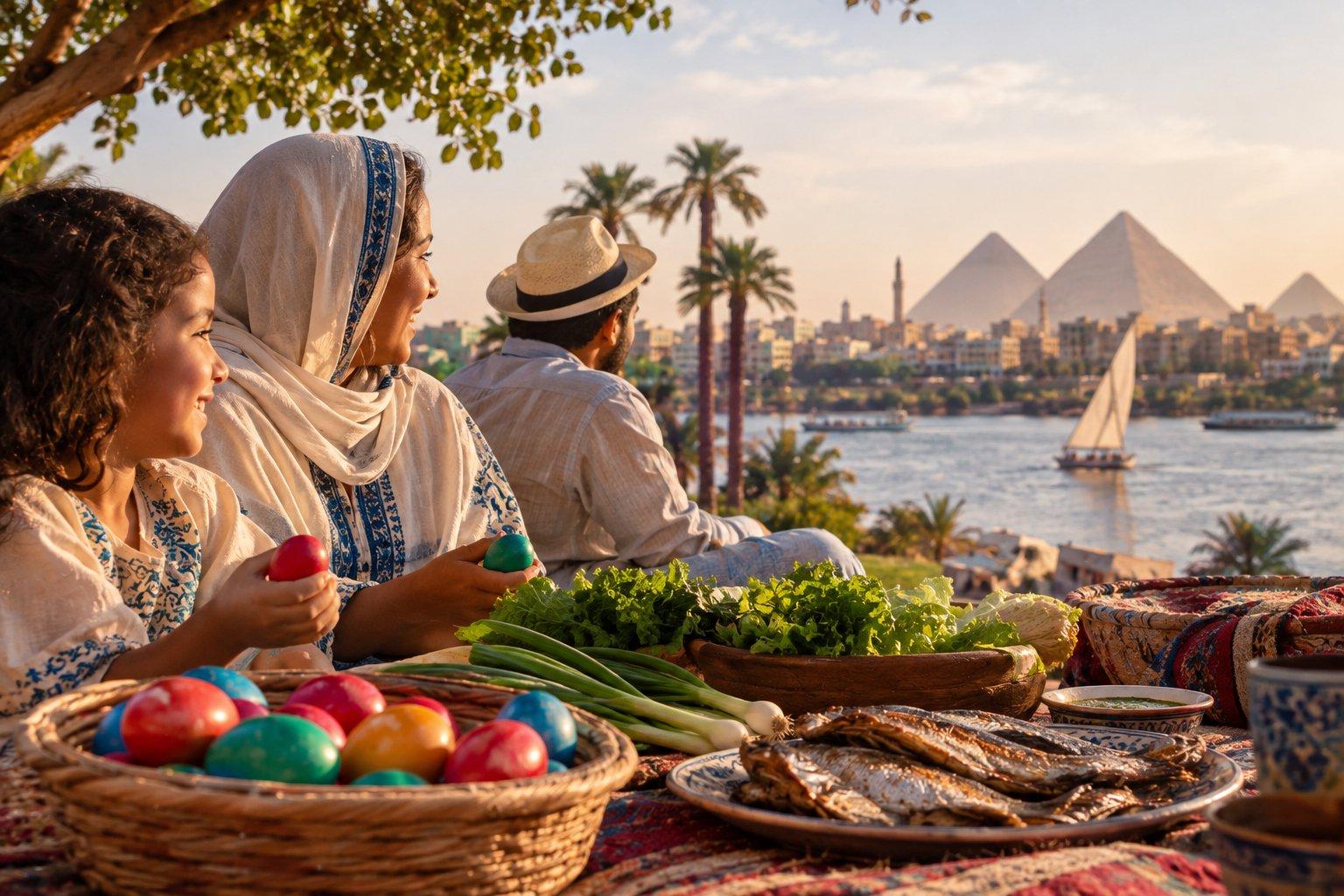
On the spring day after Coptic Easter, many Egyptian families head outdoors with colored eggs, salted fish, green onions, and lettuce. Parks, riverbanks and open spaces fill with people spending the day outside. This is Sham El-Nessim, one of Egypt's oldest annual celebrations. Egyptian government sources trace the festival back more than 4,500 years to ancient Egyptian spring and harvest traditions. Some of the foods and customs associated with it today, including salted fish, onions, lettuce and colored eggs, are also mentioned in accounts of older Egyptian practices.
The celebration now belongs to a much later Egypt as well. It falls immediately after Coptic Easter, but it is widely observed beyond the Christian community, including by Muslim Egyptians. Feseekh, the salted and fermented fish eaten during the holiday, remains one of its best-known foods. So does the habit of spending the day outside with family and friends.
Sham El-Nessim is a useful place to begin understanding Egypt because it brings several periods of the country's history into one ordinary spring holiday. Ancient Egyptian traditions, Christianity, Islam and modern Egyptian national life all appear in the same calendar without the celebration belonging exclusively to any one of them.
That is one of the interesting things about Egyptian culture. Its history is not made up of one civilization disappearing before another arrived. Greek, Roman, Christian, Arab, Ottoman and European influences all became part of the country's later history, while older Egyptian traditions were sometimes abandoned, sometimes transformed and sometimes carried forward in new forms.
Where the culture came from
Ancient Egyptian civilization developed along the Nile over thousands of years, with political unification traditionally placed around 3100 BC. It produced monumental architecture, a complex religious system centered on gods such as Ra, Osiris and Isis, and one of the world's earliest writing traditions.
Much of what is known about ancient Egypt became accessible to modern scholars only after the decipherment of hieroglyphic writing. The Rosetta Stone, discovered in 1799, contained the same decree in hieroglyphic, Demotic and Greek. Thomas Young made important advances in understanding the script, while Jean-François Champollion's work in 1822 established a major breakthrough in decipherment.
Egypt was ruled by a succession of outside powers, including the Assyrians, Persians, Greeks and Romans. Yet foreign rule did not mean that Egyptian religious practices and institutions disappeared overnight. The Ptolemaic rulers who followed Alexander the Great, for example, presented themselves in Egyptian royal forms and supported temples and Egyptian religious traditions alongside their Greek heritage.
Christianity became deeply established in Egypt during the Roman period. The tradition that the evangelist Mark brought Christianity to Alexandria in the first century is important to Coptic Christian history, although it is a tradition rather than something historians can establish with the same certainty as documented later developments.
Egypt eventually became one of the most important centers of early Christianity. Its monasteries, particularly those associated with figures such as Anthony the Great and Pachomius, played a major role in the development of Christian monasticism.
The word Copt has a long linguistic history too. It comes through Arabic and Greek forms connected to the word for Egyptian. Over time, its use narrowed and came to refer specifically to Egypt's Christian community. It is therefore misleading to say that Copt originally described a separate ancient ethnic group. The older word had a broader meaning connected to being Egyptian.
The Arab conquest in the seventh century brought Islam to Egypt, but conversion was gradual. Egypt did not become Muslim immediately after the conquest. Over the following centuries, Islam became the religion of the majority while Christian communities, particularly the Coptic community, remained an important part of Egyptian society.
Egypt later passed through Fatimid, Mamluk and Ottoman rule before coming under British occupation in the nineteenth century. Britain declared Egypt independent in 1922, although British influence over Egyptian affairs continued afterward.
The 1952 revolution ended the monarchy and brought the Free Officers movement to power. Gamal Abdel Nasser's presidency then became a defining period in modern Egyptian history, with Arab nationalism, state-led economic development and pan-Arab politics playing important roles.
One of the most consequential projects of the period was the Aswan High Dam. Its construction created Lake Nasser and flooded large areas of ancient Nubia, resulting in the displacement of Nubian communities and the loss of villages and agricultural land.
At the same time, the dam created an international heritage crisis. Between 1960 and 1980, UNESCO coordinated a major campaign to rescue monuments threatened by the rising waters. Abu Simbel and other temples were dismantled, moved and reconstructed above the future waterline. UNESCO describes the campaign as an international effort that saved major monuments from flooding.
The temples survived. Many Nubian communities had to rebuild their lives elsewhere.
Ethnic groups and languages
Egyptian identity is complicated by the country's long history and by the fact that religion, language, geography and ancestry do not always line up neatly.
Most Egyptians identify as Egyptian, while the country also contains communities with their own historical and cultural identities. Nubians are particularly important to understanding southern Egypt. Nubian communities have historically lived along the Nile in areas around Aswan and farther south toward the Sudanese border, and Nubian languages include varieties such as Nobiin and Kenuzi-Dongola.
The construction of the Aswan High Dam and the flooding of Nubian villages caused major displacement. UNESCO's documentation of Nubian intangible heritage specifically notes that the community was displaced following the construction of the dam and the flooding of villages.
That history is still relevant today because Nubian culture is not only something preserved in museums. Language, music, architecture, food and family traditions continue to be practiced, even though displacement changed where many communities live.
Arabic is the country's official language, while Egyptian Arabic is the everyday speech variety heard across much of the country. Egyptian Arabic has also travelled far beyond Egypt's borders.
Egypt's film and television industries helped make the dialect unusually familiar across the Arabic-speaking world. MIT Press describes Egyptian Arabic as the most widely understood Arabic dialect, linking that familiarity in large part to Egypt's influential television and movie industries during the twentieth century.
Coptic has a different role. It is the final historical stage of the ancient Egyptian language and is written using a script based largely on the Greek alphabet, with additional letters derived from earlier Egyptian writing traditions. It is no longer an everyday spoken language, but it remains in use in Coptic Orthodox liturgy.
So modern Egypt contains several linguistic layers at once: Arabic in everyday public life, regional varieties and minority languages in different communities, and Coptic in Christian religious practice.
Religion and belief
Egypt is overwhelmingly Muslim, with Sunni Islam making up the majority. Christian Egyptians form a significant minority, with the Coptic Orthodox Church being the country's largest Christian community. Exact population estimates vary by source, so precise percentages should be treated cautiously. The U.S. State Department's 2023 religious-freedom report cited estimates of roughly 90 percent Sunni Muslim and 10 percent Christian, while also noting differing estimates from other sources.
Religion is visible in everyday Egyptian life. The Muslim calendar shapes fasting, prayer and major holidays, while Coptic Christians follow their own religious calendar. Coptic Christmas is celebrated on January 7, and Coptic Easter follows the Orthodox calculation of Easter rather than the Western calendar.
Egypt also has a long tradition of popular religious practices that sit alongside formal religious institutions. Moulids, for example, are festivals associated with the commemoration of Muslim saints and religious figures. They can involve processions, music, food, lights and large gatherings around shrines.
Some Egyptian customs are also difficult to assign neatly to one religious period. A practice may have acquired new meaning after Christianity or Islam became dominant without necessarily preserving its original ancient meaning. That is why claims that a particular modern Egyptian custom is directly "Pharaonic" should be treated carefully unless there is specific historical evidence for that connection.
The same caution applies to the idea of perfect religious harmony. Muslims and Christians share many aspects of Egyptian public and family life, and customs such as Sham El-Nessim cross religious boundaries. At the same time, Egypt has also experienced sectarian discrimination, tension and violence. Both parts of that history belong in any honest account of the country.
Food
Food is one of the easiest ways to see how Egyptian culture has developed over time.
Koshari is probably the clearest modern example. Rice, pasta, lentils, chickpeas or other legumes, fried onions and a tomato-based sauce come together in a dish that is inexpensive, filling and widely available. In 2025, UNESCO inscribed Koshary, daily life dish and practices associated with it on its Representative List of the Intangible Cultural Heritage of Humanity. UNESCO's description emphasizes its affordable ingredients and its place in homes, restaurants and street food culture.
Ful medames is another everyday staple, particularly associated with breakfast. It is made from cooked fava beans and is commonly served with ingredients such as oil, lemon, cumin and bread. Ancient Egyptians certainly consumed legumes, but it is difficult to prove that the modern dish of ful medames is unchanged from an ancient recipe. It is safer to describe it as part of a much longer Egyptian tradition of eating beans and other legumes.
Molokhia is made from finely chopped jute mallow leaves and is commonly prepared with garlic and coriander and served with rice, often alongside chicken or rabbit. There are stories connecting the dish to ancient rulers and royal food, but these should be treated as culinary tradition and legend rather than established historical fact.
Then there is feseekh, the salted and fermented mullet associated especially with Sham El-Nessim. It is an important part of the holiday's food tradition, but it also comes with a genuine food-safety risk. Improperly prepared fermented fish can cause botulism, which is why public health authorities have repeatedly warned about feseekh around the holiday.
Qatayef, sweet stuffed pancakes commonly eaten during Ramadan, belongs to another part of Egypt's seasonal food calendar.
Food in Egypt therefore does more than feed people. Some dishes are everyday staples, some belong to religious seasons, and some carry stories whose origins are partly documented and partly preserved through family tradition.
Music, dance, and art
Egypt's cultural influence across the Arab world is particularly visible in film and music.
By the 1940s, Egypt had developed a major Arabic-language film industry whose stars and productions attracted audiences across the Arab world. Oxford's Oxford Handbook of Modern Egyptian History describes the Egyptian studio system as "Hollywood on the Nile" and notes that it drew viewers and aspiring stars from across the region.
That influence extended beyond cinema. Singers such as Umm Kulthum became major cultural figures across the Arabic-speaking world. Her voice travelled through radio to audiences far beyond Egypt, and her music remains part of the region's cultural memory.
Egyptian music itself contains many traditions. Classical Arabic music uses forms and instruments shared across the wider Arab world, including the oud, qanun and nay, while Egyptian popular and religious music developed their own local styles.
Raqs sharqi, the Egyptian form of what is commonly called belly dance, also developed into a modern theatrical style through Egypt's entertainment industry, particularly Cairo's nightclub and film culture. It should not be confused with the idea that Egypt invented every form of dance associated with the wider term "belly dance." Different forms existed across the region and beyond.
Tanoura is another striking Egyptian performance tradition. Its spinning skirts and repetitive movement are associated with Sufi and popular religious traditions, although contemporary performances may also be presented as cultural entertainment.
And Egyptian popular music did not stop with the era of Umm Kulthum.
Shaabi developed as a major popular genre associated with urban working-class life. More recently, mahraganat emerged from Egypt's electronic music scene and became an important part of contemporary youth culture. The sound is very different from the orchestral music associated with Egypt's twentieth-century stars, but the broader pattern is familiar: Egyptian musicians continue to take influences from their surroundings and turn them into something recognizably their own.
Clothes, textiles, and the people who keep making them
Modern Egyptian clothing varies enormously depending on where someone lives, their age, profession, religious practice and personal taste.
The galabeya remains one of the country's best-known traditional garments. It is a long, loose-fitting robe worn by men and, in different forms, by women, particularly in rural areas and among older generations. It should not be presented as an unchanged garment from ancient Egypt. The modern galabeya belongs to a much later history of Egyptian dress and has developed alongside wider regional clothing traditions.
The hijab is worn by many Egyptian Muslim women, although how it is worn and whether it is worn at all varies across generations, communities and individual choices.
Clothing is only one part of Egypt's textile culture. Historic Cairo still contains workshops practicing traditional crafts including copperwork, glassblowing, leatherwork, calligraphy and khayamiya, the decorative appliqué textile tradition associated with tentmaking. UNESCO has documented thirty traditional crafts in Historic Cairo and described efforts to pass these skills on through apprenticeships.
Historic Cairo itself is a UNESCO World Heritage site, reflecting the depth of the city's architectural and craft heritage.
Papyrus also remains strongly associated with Egypt, particularly through tourist markets and craft production. The plant was an important writing material in ancient Egypt, and the English word "paper" ultimately comes from the Greek word papyros. Modern papyrus products, however, should not automatically be treated as evidence that an ancient production technique survived unchanged for thousands of years.
The festivals that organize the year
Ramadan changes the rhythm of Egyptian life every year. During the lunar month, observant Muslims fast from dawn to sunset before breaking the fast with iftar. Families gather, streets become busier in the evenings, and the traditional fanoos lantern remains strongly associated with Egyptian Ramadan culture.
Eid al-Fitr follows Ramadan and brings its own traditions of family visits, food, new clothes and celebration.
For Egypt's Coptic Christian community, Christmas and Easter anchor the Christian calendar. Moulids add another layer of popular religious celebration, with gatherings around shrines often combining devotion with food, music, lights and social activity.
And then there is Sham El-Nessim.
Its modern form has changed over centuries, but the Egyptian government traces its celebration back more than 4,500 years and identifies its roots with ancient Egyptian spring and harvest traditions. Today it is celebrated across religious communities, with food and outdoor gatherings giving the day a distinctly Egyptian character.
It is a good example of how cultural continuity actually works. Traditions do not always survive in exactly the same form. Sometimes they survive because people keep practicing them while their meanings change.
One word tells a larger story
The word Copt is a good example.
Today, when people say "Copt," they generally mean a Christian Egyptian, particularly a member of the Coptic Christian tradition. But the word did not begin with that narrow meaning.
Its history passes through Greek and Arabic forms of the word for Egyptian. The Greek Aigyptios referred to an Egyptian, while later Arabic forms developed into Qibt and related words that eventually gave us "Copt." Over time, the word became associated specifically with Egypt's Christian population.
That does not mean that every ancient Egyptian should casually be called a "Copt" in the modern sense. It means the history of the word itself reflects a period when "Egyptian" and "Christian Egyptian" were not yet the same linguistic category.
That small change in a word mirrors something much larger in Egyptian history: identities acquire new meanings as societies change.
Egypt is still making its culture
It is tempting to talk about Egyptian culture as though it belongs mainly to the past: pyramids, temples, hieroglyphs, mummies and pharaohs.
But much of what makes Egypt culturally interesting is happening far away from the monuments.
Every year, people still prepare koshari, gather for Ramadan, attend moulids, celebrate Sham El-Nessim, speak Egyptian Arabic, worship in Coptic churches, make textiles, play music and pass family traditions to children.
In Aswan, Nubian communities continue working to preserve languages, music, architecture and other forms of cultural heritage shaped by a history that includes the displacement caused by the Aswan High Dam. UNESCO has specifically supported documentation and safeguarding of Nubian intangible heritage.
Egyptian cinema and music also continue to travel. The industry no longer occupies exactly the same position it held during the twentieth century, but Egyptian films and popular culture remain important across the Arabic-speaking world.
That may be the most useful way to understand Egypt.
Its culture is not a museum display where every object has remained untouched since antiquity. It is a living collection of things that have been changed, renamed, adapted, abandoned, revived and carried forward.
Some traditions can be traced confidently to particular historical periods. Others survive through family memory, religious practice or local custom, where the exact beginning is much harder to establish.
Either way, Egypt's culture is still being made.
The people eating koshari today, speaking Egyptian Arabic, celebrating Sham El-Nessim, listening to music in Cairo, weaving textiles in Upper Egypt or preserving Nubian traditions are not merely repeating history.