Explore São Tomé and Príncipe's history and culture, from Tchiloli and Creole languages to colonial plantations, food, religion, literature and the roças.
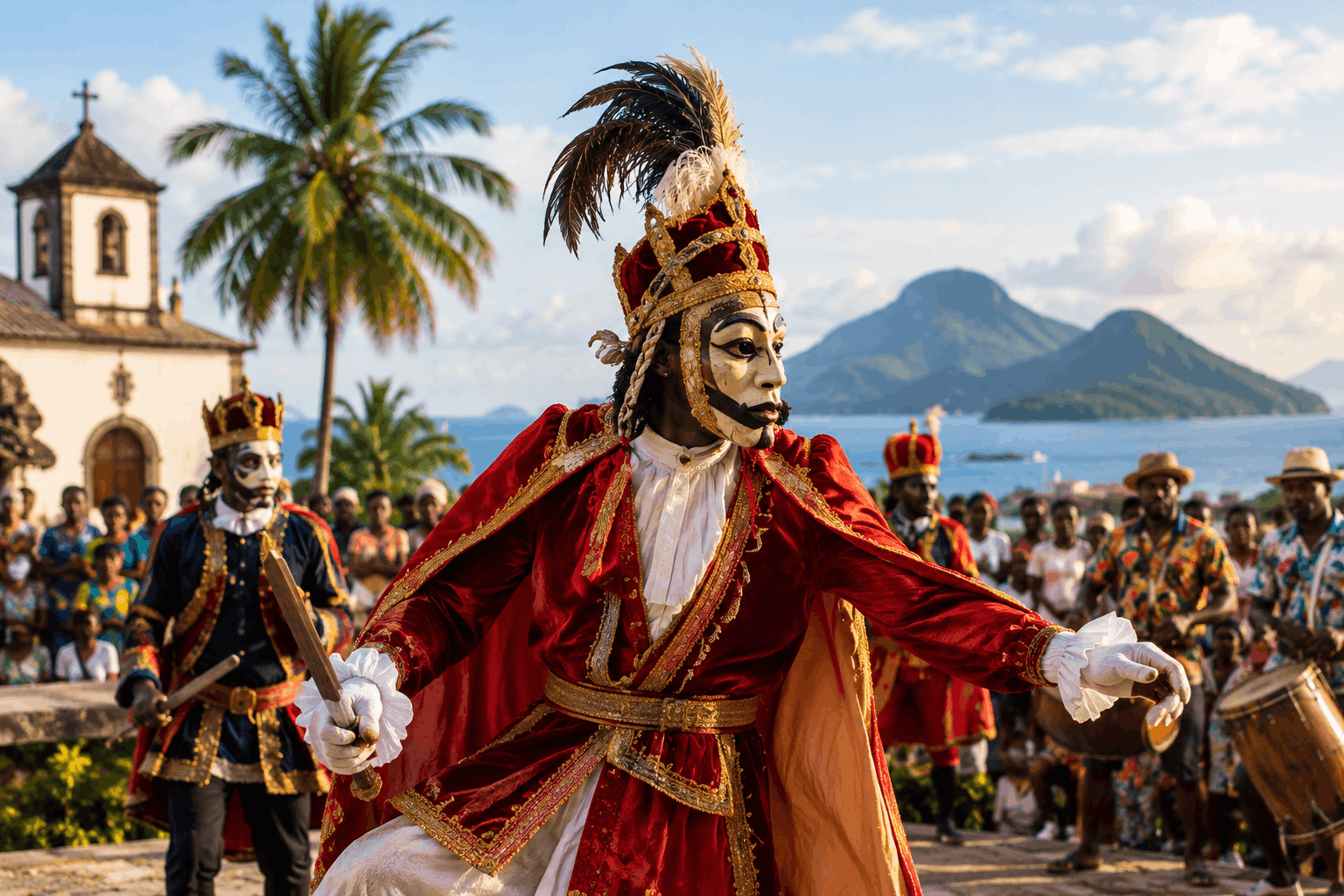
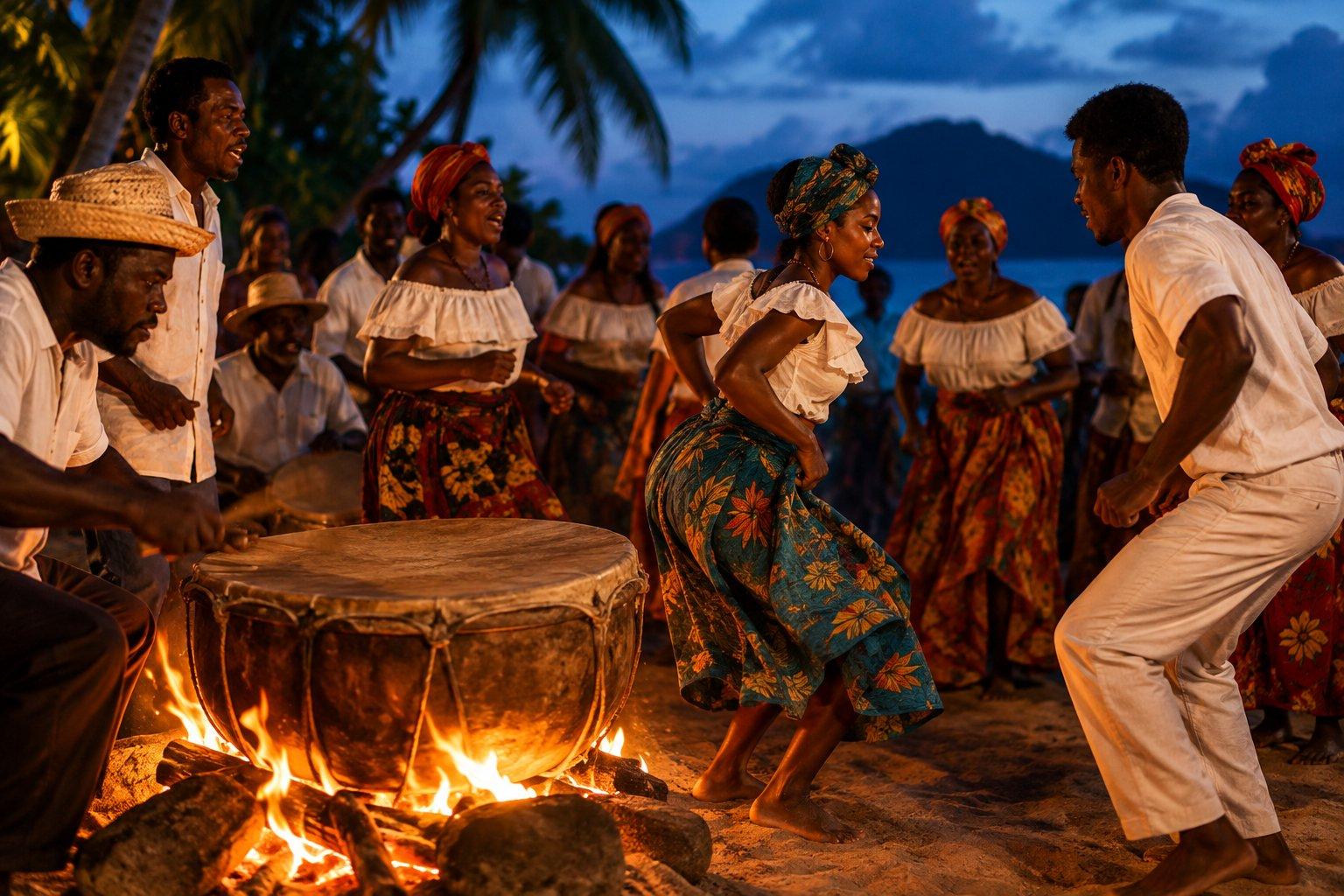
On a festival day in São Tomé, an open space can become the setting for a royal court, a murder trial and a theatrical performance. This is Tchiloli, a traditional form of theatre that has been performed on the island for generations.
At the centre of the performance is a story about murder and the difficult question that follows it: what happens when the person accused of a serious crime is a member of the ruling family?
The accused is Dom Carloto, the son of Emperor Charlemagne. He has killed Valdevinos, the nephew of the Marquis of Mantua. The death creates a conflict within the royal court because Carloto's father, the emperor, must deal with a crime committed by his own son. The story therefore brings together questions of family loyalty, political authority and justice.
The story itself did not originate in São Tomé. Its deeper roots reach back to the medieval Carolingian literary tradition, a large body of European stories built around Charlemagne, his court and the knights associated with him. These stories circulated in different forms across Europe for centuries.
The particular story performed in Tchiloli passed through another stage in the 16th century, when the Portuguese playwright Baltasar Dias produced a version based on Spanish romances that themselves belonged to the older Carolingian tradition. His version tells the story of Dom Carloto's killing of Valdevinos and the dispute over how the crime should be judged.
The story eventually reached São Tomé, but it did not remain a Portuguese literary work performed exactly as it had been written. Over generations, it became part of the island's own performance culture. Local actors, musicians, performance groups and audiences kept the drama alive, passing knowledge of the characters, costumes, music and text from one generation to another.
Tchiloli is traditionally performed outdoors rather than inside a conventional theatre. A performance can involve around 30 actors, with different characters representing members of the royal court, the family of the victim and other figures involved in the trial. Musicians accompany the action with drums, flutes and maracas.
The audience is also part of the experience. People watching a performance can react to the action, and in some circumstances participate directly. This makes Tchiloli different from a theatre tradition in which actors perform on one side of a fixed stage while the audience remains completely separate. The performance depends on the interaction between the actors, musicians and people gathered to watch.
The tradition is also connected to particular communities. Tchiloli performance groups have historically been associated with specific localities, and knowledge of roles, costumes and sections of the drama has been passed through families and performance groups. The tradition therefore depends on people learning how to perform it, not simply on preserving a written text.
The central trial gives the story its most important conflict. Carloto is the emperor's son, but his position does not prevent him from being judged. Within the drama, he is tried and condemned. The emperor is therefore placed in a difficult position: his authority gives him enormous power, but the story still requires him to confront a crime committed by someone from his own family.
UNESCO describes Tchiloli as a living theatrical tradition that communicates ideas about justice, equality and peaceful coexistence. In 2025, UNESCO inscribed Tchiloli on the Representative List of the Intangible Cultural Heritage of Humanity, recognising the tradition as part of the cultural heritage of São Tomé and Príncipe.
Understanding how Tchiloli became a São Toméan tradition requires looking beyond the play itself. The story came from Europe, but the society in which it took root had a very different history.
When the Portuguese arrived in São Tomé and Príncipe around 1470, the islands were uninhabited. Over the following decades, the Portuguese established settlements and began developing São Tomé as a plantation colony. Sugarcane was introduced, and by the early 16th century the island had become an important centre of sugar production.
The plantations depended heavily on enslaved African labour. Enslaved people were brought to São Tomé in large numbers from different parts of West and Central Africa, including regions connected to present-day Benin, the Democratic Republic of the Congo and Angola. They did not come from one single community. They arrived with different languages, religious traditions, social structures, skills and memories of the societies from which they had been taken.
The plantation system brought these different populations into a new and highly unequal social environment under Portuguese colonial rule. By the 1530s, São Tomé had become one of the major sugar-producing centres of the Atlantic world. Sugar grown on the island was processed and exported into European markets, making the colony part of a much wider Atlantic system of trade, slavery and agricultural production.
The sugar economy later declined, but the society it had created did not disappear with it. Enslaved people gained their freedom over time, and communities of freed Africans became an important part of São Tomé's population. New social groups and cultural traditions developed, and Portuguese came into contact with African languages and forms of cultural expression.
One result was the development of Creole languages. Forro, the most widely spoken of São Tomé's Portuguese-based Creoles, developed within the island's history of slavery, emancipation and African settlement. It became an important language of the local population.
Another community developed along a different historical path. The Angolares are traditionally associated with the southern and southeastern parts of São Tomé, and their language, Angolar, developed from the island's earlier Creole environment while incorporating substantial Bantu vocabulary. Scholars generally connect the emergence of Angolar communities to groups of escaped enslaved people who established maroon communities on the island, although some details of their early history remain debated. An older tradition attributes their origins to survivors of a shipwreck, but there is no contemporary 16th-century evidence confirming that account.
The population of São Tomé changed again after the formal abolition of slavery. Portuguese authorities and plantation owners brought contract workers from other African territories, including Angola, Cape Verde and Mozambique, to work on the plantations. Their legal status was different from slavery, but the contract labour system could be highly coercive, and workers were brought into an economy that still depended heavily on plantation agriculture.
The physical organisation of that plantation economy can still be seen in the roças. A roça was much more than a field where crops were grown. These large agricultural estates could contain workers' housing, administrative buildings, processing facilities, religious spaces and other infrastructure needed to organise plantation life.
Coffee and cocoa eventually became especially important to the plantation economy. Some of the historic roças remain visible today, and in 2026 UNESCO inscribed six of them as a World Heritage property under the name “The Roças of São Tomé and Príncipe: Colonial Agricultural System and Forced Migration.” The inscription recognises the estates as evidence of a colonial agricultural system that relied on forced migration and labour.
This history helps explain the environment in which Tchiloli developed, but it is important not to turn the relationship into something it was not. Tchiloli was not created as a theatrical response to slavery, and there is no evidence that the medieval story of Charlemagne was originally intended to represent São Tomé's colonial experience.
Its history is more complicated.
The story had a European literary ancestry. Portuguese writers adapted it. The material eventually reached São Tomé, where generations of local performers adopted it as part of their theatrical culture. The people who performed it lived in a society shaped by African migration, slavery, emancipation, contract labour and Portuguese colonial rule. They also brought their own languages, music, religious practices and social traditions into the performance culture of the islands.
That is what makes the history of Tchiloli worth following beyond its original European story. The written material may have travelled from one part of the world to another, but the performance itself acquired a life in São Tomé.
Its music, costumes, acting styles, performance groups and relationship with the audience developed within the island's own cultural environment. The tradition was learned through participation and passed between generations, allowing a story with medieval European origins to become part of the cultural life of a small island society in the Gulf of Guinea.
Tchiloli is therefore one thread in a much larger history of São Tomé and Príncipe. To understand the culture of the islands, we have to look at the different communities that developed there, the languages they created and maintained, the religions and traditions they practised, and the food, music and festivals that emerged from their shared history.
How São Tomé became a plantation society
In this section
Instead, they began building a colonial settlement and bringing people to the islands from Europe and Africa.
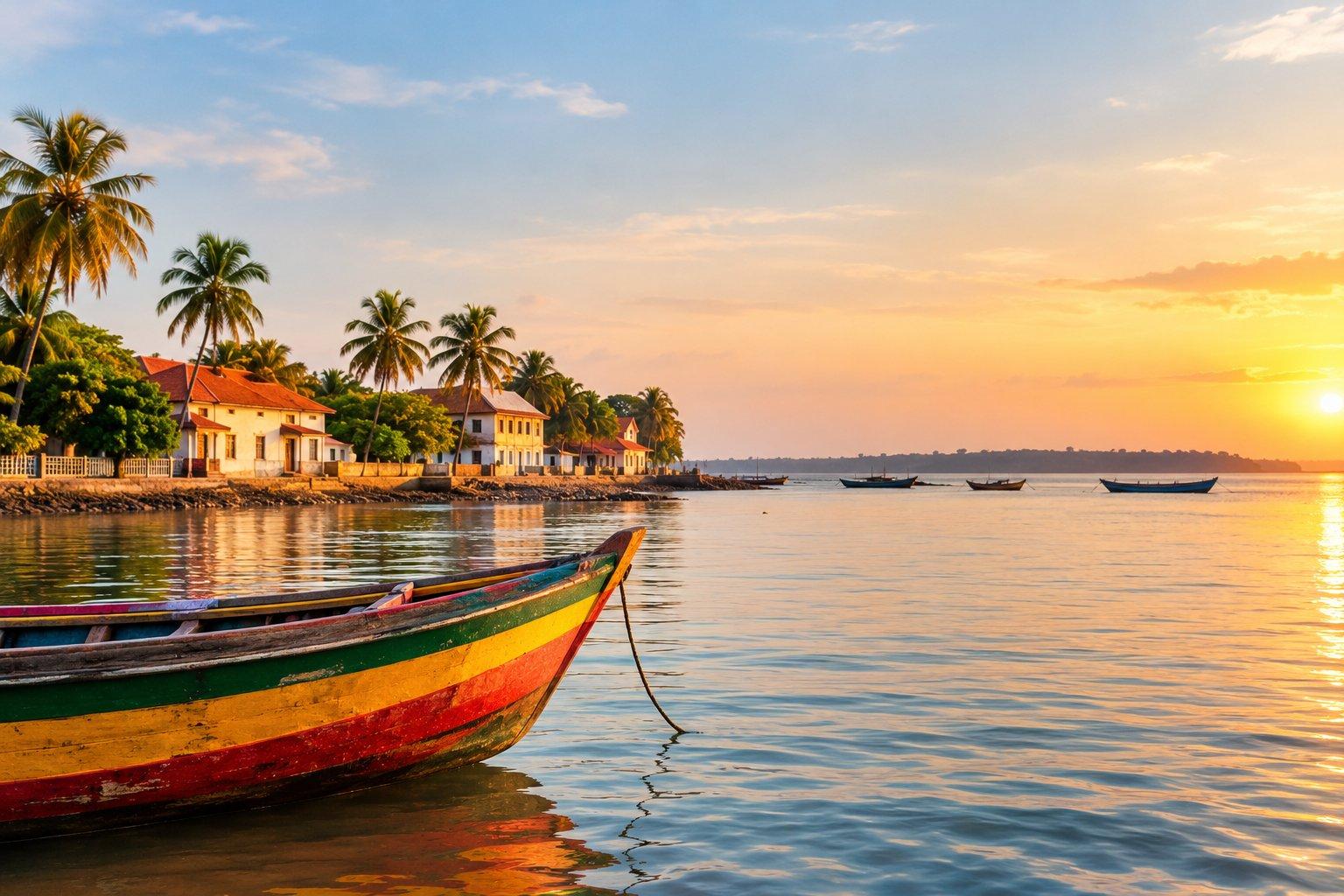
São Tomé and Príncipe is an island country in the Gulf of Guinea, off the west coast of Central Africa. It is made up mainly of two islands, São Tomé and Príncipe, along with several smaller islets. Portuguese navigators reached São Tomé around 1470 and Príncipe in 1471. At the time, the islands were uninhabited, and permanent Portuguese settlement began in the 1490s.
Because there was no established population living on the islands, the Portuguese did not take control of an existing island kingdom or indigenous state. Instead, they began building a colonial settlement and bringing people to the islands from Europe and Africa. Over time, the population grew through migration, forced migration and the enslavement of Africans brought to work on the plantations.
The geography of São Tomé made the island particularly suitable for sugar production. Its volcanic soils, tropical climate and plentiful rainfall provided favourable conditions for growing sugarcane. Portuguese settlers began cultivating the crop early, and sugarcane fields were documented by 1506. By 1517, sugar production had expanded enough for several mills to be operating or planned.
Sugar production required large amounts of labour, and the Portuguese increasingly relied on enslaved Africans. People were brought to São Tomé from different parts of West and Central Africa, including regions associated with present-day Benin, the Kongo region and Angola. They came from different societies and spoke different languages, but on São Tomé they were forced into the same plantation economy.
The island's sugar industry expanded rapidly. By the 1530s, São Tomé had become the world's leading sugar producer, surpassing Madeira in supplying European markets. Sugar grown on the island was processed in local mills and exported to Europe, connecting São Tomé to a much wider Atlantic system of trade, colonialism and slavery.
São Tomé's dominance of the sugar trade began to weaken later in the 16th century. Portuguese planters faced increasing competition from Brazil, while problems with the quality of São Toméan sugar, political instability and repeated revolts by enslaved people disrupted production. By the end of the century, the island's sugar economy had declined considerably.
The decline of the sugar industry changed São Tomé's economy, but the people who had been brought to the island and the communities that had formed around plantation life remained there. During the 17th and 18th centuries, many formerly enslaved Africans and their descendants became an increasingly important part of São Tomé's population. They developed families, communities and economic networks that were rooted in the island rather than simply reproducing the social structures of the plantation system.
This population became associated with the Forro, one of the major social groups in São Tomé. The word forro comes from Portuguese and originally referred to a person who had been freed from slavery. Over time, however, it became the name used for a broader social group whose identity had developed over generations on the island.
The same history can be traced through language. Santome, also commonly called Forro, is a Portuguese-based Creole that developed in São Tomé. Portuguese contributed much of its vocabulary, while African languages also influenced its development. The language emerged from the sustained contact between people from different linguistic backgrounds who were living within the same colonial society.
By this point, São Tomé was becoming a very different society from the one the Portuguese had first established. The island's population was increasingly made up of African-descended communities who had developed their own families, languages, social networks and cultural practices. The plantation economy had shaped how this society came into being, but the people who lived there were creating forms of life that could not be reduced to the plantation system itself.
The Angolar question
In this section
Linguistic research estimates that Bantu-derived vocabulary accounts for roughly 15 percent of its lexicon.
The history of the Angolares is difficult to reconstruct because the surviving evidence does not give us a definitive account of how the community formed. The Angolar community is concentrated in southern São Tomé, particularly around the southwestern and southeastern coast, and has historically had strong connections to fishing and other coastal livelihoods.
Their language provides one important source of evidence. Angolar is a Portuguese-based Creole with substantial Bantu influence, including vocabulary associated with Kimbundu. Linguistic research estimates that Bantu-derived vocabulary accounts for roughly 15 percent of its lexicon. Angolar is related to Santome, another Portuguese-based Creole spoken on São Tomé, but the two developed along different historical paths.
There are two main accounts of how the Angolar community came into being.
The first is the shipwreck story. According to a longstanding tradition, enslaved Africans being transported from Angola survived a shipwreck on the southern coast of São Tomé during the 16th century. The survivors are said to have escaped Portuguese control and established a community in the south of the island. The story became part of Angolar oral tradition and later appeared in written São Toméan accounts.
The historical evidence for the shipwreck itself is limited. There is no surviving 16th-century document confirming that the event took place, and the earliest known written record of the story dates from a manuscript produced in the 1710s. The account therefore remains part of the community's historical tradition rather than a documented event that can be established with certainty.
Another explanation comes from research into the history and development of the Angolar language. It proposes that the Angolares emerged from communities of escaped enslaved people, known as maroons, who fled the plantations during the first half of the 16th century. Some settled in the southern part of São Tomé, where the terrain and distance from the main plantation settlements made it more difficult for Portuguese authorities to maintain direct control.
The development of Angolar is consistent with this history. Linguistic research indicates that the language developed from an early form of Santome while acquiring substantial Bantu influence. The vocabulary therefore records contact between people who spoke Portuguese-based Creoles and people whose languages belonged to the Bantu family.
Over time, these communities developed a distinct social and cultural identity in southern São Tomé. Fishing became an important part of local life, particularly along the coast, and Angolar remained the language associated with these communities. The result was a population whose history, language and economic life differed from those of the Forro communities that became dominant elsewhere on the island.
The distinction between the two languages can be seen in their histories as well as in their linguistic structures. Santome became the main Creole associated with the Forro population, while Angolar developed among communities in the south whose history was closely connected to escape from plantation slavery and settlement in areas beyond direct colonial control.
The precise circumstances in which the Angolar community formed may never be completely resolved. The evidence does, however, point to a community that had established itself in southern São Tomé by the early modern period and developed its own language and social traditions over subsequent generations.
Today, Angolar is spoken in communities including Santa Catarina, São João dos Angolares and Ribeira Peixe. APiCS estimates around 5,000 speakers, although the language faces pressure from Portuguese and Santome. Research also indicates uncertainty about how consistently Angolar continues to be transmitted to younger generations.
From sugar to cocoa
In this section
In 2026, UNESCO inscribed The Roças of São Tomé and Príncipe: Colonial Agricultural System and Forced Migration on the World Heritage List.
São Tomé's first plantation economy was built around sugar. By the 19th century, the crops driving the colonial economy had changed. Coffee was introduced first, followed by cocoa, which eventually became the island's most important export crop.
As production expanded, large agricultural estates known as roças were established across São Tomé and Príncipe. A roça was more than a plantation field. It was an organized agricultural settlement that brought together farmland, processing facilities, workers' housing, administrative buildings and other infrastructure needed to run the estate. Some were large enough to function almost like self-contained communities, with the different parts of the estate arranged around the production of coffee or cocoa.
This expansion came after the formal abolition of slavery, but ending slavery as a legal institution did not end the colonial demand for controlled labour.
Portugal increasingly recruited workers from other parts of Africa through contract-labour arrangements. Large numbers came from Angola, Cape Verde and Mozambique, while workers were also brought from other Portuguese-controlled African territories. Their legal status was different from that of enslaved people, because they were recruited under contracts rather than being legally treated as property. In practice, however, many faced severe working conditions, restrictions on their movement and other forms of coercion.
The distinction between slavery and contract labour is therefore important when describing this period. The later plantation system was not legally the same as the slave system that had built São Tomé's earlier sugar economy. It was, however, another system in which African workers were moved across colonial territories and placed under strong control to supply labour for plantations.
The physical remains of that system can still be seen across the islands.
In 2026, UNESCO inscribed The Roças of São Tomé and Príncipe: Colonial Agricultural System and Forced Migration on the World Heritage List. The serial property includes six plantation complexes: Monte Café, Água Izé, Diogo Vaz and São João on São Tomé, and Sundy and Belo Monte on Príncipe. UNESCO describes these roças as organized colonial agricultural systems developed primarily for coffee and cocoa production and connected to forced migration and labour from the late 19th century into the 20th century.
The surviving buildings and layouts show how these estates were organized. Production areas, processing facilities, workers' quarters, administrative buildings and other structures were positioned within the same agricultural complexes, reflecting the way the colonial plantation system brought production and labour under one system of control.
Walking through the remains of a roça today therefore reveals more than the history of coffee and cocoa production. The buildings also preserve the history of the African workers who were brought to São Tomé under the contract-labour system and lived and worked within these estates. The plantations that helped generate the colony's wealth were also places where that labour was organized, supervised and controlled.
The people shaped by these migrations
In this section
Fishing and coastal life became particularly important in the southern areas where many Angolares lived.
The population of São Tomé and Príncipe was formed through several different movements of people, beginning with Portuguese settlement and the forced arrival of enslaved Africans and continuing through later migration under Portuguese colonial rule. Because these movements happened at different times and under different conditions, they produced several communities with their own languages, histories and social identities.
The Forro became the largest historically rooted Creole population on São Tomé. The term Forro originally referred to Africans who had been freed from slavery, but over generations it came to describe a broader population whose families had been established on the island for generations. Many Forro families developed outside the plantation system as slavery declined, although their communities remained closely connected to the society created during the plantation era. Their language, Santome, also developed during this period. It is a Portuguese-based Creole that incorporates influences from African languages brought to the island by enslaved people.
The Angolares followed a different historical path. Communities of escaped enslaved people became established in southern São Tomé, where they developed their own social networks and livelihoods. Over time, these communities became associated with Angolar, a Portuguese-based Creole with substantial Bantu influence. Fishing and coastal life became particularly important in the southern areas where many Angolares lived.
Príncipe developed along its own linguistic and social path as well. Its Portuguese-based Creole, known as Lung'ie or Principense, developed on the island through contact between Portuguese and African languages. Although São Tomé and Príncipe were part of the same Portuguese colony, the two islands did not develop identical populations or cultural traditions. Their separate settlement histories and geographic distance contributed to differences in language and community life.
The population changed again during the 19th and 20th centuries as the Portuguese plantation economy expanded around coffee and cocoa. After slavery was formally abolished, plantation owners still needed large numbers of workers, and Portugal recruited people from other African territories under contract-labour arrangements. Workers came in large numbers from Angola, Cape Verde and Mozambique, as well as from other Portuguese-controlled territories.
These workers and their families occupied a different position from communities whose families had been established on the islands for generations. The colonial authorities and plantation owners classified people according to categories that reflected their origins, legal status and relationship to plantation labour. One term that emerged from this system was Tonga. In the historical context of São Tomé, it was used particularly for children born on the islands to contract labourers, distinguishing them from the locally established populations and from newly arrived contract workers.
These categories shaped people's experiences, but they did not prevent communities from mixing. Workers settled in different parts of the islands, some remained after their contracts ended, and people from different communities married and formed families. Portuguese, Santome, Angolar, Lung'ie and other languages existed alongside one another, and people could learn and use more than one language depending on where they lived and whom they interacted with. Religious practice also changed as Christianity spread, while older cultural practices continued in different forms.
The result is a population whose history cannot be traced through one migration or one ethnic category. The islands first became a Portuguese settlement without an established resident population. They were then transformed by the forced arrival of Africans for the sugar plantations, the growth of locally born communities, the escape of enslaved people who established settlements in the south, and later the movement of contracted workers from different parts of Africa.
Those different histories are still visible in the country's languages, communities and family histories. Forro and Angolar developed from different experiences of the plantation era on São Tomé, Lung'ie reflects the separate history of Príncipe, and the descendants of contract workers form another important part of the population created during the later coffee and cocoa economy. São Tomé and Príncipe's present population is therefore the result of several generations of settlement, forced migration, escape, contract migration, marriage and family formation across the two islands.
Why the languages matter
In this section
The best-known of these is Santome, also called Forro, which developed on São Tomé during the early colonial period.
Portuguese is the official language of São Tomé and Príncipe and is used in government, formal education, much of the media and other areas of public life. But Portuguese is only one part of the country's linguistic history. The islands are also home to several Portuguese-based Creole languages, each of which developed from the contact between Portuguese settlers and African populations brought to the islands under different circumstances.
The best-known of these is Santome, also called Forro, which developed on São Tomé during the early colonial period. Portuguese provided much of its vocabulary, while languages spoken by the Africans brought to the island also contributed vocabulary and influenced its development. These Africans came from different parts of West and Central Africa and did not share a single language. A Creole therefore provided a way for people from different linguistic backgrounds to communicate within the new colonial society that was developing around the plantations.
As the population born on the island grew, Santome became established as an everyday language within locally rooted communities. It became particularly associated with the Forro population, whose families had been established on São Tomé for generations after the decline of slavery. The language is still widely spoken on São Tomé and remains one of the clearest linguistic traces of the island's early plantation society.
Angolar developed from a related historical environment, but under different circumstances. Linguistic research indicates that it developed from an early form of Santome and later acquired substantial Bantu influence. This is consistent with the history of Angolar communities in southern São Tomé, which were associated with escaped enslaved people who established settlements beyond direct plantation control. The language therefore shares a colonial Portuguese base with Santome while preserving linguistic features associated with the different communities that formed in the south.
Príncipe developed another Portuguese-based Creole, known as Lung'ie or Principense. The language emerged through the island's own history of Portuguese settlement, African migration and plantation society. Lung'ie is now spoken by a much smaller population than Santome, and its number of speakers has declined significantly over time. Its survival nevertheless provides evidence of the separate linguistic history that developed on Príncipe rather than simply reproducing the language patterns of São Tomé.
Other languages entered the islands through later migration. Cape Verdean Creole is associated particularly with the Cape Verdean communities that arrived during the contract-labour period, while African languages brought by workers from Angola, Mozambique and other territories have also formed part of the country's linguistic landscape. Some of these languages became concentrated within particular families or communities, while others came into contact with Portuguese and the local Creoles.
Portuguese became increasingly important as the colonial administration expanded and, later, as the independent state built a national education and administrative system. Schooling, government institutions and mass communication operated increasingly through Portuguese, giving the language a position that the older Creoles did not have in formal public life. Research on the country's language history has also identified Portuguese-language schooling and broadcasting as factors contributing to the decline of some Creole languages, particularly among younger speakers.
The way people speak therefore varies across the islands and between generations. Someone may use Portuguese at school or work, Santome with relatives and friends, and another language or Creole within a particular family or community. The choice can depend on where a person lives, their family background, age, education and the people they are speaking with.
This is particularly visible in the different fortunes of the three indigenous Portuguese-based Creoles. Santome remains widely spoken on São Tomé, Angolar continues to be used in communities in the south, while Lung'ie has a much smaller speaker population on Príncipe. Their different positions today reflect not only the number of people who speak them, but also the different histories through which each language developed and was transmitted from one generation to another.
São Tomé and Príncipe is therefore a multilingual society in which language carries the history of migration and settlement. Portuguese reflects the country's colonial and modern state institutions; Santome reflects the formation of locally rooted communities on São Tomé; Angolar is connected to the history of escaped plantation communities in the south; and Lung'ie reflects the separate development of Príncipe. Later migration added further languages to this landscape, creating the mixture of languages heard across the islands today.
Religion and local spiritual traditions
In this section
Some practices changed as they were passed down, while others were given new meanings within a Christian environment.
Christianity has been part of São Tomé and Príncipe's history since Portuguese settlement began in the late 15th century. Catholic missionaries arrived alongside the colonial authorities, and the Catholic Church became closely connected to the development of the Portuguese colonial society. Churches and religious institutions were established as the islands' population grew, while baptism and Christian instruction became part of the process through which Africans brought to São Tomé were incorporated into colonial society.
Catholicism remains the largest Christian tradition in the country. A 2023 U.S. State Department religious-freedom report, citing estimates from the Roman Catholic Bishop's Office, put Catholics at about 54 percent of the population and Protestants at about 12 percent. The report also identified smaller Muslim and other religious communities and noted that some people combine Christianity with elements of indigenous belief.
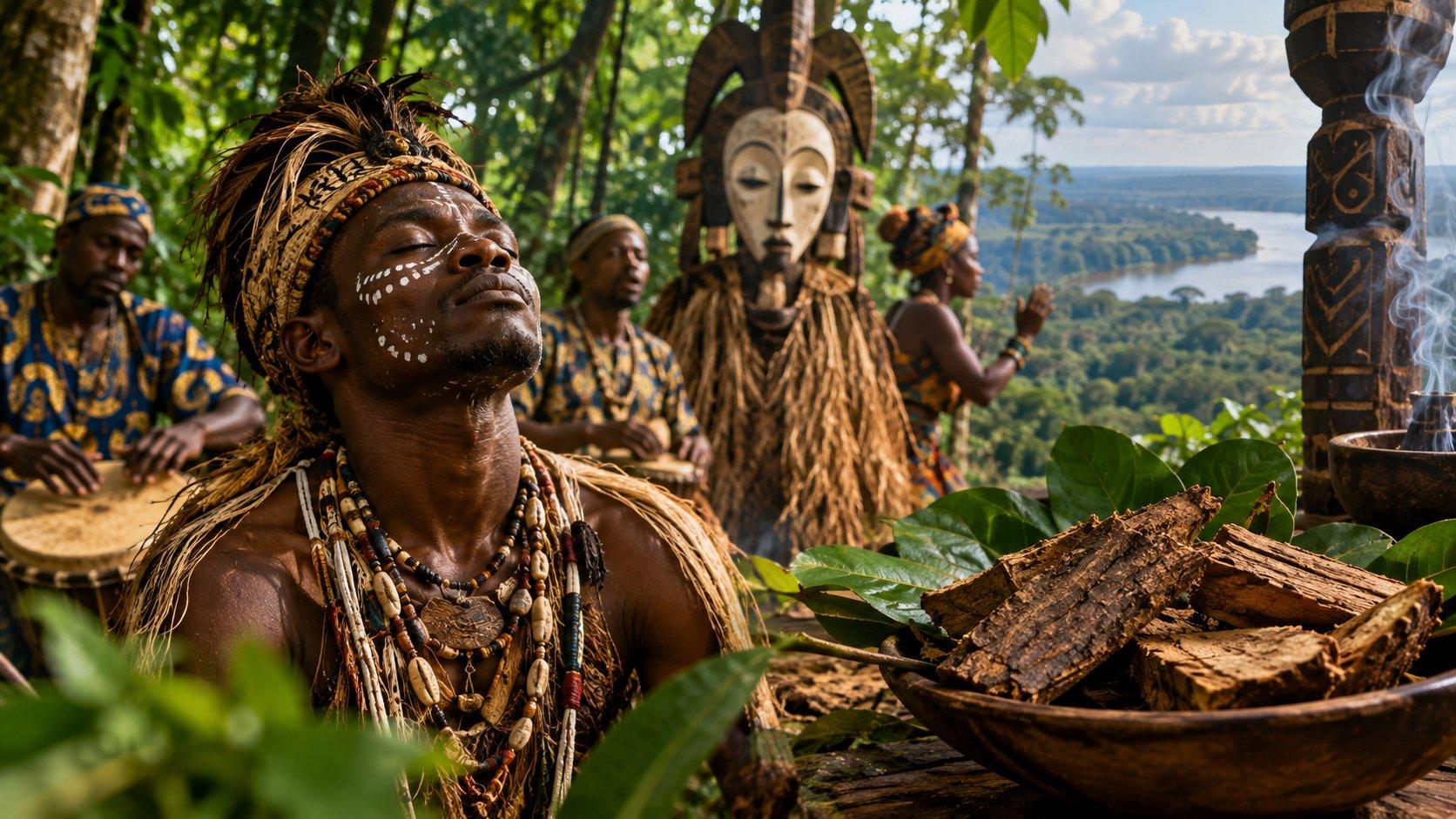
Those indigenous practices have roots in the African societies from which enslaved people were brought to São Tomé. The people arriving on the islands did not come from one culture or follow one religious system. They came from different parts of West and Central Africa, bringing beliefs about spirits, ancestors, healing and the spiritual significance of particular places. Over generations, some of these practices survived and were adapted to life on the islands.
Historical accounts provide some clues about what this religious world looked like. They describe ritual practices connected with healing and spirits, as well as objects such as red cloth, iron and carved wooden figures. Certain trees, rocks, springs and other places could also acquire spiritual significance. These practices were not necessarily organized through permanent institutions in the way Catholic worship was organized through churches and clergy, so much of what is known about them comes from historical accounts, oral traditions and descriptions of particular communities.
The relationship between these traditions and Christianity developed over a long period. Africans who were baptized and raised within a Christian colonial society did not necessarily abandon every belief or practice they had inherited from earlier generations. Some practices changed as they were passed down, while others were given new meanings within a Christian environment. In some families and communities, Christian worship could exist alongside practices associated with healing, spirits, ancestors or particular sacred places.
This helps explain why religious identity on the islands cannot always be understood through formal religious affiliation alone. A person may identify as Catholic or Protestant and participate regularly in Christian worship while also observing family traditions that do not come directly from Christian teaching. These practices can be connected to particular occasions, illnesses, family responsibilities or places rather than forming a separate religious identity.
The history has parallels elsewhere in the Atlantic world. Enslaved Africans carried religious ideas across the Atlantic, and those traditions survived in different forms after Christianization and the abolition of slavery. In some places they developed into recognizable religious systems; in others, elements survived within family customs, healing practices, ceremonies and local beliefs. São Tomé's experience belongs to this wider history, but its traditions developed through the particular populations, languages and colonial conditions of the islands.
Today, Catholic churches remain a visible part of life across São Tomé and Príncipe, alongside Protestant churches and smaller religious communities. At the same time, older African-derived beliefs and practices have not disappeared completely. They can persist through families, local knowledge and practices connected with healing and spiritually significant places.
The religious history of São Tomé and Príncipe therefore follows the same broad pattern as much of its social history. Portuguese colonization introduced Catholic institutions, while Africans brought to the islands carried their own beliefs and practices with them. Over generations, these traditions were transmitted, changed and sometimes combined, producing a religious culture in which Christianity is prominent while older African influences remain part of how some people understand illness, healing, family traditions and the spiritual significance of particular places.
Food shaped by land and sea
In this section
One of the best-known is calulu, a thick, heavily seasoned dish that can be prepared with smoked fish or meat.
São Toméan food brings much of this history into everyday life. The islands' location in the Atlantic makes fish and other seafood an important part of the diet, while the tropical climate supports crops such as bananas, breadfruit, cassava and matabala, a starchy root that is widely used in São Toméan cooking. What people eat therefore reflects both the natural environment and the agricultural history created during the colonial period.
Some of the crops that became important to the islands arrived or expanded because of colonial agriculture. Cocoa was introduced to São Tomé in the 19th century and became the country's major export crop as large roças were developed for cocoa and coffee production. Cocoa remains closely associated with São Tomé's agricultural history, even though the way it is used today is not limited to export production.
Fish remains particularly important in everyday cooking. The surrounding Atlantic provides access to a range of marine fish and other seafood, while local agriculture supplies the vegetables, leaves, roots and fruits that accompany them. This combination of seafood and locally grown crops appears in many traditional dishes.
One of the best-known is calulu, a thick, heavily seasoned dish that can be prepared with smoked fish or meat. Recipes may also include chicken, pork, beef, river shrimp or smoked sea snails, depending on the household and the ingredients available. Leaves and herbs form an important part of the dish, and it is commonly served with foods such as rice, cassava flour preparations, fúba and ngú de banana, a preparation made from banana or breadfruit.
Because calulu has been prepared in different households and communities for generations, there is no single recipe that every cook follows. The ingredients can change according to location, family practice and what is available. One household may prepare it with fish, while another may use meat or seafood, and the accompanying starches can also vary.
The dish also has a place beyond the ordinary family meal. São Toméan tourism sources describe calulu as a food served during family gatherings as well as occasions such as religious festivals, weddings and funerals. Food in this context is part of how people gather and mark important moments, so the dish's significance comes not only from its ingredients but also from when and with whom it is prepared and eaten.
Other traditional foods draw on the same combination of coastal fishing and tropical agriculture. These include breadfruit served with salted fish, cassava-based preparations, dishes made with matabala, octopus, beans and grilled fish. The ingredients may be familiar across tropical Africa, but São Toméan cooking has developed its own combinations and preparation methods through the particular history of the islands.
Cocoa provides another connection between food and history. The crop became central to the colonial economy through the roça system, where large estates produced cocoa for export using labour brought from other parts of Africa under coercive contract arrangements. Today, cocoa remains part of São Tomé's agricultural identity, but it exists within a very different social and economic setting from the plantation system that made the crop commercially important in the first place.
Food therefore brings together several parts of São Tomé and Príncipe's history without separating them into neat categories. Fish reflects the islands' position in the Atlantic, cassava, bananas, breadfruit and other crops reflect generations of local cultivation, while cocoa and coffee carry the history of the colonial plantation economy. In dishes such as calulu, these different influences meet in food that is still prepared and shared in homes and communities across the islands.
The tradition was passed between generations through repeated performances and participation in Tchiloli groups.
Tchiloli is one of several traditional performance forms found in São Tomé and Príncipe. Other forms include Ússua, Socopé, Puita and Danço Congo, each with its own music, movements and performance practices.
Ússua and Socopé are associated with social dancing and developed through the meeting of European and African influences. Puita and Danço Congo have different histories and performance styles, with stronger connections to African musical and dance traditions. Tchiloli differs from these forms because it is built around an extended dramatic story.
A Tchiloli performance brings together dialogue, music, movement and costumes, with a cast of roughly thirty actors. The central story concerns a murder and its aftermath. Dom Carloto, the son of Emperor Charlemagne, is accused of killing Valdevinos and is brought before the emperor for judgement. The performance follows the arguments, accusations and decisions surrounding the case.
The performances traditionally take place outdoors. Musicians provide the accompaniment while the actors perform the story, and spectators can react to what is happening. UNESCO describes audiences as sometimes participating directly in the performance, so the event is not structured in exactly the same way as a modern theatre production in which actors perform on a stage while the audience remains separate.
A Tchiloli group also involves many people beyond the actors. Musicians provide the accompanying music, while other members are responsible for costumes, organization and the practical work involved in preparing performances. The knowledge needed to perform the play has traditionally been passed through families and local performance groups. Younger performers can learn by watching experienced actors, joining the groups and practising the roles themselves. Organized teaching in schools has also become another way of passing on the tradition.
The costumes reflect the European setting of the story. Performers appear as emperors, nobles, soldiers, judges and other officials, using clothing and other visual elements associated with the characters they represent. The story itself comes from the European Carolingian literary tradition, a body of medieval stories centred on Charlemagne and his court.
The version of the story used in Tchiloli can be traced to the Portuguese playwright Baltasar Dias, who wrote a version of the story of Dom Carloto and Valdevinos in the 16th century. Dias's work drew on six Spanish romances connected to the wider Carolingian tradition. The story later became part of the performance tradition that developed in São Tomé.
Once the story became established on the island, it was preserved through performance rather than only through the written text. Actors learned the dialogue and roles, musicians learned the accompanying music, and communities developed the costumes, movements and conventions used in performances. The tradition was passed between generations through repeated performances and participation in Tchiloli groups.
The story consequently has a European literary source, while the performance tradition that audiences encounter today was developed and maintained in São Tomé. Its European characters and medieval setting remain visible in the costumes and narrative, while the music, performance practices, community organization and interaction with spectators belong to the history of Tchiloli on the islands.
Tchiloli is still performed in São Tomé and Príncipe, where local groups continue to maintain the tradition and teach younger generations how to take part in it. In 2025, UNESCO added Tchiloli to the Representative List of the Intangible Cultural Heritage of Humanity.
Poetry, literature and visual art
In this section
Alda do Espírito Santo later became one of São Tomé's best-known poets as well as an important political figure.
São Tomé has also developed a strong literary tradition, particularly in poetry. Writers from the islands used Portuguese to write about African identity, colonial rule, everyday life and the experience of living in a Portuguese-speaking society shaped by slavery and plantation colonialism.
Francisco José Tenreiro, born on São Tomé in 1921, became one of the important early African writers to publish in Portuguese. His poetry explored African identity, colonialism and the experience of Black people within the Portuguese-speaking world. His work placed São Tomé within the wider development of modern African literature written in Portuguese, connecting the experience of the islands to debates taking place across other Portuguese-ruled African territories.
Alda do Espírito Santo later became one of São Tomé's best-known poets as well as an important political figure. Her poetry addressed the islands, colonial rule, African identity and the struggle for independence. After independence, her writing became closely associated with São Tomé and Príncipe's national history, giving literary expression to experiences that had shaped the country during the colonial period.
The cultural record of the islands can also be found in visual art. Painters documented people, ceremonies and aspects of everyday life, creating images of traditions that might otherwise be known mainly through written descriptions and oral memory.
Pascoal Viegas Vilhete, widely known as Canarim, is particularly associated with paintings of São Toméan cultural practices, including Tchiloli. His work provides visual representations of performances and other aspects of local cultural life, giving later generations another way to see how these traditions were presented and experienced.
São Tomé's connection to the wider Portuguese-speaking art world can also be seen in the career of José de Almada Negreiros, who was born on the island in 1893. He later became one of the major figures of Portuguese modernism, working across painting, literature, theatre, murals, tapestry and other forms of art.
Almada Negreiros spent most of his artistic career in Portugal, where his work became closely associated with the development of Portuguese modernism. His place in São Tomé's cultural history is consequently different from that of artists such as Canarim, whose work focused directly on São Toméan cultural life. Almada's connection to the islands begins with his birthplace, while his major artistic career developed within Portugal's literary and artistic movements of the 20th century.
Together, these writers and artists show the different ways São Tomé has appeared in the cultural record. Tenreiro and Alda do Espírito Santo wrote about African identity, colonialism, society and the experience of the islands, while artists such as Canarim recorded aspects of São Toméan cultural life in visual form. Almada Negreiros followed a different path, carrying a connection to São Tomé through his birthplace while becoming a major figure in Portuguese art.
Independence and the end of colonial rule
In this section
The buildings that remain across São Tomé and Príncipe consequently preserve several layers of the country's history.
São Tomé and Príncipe became independent on 12 July 1975, after Portugal's Carnation Revolution in April 1974 brought down the country's Estado Novo dictatorship and opened the way for the end of Portuguese colonial rule. Independence came after negotiations between Portugal and the Movement for the Liberation of São Tomé and Príncipe (MLSTP), the main independence movement on the islands.
Both Angola and Mozambique fought prolonged armed wars against Portuguese rule, while São Tomé and Príncipe gained independence through negotiations after Portugal's 1974 Carnation Revolution. São Tomé and Príncipe did not experience a comparable independence war. The change in political authority was negotiated, and the country became independent without the kind of prolonged armed conflict that had marked the final years of Portuguese rule elsewhere in Portuguese Africa.
Independence changed the political system, but it did not immediately change the economic structure that colonial rule had left behind. Much of the country's agricultural land and productive infrastructure was still organized around the large plantations, or roças, that had been developed during the coffee and cocoa economy. These estates included farmland, processing facilities, housing and other buildings designed to support plantation production.
The new government took control of the major Portuguese-owned plantations and nationalized them as state agricultural enterprises. This meant that the land and infrastructure were no longer controlled by the Portuguese plantation companies that had operated them during the colonial period. The state now had to manage a plantation economy that had been designed for a colonial export system and had depended heavily on a controlled labour force.
That created a difficult economic problem. The roças were large and expensive to maintain, and their buildings, roads, processing facilities and other infrastructure required continued investment. The agricultural system also depended on producing crops such as cocoa and coffee for export, so changes in production, prices, labour organization and access to markets could affect the entire system.
The government later introduced land reforms that redistributed parts of the former plantation estates to small farmers. This changed the way agricultural land was used, but it also meant that the large, centrally organized plantation system became less dominant. Some former roças continued to function in agricultural production, while others gradually lost their original purpose.
Over the following decades, many of the old plantation complexes deteriorated. Buildings that had once housed workers, administrators and processing operations were left without the resources or economic activity that had sustained them during the colonial period. Some have since been restored, converted into hotels or used for other purposes, while others remain partly occupied, abandoned or in poor condition.
The buildings that remain across São Tomé and Príncipe consequently preserve several layers of the country's history. Their architecture records the organization of the plantation economy, while the settlements around them show how agricultural production and labour were structured during Portuguese colonial rule. Their later decline records another stage of the country's history: the difficulty of transforming an economy that had been built around large export plantations after independence.
This history is part of the reason the roças were inscribed on the UNESCO World Heritage List in 2026 as “The Roças of São Tomé and Príncipe: Colonial Agricultural System and Forced Migration.” The World Heritage property includes six plantation complexes: Monte Café, Água Izé, Diogo Vaz and São João on São Tomé, and Sundy and Belo Monte on Príncipe. UNESCO recognizes the sites for the evidence they preserve of the colonial agricultural system, including the organization of coffee and cocoa production and the forced movement of African workers to the islands.
The roças can therefore be read across two periods of São Tomé and Príncipe's history. Their buildings were created under Portuguese colonial rule to organize agricultural production and labour, while their present condition reflects the changes that followed independence, nationalization and land reform. Some continue to have practical uses today; others survive mainly as physical remains of the economic system that once dominated the islands.
A five-century-old story that is still being performed
In this section
The story is performed outdoors, often in front of an audience that can respond to the action as it unfolds.
Tchiloli brings several parts of São Tomé's history together in one performance. The story itself did not originate on the islands. Its literary roots lie in the medieval Carolingian tradition of stories about Charlemagne and his court. In the 16th century, the Portuguese playwright Baltasar Dias wrote a version of the story of Dom Carloto and Valdevinos, drawing on Spanish romances connected to that tradition. That version eventually became the basis for Tchiloli in São Tomé.
Once the story became established on the islands, local communities continued it through performance. Actors learned the roles and dialogue, musicians provided the accompanying music, and groups developed their own ways of organizing rehearsals and performances. Costumes, movements and other performance practices were passed between generations, with younger performers learning by watching experienced actors and eventually taking on roles themselves.
The story is performed outdoors, often in front of an audience that can respond to the action as it unfolds. Spectators may comment, react and sometimes participate directly, while the musicians remain part of the performance. A Tchiloli group consequently brings together acting, music, costume-making, organization and community participation rather than functioning only as a group of actors presenting a written play.
The story has also remained understandable because its central conflict is familiar. Dom Carloto is accused of killing Valdevinos, and the people around him must deal with the question of how justice should be applied when family loyalty, political authority and personal relationships are involved. The characters belong to the world of Charlemagne's court, but the conflict itself does not depend on knowing medieval European history.
This is how a story that began in European literature became part of São Tomé's own cultural life. The written story has its origins in the Carolingian tradition and in a 16th-century Portuguese adaptation, while the performance tradition was learned, maintained and passed down by communities in São Tomé. The language, music, costumes, acting, audience participation and organization of the performances all developed within the history of the islands.
Tchiloli can consequently tell two parts of its history at the same time. Its characters and original story came from European literature, while the way the drama is performed and preserved today belongs to generations of São Toméan performers and audiences.
What São Tomé's culture looks like today
In this section
Cocoa and coffee connect the islands to the plantation economy that developed during the 19th and 20th centuries.
São Tomé and Príncipe is now home to around a quarter of a million people. The World Bank recorded a population of 240,254 in 2025. For a country of this size, the number of communities, languages and cultural traditions that developed across the two islands is striking.
Portuguese is the official language, but Santome, Angolar and Lung'ie have their own histories. Santome developed within the early colonial society of São Tomé and became closely associated with the Forro population. Angolar developed among communities in the south whose history is connected to people who escaped plantation slavery. Lung'ie developed separately on Príncipe. Later migration brought Cape Verdean Creole and African languages spoken by workers who arrived from Angola, Mozambique and other parts of the Portuguese colonial territories.
The same layers of history can be seen in religion and everyday life. Catholicism became deeply established during Portuguese colonial rule, while African beliefs and practices continued within some families and communities. Fishing remains important along the coast, while crops such as cassava, bananas, breadfruit and matabala form part of local food traditions. Cocoa and coffee connect the islands to the plantation economy that developed during the 19th and 20th centuries.
The old roças are still part of the landscape. Some have been restored or given new uses, while others remain partly abandoned. Their buildings preserve the physical arrangement of an agricultural system that brought farmland, processing facilities, housing and labour under the control of large estates. In 2026, UNESCO inscribed six of these plantation complexes on the World Heritage List as “The Roças of São Tomé and Príncipe: Colonial Agricultural System and Forced Migration.”
Tchiloli preserves a very different part of this history. It is not a building or an agricultural site, but a performance that has been learned and repeated by generations of people on the islands. UNESCO added Tchiloli to the Representative List of the Intangible Cultural Heritage of Humanity in 2025.
The two UNESCO inscriptions consequently preserve very different kinds of evidence. The roças are physical remains of the plantation economy and the forced movement of African workers that supported it. Tchiloli survives through people: actors learn roles, musicians learn the accompanying music, groups maintain costumes and performance practices, and audiences continue to gather around the performances.
The history behind Tchiloli reaches much further back than São Tomé. Its story comes from the medieval Carolingian tradition and reached the Portuguese-speaking world through written literature before becoming part of the performance culture of São Tomé. The characters are emperors, nobles, soldiers and judges from a European literary world, while the performances take place within São Toméan communities and use practices that developed on the islands.
That combination is visible every time the play is performed. The dialogue carries a story that originated outside São Tomé. The costumes represent its European characters. Local musicians accompany the action. Actors perform roles that have been taught within performance groups for generations, and spectators respond to what happens in front of them.
The play is still being performed today, more than four centuries after its literary source was written. The people who perform it are not repeating an unchanged historical document. They are learning the roles, music, movements and conventions from people who performed before them and carrying those practices into their own time.
That is also how much of São Tomé and Príncipe's cultural history has survived: through people using languages, preparing food, practising religion, making music, telling stories, working the land and passing knowledge from one generation to another. The islands' history can be found in their buildings and archives, but it can also be heard in their languages and music and seen in performances such as Tchiloli that are still taking place today.