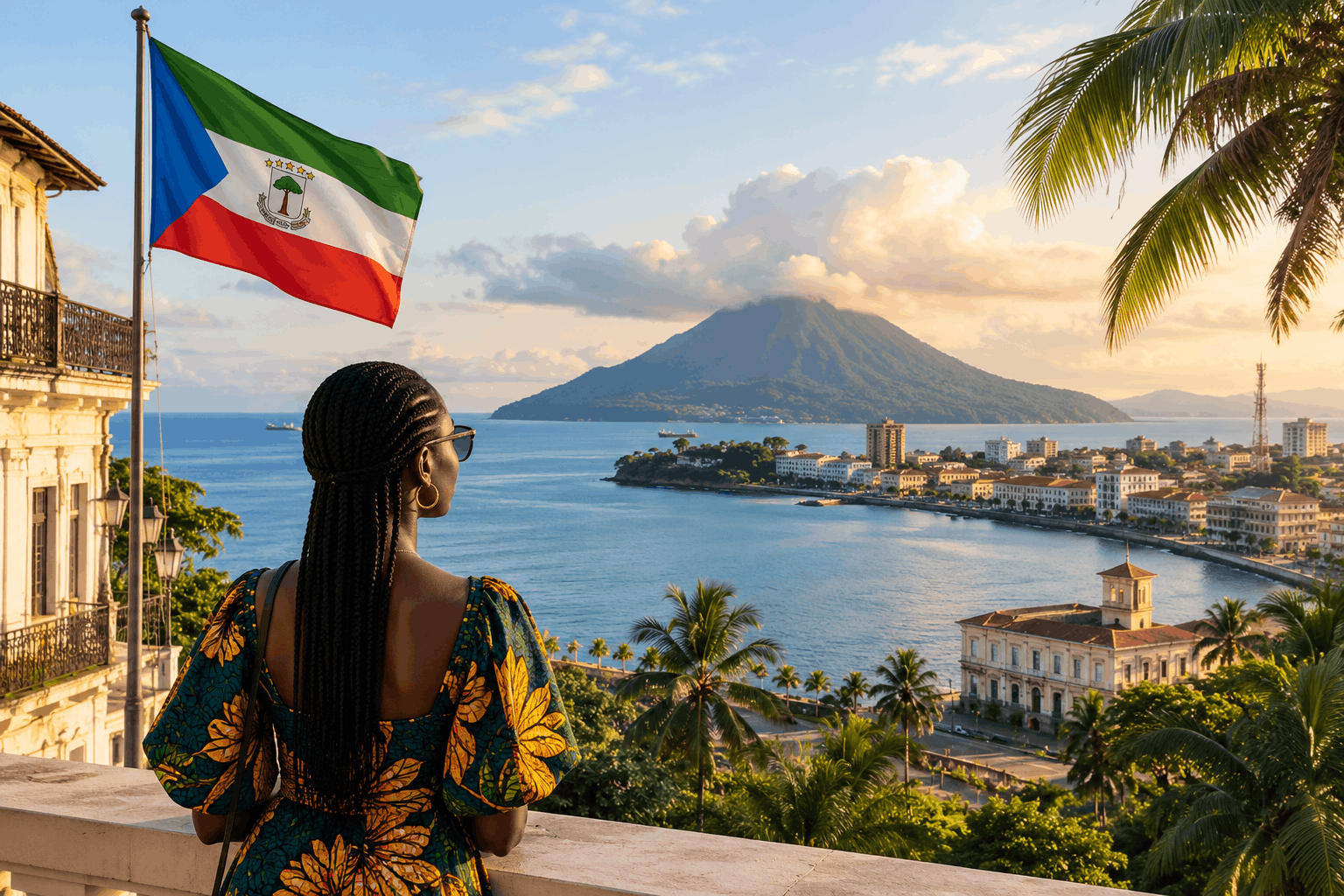
Explore Equatorial Guinea's history, Fang and Bubi cultures, Spanish language, food, religion, literature, oil boom and changing capital.
Say “buenos días” in Equatorial Guinea and you are speaking the country's dominant public language, a legacy that sets it apart from every other African state. Equatorial Guinea is Africa's only country where Spanish is an official language and the principal language of government, national media, education and much public communication. It is also officially multilingual: French and Portuguese have official status, while Fang, Bubi and other African and creole languages remain part of everyday life.
That linguistic history begins with geography that can be easy to overlook. Equatorial Guinea is divided between a mainland territory, traditionally known as Río Muni, and several islands in the Gulf of Guinea. Bioko, the country's largest island, sits only about 32 kilometres from the coast of Cameroon, while the mainland borders Cameroon to the north and Gabon to the east and south. Malabo developed on Bioko during the colonial period, but in January 2026 the government formally declared Ciudad de la Paz, a planned city on the mainland, the country's new capital. Ministries have continued operating from Malabo and Bata during the transition.
The country's population is small by African standards, estimated by the World Bank at around 1.8 million people in 2024–2025. Yet its modern history contains several very different stories at once: the migration and settlement of Bantu-speaking peoples; Spanish colonial rule; independence and the dictatorship of Francisco Macías Nguema; the long presidency of Teodoro Obiang Nguema Mbasogo; the discovery of oil in the 1990s; and the enormous gap between the wealth generated by hydrocarbons and the living conditions experienced by much of the population.
To understand Equatorial Guinea, you have to look at how these different histories come together, without allowing any single one of them to define the country as a whole.
Where the culture came from
In this section
The Bubi are the indigenous Bantu-speaking population of Bioko.
The two largest ethnic communities in Equatorial Guinea are the Fang and the Bubi, but their histories begin in different parts of the region. The Bubi are the indigenous Bantu-speaking people of Bioko Island, where their ancestors settled thousands of years ago. The Fang, also a Bantu-speaking people, have a much broader history across mainland Central Africa, with Fang communities developing across parts of present-day Cameroon, Equatorial Guinea and Gabon through successive migrations. Over time, the two communities developed their own languages, social structures, traditions and cultural practices.
The Bubi are the indigenous Bantu-speaking population of Bioko. Genetic and historical research indicates that their ancestors reached the island from the mainland roughly 2,000 years ago, although the wider history of settlement on Bioko is more complicated and archaeological evidence points to earlier human presence. Over time, the island's geography contributed to a degree of isolation from neighbouring mainland populations. Bubi society developed its own language, cultural traditions and social institutions, including well-defined matrilineal clans.
Matrilineal descent means that family affiliation and some forms of inheritance are traced through the mother's line. In Bubi society, this has historically been particularly important in relation to land and clan membership. It does not mean that every aspect of family life is controlled through women, or that Bubi society is simply the opposite of Fang society. The two communities therefore entered the history of the territory that became Equatorial Guinea through different historical paths. The Bubi developed on Bioko, while Fang communities became established across the mainland and neighbouring parts of Central Africa. By the time European colonial rule took shape, these communities already had their own languages, social structures and cultural traditions.
The Fang became the demographic majority on the mainland, while the Bubi remained concentrated on Bioko. During the colonial and late-colonial periods, movement between the mainland and the island also increased. Migration from the mainland brought more Fang people to Bioko, gradually changing the island's demographic balance.
The history of the territory was also being shaped by events far beyond these communities. European involvement began with Portuguese voyages through the Gulf of Guinea in the 15th century. The island now known as Bioko was reached by the Portuguese navigator Fernão do Pó in 1471, and Annobón was also incorporated into Portugal's Atlantic network. Portuguese control lasted for centuries, but a European diplomatic agreement eventually changed the colonial future of both islands.
The Treaty of El Pardo, signed in 1778, transferred Fernando Póo, now Bioko, and Annobón from Portugal to Spain. Portugal also granted Spain rights to trade along a section of the Gulf of Guinea coast. In exchange, Spain ceded the island of Santa Catarina and the colony of Sacramento in South America to Portugal.
The agreement was made between European powers pursuing their own imperial interests. The African communities living in and around these territories were not parties to the negotiations. Spain subsequently developed a colonial presence in a part of Central Africa where Portuguese influence had already left a linguistic and cultural imprint. Over time, Spanish became the principal language of colonial administration and education, creating the linguistic situation that remains unusual today: Equatorial Guinea became the only sovereign state in Africa where Spanish is an official language, even though its surrounding mainland neighbours were largely shaped by French or, in the case of some countries farther west, English colonial rule.
Spanish control did not immediately translate into effective administration across the entire territory. Colonial authority expanded gradually, while the economy developed around agriculture and plantation production, particularly cocoa on Bioko. The colonial economy also depended extensively on migrant and contract labour recruited from other parts of West and Central Africa. Historical research documents coercive recruitment involving both indigenous Bubi and Fang populations, as well as workers brought from places including Liberia, Cameroon, Sierra Leone and elsewhere.
Life under Spanish colonial rule consequently varied across communities and individuals. People encountered colonial rule through different combinations of forced labour, plantation work, missionary education, economic opportunity, political exclusion and changing patterns of migration. The effects were not identical for the Fang and Bubi, nor were their experiences uniform within either community.
Independence came on 12 October 1968. The country's first president, Francisco Macías Nguema, soon turned the new state into an authoritarian regime marked by political violence, persecution and the destruction of major institutions.
During Macías's rule, large numbers of Equatorial Guineans were killed, imprisoned or driven into exile. Schools and other institutions deteriorated severely, and the Catholic Church faced intense restrictions. The regime's repression also affected the Bubi population of Bioko, although the violence of the period extended far beyond one ethnic group.
Macías was overthrown in 1979 by his nephew, Teodoro Obiang Nguema Mbasogo, who became president and has remained in power since then. His government presided over another major transformation in the country's history after the discovery of significant offshore oil reserves in the 1990s.
The oil discoveries brought a rapid increase in government revenues and large investments in roads, public buildings and other infrastructure. Equatorial Guinea's economy changed dramatically, but the distribution of the new wealth remained highly unequal. The World Bank now describes the country as still heavily dependent on hydrocarbons, with declining oil production, limited employment opportunities and more than half of the population living in poverty under its current measure.
The country's political history has also included documented corruption cases involving members of the ruling family. Teodoro Nguema Obiang Mangue, the president's son and now vice president, reached a 2014 settlement with the United States involving more than $30 million in assets that U.S. authorities alleged had been purchased with corruption proceeds. French courts separately upheld his conviction for laundering and misappropriating public funds.
These cases form part of a wider record of international legal scrutiny surrounding members of the ruling family, while the country's economic story continues to be shaped by its dependence on oil and the uneven distribution of the wealth generated by it.
Fang, Bubi and the country's other peoples
In this section
The country also has French and Portuguese as official languages alongside Spanish.
Equatorial Guinea is home to several ethnic communities, and where those communities live helps explain some of the country's cultural differences. The country has two main geographical areas: Bioko and the other islands in the Gulf of Guinea, and the mainland territory known as Río Muni. The Fang are the largest ethnic group and are concentrated mainly on the mainland, while the Bubi are historically associated with Bioko. Other communities have their own longstanding connections to particular parts of the country, including the coastal mainland and the smaller islands.
The Fang make up roughly four-fifths of the population, according to commonly cited estimates, and their history extends well beyond the borders of Equatorial Guinea. Fang communities are also found across southern Cameroon and northern Gabon. This is because the modern borders of those countries were drawn during the colonial period, long after Fang communities had established themselves across the region. Fang culture, therefore, developed across a wider Central African landscape rather than within the territory of one modern country.
Fang societies have historically been organized around extended families, clans and lineages. Descent has traditionally been traced through the father's side of the family, a system known as patrilineal descent. Ancestor remembrance has also been important in Fang cultural traditions, including the byeri, a tradition involving the preservation of ancestral remains and carved guardian figures. These practices were connected to ideas about family lineage, ancestry and the responsibilities of living generations toward those who came before them.
The Bubi, by contrast, are the indigenous Bantu-speaking people of Bioko, the island on which Malabo was located before the country's recent capital move. Their ancestors are generally understood to have settled on the island roughly 2,000 years ago, although the deeper history of human presence on Bioko is more complicated and the precise origins of the Bubi remain a subject of research. Because Bioko is an island separated from the mainland by the Gulf of Guinea, Bubi society developed in relative geographic isolation from mainland communities.
That separation shaped Bubi culture in its own way. Bubi social organisation traditionally included matrilineal clans, meaning that descent and family affiliation were traced through the mother's line. Their language, customs and social institutions therefore developed along a different path from those of the Fang on the mainland. Later migration changed this picture, particularly during the colonial period and after independence, when increasing numbers of mainland residents, including Fang people, settled on Bioko.
The other communities in Equatorial Guinea add further layers to this history. Along parts of the mainland coast are communities including the Ndowe, Bujeba and Kombe, while the island of Annobón has its own distinct population, commonly known as the Annobonese. Bioko also has the Fernandino community, whose history is connected to the Atlantic trade, formerly enslaved people and migration from places including Sierra Leone.
Annobón is particularly interesting because its linguistic history reflects a period of Portuguese influence that predates Spanish rule. Portugal controlled the island before transferring it to Spain in 1778. Over generations, the island's population developed Fá d'Ambô, a Portuguese-based creole language. A creole is a language that develops through sustained contact between different language communities and becomes a community's everyday means of communication. Fá d'Ambô therefore reflects Annobón's particular history of Portuguese contact, migration and the Atlantic slave trade, rather than following the Spanish linguistic history that later shaped the wider country.
The Fernandinos developed through another part of Bioko's Atlantic history. The community included descendants of formerly enslaved people who were resettled on the island, as well as migrants from West Africa, particularly Sierra Leone. During the 19th century, some Fernandino families became involved in trade and commerce on Bioko, including the growing cocoa economy. Their history shows how movement across the Atlantic continued to shape the population long after the formal end of the slave trade.
All of this helps explain why ethnicity, geography and language do not line up neatly in Equatorial Guinea. A person's ethnic identity does not necessarily tell you which language they use in public life, and the country's modern borders do not correspond to the historical territories of its different communities. The Fang have communities across several Central African countries, the Bubi have a long history rooted in Bioko, and the Annobonese and Fernandinos developed through their own distinctive histories of island settlement and Atlantic migration.
Language adds another layer to the story.
Spanish is the dominant language of national public life. It is used extensively in government, Parliament, the Senate, the courts, education, media and written publications. This makes Equatorial Guinea unusual in Africa because it is the continent's only sovereign state where Spanish is an official language.
Spanish became dominant because of the country's long period under Spanish colonial rule, which followed the transfer of Bioko and Annobón from Portugal to Spain in 1778 and Spain's subsequent expansion of colonial administration over the mainland. Over generations, Spanish became embedded in the institutions of the state and remained an important language after independence in 1968.
That does not mean Spanish replaced the country's other languages. Fang, Bubi, Fá d'Ambô and other local languages continue to form part of everyday and cultural life in different communities. The country also has French and Portuguese as official languages alongside Spanish. Portuguese was given official status in 2010, and Equatorial Guinea joined the Community of Portuguese Language Countries in 2014.
The three European languages, however, do not have identical roles in everyday life. Spanish has the strongest institutional and public presence, while Portuguese has a much smaller everyday presence despite its official status. French also has official standing and has been used in regional and international contexts.
So when Equatorial Guinea is described as a Spanish-speaking country, that is accurate, particularly when referring to the language used by its national institutions and much of its public communication. At the same time, the country's linguistic life is much broader than Spanish alone. Its languages reflect the different communities that have lived across its islands and mainland, as well as the Portuguese, Spanish and wider Atlantic histories that shaped the country over several centuries.
Religion and older belief systems
In this section
As Christianity spread, some of these older ideas and practices continued within communities, sometimes alongside Christian belief.
Religion in Equatorial Guinea has been shaped by both colonial Christianity and older indigenous traditions. Christian missionaries became increasingly active during Spanish colonial rule, and Roman Catholicism eventually became the country's dominant religious affiliation. According to estimates cited by the U.S. State Department, about 88 percent of the population is Catholic and roughly 5 percent is Protestant. These figures describe formal religious affiliation, however, rather than every way people understand illness, family, ancestors or the spiritual world.
Christianity did not arrive in a cultural vacuum. Long before Spanish missionaries established churches and schools, communities across the territory had their own ways of understanding the world around them. These included beliefs about ancestors, spiritual beings, illness, misfortune and the influence that particular places or relationships could have on people's lives. As Christianity spread, some of these older ideas and practices continued within communities, sometimes alongside Christian belief.
Among Fang communities, for example, researchers have documented indigenous understandings of illness and spiritual problems that continue to exist alongside Christianity. In some traditional healing practices, specialists interpret a person's condition using local ideas about its physical, social or spiritual causes and may recommend particular treatments or rituals. This does not mean that Fang Christians necessarily reject Christianity. In practice, religious identity and inherited cultural traditions can exist together.
Bubi traditions developed in the different historical setting of Bioko. The Bubi have their own religious traditions associated with the island, including beliefs concerning spiritual beings and particular places in the landscape. Research on Bubi society also documents the importance of matrilineal clans, showing how family organisation, cultural identity and older traditions were closely connected. These traditions form part of a much older cultural history that predates the arrival of Christianity on the island.
This helps explain why describing Equatorial Guinea as a predominantly Christian country does not tell the entire story of religious life there. Most people identify with Christianity, particularly Catholicism, but religious practice can also carry ideas and customs inherited from earlier generations. For some people, these traditions may appear in family practices, understandings of illness, ceremonies or ideas about ancestors and the spiritual world rather than as a separate religious identity.
A similar pattern can be found in many parts of Central Africa, where Christianity became widespread without necessarily removing every older cultural belief or practice. In Equatorial Guinea, the result is a religious landscape in which Christianity is dominant while elements of older Fang, Bubi and other indigenous traditions continue to influence how some communities understand family, ancestry, illness, place and spiritual life.
Food and the ingredients that shape it
In this section
Food in Equatorial Guinea also carries traces of the country's long history of movement and outside contact.
Food in Equatorial Guinea begins with the country's geography. The mainland is covered largely by tropical forest, while Bioko and the other islands sit in the Gulf of Guinea. Communities living in these different environments have historically relied on what could be grown, gathered, raised or caught locally, so the country's food traditions are closely connected to agriculture, fishing and the availability of forest resources.
Staples such as cassava, plantain, rice and yams provide much of the carbohydrate in everyday meals. They are commonly served with fish, meat, vegetables and sauces. Palm products and peanuts are also important ingredients in many preparations, adding flavour, fat and texture to meals. Along the coast and on the islands, where fishing is an important part of local life, fish features prominently in soups, stews and grilled dishes.
The ingredients may be familiar across Central Africa, but they are prepared in ways that reflect Equatorial Guinea's own regional traditions. Bambucha, for example, is a traditional dish associated with the mainland. It is made using cassava leaves and palm-based ingredients and belongs to a broader group of Central African dishes in which leafy vegetables are cooked into substantial sauces or stews. Equatorial Guinea's government lists bambucha among the country's characteristic foods. It is sometimes incorrectly described elsewhere as an almond-and-date broth, but that description does not refer to the traditional Equatorial Guinean dish.
Another well-known preparation is pepesup, a spicy fish soup. Fish is cooked with peppers and other seasonings to produce a strongly flavoured broth, and the dish is commonly eaten with staples such as rice or plantain. The prominence of fish in dishes such as pepesup reflects the country's position on the Gulf of Guinea, where coastal and island communities have long had access to marine food resources.
The country's traditional drinks also make use of locally available ingredients. Topé, or palm wine, is produced from the sap of certain palm trees, while malamba is traditionally made from sugarcane. These drinks are part of a wider Central and West African tradition of producing beverages from plants that are readily available in the local environment.
Food in Equatorial Guinea also carries traces of the country's long history of movement and outside contact. Portuguese activity in the Gulf of Guinea introduced new connections across the Atlantic before Spain took control of Bioko and Annobón in the 18th century. Spanish colonial rule later brought European ingredients, cooking practices and patterns of food consumption into the territory. At the same time, migration from other parts of Africa brought people with their own food traditions, adding further influences to the cuisine.
Spanish influence therefore sits alongside much older food traditions rather than replacing them. Cassava, plantain, fish, palm products, peanuts and other locally important ingredients remained central to everyday cooking, while colonial contact and migration added new ingredients and culinary practices.
Today, this combination can be seen most clearly in the country's towns and cities. Traditional dishes remain part of local food culture, while imported foods, restaurants and international cooking are increasingly available in urban areas. A meal in Equatorial Guinea can therefore reflect several layers of the country's history at once: the crops that grow in its tropical environment, the fishing traditions of its coast and islands, Central African cooking practices, Atlantic connections and the influence of centuries of Portuguese and Spanish contact.
Music, storytelling and literature
In this section
Among the best-known authors are Donato Ndongo-Bidyogo, María Nsué Angüe, Juan Tomás Ávila Laurel, Justo Bolekia Boleká, Joaquín Mbomío Bacheng and Francisco Zamora Loboch.
Music and storytelling are closely connected to the way cultural knowledge has been passed between generations in Equatorial Guinea. This is particularly clear in Fang culture, where the mvet brings together an instrument, a style of performance and a much larger tradition of oral storytelling.
The mvet is a traditional stringed instrument associated with Fang communities across the wider region. A performer can use it to accompany long narrative performances dealing with ancestors, heroes, genealogy and the moral questions that shape relationships between individuals and communities. These performances are therefore more than musical recitals. They draw on a body of knowledge about the past and use stories to explore ideas about family, responsibility, courage, conflict and social behaviour.
The importance of the mvet becomes easier to understand when considered alongside the broader role of oral tradition in Fang society. Before written records became widely available, knowledge about families, ancestors, places and important events could be preserved through spoken narratives and passed from one generation to another. Myths and genealogies were not all performing the same function: some explained origins and relationships, while others conveyed moral lessons or preserved accounts of important figures and events. The mvet belongs to this wider tradition of keeping knowledge alive through performance and memory.
Bioko has its own performance traditions. One of the best known is the balélé, a communal dance associated particularly with the island and its coastal communities. It is performed at social and festive occasions, including Christmas celebrations. Like other forms of traditional performance in the country, it brings together music, movement and community participation rather than functioning only as a staged performance for an audience.
These traditions also provide a useful way into another part of Equatorial Guinea's cultural history: its written literature. Although most African countries have literary traditions shaped by European languages, Equatorial Guinea occupies a particularly unusual position because it has developed a substantial body of literature written in Spanish, the language inherited from its colonial history.
That literature did not appear as an extension of Spanish culture in Africa. Equatorial Guinean writers have used Spanish to describe experiences rooted in their own communities and history, including colonial rule, independence, political repression, exile, memory, identity and everyday life. In this sense, the language may have come through colonial rule, but the subjects and perspectives expressed through it belong to Equatorial Guinean writers.
Among the best-known authors are Donato Ndongo-Bidyogo, María Nsué Angüe, Juan Tomás Ávila Laurel, Justo Bolekia Boleká, Joaquín Mbomío Bacheng and Francisco Zamora Loboch. Their work spans different generations and forms, including novels, poetry, essays, journalism and theatre. The Instituto Cervantes' current overview of Equatorial Guinean literature also documents newer writers continuing to develop the Spanish-language literary tradition.
One of the most important works is María Nsué Angüe's Ekomo, published in 1985. The novel follows the experiences of a young Fang woman and explores questions of gender, tradition, illness, marriage and the pressures created by a society undergoing profound change. Its publication was significant because it became one of the early major works of African literature written in Spanish by an Equatorial Guinean author.
Donato Ndongo-Bidyogo's writing takes up other parts of the country's history. His fiction examines colonialism, political violence, exile and the experience of living between different cultural and political worlds. His work has also helped place Equatorial Guinea within wider discussions about African literature written in European languages.
Juan Tomás Ávila Laurel represents a later generation of Equatorial Guinean writers. He has worked across fiction, poetry, essays and theatre, often addressing political conditions, social life and questions of identity. His writing, like that of other Equatorial Guinean authors, shows how Spanish has been adapted as a literary language for experiences that are specifically rooted in the country's history.
There is therefore a clear line between the older oral traditions and the country's modern literary culture, even though they are not the same form of expression. The mvet and other storytelling traditions preserve knowledge through performance and memory, while novels, poems, essays and plays record experiences through writing. Both belong to a cultural history in which people have used language to preserve memory, interpret the present and make sense of the world around them.
Equatorial Guinea's literary culture consequently sits at the intersection of several histories. Its writers participate in the wider Spanish-language literary world, but they write from a Central African country with its own languages, communities, colonial experience and political history. The Spanish language provides the medium; the stories, questions and experiences come from Equatorial Guinea.
Fang art and Bubi cultural heritage
In this section
Historical accounts describe Bubi people using distinctive facial markings as forms of identity and belonging.
Art in Equatorial Guinea reflects the different histories of the communities that developed across the mainland and islands. Among the Fang, some of the most important surviving works are closely connected to ideas about ancestors, family lineage and the protection of the community.
The best-known examples are byeri reliquary figures, carved wooden figures traditionally associated with containers that held the remains of important ancestors. The figures were placed with these reliquaries as guardians and were part of a broader system of ancestor remembrance. For Fang communities that practised the byeri tradition, the remains of ancestors were connected to the history and continuity of the family or lineage, while the carved figures helped represent and protect that connection.
This is why byeri figures were not originally made as artworks for display in the modern museum sense. They had a purpose within Fang religious and social life. Their importance came from the people, histories and ancestral relationships they represented. Many of the surviving examples are now held in museums outside Equatorial Guinea, where they are studied as important works of African art, but their original meaning was rooted in Fang communities and their practices surrounding ancestry.
Fang visual traditions also include ceremonial masks, although these should not be treated as one uniform style. Different Fang communities developed different forms of masks for particular ceremonies, performances and social or ritual purposes. Their shapes, materials and meanings vary, so there is no single mask that can represent all Fang artistic traditions.
Bubi cultural heritage developed in a different setting. The Bubi are the indigenous people of Bioko, and the island's geography contributed to a long period of relative separation from mainland populations. Their cultural traditions consequently developed around their own language, social organisation, oral traditions and knowledge of the island's landscape.
One part of this recorded history is facial scarification. Historical accounts describe Bubi people using distinctive facial markings as forms of identity and belonging. Some accounts have also connected the markings with the need to recognise members of the same community during periods when people could be separated through enslavement or forced displacement. Because the historical evidence does not establish one explanation for every form of Bubi scarification, it is safer to understand the markings as part of a broader system of identity and social belonging rather than assigning them a single purpose.
These traditions also show why the cultural history of Equatorial Guinea cannot be reduced to the country's colonial heritage. Fang sculpture and performance developed from systems of ancestry, lineage and community life on the mainland, while Bubi traditions grew within the particular history of Bioko. Both survived periods of profound political and social change, and both remain part of the cultural history through which Equatorial Guineans understand their communities and their past.
Bioko, the mainland and a changing capital
In this section
Bioko is a volcanic island with a mountainous interior, and Mount Basilé rises to more than 3,000 metres.
For much of Equatorial Guinea's modern history, Malabo was the country's political centre. The city lies on the northern coast of Bioko, overlooking the Gulf of Guinea, and developed under Spanish colonial rule. Buildings from that period still form part of the city's architectural landscape, alongside newer government offices, businesses and residential areas.
Malabo's location on Bioko is also important to understanding the country's geography. Bioko is a volcanic island with a mountainous interior, and Mount Basilé rises to more than 3,000 metres. The island is separated from the mainland by the Gulf of Guinea, so movement between the two parts of the country has always involved crossing the sea. That physical separation contributed to the different historical development of Bioko and the mainland, even though both became part of the same modern state.
On the mainland, Bata developed into the country's largest city and an important centre for commerce, transport and government activity. Its position on the Atlantic coast made it an important link between the mainland and the wider Gulf of Guinea region. As the country's economy expanded, Bata also became one of the places where government investment in roads, public buildings and other infrastructure was concentrated.
Much of this newer construction dates from the period after Equatorial Guinea began earning substantial revenues from offshore oil and gas production in the 1990s. Government spending increased sharply, allowing the state to build and expand roads, airports, public buildings and planned urban developments. The physical appearance of parts of the country therefore changed considerably during the oil boom, creating a built environment that sits alongside the older architecture inherited from Spanish colonial rule.
The most ambitious example of this new development was a planned city on the mainland.
The city now known as Ciudad de la Paz, formerly called Oyala, was developed during the oil boom as a new administrative centre. It was designed on a much larger scale than the existing settlements around it, with government buildings, roads and other infrastructure constructed in anticipation of a future concentration of national institutions there.
That future arrived formally in January 2026, when the government declared Ciudad de la Paz the country's new capital, replacing Malabo. The change was not an overnight relocation of the entire government, however. The World Bank reports that ministries continue to operate from Malabo and Bata while the transition takes place.
The move also changes the geographical balance of the country. For more than a century, the national capital had been on Bioko, an island with a Spanish colonial history and a population whose indigenous history is distinct from that of the mainland. Ciudad de la Paz places the formal capital on the mainland, closer to the country's largest landmass and to many of its mainland communities.
The timing of the move is also closely connected to the economic history of the past three decades. The infrastructure built during the oil boom was financed during a period when petroleum revenues transformed the government's resources. Oil production has since declined, however, and Equatorial Guinea remains heavily dependent on hydrocarbons while facing pressure to develop other parts of the economy.
The World Bank reports that more than half of the population lives in poverty under its current measure and identifies declining hydrocarbon production, limited employment opportunities and weak economic diversification among the country's continuing challenges. The government therefore faces a different economic environment from the one in which many of the country's largest infrastructure projects were conceived.
Ciudad de la Paz is consequently both a product of the oil era and part of the country's next chapter. Its roads, government buildings and planned urban spaces were developed during a period of exceptionally high petroleum revenues, while the country is now having to manage declining oil production and look for ways to create broader economic opportunities beyond hydrocarbons.
The 1998 Bubi crackdown
In this section
The events left a lasting mark on relations between Bioko's Bubi population and the national authorities.
Relations between the Bubi population of Bioko and the national government became particularly tense in the 1990s. By then, Equatorial Guinea was governed by a state in which the Fang formed the demographic majority, while the Bubi remained the indigenous population of Bioko. Political tensions on the island included demands for greater autonomy and, among some groups, separatism. These positions did not represent the Bubi population as a whole, but they formed part of the political environment in which a serious confrontation took place in 1998.
On 21 January 1998, armed separatists attacked military installations on Bioko. The government responded with a large security operation across the island. What followed was not limited to the pursuit of people directly involved in the attacks. Human-rights investigations documented widespread abuses against Bubi civilians during the security response, including arbitrary arrests, torture, looting and sexual violence.
The scale of the arrests was substantial. A U.S. State Department human-rights report documented the arrest and interrogation of around 500 ethnic Bubi people following the attacks. Reports also described abuses against people who were detained without adequate evidence that they had taken part in the armed attacks.
The legal proceedings that followed raised further concerns. Amnesty International documented unfair trials involving more than 110 people and reported that some convictions, including death sentences, relied on confessions that detainees said had been obtained through torture. These cases became part of a broader record of concerns about due process and treatment of political detainees in Equatorial Guinea.
It is important to separate the armed attack itself from what happened afterwards. Some people did participate in an armed separatist action against government and military targets, but that does not mean that the wider Bubi population supported the attack or that civilians could be treated as responsible for it. The human-rights investigations focused in particular on the treatment of civilians and detainees during the government's response.
The events of 1998 therefore became an important part of the modern history of Bioko. They added to existing tensions surrounding political representation, ethnic identity and the relationship between the island and the mainland-based national government. For many discussions of Bubi history, the crackdown is also important because it shows how political conflict involving a relatively small armed group could have consequences for a much larger civilian population.
The events left a lasting mark on relations between Bioko's Bubi population and the national authorities. They also form part of the wider political history of Equatorial Guinea, where questions about ethnic identity, political power, security and the treatment of dissent have continued to shape the country's modern history.
A detail about the language that goes back to 1778
In this section
More than two centuries after the Treaty of El Pardo, that decision can still be heard in everyday public life.
Spanish became an important part of Equatorial Guinea's identity through colonial history rather than through the settlement of a large Spanish-speaking population in Central Africa. To understand why Spanish is spoken there today, it helps to go back to the period when European powers were dividing and negotiating territories around the Gulf of Guinea.
Before Spanish rule, Bioko and Annobón had already experienced centuries of Portuguese contact. Portugal controlled the islands until 1778, when the Treaty of El Pardo transferred Fernando Póo, now known as Bioko, and Annobón to Spain. The agreement was part of a much wider negotiation between Portugal and Spain. In the exchange, Spain ceded Santa Catarina and the colony of Sacramento in South America to Portugal, while Portugal also granted Spain commercial rights along part of the Gulf of Guinea coast.
The communities living in these territories were not parties to the treaty. The agreement was made between European powers as part of their imperial competition and diplomacy, but it changed the colonial administration under which the islands and, eventually, the mainland territories would develop.
Spanish control expanded gradually rather than transforming the territory immediately. Over the following decades, Spain established colonial institutions, missionary activity and economic enterprises, particularly on Bioko. Spanish became increasingly important within those institutions, especially in administration, education and later the media. Over generations, this gave the language a role that extended beyond the relatively small number of people who spoke Spanish as a first language.
That history helps explain the linguistic situation of modern Equatorial Guinea. Spanish is now the principal language used by the national government and in much of the country's formal public life. Parliamentary and judicial proceedings are conducted in Spanish, and Spanish has a major presence in education, publishing and audiovisual media.
At the same time, Spanish did not replace the languages spoken by the country's different communities. Fang remains widely spoken on the mainland, while Bubi is associated historically with Bioko. Fá d'Ambô, a Portuguese-based creole, developed on Annobón, reflecting the island's earlier Portuguese history and its connections to the Atlantic world. Other local languages also remain part of the country's linguistic landscape.
This means that Equatorial Guinea's Spanish identity is best understood as the result of a long institutional history. Spanish became the principal language of the colonial administration and remained important after independence in 1968, eventually becoming the dominant language of national public life. At the same time, the country continued to contain several indigenous and locally developed languages whose histories reach much further back than Spanish colonial rule.
More than two centuries after the Treaty of El Pardo, that decision can still be heard in everyday public life. A country whose largest communities speak Bantu languages has Spanish as its principal national language, while Portuguese survives in the distinct linguistic history of Annobón and local languages continue to connect communities with their own histories and cultural traditions.
What Equatorial Guinea looks like now
In this section
Teodoro Obiang Nguema Mbasogo has been president since 1979, making his government part of the country's political landscape for more than four decades.
All of these histories are still visible in Equatorial Guinea today, although they appear in different parts of national life.
The country's political and economic circumstances have changed considerably over the past few decades. Teodoro Obiang Nguema Mbasogo has been president since 1979, making his government part of the country's political landscape for more than four decades. The discovery and development of offshore oil in the 1990s then changed the resources available to the state, allowing large investments in roads, airports, government buildings and new urban developments.
That period of rapid oil-funded construction has since given way to a more difficult economic environment. Hydrocarbon production has declined, and the World Bank reports that Equatorial Guinea continues to face limited employment opportunities, weak economic diversification and high levels of poverty. More than half of the population is estimated to live below the World Bank's current poverty measure. The infrastructure built during the oil boom remains visible, but the economic conditions that made such spending possible have changed.
The country's geography is changing at the same time. For most of the modern period, Malabo, on Bioko Island, served as the capital. In January 2026, the government formally declared Ciudad de la Paz, a purpose-built city on the mainland formerly known as Oyala, the new capital. The move is still being implemented, with ministries continuing to operate from Malabo and Bata during the transition.
That change brings the country's political centre closer to the mainland, where the Fang form the largest ethnic community, but it does not alter the older histories of the places that make up Equatorial Guinea. Bioko remains the historical home of the Bubi, while the mainland contains Fang communities alongside Ndowe, Bujeba, Kombe and other groups. Annobón retains its own history and the Portuguese-based Fá d'Ambô language, while Bioko's cultural history also includes the Fernandino community.
Language continues to bring these different histories together within the modern state. Spanish is the dominant language of national public life and is used extensively in government, education, media and literature. At the same time, Fang, Bubi, Fá d'Ambô and other African languages remain part of everyday and cultural life. French and Portuguese also have official status, reflecting additional layers of the country's colonial and regional history.
The Spanish language has also developed a life of its own in Equatorial Guinea's literature. Writers including Donato Ndongo-Bidyogo, María Nsué Angüe, Juan Tomás Ávila Laurel and Justo Bolekia Boleká have used Spanish to write about experiences rooted in Equatorial Guinea, including colonialism, exile, memory, identity, political repression and everyday life. Newer writers continue to add to that body of work. Spanish may have entered the country through colonial rule, but Equatorial Guinean writers have spent generations using it to tell their own stories.
Older cultural traditions remain present alongside this modern literary culture. Fang performers continue to draw on the mvet tradition, in which music and oral narrative preserve stories about ancestors, heroes, genealogy and social life. Fang artistic traditions also include byeri reliquary figures and ceremonial masks. On Bioko, Bubi language, social traditions and historical memory remain connected to the island and its particular cultural history.
Religion carries some of the same layers. Roman Catholicism is the country's dominant religious affiliation, reflecting the long influence of Spanish colonialism and missionary activity. At the same time, indigenous ideas and practices have continued within some communities, including traditions concerning ancestors, illness, spiritual beings and particular places. These traditions do not necessarily exist as separate systems. For some people, Christian belief and inherited cultural practices form part of the same lived religious world.
Food provides another everyday expression of this history. Cassava, plantain, rice, yams, fish, palm products and peanuts remain important ingredients, while dishes such as bambucha and pepesup belong to local culinary traditions. Portuguese and Spanish contact, migration from other parts of Africa and the country's position on the Gulf of Guinea have all added further influences, but older Central African food traditions remain at the centre of everyday cooking.
The same layering can be seen in the country's physical surroundings. Spanish colonial buildings remain in parts of Malabo. Bata contains infrastructure developed during the oil boom. Ciudad de la Paz represents a later attempt to create a new administrative centre on the mainland. These places belong to different periods of Equatorial Guinea's history, but they now exist within the same country.
Looking at Equatorial Guinea this way also helps explain why no single part of its history can stand in for the whole country. Its Spanish language comes from colonial rule, but the communities who use it have histories that predate Spain's arrival. Its oil wealth transformed government spending and the built environment, but older economic and cultural practices continued alongside that transformation. Its Christian majority reflects centuries of missionary influence, while indigenous traditions have survived within some communities. Its new capital represents a major change in the country's political geography, but Bioko remains central to the history of the Bubi and to the country's colonial past.
Equatorial Guinea today is therefore the product of several periods that have accumulated rather than replaced one another. The Fang and Bubi histories, the cultures of Annobón and the mainland coast, Portuguese and Spanish colonial rule, independence, the decades of Obiang's government, the oil boom and the current economic and political changes all form part of the country people live in now.
You can hear that history in the languages spoken across the country, see it in the buildings and cities, find it in the food served at home, and encounter it in music, literature, religion and family traditions. The country has changed considerably since independence, and it continues to change, but many of the cultural histories that existed before the modern state remain part of everyday Equatorial Guinean life.