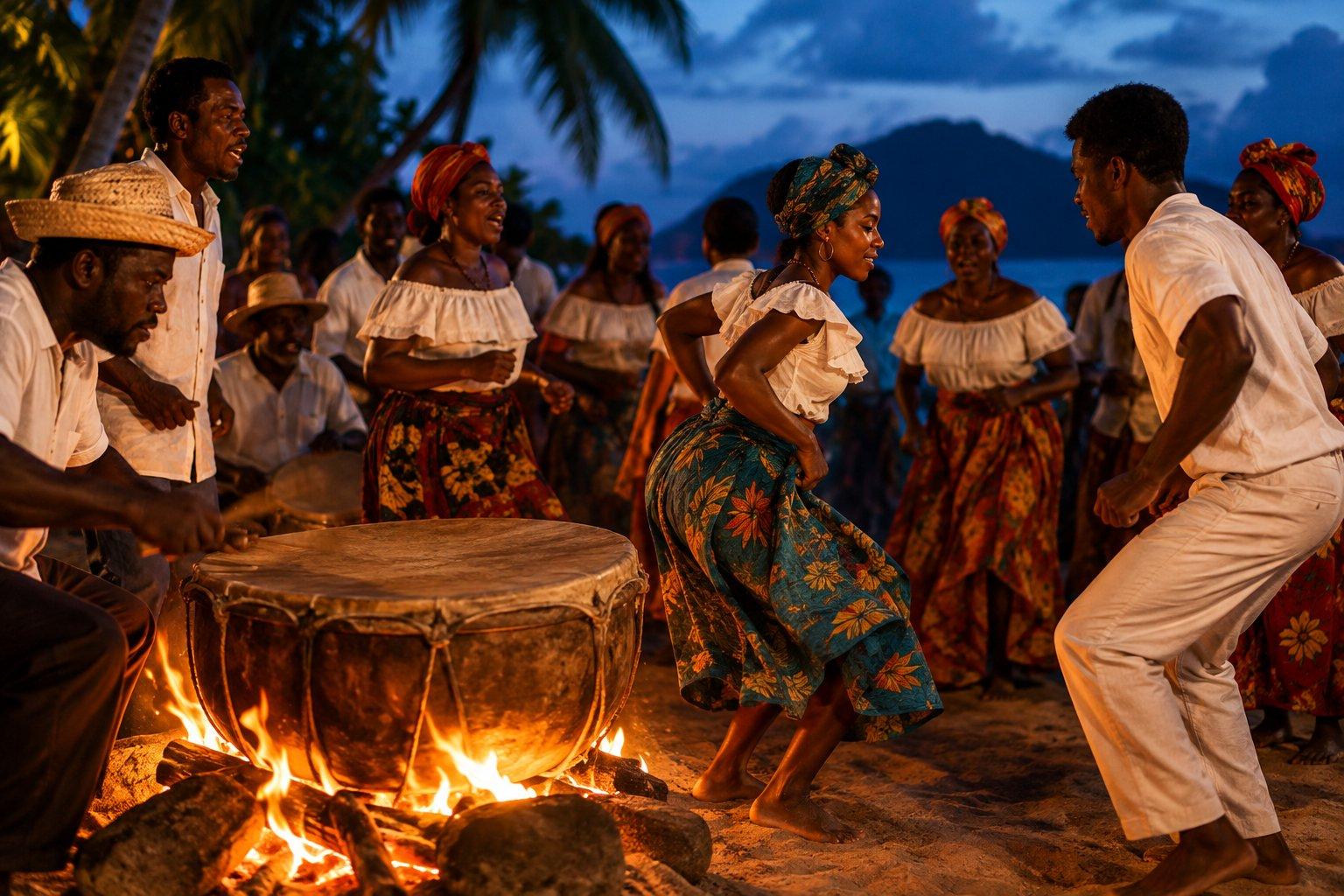
Explore Bwiti in Gabon, from iboga and initiation to Mitsogho and Fang traditions, ancestral art, music, Punu masks and the forests that shaped them.
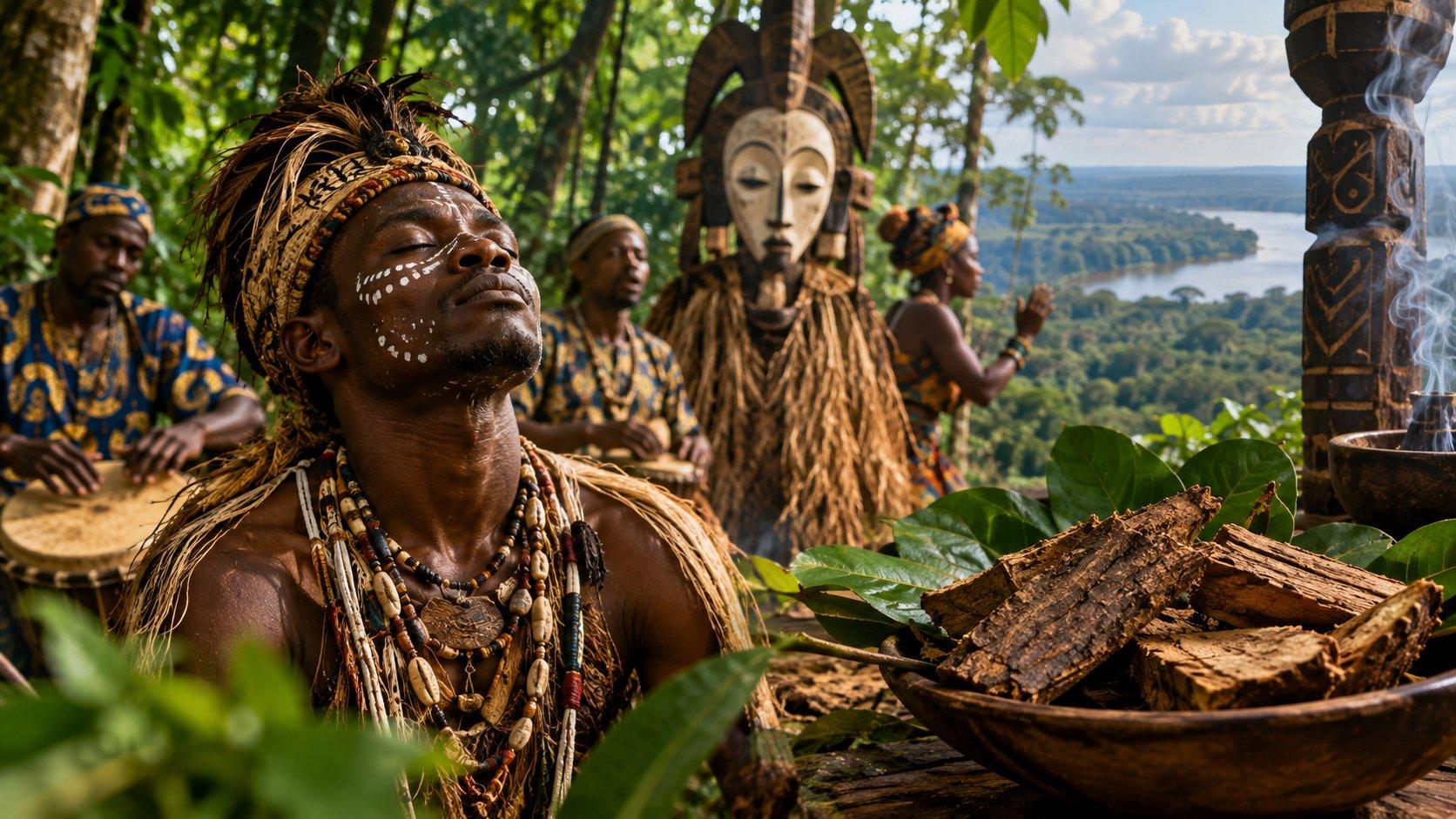
In the forests of southern Gabon, there are religious ceremonies where music, dancing, chanting, prayer, carved objects, ancestral teachings and the root bark of a plant called iboga all come together. For people being initiated into Bwiti, these are not separate elements that happen to appear in the same ceremony. They belong to the same religious world, where iboga is used as a sacrament and the wider ceremony provides a way of engaging with ancestors, healing, knowledge, community and the unseen world.
This is part of what makes Bwiti difficult to understand from the outside. Most international attention around Gabon has focused on iboga because its root bark contains psychoactive compounds that can produce intense and prolonged experiences. Scientists have also become interested in ibogaine, one of its main alkaloids, particularly because of research into substance-use disorders. But within the communities that have used iboga as part of religious practice for generations, the plant has never existed as an isolated psychedelic substance. It sits inside a much older and wider tradition that includes initiation, music, divination, ancestral relationships, healing practices and different forms of religious knowledge.
There is also no single version of Bwiti that can represent every community that practises it. The tradition developed among different peoples in Gabon, and as it moved from one community to another, it was shaped by existing beliefs, languages and social structures. The Mitsogho and Apindji of southern Gabon are particularly important in the historical literature on Bwiti, while Fang communities later adopted and developed their own forms of the tradition. Other communities, including the Punu, have their own religious and ancestral practices that are related to the wider cultural landscape but should not automatically be treated as identical to Bwiti.
The history of iboga itself is similarly difficult to reduce to one origin story. Oral traditions place forest peoples, including the Babongo, at an early point in the history of the plant, while anthropologists have documented different accounts of how its religious use developed. These traditions are valuable sources of cultural knowledge, but they cannot be treated in exactly the same way as archaeological evidence, particularly because written records about Bwiti and iboga appeared much later than the practices themselves.
What we can trace more clearly is the way these traditions developed and moved through southern and central Gabon. Forms of Bwiti associated with the Mitsogho became influential beyond their original communities, and Fang communities later adopted and transformed the practice. By the beginning of the 20th century, Fang Bwiti had become an important form of the tradition, shaped by Fang ideas about ancestors as well as by the southern Gabonese practices from which it developed.
Once you follow that history, the story of Gabon starts to become much larger than iboga. You begin to see how religion, language, migration, forests, music, art and colonial history have all influenced one another over time. To understand why Bwiti looks the way it does today, it helps to begin with the communities that carried it.
Where Bwiti came from
In this section
Understanding that diversity also helps explain what happened when European colonialism began to reshape Gabon.
The word Bwiti comes from the Tsogo linguistic environment associated with the Mitsogho of southern Gabon, while the name iboga is associated with a different linguistic environment among Myene-speaking communities around the coast and lower Ogooué. That difference is useful because it immediately shows that the history surrounding the tradition involves several communities rather than one isolated group.
Among the Mitsogho, Bwiti is closely associated with initiation and relationships with ancestors. Ethnographic research describes different branches, including Disumba and Misoko. Within Mitsogho understandings of the tradition, Disumba is generally described as the older branch, while Misoko is particularly associated with divination and healing. These descriptions tell us how practitioners understand the branches of Bwiti, but they should not be treated as a precise archaeological chronology because much of the tradition's earlier history was transmitted orally.
The movement of Bwiti between communities is also important. When a religious tradition enters a new community, it does not necessarily replace the beliefs that were already there. People interpret new practices through the religious and social systems they already understand, which means that the same broad tradition can develop different forms in different places.
This happened in Gabon as Bwiti spread beyond the Mitsogho and Apindji. Different communities developed their own relationships with the practice, and their existing ideas about ancestors, initiation, healing and the spiritual world influenced how Bwiti was understood.
The Fang provide one of the clearest examples of this process because Fang Bwiti eventually became one of the forms most widely discussed outside Gabon. Historical scholarship generally places its development around the beginning of the 20th century, after Fang communities encountered southern Gabonese forms of the tradition. The exact circumstances of that transmission are still discussed by scholars, but the broader history is clearer: Fang communities adopted an existing tradition and reshaped it within their own cultural and religious world.
That existing world already had an important ancestral tradition known as byeri. Byeri involved relationships with the remains of important ancestors and with objects used to preserve and represent them. These practices gave Fang communities their own established ways of thinking about ancestry, memory, protection and the relationship between living people and those who had died.
Christianity later became another influence on some forms of Fang Bwiti, particularly during the colonial period. Christian prayers and symbols could appear alongside older Fang and southern Gabonese religious ideas, producing forms of Bwiti that reflected several layers of Gabon's history at once.
This is why there is no single ceremony that can represent every form of Bwiti. The name connects related traditions, but those traditions have their own histories, communities and ways of organising religious life.
Understanding that diversity also helps explain what happened when European colonialism began to reshape Gabon.
How colonialism changed the religious landscape
In this section
A settlement developed around the site, and in August 1849 a municipal administration was established.
European involvement in Gabon began along the coast centuries before the territory became a French colony. Portuguese traders reached the region in the late 15th century, and European commercial activity later became closely connected to the Atlantic slave trade. During the 19th century, French influence expanded, eventually developing into colonial rule.
Libreville itself carries part of that history. According to the city's official historical account, 52 people liberated from the Brazilian slave ship L'Elizia, including 27 men, 23 women and two children, arrived at Fort d'Aumale on 30 May 1848. A settlement developed around the site, and in August 1849 a municipal administration was established. The name Libreville, meaning "free city," reflected the circumstances surrounding its establishment.
By the time colonial rule expanded, the societies that European powers encountered already had their own political structures, economies, languages and religious systems. Colonialism therefore did not introduce organised society into an otherwise empty space. It introduced a new political and economic system into societies that were already structured in their own ways.
Christian missionaries became part of that process. They established churches and schools and often viewed indigenous religious practices through Christian ideas about religion and spirituality. Ceremonies involving ancestors, initiation, divination and iboga could be regarded by missionaries as practices that needed to be rejected or replaced.
Gabonese communities responded in different ways. Some people converted to Christianity and moved away from particular indigenous practices. Others maintained older traditions within their communities, while some incorporated Christian elements into existing religious systems.
The development of Fang Bwiti illustrates this process particularly well. Christian prayers and symbols became part of some forms of the tradition, while Fang ancestral ideas and southern Gabonese religious practices remained important. Rather than disappearing, the tradition continued to change as the people practising it responded to the world around them.
That history is important because it means contemporary Bwiti cannot be understood as a practice that has remained completely untouched since precolonial times. Like many living religious traditions, it has developed through contact, adaptation and continuity.
The country around it changed as well, eventually becoming an independent state.
Gabon after independence
In this section
Gabon adopted a new constitution in December 2024, and presidential elections were held on 12 April 2025.
Gabon became independent from France on 17 August 1960, and the decades that followed were marked by a long period of political continuity. Omar Bongo became president in 1967 and remained in office until his death in 2009. His son, Ali Bongo Ondimba, succeeded him and served as president from 2009 until 2023.
In August 2023, military officers took power and ended Ali Bongo's presidency, beginning a transition under General Brice Clotaire Oligui Nguema.
Gabon adopted a new constitution in December 2024, and presidential elections were held on 12 April 2025. The Constitutional Court proclaimed Brice Clotaire Oligui Nguema elected with 588,074 votes, representing 94.85 percent of valid votes. He was sworn in on 4 May 2025, when the government formally declared the transition over.
These changes are part of Gabon's recent political history, but they also provide context for understanding the country's religious environment today. The constitution establishes Gabon as a secular republic and separates the state from religious institutions while protecting freedom of conscience and the free practice of religion and worship.
Bwiti therefore exists within a modern state that does not have an official indigenous religion. It exists alongside Christianity, Islam and other forms of religious practice, including traditions that combine elements from different religious histories.
To understand why that diversity exists, however, we need to look at the people who make up Gabon itself.
The people of Gabon
In this section
French is the official language and is widely used in government, education, business and public life.
Gabon is home to many ethnic communities, and those communities have their own histories, languages and cultural traditions. The Fang are the country's largest ethnic group, while the Punu, Nzebi, Teke, Myene, Kota, Mitsogho, Apindji and many other communities form important parts of the country's population.
French is the official language and is widely used in government, education, business and public life. Indigenous languages remain important in families and communities, although their use varies considerably depending on region, generation and social setting.
This diversity is important when discussing Bwiti because the tradition cannot be separated from the communities through which it developed. The Mitsogho are closely associated with important southern Gabonese forms of Bwiti. The Apindji also appear prominently in the historical literature. Fang communities later developed their own forms of the practice, while other communities maintained their own ancestral and religious traditions.
The same applies to Gabon's broader cultural life. A Fang ancestral practice, a Punu masquerade, a Mitsogho initiation and a Myene coastal tradition can all belong to Gabon's cultural landscape without being interchangeable.
Once that distinction is clear, it becomes easier to understand why Bwiti ceremonies can look different from one community to another.
It also becomes easier to understand what iboga is actually doing inside those ceremonies.
What happens inside Bwiti
In this section
The role of iboga also makes more sense when we look at the environment from which the plant comes.
Initiation is central to many forms of Bwiti, and the initiate enters a structured religious process in which music, instruction, ritual activity and iboga are brought together.
From outside the tradition, it can be tempting to focus almost entirely on the effects of iboga because those effects are so unusual. The root bark contains ibogaine and other alkaloids that affect the nervous system and can produce intense and prolonged psychological experiences. Those pharmacological effects are part of why iboga has attracted so much international attention.
Within Bwiti, however, the experience is understood through the religious system surrounding it.
The visions or other experiences associated with iboga may be interpreted in relation to ancestors, personal problems, healing, knowledge and the unseen world. In Misoko, which is particularly associated with divination and healing, ethnographic research has documented people entering the tradition after periods of repeated misfortune or other problems that they understand through a religious framework.
The ceremony gives those experiences a context.
This is also why it is difficult to understand Bwiti by reading only descriptions of iboga's pharmacological effects. The plant may produce a particular neurological experience, but the meaning attached to that experience comes from the religious and cultural setting in which it takes place.
There are also parts of initiation that are not intended to be public. Some knowledge is transmitted to initiates through participation, instruction and experience rather than through books or published research. Researchers can describe the broader structure of the tradition, but there are limits to how completely an outsider can reproduce knowledge that belongs within the community itself.
The role of iboga also makes more sense when we look at the environment from which the plant comes.
Gabon is not just the setting around the tradition. Its forests are part of the history that made the tradition possible.
The forest is part of the story
In this section
For people who have lived in and around these forests for generations, the forest is much more than scenery.
Gabon is one of the most heavily forested countries in Africa. The World Bank recorded forest covering approximately 91.2 percent of the country's land area in 2023.
For people who have lived in and around these forests for generations, the forest is much more than scenery. It has provided food, medicines, timber, construction materials and other resources, while communities have developed detailed knowledge of plants and animals through generations of observation and use.
Iboga belongs within that larger history of knowledge about the natural environment.
Tabernanthe iboga is a shrub native to Central Africa, and Gabon has an especially important place in the cultural traditions surrounding its use. The plant's significance developed within communities that knew their environment closely and understood particular plants in relation to food, medicine, ritual and everyday life.
This is one reason the international description of iboga as a "psychedelic plant" can feel incomplete when applied to Gabonese traditions. It describes one property of the plant, but it does not explain the cultural system in which that property became meaningful.
The forest itself has also become the subject of another important part of Gabon's modern history: conservation.
Thirteen national parks were established in 2002, creating the foundation of the country's national park system. These protected areas are important for biodiversity conservation, but they also exist within landscapes where communities have historically hunted, gathered plants and maintained livelihoods.
That creates questions that do not have easy one-line answers. Protecting forests can be essential for biodiversity and climate regulation, while restrictions on access to protected areas can affect people whose families have long depended on those landscapes. The relationship between conservation and local communities therefore requires attention to both environmental and human realities.
In Gabon, the forest carries both ecological and cultural importance.
And some of the knowledge carried through that environment is expressed through music.
Music that carries knowledge
In this section
Within a ceremony, music helps structure the experience, and songs can carry teachings, stories and references to ancestors.
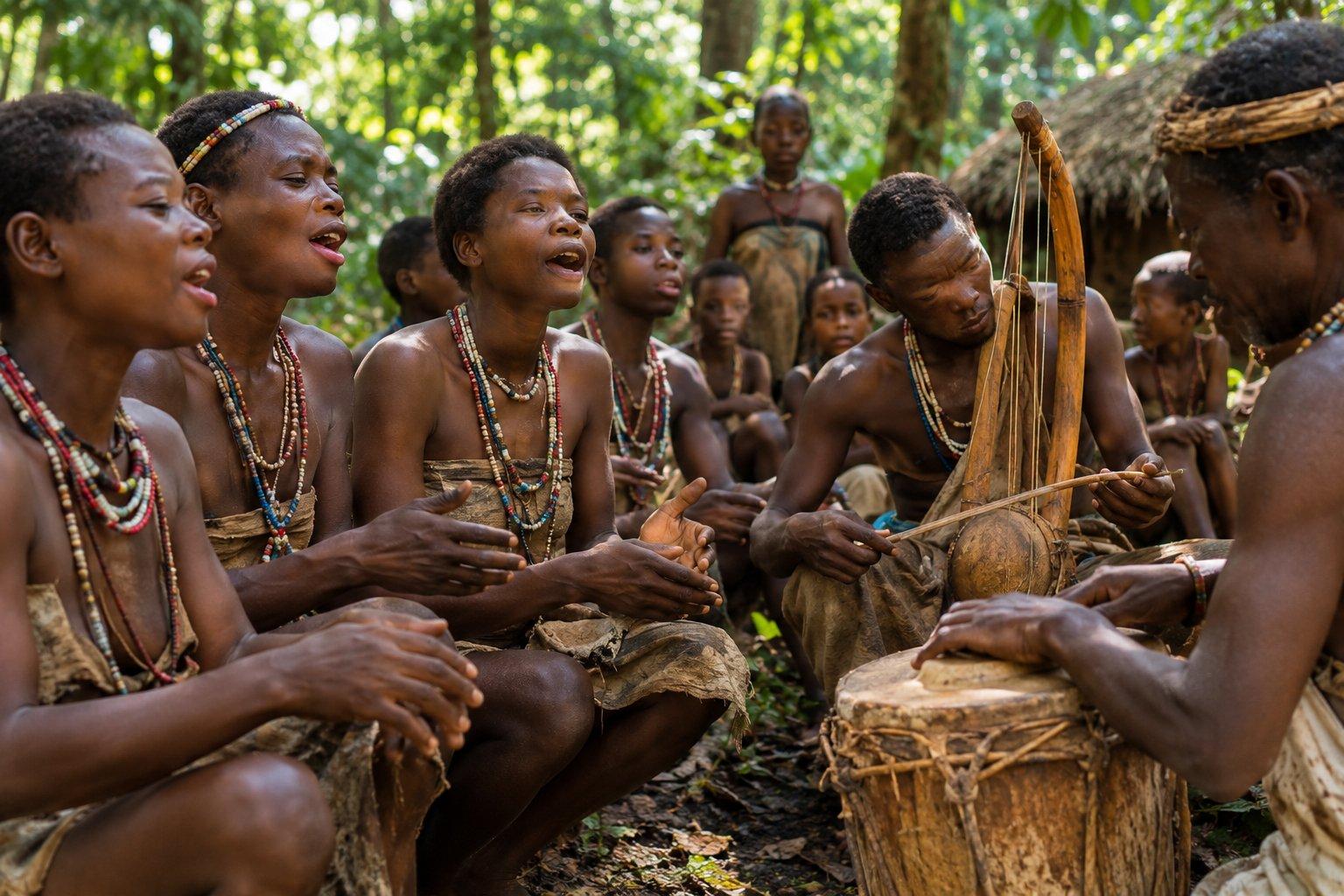
Music plays an important role in many Bwiti ceremonies, and one of the best-known instruments associated with Gabonese Bwiti is the ngombi, an arched harp found in Fang and other Gabonese contexts.
The ngombi is now held in museum collections around the world, but seeing the instrument displayed behind glass does not tell us everything about its original role. Within a ceremony, music helps structure the experience, and songs can carry teachings, stories and references to ancestors.
The music also contributes to the atmosphere of initiation. Repetition, rhythm, singing and instrumental patterns can continue for long periods, creating a setting in which participants remain engaged with the ceremony and the knowledge being transmitted.
This is important because religious knowledge is not always transmitted as a written explanation. Sometimes it is carried through a song that people learn by listening. Sometimes it is carried through a ritual sequence that people learn by participating. Sometimes an object, an instrument or a particular movement carries meaning that only makes sense when it is placed within the ceremony.
The ngombi also gives us another way of seeing the movement of culture through Gabon. Instruments, songs and religious practices travelled as people interacted with neighbouring communities, and they could change as they entered new cultural settings.
That same connection between objects and religious life appears in Gabon's ancestral sculpture.
The art of remembering ancestors
In this section
African sculpture attracted the attention of several European modernist artists during the early 20th century.
Among Fang communities, the byeri tradition involved preserving the remains of important deceased people, including parts of the skull and other bones, in bark containers. A carved figure or head could be attached to the container and function as a guardian associated with the ancestral remains.
These objects later became some of the most recognisable examples of Gabonese art in European museums.
Their history in Europe is complicated because the context in which they were originally made was very different from the context in which European collectors encountered them. For Fang communities, the objects were connected to ancestry, memory, protection and religious practice. For European collectors and artists, they increasingly became objects of artistic and aesthetic interest.
African sculpture attracted the attention of several European modernist artists during the early 20th century. The Metropolitan Museum of Art records that artists including Pablo Picasso, André Derain, Maurice de Vlaminck and Henri Matisse collected or studied African sculpture. Kota reliquary figures from Gabon also entered European collections and became part of the visual environment encountered by artists such as Picasso, Fernand Léger and Paul Klee.
It would be too simplistic to say that a particular Gabonese sculpture "created" Cubism or that European modern art can be traced back to one African object. The history involved many artists, objects, collections and influences.
What is clear is that African artworks entered European artistic circles and became important to the way some European artists thought about form and representation.
For the communities that created those objects, however, their original meaning was not primarily about European art history. These were objects connected to living relationships with ancestors.
That distinction between the object and its context becomes even more obvious when we look at Punu masquerades, because there the meaning cannot be separated from movement and performance.
Punu masks and dancers on stilts
In this section
A museum can preserve an object, but it cannot completely preserve the social world in which the object was used.
Southern Gabon is particularly known for the mukudj masks associated with Punu communities.
These masks often have white faces, carefully carved hairstyles and features representing an idealised form of feminine beauty. They are worn by male performers during masquerades, where the dancer moves on tall stilts beneath a fibre costume.
The height of the dancer changes the entire experience of the performance. The masked figure rises above the crowd, and the dancer has to maintain extraordinary control while moving on stilts.
The white surface of the mask is traditionally made with kaolin, a fine white clay, and whiteness carries associations with beauty and the spirit world in Punu contexts. The mask's hairstyle and facial features also carry meaning, so the object communicates through its materials and design before the dancer even begins to move.
Once the mask becomes part of a performance, however, it becomes something more than a sculpture.
A museum visitor sees carved wood.
The audience at a masquerade sees a moving figure surrounded by music, people and ceremony.
That difference appears repeatedly in Gabon's cultural heritage. A museum can preserve an object, but it cannot completely preserve the social world in which the object was used.
The same is true of everyday cultural practices, including food and clothing.
Food, clothing and everyday life
Gabon's food traditions reflect the country's forests, rivers, coastline and agricultural systems.
Cassava and plantain are important foods in many communities, while fish is particularly important in areas connected to the coast and rivers. Palm products are also widely used, including in nyembwe, a palm-nut sauce that is central to one of Gabon's best-known dishes, poulet nyembwe.
Food traditions vary between communities and regions, so there is no single recipe that can represent all of Gabon. Ingredients, preparation methods and preferred dishes are influenced by geography, family traditions and the resources available in different parts of the country.
Clothing has also changed over time.
There are traditional textiles and ceremonial forms of dress, but modern Gabonese clothing also reflects Christianity, Islam, colonial history, imported fabrics, urbanisation and contemporary African fashion.
This mixture is particularly visible in cities such as Libreville, where people can participate in a modern urban economy while maintaining family relationships, foods, languages, ceremonies and cultural practices connected to communities whose histories go back much further.
That combination of continuity and change is also what we see in the international story of iboga.
Iboga and the outside world
In this section
Both are discussing the same plant, but they are approaching it from very different systems of knowledge.
Iboga has travelled far beyond the communities in which its religious uses developed.
Researchers outside Africa have studied ibogaine because of its effects on the nervous system and its possible relevance to substance-use disorders. There is scientific interest in whether ibogaine could have therapeutic applications, but that research should not be confused with an established medical treatment. Ibogaine can also produce serious adverse effects, including potentially dangerous effects on the heart.
At the same time, people from outside Gabon have travelled to the country because they are interested in iboga and Bwiti.
Their reasons are not always the same. Some are interested in the religious tradition, some are interested in psychedelic experiences, and others are interested in research into addiction and ibogaine.
For Gabonese communities, that international interest creates several questions.
Iboga has economic value, but it is also a religious sacrament. It is a plant that grows within an ecosystem, but it is also connected to generations of local knowledge. It has become the subject of international scientific research, but it remains part of religious traditions whose meaning cannot be separated from the people who practise them.
Increased international demand can therefore affect access to the plant, the way Bwiti ceremonies are represented to outsiders and the relationship between traditional practitioners and visitors who may understand iboga very differently.
The difference can even be seen in the language people use.
An outsider may talk about iboga in terms of alkaloids, altered states of consciousness and potential therapeutic applications. A practitioner may talk about ancestors, initiation, healing, knowledge and religious responsibility.
Both are discussing the same plant, but they are approaching it from very different systems of knowledge.
That brings us back to the wider religious landscape in which Bwiti exists today.
What Gabon's religious landscape looks like today
Christianity is widespread in Gabon, with Roman Catholic and Protestant communities forming an important part of the country's religious landscape. Islam is also practised, including among Gabonese Muslims and immigrant communities, while indigenous religious traditions continue to exist alongside these faiths.
The constitution protects freedom of conscience and religious practice while maintaining a separation between the state and religious institutions.
This means that contemporary Gabon cannot be neatly divided into "modern" religion on one side and "traditional" religion on the other. People can live within several cultural worlds at the same time.
Someone can live in Libreville, speak French, attend church, use modern technology and still have family connections to indigenous traditions.
Someone else can participate in Bwiti initiation while living in a society shaped by Christianity, modern education, urbanisation and international media.
These combinations are part of contemporary Gabon.
The traditions have changed because the country has changed, but change has not necessarily meant disappearance.
What remains alive
In this section
The forest may have given away the secret of iboga, but the deeper story has always belonged to the people who knew what the plant meant.
It is easy to encounter Gabon's cultural traditions through old photographs, museum collections and ethnographic accounts and assume that they belong mainly to the past. The people who practise these traditions, however, are living in the present, and their relationship with cultural heritage continues to change as their communities change.
Bwiti ceremonies continue to take place, and music, initiation and ancestral practices remain part of the lives of communities that maintain them. Punu masquerades continue to connect masks with performance, while Gabonese artists, musicians and craftspeople continue to work within cultural traditions that have much longer histories than the modern state itself.
At the same time, these traditions are not frozen.
They have encountered Christianity, colonial rule, independence, urbanisation, changing economic conditions, environmental regulation and growing international interest in African cultural and medicinal knowledge. Younger generations also encounter their heritage through schools, churches, cities, museums, social media and family life, so the ways in which traditions are understood and transmitted continue to develop.
That is why the story of Gabon is much larger than the story of a plant called iboga.
Iboga is certainly one of the country's most fascinating cultural and natural treasures, but its meaning comes from the people and traditions that have surrounded it. The religious ceremonies give it context, the forest provides its habitat, the songs and instruments carry knowledge, ancestral objects preserve relationships with the past, and different communities have shaped the traditions according to their own histories.
When you look at Gabon this way, the forest begins to tell a much larger story.
It tells you about the people who learned its plants, the communities that moved through its landscapes, the religious traditions that developed around their understanding of the world, and the generations that continued to adapt those traditions as Gabon itself changed.
The forest may have given away the secret of iboga, but the deeper story has always belonged to the people who knew what the plant meant.