Explore Gorée Island, the House of Slaves and the Door of No Return, including the history, slave-trade estimates and debate surrounding the site.
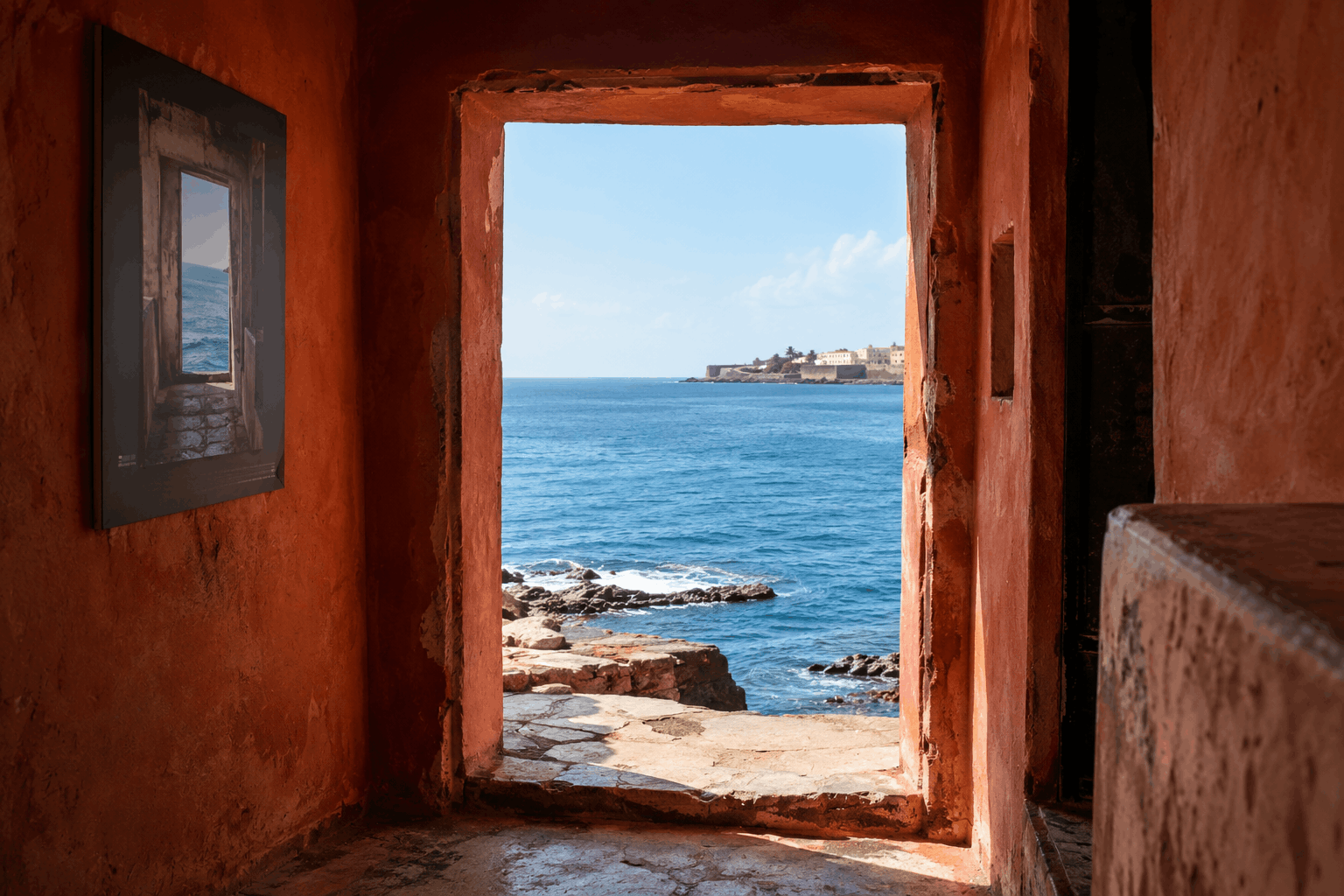
Every day, visitors to Gorée Island line up in a narrow passage inside a pink-walled house, waiting their turn to stand in a doorway. Beyond it is a small ledge of rock and, past that, the Atlantic Ocean. Guides explain that this was the final exit for Africans who had been captured, held in the rooms below, and taken to ships bound for the Americas. That description is part of the site's memorial narrative. The historical role of this particular building and doorway is disputed.
This article explains why. It covers where Gorée is, why Europeans fought over it, how the slave trade worked on this coast, what historians can and cannot say about the House of Slaves, how the building became a global memorial, and what a visit involves today. One distinction matters throughout. Gorée was unquestionably part of the Atlantic slave trade. What is disputed is how large a part it played, and whether this building was the large-scale holding and departure point its museum has presented.
Where Gorée is and why Europeans wanted it
In this section
In an era before modern harbours, ships needed protected anchorage, fresh water, and a place to store goods.
Gorée is a small island about 3.5 kilometres off Dakar, the capital of Senegal, on the Cap-Vert Peninsula, the westernmost point of the African mainland. UNESCO, the United Nations agency that maintains the World Heritage List, gives its area as 28 hectares. The crossing by ferry takes roughly half an hour. There are no cars on the island.
The name is commonly linked to the Dutch Goede Reede, a "good roadstead." A roadstead is a stretch of sheltered water where ships can anchor safely without entering a port. That explains the island's value. In an era before modern harbours, ships needed protected anchorage, fresh water, and a place to store goods. Gorée offered all three close to the mainland, and its rocky shape made it easy to defend. An island fort could be held with far fewer men than a mainland post, where hostile neighbours and disease were constant risks. (The etymology is not fully settled. Some scholars have also proposed a link to the Dutch island of Goeree.)
Gorée was not empty before Europeans arrived. UNESCO records a local name for the island, Ber, and fishing communities lived along this coast. European traders entered a region that already had its own communities, political authorities, and commercial networks.
The existence of slavery in West Africa also predates the Atlantic trade. Different systems of enslavement and dependency existed in parts of the region before European ships began carrying captives across the Atlantic in large numbers. European demand did not create every form of slavery that already existed, but Atlantic commerce connected existing political and commercial systems to a rapidly expanding overseas market. That distinction becomes important when looking at who participated in the trade and how Gorée fitted into it.
Four centuries of changing control
In this section
Enslaved people were among them, and the slave trade became an important part of Gorée's commercial history.
Portuguese navigators reached Gorée in the fifteenth century, and European occupation began during that period. The Dutch established control in the early seventeenth century, but the island changed hands repeatedly among European powers, and Portuguese and English forces intervened several times. The French captured it in 1677. Britain occupied it during several later wars, and France regained permanent control in 1817 and kept it until Senegal became independent in 1960.
The repeated fighting shows that the island's importance came from its position and not its size. It was a commercial base for European companies trading along the Senegambian coast, the region around the Senegal and Gambia rivers. The goods traded there included gum arabic, hides, and gold. Enslaved people were among them, and the slave trade became an important part of Gorée's commercial history.
Gorée was also one part of a much wider trading network. Saint-Louis, the Senegal River, the Gambia River and other coastal settlements connected the interior to Atlantic shipping routes. Captives could move through different points in this network depending on the period, the merchants involved and the availability of ships. That is one reason a figure for people leaving the wider Senegambian region cannot automatically be treated as a figure for Gorée itself. Gorée was part of the system, but the system was larger than the island.
How the trade worked, and where Gorée fit
In this section
Over the eighteenth century, a mixed African and European community grew up on the island.
To judge Gorée's role, it helps to see how the trade operated. It was not one building or one port. People were seized or bought inland, often as a result of wars, raids, or debt, and the people involved in capturing, selling and transporting captives included African and European actors. Their roles were not identical. African rulers, merchants and intermediaries could participate in capturing and selling people, while European merchants and companies were deeply involved in the Atlantic commercial and shipping networks that transported captives overseas.
Captives were moved toward the coast, sold to merchants, held until a ship arrived, and then shipped across the Atlantic in the voyage known as the Middle Passage. A place like Gorée could serve as one holding point in that chain. But ships also loaded people directly from beaches and river mouths, and much larger volumes left from other places, including Saint-Louis to the north and points along the Gambia River to the south.
This also means that the history of slavery on Gorée cannot be reduced to people waiting for Atlantic ships. Enslaved people lived on the island itself, worked in households and businesses, and occupied different positions within its society. Archaeological research has found evidence of a heterogeneous eighteenth-century population that included both free and enslaved Africans, while documentary research shows that slavery was embedded in the island's social and economic life.
Gorée's society was also unusual. Over the eighteenth century, a mixed African and European community grew up on the island. Its most prominent members included the signares, women of African or mixed descent who formed partnerships with European traders and became merchants and property owners. Some signare households also owned enslaved people. Their role therefore cannot be reduced to a simple story of intermediaries between Europeans and Africans. They were property owners, traders and participants in the social and commercial life of Gorée, while also being part of a society in which slavery existed.
Historical research documents slave sales and departures from Gorée, and archaeological research has identified an eighteenth-century society there that included both free and enslaved Africans. The signares' households owned enslaved people too. That detail is central to understanding the House of Slaves.
The House of Slaves: who built it and what it was
In this section
The evidence for Gorée's participation is much broader than the evidence for the precise function of this building.
The building dates to the late eighteenth century. Research places its construction between about 1776 and 1786 and associates it with Nicolas Pépin, the son of a wealthy signare, Catherine Baudet. His daughter, Anna Colas Pépin, later inherited it and became one of Gorée's prominent signares. Popular accounts often say the Dutch built it, but the Dutch had left the island long before, so that attribution is a problem for the traditional story.
The layout is real and striking. The living quarters were on the upper floor, and small, low rooms sat on the ground floor. A passage runs through the house to a doorway on the seaward side. What those ground-floor rooms were used for is contested. Some researchers read them as storage areas, others as rooms where captives were held. The house was a family residence and a place of business in a slave-trading society, and it may have played a part in that trade. Whether it operated as a large-scale holding and embarkation site, as its museum presents it, is the disputed point.
The difficulty is that the surviving building cannot answer every historical question by itself. A room's physical size can tell researchers something about how a building was organised, but it cannot establish on its own who occupied that room, for how long, or what every room was used for. Written records can document sales, ownership, commercial transactions and departures from Gorée, but a record showing that enslaved people were sold on the island does not automatically show that those people were confined inside this particular house.
This is why the debate is more specific than asking whether Gorée participated in the slave trade. The evidence for Gorée's participation is much broader than the evidence for the precise function of this building. Archaeology, maps, property records, commercial documents and later accounts can be read together, but they do not necessarily produce the same answer about the House of Slaves. Recent scholarship continues to examine the gap between the building's documented history and the memorial interpretation that developed around it.
The numbers people quote and the numbers historians estimate
In this section
The historian Raymond Mauny questioned the role attributed to the House of Slaves in his 1951 Guide de Gorée.
Two very different sets of figures circulate about Gorée. Under the interpretation of Boubacar Joseph Ndiaye, the House of Slaves' longtime curator, figures of 10 to 15 million enslaved Africans were associated with the site. The historian Ana Lucia Araújo has documented those figures and notes that they exceed the total number of Africans actually taken to the Americas. Historians have rejected them as unsupported by the documentary record.
The Trans-Atlantic Slave Trade Database, a scholarly compilation of records of slave voyages, estimates that about 12.5 million Africans were embarked across the entire transatlantic trade. A claim that 15 million people passed through one doorway on one small island would therefore exceed the estimated number embarked from the whole continent.
What do historians estimate for Gorée itself? One frequently cited estimate, drawn from the work of the historian Philip Curtin, is around 26,000 enslaved people brought through the island. Other estimates are higher, including one discussed in scholarship of roughly 40,000 to 45,000 between 1677 and 1818. All of these remain far below the millions sometimes claimed. Annual figures varied widely. Curtin's reconstruction suggests that Gorée's direct exports were generally small compared with the major slave-trading centres, with some important years recording only a few hundred people. Records for other years show larger sales, such as 350 at Gorée in 1754 and 600 in 1755.
The challenge to the popular story is also old. The historian Raymond Mauny questioned the role attributed to the House of Slaves in his 1951 Guide de Gorée. He was later appointed to the Sorbonne's chair of medieval African history in 1962. Later scholarship has continued to question the scale traditionally attributed to the House of Slaves, while also documenting Gorée's genuine participation in the trade.
The official record reflects the tension. UNESCO's original World Heritage description calls Gorée the largest slave-trading centre on the African coast, while UNESCO's own more recent writing acknowledges that the island's central role in the trade is debated.
How the House of Slaves became a memorial
In this section
The island's historic buildings survived, because Gorée was not redeveloped after its commercial decline.
The history of the doorway is part of this debate. The physical opening is an old part of the building, but its modern identity as the "Door of No Return" comes from the way the site has been interpreted and presented as a memorial to the Atlantic slave trade. Visitors are therefore encountering two things at once: a surviving historic structure and a twentieth-century memorial interpretation of what happened there.
If Gorée was not the trade's largest port, why is it so prominent? The record shows a sequence of developments. The island's historic buildings survived, because Gorée was not redeveloped after its commercial decline. The House of Slaves was turned into a museum in 1962, shortly after independence, and Ndiaye became its most influential public interpreter. Ndiaye presented the building as the final exit point for enslaved Africans, and his interpretation shaped how generations of visitors understood it. In 1978, the World Heritage Committee inscribed Gorée on the World Heritage List, among the first 12 properties on the list. UNESCO now describes the island as a memorial site and a pilgrimage destination for the African diaspora, the communities of African descent living outside Africa.
Gorée was also the first site in Senegal to be inscribed on the World Heritage List. Its heritage status came relatively early in the development of the international World Heritage system, helping establish the island not only as a historic place in Senegal but as an international site of memory.
Visits by prominent figures added to that visibility: Nelson Mandela in 1991, Pope John Paul II in 1992, Bill Clinton in 1998, George W. Bush in 2003, and Barack Obama in 2013. These visits helped make Gorée a highly visible international site of remembrance.
This makes Gorée what historians call a site of memory. It is a place that stands for a much larger history, including events that happened elsewhere. That does not make its memorial function false. It does mean that the symbol and the archive are two different things, and keeping them apart is part of understanding the place.
The distinction is particularly relevant to the doorway. It has become a powerful symbol of forced departure across the Atlantic, but a symbol does not have to function as a precise passenger record. The millions of Africans forced into the Atlantic slave trade were taken from many parts of West and Central Africa and passed through many different coastal and riverine locations. Gorée's memorial significance therefore extends beyond the number of people who can be shown to have passed through this particular doorway.
The decline that reduced Gorée's commercial importance also helped leave much of its historic built environment intact.
The trade ended slowly. France abolished slavery in its colonies for good in 1848, after an earlier abolition in 1794 that Napoleon reversed in 1802. Gorée's commercial decline, however, was already underway before abolition. As Dakar developed on the mainland and became a more important port, the island lost some of its earlier commercial importance.
After abolition, Gorée became a quieter garrison and residential town. Its later history was still part of French colonial rule, and military and administrative uses continued on the island. Because it was never rebuilt on a large scale, much of its eighteenth- and nineteenth-century architecture survives: colour-washed houses, wooden shutters, wrought-iron balconies, and interior courtyards.
There is an irony in that preservation. The decline that reduced Gorée's commercial importance also helped leave much of its historic built environment intact. Those surviving buildings later became one of the reasons the island could function so powerfully as a heritage and memorial site.
Around 1,700 people live in the commune of Gorée, according to 2024 population figures. They fish, run guesthouses and small restaurants, and work as guides and artists. A visitor walking the sandy lanes is walking through a neighbourhood, and the pressures of visiting fall on the people who live there.
What a visit looks like
In this section
The wider island also provides evidence of a society that cannot be understood only through the Atlantic slave trade.
From the quay, the walk into the village takes only a few minutes. The House of Slaves is the main stop. Guides take small groups through the ground-floor rooms, up the staircase, and along the passage to the doorway at the back. The rooms are bare, and the guide's account provides the context.
Knowing the debate helps here. It is reasonable to ask a guide which parts of the story are documented and which come from the site's memorial tradition. You can also ask about the history of the building itself, rather than assuming that every feature of the house has one uncontested interpretation.
Other stops widen the picture. Fort d'Estrées, a fortification on the island's high ground, houses a historical museum covering Senegal's past well beyond the slave trade. The island's Saint-Charles Borromeo Church and old administrative buildings show how it was governed, and the lanes themselves take an hour or two to explore.
The wider island also provides evidence of a society that cannot be understood only through the Atlantic slave trade. Houses, streets, religious buildings, military structures and archaeological remains reflect the lives of free and enslaved people who lived there, as well as the European and African communities that developed on the island. Archaeological research has described Gorée as a heterogeneous and transnational settlement by the eighteenth century, while also noting that slavery itself can be difficult to read directly from the archaeological record.
Getting there and planning the day
In this section
If you want a guide, decide before you arrive and agree on the price first, since you will be approached by many.
Ferries to Gorée leave from the port in downtown Dakar, in the Plateau district. The crossing takes roughly half an hour, although schedules and vessels change. The Port Autonome de Dakar publishes the current timetable and fare table, and it is worth checking both before you travel. Fares differ by traveller category, with separate rates for Senegalese residents, African residents, and other visitors. Bring your passport or other valid identification, since current visitor guidance indicates it may be checked at the port entrance. Weekends and school holidays draw large crowds, so allow extra time for queues. A traveller's account from April 2026 recommends the first morning boats so you can walk the island before the House of Slaves opens.
There is also a 500 CFA municipal service or tourist tax associated with visiting the island. UNESCO has documented the use of tourist-tax revenue for daily maintenance, while the municipality has described the 500 CFA charge as helping to fund services such as waste management.
Current visitor listings generally show the House of Slaves closed on Mondays and open Tuesday to Sunday, usually with a midday break. Confirm locally, since hours can change. Wear comfortable shoes for sand and uneven stone, and carry some cash. If you want a guide, decide before you arrive and agree on the price first, since you will be approached by many. Plan on half a day.
Pressures on the island
In this section
Some aspects of Gorée's history are documented through commercial records, maps, property records and archaeology.
Gorée faces three kinds of pressure. The first is physical. UNESCO reports coastal erosion caused by sea currents and rising sea levels, damage to protective walls and batteries, and weakening historic buildings. Preserving the island requires continual public and international investment.
The second is tourism. UNESCO says the House of Slaves receives several hundred visitors every day. Tourism brings revenue and employment, but it also puts pressure on an island where people still live and where fragile buildings need constant care.
The third is historical accuracy. As research on the Senegambian trade continues, the story told at the site may shift toward a fuller account: one that keeps Gorée's memorial role but is candid about the estimated numbers, the involvement of local and mixed-heritage traders, the history of slavery within Gorée itself, and the other ports where larger numbers were shipped.
That fuller account also has to deal with the fact that the evidence is uneven. Some aspects of Gorée's history are documented through commercial records, maps, property records and archaeology. Other claims depend more heavily on later oral and memorial traditions. The House of Slaves sits at the point where those different forms of evidence meet, which is why its history remains debated.
Back at the doorway
Return to the doorway. It can still function as a memorial to the millions of Africans who were forced into the Atlantic slave trade, without treating it as proof that millions passed through that particular opening. The trade involved many ports, rivers, beaches, merchants, ships and communities across a vast region. Gorée was one part of that history.
Gorée's history is larger than one building, and the limits of the building's evidence are part of that history too.