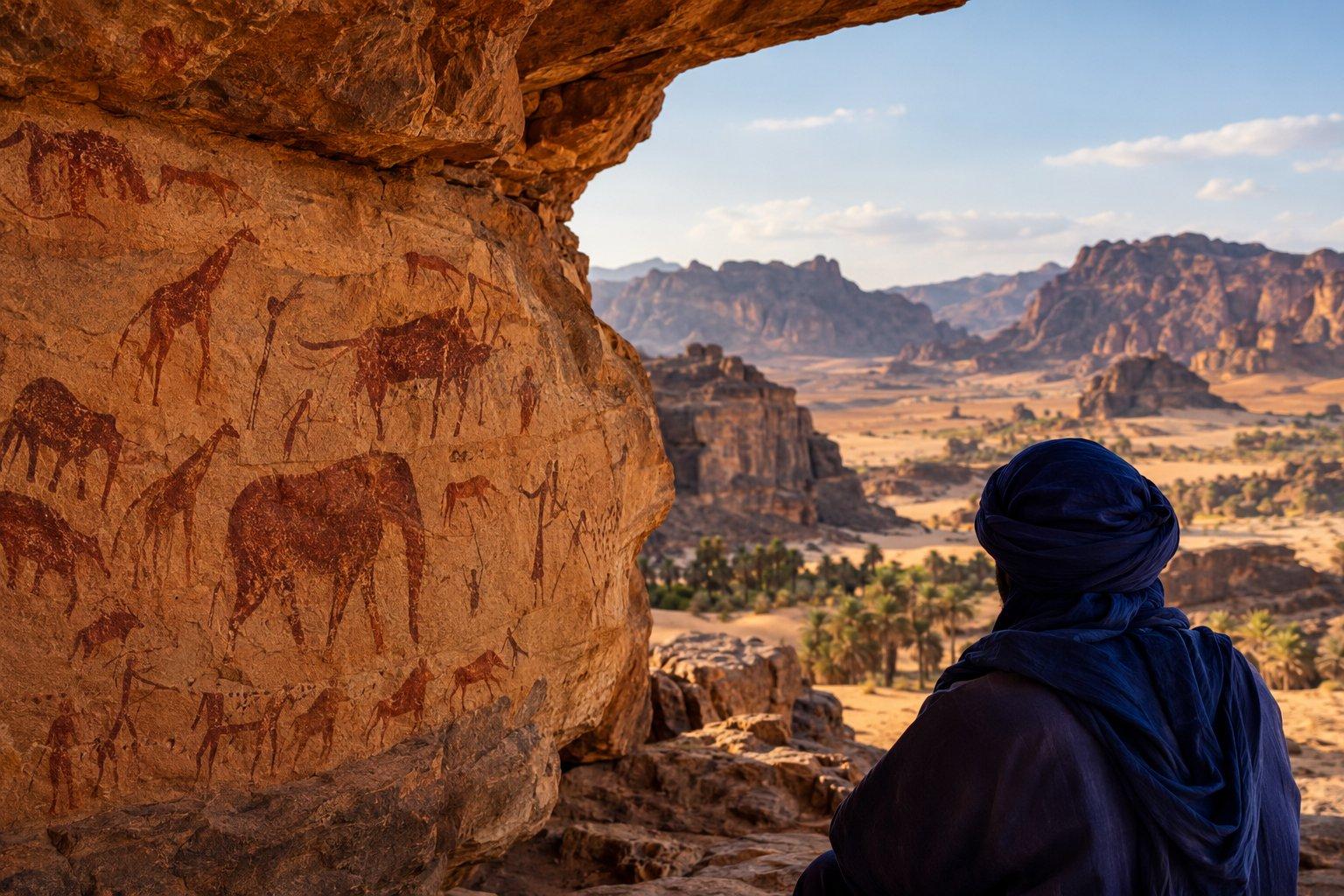
In the Tadrart Acacus mountains of southwestern Libya, thousands of paintings and engravings record lives lived in a Sahara that looked very different from the desert we know today. UNESCO dates the oldest rock art at the site to around 12,000 BCE, with later works continuing until about the first century CE. Across those different periods, the images include elephants, giraffes, rhinoceroses, cattle, other animals, human figures and scenes connected to changing ways of life. The sequence is important because it shows that the environment was changing too. The Sahara was once considerably wetter, supporting vegetation and wildlife that could not survive there under today's conditions.
The people who made these images left no written explanation beside them, so archaeologists have had to reconstruct their worlds through the art itself, together with archaeological and environmental evidence. What remains is an extraordinary record of human adaptation across thousands of years.
There is another kind of silence in Libya's history, and it is much more recent.
Under Muammar Gaddafi, who ruled Libya from 1969 until his overthrow and death in 2011, Amazigh language and cultural expression were heavily restricted. Tamazight could not be taught in schools, Amazigh names were prohibited, and Amazigh symbols and public expressions of identity were suppressed. After 2011, Amazigh communities began publicly reclaiming language, festivals, symbols and cultural institutions that had been pushed out of official life for decades.
This creates an interesting way of looking at Libya. The country's modern history is usually told through monarchy, Gaddafi, revolution, armed groups, competing political authorities, oil and migration. Those are important parts of the story, but they are not the whole country.
Libya also contains Amazigh communities in the Nafusa Mountains and Zuwara, Tuareg communities across parts of the southwest, Tebu communities in the south and southeast, Arab communities with histories that differ considerably between regions, and three historic geographical regions, Tripolitania, Cyrenaica and Fezzan, whose identities long predate the modern state.
Where the culture came from
Libya's history has never been isolated from the wider Mediterranean or Sahara.
The western coast became part of Phoenician and Punic trading networks. Sabratha began as a Phoenician trading post, while Leptis Magna was founded by Phoenicians in the seventh century BCE and later became one of the major cities of Roman North Africa. In the east, Greek settlers from Thera founded Cyrene around 630–631 BCE. The city eventually became the centre of the powerful Cyrenaican Greek world before passing under Roman rule.
These cities were not empty landscapes waiting for foreign civilizations to arrive. They developed within regions already inhabited by indigenous North African populations and connected to older Saharan trading networks. The ancient history of Libya is therefore better understood as layers of interaction than as a succession of civilizations replacing one another completely.
The Arab conquest began in the seventh century. Cyrene fell to Arab forces in the 640s, while the Fezzan was also incorporated into the expanding Islamic world. Arabic and Islam spread gradually, rather than transforming the entire population overnight. Over subsequent centuries, Arabic became increasingly dominant through religious, political, commercial and social processes.
The arrival of Banu Hilal and Banu Sulaym in the 11th century was particularly important. These Arab tribal migrations contributed significantly to the spread of Bedouin Arabic across North Africa. In Libya, Banu Sulaym became particularly associated with Cyrenaica, while Hilalian varieties became important in western Libya. At the same time, Amazigh languages survived in particular communities and regions, including the Nafusa Mountains and other parts of western and southern Libya.
Ottoman rule followed, with the Ottoman Empire establishing control over Tripoli in the sixteenth century and reasserting direct control over the region in 1835. The territory that became modern Libya was never governed as a completely uniform space. Tripolitania had strong links with the Maghreb and Mediterranean, Cyrenaica was more closely connected historically to Egypt and the eastern Mediterranean, while Fezzan was deeply tied to Saharan and sub-Saharan trade routes.
Italian invasion began in 1911, and Italy formally acquired Libya from the Ottoman Empire in 1912. The colonial period was particularly violent. During the Fascist regime's campaign to crush resistance in Cyrenaica, Italian authorities forcibly displaced large numbers of people and confined much of the nomadic and semi-nomadic population in concentration camps. Academic estimates place the number of Libyan prisoners in those camps at roughly 100,000–120,000, with deaths estimated at around 40,000–48,000.
The repression included forced displacement, starvation, disease, executions and the destruction of pastoral livelihoods. Omar al-Mukhtar, one of the best-known leaders of the Cyrenaican resistance, was captured and executed by the Italian authorities in 1931.
Libya became independent on 24 December 1951 as the United Kingdom of Libya, with Idris al-Senussi as king. In September 1969, a military coup led by Muammar Gaddafi overthrew the monarchy. Gaddafi remained the country's dominant political figure until the 2011 uprising and civil war that brought down his government.
The political divisions that followed have lasted much longer than the immediate aftermath of the revolution. In 2026, the United Nations continues to describe Libya as having divided institutions and a prolonged political transition, while efforts continue to create unified institutions and prepare for national elections. In August 2026, Libyan political actors reached a UN-facilitated agreement on parts of the electoral framework, and the House of Representatives endorsed that agreement in September.
Ethnic groups and languages
There is no recent comprehensive census that provides a reliable ethnic breakdown of Libya, so precise percentages should be treated carefully.
U.S. government reporting has described Arabic-speaking Muslims of Arab, Amazigh or mixed Arab-Amazigh ancestry as making up the overwhelming majority of citizens, while identifying Amazigh, Tuareg and Tebu as the principal linguistic minorities. Minority Rights Group likewise identifies the Imazighen, Tuareg and Tebu among Libya's principal minority communities.
The Amazigh, or Imazighen, are indigenous to North Africa. In Libya, Amazigh communities are particularly associated with the Nafusa Mountains and the coastal town of Zuwara, while other Amazigh-speaking communities have historically lived in oasis areas. Tamazight survived despite decades of official repression under Gaddafi.
The Tuareg are a group of Saharan peoples whose communities cross modern national borders in Libya, Algeria, Niger and Mali. In Libya they are particularly associated with the southwest, including Ghat and areas around Ubari and the wider Fezzan. Their languages belong to the Berber branch of the Afroasiatic language family.
The Tebu are another distinct Saharan people, with communities extending across southern Libya and into Chad and Niger. Their identity and history cannot be reduced to the Arab-Amazigh division that dominates many descriptions of northern Libya.
Libya's linguistic history is therefore more complicated than the country's official language would suggest. Arabic dominates public life, but different Amazigh languages and varieties, including Nafusi, Ghadamisi, Awjilah and Tamasheq varieties, have survived in different communities. Constitutional and legal developments since 2011 have recognized Tamazight, Tuareg and Tebu languages as part of Libya's cultural and linguistic heritage, although Arabic has remained the official language in the constitutional texts referenced by international reporting.
There is also a longer history of Black communities in Libya connected partly to the trans-Saharan slave trade. Fezzan was an important centre in these networks, with enslaved people transported north from regions south of the Sahara. Historians have also documented the lives and emancipation of enslaved and formerly enslaved Black people in cities including Benghazi. Their descendants form part of Libya's social history, although they should not be treated as one single ethnic or linguistic group.
Religion and belief
Libya is overwhelmingly Muslim. Recent U.S. government reporting estimates that Sunni Muslims constitute around 90–95 percent of the population, with Ibadi Muslims making up approximately 4.5–6 percent. Many Libyan Ibadis are Amazigh. Small Christian, Hindu, Buddhist, Baha'i and other communities also exist, but most non-Muslims living in Libya are foreign residents.
Sufi traditions have also been important in Libyan history. The most politically significant was the Sanusiyya, an Islamic religious order founded in the nineteenth century that developed a particularly strong base among communities in Cyrenaica and the Fezzan. Its religious and political influence became central to the formation of modern Libya, and Idris al-Senussi, the country's first king, was the head of the order's political and religious establishment.
Amazigh religious history also cannot be separated neatly from Islam. Many Amazigh communities adopted Islam centuries ago while retaining particular local customs and symbolic traditions. Among Libyan Amazigh communities, Ibadi Islam has historically been particularly important.
Libya also once had a substantial Jewish population. Jewish communities were present in the country for at least two millennia, with some historical accounts tracing the community back to the Hellenistic period. Around 36,000–38,000 Jews lived in Libya in 1948. More than 30,000 left for Israel between 1949 and 1952, and the community declined further after the violence surrounding the 1967 Arab-Israeli war. By the time Gaddafi took power in 1969, fewer than 100 Jews remained. His government subsequently confiscated Jewish property and restricted emigration. No permanent Jewish community remains in Libya today.
That history is important because Libya's religious landscape was once more diverse than the country appears today.
Food
Libyan food reflects the country's geography. Mediterranean ingredients meet Saharan staples, while Arab, Amazigh, Ottoman, Italian and wider North African influences appear in different dishes and cooking traditions.
Bazeen is one of the dishes most strongly associated with Libyan cuisine. It is traditionally made from barley flour, formed into a dense mound and served with a sauce, often containing tomato, meat and vegetables. It is commonly eaten communally, with diners taking portions from the shared dish using the right hand.
Sharba Libiya is another familiar dish, a spiced soup commonly made with lamb, tomato paste and spices. Couscous, pasta, rice, dates, olives, grains and dairy products are also important parts of Libyan food traditions, with regional variations in how they are prepared.
Dates have a particularly long history in the country's oasis communities, while olives and olive oil connect Libya's food traditions to the Mediterranean coast.
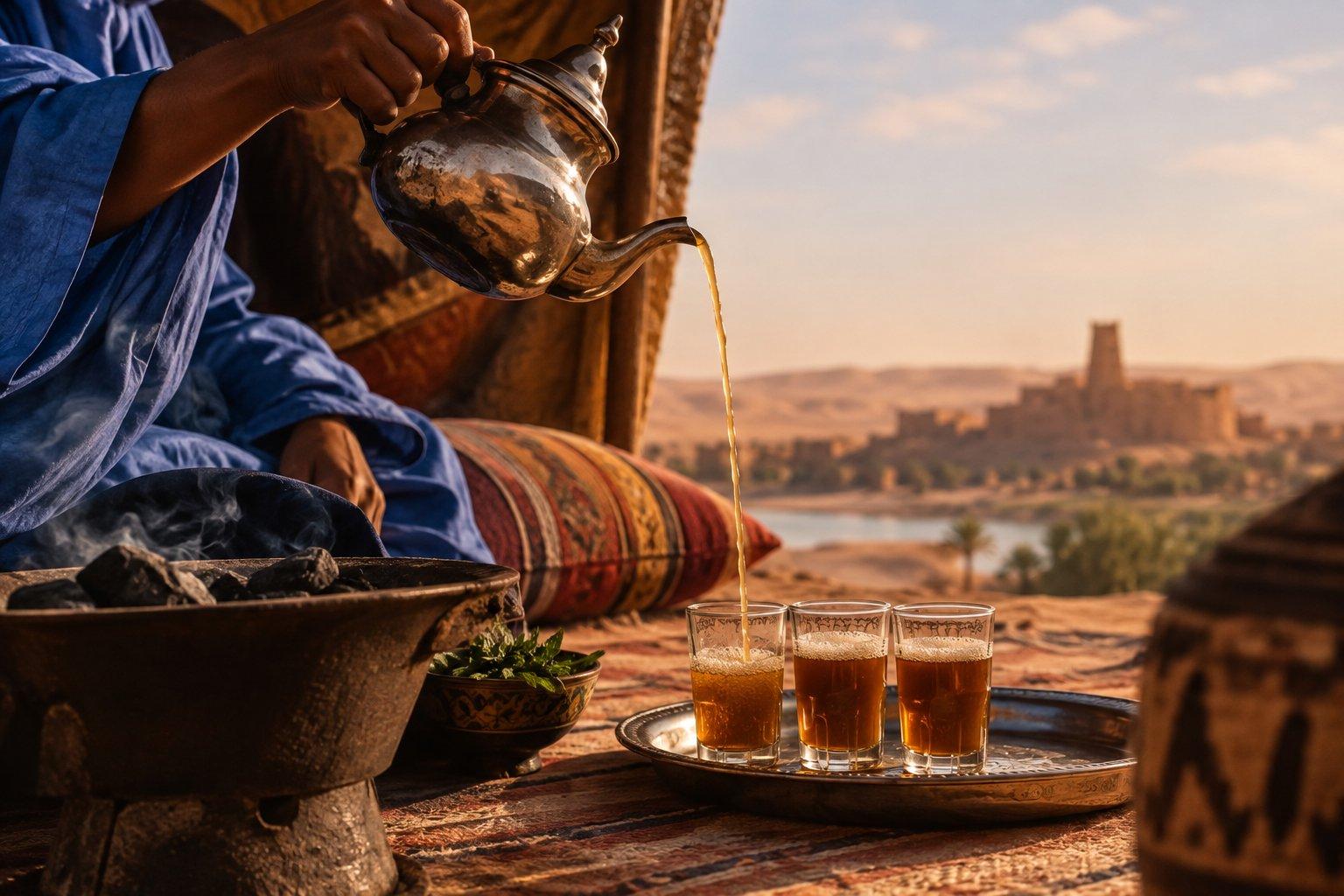
Tea has its own place in Libyan hospitality. Traditional Libyan tea is strongly brewed and served in small glasses, and the presentation can involve several rounds. Contemporary Libyan cultural sources describe the tea service, including its utensils and preparation, as an important expression of hospitality and social interaction.
Music, dance and art
Libyan music varies considerably by region.
Malouf, an Andalusian-influenced musical tradition, became an important part of urban musical life, particularly in western Libya. It belongs to a much wider North African musical tradition whose history is connected to the movement of Andalusian musical culture across the Maghreb.
In the south, Tuareg musical traditions bring a different sound and history. The imzad, a one-stringed bowed instrument, has a particularly important place in Tuareg culture and has traditionally been played predominantly by women. The tindé drum is another important instrument.
Libya also has its own traditions of women's wedding music. Zamzamat, sometimes written Zimzamat, is associated particularly with female musical performance at celebrations and weddings. Women sing, clap and perform verses connected to the occasion, creating a musical space that is distinct from many of the male musical traditions performed alongside it.
Visual culture extends from prehistoric rock art to contemporary craft. Amazigh communities have maintained distinctive geometric motifs in textiles, embroidery and jewellery, while older tattooing traditions are documented in ethnographic records. These designs should not be treated as one universal Amazigh symbolic language because meanings vary between communities.
The ancient rock art of Tadrart Acacus belongs to a much earlier period, of course, and cannot be straightforwardly described as “Amazigh art.” What it does show is that people living in what is now Libya were producing sophisticated visual representations thousands of years before the identities and political categories used today existed.
Traditional clothing varies considerably across Libya.
Amazigh women's clothing in the Nafusa Mountains and other communities has its own forms, colours, jewellery and embroidery. Tuareg men are traditionally associated with the tagelmust, the long veil wrapped around the head and face that is worn across several Tuareg societies of the Sahara.
Libyan craft traditions also include wool weaving, leatherwork, silk textiles, palm-fibre work, pottery, woodwork and gold and silver jewellery. Libya's Ministry of Tourism and Traditional Industries identifies areas including the Western Mountain, Misrata, Tripoli, Ghadames, Ghat, Murzuq and other oasis communities as important centres for different forms of traditional craft production.
Ghadames is particularly associated with leatherwork and palm-fibre crafts, while wool and textile production have historically been practiced across several cities and rural regions. Jewellery is another important part of ceremonial dress, particularly for weddings and other major occasions.
The former Jewish community also had distinctive clothing traditions. The kiswa kabira, an elaborate bridal ensemble, is among the most recognisable examples of Libyan Jewish material culture. Much of that tradition now survives through museum collections, historical photographs, community memory and the Libyan Jewish diaspora.
Festivals, ceremonies and rites of passage
For most Libyans, Ramadan and the two Eids remain central occasions of religious and family life. Ramadan brings fasting during daylight hours, evening meals and increased family and community gatherings, while Eid al-Fitr and Eid al-Adha are marked by prayer, visiting relatives, food and gifts.
Amazigh communities have also revived cultural celebrations that were suppressed or restricted under Gaddafi. Yennayer, the Amazigh New Year, is generally observed around 12–13 January depending on the calendar tradition being followed. In Libya, post-2011 Amazigh cultural activism has included public celebrations of language, dress, music and heritage alongside demands for stronger legal recognition.
Weddings are another important space where regional culture remains visible. Traditional Libyan weddings can extend over several days and may include henna ceremonies, different gatherings for women and men, elaborate bridal clothing, music, dancing and large family meals. The details vary significantly between Tripolitania, Cyrenaica, the south and Amazigh communities, so there is no single Libyan wedding format.
That regional variation is part of the point. Libya's cultural life has never fitted neatly into one national template.
The rock art is not only ancient history
The Tadrart Acacus deserves particular attention because its importance is not confined to the distant past.
UNESCO describes thousands of paintings and engravings spanning different artistic periods from around 12,000 BCE to the first century CE. The images record changes in fauna, vegetation and human ways of life as the Sahara became progressively drier. The site was inscribed on the UNESCO World Heritage List in 1985.
It is also currently a site at risk.
The Tadrart Acacus has been on UNESCO's List of World Heritage in Danger since 2016. In its 2026 decision, the World Heritage Committee retained it on that list and noted that Libya had not submitted a state-of-conservation report since February 2021. UNESCO has also previously documented vandalism and the looting of rock-art fragments.
That means the story is not only about something ancient surviving into the present. It is also about whether that surviving record can continue to survive.
What Libya's cultural story looks like today
The Amazigh cultural revival that followed the 2011 uprising has produced greater public use of Tamazight, cultural associations, festivals, educational initiatives and demands for constitutional recognition. But recognition remains incomplete and uneven. The language has gained space in community life and education while national political institutions remain divided.
The same wider political fragmentation affects cultural heritage. In 2026, the United Nations continues to describe Libya as divided between competing institutions and working through a prolonged political transition. Yet cultural life has not disappeared inside that political crisis.
Women continue to perform wedding music. Families continue to prepare traditional food. Craftspeople continue working with wool, leather, palm fibre, silk, silver and gold. Tuareg communities continue to maintain musical traditions associated with the imzad. Amazigh communities continue to teach and publicly celebrate their language and heritage.
And deep in the southwest, the paintings of Tadrart Acacus remain on the rocks.
They were made by people whose names we do not know, in landscapes that were once greener and wetter than the Sahara we see today. Later generations changed the landscape, changed languages, built cities, established kingdoms, followed religions, traded across the desert and along the Mediterranean, endured colonial rule, created a modern state and then watched that state fracture.
The paintings remained.
That is perhaps one of the most useful ways to understand Libya's cultural history. The country has been repeatedly reorganised by empires, governments, migrations and political movements, but the people living there have also carried things forward: languages, food, music, clothing, religious traditions, craft techniques and memories of places that existed long before the modern Libyan state.
Libya's story, then, was written more than once.
The oldest version was painted and carved into stone.
The newer versions survived in languages spoken at home, songs performed at weddings, jewellery worn for ceremonies, recipes prepared for family gatherings and cultural traditions that people continued practicing even when the state tried to decide which parts of their identity were allowed to be visible.