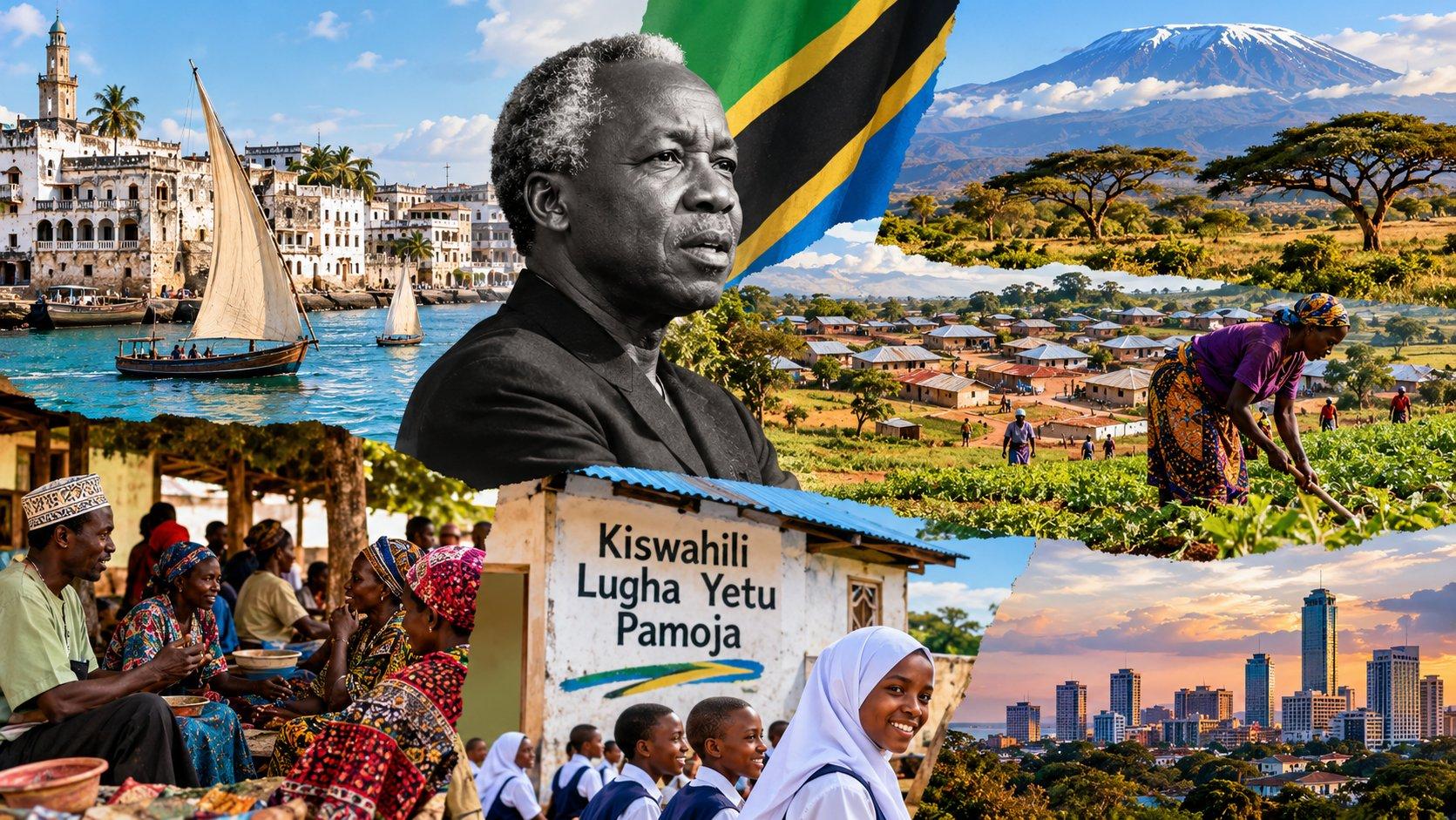
In 1967, Tanzania's ruling party, the Tanganyika African National Union, adopted the Arusha Declaration, setting out a programme of African socialism built around equality, self-reliance and public ownership. One of the ideas at its centre was ujamaa, a Swahili word that Nyerere used to mean "familyhood" or a society organized around mutual obligations. The word came from jamaa, meaning kin or family.
Nyerere's idea was not simply that Tanzania should reproduce the structure of an extended family on a national scale. Ujamaa was a political and economic philosophy. It drew on Nyerere's understanding of African social organization, but it was also shaped by socialism, anti-colonialism, ideas about economic equality and the belief that Tanzania should build its own development path rather than remain dependent on foreign capital and institutions. The Arusha Declaration committed the government to public ownership of major economic resources and to a development strategy centred on self-reliance.
The attempt to put those ideas into practice produced one of the most consequential experiments in postcolonial African history.
At first, ujamaa villages were largely voluntary. From 1967 to 1972, the government encouraged rural communities to move into villages where agricultural cooperation and shared services could be developed. But progress was slower than the government wanted. In 1973, the policy changed dramatically. Under what became known as Operation Vijiji, the government began moving rural populations into planned settlements on a compulsory basis.
The scale was enormous. By 1976, the government estimated that about nine million people, roughly 65 percent of the rural population, were living in villages created through the villagization programme.
The reasons behind the policy were not arbitrary. Concentrating scattered rural populations was supposed to make it easier for the state to provide schools, health facilities, roads, water and agricultural services. The government also wanted rural production to become more cooperative and less dependent on small, isolated farms.
But the implementation created serious problems. People were sometimes moved away from established farms and water sources, new settlements were not always adequately planned, and agricultural production was disrupted in some areas. The government eventually moved away from the more ambitious idea of fully collectivized agriculture. By the mid-1970s, much of the system had become villagization without the fully communal production that Nyerere's original vision had envisaged.
The economic problems of the period cannot be attributed to ujamaa alone. Tanzania also faced external economic shocks, limited capital, dependence on imported goods, drought and other structural constraints. But the agricultural policies of the period contributed to serious production problems, and the collectivist experiment was ultimately abandoned.
Yet there was another part of Nyerere's nation-building project whose consequences were very different.
Language.
Tanzania inherited a country containing more than 120 ethnic communities and a large number of languages. Rather than allowing one ethnic group's language to become the dominant symbol of the new state, the government promoted Kiswahili, a language already used widely across East Africa and especially along the Tanzanian coast, as the common language of national life. Tanzania's national identity became closely associated with Kiswahili.
That decision did not erase ethnic identities. Tanzanians continue to identify with communities that have their own languages, histories, foods, ceremonies and traditions.
What it did was give those different communities a shared public language.
That distinction is important. Tanzania's national cohesion was not produced by eliminating diversity. It was partly produced by creating institutions and a national language through which people with different backgrounds could participate in the same national life.
Before Tanzania: A country shaped by movement
The Tanzania of today was created in 1964. The histories of the mainland and Zanzibar are much older.
Along the East African coast, African societies developed extensive commercial links across the Indian Ocean. Traders, sailors and settlers connected the coast to Arabia, Persia, India and other parts of the Indian Ocean world. Over centuries, these interactions helped produce the Swahili civilisation, a coastal cultural world with African foundations and extensive connections to Asia and the Middle East.
Stone Town in Zanzibar is one of the clearest surviving examples.
UNESCO describes it as a Swahili trading town whose architecture combines African, Arab, Indian and European influences developed through more than a millennium of interaction. Its buildings include Swahili courtyard houses, Indian commercial buildings, Omani-influenced structures, mosques, churches and other monuments connected to the island's trading history.
Zanzibar became particularly important during the nineteenth century.
Under the Omani sultanate, the island developed a powerful commercial economy based partly on cloves, ivory and the slave trade. Enslaved Africans were brought through Zanzibar and other East African ports, while many were also used as labour on the islands' plantations. UNESCO identifies Zanzibar as one of the major slave-trading ports of East Africa and emphasizes the site's importance to the history of the suppression of the slave trade.
The clove economy was particularly important. By the middle of the nineteenth century, thousands of enslaved people were being brought into Zanzibar each year, with a substantial proportion absorbed into the island's clove plantations. The plantation economy helped make Zanzibar wealthy while also tying that wealth directly to systems of enslavement.
That history remains physically visible in Stone Town. Christ Church Anglican Cathedral was built on the site of the former slave market, and UNESCO includes it among the monuments that give the city its historical significance.
The mainland followed a different colonial path.
The territory known as Tanganyika came under German rule in the late nineteenth century and became part of German East Africa. After Germany's defeat in the First World War, Tanganyika was transferred to British administration under a League of Nations mandate.
Kiswahili already had an important role before independence. German colonial authorities had promoted its use in administration, so Nyerere's government did not invent Kiswahili as a national language from nothing. What changed after independence was its political purpose and reach. The Tanzanian state deliberately expanded its use in education, government and national communication as part of the construction of a common national identity.
Tanganyika became independent in December 1961, with Julius Nyerere as its first prime minister and later president.
Zanzibar became independent in December 1963.
On 12 January 1964, the Zanzibar Revolution overthrew the sultanate government. The revolution involved deep political, racial, ethnic and class tensions, and serious violence followed. It cannot accurately be reduced to a simple conflict between Arabs and Africans, although the historical association between Arab political dominance, land ownership and the slave-owning past was an important part of the political environment.
Three months later, on 26 April 1964, Tanganyika and Zanzibar formed the United Republic of Tanganyika and Zanzibar, later renamed the United Republic of Tanzania.
Zanzibar retained a considerable degree of internal autonomy, including its own government and legislature. That arrangement remains one of the unusual features of the Tanzanian state: the union government handles matters such as defence, foreign affairs and monetary policy, while Zanzibar has authority over many matters internal to the islands.
Why Kiswahili became so important
Tanzania's language policy makes more sense when you look at the country's demographic structure.
There is no single ethnic group that represents anything close to the entire population. The Sukuma are generally identified as the largest ethnic community. Other large groups include the Haya, Nyakyusa, Nyamwezi and Chagga, alongside many smaller communities. Older United States government demographic descriptions identify more than 120 ethnic groups in the country.
The linguistic diversity is equally significant.
Most Tanzanian languages belong to the Bantu branch of the Niger-Congo language family. But Tanzania also contains Nilotic-speaking communities such as the Maasai, Cushitic-speaking communities such as the Iraqw, and smaller populations whose languages belong to different or disputed classifications.
Northern Tanzania's Rift Valley is particularly interesting because languages from several unrelated language families have existed in close proximity for centuries. Linguists use the region to study language contact, borrowing and how neighbouring languages influence one another.
Then there is Kiswahili.
Kiswahili provided something that none of the individual ethnic languages could provide on a national scale: a language that people from different communities could use with one another.
This mattered politically.
If the government had chosen one major ethnic language as the dominant national language, that decision could have attached national identity more closely to one community. Kiswahili avoided that problem because it was already widely used across ethnic boundaries and did not belong exclusively to the largest mainland ethnic group.
English remained important, particularly in higher education, international business and some formal institutional contexts. But describing English as a straightforward co-official language alongside Kiswahili oversimplifies Tanzania's language arrangements. Kiswahili occupies the central national role, while English continues to have important practical uses.
A person whose first language is Sukuma can speak Kiswahili with someone whose first language is Chagga. A Maasai speaker can use it with a Nyamwezi speaker. A resident of Zanzibar can communicate with someone from the mainland through the same national language.
The language did not make these people culturally identical.
It gave them a common linguistic space.
More than 120 communities, but no single cultural template
The phrase "more than 120 ethnic groups" can sound abstract until you look at what that diversity actually contains.
The Sukuma are concentrated around the southern and southeastern shores of Lake Victoria and are the largest ethnic community in Tanzania.
The Chagga are associated particularly with the slopes of Mount Kilimanjaro, where intensive agriculture has long been important.
The Maasai occupy areas of northern Tanzania as well as southern Kenya and are known for pastoralism and an age-set system in which people pass through socially defined stages of life.
The Datoga, another northern Tanzanian community, have traditionally combined livestock keeping with farming and are also known for metalworking.
Then there are the Hadzabe, whose society and language are particularly important to anthropologists and linguists.
The point is not that all these communities live completely separate lives. They have interacted with one another for generations through trade, migration, marriage, conflict and political change.
Tanzania's diversity is therefore not a collection of sealed cultural boxes.
It is a history of neighbouring societies influencing one another while retaining distinct identities.
The Hadzabe and the limits of the "living window" story
The Hadzabe are one of the most frequently misunderstood communities in discussions of Tanzania.
They live mainly in the Lake Eyasi region of northern Tanzania, and some communities continue to rely substantially on hunting and gathering. Their language, Hadzane, contains click consonants and is generally treated by linguists as a language isolate. That means researchers have not demonstrated a genealogical relationship between Hadzane and another established language family.
The clicks are sometimes used to connect Hadzane with the languages of southern Africa that were once grouped under the label "Khoisan." Modern linguistic scholarship does not support treating Hadzane as a member of a demonstrated Khoisan language family. Its classification remains distinct.
The Hadzabe have also attracted genetic research because their population history differs in important ways from that of many neighbouring groups. But this does not mean that the Hadzabe are an untouched remnant of prehistoric humanity or that they can be treated as a living reconstruction of what early humans were like.
They are contemporary Tanzanians.
Their society has changed over time, and their communities have had to respond to changing land use, farming, conservation policies, tourism and government decisions.
That contemporary reality is important because the question facing Hadzabe communities is not whether they belong to the modern world. They do.
The question is how they can maintain control over their land, livelihoods and cultural practices while that world changes around them.
Religion: Christian, Muslim and much more varied than a 50/50 split
Tanzania's religious landscape is diverse, but the commonly repeated description of the country as roughly half Christian and half Muslim is not supported by the latest major cross-country estimates.
Pew Research Center's 2020 estimates place Tanzania at approximately 63 percent Christian and 34 percent Muslim, with smaller proportions belonging to other religions or categories. Pew notes that these are estimates derived from censuses and surveys and that religious affiliation cannot be measured with complete precision in every country.
Religion is not distributed evenly across the country.
Islam has particularly deep roots along the coast and in Zanzibar, where it is the dominant religion. Christianity is more prevalent across much of mainland Tanzania.
That distribution reflects history.
Islam reached the East African coast centuries ago through the Indian Ocean trading world and became deeply established in coastal societies. Christianity expanded much later through nineteenth- and twentieth-century missionary activity and colonial-era institutions.
But formal religious affiliation does not describe every aspect of religious practice.
Traditional healing remains important in parts of Tanzania, and people may use biomedical services, traditional healers and religious forms of healing at different times or even alongside one another.
Traditional practices also vary enormously between communities. There is no single Tanzanian "traditional religion" that exists underneath Christianity and Islam.
Some communities maintain distinct beliefs and ceremonies. Others have incorporated particular traditional practices into Christian or Muslim social life. Some practices have declined.
The important point is that Tanzanian religious life cannot be understood through a strict either-or division between Christianity and Islam.
Food tells the same story
Food provides another way to see how Tanzania's different histories meet without becoming identical.
On much of the mainland, ugali, a stiff maize-based porridge, is a staple food. It is usually eaten with vegetables, beans, meat, fish or another accompanying dish.
Along the coast and in Zanzibar, rice has a particularly important place. Pilau and biryani reflect the long history of interaction across the Indian Ocean, while coconut, cardamom, cloves and other spices are deeply associated with coastal cooking.
Zanzibari cuisine also includes foods such as fish cooked with coconut, spiced potatoes, mandazi and vitumbua.
The influence works in both directions. These dishes are not merely foreign recipes imported into Africa. They developed through centuries of interaction involving African coastal communities and traders and settlers from other parts of the Indian Ocean.
Zanzibar's cloves are an especially clear example of the connection between food and history.
The nineteenth-century clove economy generated considerable wealth but depended heavily on enslaved labour. The same agricultural product that became part of Zanzibar's commercial identity was therefore also tied to the island's system of plantation slavery.
Today, spice farms remain part of Zanzibar's agricultural and tourism economy.
A visitor can encounter the same plants that once occupied a much larger place in the island's nineteenth-century export economy, but in a very different economic and political system.
Music changed as Tanzania changed
Tanzania's music shows how older traditions can survive while new ones develop around them.
Taarab is one of the best-known musical traditions of the Swahili coast. It is particularly associated with Zanzibar and has long been performed at weddings and other extended celebrations. UNESCO describes taarab as a traditional form of Swahili cultural expression and has supported projects designed to preserve its transmission to younger musicians.
The genre itself reflects the history of the coast. Its development involved African musical traditions alongside influences from the wider Indian Ocean world.
Siti binti Saad became one of the most important early recording artists associated with taarab. Her recordings helped bring Swahili-language music to audiences beyond Zanzibar.
Bi Kidude later became another internationally known Zanzibari performer, remaining active into old age.
But Tanzania's musical identity did not stop with taarab.
From the 1990s, musicians in Dar es Salaam developed Bongo Flava, a broad popular genre influenced by hip-hop, R&B, reggae, dancehall and Tanzanian musical traditions. Its growth coincided with major changes in Tanzania's media environment, including the expansion of private radio and television.
Kiswahili became one of the genre's defining features.
Artists could borrow musical styles from the United States, Jamaica and elsewhere while writing about Tanzanian relationships, politics, money, neighbourhoods and everyday life in a language their local audiences understood.
That is one reason Bongo Flava became such an important part of contemporary Tanzanian popular culture.
The country was no longer choosing between "traditional" and "foreign" music.
Musicians were combining influences and producing something new.
Makonde sculpture and Tingatinga painting
Tanzania's visual arts offer two very different examples of how cultural traditions develop.
The Makonde, a people living in southeastern Tanzania and northern Mozambique, have a long history of wood carving. Makonde sculpture includes figures, masks and other carved forms, and twentieth-century works became increasingly visible in international museums and art markets. The Metropolitan Museum of Art, for example, holds Makonde works in its collection.
Some twentieth-century Makonde sculpture became associated with forms known as ujamaa, in which multiple human figures are interconnected. The word's association with Nyerere's political philosophy has encouraged later interpretations connecting these sculptures to the idea of collective life.
But it is safer to treat that connection as an interpretation rather than claiming that the entire Makonde tradition was created to illustrate Nyerere's political programme.
Makonde artistic traditions are older and broader than ujamaa politics.
Tanzania's other famous visual tradition is much younger.
Tingatinga painting developed in Dar es Salaam in the 1960s through Edward Saidi Tingatinga. The style became known for brightly coloured, highly stylized representations of animals and other subjects and subsequently developed an international market.
The contrast is striking.
Makonde carving connects contemporary Tanzania with older artistic traditions.
Tingatinga emerged in the post-independence city of Dar es Salaam.
Both became associated internationally with Tanzania.
Cloth that can speak
The kanga is another example of how culture can carry information without requiring a formal document.
Kangas are printed rectangular cloths widely worn in East Africa. Many contain a proverb, saying or short message printed along the border.
The message can communicate affection, advice, humour, warning or social commentary. Because the wording is visible to other speakers of the language, the cloth can communicate something without the wearer having to say it aloud.
The meaning is not always secret.
It is better understood as a form of public, culturally legible messaging.
UNESCO has recently supported a project specifically titled "Khanga: a symbol of Tanzanian identity and cultural heritage," reflecting continued efforts to document and safeguard the textile tradition.
That contemporary recognition matters because traditions such as the kanga are not museum pieces.
People still wear them.
They still produce new designs.
And the messages printed on them can respond to the concerns of the present.
Festivals that preserve older histories
Zanzibar's Mwaka Kogwa is celebrated particularly in Makunduchi and is associated with the Shirazi New Year. The festivities include ritualized mock fighting using banana stalks, communal celebration and the burning of a small hut.
The festival is often connected to Persian cultural influence in Zanzibar.
But its exact historical origins are difficult to reduce to one source. Zanzibar's society developed through centuries of interaction among African, Persian, Arab, Indian and Islamic traditions, so claims that Mwaka Kogwa is a direct survival of a purely pre-Islamic Persian ritual should be treated cautiously.
The same principle applies to many other Tanzanian ceremonies.
Maasai age-set systems organize aspects of social life around groups of people who pass through recognized stages of life.
Among the Makonde, Mapiko is connected to initiation and the transition from childhood to adulthood. UNESCO describes it as a performance involving masks, music and dance that forms part of the Makonde initiation tradition and transmits knowledge about community life and values.
These practices show why it is difficult to describe Tanzanian culture as one thing.
The national identity may be shared.
The cultural traditions within it are not interchangeable.
Tanzania's national identity was constructed, not inherited whole
This is where the story of ujamaa comes back into focus.
When Tanganyika became independent, Nyerere inherited a territory whose communities had different histories, languages and social structures. There was no ancient Tanzanian national culture that had existed unchanged across the territory.
The modern nation had to be built.
Nyerere's government used several tools to do that.
Kiswahili created a common language.
The education system expanded national communication.
Political institutions emphasized national rather than ethnic identification.
The government discouraged the overt use of ethnic identity as the organizing principle of national politics.
Ujamaa supplied another part of the vocabulary. It presented society as a community in which people had responsibilities toward one another.
The economic programme built around that philosophy ultimately encountered serious problems. Compulsory villagization disrupted many people's lives, agricultural collectivization did not deliver the results expected, and the state eventually retreated from the more ambitious economic model.
But the language of familyhood did not disappear with the agricultural policy.
Nor did Kiswahili.
This distinction is important because Tanzania's post-independence history contains two different outcomes from the same nation-building period.
One set of policies attempted to reorganize how people produced food and organized rural economies.
Another set attempted to create a common national identity.
The first produced substantial failures.
The second left institutions and habits that continued long after Nyerere left office.
What Tanzania looks like now
The Tanzania of today is not Nyerere's Tanzania.
The country has a much larger urban population, a more diversified economy, a large private sector, a different media environment and a younger population that grew up with technologies and cultural influences Nyerere could not have anticipated.
Yet several of the structures created or strengthened after independence remain visible.
Kiswahili remains the national language and the principal shared language across Tanzania's many communities. Tanzania remains home to more than 120 ethnic groups. Religious life remains divided primarily between Christianity and Islam, with smaller religious traditions also present. Zanzibar retains its separate political institutions within the union.
And the country's cultural institutions are still actively working to preserve living traditions.
UNESCO's current Tanzania programme includes projects covering traditional Swahili music, kanga, community-based documentation of intangible heritage and other cultural practices. In 2026, UNESCO approved additional assistance for Tanzania to strengthen national and local capacity to document and safeguard living heritage.
That is significant because culture in Tanzania is not frozen in the past.
A taarab performance in Zanzibar belongs to the present.
A kanga printed with a new message belongs to the present.
A young musician producing Kiswahili lyrics over a global beat belongs to the present.
A Makonde artist producing new work belongs to the present.
The traditions continue because people continue to use, modify and transmit them.
What ujamaa left behind
Ujamaa did not transform Tanzania into the socialist agricultural society Nyerere envisioned.
The compulsory villagization programme caused serious disruption, and the economic model built around state control and collective rural production was eventually abandoned. Scholars continue to debate the precise weight that ujamaa, external economic shocks, agricultural policy, drought and other factors carried in Tanzania's economic difficulties.
But the failure of one policy does not erase everything that happened during the same period.
Tanzania's national identity was deliberately cultivated through language, education, political institutions and public culture. Kiswahili became the shared language of a country whose population remained ethnically and linguistically diverse.
That does not mean Tanzania has been free of political tension, religious tensions, regional differences or disputes over the union between the mainland and Zanzibar.
It means those differences have existed within a national framework that has proved unusually durable.
And that brings the story back to the word with which it began.
Ujamaa means familyhood.
It was never the whole explanation for Tanzania.
It was an economic philosophy, a political ideal and a piece of the language through which the country's first generation of leaders tried to answer a difficult question: how do you build a nation from a territory containing many communities that did not previously share one national identity?
Tanzania's answer involved more than one policy.
It involved a shared language.
A common education system.
National political institutions.
A deliberate discouragement of ethnic competition in public life.
And a political vocabulary that asked citizens to think of themselves as members of a wider community.
The result is not a country without difference.
It is a country in which difference has, for much of its history since independence, existed alongside a strong sense of belonging to the same national state.
That is a more complicated story than saying one word held Tanzania together.
It is also a more interesting one.
Because Tanzania did not become one culture.
It became a country in which many cultures could remain distinct while sharing a national language, a political identity and a common name: Tanzania.