Discover the history of Moutya, Seychelles’ traditional dance shaped by slavery, colonial restrictions, community life and generations of cultural transmission.
Picture a night in Seychelles before the islands became the holiday destination most people know today.
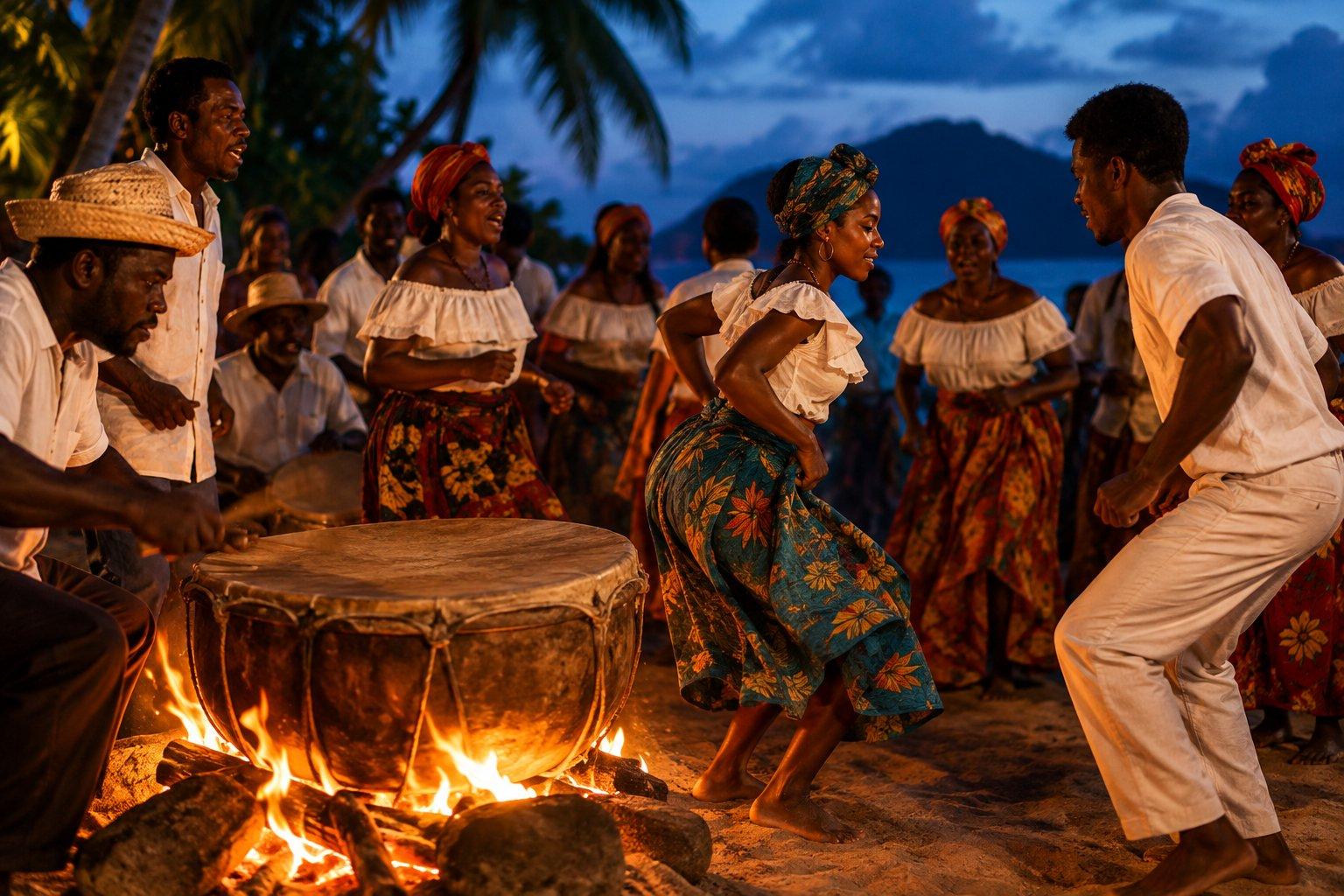
There is a fire outside. Around it, people gather. A large drum covered with goat skin is placed over the fire for a while because heating the skin makes it tighter and changes the sound it produces. When the drum is ready, the drummers begin. Men call out lines about things happening in everyday life, and women answer in high voices. People start dancing, moving their hips and shuffling their feet. The dancers come close to one another, but traditionally do not touch.
This is moutya, one of the traditional music and dance forms of Seychelles.
Its history begins with slavery.
Moutya was brought to Seychelles by Africans who were enslaved and taken to the islands during the colonial period. UNESCO describes it as a form of expression that gave people comfort during hardship and poverty and allowed them to express resistance to servitude and social injustice. In 2021, UNESCO added moutya to its Representative List of the Intangible Cultural Heritage of Humanity.
But there’s another aspect of this story we're more interested in, maybe because oftentimes, when it’s being told, it does not give the full picture. You will sometimes see the story described as though the British simply banned moutya. The surviving law gives more details.
In 1935, the colonial government introduced the Drums Regulations. They did not say that moutya itself was illegal. Instead, they prohibited people from beating drums or tambours, or blowing shells, after 9 p.m. in certain parts of the islands.
Those areas included Victoria and its surrounding area on Mahé, areas around police stations at Anse Royale on Mahé and Baie Ste. Anne on Praslin, part of Grand'Anse on Praslin, and part of La Passe on La Digue.
The difference might seem insignificant, until you understand how moutya was traditionally performed. Moutya was a night-time gathering. The drum was central to it. So a law restricting nighttime drumming also made it much harder to hold the kind of gathering in which traditional moutya took place.
The Drums Regulations were eventually repealed in 2018. UNESCO lists that repeal as one of the measures taken to help protect and revive moutya.
So the story is not “Britain banned moutya.”
The documented story is that colonial authorities placed restrictions on nighttime drumming, while the dance itself survived and continued to be passed from one generation to another.
To understand why that matters, you first need to understand how Seychelles became the country it is.
Seychelles did not begin with an indigenous population
In this section
The Seychelles National Museum records a Portuguese map from 1502 and a recorded English landing in 1609.
Seychelles is an island country in the western Indian Ocean, northeast of Madagascar. It has 115 islands, although most people live on three main islands: Mahé, Praslin and La Digue. There was no known permanent indigenous population living in Seychelles before the first permanent settlement.
European sailors had encountered the islands much earlier. The Seychelles National Museum records a Portuguese map from 1502 and a recorded English landing in 1609. France later claimed the islands in the eighteenth century, and the first permanent French settlement was established on Ste Anne Island on 27 August 1770.
That 1770 date is important.
It means that the population that eventually became Seychellois was built through settlement and migration. Africans, Europeans, Indians, Malagasy people and, later, Chinese migrants became part of the society at different points in its history.
And slavery was part of that beginning.
The first settlers who arrived in 1770 included enslaved Africans. The Seychelles National Museum records that the first settlement had 28 people: 15 white men, seven enslaved Africans, five Indians and one African woman.
That is a very small group.
But the population grew, and the number of enslaved people grew dramatically with it.
By 1835, when slavery was abolished in the British colonies, Seychelles had about 7,500 inhabitants. According to the Seychelles National Museum, 6,521 enslaved people were emancipated that year. Its records show that the population included people of African, Mozambican, Malagasy and Indian backgrounds.
So when we talk about Seychellois culture today, we are talking about a society whose foundations were laid by people from several parts of the world, including large numbers of Africans who had been brought to the islands through slavery. That is where the story of moutya begins to make sense.
How slavery changed Seychelles
In this section
In Seychelles, Creole describes a culture and society that developed from different populations living together over generations.
The French began settling Seychelles permanently in 1770. They wanted to develop the islands, and plantation agriculture became an important part of the colony. But plantations needed workers, so enslaved Africans were brought to Seychelles and forced to work.
People from Madagascar were also brought to the islands through the slave trade. Seychelles was part of the wider slave-trading and plantation system of the western Indian Ocean, which connected it with places such as Mauritius and Réunion.
This changed the population of Seychelles.
People who had been brought from Africa and Madagascar came from different communities and carried their own languages, food traditions, songs, stories, beliefs and knowledge with them. Once they were living in Seychelles, however, they were also living alongside people from other backgrounds in a completely different environment.
Over time, those cultures began to influence one another.
People learned ways of speaking from one another. They cooked with ingredients that were available on the islands. They shared songs and stories. Children grew up with influences from more than one cultural background. New customs developed alongside older ones.
This is how Seychelles became a Creole society.
In Seychelles, Creole describes a culture and society that developed from different populations living together over generations. It is not the name of one race.
You can see this most clearly in the language. Seychellois Creole, also called Kreol or Seselwa, developed mainly from French but was also shaped by African, Malagasy and other linguistic influences. Today, Seychellois Creole, English and French are the country's three official languages.
The same mixing can be seen in Seychellois food and music. African, European, Malagasy, Indian and Chinese influences all became part of life in the islands, although they did not all arrive at the same time or under the same circumstances.
Moutya belongs to this history.
It developed among communities whose lives had been deeply shaped by slavery and colonial rule. People used music, dance and song as part of life in their communities, including as a way of expressing what they were experiencing.
So before we get to the story of colonial restrictions on moutya, we need to understand the society in which the dance took shape.
That society was created through migration, slavery, cultural exchange and generations of life in Seychelles.
British rule did not end slavery immediately
In this section
Plantations still existed, and the economy had been built around the labour of enslaved people for decades.
Seychelles was first a French colony, but Britain took control of the islands in 1811 during the Napoleonic Wars. British control was formally established under the Treaty of Paris in 1814, and Seychelles remained under British administration until independence. In 1903, it became a separate British Crown Colony.
But the change from French to British rule did not end slavery.
Slavery continued under British rule until 1835, when emancipation took effect in the British colonies. In Seychelles, more than 6,500 enslaved people were freed.
That changed their legal status, but it did not suddenly change the society they were living in.
Plantations still existed, and the economy had been built around the labour of enslaved people for decades. Formerly enslaved people therefore entered freedom without leaving that system behind overnight. They still had to find work, earn a living and raise their families within a society shaped by plantation agriculture and the inequalities created during slavery.
But there was something else that slavery could not erase.
The people who had been enslaved remained in Seychelles. They built families and communities, and they continued passing things on to their children: ways of speaking, cooking, making music, dancing, telling stories and celebrating.
Over time, those traditions became part of the culture of Seychelles.
Moutya was one of them.
Its history therefore did not end when slavery ended. The people who had carried the tradition into Seychelles continued to live there, and the dance was passed from one generation to the next.
What happens during a moutya performance
In this section
Men may call out lines about things happening in everyday life, while women respond by singing in higher voices.
The gathering usually begins around a fire. The drum used for moutya is made with goat hide, and the skin is heated over the fire before the drumming starts. Heating the hide tightens it and changes the sound of the drum.
Once the drums are ready, the drummers begin to play.
The singing follows. Men may call out lines about things happening in everyday life, while women respond by singing in higher voices. The subjects can be ordinary and familiar: people in the community, relationships, behaviour, problems, news or something that has happened recently.
This is what UNESCO means when it describes moutya songs as social commentary. People were using songs to talk about the world around them.
That did not mean every moutya song was a political protest. The songs could also be humorous, personal or concerned with everyday situations. What mattered was that the performance gave people a way to say things, share observations and respond to what was happening in their community.
As the singing and drumming continue, people dance.
The traditional movements include swaying the hips and shuffling the feet. Men and women may move towards each other, but traditionally they do not touch. UNESCO describes the movements as sensual, although the dance itself uses a relatively small number of repeated movements.
So a moutya gathering was more than people performing a dance for an audience.
People came together around the fire. Someone played the drums. People sang, responded to one another, danced and talked. The gathering created a space where people could spend time together and express things about their lives.
Historically, these gatherings often took place at night, sometimes away from the plantation houses.
Knowing this becomes important when we look at what colonial authorities later tried to control.
Why moutya was performed at night
In this section
Colonial documents were usually written by administrators, plantation owners and other authorities.
Moutya was traditionally performed at night, often in forests away from the plantation houses where enslavers lived. UNESCO describes these gatherings as places where enslaved Africans could find comfort and express their feelings about slavery and the conditions they were living under.
The setting makes sense when you think about their daily lives.
They were enslaved. They worked on plantations they did not own, under a system they had no power to change. Their movements and working conditions were controlled by other people.
But at night, they could gather with other members of their community.
They could light a fire, heat the goat-hide drum, sing, dance and talk. They could spend time with people who understood the life they were living.
The songs gave them another way to speak.
A song could be about a person in the community, a relationship, someone's behaviour, a problem or something that had happened. It could carry a complaint, a joke, an observation or a story about everyday life.
UNESCO's earlier documentation of moutya points out that these songs could preserve people's experiences in a way that colonial records did not.
That is important because the people who were enslaved were rarely the ones writing the official records.
Colonial documents were usually written by administrators, plantation owners and other authorities. They recorded laws, labour, property, punishments, disputes and other matters that the colonial system considered important.
A song could tell you something else.
It could tell you what people were laughing about, what was annoying them, who was being talked about, what was happening in their community or how they felt about the lives they were living.
Not every song was recording a major event. Most people were also just living their lives.
But those ordinary details are part of history too.
That is why the songs passed down through moutya give us another way to understand what life was like for the people who lived through slavery in Seychelles.
What Britain actually restricted
In this section
Traditional moutya depended on drums, and the gatherings had historically taken place at night.
This is where the story about Britain and moutya needs to be told carefully. In 1935, the colonial government introduced the Drums Regulations, which restricted nighttime drumming in certain parts of Seychelles. Under the regulations, people could not beat drums or tambours, or blow shells, after 9 p.m. in the areas covered by the law. The restriction was not applied everywhere in the islands.
In Victoria, it covered the town and an area extending one mile beyond it. There were also restricted areas around the police stations at Anse Royale on Mahé and Baie Ste. Anne on Praslin, as well as specified parts of Grand'Anse on Praslin and La Passe on La Digue.
However, the regulations did not say that moutya itself was illegal. They restricted particular forms of nighttime drumming and shell blowing in specified areas after 9 p.m.
But that still affected moutya.
Traditional moutya depended on drums, and the gatherings had historically taken place at night. If you lived in one of the areas covered by the regulations, you could no longer hold a late-night drumming gathering there in the same way.
The regulations stayed in force for decades. They were eventually repealed in 2018, and UNESCO later identified that repeal as one of the measures taken to safeguard moutya.
There is another part of the story that comes from Seychelles' own cultural record. Official tourism material describes colonial attitudes towards moutya as hostile to the dance and says it was viewed as sexually improper. It also describes moutya as having been banned.
That account helps explain how the restriction has been remembered in Seychelles. But the surviving 1935 legislation gives us a more precise picture of what was actually written into law.
The law restricted nighttime drumming, tambour playing and shell blowing in particular areas after 9 p.m.
It did not contain a blanket ban on moutya itself.
How moutya survived
In this section
Older people could teach younger people the songs, the dancing and the drumming simply by doing them together.
Slavery ended. Colonial governments changed. The economy changed. The population changed.
But moutya stayed because people kept doing it.
The dance was part of community life, so it did not depend on a plantation, a government office or a formal institution to survive. People could carry it into their homes, family gatherings and community celebrations. Older people could teach younger people the songs, the dancing and the drumming simply by doing them together.
The restrictions placed on nighttime drumming did not erase the knowledge people already had.
People still knew the songs. They still knew the movements. They still knew how the drums were made and how to prepare the goat hide before playing. As long as people continued to practise those things and teach them to others, the tradition could continue.
UNESCO says moutya has traditionally been passed down through performance, observation and imitation. In other words, people learned it by taking part and watching other people do it.
A child might watch an older relative dance and copy the movements.
Someone might learn how to make the drum.
Someone else might learn how to heat the goat hide so that it produces the right sound.
A song might be taught by an older family member.
A story about an old performance might be told again years later.
Then the younger generation would carry those things forward.
Moutya also changed as Seychelles changed. It was no longer being performed only in the circumstances in which enslaved people had first practised it. People found new places and occasions to perform it, and the tradition gradually became part of a wider Seychellois cultural identity.
That helped it survive beyond the period that created it.
And survival did not mean that moutya remained frozen in its original form. The way people performed it could change, the places where they performed it could change, and the subjects of the songs could change.
What remained was the knowledge passed from one generation to the next: the drumming, the singing, the movements and the practice of gathering together around the dance.
That is how moutya survived.
Moutya was part of a larger culture
In this section
Seychelles is an island country in the Indian Ocean, so fish and other seafood have long been important.
Moutya did not survive on its own. It became part of a wider Seychellois culture that had been developing for generations.
People from Africa, Madagascar, Europe, India and China all became part of the population at different points in Seychelles' history. They did not all arrive in the same way or under the same circumstances, but their presence can still be seen in everyday life.
You can see it in the food.
Seychelles is an island country in the Indian Ocean, so fish and other seafood have long been important. Coconut, rice, spices, fruit and vegetables are also common in Seychellois cooking.
Take kari zourit, an octopus curry usually cooked with spices and coconut. There is satini reken, made with shark, and ladob, which can be made with ingredients such as banana or sweet potato and cooked with coconut and sugar.
Seychelles' official tourism material describes Creole cuisine as having French, African, Indian, Malagasy and Chinese influences. Those influences did not all enter the islands at the same time. They became part of the food people ate as different communities became part of Seychellois society.
You can hear those different influences in the music too.
Moutya has strong African roots and developed within the history of slavery in Seychelles. Sega is another important music and dance tradition in Seychelles and across parts of the Indian Ocean. There are also dances influenced by Europe, including forms of kontredans, which developed during the period of French and British colonial rule.
Over generations, these different traditions became part of everyday life in the islands.
Some were kept much as they had been. Others changed as people learned from one another or adapted to life in Seychelles. New forms also developed from those encounters.
That is what people mean when they describe Seychelles as a Creole society.
It describes a society shaped over generations by people from different places, bringing their own traditions with them and then creating new ways of living together in the islands.
You can see the history of Seychelles in its older houses too.
Traditional Creole houses often had steep roofs, verandas and openings that allowed air to move through the building. Those features suited Seychelles' hot and humid climate.
The houses also carried European influences, but people adapted those ideas to the conditions they found in the islands. They were building for a tropical climate, not for the places where some of the architectural ideas had originally come from.
There were practical choices as well.
Some older Seychellois homes had a separate building for cooking instead of putting the kitchen inside the main house. Tourism Seychelles gives two reasons for this: cooking produced smoke and strong smells, and an open fire close to the main house could be dangerous.
So even something as ordinary as a house shows how life in Seychelles developed.
People brought ideas from different places, then changed them to suit the climate, the materials available and the way they lived on the islands.
Christianity and older traditions
Christianity became the dominant religion in Seychelles during the colonial period, with Roman Catholicism becoming particularly influential. Catholic churches remain an important part of life in the islands, alongside Anglican, Hindu, Muslim, Seventh-day Adventist, Bahá'í and other religious communities.
But becoming Christian did not mean that people stopped doing everything they had learned from earlier generations.
People continued to cook with knowledge passed down through their families. They continued to tell stories, use traditional knowledge about plants and keep other customs that had become part of everyday life.
That does not mean there was one hidden African religion continuing underneath Christianity. The history is more complicated than that.
A person could go to church and still cook a family recipe they had learned from their grandparents.
They could be Christian and still know stories that had been passed down through their family.
A family could adopt Christianity while keeping some of the food, music, knowledge and customs it had inherited.
That is another part of the history of Seychelles: new beliefs and institutions became part of life, while older knowledge and customs continued to be passed from one generation to another.
The coco de mer
In this section
The sale and handling of mature nuts are regulated, and anyone dealing in them needs the appropriate licence.
Seychelles also has a plant that grows naturally nowhere else in the world: the coco de mer palm.
It grows naturally on the islands of Praslin and Curieuse. Its seed is enormous and has a distinctive shape, which made it an object of fascination long before people understood where it came from.
Before Europeans knew that the seeds came from a palm growing on the Seychelles islands, some of them were found floating in the Indian Ocean. People therefore imagined that they came from a mysterious tree growing beneath the sea. That is where the name coco de mer, meaning “sea coconut,” comes from.
Today, the coco de mer is one of the best-known natural symbols of Seychelles.
But it is also protected.
Mature coco de mer nuts cannot simply be collected and sold as souvenirs. The sale and handling of mature nuts are regulated, and anyone dealing in them needs the appropriate licence. Mature nuts must also carry approved labels.
So if you see a coco de mer for sale, there are rules governing where it came from and how it can legally be sold. The protection is important because the palm is native to only a small part of Seychelles and the seed takes a long time to develop.
From colony to independent Seychelles
In this section
The plantation economy had changed, and tourism and fisheries eventually became major parts of the economy.
Seychelles became independent from Britain on 29 June 1976, with James Mancham becoming the country's first president.
The following year, in June 1977, supporters of France-Albert René overthrew Mancham in a coup. René later established a one-party political system. In 1991, Seychelles began the process of returning to multiparty politics, and a new constitution was approved in 1993.
All of that happened within a few decades.
The islands had already gone through enormous changes before independence. They had moved from French colonial rule to British rule. Slavery had been abolished in 1835. The plantation economy had changed, and tourism and fisheries eventually became major parts of the economy.
Then Seychelles became an independent country and went through another period of political change.
For someone living through all of this, the country around them could look very different within a single lifetime.
But some things continued.
People still cooked food they had learned from older generations. They still spoke Seychellois Creole. They still passed down stories, music and dances.
Moutya was one of the traditions that came through those changes.
It had begun in a society shaped by slavery and colonial rule, survived after slavery ended, continued through the years of British rule and remained part of Seychellois life after independence.
Moutya today
In this section
The dance is still used to bring people together, tell stories and share things happening in the community.
Moutya has changed over time.
That is worth saying because keeping a tradition alive does not mean performing it exactly as people did hundreds of years ago.
UNESCO's documentation says that contemporary moutya can be performed on beaches and stages, rather than only at the nighttime gatherings associated with its earlier history. The songs have changed too. Older songs could comment directly on people's lives and the conditions around them, while contemporary songs often deal with lighter subjects.
The dance is still used to bring people together, tell stories and share things happening in the community.
The setting, however, is very different from the one in which moutya was practised by enslaved people.
A performance today might take place on a stage at a cultural festival or in a public gathering. The people dancing are not plantation workers living under slavery. They are performing a tradition that is now recognised as part of Seychellois culture.
In 2021, UNESCO added moutya to its Representative List of the Intangible Cultural Heritage of Humanity.
That recognition did not turn moutya into something that belongs only to the past.
People in Seychelles still perform it. They still learn the movements. They still make and play the drums. They still sing the songs.
The tradition survived because people kept using it.
And now, the people carrying it forward are doing so in a Seychelles that looks very different from the one in which moutya began.
What moutya tells us about Seychelles
In this section
The moutya performed today is not happening in the same circumstances as the moutya performed by enslaved people.
If all you hear is that Britain “banned moutya,” you miss a lot of the story.
You miss how Seychelles was settled. You miss the Africans who were brought to the islands through slavery. You miss the Malagasy, Indian, European and Chinese communities that became part of Seychellois society over time.
You also miss what happened after slavery ended.
Slavery was abolished in 1835, but the society that had been built around it did not disappear. The people who had been enslaved remained in Seychelles, raised families and continued passing things on to their children. Their languages, food, music and other traditions became part of life in the islands.
That is how a Creole society developed.
It is also why Seychellois Creole, the food, the music and other parts of everyday life carry influences from different places.
And when it comes to moutya itself, the story is more specific than saying that Britain banned the dance.
In 1935, the colonial government introduced regulations that restricted nighttime drumming, tambour playing and shell blowing after 9 p.m. in particular areas. Because traditional moutya depended on drums and nighttime gatherings, the regulations made it harder to hold those gatherings in the affected areas.
The regulations remained in force for decades and were eventually repealed in 2018.
But moutya did not disappear.
People kept performing it. They kept teaching it. They kept learning the songs and the movements. They kept making and playing the drums.
And the dance changed as Seychelles changed.
The moutya performed today is not happening in the same circumstances as the moutya performed by enslaved people. It can be performed on beaches, stages and at cultural events. It is now recognised as an important part of Seychellois culture, and UNESCO added it to its Representative List of the Intangible Cultural Heritage of Humanity in 2021.
So when you watch a moutya performance today, you are seeing a tradition that has lived through several different versions of Seychelles.
The people performing it are free.
The gathering can be public.
The dance can take place on a stage.
The songs can talk about subjects very different from those sung generations ago.
But the drum is still there. The singing is still there. The dancing is still there.
The tradition did not survive because Seychelles stayed the same.
It survived because people carried it with them as Seychelles changed.