On Grande Comore, a man can be legally married for years and still be waiting for the ceremony that gives him a different kind of standing in his community.
He may already have a wife, children, a home and an ordinary family life. He may work abroad and send money home. He may even hold public office. Yet if he has not completed the Grand Marriage, known locally as the Anda na mila, there are forms of customary status that remain beyond his reach.
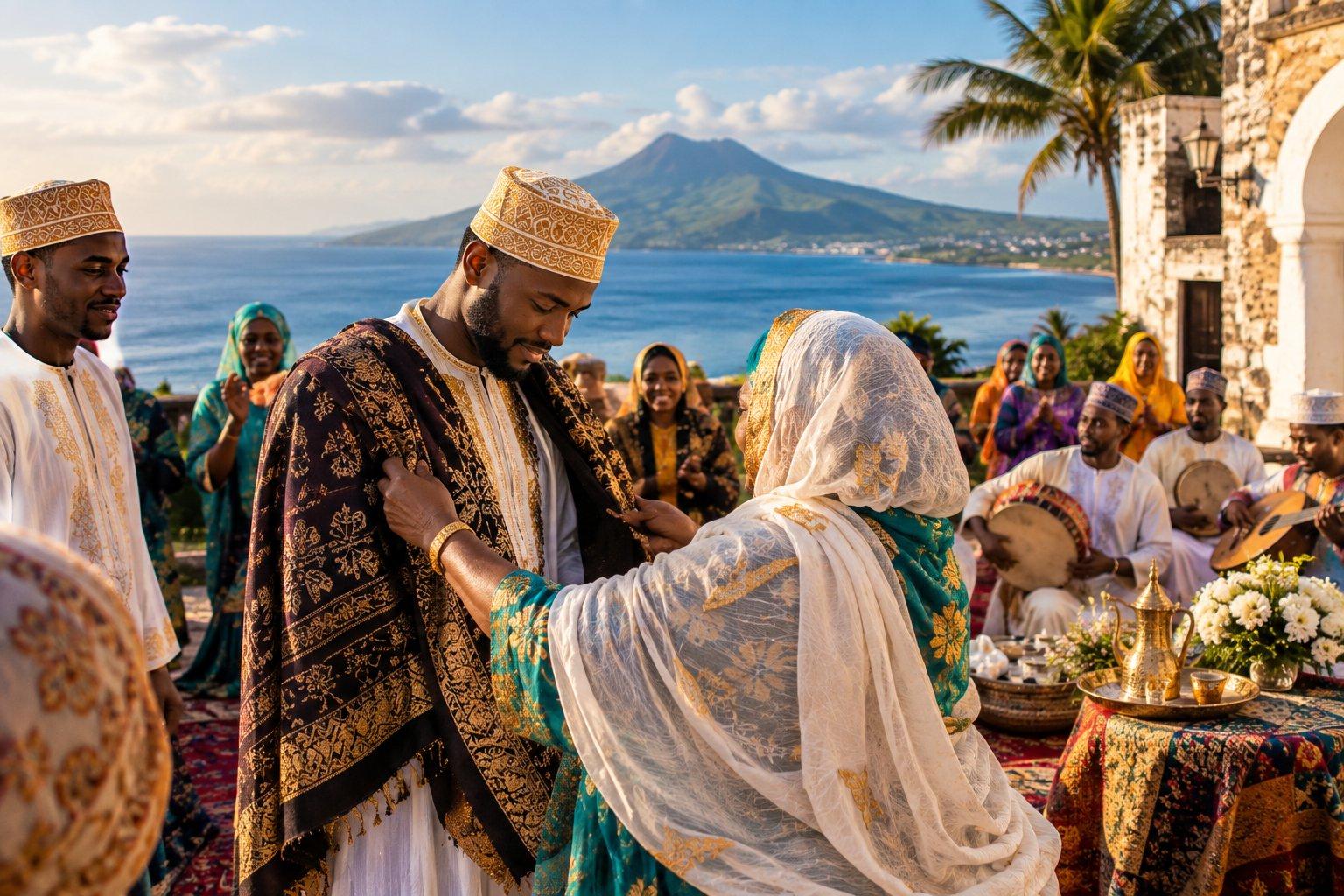
The Grand Marriage is most deeply institutionalised on Grande Comore, or Ngazidja. It is a huge public ceremony involving marriage, gift exchange, feasting, music, processions and the redistribution of wealth through extended families and village networks. A couple can marry in a smaller ceremony first and postpone the Grand Marriage for years while relatives save and contributions are gathered.
For some families, the wait can last decades.
A former Comorian education minister, Yehia Mohamed Elias, described the ceremony in an Al Jazeera documentary after being married to his first wife for 20 years. He had also married a second wife two years earlier. The family was preparing to hold the Grand Marriage for both relationships. Elias described the ceremony as a necessity comparable to death, calling it a glass that everyone eventually has to drink from.
The phrase captures the pressure surrounding the institution without turning it into a legal requirement. The Grand Marriage is a customary system of status, obligation and public recognition. Its consequences are social and political rather than written into national law.
On Grande Comore, completing it has traditionally allowed a man to enter higher age and status groups, wear particular ceremonial clothing, take a position closer to the front of the mosque during prayer and participate more fully in village political assemblies. Older ethnographic research also found that few successful national politicians had reached office without having completed the ceremony.
A wedding, in other words, can happen long before the wedding that everyone remembers.
Where the culture came from
Comoros consists of four islands in the northern Mozambique Channel: Grande Comore, Mohéli, Anjouan and Mayotte. The first three form the independent Union of the Comoros. Mayotte is administered by France and has been a French department since 2011.
The islands sit along an old Indian Ocean trading network that connected the East African coast with Madagascar, Arabia, Persia, India and, farther east, the islands of the western Indian Ocean.
Their population reflects those movements.
Archaeological, linguistic and genetic research points to African and Austronesian contributions to the population, with later arrivals and interactions involving Malagasy, Arab and Persian-linked communities. Comorian languages belong to the Bantu family and are closely related to Swahili, while Malagasy influence survives in aspects of language, agriculture and culture.
Islam arrived through the same Indian Ocean networks. By the medieval period, Muslim settlements and ruling elites had developed across the islands, and the Comorian towns became part of the wider Swahili world.
The historic cities that emerged during this period were organised around mosques, houses, marketplaces and defensive structures. Their architecture reflects centuries of movement across the western Indian Ocean, rather than a single outside influence.
In July 2026, UNESCO added the Medinas of the Historic Sultanates of the Comoros to the World Heritage List. The inscription covers six historic cities: Moroni, Ntsudjini, Itsandra and Iconi on Grande Comore, and Mutsamudu and Domoni on Anjouan.
The designation gives international recognition to places whose histories were built around trade, Islam, sultanates and island communities long before the modern state of Comoros existed.
Iconi, on Grande Comore, carries another kind of history.
Local oral tradition tells of a Malagasy slave raid in which women trapped in the town chose to leap from the cliffs rather than be captured. The story has survived as collective memory rather than as a modern historical account that can be verified in every detail. It remains part of the way Iconi remembers the violence associated with slave raiding in the western Indian Ocean.
The French arrived during the nineteenth century. Mayotte became a French possession in 1843. France subsequently established protectorates over the other islands, and Grande Comore, Anjouan and Mohéli became French colonies in 1912.
Comoros achieved independence in 1975.
Mayotte took a different path.
In the 1974 referendum on independence, the three islands that form today's Union of the Comoros voted overwhelmingly for independence, while Mayotte voted to remain under French administration. A second referendum in Mayotte followed in 1976. France retained control, and Mayotte later became an overseas department.
The Union of the Comoros continues to claim Mayotte as part of its territory. The African Union has historically supported the Comorian position, while France continues to administer Mayotte.
The division is visible on maps, but its consequences are lived through family relationships, migration and movement between islands that share language, religion and centuries of history.
The years after independence
The new country inherited political institutions that were still young when independence arrived.
Ahmed Abdallah became the first president of independent Comoros. His rule was interrupted by a coup led by Ali Soilih in 1975, and Soilih governed until he was overthrown in 1978.
Soilih's government tried to change much more than the country's political leadership. It attacked customs that the revolutionary government considered expensive or socially restrictive, including the Grand Marriage. The government viewed the ceremony's enormous financial demands as wasteful at a time when the country had very limited resources.
The restrictions did not last.
After Soilih's overthrow in 1978, the Grand Marriage regained its place in public life.
Comoros then entered one of the most turbulent periods of postcolonial politics anywhere in the region. A United Nations report later counted at least 20 coups or attempted coups during the country's early post-independence history.
French mercenary Bob Denard became one of the most recognisable figures in that story. He helped overthrow Soilih in 1978 and later headed the presidential guard under Ahmed Abdallah. His forces were involved in repeated interventions in Comorian politics, illustrating how easily a small state with limited military resources could become vulnerable to armed interference.
The political instability did not end with the departure of the mercenaries.
Anjouan declared independence in 1997 after a period of conflict with the central government. The crisis eventually contributed to the constitutional settlement of 2001, which created the Union of the Comoros and gave the individual islands substantial autonomy.
Each island received its own executive institutions, while authority was divided between the island governments and the Union government.
The arrangement has changed over time, but the underlying question has remained familiar: how do three islands with their own histories and political interests govern themselves as one country?
A country with one name and several languages
There is a strong shared Comorian identity, but describing Comorians as one homogeneous ethnic group misses the history that produced the population.
African, Malagasy, Arab and Persian-linked populations have interacted in the islands for centuries. The result is a society whose people share language families, religion, customs and kinship systems while also carrying different island histories.
The everyday language is Comorian, or Shikomori, a group of closely related Bantu varieties.
On Grande Comore it is called Shingazidja. On Mohéli, Shimwali. On Anjouan, Shindzuani. Mayotte has Shimaore.
The varieties differ, but speakers can generally communicate across them with some adjustment. French or Arabic is not automatically required simply because someone comes from another island.
French and Arabic are also official languages of the Union of the Comoros. French remains deeply embedded in government, formal education and administration. Arabic has a different but equally important role, especially in Quranic education, Islamic scholarship and religious life.
The country's relationship with France also extends far beyond colonial history.
Comoros has a large diaspora, especially in France. The French Development Agency estimates that around 400,000 Comorian nationals live outside the country, including roughly 300,000 in France. Money sent home by this diaspora is one of the most important sources of income for households in Comoros. World Bank data put remittances at around 23 percent of GDP in 2023.
The money does not only pay for food, school fees or construction.
It can help finance a Grand Marriage.
Someone living in Marseille, Lyon or Paris may spend years contributing to a ceremony taking place thousands of kilometres away on Grande Comore. A wedding can therefore involve relatives who are physically scattered across several countries but remain economically and socially tied to the same village.
Islam and the matrilineal household
More than 95 percent of Comoros's population is Muslim, and Sunni Islam is central to national identity and public life.
The country follows the Shafi'i tradition of Sunni Islam, and mosques, Quranic schools and Islamic celebrations form part of ordinary community life. Friday prayers, Ramadan, Eid al-Fitr and Eid al-Adha structure the religious calendar.
There are also important restrictions. Comoros recognises Sunni Islam as the state religion, and religious activities outside the established Islamic framework face legal and social constraints.
The more unusual part of the social system becomes visible inside the family.
Grande Comore has a strongly matrilineal and matrilocal social structure. Descent and important forms of property transmission run through women, and the family house has traditionally belonged to the woman's maternal line.
A man may therefore exercise public authority while living within a domestic system in which his wife's family has a stronger claim to the house and land.
UNESCO's description of the historic Comorian cities notes the coexistence of matrilineal and matrilocal customs with patrilineal Islamic traditions. The two systems did not produce one uniform replacement of the other. They developed alongside each other.
That arrangement also helps explain why the Grand Marriage is so closely connected to male status.
The domestic world and the public world operate according to different lines of inheritance and authority. On Grande Comore, the Grand Marriage historically gives men access to age groups and public roles that are not automatically available to them simply because they are married.
Women inherit important property.
Men accumulate public status through the Grand Marriage.
The two systems sit beside each other.
Food from an island kitchen
Rice is a staple across Comoros, commonly eaten with fish, seafood, meat or sauces made with coconut and spices. Cassava, bananas and breadfruit also feature in the diet.
The ingredients tell the story of the islands' geography.
Fish comes from the surrounding Indian Ocean. Coconut grows in the tropical climate. Cassava and bananas are important crops. Cloves, vanilla and other spices have long connected Comorian agriculture to overseas markets.
Vanilla has an especially interesting history.
French colonial agricultural development helped establish commercial vanilla cultivation in the Comoros during the late nineteenth century. The islands became important producers of vanilla, while ylang-ylang became another major export crop. Ylang-ylang oil is used in the perfume industry and has given Comoros the nickname the Perfume Islands.
The ingredients also appear in local cooking.
One of the dishes most closely associated with the country is langouste à la vanille, lobster prepared with vanilla. The combination sounds unusual until you remember where the ingredients come from: seafood from the surrounding waters and vanilla from the island's agricultural economy.
The result is a dish that could hardly have been created anywhere else in quite the same way.
Music is inseparable from major Comorian celebrations.
Twarab, the Comorian form of the wider East African taarab tradition, carries influences associated with Arabic music, the Swahili coast and local Comorian performance. It is performed at weddings and other major gatherings, with singers and instrumentalists providing music for dancing and celebration.
The Grand Marriage gives these performers work.
A ceremony can require musicians, dancers, jewellery makers, tailors and other craftspeople. The exchange of gifts and ceremonial clothing creates another layer of economic activity around the marriage itself.
The ceremony can therefore keep cultural skills in use because families continue to need the people who know how to make, play, sew, sing or perform the things the occasion requires.
Comorian oral traditions serve another purpose.
Stories, songs and remembered accounts carry village histories across generations. Some concern sultans and battles. Others remember migration, slavery, religious figures or particular families. The story of the women of Iconi belongs to this world of collective memory.
A written archive is only one way a society remembers.
Clothes that tell you who has completed the ceremony
Clothing can reveal a man's social position before he says a word.
On Grande Comore, men who have completed the Grand Marriage can wear ceremonial items associated with their new status. Among them is the mharuma, a traditional shawl or garment worn as part of formal dress.
The clothing is not merely decorative.
It tells other people that the wearer has completed the ceremony that permits him to enter a different social category.
Jewellery carries its own meaning. Gold and silver objects exchanged during the Grand Marriage can represent wealth, family ties and obligations between households. Their production has helped sustain local metalworking traditions.
The architecture of the islands tells another part of the story.
Historic Comorian towns contain mosques, stone houses, sultanate buildings, tombs, defensive structures and carved architectural details shaped by centuries of Indian Ocean exchange. The medinas of Moroni, Ntsudjini, Itsandra and Iconi on Grande Comore, together with Mutsamudu and Domoni on Anjouan, were inscribed by UNESCO as a World Heritage property in July 2026.
The inscription recognises six historic cities whose buildings and urban forms developed during the era of the Comorian sultanates.
They are still cities, not museum pieces.
People live, trade and worship around buildings that carry several centuries of history.
The ceremony that can take years to prepare
The Grand Marriage is expensive because it involves much more than the couple.
Families provide food. Relatives contribute money. Guests receive gifts. Musicians are hired. Clothes and jewellery are prepared. Large numbers of people have to be fed, and social obligations accumulated over years can become part of the ceremony.
On Grande Comore, completing the ceremony traditionally moves a man into a higher status category within the village's age-based social organisation. That status can affect where he sits in the mosque, what clothing he can wear and whether he can participate in certain village decisions.
The ceremony therefore has a political dimension without being a political institution in the modern legal sense.
It is also expensive enough to exclude people.
Critics within Comoros have long questioned the financial burden placed on families and the pressure placed on men to demonstrate that they have accumulated enough resources to stage the ceremony. The contradiction is difficult to miss: the same event that redistributes wealth through families and communities can also deepen the pressure to acquire wealth in the first place.
Some families save for years.
Some relatives living abroad contribute.
Some men spend long periods working outside the country before returning home.
The wedding may be delayed until enough money has been assembled.
And when it finally happens, the event belongs to far more people than the couple standing at its centre.
The ceremonies that bring people home
Eid brings families together. Funerals bring them home. The Grand Marriage can do the same.
For members of the Comorian diaspora, these occasions can mean flights from France and other countries, weeks of preparation and substantial financial contributions made from abroad.
The physical distance between a Comorian family in France and its relatives on Grande Comore does not necessarily weaken the obligations created by kinship. In some cases, the distance becomes part of the story: money travels one way, people travel another, and a ceremony takes place at the centre of it all.
The Grand Marriage has survived colonial rule, independence, coups, revolutionary attempts to suppress it and decades of economic difficulty.
On Grande Comore, a man can already be married and still be waiting.
He can have children, a career and a household of his own. He can spend years gathering the money required to complete the ceremony that carries the status his ordinary marriage did not provide.
When the day finally comes, the event fills more than a house.
There are relatives to feed, gifts to exchange, musicians to hear, clothes to wear, obligations to settle and a whole village watching a man move into a new place within its social order.
That is why the Grand Marriage is so difficult to separate from the history of Grande Comore itself. It sits inside the family, the mosque, the village assembly, the economy and the diaspora at the same time.
A marriage can begin with two people.
The Grand Marriage belongs to everyone around them.