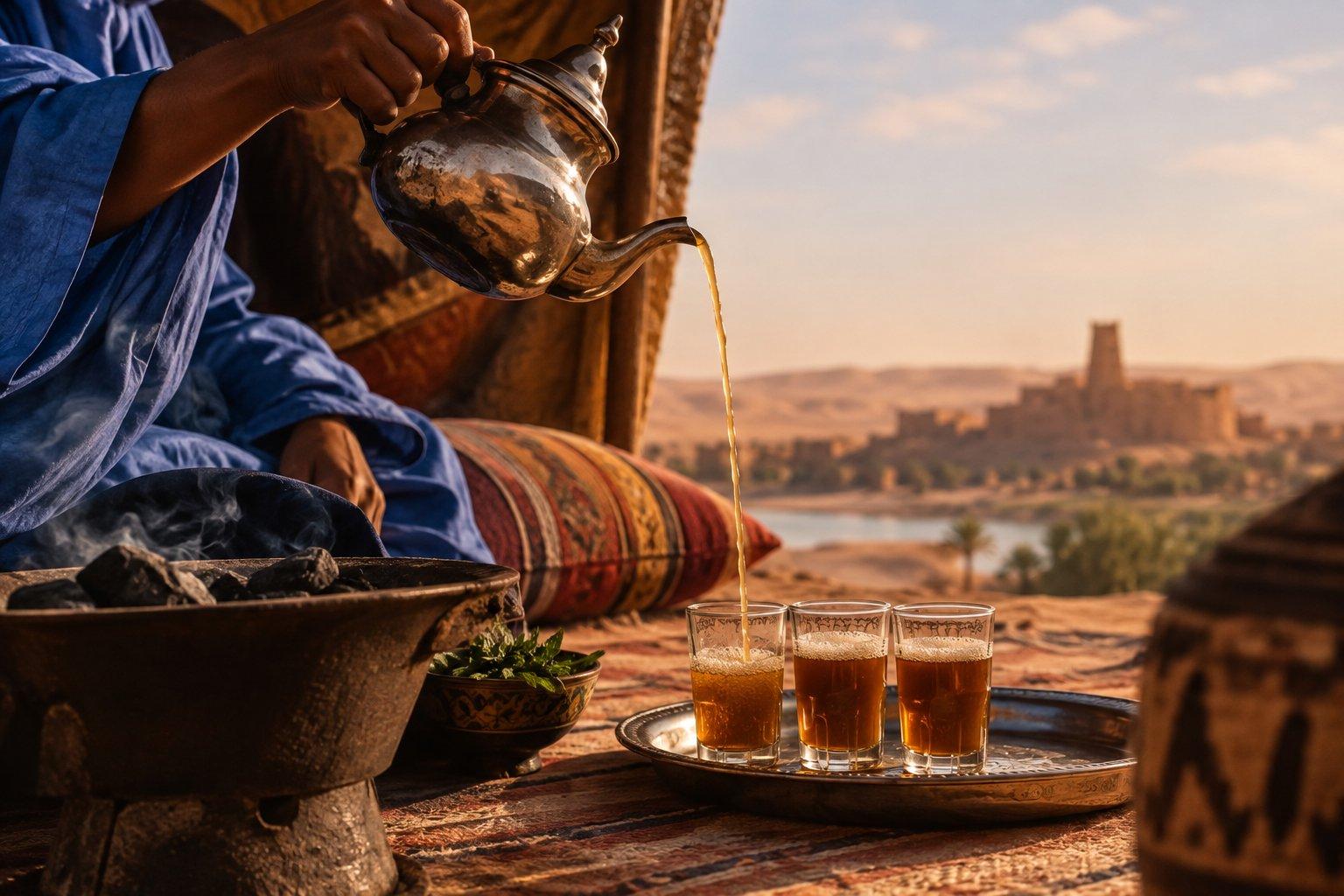
In a tent or a living room anywhere in Mauritania, tea is traditionally prepared and served in three successive glasses. A small teapot sits over hot coals, green tea leaves and sugar are brewed and poured between the pot and a set of small glasses, with the liquid lifted and streamed back down repeatedly as part of the preparation. The three-glass ritual is not simply about drinking tea. Mauritania's National Tourism Office describes it as a social ceremony centred on conviviality and sharing, with three principles known as the three "J's": Jemaa, meaning the gathering; Jarr, taking one's time; and Jmar, good charcoal or embers.
A popular saying associates the three glasses with life, love and death: the first is bitter like life, the second sweet like love, and the third associated with death. The wording and symbolism vary across accounts, so it is better understood as tea folklore than as a rule followed identically in every Mauritanian household. What is less disputed is the social purpose of the ritual. Tea creates time for conversation, poetry, history and stories, and the preparation itself becomes part of the gathering rather than something done separately from it.
Mauritania sits at a genuine crossroads, geographically and culturally. Its northern and central regions are deeply connected to the Arab-Berber history of the western Sahara, while the Senegal River valley in the south has long been home to Pulaar-speaking, Soninke and Wolof communities whose cultural and historical ties extend into Senegal and Mali. This combination of Moorish and West African identities has shaped both the country's culture and some of its most difficult political and social conflicts.
Where the culture came from
The Sahara that now covers much of Mauritania was, thousands of years ago, considerably wetter. Archaeological evidence from the wider Sahara, including rock art depicting animals associated with wetter environments, records a landscape very different from today's desert. Over thousands of years, increasing aridity changed where people could live, travel and keep livestock, contributing to the concentration of settled populations around more reliable water sources, including the Senegal River and desert oases.
The region was home to Sanhaja Berber communities and became part of a long process of interaction between Berber-speaking populations and Arabic-speaking groups. Arabization did not happen in one moment. It developed over centuries through migration, political power, intermarriage, trade and cultural change. The Beni Hassan and other Arabic-speaking groups became increasingly influential in the western Sahara, while Arabic eventually became dominant in much of the region. The Hassaniya variety of Arabic that developed in this environment also retained strong Berber linguistic influences.
The Sanhaja Berber confederations of the western Sahara also played a central role in the Almoravid movement of the 11th century, a religious and military movement that expanded across large parts of North Africa and into al-Andalus, in present-day Spain and Portugal. Its emergence illustrates how the western Sahara was connected to political and religious developments far beyond the desert itself.
Over subsequent centuries, a complex social hierarchy developed within Moorish society. Warrior groups known as Hassan held military and political power, while Zawaya families were associated with Islamic scholarship and religious education. Other groups, including Znaga communities, M'allemin artisans and Iggawen griots, occupied specialised social roles, while Haratin communities carried the legacy of slavery and hereditary social subordination. These categories were not simply modern ethnic groups. They were also social and occupational categories shaped by centuries of history.
French colonial rule developed in the early 20th century, and Mauritania became independent on 28 November 1960. But independence did not erase the social structures created over centuries. Mauritania's post-independence history has included military coups, periods of authoritarian rule and recurring tensions between Moorish and Afro-Mauritanian communities.
The most serious rupture came in 1989, when a long-standing border dispute between Mauritania and Senegal escalated into ethnic violence. Approximately 60,000 Mauritanians fled to Senegal and Mali, while others were expelled across the border in the opposite direction. UNHCR later facilitated returns and reintegration, including the organised voluntary repatriation of refugees from Senegal. The episode remains an important part of the country's modern history because it affected citizenship, land, family ties and political trust between communities.
Ethnic groups and languages
Mauritanian society is often described through three broad population categories: Bidhan, Haratin and Afro-Mauritanian communities including Halpulaar, Soninke and Wolof. These categories should not be treated as rigid census groups. They describe overlapping histories of ancestry, language, culture and social status.
The Bidhan, or Bīḍān, are the Arabic-speaking Moorish population historically associated with Arab and Berber ancestry, although the history of Moorish populations also includes substantial interaction and ancestry from sub-Saharan African communities. The Haratin are Arabic-speaking and culturally Moorish, and are widely understood as descendants of formerly enslaved populations, although their histories and identities are more complex than the simple label "former slaves" suggests. They share Hassaniya Arabic and many cultural practices with other Moorish communities while also carrying the legacy of a historically subordinate position within Moorish social structures.
Afro-Mauritanian communities including the Fulani or Halpulaar, Soninke and Wolof are concentrated particularly along the Senegal River valley. They maintain their own languages, cultural traditions and historical connections with related communities across the borders in Senegal and Mali.
Reliable contemporary ethnic population figures are limited, and estimates vary by source. U.S. government reporting has described Haratines as the country's largest ethnocultural group and has previously estimated them at at least 45 percent of the population, with Beydane at up to 30 percent and sub-Saharan ethnic groups at roughly 25 percent. These figures should be treated as estimates rather than as the result of a current official ethnic census.
Arabic is Mauritania's official language. The Constitution recognises Arabic, Pulaar, Soninke and Wolof as national languages and explicitly states that Arabic is the official language. Hassaniya is the dominant Arabic variety spoken by much of the population, but it is not itself the constitutionally designated official language. French, meanwhile, remains important in education, administration and commerce because of the country's colonial history and continued French-Arabic bilingualism.
Language has also been politically sensitive. Policies favouring Arabic in education and public life have sometimes been viewed by southern communities as marginalising their own national languages. These debates are connected to broader questions about political representation, national identity and the place of Afro-Mauritanian communities within the state.
Religion and belief
Mauritania is overwhelmingly Sunni Muslim. Mauritanian government estimates cited by the U.S. State Department put Sunni Muslims at approximately 99 percent of the population. Islam is also constitutionally central: Mauritania defines itself as an Islamic republic, and its Constitution gives Islam a foundational place in the country's legal and political framework.
The country's Islamic tradition is strongly associated with the Maliki school of Sunni jurisprudence. Religious scholarship has historically been particularly important in Moorish society, with Zawaya families producing scholars and teachers and mahadra schools providing religious and literary education. A mahadra is a traditional Islamic learning environment in which students study the Qur'an, Islamic jurisprudence, Arabic and related subjects, often outside the formal state education system.
Sufi traditions and religious scholars have also played important social roles in Mauritania. Marabouts, a term commonly used for respected Muslim religious figures in parts of West and North Africa, have historically provided religious instruction, advice and mediation within communities. Their influence developed alongside, rather than simply in place of, formal state institutions.
Sharia has a formal place in Mauritania's legal order, while the modern legal system also contains legislation and institutions influenced by the country's French colonial history. The result is not a legal system based on one source alone, but a system in which Islamic principles have an especially prominent constitutional and legal role.
Food
Thieboudienne, the fish and rice dish strongly associated with Senegal and the wider Senegambian region, is also eaten in Mauritania, particularly in communities connected culturally and historically to the Senegal River valley. Further north and in Moorish communities, couscous appears in many forms, made from wheat, barley or millet and served with meat, vegetables or milk.
Mauritanian cuisine varies by region and community rather than following one national menu. The country's National Tourism Office highlights several preparations of couscous, along with méchoui, meat cooked over a fire, braised meat, dried meat and dishes incorporating camel meat and other locally available ingredients.
Dates are important in oasis communities, while camel milk has long been associated with pastoralist life in the desert. Along the Atlantic coast, fish is an important part of the food economy. Mauritania's coastal waters are highly productive and support a major fishing industry, particularly around Nouakchott and Nouadhibou. The country's tourism authority describes the coast as exceptionally rich in fish resources.
Fishing is also an important economic and political issue. Mauritania has long allowed foreign vessels to fish in its waters through agreements and licences. The European Union, for example, has maintained a fisheries partnership with Mauritania for decades. Under the current protocol, vessels from several EU countries have authorised access to Mauritanian waters, with quotas, fees, monitoring requirements and scientific cooperation built into the agreement. The arrangement is intended to manage fish stocks while generating revenue and supporting Mauritania's fisheries sector.
The tea ceremony described at the opening of this piece functions as one of Mauritania's most important everyday social rituals. It is common enough that the country's own tourism authority describes tea as an integral part of Mauritanian life, including in its major cities.
Music, dance, and art
The Iggawen are a hereditary griot tradition within Moorish society. Griots are oral historians, musicians and performers who preserve and transmit poetry, genealogy, history and collective memory. In Mauritania, Iggawen traditionally perform with instruments including the tidinit, a plucked string instrument, and the ardin, a harp traditionally played by women, as well as percussion instruments.
The T'heydinn is one of the most important traditions associated with this culture. It is a Moorish epic consisting of dozens of poems celebrating the deeds of historic emirs and sultans. UNESCO inscribed the T'heydinn on its List of Intangible Cultural Heritage in Need of Urgent Safeguarding in 2011. The organisation describes it as a literary and artistic expression of Hassaniya and records the role of griots in preserving and transmitting the repertoire.
The tradition is learned through generations. Young griots traditionally learn instrumental skills before entering more deeply into the poetic tradition, and different griot families may maintain different repertoires. The T'heydinn can be performed at weddings, reconciliation ceremonies and other social gatherings. UNESCO has warned, however, that the tradition is declining: the number of griots with full knowledge of the epic is small, many are elderly, and younger performers may know only parts of the repertoire or perform shortened versions.
Dimi Mint Abba, an Iggawen singer, became one of Mauritania's best-known traditional musicians and gained international recognition for her music. Her career helped bring Mauritanian music to audiences beyond the country, while traditional Moorish poetry continues to hold an important place in Mauritanian cultural life.
Clothing, textiles, and craft
The boubou, a flowing robe worn across much of the Sahel and West Africa, is common in Mauritania. Mauritanian women are particularly associated with the melhfa, a long piece of fabric wrapped around the body and head. The garment can be worn in everyday life as well as for formal occasions, and contemporary melhfas appear in a wide range of colours, fabrics and patterns.
Leatherwork and metalworking have historically been associated with specialised artisan groups, including the M'allemin within traditional Moorish social structures. Their work included practical objects, saddlery, jewellery and other goods connected to pastoral and desert life. These crafts were traditionally passed through particular families and occupational communities, meaning that social status and skilled work were historically closely connected.
Islamic holidays, particularly Eid al-Fitr and Eid al-Adha, are among Mauritania's major public and family celebrations given the country's overwhelmingly Muslim population. Eid al-Fitr marks the end of Ramadan, while Eid al-Adha is associated with the Islamic pilgrimage season and the sacrifice of livestock by Muslims who are able to perform it. Families commonly mark these occasions through prayer, visits, meals and new clothing.
Mauritania also holds cultural festivals throughout the country. UNESCO's reporting on the country's intangible cultural heritage identifies more than 60 festivals covering different aspects of cultural life, including events devoted to culture, national unity and local traditions. Such gatherings provide spaces for music, poetry, community meetings and the preservation of cultural practices.
Marriage ceremonies within Mauritanian communities combine Islamic requirements with local customs, and historical social divisions have influenced who people marry. Traditional social hierarchies have included distinctions between Bidhan, Haratin and occupational groups such as griots and artisans. However, marriage patterns are not uniform across the country, and contemporary Mauritanian families differ in how strongly they follow these historical divisions. It is therefore more accurate to describe social endogamy as a documented historical pattern than to present it as a rule followed by every community today.
Slavery, abolition, and what happened afterwards
Mauritania was the last country in the world to formally abolish slavery, doing so in 1981. The abolition itself did not immediately make slaveholding a criminal offence. Mauritania criminalised slavery in 2007, and a stronger law adopted in 2015 defined slavery as a crime against humanity, increased penalties and created specialised courts for slavery-related cases.
The distinction between abolition and criminalisation matters. Abolition means the law declares an institution illegal. Criminalisation establishes specific offences and penalties that can be used to prosecute people who continue the practice. In Mauritania, there was therefore a substantial gap between the formal abolition of slavery in 1981 and the creation of a criminal offence in 2007.
The legal changes did not immediately eliminate the social structures created by centuries of hereditary slavery. Human rights organisations have continued to document cases involving hereditary slavery and slavery-like practices, particularly affecting Haratine communities and some Afro-Mauritanian communities. The Mauritanian government has disputed claims about the extent of contemporary slavery while also maintaining programmes aimed at addressing the legacy of slavery and poverty.
The scale of contemporary modern slavery is difficult to measure directly, partly because the practices are hidden and because definitions vary between studies. The 2023 Global Slavery Index estimated that 149,000 people in Mauritania were living in modern slavery in 2021, equivalent to 32 people per 1,000. The index defines modern slavery broadly to include forced labour and forced marriage, so this figure should not be treated as a direct count of people living under hereditary slavery. It ranked Mauritania third globally and second in Africa for estimated prevalence.
The legal framework has therefore changed substantially, but the existence of laws does not by itself erase the social and economic conditions that developed under slavery. The history remains closely connected to questions of land, education, employment, political representation, poverty and social status.
The T'heydinn tradition today
The T'heydinn griot tradition remains alive, but UNESCO considers it endangered. Its reports note that the number of practitioners with complete knowledge of the epic is small and that many of the most knowledgeable performers are elderly. Younger griots may know only portions of the repertoire or perform shorter versions, while changing social and economic conditions have reduced some of the spaces in which the tradition was historically performed.
Safeguarding efforts are therefore focused not only on recording the existing repertoire but also on helping younger generations learn it. UNESCO has specifically encouraged training, documentation, public education and measures that support the livelihoods of the people who carry the tradition.
Mauritanian women's melhfa fashion, meanwhile, continues to change with new colours, fabrics and styles. It remains everyday clothing for many women rather than a garment preserved only for cultural demonstrations, which makes it another example of a tradition that continues to develop as contemporary Mauritanian life changes.
And every day, in homes and gatherings across Mauritania, the three-round tea ritual continues to bring people together. The popular saying may describe the glasses as bitter like life, sweet like love and associated with death, but the documented purpose of the ritual is more concrete: gathering, taking one's time and sharing conversation.
Mauritania therefore holds two realities at once. Its tea ceremony expresses a long-standing culture of hospitality and social gathering, while its history of slavery and the continuing debate over its legacy show how deeply historical social structures can survive changes in law. The country has formally abolished slavery, criminalised it and strengthened the legal institutions designed to prosecute it. At the same time, organisations inside and outside Mauritania continue to debate how much of the old system survives in practice and how effectively the law reaches the people most affected by its legacy. That tension is part of understanding Mauritania today: its culture cannot be reduced either to its desert traditions or to its most difficult history. Both remain part of the country people live in now.